By six o’clock, I couldn’t pretend anymore.
My husband and my three sons had forgotten my birthday.
I was standing at the stove in my kitchen. A big pot of water was coming to a boil. The table behind me was set for five. Four plates for them, one for me. Cloth napkins. The good glasses. And above every chair, a bright helium balloon bobbing on a curly ribbon. Pink, blue, yellow, green, silver.
I’d bought the balloons myself. At the party store that afternoon. I’d stood in line behind a mother buying a Happy 5th Birthday banner, and when the cashier asked who the balloons were for, I’d said, “Me,” and she’d given me a funny look.
My phone buzzed on the counter.
It was Brad.
I picked it up, and for one stupid second, my heart jumped. Here it is. He’s pulling into the driveway. They’re all in the car with a cake. They’ve been planning something this whole time.
I read the message.
Hey hon, gonna stop at that Renaissance fair the boys have been talking about for two weeks. Probably gonna be home late. Will bring you something. Just make dinner for yourself.
I read it again.
I stood there in my kitchen with steam coming off the pot and the balloons floating over the empty chairs.
Then I typed back three words.
Are you serious?
I should tell you about the morning.
Because that morning, I’d still been making excuses for them.
I got up at 5:45, like always. I made coffee. I packed Justin’s lunch. I ironed Brad’s blue shirt, the one he needed for his meeting, which he’d told me about at eleven o’clock the night before.
At 6:30, the house woke up.
Brad came down the stairs fast, knotting his tie.
“Have you seen my car keys?”
“In your coat pocket,” I said.
He checked. They were in his coat pocket. He didn’t say thank you.
“Early meeting,” he said. “Big client. I gotta run.” He grabbed the coffee I’d poured for him and headed for the door.
He didn’t kiss me. He usually kissed me. On the cheek, fast, on his way out. It was a habit, like brushing his teeth. That morning, he didn’t.
He’s trying to act normal, I thought. So I won’t suspect anything.
Pete came down next. He’s nineteen, our oldest. He works at a sporting goods store downtown, six blocks from the house. He was rushing, like always. Pete is always rushing and always late.
“Mom, where’s my name tag?”
“On the hook by the door.”
He grabbed it and was gone.
Then Mike. Seventeen. Our middle son. He came into the kitchen holding his head like it hurt.
“Mom. My gym bag. I can’t find my gym bag. I have practice after school and I can’t find it anywhere.”
“It’s hanging on the back of your chair,” I said. “Right there. Where I told you it was last night.”
He turned around. There was the gym bag. Hanging on the back of his chair. He picked it up and walked out without a word.
And then Justin. Fourteen. Our baby. He stood in front of the open pantry for a long time.
“We’re out of the Frosted Flakes,” he said. He sounded betrayed. “Mom. We’re out.”
“There’s Cheerios.”
“I don’t like Cheerios.”
“Then have toast.”
He sighed like I’d asked him to eat a live frog. He had toast.
None of them said happy birthday.
Not one.
By lunch, I’d gotten two emails.
One from a clothing store. Happy Birthday, Sophie! Here’s 20% off, just for you! One from a kitchen supply website. It’s your special day! Treat yourself!
And a text from my dentist’s office. Happy Birthday from all of us at Bright Smile Dental! Don’t forget your cleaning on the 14th!
The dentist remembered.
My family didn’t.
But I was still making excuses.
Maybe they’re planning something, I thought. A surprise party. Maybe Brad told the boys to act normal so I wouldn’t guess. Maybe that’s why he didn’t kiss me. He was scared I’d see it on his face.
It made sense. Kind of. If I squinted.
So I decided to make them dinner.
I spent the whole afternoon cooking.
I made fresh pasta. From scratch. Flour on the counter, a well in the middle, eggs cracked into it, mixed with my fingers until it came together into a smooth ball of dough. Then I rolled it out thin and cut it into long, wide ribbons. Pappardelle. My favorite.
I made a sauce. Roma tomatoes, roasted in the oven with olive oil and salt until the edges went black and sweet. A whole head of garlic, roasted soft. Fresh basil from the pot on the windowsill. A splash of cream at the end.
I made a salad with pears and walnuts. I made garlic bread. I bought a bottle of wine. Not the cheap kind.
And I bought the balloons. Because I learned a long time ago that if I wanted the house decorated for anything, I had to decorate it myself.
Christmas. Easter. Halloween. Fourth of July. Every single one of their birthdays. Four birthdays a year, nineteen years. Seventy-six birthdays.
I decorated for every single one.
And at six o’clock, my phone buzzed.
Are you serious?
I sent it. I stood there holding the phone.
Brad’s answer came back almost instantly. Like he’d had it ready.
Well, if I don’t take care of the boys, you’re upset. I finally take them out somewhere so you can have an evening off, and you’re upset. It’s like I can’t please you no matter what. Just take the chance and go watch Love Island. Love you.
I read it twice.
You can have an evening off.
Go watch Love Island.
I locked my phone. I put it face down on the counter.
Behind me, the water on the stove had started to boil. Big rolling bubbles. Ready for the pasta.
I looked at the table. Five places. Five cloth napkins. Five balloons floating above five chairs. Bright and happy and stupid.
I turned off the stove.
I took the balloons down one at a time.
I untied each ribbon from the back of each chair. I held each balloon against my chest. And I pinched the knot open and let the air out.
The room filled with these weak, ugly squealing sounds. Eeeeeeee. Like something small and sad dying slowly.
It felt appropriate.
The pink one. The blue one. The yellow one. The green one. The silver one.
When they were all flat, I threw them in the trash.
I took the four extra plates off the table. I put them back in the cupboard. I took the four extra napkins and folded them and put them back in the drawer.
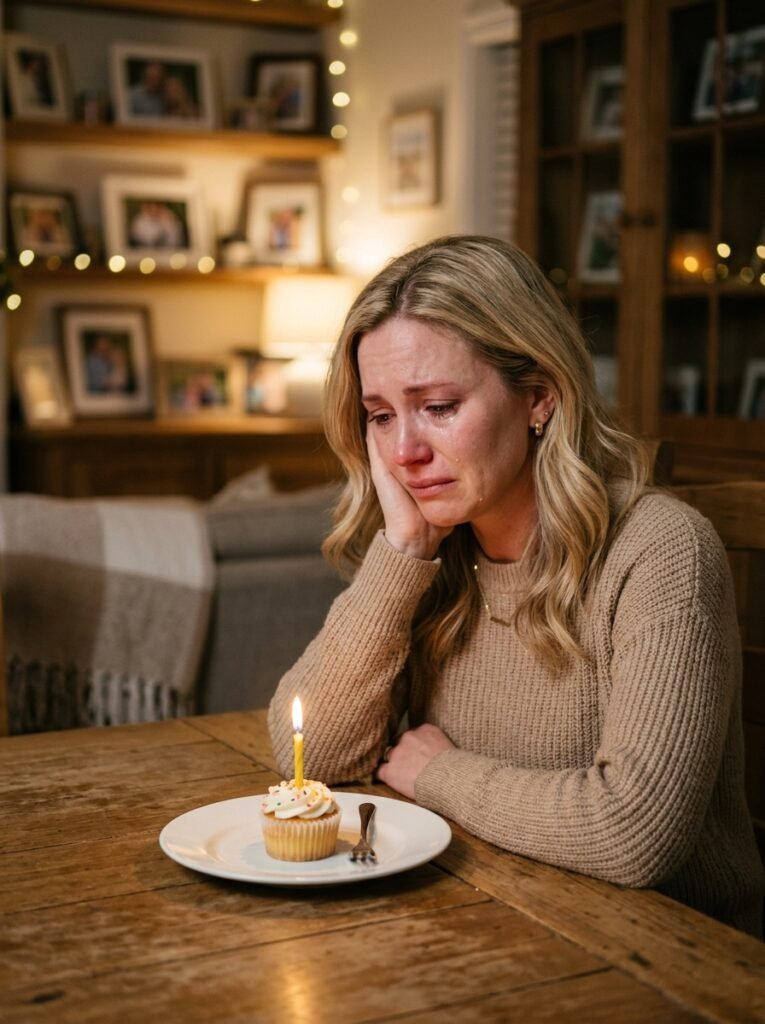
Then I went to the pantry and got out the cupcake.
I’d bought it that morning. From the grocery store bakery. One single vanilla cupcake with pink frosting and little rainbow sprinkles, in a clear plastic box. Just in case. Just in case nobody made me a cake.
I’d known. Somewhere in me, I’d known.
I put the cupcake on a plate. I found a birthday candle in the junk drawer. One of the leftover ones from Justin’s party in March. It was blue.
I stuck it in the frosting. I sat down at the table. Alone.
For nineteen years, I cooked every birthday dinner in that house.
Except my own.
Brad’s favorite meal is beef Wellington. It’s a nightmare to make. You wrap a whole beef tenderloin in mushroom paste and ham and puff pastry, and if you get any single step wrong, the whole thing falls apart. It takes me six hours. I make it every year on his birthday.
Pete always wants fried chicken. Buttermilk, brined overnight, double-dipped. And mashed potatoes. And biscuits. From scratch.
Mike asks for homemade pizza. Dough that rises for two days. Sauce from tomatoes I freeze in the summer.
Justin wants this ridiculous three-layer chocolate cake. With chocolate pudding filling between the layers and chocolate ganache poured over the top and chocolate shavings on the sides. It takes half a day. Every year, I tell him it’s the last time. Every year, I make it again.
I remember all their birthdays without reminders. I never need a calendar.
I buy the gifts. I wrap them. I plan the parties. I send the invitations. I text their grandparents and their aunts and their cousins to remind them.
I make sure everybody feels loved.
And on my birthday, they went to watch grown men in costumes hit each other with wooden swords.
I lit the candle.
“Happy birthday, Sophie,” I whispered to myself.
Then I blew it out.
And then I felt ashamed.
That was the worst part.
I sat there at the table with the smoke curling up from the little blue candle, and I felt ashamed for being so angry. I felt childish. Selfish. Like a little girl pouting because nobody came to her party.
Love shouldn’t be a transaction, I told myself. You don’t take care of your family so they’ll owe you something. You do it because you love them. That’s what love is.
I’d told myself that a thousand times.
But sitting there that night, I finally realized something.
I wasn’t asking for payment. I wasn’t asking for a beef Wellington or a three-layer chocolate cake. I wasn’t asking them to do for me everything I did for them.
I was just asking to be seen.
That’s all. Just to be seen. By the four people I’d spent nineteen years looking at.
Before I married Brad, I trained as a chef.
People forget that. My own family forgets it. Or maybe they never really knew it.
I went to culinary school when I was twenty. And then I worked for two years at a restaurant downtown called Rosemary’s. It was the best restaurant in the city back then. It was owned by a woman named Evelyn Marsh.
Evelyn was sixty years old. She was barely five feet tall. She had short gray hair that stuck up in the back and forearms covered in little white burn scars. And she was absolutely terrifying.
She could taste a sauce once, just once, off the tip of a spoon, and tell you exactly which herb you’d added three minutes too early.
“The thyme,” she’d say. “You put it in when the onions were still raw. It’s bitter now. Start over.”
“It’s just a little—”
“Start over.”
She was demanding. She was brilliant. She made grown men cry in her walk-in freezer.
And she thought I had real talent.
I remember the exact day she told me. It was a Tuesday night in November. We’d had a terrible service. Two cooks called in sick, the dishwasher broke, and a food critic came in unannounced. I’d been working the sauté station for eleven hours. My feet were bleeding inside my shoes.
After the last table left, Evelyn came over to my station. She picked up a spoon. She dipped it in the pan sauce I’d made for the duck. The one I’d made up on the spot when we ran out of the cherry sauce on the menu.
She tasted it.
She didn’t say anything for a long time.
“Where did you learn to do this?” she asked.
“I didn’t,” I said. “We ran out of cherries. I used the blackberries from the pastry station. And a little of the port. And some of the orange zest.”
She put down the spoon. She looked at me.
“You have instinct, Sophie,” she said. “Technique can be taught. Anybody can learn to hold a knife. Instinct can’t be taught. You either have it or you don’t.”
She tapped the side of the pan.
“You have it.”
I went home that night and cried for an hour. Happy crying.
I wanted my own restaurant. Someday. That was the dream. A little place. Maybe twelve tables. Food that tasted like somebody cared about you.
Then I met Brad. And a year later, I got pregnant with Pete.
Brad and I agreed that I’d stay home for a few years.
Just a few. Until the baby was bigger. Brad was making good money at the insurance company. It made sense. I told Evelyn I’d be back in two years, maybe three.
She hugged me. She said, “You’d better be.”
A few years became four. Then Mike came along. Then Justin.
A few years became nineteen.
And every time I brought up going back to work, Brad had a reason why it was the wrong time.
When Pete was three, the boys were too young.
When Justin was in kindergarten, they were too busy. All the soccer practices and swim lessons and school plays. Who would drive them?
When the boys were in middle school, the family needed stability. “You’re the glue, Soph,” Brad would say. “Everything falls apart without you.”
When Justin started high school, I tried again. I told Brad I’d found a job listing. A new restaurant opening downtown. They needed a sous chef.
Brad laughed.
He actually laughed.
“You want to stand in a hot kitchen for twelve hours a day?” he said. “At your age?”
I was forty-one.
About a year ago, I started talking about a food truck.
Smaller than a restaurant. Cheaper. I could set my own hours. I could start small.
I brought it up at dinner one night. I’d made pot roast.
“A food truck?” Pete said. He laughed. “Mom. Who would even buy food from a truck that just pops up out of nowhere one day?”
“People buy from food trucks all the time,” I said.
“Yeah, tacos,” Pete said. “From trucks that have been there forever.”
Mike looked up from his plate.
“But who would make dinner?” he asked.
He wasn’t joking. He was genuinely asking. Like it was a real problem. Like the whole family would starve to death if I wasn’t standing at the stove every night at six.
And Justin, fourteen, shrugged.
“You already cook all day,” he said. “Why would you want to do more of it?”
Brad didn’t say anything. He just reached for another roll and smiled at the boys like they’d made a good point.
Here’s what I don’t understand.
They loved my food. All of them. They ate everything I made. They went back for seconds and thirds. Pete’s friends asked to come over for dinner. Mike’s coaches asked for my banana bread recipe. Justin once traded one of my cookies at school for a kid’s entire lunch.
They loved my food.
They just didn’t believe anybody else would.
Or maybe they didn’t want to believe it. Because if strangers would pay for my cooking, then my cooking wasn’t just something I did for them. It was a skill. A real one. Something that belonged to me.
That night, sitting at the table with my one cupcake and the smoke from the blue candle, I picked up my phone again.
I didn’t text Brad. I didn’t text the boys.
I opened our family banking app.
I looked at the savings account.
It had more than enough money in it to buy a food truck. A good one. Used, but good.
A lot of that money came from me.
Not from a paycheck. I didn’t have a paycheck. But from nineteen years of stretching grocery budgets. Clipping coupons. Buying chicken thighs instead of chicken breasts. Turning Sunday’s roast chicken into Monday’s soup and Tuesday’s chicken salad. Fixing the boys’ torn jeans instead of buying new ones. Skipping vacations. Cutting my own hair in the bathroom mirror for eleven years.
Every dollar I saved went into that account.
And I scrolled through what came out of it.
Brad’s new car. Two years ago. A black SUV with leather seats and a sunroof. He’d bought it on a Saturday and driven it home as a surprise. “It’s an investment,” he’d said. “In our safety.”
Pete’s motorcycle. Last summer. He’d borrowed the money. He was going to pay it back. He hadn’t paid back a dollar. He’d ridden it maybe six times. It was sitting in our garage under a tarp.
Mike’s sports fees. Travel soccer. Summer camps. Private coaching. Every year.
Justin’s gaming computer. For Christmas. It had lights that changed color.
And every single time, somebody called it the same thing.
An investment in the family.
I looked at that savings account for a long time.
And I thought, I’m family too.
For months, I’d been looking at food trucks online.
Late at night. After everybody was asleep. I’d sit on the couch with my laptop and scroll through listings.
I had a secret folder on my computer. Recipes – Old. Nobody in my house would ever open a folder called that.
Inside were twenty-three saved listings of food trucks for sale.
My favorite was number seven. A 2016 step van. White. Converted two years ago by a couple who ran a barbecue business, then retired to Arizona. It had a flat-top grill, a six-burner range, a double fryer, two refrigerators, a three-compartment sink, and a big service window on the side. Everything clean. Everything inspected. Everything ready to go.
It was an hour away. It was listed at a fair price. It had been for sale for four months.
I’d been looking at it for four months.
I’d shown Brad the pictures three times. The first time he said, “Huh.” The second time he said, “That’s cute.” The third time he said, “Soph, you’re not seriously thinking about that stupid idea again.”
That night, I opened the folder.
I opened listing number seven.
I clicked the button that said Contact Seller.
It was 7:15 on a Friday night. I didn’t expect an answer.
The seller answered in four minutes. His name was Gary. He said the truck was still available. He said somebody else had been asking about it that week, but hadn’t put a deposit down. He said if I wanted it, I could do a deposit online tonight and pick it up Monday.
I looked at the cupcake.
I looked at the flat balloons sticking out of the trash can.
I was tired of negotiating with myself. I was tired of waiting for the right time. The right time was never going to come. Brad had made sure of that.
I was forty-two years old. And I was finally ready to put myself first. No matter how old I was. No matter how long it had taken me.
I put down the deposit.
Then I picked up my cupcake and ate it.
The whole thing. With my fingers. Licking the pink frosting off my thumb.
It was the best cupcake I’d ever had.
I knew Brad would find out. I knew the boys would complain.
I just didn’t know how fast.
The bank sends alerts to both of us whenever anything big comes out of savings. I’d forgotten about that.
I was licking the last of the frosting off my fingers when my phone rang.
I answered.
“What did you just do?” Brad shouted.
In the background, I could hear music. Crowds. Somebody yelling Huzzah! One of the boys laughing.
“I bought myself a birthday present,” I said.
Silence.
“What kind of birthday present costs thousands of dollars?”
“A food truck.”
More silence. Then: “You did what?”
“I bought the food truck. The one I’ve been showing you for months. The white one. Number seven.”
“You showed me pictures, Sophie. You didn’t say you were actually going to buy it.”
“I did say. Three times. You called it a stupid idea.”
“Because it is a stupid idea!”
And something inside me went very calm.
Very quiet. Like a lake at night.
“Come home safely, Brad,” I said.
“Sophie. Cancel it. Right now.”
“No.”
“You can’t just spend our savings without discussing it with me!”
“You bought your car without discussing it.”
“That was different.”
“How?”
“We needed a new car.”
“We had a car. It was four years old.”
“Sophie—”
“What about Pete’s motorcycle?”
“He needed it for transportation!”
“He works six blocks away, Brad. Six. Blocks.”
Brad lowered his voice. I could hear him walking away from the noise. Probably ducking behind a tent full of people selling turkey legs.
“We’ll talk about this when I get home,” he said.
“No,” I said. “You’ll talk. I’ve been talking for years. Nobody listened.”
I hung up.
They got home a little after nine.
I was sitting at the kitchen table with a cup of tea. The dishes were washed. The pasta dough was wrapped in plastic in the refrigerator. The sauce was in a container.
I heard the car pull into the driveway. I heard car doors. Voices. Laughter. Then quiet. Somebody going shhh.
The front door opened.
Brad came in first.
He was still wearing a paper crown. A gold one, from the fair. It said KING FOR A DAY across the front in red letters. It was sitting a little crooked on his head.
Behind him came Pete, holding a giant plastic cup of some bright blue drink. Mike, holding a cookie the size of a dinner plate. Justin, holding a paper bag of cinnamon-sugar nuts.
Nobody was carrying a birthday present.
Brad walked straight to the kitchen counter. He put both hands flat on it. He looked at me.
“Tell me you canceled it.”
“I did not.”
Pete frowned. He set down his blue drink.
“Wait. You seriously bought a food truck?”
“Yes.”
Mike laughed. He actually laughed, with his mouth full of cookie.
“Mom. Nobody’s going to eat there.”
Justin wasn’t listening. He was looking at the kitchen table. At the clean, empty table.
“Is there dinner?” he asked.
I stared at him.
“What?”
“We didn’t really eat,” he said. “Just, like, snacks. Is there dinner?”
“There’s bread in the pantry,” I said.
Brad’s face went red. It started at his neck and climbed up under the paper crown.
“Stop being so dramatic, Sophie.”
I stood up.
I walked over to the trash can by the back door. I opened the lid.
I pulled out one of the flat balloons. The pink one. It hung limp and wrinkled from its curly ribbon.
I held it up.
“Do you know what today is?” I said.
They all looked at the balloon.
It was very quiet in the kitchen.
Pete understood first. I watched it happen. His face just fell.
“Oh,” he said quietly.
Mike’s mouth fell open. There was cookie in it.
Justin went pale.
“Your birthday,” he whispered.
Brad reached up slowly. He took off the paper crown. He held it in both hands.
“Sophie,” he said. “I—I wasn’t ignoring it. I swear. I thought it was next week.”
“You’ve been married to me for nineteen years, Brad.”
“I made a mistake.”
“All four of you did.”
“We can celebrate tomorrow,” he said quickly. “We’ll go out. Anywhere you want. That Italian place you like—”
“No.”
He sighed. That long, tired sigh. Like I was being impossible.
“Well, what do you want me to say, Sophie?”
I looked at him.
“Nothing,” I said.
I walked over to the refrigerator.
There was a sheet of paper on the counter next to it. I’d typed it up on my laptop while I was waiting for them to come home. I’d printed it out.
I took a magnet off the fridge door. A magnet shaped like a chicken, from a trip to a farm when the boys were little.
I stuck the paper to the refrigerator.
It was a schedule. A household schedule.
Laundry. Cooking. Dishes. Grocery shopping. Vacuuming. Bathrooms. Trash. Lawn.
Every day of the week. Every task.
And next to every single task, a name.
Not my name. Not only my name.
Brad. Pete. Mike. Justin. Sophie.
Brad stared at it.
“What is this?”
“I start getting ready to open my food truck on Monday,” I said. “I have permits to apply for. Inspections. Insurance. A menu to plan. Suppliers to find. I’m going to be busy.” I tapped the paper. “I’m not available to run this whole house by myself anymore.”
Mike leaned in close to the paper. He pointed at it.
“You put me down for dinner. Twice a week.”
“Yes.”
“Mom. I can’t cook.”
“Then learn.”
“I have work,” Pete said.
“So do I.”
“You haven’t even opened yet.”
“I told you. I start Monday.”
Brad folded his arms across his chest.
“You can’t do this, Sophie.”
“I can,” I said. “And I am.”
I looked at all four of them. My husband, holding a paper crown. My three sons, holding fair food.
“If you don’t follow the schedule,” I said, “you’ll wear dirty clothes. And eat cereal.”
Justin looked horrified.
“But we’re out of the cereal I like.”
“Then you’d better put it on the grocery list,” I said. “It’s your turn to shop on Thursday.”
I picked up my cup of tea and walked upstairs.
On Monday morning, I drove an hour north to pick up my truck.
Gary met me in the parking lot of a closed-down diner. He was about seventy, with a big white mustache and a Hawaiian shirt. His wife, Marlene, was sitting in their car with the window rolled down, doing a crossword puzzle.
“She’s all ready for you,” Gary said.
He walked me around the truck. He showed me everything. How the generator worked. How to light the pilot on the range. Where the water tanks were. Which cabinet door stuck and how you had to jiggle it.
Then he held out the keys.
I took them.
They were heavier than I expected.
I stood there in that empty parking lot, holding the keys to my own food truck, and I felt two things at the exact same time.
I was so excited I could barely breathe.
And I was absolutely terrified.
It’s mine. It’s really mine. What have I done?
“She’s a good truck,” Gary said. He patted the side of it like it was a horse. “Marlene and I ran her for eight years. Paid off our house with her.” He looked at me. “What are you going to call her?”
I hadn’t thought that far.
I opened my mouth. Nothing came out.
And then, for some reason, I thought of Evelyn. Standing at my station at eleven o’clock at night. Tasting the blackberry sauce.
You have instinct, Sophie.
I’d had it. Twenty years ago. And then I’d put it away in a box for nineteen years.
But maybe it was still there. Maybe you don’t lose instinct. Maybe it just waits.
“Second Serving,” I said.
Gary smiled under his mustache.
“I like that,” he said.
From the car, Marlene called out, “So do I!”
For the next six weeks, I worked harder than I’d worked in almost twenty years.
I took food safety classes. Two full days in a community college classroom with a bunch of teenagers who’d just gotten jobs at fast-food places. I got the highest score on the test. The teacher asked if I’d done this before. I said, “A long time ago.”
I applied for permits. City permits. County permits. A fire department permit for the propane tanks. A health department permit. I spent eleven hours in waiting rooms. I filled out forms in triplicate.
I met with the health inspector. A tall, serious man named Mr. Pruitt, who checked every single inch of my truck with a flashlight. He opened every cabinet. He checked the temperature of both refrigerators twice. He ran his finger along the top of the exhaust hood.
I stood there sweating the whole time.
When he was done, he signed his clipboard.
“This is the cleanest truck I’ve inspected this year,” he said.
I almost hugged him. I didn’t.
I set up insurance. I found suppliers. A farm forty minutes out that sold me tomatoes and peppers and herbs. A bakery that would make my bread rolls fresh every morning.
And I designed a menu.
I thought about it for a long time. I didn’t want to do too many things. I wanted to do a few things really well. Food I could make fast, but that still tasted like somebody cared.
Crispy chicken sandwiches on soft rolls, with a roasted red pepper sauce I’d been making at home for years.
Potato cakes. Crisp on the outside, soft on the inside, with scallions and a little sharp cheddar.
Herb rice bowls with grilled chicken, cucumbers, tomatoes, and a lemon-garlic yogurt sauce.
Tomato soup. My roasted tomato soup. The same tomatoes from my birthday sauce.
And little hand pies. Fruit pies small enough to hold in one hand. Whatever was in season. Apple. Blueberry. Peach.
But my best decision wasn’t the food.
It was the location.
On the other side of town, there was a big sports complex. A college stadium, a bunch of practice fields, an indoor track, and a youth soccer complex. College athletes practiced there every day. Youth teams practiced there every evening. There were trainers and coaches and parents coming and going from six in the morning until nine at night.
And there was no food.
None. There was one vending machine by the locker rooms that sold chips and sodas. That was it.
Most food trucks in the city didn’t want to go out there. It was a long drive from downtown. They could sell more food in less time parked outside office buildings.
But I drove past that sports complex every single week for eleven years. Taking Mike to soccer practice. And every single week, I’d watched kids come out of those fields, sweaty and exhausted and starving, and head straight for the vending machine.
I saw it.
I called the facility manager. A friendly, heavyset man named Hal Brooks. I explained what I wanted to do.
“A food truck?” he said. “Out here? You sure? Nobody’s ever wanted to come out this far.”
“I’m sure,” I said.
He was quiet for a second.
“All right,” he said. “Tell you what. I’ll give you a trial permit. Three days a week. Tuesday, Thursday, Saturday. Two months. If it works, we’ll talk.”
Brad kept telling me I would fail.
Every single day. Sometimes more than once.
“People don’t want your homemade soup after practice, Sophie. They want Gatorade and a protein bar.”
“They might want soup.”
“You’re spending more money.”
“I’m buying supplies.”
“Same thing.”
“It’s not the same thing, Brad. You need supplies to run a business. That’s how businesses work.”
He’d shake his head and walk away.
And the boys complained about the chore schedule. Constantly.
Mike burned pasta. Not a little. He forgot to put water in the pot. He put dry pasta in an empty pot on high heat and walked away to play video games. The smoke detector went off. The kitchen smelled like burned toast for three days.
“How was I supposed to know you needed water?” he yelled.
“It says it on the box, Mike.”
“Nobody reads the box!”
Justin did the laundry on his first Tuesday. He put everything in one load. Whites, darks, towels, Brad’s good work shirts. All together. On hot.
Three of Brad’s shirts came out small enough to fit a ten-year-old. And pink. Because one of Justin’s red gym shirts was in there too.
Brad held one up in the kitchen. It was the size of a dishtowel.
“Sophie.”
“It’s Justin’s laundry day,” I said. “Talk to Justin.”
And Pete forgot to buy groceries on his Thursday. He forgot completely. On Friday morning, there was nothing in the house for breakfast. No bread. No eggs. No milk. Not even Cheerios.
Pete stood in front of the open refrigerator, staring at the empty shelves.
“Mom,” he said. “There’s no food.”
“It was your day to shop, honey.”
“But—” He turned around. He looked at me. The way they all looked at me. Every time something went wrong.
Like I should fix it.
Like I should rescue them.
I didn’t.
I picked up my car keys and my travel mug of coffee and went to the commercial kitchen I was renting to prep for the week.
It was the hardest thing I’d ever done. Walking out of that door while my nineteen-year-old son stood hungry in front of an empty refrigerator.
Harder than the health inspection.
On my first day open, I sold twelve meals.
Twelve.
I’d made enough food for a hundred and fifty.
I parked the truck in the lot by the practice fields at eleven in the morning. I opened my service window. I put out my little chalkboard sign with the menu written on it in my best handwriting.
And I waited.
People walked past. College athletes in their warm-up suits. Coaches with clipboards. Parents dropping off kids. Some of them looked at the truck. A few of them looked at the menu.
Most of them kept walking to the vending machine.
By three o’clock, I’d sold six chicken sandwiches, four bowls of soup, one rice bowl, and one peach hand pie.
By six, when I finally closed, I had made less money than I used to spend on groceries in a single week.
I pulled down the service window. I turned off the grill.
And I sat down on an overturned milk crate inside my food truck. And I cried.
Big ugly sobs. The kind that make your whole body shake. Surrounded by a hundred and thirty-eight unsold meals.
Maybe Brad was right, I thought.
Maybe they were all right. Maybe nobody wants food from a truck that pops up out of nowhere. Maybe I’m too old. Maybe it’s too late. Maybe I lost it. The instinct. Maybe Evelyn was wrong about me. Maybe I’m just a mom who can make a decent pot roast, and that’s all I’ll ever be.
Maybe I just spent our family’s savings on a very expensive mistake.
Somebody knocked on the service window.
I jumped. I wiped my face fast with the back of my hand.
I stood up and pushed the window up a few inches.
A young woman was standing outside. Maybe nineteen or twenty. Tall. Wearing a maroon track uniform with the college’s logo on it. Her hair was pulled back in a tight ponytail. She was sweaty and out of breath, like she’d just run a very long way.
“Hi,” she said. “Are you still open?”
“Technically, no,” I said. My voice was still shaky from crying. “I just closed.”
She smiled. A big, tired smile.
“Please?” she said. “My coach kept us late. We did hill sprints for an hour. I’m literally going to die. And the vending machine is broken again.”
I looked at her.
“What do you want?”
She looked at the chalkboard.
“What’s good?”
“Everything,” I said. And I realized I meant it.
“Then whatever you think.”
I heated up a chicken sandwich on the flat-top. I put extra red pepper sauce on it. I wrapped it in paper. I added a potato cake and a blueberry hand pie. I didn’t charge her for the pie.
She took it. She stood right there at my window and unwrapped the sandwich and took a huge bite.
She stopped chewing.
She closed her eyes.
“Oh my God,” she said with her mouth full. “What is this sauce?”
“Roasted red peppers. Garlic. A little smoked paprika. A little lemon.”
She took another bite. And another.
“This is so good,” she said. “This is so good. Why is this so good?”
I laughed. My eyes were still wet from crying. I didn’t care.
“What’s your name?” I asked.
“Keisha,” she said. “Four hundred meters.” She pointed at my chalkboard sign. “Second Serving. Are you here every day?”
“Tuesday, Thursday, Saturday.”
“Cool,” Keisha said. She finished the whole sandwich in about four bites. “I’ll be back Thursday.”
She came back Thursday.
She brought six of her teammates.
They stood in front of my window in their maroon uniforms, arguing about what to order. Keisha told them all to get the chicken sandwich. Two of them got the rice bowl anyway. They all got hand pies.
On Saturday, their coach came.
A short, muscular woman named Coach Delaney, with a whistle around her neck and a very serious face. She ordered a rice bowl and ate it standing at the side of my truck without saying a word.
When she was done, she came back to the window.
“You use real lemons in that sauce,” she said.
“Always.”
“Not the bottled kind.”
“Never.”
She nodded slowly.
“My kids have been eating garbage out of that vending machine for two years,” she said. “I’ve been complaining to Hal about it every week. You’re the first person who listened.” She took out her phone. “What’s your number? I’m going to start texting you orders before practice ends. Fifteen, twenty meals. Can you do that?”
I stared at her.
“Yes,” I said. “Yes. I can do that.”
After that, it happened fast.
A week later, a youth soccer team found me. Their parents found me the week after that. The parents loved the hand pies. They started buying them by the half-dozen to take home.
Then the stadium employees. The grounds crew, the ticket takers, the janitors. They’d line up on their lunch breaks.
Then the college football team found me. Thirty enormous young men, all at once, all ordering double chicken sandwiches.
The athletes said they loved that my food tasted fresh. Real. That it filled them up without making them feel heavy and sick before practice. The coaches loved that it wasn’t greasy. The parents loved that it wasn’t fast food.
By the end of the first month, Coach Delaney was texting me orders for thirty meals at a time. By the end of the second month, three other coaches were doing the same.
I started doing breakfast wraps for the early morning training sessions. Eggs, potatoes, peppers, and cheese in a big soft tortilla. I’d have to get up at four-thirty to make them. I didn’t mind.
At the end of the two-month trial, Hal Brooks came out to see me.
“Tuesday, Thursday, Saturday,” he said. “How about we make it every day?”
Within three months, I needed help.
I couldn’t keep up by myself anymore. The lines were getting too long. I was working fourteen-hour days.
I put up a sign at the community college. HELP WANTED. Food truck. Culinary students preferred. Must like fast pace and good food.
A girl named Dana called me the next morning.
She was twenty-two. She had purple streaks in her hair and a tattoo of a whisk on her wrist. She was in her second year of culinary school. She was fast. She was funny. She sang along to the radio while she chopped onions.
On her third day, I asked her something.
“Dana. The potato cakes. What do you think? Do they need something?”
She stopped chopping. She stared at me.
“You’re asking me?”
“Yes.”
Her eyes filled up with tears. She had to put the knife down.
“I’m sorry,” she said. She wiped her eyes. “It’s just—my last boss. At the steakhouse. He told me thinking wasn’t in my job description. He said I was there to chop, not to think.”
I looked at her. At this young woman with a whisk tattooed on her wrist, crying in my food truck because somebody asked her opinion.
I thought about Evelyn.
“In this truck,” I said, “thinking is in everybody’s job description.”
Dana laughed through her tears.
“Chives,” she said. “The potato cakes need chives. Fresh ones. On top. At the end.”
She was right.
At home, things changed.
But more slowly.
Brad resented every single afternoon I spent away from the house. Every late night. Every early morning. He didn’t say it out loud. But I could feel it. In the way he sighed when I came home at eight o’clock. In the way he said, “Oh, you’re home,” like I was a houseguest.
One night, about two months in, I came home late. Almost nine. I’d been doing inventory.
I walked into the kitchen, and Brad was sitting at the table eating a plate of eggs.
Burned eggs. Black on the bottom. Crunchy.
Mike was standing at the sink, scraping at a black frying pan with a scrubber. His arms were wet up to the elbows.
The kitchen smelled like smoke.
Brad looked up at me.
“This house is falling apart, Sophie,” he said.
I put my bag down on the counter.
“No,” I said. “This house is learning what it should have learned a long time ago.”
He looked at me.
He looked at me for a long moment. Really looked. Like he was seeing somebody he’d never met before. Like he was trying to figure out who this woman was, standing in his kitchen in a black chef’s jacket with SECOND SERVING stitched over the pocket in red thread.
Maybe he had never seen me before.
Not really. Not in nineteen years.
The turning point came in October.
There was a big weekend tournament at the sports complex. A regional youth soccer tournament. Thirty-two teams. Hundreds of kids. Thousands of parents. Hal asked me to serve both days, Saturday and Sunday, from eight in the morning until six at night.
I said yes. I prepped for three days straight. Dana and I made four hundred hand pies.
I expected a lot of people.
I did not expect the line that formed before noon on Saturday.
It stretched past the practice fields. Past the parking lot. Around the corner of the stadium. I couldn’t even see the end of it.
Dana and I could barely keep up. I was on the grill and the fryer at the same time. Dana was taking orders, making bowls, bagging hand pies, and running the cash register. Sweat was running into my eyes. My arms were burning. My back was screaming.
And then I looked up from the grill, and I saw them.
Pete. Mike. Justin.
Standing near the back of the line.
And Brad, standing behind them. In his weekend jeans. With his hands in his pockets.
My stomach dropped.
They came to complain, I thought. They came to tell me the house is on fire. That somebody shrank another shirt. That there’s no food again.
I went back to the grill. I didn’t have time for it.
A few minutes later, somebody knocked on the back door of the truck.
I opened it.
It was Justin.
My fourteen-year-old son, standing on the metal step at the back of my truck. Looking up at me. He looked nervous.
“Mom,” he said. “Do you need help?”
I almost laughed.
I actually almost laughed out loud, standing there with a spatula in one hand and a basket of fries in the other.
“Can you take orders?” I said.
He nodded. Fast. “Yeah. I think so.”
“Get in here.”
Justin took Dana’s spot at the window taking orders. Dana moved to the bowls and the pies.
Pete started handing out drinks from the cooler. Bottles of water and lemonade, one after another, down the line.
Mike carried supplies from my car. Bags of potatoes. Cases of rolls. Boxes of hand pies from the back seat. Back and forth, back and forth, across the parking lot.
And Brad just stood there. At the back door of the truck.
He looked awkward. Out of place. He didn’t know what to do with his hands.
Finally, he cleared his throat.
“Sophie,” he said. “What can I do?”
I looked at my husband.
The man who laughed at me. You want to stand in a hot kitchen for twelve hours at your age? The man who called it a stupid idea. The man who went to a Renaissance fair on my birthday.
“Dishes,” I said.
I pointed at the three-compartment sink in the back. It was piled high. Mixing bowls. Sheet pans. Cutting boards. Tongs. Spatulas. Every pot I owned.
Something in his face changed.
Then he rolled up his sleeves.
For four hours, my family worked inside the life they’d laughed at.
They heard customers praise the food. Over and over. This is the best chicken sandwich I’ve ever had. Is this sauce homemade? Can I get the recipe? My kid won’t eat anything but he ate this whole thing.
They watched athletes come back for seconds. The college football team came through twice.
They saw parents buy hand pies by the dozen.
And they saw a coach from a big club team in the next county come to the window and ask if I did catering. For a regional tournament in the spring. Three days. Five hundred people.
“Yes,” I said. “Yes. I do catering.”
I’d never done catering in my life.
Behind me, I heard Brad drop a sheet pan in the sink with a loud clang.
At six o’clock, we closed.
We’d sold out of everything. Every single chicken sandwich. Every potato cake. Every bowl of soup. Every one of the four hundred hand pies.
I pulled down the service window.
All five of us were crammed inside the truck. Sweaty. Exhausted. Covered in flour and sauce and grease. Brad’s shirt was soaked all the way through the front from the dishwater.
Justin sat down heavily on an overturned milk crate. The same crate I’d sat on and cried on, on my very first day.
He looked up at me.
“Mom,” he said. “You’re actually famous here.”
“I am not famous.”
“That goalkeeper asked for a picture with you!”
“She asked for a picture with her sandwich.”
“You were in the picture!”
Dana laughed from the corner, where she was counting the cash drawer.
Pete was quiet. He was looking around the inside of the truck. At the flat-top grill, still ticking as it cooled. At the chalkboard sign with the menu. At the list of catering orders taped to the wall. At the photo I’d stuck up by the window. Me and Evelyn at Rosemary’s, twenty years ago, both of us in white chef’s jackets.
“I thought,” he said slowly, “this was just something you wanted because you were bored.”
“I was never bored, Pete.”
He lowered his head.
“Yeah,” he said quietly. “I guess we never asked.”
Brad was quiet on the drive home.
The boys went in the other car. Brad drove my car. I sat in the passenger seat with my eyes closed. I was so tired I could barely move my arms.
He didn’t turn on the radio. He didn’t say anything. He just drove.
That night, after the boys went to bed, Brad found me at the kitchen table. I was going through invoices. Receipts from my suppliers. The catering order from the club team coach.
He pulled out the chair across from me and sat down.
“I owe you an apology,” he said.
I didn’t look up from the invoices.
“More than one,” I said.
“I know.”
I waited.
He was quiet for a long time. So long that I finally looked up.
His face looked different. Older. Tired. His hands were red and wrinkled from four hours of dishwater.
“I was afraid,” he said.
“Of a food truck?”
“Of what it would change.”
I put down my pen.
“What did you think would happen, Brad?”
He looked down at his hands.
“That you wouldn’t need us anymore,” he said quietly.
That answer stunned me.
I sat there across the table from him and couldn’t speak. For almost a minute.
“Brad,” I said finally. “I didn’t want you to need me. I wanted you to value me. Those are two different things.” I shook my head. “You needed me because you couldn’t wash a shirt. You needed me because the boys couldn’t find their gym bags. That’s not the same as valuing me.”
He looked ashamed. His whole face.
“I liked our life,” he said. “The way it was.”
“Because it worked for you,” I said. “It worked great for you. It didn’t work for me.”
He nodded slowly.
“And I taught the boys to expect it,” he said. “Didn’t I? The same way I expected it. That you’d just always be there. Doing everything.”
“Yes,” I said. “You did.”
He was quiet for a long time.
“I’m sorry, Sophie,” he said. “For the birthday. For the fair. For the food truck. For laughing at you. For the sous chef job. For all of it. For nineteen years of all of it.”
I didn’t forgive him that night.
I want to be honest about that. I didn’t throw my arms around him. I didn’t cry. I didn’t say it’s okay.
Because an apology isn’t a reset button. You can’t press it and make nineteen years disappear.
I just said, “Thank you for telling me.”
And I went back to my invoices.
But he began to change.
Slowly. Unevenly. With a lot of mistakes.
He took over the grocery shopping. Every week. He made a list on his phone. The first week, he came home with eleven boxes of Frosted Flakes and no vegetables. The second week was better.
He started cooking on Tuesdays. Badly, at first. Very badly. He made meatloaf one Tuesday that was so dry Justin said it tasted like a brick. He made chili the next Tuesday that was so spicy Mike had to drink a whole gallon of milk. The third Tuesday, he made spaghetti, and it was fine. Just fine. Not good. Fine.
It was the best spaghetti I’d ever eaten.
And he stopped calling my work a hobby.
That was the thing I noticed most. For months, he’d been saying it. Your little truck. Your hobby. Your food thing. And one day, he just stopped. One day, his brother called and asked what I was up to these days, and I heard Brad say from the other room, “Sophie runs a business. A food truck. She’s got three employees now. She’s doing catering. You should see the line.”
I stood in the hallway and listened.
He didn’t know I was there.
The boys changed too.
Pete learned to make chili. A good one. Better than Brad’s. He practiced every Sunday for a month. He made me taste every batch. By the fifth one, he’d figured out that you had to toast the spices in the pan first. I didn’t tell him. He figured it out by himself.
“Mom,” he said. “Is this what you mean by instinct?”
“That’s exactly what I mean.”
Mike became responsible for the laundry. And he discovered, to his great shock, that clothes do not fold themselves. That somebody has to actually fold them. That somebody had been folding his clothes for seventeen years.
He came into the kitchen one Sunday afternoon holding a fitted sheet. He looked like he was about to cry.
“How,” he said. “How do you fold these? It’s impossible. It’s a circle.”
I showed him.
He never quite got the hang of it. But he tried.
And Justin started helping me at the truck on Saturdays.
He was surprisingly good at it. Especially with customers. He was friendly and fast and remembered everybody’s order. He knew the college football players by name. He knew which ones wanted extra sauce and which ones were allergic to walnuts. The little kids from the soccer teams loved him. He’d do magic tricks for them with the napkins while they waited.
“Your son is a natural,” Coach Delaney told me one Saturday.
“He gets it from his mom,” Dana said, without looking up from the grill.
Justin turned red. But he was smiling.
In November, I did something I’d been thinking about for months.
I found Evelyn.
It wasn’t hard. Rosemary’s closed eight years ago. But Evelyn still lived in the same house, in the same neighborhood. She was eighty-one years old now.
I didn’t call. I drove over one Sunday afternoon with a box.
She opened the door slowly. She was using a cane. She was even smaller than I remembered. Her hair was completely white now. But it still stuck up in the back.
She looked at me for a long time.
“Sophie,” she said. “Sophie Carver. From the sauté station.”
“Hi, Evelyn.”
“You said two years,” Evelyn said. “Maybe three. You never came back.”
“I know,” I said. “I’m sorry.”
She looked at me for a long moment.
“What’s in the box?”
I opened it.
Inside was a bowl of tomato soup, still warm. A chicken sandwich with roasted red pepper sauce. A potato cake with chives. And a blueberry hand pie.
“I have a food truck now,” I said. “I wanted you to taste it.”
Evelyn looked at the food. Then at me.
Then she stepped back and held the door open.
We sat at her kitchen table. She tasted everything. Slowly. One bite at a time. She didn’t say a word.
She tasted the red pepper sauce last. Just a little, on the tip of a spoon. The same way she used to.
She put the spoon down.
“The paprika,” she said. “You put it in at the end.”
“Yes.”
“Smart. It would go bitter if you put it in earlier.”
She looked at me across the table.
“It’s still there,” she said. “The instinct. I told you. It doesn’t go away. It just waits.”
I cried at Evelyn’s kitchen table. She handed me a dish towel and told me to stop being ridiculous and eat my own hand pie before it got cold.
She comes to the truck now. The second Saturday of every month. Justin picks her up in my car. She sits on a folding chair next to the service window and tastes everything and tells Dana what she’s doing wrong.
Dana adores her.
Six months after my birthday, Brad came home with a cake.
It was a Thursday. A regular, ordinary Thursday in March. I’d just gotten home from the truck. I was sitting at the kitchen table, taking off my shoes.
Brad came in the back door carrying a cake box from the bakery downtown. The fancy one.
He set it down on the table in front of me.
“What’s this?” I asked. “It’s not my birthday.”
“I know,” he said.
He opened the box.
It was a chocolate cake. Three layers. With chocolate ganache poured over the top. And written across the top, in white frosting:
SOLD OUT — DAY ONE
I stared at it.
“The first day you sold out,” Brad said. “Every single thing. It was the tournament. October fourteenth. Remember?”
I remembered.
“You remembered the date,” I said.
“I wrote it down,” he said. “In my phone. That night.” He paused. “I’ve been writing down a lot of dates.”
All three boys were there. They came into the kitchen one after another. Pete. Mike. Justin. Like they’d been waiting upstairs for their cue.
Pete got out glasses from the cupboard. He poured sparkling cider into all of them. He handed them around.
He raised his glass.
“To Mom,” he said.
Justin raised his.
“To the entrepreneur,” he said. He paused. Then he said it again, slower. “To the entrepreneur she is.”
That mattered more than he knew.
Not to the best mom. Not to the best cook. Not to the woman who makes dinner.
To the entrepreneur she is.
My family didn’t become perfect.
I want to be clear about that.
They still forget their chores. Mike still can’t fold a fitted sheet. Pete still forgets to buy milk. Justin put a red sock in with the whites again last month, and now Brad owns four pink shirts.
And Brad still slips into old habits sometimes. He still sighs when I come home late. He still says Oh, you’re home once in a while. Last month he booked a golf weekend with his brother on the same weekend as a big catering job, without asking me, and we had a real fight about it.
He canceled the golf weekend. He came to the catering job and washed dishes for eight hours.
And I still have to remind myself, every single day, not to solve every problem before anybody else even notices it. Not to reach for the gym bag before Mike asks where it is. Not to buy the cereal before Justin notices we’re out.
It’s harder than it sounds. Nineteen years is a long time. The habit is deep.
But they stopped treating my time like it was endless. Like it belonged to them.
And they stopped treating my dreams like they were silly.
Second Serving started making money in the fourth month.
By the end of the first year, it was paying for itself. And then some. I put money back into the family savings account. Every dollar I’d taken, plus more.
I hired a second employee. A retired school cafeteria cook named Bernard, who could make a hundred breakfast wraps in an hour and whistled the entire time.
I started catering small events. Birthday parties. Graduation parties. Team banquets. The club team tournament in the spring. Five hundred people, three days. We didn’t run out of anything.
Coach Delaney hired me to cater her daughter’s wedding.
Keisha graduated. She came to my window on her last day, in her cap and gown, and ordered one last chicken sandwich.
“I’m going to law school,” she said. “In Chicago. I’m going to miss this sauce so much.”
I gave her a jar of it to take with her. I wrote the recipe on the lid.
On my next birthday, I didn’t cook dinner.
I didn’t buy balloons. I didn’t buy myself a cupcake. I didn’t set the table.
Brad and the boys did.
I came home from the truck at six o’clock, and the house smelled like garlic and tomatoes. The table was set. Five places. Cloth napkins. The good glasses.
And above every chair, a balloon. Pink, blue, yellow, green, silver.
They’d made my pasta. The fresh pappardelle. From scratch. Pete had looked up a video on how to make it. It had taken them four tries. There was flour on every single surface of the kitchen. There was flour on the ceiling. I have no idea how.
The pasta was too soft. The sauce needed salt. The cake, which Justin had made by himself, was leaning slightly to one side, like it was tired.
It was perfect.
It was absolutely, completely perfect.
Before I blew out the candles, Brad leaned over.
“What do you want this year?” he asked.
I looked at my family.
At Pete, with flour in his hair. At Mike, with sauce on his shirt. At Justin, anxiously watching his leaning cake to make sure it didn’t collapse before I blew out the candles.
At Brad, next to me, holding my hand under the table.
And then I looked down at the food truck keys sitting next to my plate. Where I’d dropped them when I sat down. Heavy and familiar in a way they weren’t a year ago.
“I already have what I want,” I said.
And I blew out the candles.
They were scared of the truck. I understand that now.
They were scared that if I had something of my own, I’d stop being theirs. That it would take me away from them.
But it didn’t take me away from them.
It gave me back to myself.
For nineteen years, I’d been slowly disappearing. Into the laundry. Into the lunches. Into the birthday dinners for everybody but me. I’d made myself so small that the four people I loved most could look right at me and not see me at all.
And once I stopped disappearing inside my family, they finally learned how to see me.
And I learned how to see myself.
A woman who can taste a sauce and know exactly what it needs. A woman with instinct.
It had been waiting for me the whole time.