Pretend You’re Still Asleep
When I opened my eyes, I didn’t know where I was.
The ceiling was white. Not my ceiling. My bedroom ceiling has a water stain in the corner shaped like the state of Ohio, and this one didn’t. There was a beeping sound somewhere to my left. Slow and steady. There were tubes taped to the back of my hand. When I tried to take a deep breath, something behind my ribs ached, dull and heavy, like somebody had parked a car on my chest and forgotten to move it.
I didn’t remember how I got there.
Later, the doctor would tell me I’d been unconscious for eleven days. A car accident. Black ice on Route 30, a Tuesday night in January, coming home from Walter’s school concert. My car went into a ditch and rolled once. Broken ribs. A punctured lung. A bleed on my brain that they’d had to watch for days. They’d kept me asleep on purpose at first, to let the swelling go down. Then, when they stopped the medicine, I just hadn’t woken up.
But I didn’t know any of that yet.
All I knew was the white ceiling and the beeping and the ache.
And then I turned my head, and I saw the little figure curled up in the chair beside my bed.
My grandson. Walter. Nine years old.
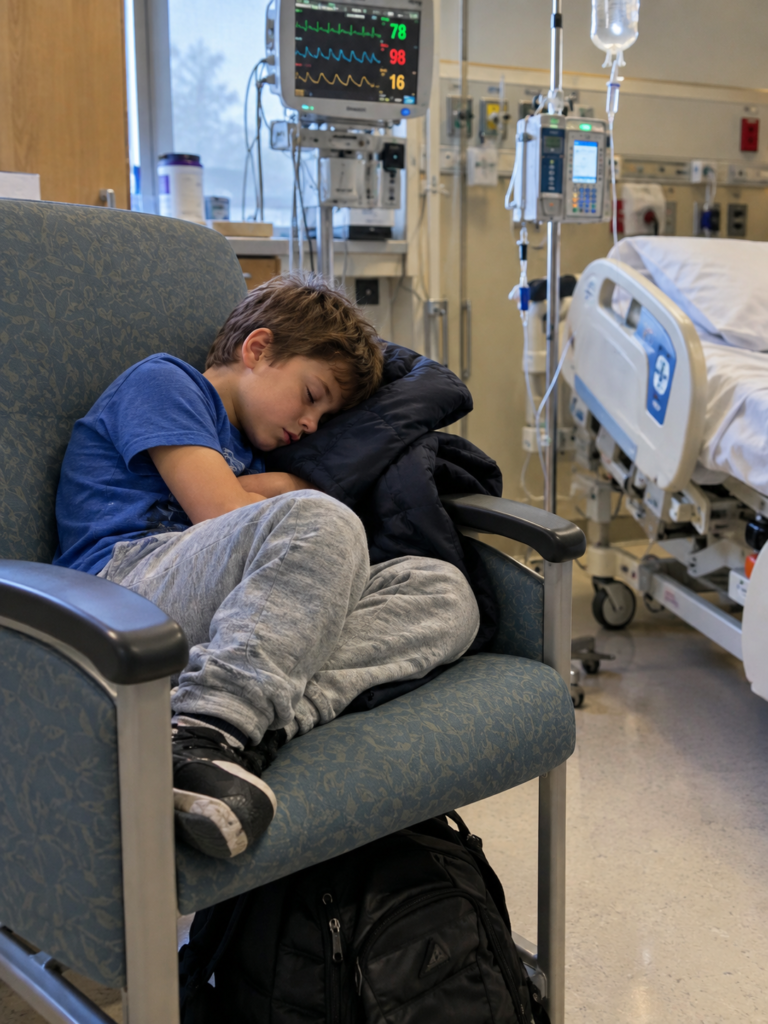
He was asleep. Folded up in one of those awful vinyl hospital chairs like a paper crane somebody had crumpled. His backpack was on the floor under his feet. His cheek was pressed against his rolled-up jacket, which he was using for a pillow. And one small hand was still stretched out across the gap between the chair and the bed, wrapped tight around the edge of my blanket.
Like he’d fallen asleep holding on.
He was wearing an old gray T-shirt with a faded fire department logo on the front. It was way too big for him. It hung down past his knees. I knew that shirt. It was his father’s. My son David’s. Walter kept it folded in the bottom drawer of his dresser, and he only took it out on the very worst days.
There were dark circles under his eyes. Purple ones, like bruises. I’d never seen anything like that on him before. He was nine. Nine-year-olds aren’t supposed to have circles like that.
Seeing him there nearly broke me in half.
Walter had lived with me since his father died four years ago.
David was a firefighter. He died on a warehouse call in the spring, when a roof came down. He was thirty-four. Walter’s mother had left when Walter was two. Moved to Florida with a man she met online and never came back. She didn’t come to the funeral. She sent a card with a picture of a lily on it and no return address.
So Walter came to me.
I was sixty-two then. A retired school librarian. A widow for nine years already. I lived alone in a little blue house on Maple Street with a cat named Pickles and a garden full of tomatoes I talked to.
And suddenly I had a five-year-old boy who wet the bed and screamed in his sleep and wouldn’t eat anything that wasn’t beige.
I learned. You learn. I learned how to pack a lunch he’d actually eat. Peanut butter and honey, crusts off, cut into triangles, never squares. I learned how to walk him to school every morning and stand by the fence until he was inside the door, because if I left too soon he’d panic. I learned which night-light had to stay on when he couldn’t sleep. The blue one shaped like a moon. Not the yellow star. The yellow star made scary shadows on the closet door.
I learned that when he was sad, he didn’t cry. He went very quiet and very careful, like a grown-up. That was the worst part. A five-year-old being careful.
We’d built a life. The two of us and Pickles. It wasn’t fancy. But it was ours.
And now here he was, curled up in a hospital chair in his dead father’s shirt, with purple circles under his eyes, holding on to my blanket.
“Walter?” I said.
My voice came out like sandpaper. My throat was so dry it hurt.
His eyes flew open.
For one second, he just stared at me. Like he didn’t believe it. Like he’d dreamed this so many times he wasn’t sure which one this was.
Then he threw himself against my chest.
“Granny!“
It hurt. God, it hurt. My ribs screamed. I didn’t care. I got my arm around him, the one without all the tubes, and I held on to him with everything I had.
He was crying so hard I could barely understand him. “You woke up, you woke up, you woke up, I knew you would, I told them, I told them you would—”
“I’m here, sweetheart. I’m here.”
“They said maybe not. They said maybe you wouldn’t. But I knew.”
A nurse came rushing in. A heavyset woman in purple scrubs, maybe fifty, with reading glasses pushed up in her gray curls. She took one look at us and stopped. Then her whole face broke into a smile.
“Well, look at that,” she said softly. “Look who decided to come back.”
She came over and checked the monitor. She checked my eyes with a little flashlight. She asked me my name. I told her. Helen Marsh. She asked me what year it was. I told her. She nodded.
“I’m Bernadette,” she said. “I’ve been taking care of you. I’ll go get Dr. Patel.” She looked at Walter, who was still pressed against me, still shaking. Her eyes got soft. “He’s been waiting for this. That boy has hardly wanted to leave your side.”
She went out. I stroked Walter’s hair. It was greasy. Like it hadn’t been washed in days.
“Sweetheart,” I said. “You’ve been sleeping here?”
He nodded against my chest.
“How long?”
“Since the third day,” he said. His voice was muffled.
“Every night?”
He nodded again.
I looked at the chair. At the crumpled jacket he’d been using as a pillow. At the backpack. There was an empty bag of vending machine pretzels sticking out of the front pocket.
“Why aren’t you at home?” I asked. “Why aren’t you staying with Aunt Lisa?”
At the sound of my daughter’s name, his whole body went stiff.
Instead of answering, Walter suddenly lifted his head. He looked toward the door.
And his face changed.
I’d seen that face before. The night after David’s funeral, when a car door slammed outside and he thought it was his father coming home. It was the face of a child listening for something. Something he was afraid of.
He climbed closer. He put his mouth right against my ear. His breath was warm and fast.
“Granny,” he whispered. “If Aunt Lisa comes in, close your eyes. Pretend you never woke up.”
I stared at him.
“Why?”
He squeezed my hand. Hard. So hard it hurt my fingers.
“Please,” he whispered. “That’s why I’ve been staying here every night. You need to hear what she says when she thinks you’re asleep.”
“Walter, honey, what are you talking about?”
Before I could ask anything else, I heard it.
Footsteps in the hallway. Heels. The click-click-click of good shoes on a hospital floor.
They stopped right outside my door.
Walter’s eyes went wide.
“Granny,” he breathed. “She’s coming.”
He slid off the bed and back into the chair so fast it was like he’d never moved. He grabbed my blanket again. He put his head down on his jacket.
I barely had time to close my eyes.
The door opened.
I knew it was her before she said a word.
I knew her perfume. She’d been wearing the same one since she was twenty-five. Something with gardenias in it. Too strong. It filled the whole room in a second.
My daughter. Lisa. Forty-one years old.
For several seconds, nobody said anything.
I lay very still. I made my breathing slow and even. I made my face go loose. It was harder than I thought it would be. My heart was pounding so hard I was sure she’d see it on the monitor. I was sure the beeping would give me away.
I heard her set down her purse on the tray table. I heard her sigh.
Then I heard her laugh. A little laugh. Not a nice one.
“Still waiting for her to wake up?” she said. “That’s pathetic, Walter. You really don’t know when to give up, do you?”
Walter didn’t answer.
“Did you even go to school today?”
Nothing.
“I called the office and told them you have the flu. Again. You’re welcome.” Her heels clicked closer. “Honestly. Sitting in this chair day and night like some kind of guard dog. What do you think you’re going to do? She’s not going to sit up and make you pancakes.”
Walter still didn’t answer. I could hear him breathing. Quick and shallow.
Lisa came closer to the bed. I felt her standing over me. I could smell the gardenias and, under them, something else. Cigarettes. She’d quit twelve years ago. Or said she had.
“Fine,” she said. “Since you’re so determined to sit here, let me tell you a little secret about your grandma.”
I kept my eyes shut. I forced myself not to move.
What my daughter said next made my heart drop through the floor.
“She’s never coming home,” Lisa said.
Her voice was light. Almost cheerful. Like she was telling him the weather.
“Dr. Patel told me yesterday. Even if she wakes up, she won’t be the same. The bleeding in her head. Her memory will be bad. She won’t be able to live alone. She won’t be able to take care of a little boy. She’ll need a facility.” A pause. “And guess who has the papers? Me. I’m her healthcare proxy. I’m the one who decides.”
She was lying. I knew she was lying. I’d heard nothing about what Dr. Patel said. But she said it so smoothly. So easily.
“So here’s what’s going to happen,” Lisa said. “The house goes on the market next week. I already signed with the realtor. She’s coming to take pictures on Thursday. Your cat’s going to the shelter. And you’re going to Brookfield.”
I heard Walter make a small sound.
Brookfield. I knew Brookfield. It was a residential school two hours north. For “boys with behavioral challenges.” That’s what the brochure said. It was where families sent kids they didn’t want.
“It’s a very nice place,” Lisa said. “They have horses. And it’s paid for. Do you know who’s paying for it?”
Walter didn’t answer.
“Your daddy,” Lisa said.
I felt the blood drain out of my face. I had to fight to keep my eyelids from twitching.
“His life insurance,” Lisa said. “Two hundred and fifty thousand dollars. Your granny put it in a trust for you. For college. She was so proud of that. She told everybody. ‘Walter’s going to college. His father made sure of it.’” Lisa laughed again. “But the thing about trusts is, somebody has to manage them. And when your granny can’t anymore, that somebody is going to be your guardian. And I already filed the papers to be your guardian, Walter. Yesterday. At the courthouse.”
The monitor beside me was beeping faster now. I prayed she wouldn’t notice. I prayed she didn’t know what it meant.
“So your daddy’s money,” Lisa said softly, “is going to pay for Brookfield. And for a few other things. Things I need. Your Uncle Craig’s business went under, did you know that? No, of course you didn’t. Nobody tells you anything. Well, it did. And the bank wants the house back. Our house. And your granny said no when I asked her for help. Three times. She said she was saving it for you.”
She said you like it was a dirty word.
“Well,” she said. “Now she can’t say no.”
I heard her pick up her purse.
“Oh,” she said. “And one more thing. Since you like secrets so much.”
She leaned down. Close to Walter. I could hear it in her voice. She was right next to him.
“I already took some,” she whispered. “From her checking account. Thirty-eight thousand dollars. Last week. I had her checkbook, and I had her password, because she wrote it on a sticky note inside her kitchen cabinet like an old lady. And do you know what the best part is?”
Walter was crying now. Very quietly. I could hear it.
“She’ll never remember,” Lisa said. “Even if she wakes up. The doctor said her memory will be gone. And nobody’s ever going to believe a nine-year-old who skips school and sleeps in a hospital chair.”
She straightened up. I heard her heels click toward the door.
“Go home and take a shower, Walter,” she said. “You smell like a vending machine.”
The door opened.
It closed.
The heels clicked away down the hall.
I opened my eyes.
Walter was sitting in the chair with his knees pulled up to his chest and his face pressed into them. His shoulders were shaking. He was making no sound at all. That careful silence. That terrible, careful, grown-up silence.
“Walter,” I said.
He lifted his head. His face was wet and red.
“You heard,” he said. “Right? Granny? You heard her?”
“I heard every word.”
“I told you,” he said. And his voice cracked all the way through. “I told the nurse. I told Bernadette. I told the man at the front desk. I told everybody. Nobody believed me. They said Aunt Lisa’s your daughter. They said she’s just stressed. They said I was confused because I was scared.”
He got up. He climbed back onto the bed, very carefully, and curled up against my side, the side without the broken ribs. He knew which side. Of course he knew. He’d been watching the nurses for eleven days.
“I heard her on the phone,” he whispered. “The second day. In the hallway. She thought I was asleep. She was talking to Uncle Craig. She said, ‘If she doesn’t wake up by Friday, I’m signing the papers. I’m not waiting forever.’” He was shaking. “I didn’t know what papers. I thought she meant… I thought she meant she was going to let you die, Granny. Like on TV. When they turn off the machines.”
My heart stopped.
“So I stayed,” he said. “I couldn’t go home. If I went home, she might do it while I was gone. So I stayed. Every night. I made myself stay awake as long as I could. I only slept when the nurses were in here. Because if a nurse was here, she couldn’t do anything bad.”
I put my hand on the back of his head. On his greasy, unwashed hair. And I held him while he cried into his dead father’s shirt.
My nine-year-old grandson had been guarding my life for eleven days.
And nobody had believed him.
Dr. Patel came in twenty minutes later. He was young, maybe forty, with kind eyes and a tired face. Bernadette was behind him.
He checked everything. My eyes. My reflexes. He asked me to squeeze his fingers. He asked me to follow his pen with my eyes. He asked me who the president was. He asked me my address and my birthday and what I had for breakfast the day of the accident.
“Oatmeal,” I said. “With raisins. Walter wanted pancakes, but it was a school day.”
Dr. Patel smiled. “Your memory seems excellent, Mrs. Marsh.”
“Dr. Patel,” I said. “Did you tell my daughter yesterday that I’d never be able to live alone again? That I’d need a facility?”
His smile disappeared. He looked confused.
“No,” he said. “I told her the opposite. I told her your brain scans looked very good. That the bleeding had resolved. That we were optimistic you’d wake up and make a strong recovery.” He paused. “Why do you ask?”
I looked at Bernadette.
She was standing by the door with her arms crossed. She was looking at Walter. And her face was slowly changing. From confusion. To something else.
“Bernadette,” I said. “My grandson told you something. A few days ago. About my daughter.”
Bernadette’s face went red.
“He did,” she said slowly. “He said she wanted to hurt you. He said he heard her on the phone. I thought…” She put her hand over her mouth. “I thought he was a scared little boy who didn’t understand what grown-ups were talking about. I told him his aunt loved him. I told him to go home and get some sleep.”
“She told the school he had the flu,” I said. “She told him she’s filed to be his guardian. She told him she’s selling my house. She told him she took thirty-eight thousand dollars out of my bank account. She said all of that standing right there. At the end of my bed. Not ten minutes ago. Because she thought I couldn’t hear.”
The room went dead quiet.
Dr. Patel looked at Walter. Walter was sitting up now, next to me on the bed, holding my hand.
Bernadette walked over to him. She knelt down beside the bed. Her knees cracked.
“Walter,” she said. “I’m so sorry, honey. You told me the truth, and I didn’t listen. That’s not okay. I’m so sorry.”
Walter looked at her for a long moment.
“It’s okay,” he said. “Grown-ups never believe kids.”
Bernadette flinched like he’d slapped her.
“This one does now,” she said.
They brought in a social worker that afternoon. A thin woman named Grace Adeyemi, with short gray hair and a clipboard. She sat in the vinyl chair where Walter had been sleeping for eleven days and listened to everything.
When I was done, she was quiet for a long time.
“Mrs. Marsh,” she said finally. “What you’re describing, if it’s true, is elder financial abuse. Possibly fraud. Possibly theft. And the guardianship petition, if she filed it while misrepresenting your medical condition to the court, that’s a serious problem.”
“It’s true,” I said.
“I believe you.” She looked at Walter. “And I believe him. But believing isn’t the same as proving. She’s your healthcare proxy. She’s your next of kin. She has a lot of legal standing right now. More than you might think.”
“Then how do I take it away?”
“You revoke the proxy,” Grace said. “Today. In writing. With a witness. Dr. Patel will need to document that you have the capacity to make that decision. Which, from what he tells me, you do.”
“And the money?”
“You’ll need to call your bank. Freeze the accounts. And you’ll need a lawyer.”
I thought about it.
“I have a lawyer,” I said. “Sort of.”
His name was Arthur Finch. He was seventy-four. He’d been my late husband’s best friend since they were boys. He’d been a lawyer in town for fifty years. He’d done our wills. He’d done the trust for Walter after David died. He’d retired six years ago, but he still kept an office above the hardware store on Main Street, and he still answered his phone.
He came to the hospital that evening. He walked in with a cane and a leather briefcase older than Walter, and he sat down in the vinyl chair and looked at me over his half-moon glasses.
“Helen,” he said. “You look terrible.”
“Thank you, Arthur.”
“No, I mean it. You look like somebody ran you over with a truck.”
“Somebody’s truck ran me into a ditch.”
“Well.” He smiled. “You’re still prettier than me.”
Then I told him everything. And the smile went away.
He listened without interrupting. When I got to the part about the thirty-eight thousand dollars, he took off his glasses and pinched the bridge of his nose. When I got to the part about Brookfield and David’s life insurance, he put his hand over his eyes.
When I was done, he didn’t say anything for a long time.
“I baptized that girl,” he said finally. “Did you know that? I was her godfather. I held her at the font at St. Luke’s. She screamed so loud the priest dropped his book.”
“I remember.”
“She used to ride on my shoulders at the Fourth of July parade.” He shook his head slowly. “What happened to her, Helen?”
I didn’t answer.
Because I was afraid I knew.
That night, after Arthur left, after Bernadette brought Walter a real dinner from the cafeteria and made him eat every bite, after she made up a cot for him beside my bed so he wouldn’t have to sleep in that awful chair, I lay awake in the dark.
Walter was asleep on the cot. Really asleep. For the first time in eleven days, probably. His mouth was open. He was snoring a little. One hand was still stretched up, holding on to the edge of my blanket.
I lay there and I thought about Lisa.
I thought about her at five years old, standing in the doorway of the nursery the day we brought David home from the hospital. She’d been so excited to be a big sister. She’d made a sign. WELCOME BABY in purple crayon. She’d spelled baby with two Ys.
I thought about her at eight, standing in the kitchen with a report card full of A’s, waiting for me to look at it. And me, standing at the stove with David on my hip because he had an ear infection and wouldn’t stop screaming. “Not now, honey. Put it on the fridge. I’ll look at it later.”
I never looked at it later.
I thought about her at twelve, at her piano recital. She played Clair de Lune. She’d practiced for six months. And I was late because David had a Little League game that ran into extra innings, and he’d hit a double, and I couldn’t leave. I got to the recital hall just as she was taking her bow. She saw me come in the back door. She saw me miss it.
I thought about her at seventeen, crying in her room because she didn’t get into the college she wanted. And me, standing at her door, saying, “Well, maybe if you’d worked as hard as your brother does at football.”
I thought about her wedding. How I cried through the whole thing. And how, at the reception, I spent most of the night at the table with David, who’d just gotten into the fire academy, telling everybody how proud I was of my boy.
I thought about the day David died. How Lisa drove over from two towns away and stood in my kitchen and tried to hug me, and I pushed her away. “Not now,” I said. “Not now, Lisa. I can’t.”
And I thought about the three times this past year she’d asked me for money. How she’d sat at my kitchen table with her hands wrapped around a coffee mug and told me Craig’s business was failing. How scared she was. How they might lose the house.
And how I’d said no. All three times.
“That money’s for Walter,” I’d said. “That’s David’s money. That’s what he left his son. I’m not touching it.”
“I’m not asking for David’s money, Mom. I’m asking for yours. Just a loan. Just to get us through.”
“I can’t, Lisa. I’m sixty-six. I have a nine-year-old to raise. I need every penny.”
She’d looked at me across that table for a long time. Then she’d said something I didn’t really hear at the time. I heard it now, lying in the dark.
“It’s always been David,” she’d said. “Hasn’t it? Even now. Even dead. It’s still David.”
I’d told her she was being ridiculous.
She got up and left without finishing her coffee.
I didn’t sleep that night. I lay there listening to Walter snore and the monitor beep, and I cried. Quietly. So I wouldn’t wake him.
Not because Lisa had done something terrible. She had. What she did to Walter, what she said to him, what she was planning, was unforgivable. I knew that.
I cried because some part of me understood exactly how she’d gotten there.
And some part of that path had my footprints on it.
Arthur came back the next morning with the papers.
A revocation of the healthcare proxy. A new one, naming him instead. A letter to my bank. A letter to the courthouse, contesting the guardianship petition. An affidavit for Walter to sign, describing what he’d heard.
“He’s nine,” I said. “Does he have to?”
“He doesn’t have to,” Arthur said. “But it’ll help.”
Walter was sitting on his cot, eating a muffin Bernadette had brought him. He looked up.
“I’ll do it,” he said.
“Honey, you don’t have to—”
“I want to.” He put down the muffin. “Nobody believed me. For eleven days. Now I can write it down, and it’ll be official. Right? Like, in court?”
“Like in court,” Arthur said.
Walter nodded. He wiped his hands on his jeans. He walked over to the tray table. Arthur gave him a pen.
He wrote it all down. In careful, crooked fourth-grade handwriting. It took him forty-five minutes. He only asked how to spell three words. Guardian. Insurance. Pathetic.
When he was done, he signed his name at the bottom. Walter David Marsh.
Arthur looked at the paper. His eyes were wet.
“That’s the best affidavit I’ve seen in fifty years,” he said.
Dr. Patel came by at ten to sign the capacity evaluation. Grace came at eleven as a witness. Bernadette came at eleven-fifteen, just because.
I signed the revocation. My hand was shaking. My signature looked like an old woman’s. It was an old woman’s.
Then Arthur called my bank.
He put it on speaker. It took forty minutes to get through to the right person. A young man named Terrence in the fraud department.
“Yes, Mrs. Marsh,” Terrence said. “I’m looking at your account now. I see a withdrawal on January fourteenth. Thirty-eight thousand dollars. Transferred to an external account.”
“Whose account?”
A pause. Typing.
“The account holder is Lisa Marsh-Dunne,” he said.
The room was very quiet.
“The transfer was authorized online,” Terrence said. “Using your login credentials. From an IP address that… one moment. It’s not a location you’ve logged in from before.”
“I was unconscious in the ICU on January fourteenth,” I said.
Another pause. Longer.
“I understand, ma’am,” Terrence said, very carefully. “I’m going to flag this as fraud and freeze the account right now. Would you like to file a police report?”
I looked at Walter. He was sitting on the cot with his knees pulled up, listening to every word.
“I don’t know yet,” I said. “Not yet.”
Lisa came back that afternoon.
We knew she was coming. Grace had called her. She’d told her that the hospital needed to meet with the family about “next steps.” She didn’t tell her I was awake.
“I want to see her face,” I said to Arthur. “When she comes in. I want her to think I’m still asleep. I want to hear what she says. One more time.”
“Helen, that’s—”
“Please, Arthur. One more time. Then I’ll open my eyes.”
Arthur looked at me for a long moment. Then he looked at Walter.
“What do you think, son?” he asked.
Walter thought about it very seriously.
“I think Granny should get to hear it herself,” he said. “Not just from me. So she knows I wasn’t making it up.”
“I already know, sweetheart.”
“I know,” he said. “But I want you to know know.”
Arthur waited in the family lounge down the hall. Grace sat at the nurses’ station, where she could see my door. Bernadette hovered nearby, pretending to sort charts.
Walter sat in the chair beside my bed. Holding the blanket.
I closed my eyes.
At 2:47, I heard the heels.
Click. Click. Click. They stopped at my door.
The gardenia smell came first. Then her voice.
“Ugh,” Lisa said. “You again.”
Walter didn’t answer.
She set her purse down on the tray table. I heard paper rustling. A folder.
“Well,” she said. “Since you’re here, you might as well know. The hospital called. They want a family meeting. Probably to talk about moving her somewhere. There’s a place in Hartford, a long-term care facility, very reasonable. I already called them. They have a bed opening up next week.”
Paper rustled again.
“And I brought the listing agreement for the house. The realtor needs a signature from the proxy. Which is me.” She laughed a little. “Isn’t that funny? She made me her proxy fifteen years ago. After Dad died. She was so worried about David being too busy at the fire station to handle it. So she picked me. The backup. The spare. And now look.”
I felt her come closer to the bed. I felt her standing over me.
“You never thought I’d be the one who mattered,” she said.
She wasn’t talking to Walter anymore. She was talking to me.
“Did you?” she said. Her voice was quiet now. Different. “All those years. Report cards on the fridge you never looked at. Recitals you walked in late to. ‘Why can’t you be more like your brother.’ You never once thought the spare would end up holding all the keys.”
Her voice cracked.
“And then he died,” she said. “And you know what I thought, standing at his funeral? I thought, now she’ll see me. Now I’m all she’s got left. Now she’ll finally turn around.” She laughed again. It was a horrible, broken sound. “And instead you turned around and picked up his kid. And poured everything into him. Every penny. Every second. Every ounce of love you had left. You loved David’s son more than you ever loved your own daughter.”
Walter made a small sound.
“I’m sorry, Walter,” Lisa said. And for a second, she actually sounded like she meant it. “It’s not your fault. You didn’t ask for any of this. But you’ve got something I never got. And I’m tired. I’m so tired. Craig’s going to lose the business. We’re going to lose the house. My kids are going to lose everything. And she wouldn’t help. She said no. Three times. She said she had to save it for you.”
She took a breath.
“So I’m helping myself,” she said. “For once in my life.”
I opened my eyes.
Lisa was standing at the foot of my bed with a manila folder in her hand. She was looking down at Walter. She didn’t see me at first.
Then she did.
Her whole body went rigid. The folder slipped out of her hand. Papers slid across the floor. A realtor’s listing agreement. A brochure for a care facility with a smiling old woman on the front. A copy of a petition with the county seal on it.
“Hello, Lisa,” I said.
She took a step back. She hit the tray table. Her purse fell off. Lipstick and keys and a pack of cigarettes scattered across the floor.
“Mom,” she whispered. “You’re… How long have you…”
“Since yesterday morning,” I said. “Walter woke me up.”
Her face went white. Then red. Then white again.
“You heard,” she said.
“I heard everything. Yesterday and today.”
She looked at Walter. He was sitting very straight in the chair, still holding my blanket. He didn’t look away from her.
“You little—” Lisa started.
“Don’t,” I said.
It came out louder than I meant it to. It hurt my ribs. I didn’t care.
“Don’t you dare say one more word to him,” I said. “Not one. He sat in this chair for eleven days. He slept here. He ate pretzels out of a vending machine. He skipped school. He wore his father’s shirt because it was the only thing he had that made him feel safe. He told every grown-up in this building that you were going to hurt me, and nobody believed him. And he stayed anyway.” My voice was shaking. “He’s nine years old, Lisa. He’s nine.”
Lisa stood there. Her mouth was open. Nothing came out.
The door opened behind her. Arthur came in, leaning on his cane. Grace was behind him. Bernadette was in the hallway, with her arms crossed, blocking it like a linebacker.
Lisa turned and saw Arthur.
“Uncle Arthur,” she said. Her voice was very small.
“Hello, Lisa,” Arthur said. He didn’t smile.
“What are you doing here?”
“Your mother revoked your healthcare proxy this morning,” Arthur said. “I’m her proxy now. We’ve contacted the bank. The account’s frozen. The transfer on January fourteenth has been flagged as fraud. I’ve filed a response with the court contesting your guardianship petition.” He paused. “Which, I’ll point out, contains a sworn statement from you that your mother’s physician told you she would ‘never regain the capacity to live independently.’ Dr. Patel is prepared to testify that he said no such thing.”
Lisa put her hand against the wall to steady herself.
“And Walter,” Arthur said, “has written an affidavit. Describing everything you said to him in this room yesterday. Word for word.”
Lisa looked at Walter.
Walter looked back at her.
“You said I smelled like a vending machine,” he said quietly. “I put that in too.”
For a long moment, nobody moved.
Then Lisa started to cry.
Not the crying she used to do when she was little, when she wanted something. Not loud or dramatic. She just stood there by the wall with her hand over her mouth and her shoulders shaking, and tears running down her face, making lines in her makeup.
“I’m sorry,” she said. “I’m sorry. I didn’t… I don’t know what happened to me. I don’t know how I got here.”
“You got here one step at a time,” I said. “Same as everybody.”
She looked at me.
“I heard what you said,” I told her. “About the report cards. The recital. Your brother.” I had to stop. My throat was too tight. “You’re right.”
Lisa stared at me.
“You’re right,” I said again. “I did that. I did all of it. I loved David so much, and he was so easy to love, and you were…” I stopped. “You were harder. You were always angry. And I didn’t know why. And instead of trying to find out, I just turned toward the one who was easy.” I wiped my eyes with my free hand. “I’ve been lying here in the dark all night thinking about that recital. Clair de Lune. You practiced for six months.”
Lisa made a sound like she’d been punched.
“You remember that?” she whispered.
“I remember walking in late. I remember you seeing me. I remember your face.” My voice broke. “I never said I was sorry. I never once in thirty years said I was sorry.”
Lisa slid down the wall until she was sitting on the floor. Right there, in the middle of her scattered papers and spilled lipstick. She put her face in her hands.
“I’m sorry, Lisa,” I said. “I’m sorry I made you feel like the spare. You were never the spare. You were my first baby. And I forgot that. For a long, long time.”
Nobody said anything for a while.
Lisa sat on the floor and cried. Arthur stood by the door with his cane. Grace had her hand on Bernadette’s arm.
Walter was very still in his chair.
“But Lisa,” I said finally. “Being hurt doesn’t give you the right to hurt him.”
She lifted her head.
“Whatever I did to you,” I said, “whatever I didn’t give you, that’s between you and me. That’s my debt. Not his. You don’t get to take it out of a nine-year-old. You don’t get to stand over his dying grandmother’s bed and tell him he’s going to a school for unwanted boys. You don’t get to tell him his dead father’s money is going to pay for it. You don’t get to steal from me while I’m lying unconscious and tell a child nobody will ever believe him.”
“I know,” she whispered.
“You scared him so badly he thought you were going to kill me. Do you know that? He’s been sitting in this chair for eleven days because he thought if he left, you’d turn off the machines.”
Lisa looked at Walter. Her face crumpled all over again.
“Walter,” she said. “I would never. I would never have done that. I was just… I was talking to Craig. About the facility. About moving her. I wasn’t going to…”
“You said, ‘If she doesn’t wake up by Friday, I’m signing the papers,’” Walter said. His voice was very quiet and very steady. “I heard you. I didn’t know what papers. I thought you meant the bad kind.”
Lisa closed her eyes.
“I’m so sorry,” she said. “I’m so sorry, Walter.”
Walter didn’t say anything. He just held on to my blanket.
Grace walked Lisa out. Quietly. Down the hall, past the nurses’ station, to the family lounge, where they sat together for over an hour. I never found out everything they talked about.
Arthur picked up the papers from the floor. The listing agreement. The facility brochure. The guardianship petition. He put them all back in the folder and tucked the folder under his arm.
“What do you want to do, Helen?” he asked quietly. “The bank’s going to want to know. So will the court. You can press charges. You’d be within your rights.”
I looked at Walter.
He was still sitting in the chair. He was staring at the door where Lisa had gone out.
“What do you think, sweetheart?” I asked him. “You’re part of this. You get a say.”
He thought about it for a long time.
“Is she going to go to jail?” he asked.
“She might,” Arthur said honestly. “If your granny presses charges. It’s a serious thing, what she did.”
Walter looked down at his hands.
“She has two kids,” he said. “Emma and Jake. They’re my cousins. Emma’s seven. She’s scared of the dark too.” He looked up. “If their mom goes to jail, who’s going to leave the light on for them?”
The room went very quiet.
Arthur took off his glasses. He wiped them on his shirt. He put them back on.
“Well,” he said, and his voice was rough. “That’s a better legal argument than I’ve heard from most lawyers.”
In the end, I didn’t press charges.
But I didn’t let her off, either.
Arthur drew up an agreement. Lisa had to pay back every penny of the thirty-eight thousand dollars. She had to withdraw the guardianship petition and sign a statement admitting she’d misrepresented my medical condition. She had to agree to never again act on my behalf, in any capacity, legal or medical or financial, without my written consent.
And she had to go to counseling. Real counseling. With a therapist. Every week for a year.
“If she misses a payment,” Arthur said, “or a session, or if she does anything like this ever again, we go straight to the district attorney. With Walter’s affidavit and the bank records and Dr. Patel’s testimony. Understood?”
Lisa signed it in the family lounge with her hand shaking. Craig was sitting next to her. He hadn’t known about the money. When Arthur showed him the bank statement, he’d put his face in his hands and said, “Oh, Lisa. Oh, honey. What did you do?”
She’d already transferred most of it back by the end of the week. Twenty-nine thousand dollars. She’d spent nine on Craig’s business debts. She said she’d pay the rest in installments. Three hundred a month.
“It’s going to take almost three years,” she said.
“Then it takes three years,” I said.
I was in the hospital for nine more days. Then a rehab facility for three weeks. Relearning how to walk without falling over. How to breathe all the way in. How to climb stairs.
Walter came every single day after school. He went back to school the day after Lisa left. I made him. He protested. I told him if he didn’t go, I’d tell his teacher he’d been faking the flu for eleven days, and she’d give him extra homework for the rest of the year.
He went.
But every day at 3:30, he was in my room. With his backpack and a snack from the vending machine and a report on what happened at school. He did his homework at my bedside tray. He read to me out loud from his library books. He was reading about sharks that month. I learned more about sharks than any sixty-six-year-old woman ever needed to know.
Bernadette brought him dinner from the cafeteria every night until I moved to rehab. She wouldn’t let me pay her back.
“That boy,” she said, “taught me something. I’ve been a nurse for twenty-six years. I’ve seen a lot of families. I thought I knew how to tell the good ones from the bad ones.” She shook her head. “Turns out I didn’t know anything. Turns out sometimes the kid in the chair knows more than all of us put together.”
Arthur brought Pickles to visit me in rehab. Smuggled her in under his coat. She was very offended by the whole thing. She bit him twice.
“She’s been staying at my place,” he said, holding her on his lap. “Walter’s been coming over every afternoon to feed her. He brings her a little bit of tuna in a baggie. He says she won’t eat without it.”
“She’ll eat,” I said. “She’s spoiled.”
“He also asked me,” Arthur said, “whether you were going to be able to live at home by yourself. When you get out. He’s very worried about it. He asked me if he needed to get a job.”
I laughed. Then I stopped laughing.
“What did you tell him?”
“I told him,” Arthur said, “that the job he already has is the most important one there is.” He stroked the cat. “He asked what job. I said, ‘Being her grandson.’ He thought about it for a minute. Then he said, ‘Does it pay?’”
I went home on the fifth of March.
Arthur drove. Walter sat in the back seat with Pickles in her carrier on his lap. The whole way, he kept leaning forward between the seats, asking if I was okay. If I needed anything. If my ribs hurt. If I was cold.
“I’m fine, sweetheart.”
“You’d tell me if you weren’t?”
“I’d tell you.”
“You promise?”
“I promise.”
When we pulled into the driveway of the little blue house on Maple Street, there was a car parked in front.
Lisa’s car.
She was sitting on my front porch steps. In a sweater and jeans, no makeup, her hair pulled back. She had a casserole dish on her lap. Beside her were her two kids. Emma, seven, with a gap in her front teeth and a pink backpack. Jake, five, with a truck in each hand.
Arthur stopped the car. He looked at me in the rearview mirror.
“I can drive around the block,” he said.
“No,” I said. “It’s okay.”
Walter was very still in the back seat.
“Walter,” I said. “You don’t have to go say hi. You can go straight inside.”
He looked at the porch for a long time.
Then he unbuckled his seatbelt.
He got out of the car. He walked up the front walk with Pickles in her carrier. He stopped at the bottom of the steps.
Lisa stood up. She was holding the casserole dish in both hands. She looked at Walter.
Neither of them said anything.
Emma was the one who broke it.
“Walter!” she said. “Is Grandma okay? Mom said she was in a coma. That’s like a really long sleep. I read about it.”
“She’s okay,” Walter said. “She woke up.”
“Did you wake her up?”
Walter thought about it. “Kind of,” he said.
Emma looked impressed.
Lisa was still standing there with the casserole. Her eyes were red. She looked at Walter. Then at me, getting out of the car slowly with Arthur’s help.
“It’s lasagna,” she said. Her voice was shaking. “I didn’t know what else to bring. I remember you used to like my lasagna. Walter. At Christmas. You’d eat three pieces.”
Walter looked at the dish. Then at her.
“The one with the ricotta?” he said.
“The one with the ricotta.”
He was quiet for a long moment.
Then he held out the cat carrier to Emma. “Can you hold Pickles? She bites. But not if you talk to her.”
Emma took the carrier very carefully.
Walter walked up the porch steps. He stopped in front of Lisa. He looked up at her.
“I was really scared,” he said. “At the hospital. When you said all those things.”
“I know,” Lisa whispered. “I’m so sorry.”
“I thought you were going to hurt Granny.”
“I know. I know you did. I wasn’t. I promise. But I understand why you thought it. I said terrible things. I was a terrible person in that room.” She wiped her eyes with the back of her wrist. “I’m trying really hard not to be that person anymore. I’m going to a doctor every week. A talking doctor. To help me figure out why I got so angry.”
Walter thought about that.
“Is it helping?”
“A little,” she said. “It’s slow.”
He nodded. Like that made sense. Like he knew about slow.
Then he held out his hands for the lasagna.
Lisa gave it to him. He carried it inside.
At the door, he stopped. He turned around.
“Are you guys staying for dinner?” he asked. “There’s a lot. You made a lot.”
Lisa looked at me.
I was standing at the bottom of the porch steps, holding on to Arthur’s arm, trying very hard not to cry.
“Only if Granny says it’s okay,” Lisa said.
I looked at my daughter. Forty-one years old. Standing on my porch in a sweater with no makeup, holding her son’s hand. She looked about eight years old. Standing in the kitchen with a report card, waiting for somebody to look.
“Come in, Lisa,” I said. “Come in and eat.”
It wasn’t fixed. I want to be honest about that.
It wasn’t fixed that night, or that month, or that year.
There were hard days. There were days Lisa didn’t call. There were days she called and we fought about old things, things from thirty years ago, and one of us hung up. There was a day in June she missed a counseling appointment, and Arthur called her, and she cried on the phone and said she couldn’t do it, it was too hard, and he said, “Then do it hard,” and she went the next week.
There was a night in August when Walter woke up screaming. A nightmare. He’d dreamed I was back in the hospital and Lisa was standing over the bed and he couldn’t wake me up. I sat on the edge of his bed until two in the morning with my hand on his back, and he said, “Is she going to do it again? When you’re really old?”
“No, sweetheart,” I said. “She’s not.”
“How do you know?”
I didn’t have a good answer. So I told him the truth.
“I don’t know for sure,” I said. “Nobody knows anything for sure. But I’m going to watch. And Arthur’s going to watch. And you’re going to watch. And if anything ever feels wrong again, you tell me. And this time, I’ll believe you. The very first time.”
He looked at me in the blue light of the moon-shaped night-light.
“You promise?”
“I promise.”
But there were good days, too.
Lisa’s checks came on the first of every month. Three hundred dollars. Never late. Every single one had a note paper-clipped to it. At first, they just said Payment 1. Payment 2. Payment 3.
Then, around payment eight, they started saying other things.
Payment 8. Emma lost her first tooth. She wants to know if the Tooth Fairy visits Grandmas too.
Payment 11. Craig got a job. A real one. Benefits and everything. We might be able to pay you back faster.
Payment 14. My therapist asked me to write down one good memory of you. I wrote about the time you took me to the library when I was six and let me check out twelve books, even though the limit was ten. You told the librarian I was a very serious reader. I’ve never forgotten that.
I kept all of them. In a shoebox on the top shelf of my closet.
On a Saturday in November, almost a year after the accident, Lisa came over with Emma and Jake. The kids went out to the backyard with Walter to rake leaves into a pile and jump in them. Lisa and I sat at the kitchen table with cups of coffee.
The same table where she’d asked me for money three times. The same table where I’d said no.
She had a piece of paper in her hand. She pushed it across the table to me.
It was a program. From the community center downtown. Adult Piano Recital. Saturday, December 14th. 7:00 PM.
I looked at the list of names. Halfway down, I found it.
Lisa Dunne — Clair de Lune, Debussy.
I looked up at her.
“I started taking lessons again,” she said. “In March. My therapist said I should do something that was just mine. Something I used to love.” She looked down at her coffee. “I haven’t played since I was seventeen. I’m terrible. I’m so rusty. But…”
She stopped.
“But I’d like you to come,” she said. “If you want to. You don’t have to.”
I looked at the program for a long time.
“Lisa,” I said. “What time do I need to be there?”
“Seven.”
“Then I’ll be there at six-thirty,” I said. “In the front row.”
She laughed. Then she put her hand over her mouth. Then she was crying, and I was crying, and in the backyard, three kids were screaming and throwing leaves at each other, and neither of us said anything else for a long time.
I went. I sat in the front row. I got there at six-fifteen.
Walter sat next to me in a clip-on tie. Emma and Jake sat on my other side. Craig was at the end of the row with a video camera.
When Lisa walked out onto the stage, she was shaking. I could see it from my seat. She sat down at the piano. She put her hands on the keys. She looked out at the audience.
She found me.
I was right there. In the front row. On time. Looking at her.
She smiled.
Then she played.
She wasn’t perfect. She missed a note in the second part. She rushed the middle a little bit. But it was the most beautiful thing I have ever heard in my life.
When she finished, I stood up. I was the first one. My ribs still hurt when I clapped too hard. I clapped anyway.
Walter stood up next to me. Then Emma. Then Jake, who didn’t know what was going on but liked standing on the chair.
Lisa stood up from the piano and took a bow. When she straightened up, she looked right at me. And her face did something I hadn’t seen it do since she was eight years old.
It looked like somebody had finally seen her.
That night, after we got home, I tucked Walter into bed.
He was ten now. Too old to be tucked in, he said. He let me do it anyway.
I turned on the night-light. The blue one shaped like a moon. Not the yellow star.
“Granny?”
“Yes, sweetheart?”
“Aunt Lisa played really good.”
“She did.”
“Was she scared?”
“Very scared.”
“She did it anyway.”
“She did.”
He was quiet for a moment, looking at the moon on the wall.
“When you were asleep,” he said. “In the hospital. For eleven days. Could you hear me? When I talked to you?”
I thought about it. I didn’t remember anything from those eleven days. Just darkness. And then the white ceiling.
“I don’t know, honey,” I said. “What did you say?”
He pulled the blanket up to his chin.
“I told you about school,” he said. “And Pickles. And I read you my shark book. And every night, before I went to sleep in the chair, I told you the same thing.”
“What was it?”
He looked at me in the blue light.
“I said, ‘I’m not leaving, Granny. You didn’t leave me when Dad died. So I’m not leaving you.’”
I couldn’t say anything. I just sat there on the edge of his bed with my hand on his chest, feeling his heart beat under my palm.
“I think maybe you heard,” he said sleepily. “I think that’s maybe why you woke up.”
“Maybe,” I whispered. “Maybe that’s exactly why.”
He closed his eyes. His breathing got slow and deep.
I didn’t leave. I sat there on the edge of his bed for a long time, in the blue light of the moon on the wall, listening to him breathe. The way he’d sat beside me for eleven nights in a hospital chair, holding on to the edge of my blanket.
I used to think love was something you gave to the people who were easy. The ones who made you proud. The ones who hit doubles in extra innings and got into the fire academy.
It took a coma and a nine-year-old boy to teach me that love is mostly just staying.
Staying in the chair when nobody believes you. Staying when it’s hard and slow and you’re not sure it’ll work. Staying in the front row, on time, for the daughter you missed the first time.
Staying until somebody opens their eyes.