What the Ocean Knows
A Story About Love That Arrives After Someone Is Gone, and the Things We Leave Behind
Let me tell you about my father’s hands.
They were large hands — the hands of a man who had worked with them for forty years, first in construction and then in the garden behind the house where I grew up. The knuckles were prominent and the palms were rough and the fingers moved with the specific deliberateness of someone who understood that most things worth doing required care and patience and the willingness to hold on.
Those were the hands that held Sophie’s during chemotherapy.
She was so small against him. Six years old, thin from the treatments, her hair already mostly gone, and she would curl against my father’s side in the treatment chair and he would hold her hand and read to her in the particular voice he used for fairy tales — slightly deeper than his normal voice, slower, the voice of a man who understood that the story was not just the words but also the safety of being held while someone told it to you.
She loved The Little Mermaid most.
She asked for it twice almost every session. My father never complained about this. He would finish it and she would look up at him with her serious eyes and say can we do it again? and he would simply turn back to the first page as if it were exactly the thing he wanted to do.
What is it about that one? I asked her once, on the drive home.
She thought about it with the gravity she gave important questions.
She wants to go somewhere she’s never been, Sophie said. And she goes.
I drove and didn’t say anything.
The ocean, she said. I wish I could see the ocean with my own eyes someday. She was quiet. I’m so sad that I’ll never get to see it.
That sentence.
I covered my mouth with my hand so she wouldn’t hear the sound I was about to make. In the front seat, my knuckles went white on the steering wheel, and I breathed through my nose and I did not let her hear me cry, because she had enough of her own things to carry and she did not need mine.
I’m so sad that I’ll never get to see it.
She said this in the same voice she used to say other matter-of-fact things about her situation, the voice of a child who had been living with medical language long enough that certain truths had settled into her understanding the way furniture settles into rooms — just there, just real, something to navigate around.
It broke me in a way that was completely silent.
Before I tell you about the trip, I need to tell you about the diagnosis.
Sophie was four when I first noticed.
Not the subtle signs — I’m not a doctor and I don’t have the training to read the early signs of what Sophie had, which was a rare pediatric cancer that presented first as fatigue and recurrent infections and then as the specific kind of weight loss that makes a child’s face look too old for its age. What I noticed was that she was tired in a way that sleep didn’t fix, and that the circles under her eyes were dark in a way that made the pediatrician look at her twice, and that she had been sick three times in two months with the kind of low-grade fever that comes and goes without explanation.
I took her to the pediatrician.
The pediatrician referred us to a specialist.
The specialist ran tests that took five days to process, and I spent those five days in the particular suspended state of a person who knows something is coming and has not yet been told what it is. I went to work. I made Sophie dinner. I read her bedtime stories — The Little Mermaid was already her favorite then — and kissed her forehead and went to my own room and sat on my bed in the dark trying to think about something that was not the tests.
The specialist called on a Tuesday.
I remember the light. I remember exactly where I was standing, in the kitchen, with a glass of water in my hand that I set down on the counter very carefully as though my hands had temporarily lost confidence in their ability to hold things.
He said the words.
I will not reproduce them here, not because they are unspeakable but because they are the kind of words that belong to the person who received them, and reproducing them does not add anything to what I need to tell you.
What I will tell you is that I stayed standing.
Afterward, I would consider this a small achievement. That I stayed standing, that I said thank you to the doctor in the way you say thank you when someone has told you something terrible because the alternative is silence and silence feels like you have been struck mute and you are not ready to be mute yet. I stayed standing and I said thank you and I put the phone down and I stood in my kitchen for approximately four minutes before I picked it up again.
I called my father.
My father’s name is Joseph.
He is seventy-one years old. He lost my mother to a heart attack six years ago, which he had described to me as the kind of event that reorganizes your understanding of what the days are for. He meant that he had understood, when she died, that the days were for being present for the people he loved, and he had organized his retirement accordingly: the garden, the grandchildren’s visits, the Wednesday morning walks with his friend Arthur, the Saturday afternoons with Sophie that had become, in the last year, the focal point of his week.
He came when I called.
He came in fifteen minutes, which tells you about the distance between his house and mine and also about what he understood from my voice on the phone. He came in and he went directly to where I was sitting at the kitchen table and he put his arms around me and held on, and I cried in the way I had been holding off since the specialist’s call — not quietly, not gracefully, but the full ugly sound of someone who has been trying to hold a thing and has finally had to put it down.
He didn’t say anything.
He just held on.
Later, when the first wave had passed and I was sitting with a glass of water trying to put myself back together, he sat across from me.
Tell me, he said.
I told him.
He listened with his hands flat on the table, the way he listened when something was serious, and when I finished he was quiet for a long time.
What does she need? he said finally. Always the practical question. Always the question that moved you from the catastrophe toward the next possible thing.
Treatment, I said. Chemotherapy. There’s a clinical trial they think she might qualify for. It won’t— I stopped. It will slow things down. That’s all they can promise.
He nodded.
And what do you need?
I looked at the glass.
I don’t know yet, I said.
Okay, he said. When you know, tell me.
The treatment started three weeks later.
My father rearranged his entire life around the treatment schedule.
Not because I asked him to — he simply arrived the morning of the first session and said he was coming, and he came, and he sat on the side of the reclining chair closest to Sophie and took her hand before the nurse even had the IV in, and Sophie looked at him and her face changed in the way children’s faces change when they locate their safety in a room.
Will you read to me? she said.
What would you like?
She told him.
He read it to her twice.
And then again the next week.
And the week after that.
The fairy tales were his medium — the mechanism by which he communicated to Sophie that the world still contained wonder, that there were things beyond this room and this chair and this particular shade of fluorescent light, that somewhere there were oceans and mermaids and impossible things that happened anyway because love was the kind of force that could rearrange the structure of what was possible.
He was telling her this through the story.
She understood.
Grandpa, she said one afternoon, while the IV dripped, is the ocean very far away?
He looked at her.
Not so far, he said. People go there all the time.
People who aren’t sick, she said.
He didn’t correct this. He was not a man who corrected painful truths by pretending they were false. What he did instead was hold her hand a little tighter and keep reading.
That was when she said it — I wish I could see the ocean with my own eyes someday. I’m so sad that I’ll never get to see it — and he looked at me over the top of her head, this quiet, devastating look that said: we have to try.
Afterward, in the hallway:
I’ll pay for it, he said.
Dad—
Whatever it costs. I’ll pay for it. He looked at his hands. Even if it’s only a few days. Please take her.
I stood in the hallway of the pediatric oncology ward and looked at my father’s hands and I understood that we were in the territory where what you wanted to do and what you were able to do had converged, and that the only question was whether I would let myself accept the help.
Okay, I said.
Okay, he said.
Sophie’s oncologist, Dr. Reyes, was a woman of perhaps forty-five with the specific quality of attention that distinguished good doctors from great ones — the ability to be fully present in a conversation while simultaneously holding the full weight of what had already been said.
She listened to my request.
Her counts are stable enough for travel, she said, looking at Sophie’s chart. We’ll need to talk about protocols — medications to bring, what to do if she has a reaction, facilities in the area in case we need to escalate. She looked at me over the chart. But yes. I think you should go.
You do?
She looked at Sophie’s name in the file.
She’s asked me twice about the ocean, she said. In different conversations. She thinks I don’t remember the first time. I do. She closed the chart. Yes. Go. Go soon, go carefully, and go.
I booked the hotel that evening.
A small place on the coast, three hours by plane from home, the kind of hotel that was not expensive but was clean and situated directly across from the beach so that the sound of the ocean would come through the window at night. I checked the reviews obsessively, looking for any mention of accessibility, of elevators, of proximity to medical facilities. I packed Sophie’s medication in a case that I had organized with military precision, with printed information sheets and a card listing Dr. Reyes’s emergency number.
I had done everything I could think to do.
What I had not done was tell my father I was nervous.
I called him the night before we flew.
Are you worried? he asked, reading me the way he always read me.
Yes.
About her health?
About whether this will be— whether it will be enough. Whether it will be what she needs it to be. I paused. She’s been waiting for this for so long. In her mind. I’m afraid it won’t—
Elena, he said.
Yes.
The ocean is the ocean. She’ll see it and she’ll know it’s real. He paused. That’s enough. That’s more than enough.
Dad.
Yes.
Thank you. For making this happen.
He was quiet for a moment.
I love that little girl, he said.
I know.
I love you too, you know.
I know.
Okay then. Get some sleep. She’s going to run straight for the water. There was something in his voice — a warmth, a fullness, the voice of a man who was picturing something with great precision. Make sure you have your shoes you can get wet.
We said goodnight.
That was Thursday.
We flew Friday morning.
He called to wish us good travels.
My father died on Saturday.
I did not know this on Friday.
I want to be very clear about the order of events, because the order matters more than almost anything else in this story.
On Friday morning, I did not know he was going to die. I held Sophie’s hand on the plane and we looked out the window at the clouds and she told me about mermaids and whether they could live in both the ocean and rivers and whether there was a difference between mermaids who had powers and ones who didn’t, and I answered her questions and marveled at the aliveness of her curiosity, the way illness had not been able to touch that part of her.
We landed.
We took a taxi to the hotel — a small white building with blue shutters, one block from the beach, exactly as it had appeared in the photographs.
Sophie walked through the lobby with the specific alertness of someone arriving somewhere significant.
The hotel clerk was kind. The room was clean. The window, when I opened it, admitted a rush of salt air that made Sophie’s eyes go wide.
Can we go? she said. Can we go to the water now?
After we put your things away.
But Mom—
Five minutes, I said.
She helped me unpack with a speed and purpose she rarely brought to tasks that did not excite her, and then she stood at the door vibrating with the specific energy of a six-year-old who has been patient for as long as is humanly possible and has reached the limit.
We walked across the street.
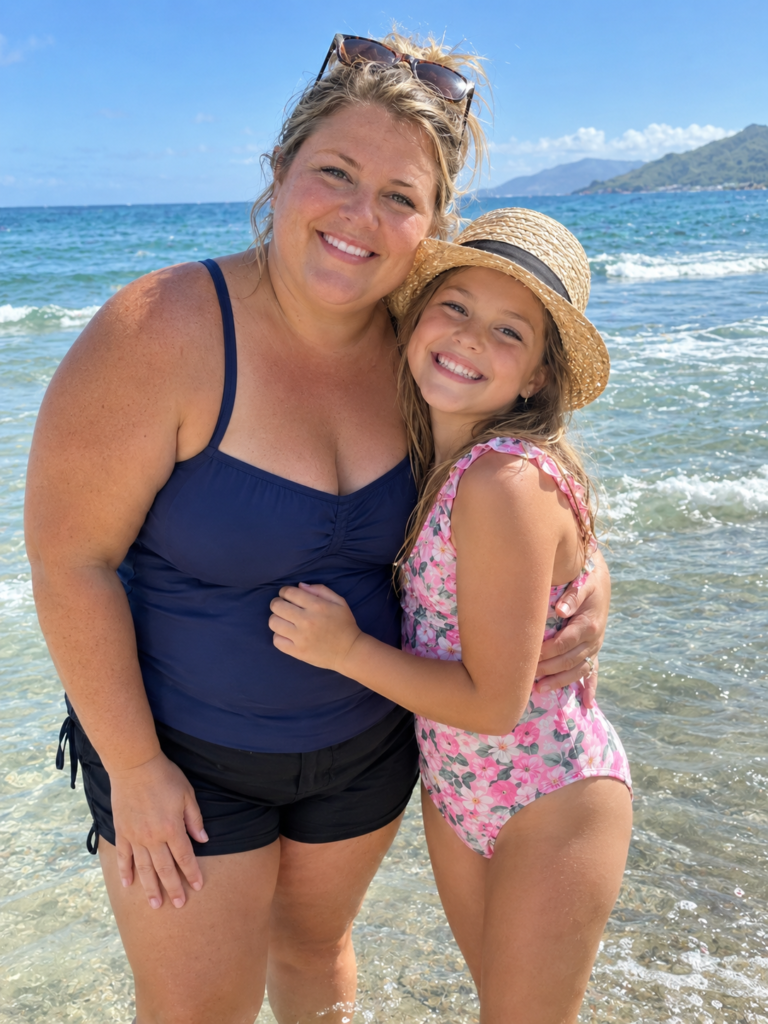
The beach was wide and pale and the ocean stretched to the horizon in the specific way that oceans do — you look at it and some part of you that is very old, older than language, simply recognizes something. Sophie stopped walking when she saw it. She stood at the edge of where the sand was hard and wet and the waves were coming in, and she stood there for a moment that felt complete in itself, like a breath held and then released.
Then she ran.
She ran toward the water the way children run when they are not thinking about their bodies but only about the thing ahead of them, and she splashed into the shallow edge of it with her sneakers already getting wet, and she laughed.
She laughed.
I heard her laugh, and I stood on the beach and I covered my mouth with my hand, and this time I did not prevent anything. I cried and I didn’t try to hide it, because there was no one to hide it from, and the sound of her laughter was big enough that it could hold my tears inside it.
We stayed until she was tired, which was later than I expected. We collected shells — she was very specific about which ones she wanted, examining each one with the attention of an appraiser, selecting four and rejecting six others with stated reasons. We let the waves come up to our ankles. She stood at the edge and looked out and asked me if I thought the mermaids lived far out where you couldn’t see.
I think they live exactly as far out as you imagine them, I said.
She considered this.
Then they live very far out, she said.
Then they live very far out.
We went back to the room.
We were changing for dinner.
There was a knock at the door.
The hotel manager was a man of about fifty named Mr. Caruso, with the bearing of someone who took his responsibilities seriously and was currently holding a box that he seemed to be carrying with a particular kind of care.
I’m sorry to disturb you, ma’am, he said. But there’s something you don’t know about this trip. He held out the box. I was asked to personally deliver this to you on your first day here.
Sophie was beside me, looking up at him with her serious eyes.
I had very specific written instructions, he said, about when it was supposed to be given to you.
I took the box.
It was not large — the size of a shoebox, heavier than I expected, wrapped in plain brown paper with my name written on the outside in handwriting I knew.
I knew the handwriting.
I looked at the box and I knew the handwriting and I could not immediately understand why I was looking at my father’s handwriting on the outside of a box that a hotel manager was telling me had been sent here with specific instructions, because my father was at home, my father was in his house three hours away by plane, my father had called me Thursday night to tell me to pack shoes I could get wet.
There’s a note inside, Mr. Caruso said. The person who sent it was quite specific about the order of things. He said you should read the note first.
I set the box on the table.
Sophie looked at it.
I opened it.
Inside, on top of everything else, was an envelope with my name on it.
I opened the envelope.
I unfolded the letter.
Dear Elena, it began. If you’re reading this, it means everything went as I planned, and you and Sophie made it to the ocean.
I read one line and I had to stop.
I read it again.
I’ve known for a few months that my heart is in worse shape than I’ve been telling you. The doctors say it’s a matter of when, not if. I didn’t want to tell you while you had Sophie’s situation to manage, and I didn’t want to give you one more thing to carry. That was selfish of me and I’m sorry for it.
I sat down on the edge of the bed.
I set this up three weeks ago. The hotel was arranged through a travel agent — I paid for the room and for the flights, and I contacted Mr. Caruso directly to explain the situation and ask him to hold this box for you. He was very kind about it. I think you’ve found good people.
Sophie had climbed up beside me on the bed. She was watching my face.
The box has some things in it that I want the two of you to have. Instructions for each one are inside.
I looked at the box.
I looked at the letter.
I know this is going to hurt. I know it’s the worst possible time, and I’m sorry for that. But I wanted you to be there — at the ocean, the place Sophie wanted to see — when you found out. Not because it will make it hurt less. But because I wanted her to see the ocean before she heard, and I wanted you to have seen her joy before you heard, so that you’d have that to hold.
I could not see the words clearly.
I love you more than I’ve known how to say. I love Sophie more than the Little Mermaid loves the ocean, and she’ll understand what that means.
Open the box with her. Do it together.
Love, Dad
I don’t know how long I sat there.
Sophie put her small hand on my arm.
Mommy?
I folded the letter. I put it in my pocket. I sat for a moment with my hand flat on the bed and I breathed in the way Dr. Reyes had taught Sophie to breathe when things were hard — slowly, from the bottom, counting the seconds.
Then I looked at my daughter.
Her eyes, so much older than her age. Her face, which already held the specific knowledge of a child who has lived close to hard things and has developed an early fluency in adult pain.
Mommy, did something happen to Grandpa?
She had read my face.
She had always been able to read my face.
Yes, sweetheart, I said.
She looked at the letter in my pocket.
Is he—
Yes.
She was very still.
I opened my arms and she came into them and I held her.
We sat like that for a while.
She did not make a sound.
After a long time, she lifted her head.
He sent us a box, she said. She was looking at it on the table.
Yes.
Before. She had understood the timeline. He sent it before.
Yes.
She looked at it.
He said he wanted us to open it together.
Yes.
She slid off the bed.
She walked to the table.
She put both her hands on the edge of the box and looked at it.
Okay, she said.
We opened it together.
I will tell you what was inside.
Not because the objects themselves are the point, though they are specific and they matter. Because they are evidence of something — of what it looks like when a person has thought, carefully and in full knowledge of his own mortality, about what he wants to leave behind and who he wants to leave it for.
On the top, under a card that said Open first, were two small notebooks. Mine was plain navy blue. Sophie’s was covered in seashells. My father’s handwriting was inside both of them — mine full of things he wanted to say to me that I’m not going to share here, because they belong to me, and Sophie’s full of things he wanted her to know, including a new fairy tale he had written himself, which was about a girl who goes to the ocean to find the mermaid she had always wanted to meet, and does.
She finds her? Sophie said, reading over the pages.
Read it and see, I said.
She read it slowly, with the focus of a child reading something important.
When she finished, she closed the book and held it against her chest.
He wrote it for me, she said.
Yes.
He knew he wasn’t going to be here to read it to me.
Yes.
She pressed the book tighter against her chest.
But it’s still him reading to me, she said. Even if he’s not here.
I could not speak for a moment.
Yes, I managed. That’s exactly right.
Under the notebooks was a small envelope containing two photographs. The first was of Sophie and my father, taken at the treatment center about three months before. She was in the reclining chair and he was beside her with the fairy tale book open, and they were both looking at the camera in the middle of the session, and they were both smiling — the specific smile of people interrupted mid-story who don’t mind the interruption.
The second photograph was of me as a child. I was perhaps seven, standing at the edge of a lake in summer, my shoes in my hand, laughing at something outside the frame. My mother was in the background, slightly blurred, and my father must have taken the photograph, because my father always took the photographs.
I had not seen this photograph in years.
I did not know he had kept it.
Under the photographs was a folded map.
It was a hand-drawn map — my father’s drafting was careful and clear, the skill of a man who had spent forty years in construction and knew how to communicate spatial information. It was a map of the beach area outside the hotel, and on it he had marked, with small handwritten notes, several things: a good spot for shell-collecting at low tide, a café that a friend of his had told him made exceptional coffee, a bench near the water that faced west for the sunset, and a small pier where, according to his note, the pelicans gather in the afternoon and are very large and will make Sophie laugh.
He planned where we would go, Sophie said, looking at the map.
Yes.
He didn’t know if he was going to be here. She traced one of the lines on the map with her finger. But he made us a map anyway.
Yes.
She looked at the pier he had marked.
Can we go see the pelicans?
Yes, I said. We can go tomorrow.
At the very bottom of the box, wrapped in tissue paper, was a small object. I unwrapped it carefully.
It was a snow globe.
But not the typical kind. Inside the glass was a little ocean scene — a beach, a wave, and a tiny figure of a girl standing at the water’s edge. The base was labeled, in small painted letters: Sophie at the ocean.
He had had it made.
He had commissioned it, or found it, or somehow arranged it — a snow globe with Sophie’s name and a scene of the exact wish she had expressed.
She picked it up.
She held it in both hands the way she held Captain in the story I read earlier — gently, with the full awareness of something precious.
He knew I was going to see the ocean, she said.
He knew.
And he made me this so I could always keep it.
Yes.
She shook the snow globe gently. The glitter inside moved like sea foam.
Even when we go home, she said. I’ll still have the ocean in this.
I pressed my lips together.
And the story he wrote you, I said.
And the story. She looked at the notebook. And the photographs. She looked at the envelope. And the map.
Yes.
She set the snow globe down carefully on the table.
She turned and looked at me.
He thought of everything, she said.
She said it with the specific serious wonder of someone encountering a thing they need to sit with.
He did, I said.
Because he loves us.
Yes.
Even when he wasn’t going to be here anymore. She was working through it, out loud, in the way she processed things. He was still going to love us. He just made it— She paused, looking for the word. Into things. He put his love into things so we’d have it.
I was crying.
I was not hiding it this time either.
Yes, I said. That’s exactly what he did.
She came back to me.
She put her arms around my neck and held on, and I held her back, and we stayed like that in the hotel room with the box on the table and the ocean audible through the window, the sound of it constant and indifferent and also, somehow, the sound of a man who had loved us and planned for us and made sure we had what we needed.
We stayed for four days.
We went to the pier on the second day, and the pelicans were exactly as my father had noted — very large, absurd in a wonderful way, completely unbothered by Sophie who stood at the railing and watched them with the intensity of a researcher. She laughed at them. I took photographs. I thought about my father watching her laugh in his mind when he had written that note on the map.
He had known she would laugh.
He had put it there for her to find.
We went to the café he had marked, which did in fact make exceptional coffee, and the woman behind the counter had a weathered face and kind eyes and she brought Sophie a small biscuit with her hot chocolate without being asked because she said Sophie looked like someone who had been doing important work and deserved a biscuit.
Sophie agreed with this assessment.
We sat at the table by the window and watched the street and Sophie ate her biscuit and read the fairy tale my father had written, and I drank my coffee and watched her, and I thought about love as a practice — not a feeling, not a noun, but a verb, a continuous action, the ongoing work of paying attention to another person and responding to what you see.
My father had been paying attention for six years.
He had been paying attention since the day Sophie was born and he had held her in his arms with those large, rough hands and she had looked at him with the unfocused seriousness of a newborn and he had said, very quietly, well, hello. He had been paying attention through the diagnosis and the treatments and the fairy tales and the handholding, and he had continued paying attention even when he was looking at his own ending, had turned that attention outward instead of inward, had used the limited time he had left to make sure we would have what we needed.
He had put his love into things.
So we’d have it.
On the third evening, I sat on the bench he had marked for the sunset.
Sophie was asleep in the hotel room — Mr. Caruso had offered to check on her, and I trusted him now in the way my father had trusted him, because he had proven himself trustworthy in the manner my father had predicted. I sat on the bench and watched the sun go down over the water, and the colors were the specific colors that sunsets over oceans are, which is to say unreasonable, more than you’d expect, the kind of colors that make you feel you’ve been given something you didn’t earn.
I held the snow globe in my lap.
I shook it once.
The glitter moved like sea foam.
I thought about Sophie at the water’s edge on the first afternoon, running toward it, laughing. I thought about the sound of her laugh and the way she had turned back to look at me, her face completely open, her eyes saying: look, Mom. Look at this. Look at what the world has in it.
She had run to the ocean.
My father had planned for her to run to the ocean.
He had planned for her to run and laugh and feel, for those minutes, exactly the thing a child should feel when they are six years old and have spent months in a treatment chair and have finally arrived at the thing they have been wanting — not the specific complicated feeling of a dying child at an ocean, but the simple uncomplicated feeling of a child at an ocean. Just that. Just the joy of it.
He had protected her right to that joy.
He had protected mine too.
He had waited until after — until after she had run and laughed and splashed and collected shells and stood at the water’s edge asking about mermaids — to let the harder thing arrive.
This is what he had written: I wanted you to have seen her joy before you heard, so that you’d have that to hold.
He had known that grief is easier when it arrives next to something beautiful.
He had arranged for the beauty to arrive first.
On the last morning, Sophie and I went to the beach before breakfast.
She carried the snow globe in both hands.
She walked to the edge where the waves came in, and she stood there, and she held the snow globe up against the horizon, so that the little ocean inside it was lined up with the real ocean beyond the glass.
Look, Mommy, she said. He gave me the ocean in two sizes.
I stood beside her.
He did, I said.
She shook it gently, watching the glitter move.
Do you think he can see it? she said.
I think he sees you, I said. I think he’s watching you hold it right now.
She thought about this.
I’m going to tell him what the pelicans looked like, she said.
Good idea.
He put them on the map but I don’t think he’d ever seen them either.
You’re probably right.
She looked at the snow globe again, then at the horizon.
I think he would have loved it here, she said.
I know he would have.
Can we come back someday?
I thought about this.
Yes, I said. Someday we’ll come back.
And we’ll bring the map.
And we’ll bring the map.
She lowered the snow globe and held it in both hands again, looking at the small figure inside it — the tiny girl at the water’s edge.
He put me in it, she said.
Yes.
He thought about what I’d look like here, at the ocean. And he put me in it. She turned it over, looking at the base with Sophie’s name painted in small letters. He imagined me here before I got here.
Yes, I said. He loved you like that. He paid that much attention.
She was quiet.
Then: I’m going to pay attention to you like that.
I looked at her.
For the rest of my life, she said, very seriously, I’m going to notice things about you and remember them. So I can put them into things later. So you’ll have it.
I crouched down to her level.
She looked at me with her old eyes in her child’s face.
Okay, I said.
Okay, she said.
We stayed until the tide started coming in.
I need to tell you what happened after.
Not the funeral — though my father’s funeral was attended by people who each had their own version of the story of his hands, the ways they had fixed things and held things and built things. Not the first months without him — though those were hard in the specific way of hard things that don’t announce themselves in advance but simply are there each morning when you wake up.
What I need to tell you is what happened two years later.
Sophie had been doing a school project about important people in her life. She was eight. She was still receiving treatment, still in the cautious, ongoing negotiation with her illness that Dr. Reyes managed with the specific precision of someone who had committed to the long game.
She came home and told me she had been working on the project for two weeks.
She had told me it was about Grandpa.
She handed it to me.
It was a small book she had made herself, with construction paper covers and pages that she had filled in her careful eight-year-old handwriting, illustrated with drawings in crayon and pencil. The book was titled: What My Grandpa Put Into Things.
Inside, she had documented every item from the box.
The notebooks, photographed and described. The photographs, described. The map, traced and annotated with notes about where they had gone and what they had found. The snow globe, photographed from every angle.
And then, at the end, a section I had not expected:
What He Taught Me About Love.
She had written, in her careful handwriting:
My grandpa knew he was going to die. He didn’t want to tell us because he didn’t want us to be sad when we were already sad. So instead of telling us, he planned things. He thought about what we would need and he made sure we would have it. He put his love into a box and made sure the box would find us.
I think that’s what love is. It’s not just a feeling. It’s paying attention to someone and thinking about what they need and then doing something about it. Even when it’s hard. Even when you won’t be there to see it work.
My grandpa won’t be at my birthday parties anymore. But he taught me how to love. So he’ll be there in the way I love people. That’s what he left me.
I sat at the kitchen table and read my daughter’s project.
She was eight years old.
She had understood something I was still working to understand.
The snow globe is on her nightstand.
It has been there since we came home from the trip, and it has moved with us once, to a slightly larger apartment, and it sat in the same position on her new nightstand within twenty-four hours of us arriving.
She shakes it sometimes when she’s thinking.
I see her do it and I know she’s having a particular kind of thought — the ones about the people who are not here, the ones about continuity, the ones about what love looks like when it keeps going after the person has stopped.
The map is framed on the wall of her room.
The fairy tale book is on her shelf, read many times now, the spine slightly worn.
The notebook he wrote to her is kept in a box that she considers important — the box holds other things she considers important, and the notebook lives there alongside them.
She has read it to me twice. On both occasions, she read it the way my father read the fairy tales: slowly, deliberately, with the voice of someone who understands that the story is not just the words.
I will tell you the last thing.
On Sophie’s most recent birthday, she asked if we could go back to the ocean.
I said yes.
We booked the same hotel.
Mr. Caruso was still there. He remembered us. He greeted Sophie by name and she shook his hand with her serious eyes and told him she had come back because her grandpa’s map still had places on it they hadn’t visited yet.
He said he thought that was exactly right.
We took the map.
We found two places on it we hadn’t been to — a tidal pool area with small crabs and anemones that my father had heard about from the same friend who had recommended the café, and a lookout point about a mile up the coast where, he had noted, you can see very far, and feeling small is sometimes useful.
We went to the tidal pool and Sophie looked at the crabs with the intensity of someone making important notes.
We went to the lookout point in the late afternoon.
We stood there together and looked out at the water, which stretched to the horizon and kept going past it, as oceans do.
Sophie had the snow globe in her jacket pocket. She took it out and held it up.
Hi, Grandpa, she said. We followed your map.
The wind moved around us.
The ocean made its sound.
The crabs were smaller than I expected, she said to the horizon. But there were more of them. I think you would have liked them.
She held the snow globe up against the sky.
The little girl inside it was still standing at the water’s edge, the same as she had always been, doing what she had always been doing.
Thank you, Sophie said, to the ocean, to the sky, to the man who had thought about what she would need and made sure she had it.
She put the snow globe back in her pocket.
She took my hand.
We stood there for a while, feeling appropriately small, the way he had thought we might.
Then Sophie looked up at me with her old eyes.
He thought of everything, she said again. The same words as the hotel room on the first day. The same wonder in them.
He did, I said.
Because he loves us.
Not loved. Loves.
She was right about that too.
Some love is past tense.
The love he put into things keeps going.
We walked back down the cliff path as the sun was getting low, two figures on a coast, following a map that a man had drawn for us so we would know where to look.
The snow globe is on Sophie’s nightstand.
She shakes it sometimes when she’s thinking.
The fairy tale still ends the same way.
The girl finds the mermaid.
The ocean keeps going.