Nathan Reed walked through the doors.
And three hundred people forgot how to breathe.
He wore a black tuxedo so precisely tailored that it made every expensive suit in the ballroom look rented. No tie. No unnecessary jewelry. No smile.
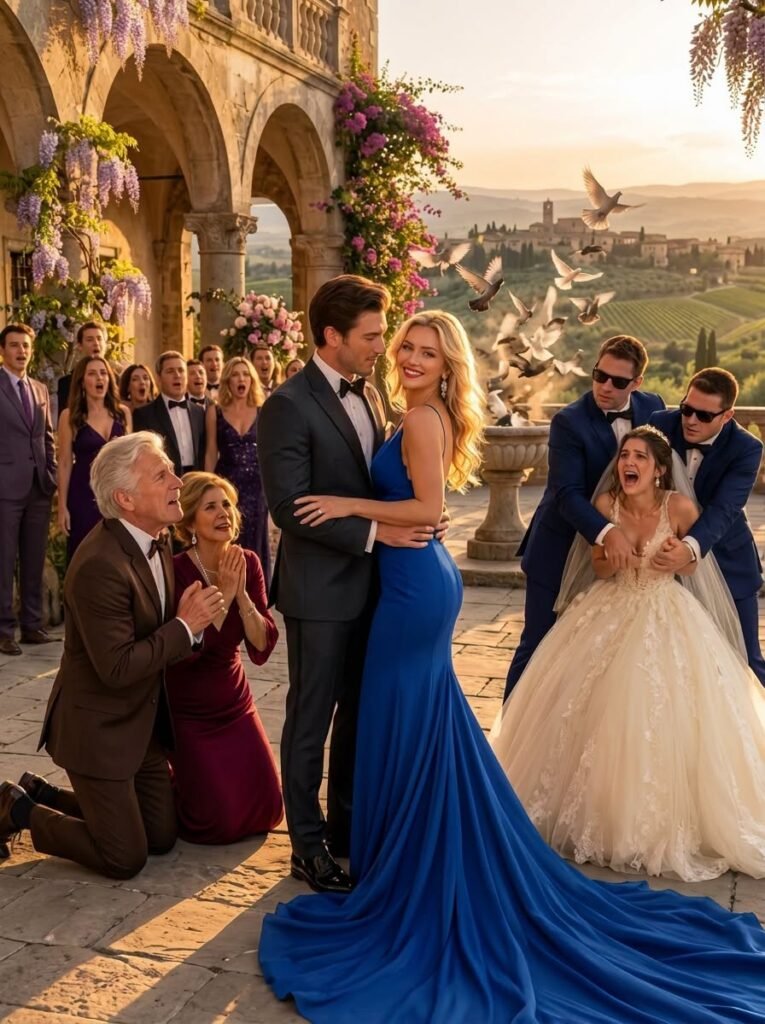
He didn’t need any of it.
Nathan Reed had the kind of face people recognized before they could remember where they had seen it.
Financial magazines.
Television interviews.
Photographs taken outside congressional hearings.
Business covers with headlines about hostile acquisitions, collapsing competitors, and deals worth more than the economies of small countries.
Reed Global.
Private aviation.
Cybersecurity.
Commercial real estate.
Biotechnology.
Defense contracts.
Hotels.
Banking.
Nathan Reed wasn’t merely wealthy.
He was the man other billionaires called when they were about to lose everything.
My father’s pointing hand slowly lowered.
My mother’s mouth fell open.
Allison’s smile disappeared.
And Nathan looked at none of them.
His eyes found me immediately.
The moment he saw the wine soaking my dress, something changed in his expression.
Not shock.
Not confusion.
Rage.
Controlled rage.
The most dangerous kind.
He crossed the ballroom without hurrying.
Nobody tried to stop him.
Nobody even moved.
When he reached me, Nathan slipped off his tuxedo jacket and placed it gently around my shoulders.
His fingers brushed my cheek.
“Are you hurt?”
The question was quiet.
That made it worse.
“No.”
His gaze dropped to the red stain running down the front of my gown.
“Did someone touch you?”
I glanced at the waiter.
Nathan followed my eyes.
The waiter turned white.
My father finally recovered enough to speak.
“Mr. Reed.”
Nathan ignored him.
Robert stepped closer.
“Mr. Reed, I’m Robert Whitmore. I’m the father of the bride. There seems to have been some kind of misunderstanding.”
Nathan continued looking at me.
“Meredith.”
“I’m fine.”
“Did he touch you?”
My father’s face tightened.
“I beg your pardon?”
I looked at Nathan.
“He was about to.”
Every trace of softness left my husband’s face.
He turned.
My father actually stepped backward.
It was almost funny.
Robert Whitmore had spent my entire childhood making other people shrink.
Employees.
Waiters.
My mother.
Me.
Especially me.
But Nathan Reed looked at him the way a surgeon looked at an infected organ.
Something that might have to be removed.
“You raised your hand to my wife?”
The words traveled across the ballroom like a blade.
Silence.
Then Tiffany whispered much too loudly,
“Wife?”
My mother grabbed the edge of the table.
Allison stared at me.
Her new husband, Andrew Mercer, slowly turned his head toward her.
My father blinked.
“Your… wife?”
Nathan reached for my left hand.
I had removed my wedding ring before entering the venue.
Not because I was ashamed.
Because I knew my family.
Three years earlier, Nathan and I had married privately in a chapel outside Geneva with twelve people present.
No newspapers.
No announcement.
No public photographs.
Nathan valued privacy.
I valued peace.
Most of the world knew that Nathan Reed was married.
Almost nobody knew to whom.
We had worked very hard to keep it that way.
Until tonight.
Nathan slid his hand into his trouser pocket.
Then he took out a narrow platinum band set with a single flawless diamond.
My ring.
He had kept it for me because I had been afraid my family would notice.
He placed it on my finger.
Gasps spread through the room.
Nathan raised my hand and kissed my knuckles.
“Yes,” he said.
“My wife.”
My mother made a strange choking sound.
Allison rose so quickly that her chair nearly fell backward.
“That’s impossible.”
I looked at her.
“Why?”
She opened her mouth.
Nothing came out.
Nathan finally gave her his attention.
“You must be Allison.”
She swallowed.
“Yes.”
“The bride.”
“Yes.”
“My condolences.”
Andrew coughed into his fist.
A few guests looked down to hide smiles.
Allison’s face turned crimson.
My father stepped between us.
“This is ridiculous. Meredith has been working as an administrative coordinator for years.”
I almost laughed.
Nathan did not.
“She is chief strategy officer of Reed North Atlantic Holdings.”
My father stared at him.
The room erupted in whispers.
I watched the realization move across his face.
Slowly.
Painfully.
The “dead-end office position” he had mocked for years was the cover title I had given my family because every time I had ever succeeded, they found a way to take it.
When I graduated from Harvard, my mother said I had benefited from affirmative recruiting.
When I earned my MBA, Robert said business schools were becoming easier.
When I joined a private equity firm, Allison told everyone I was probably a secretary.
So I stopped explaining.
I let them believe whatever made them comfortable.
Nathan continued.
“Meredith manages more capital before breakfast than most of the people in this room will see in their lifetimes.”
The laughter from earlier was completely gone now.
My father looked around as though hoping someone might rescue him.
No one did.
Then my mother found her voice.
“You kept this from us?”
I met her eyes.
“Yes.”
“You let your own family think you were struggling?”
“You never asked if I was struggling.”
I paused.
“You just enjoyed believing I was.”
Her expression hardened.
“That is not true.”
“Really?”
I turned toward the room.
“Should we ask them?”
My father snapped,
“That is enough.”
“No, Robert.”
Nathan’s voice cut through his.
“It isn’t.”
One of the men in dark suits approached him and whispered something.
Nathan listened.
Then his eyes moved toward the waiter.
“Bring him here.”
The waiter panicked.
“No.”
He stepped back.
“I didn’t do anything.”
Two security men moved toward him.
“I said it was an accident!”
I pulled Nathan’s sleeve.
“Don’t frighten him.”
Nathan looked at me.
“He poured wine over you.”
“He was told to.”
The waiter froze.
Allison stopped breathing.
I had seen it.
Not the impact.
Before that.
When I entered the ballroom, Allison had leaned toward the catering manager.
The manager had looked toward me.
Then toward the waiter.
Then money changed hands beneath a folded napkin.
I hadn’t been certain.
Until the waiter hit me with his shoulder so hard it almost knocked me down.
Nathan turned to him.
“Who told you?”
The waiter looked toward my sister.
Allison immediately shouted,
“Don’t look at me!”
That was all the answer anyone needed.
Andrew stared at her.
“Allison.”
She spun toward him.
“Oh, please. It was a joke.”
“A joke?”
“She always makes everything about herself.”
I laughed once.
Quietly.
That made her angrier.
“You came here wearing that ridiculous dress.”
“My dress offended you?”
“You knew photographers were coming.”
“It’s silver.”
“It’s attention-seeking.”
“You’re wearing a cathedral veil with seven thousand hand-sewn crystals.”
A few people laughed.
Allison’s eyes filled with hatred.
“You always do this.”
“Do what?”
“Act superior.”
I tilted my head.
“It was wine!”
“And when we were sixteen, you cut my prom dress with scissors.”
The room went silent again.
My mother’s face changed.
I continued.
“When I was nineteen, you deleted the email offering me a summer internship in London.”
Allison’s lips parted.
“When I was twenty-two, you told our relatives I had cheated my way into Harvard.”
“That was a misunderstanding.”
“And when Grandmother left me her emerald necklace, you told Mom I had stolen it.”
My mother whispered,
“You said Meredith admitted it.”
“I never admitted anything.”
I looked at her.
“You sold the necklace.”
My mother went pale.
My father turned sharply.
“What?”
There.
That was new.
Even Robert hadn’t known.
My mother’s eyes darted away.
Nathan looked at me.
I shook my head.
“Later.”
But the night wasn’t finished with them.
Not even close.
Because the doors opened again.
This time, three people entered.
A woman carrying a leather portfolio.
A middle-aged man with silver hair.
And the general manager of the Fairmont.
My father frowned.
“Who are they?”
Nathan’s mouth barely moved.
“Consequences.”
The silver-haired man approached.
“Mr. Reed.”
“David.”
He turned toward my father.
“Robert Whitmore?”
“Yes.”
“My name is David Klein. I represent Hawthorne Capital.”
My father’s expression changed instantly.
Hawthorne Capital financed Whitmore Development.
Or more accurately, it kept Whitmore Development alive.
My father’s company had spent the last five years expanding too aggressively.
Boston.
Providence.
Hartford.
Two luxury residential projects in Manhattan.
One disastrous waterfront development outside Baltimore.
Robert pretended everything was thriving.
I knew better.
I had seen the debt reports.
Not because I was spying.
Because six months earlier, his largest lender quietly approached Reed North Atlantic Holdings about purchasing part of its loan portfolio.
I had refused to interfere.
My family was cruel.
But I had no desire to destroy them.
Tonight changed that.
David opened his portfolio.
“As of seven forty-two this evening, Hawthorne Capital has transferred its senior debt position in Whitmore Development.”
Robert’s face drained of color.
“To whom?”
David looked at Nathan.
Nobody needed the answer.
My father whispered,
“No.”
Nathan said nothing.
Robert turned to me.
“You did this?”
“No.”
He looked relieved for half a second.
Then I added,
“I told Nathan not to do it six months ago.”
Nathan glanced at me.
“You told me not to interfere while they left you alone.”
His eyes returned to Robert.
“They failed to honor the condition.”
My mother gripped my father’s arm.
“What does that mean?”
Robert didn’t answer.
He understood perfectly.
Nathan now controlled the debt against his company.
Tens of millions.
Cross-default provisions.
Personal guarantees.
Real estate collateral.
The machinery that had allowed Robert Whitmore to posture as Boston royalty was suddenly sitting in my husband’s hand.
My father stepped closer to Nathan.
“Business is business. Whatever happened tonight has nothing to do with Whitmore Development.”
Nathan’s expression remained calm.
“I agree.”
Robert blinked.
“I will not call your loans because you humiliated my wife.”
Relief flashed through my father’s eyes.
Then Nathan finished.
“I will call them because your company breached three lending covenants last quarter, concealed a material construction delay, and submitted inflated occupancy projections to Hawthorne.”
My father stopped moving.
Now I was surprised.
I looked at Nathan.
He leaned toward me.
“Found it this afternoon.”
Robert’s voice cracked.
“That is confidential information.”
David Klein replied.
“It is information supplied by your own financial officers.”
My father’s breathing changed.
My mother whispered,
“Robert?”
He ignored her.
“Those projections were preliminary.”
“They were represented as final,” David said.
My father looked at Nathan.
“We can fix this.”
“Perhaps.”
Nathan’s eyes moved toward me.
“But you will not discuss it with me tonight.”
Robert followed his gaze.
And for the first time in my life, my father looked at me not as a disappointment.
Not as an inconvenience.
Not as the daughter he could dismiss.
He looked at me as someone holding a key to his future.
“Meredith.”
I hated the way he said my name.
Soft now.
Almost fatherly.
I had waited thirty-two years to hear that tone.
It meant nothing.
He approached me.
“Whatever disagreements we’ve had—”
“Disagreements?”
My voice remained low.
“You hired someone to humiliate me at your daughter’s wedding.”
“I didn’t hire the waiter.”
“Allison did.”
“I didn’t know.”
“But you took the microphone.”
His face tightened.
“You called me pathetic.”
He opened his mouth.
“You called me a spinster.”
His eyes dropped toward my wedding ring.
“You mocked my career.”
Silence.
“And then you tried to throw me out.”
My mother interrupted.
“Meredith, families say things in anger.”
I looked at her.
“You called me pathetic too.”
She flinched.
“I was upset.”
“At what?”
She couldn’t answer.
“At what, Mom?”
Her eyes filled with tears.
I felt nothing.
“You were angry because I didn’t fail.”
That hit harder than shouting could have.
Allison suddenly pushed away from the table.
“This is insane!”
Every head turned toward her.
“It’s my wedding!”
Andrew closed his eyes.
“Allison, stop.”
“No!”
She pointed at me.
“She does this every time. Everything becomes about Meredith!”
I stared at her.
“You arranged the entire humiliation.”
“Because you deserved it!”
Andrew slowly turned.
“Allison.”
She was too furious to stop.
“She has always looked down on us! She walks around acting like she’s better than everyone!”
“I sat at Table 19.”
“You chose that dress!”
“You assigned the table.”
“You could have worn something normal!”
“And then what?”
I took a step toward her.
“If I wore a cheaper dress, would you love me?”
She said nothing.
“If I arrived alone and miserable, would you love me?”
Nothing.
“If I had a worse job than you, a smaller apartment than you, less money than you, would you finally be kind to me?”
Her chin trembled.
And suddenly I understood.
This had never been about me winning.
It was about her needing me to lose.
I lowered my voice.
“There was never a version of my life small enough to make you feel secure.”
Allison’s face collapsed.
But only for a second.
Then anger returned.
“You think you’re so perfect because you married him?”
“No.”
I looked at Nathan.
“I married him because he was the first person in my life who never asked me to become smaller so he could feel taller.”
Nathan’s jaw tightened.
Andrew looked at Allison.
Something inside him seemed to break.
He removed his wedding ring.
Allison noticed.
“What are you doing?”
He placed it on the table.
Her eyes widened.
“Andrew.”
“I asked you three times why Meredith was sitting by the kitchen.”
“You said it was a seating mistake.”
“It was.”
“No.”
He shook his head.
“You lied.”
“That doesn’t mean anything.”
“You paid a waiter to dump wine on your sister.”
“It was supposed to be funny.”
“You laughed when your father called her pathetic.”
“So did everyone!”
Andrew looked around the ballroom.
“No.”
His voice became quiet.
“Not everyone.”
Several guests looked away.
He continued.
“My parents didn’t.”
A gray-haired couple at the next table remained stone-faced.
“My brothers didn’t.”
Two younger men looked disgusted.
“And I didn’t.”
Allison grabbed his arm.
“Please.”
He pulled away.
“Do you know what scares me?”
Her eyes filled.
“Today was supposed to be the happiest day of your life.”
He looked at me.
“And humiliating your sister was still important enough to plan.”
Allison’s lips trembled.
“Andrew…”
“I need air.”
He walked away.
Allison followed him.
My mother tried to stop her.
“Allison!”
But she was already disappearing through the side doors.
For the first time all night, I felt exhausted.
The adrenaline drained from my body.
My dress was cold against my skin.
The ballroom smelled of wine, roses, and expensive perfume.
Nathan noticed immediately.
He always did.
“We’re leaving.”
My father stepped in front of us.
“No.”
Nathan looked at him.
Robert corrected himself.
“Please.”
The word seemed physically painful.
“Meredith, please.”
I waited.
He glanced toward the guests.
Of course.
Even now, the audience mattered.
“Can we discuss this privately?”
“No.”
His shoulders stiffened.
“Meredith.”
“Everything you wanted to say to me was public.”
I gestured toward the ballroom.
“So anything you need to say now can be public too.”
His face darkened.
For one dangerous second, the old Robert returned.
Then he remembered Nathan.
He swallowed it.
“I was wrong.”
It was the first time I had ever heard those words from my father.
They should have meant something.
They didn’t.
“I have been hard on you.”
I almost smiled.
“You enjoyed hurting me.”
His eyes flickered.
“No.”
“You did.”
“Meredith.”
“You enjoyed having one daughter you could praise and one you could punish.”
My mother began crying.
I looked at her.
“And you let him.”
“I tried to keep this family together.”
“No.”
My voice sharpened.
“You kept yourself comfortable.”
She stared at me.
“You watched him destroy my self-confidence for years because challenging him would have made your life harder.”
“That is unfair.”
“Was it unfair when he refused to attend my Harvard graduation because Allison had a dance recital?”
My father’s jaw clenched.
“Was it unfair when you returned my graduation gift because Allison said hers wasn’t as expensive?”
My mother whispered,
“I don’t remember that.”
“I do.”
My voice cracked for the first time.
And I hated that.
But I continued.
“I remember every birthday where Allison got twice as much because she was younger.”
“I remember being told not to celebrate promotions around her.”
“I remember you asking me to lie about my salary.”
“I remember Dad telling me no man would tolerate an ambitious woman.”
My father looked away.
“And when I finally found someone who loved me exactly as I was, I hid him from you.”
I touched my wedding ring.
“Do you understand how humiliating that is?”
Neither of them spoke.
“I wasn’t ashamed of Nathan.”
I looked at them.
“I was ashamed of what you would do if you knew I was happy.”
That landed.
My mother covered her mouth.
Robert’s face changed.
For perhaps the first time, he looked old.
Not powerful.
Not terrifying.
Just old.
Nathan slid his hand into mine.
“We should go.”
I nodded.
But then the woman carrying the leather portfolio stepped forward.
“Mrs. Reed?”
I looked at her.
“Yes?”
She handed me a sealed envelope.
“This came from the Whitmore family attorney forty minutes ago.”
My father turned.
“What?”
The woman introduced herself.
“Claire Donovan. General counsel for Reed North Atlantic.”
My father looked at the envelope.
“What family attorney?”
Claire answered.
“Samuel Price.”
My mother went pale.
I noticed.
So did Nathan.
I slowly opened the envelope.
Inside was a letter.
And a copy of a trust document.
At the top was my grandmother’s name.
Eleanor Whitmore.
My mother whispered,
“Meredith, don’t.”
I looked at her.
That was exactly the wrong thing to say.
I began reading.
The Whitmore family’s Beacon Hill residence.
A lake property in Vermont.
A portfolio of municipal bonds.
And shares in the original family holding company.
All had been placed into a trust when my grandmother died eleven years earlier.
I had been told Allison was the primary beneficiary.
That was not true.
I was.
My grandmother had left me fifty-one percent controlling interest.
I stared at the document.
“This can’t be right.”
Claire replied,
“It is.”
My father looked furious.
“That trust was amended.”
“No,” Claire said.
“An amendment was drafted.”
She opened her portfolio.
“It was never executed by Eleanor Whitmore.”
My mother’s face had gone completely white.
I looked at her.
“What did you do?”
“Nothing.”
“Mom.”
“It was supposed to be fixed.”
My father turned to her.
“What was supposed to be fixed?”
She began shaking.
My heart pounded.
Nathan moved closer beside me.
My mother looked toward the doors as if considering escape.
Claire continued.
“After Mrs. Whitmore’s death, instructions were provided to Mr. Price’s office indicating that Meredith had disclaimed her interest in favor of Allison.”
I stared at her.
“I never signed anything.”
“We know.”
The ballroom became so quiet I could hear the kitchen doors swinging behind me.
Claire looked at my mother.
“The disclaimer signature appears inconsistent with Mrs. Reed’s verified signatures.”
My father’s voice dropped.
“Catherine.”
My mother began crying harder.
“It was your mother’s fault.”
Nobody moved.
“She always favored Meredith.”
I felt as if the floor had shifted beneath me.
My mother continued.
“She said Meredith was the only one responsible enough to protect the family assets. Do you know what that did to Allison?”
I almost couldn’t speak.
“So you forged my name?”
“I was protecting your sister!”
My father stared at her.
“You forged legal documents?”
“It was supposed to be temporary.”
“For eleven years?”
She snapped toward him.
“Don’t you dare judge me! You were thrilled when Allison got the house!”
Robert froze.
And there it was.
He had known enough not to ask questions.
Maybe not the forgery.
But the outcome.
The favoritism.
The theft.
It had benefited the daughter he preferred.
So he had accepted it.
My hands were trembling now.
Nathan took the papers from me.
He read quickly.
His face became frighteningly calm.
“Claire.”
“Yes?”
“Preserve everything.”
My mother panicked.
“What does that mean?”
“It means nobody destroys a document, email, computer, phone, or financial record connected to this trust.”
“This is a family matter.”
Nathan looked at her.
“No.”
His voice was almost gentle.
“Forgery involving a trust worth approximately eighteen million dollars is not merely a family matter.”
Allison reentered the ballroom at that exact moment.
She had been crying.
Andrew was not with her.
“What happened?”
No one answered.
She looked from my mother to me.
Then to the papers.
“What?”
I held up the trust.
“Grandmother left me the Beacon Hill house.”
Allison stared.
“And the Vermont property.”
Her face changed.
“And controlling interest in Whitmore Family Holdings.”
She looked at our mother.
“Mom?”
Catherine collapsed into a chair.
Allison understood.
Slowly.
“No.”
I watched her.
For once, she wasn’t acting.
“You told me Grandma changed it.”
My mother began sobbing.
“I was trying to protect you.”
Allison stepped backward.
“You told me Meredith rejected the inheritance.”
“I didn’t want you to feel second best.”
“I wasn’t second best.”
Her voice cracked.
“You made me think she gave it to me.”
My mother said nothing.
Allison looked at me.
Then at the ballroom.
Then at the flowers.
The ice sculptures.
The imported champagne.
The string orchestra.
The wedding.
I realized before she did.
Much of it had been paid for using distributions from assets that should have belonged to me.
Her face crumpled.
“Oh my God.”
My father sank into a chair.
And suddenly all the cruelty in the room felt smaller than the truth underneath it.
This family had spent years building a hierarchy.
Allison above me.
Me beneath everyone.
And now we were discovering that hierarchy had required lies, forged signatures, stolen money, and constant manipulation to survive.
Allison looked at me.
For the first time in my life, there was no contempt in her eyes.
Only horror.
“I didn’t know.”
I believed her.
That surprised me.
She had known about the waiter.
She had planned the humiliation.
She had been cruel.
But this?
No.
She hadn’t known.
“I believe you,” I said.
My mother looked up hopefully.
“Then we can fix this.”
I stared at her.
“No.”
Her hope vanished.
“I can believe Allison didn’t know and still refuse to excuse what she did tonight.”
Allison lowered her head.
I continued.
“And I can understand that you were afraid she would feel less loved without forgiving you for stealing from me.”
My mother began to speak.
I raised one hand.
“No.”
She stopped.
“This is the last time you get to explain my pain back to me as if it was necessary.”
She started crying again.
I felt strangely calm.
The anger was leaving.
Not because I forgave them.
Because I finally understood I didn’t need anything from them anymore.
Not an apology.
Not approval.
Not recognition.
Nothing.
Nathan looked at me.
“Ready?”
“Yes.”
We began walking toward the doors.
Then my father called my name.
I stopped.
He stood alone beside the head table.
The great Robert Whitmore.
His company in danger.
His wife exposed.
His daughter’s marriage possibly over.
Three hundred guests watching.
He looked smaller than I had ever seen him.
“Meredith.”
I waited.
“I am sorry.”
No excuse.
No explanation.
Just four words.
I studied him for a long moment.
Then I nodded once.
“I hope someday you become the kind of man who means that.”
And I walked away.
Nathan and I reached the ballroom entrance.
Behind us, the wedding reception dissolved into whispers and crying.
Outside, rain had begun falling across Boston.
Nathan’s car waited beneath the awning.
Before we stepped outside, I stopped.
“My dress is ruined.”
He looked down at it.
“It is.”
“It cost twenty-eight thousand dollars.”
“Thirty-four.”
I blinked.
“What?”
“You never saw the final alterations invoice.”
Despite everything, I laughed.
A real laugh.
Nathan smiled.
“There she is.”
I leaned into him.
For a moment, I simply stood there wrapped in his jacket.
Then I looked back through the ballroom doors.
Allison sat alone at the head table.
My mother had disappeared.
My father stood speaking with David Klein.
Guests were leaving.
The magnificent wedding had collapsed in less than one hour.
Nathan followed my gaze.
“Do you want me to accelerate the loans?”
I thought about it.
The old version of me might have said yes.
The wounded girl.
The girl sitting alone while her sister received applause.
The girl being told not to dream too loudly.
The girl who had just stood beneath three hundred laughing faces soaked in red wine.
That girl wanted revenge.
But I wasn’t her anymore.
“No.”
Nathan studied me.
“No?”
“Review the company normally.”
“If it defaults?”
“Then act.”
“And if it can survive?”
“Let it.”
His eyes softened.
“You are kinder than they deserve.”
“No.”
I looked back at the ballroom one final time.
“I’m just done letting them decide who I become.”
We stepped into the rain.
Three months later, Whitmore Development survived.
Barely.
My father sold two luxury projects, cut his personal spending, and resigned as chief executive under pressure from his board.
He did not lose everything.
But he lost the thing he valued most.
Control.
My mother was formally investigated over the forged trust documents.
I declined to pursue every possible civil claim, but the trust assets were restored to me.
The Beacon Hill house became mine.
I sold it.
I had no interest in living inside a monument to people who had taught me love was something you earned by making yourself smaller.
Half of the proceeds went into a foundation supporting young women from financially controlling households who needed legal and educational assistance.
The other half stayed invested.
Grandmother would have approved of both.
As for Allison?
Andrew postponed filing an annulment.
He didn’t return to her immediately either.
They entered counseling.
For six weeks, Allison did not contact me.
Then one morning, a letter arrived.
Not a text.
Not an email.
A handwritten letter.
Six pages.
She apologized for the wedding.
The waiter.
The dress.
The years of competition.
The prom incident.
The internship email.
Things I had forgotten.
Things I had not.
She did not ask me to forgive her.
That was why I answered.
We were not sisters again overnight.
Maybe we never would be in the way people imagined sisters should be.
But we started with coffee.
Forty minutes.
Neutral territory.
No parents.
No husbands.
No pretending.
It was enough.
My father called every Sunday for two months.
I answered none of those calls.
Then one evening he left a voicemail.
He did not ask for money.
He did not mention the company.
He did not blame my mother.
He simply said,
“I spent your entire childhood confusing obedience with love. I don’t expect you to forgive me. I only wanted you to know that I finally understand the difference.”
I saved the message.
I did not call him back.
Not yet.
Perhaps someday.
Perhaps not.
Healing was not a debt I owed him.
Six months after the wedding, Nathan and I attended a charity gala in New York.
For the first time, we appeared publicly as husband and wife.
No secrecy.
No hidden ring.
No invented job title.
I wore another silk gown.
Deep green this time.
Nathan looked at it suspiciously.
“Should I have security inspect the wine?”
I laughed.
“Probably.”
We entered the ballroom together.
Photographers shouted my name.
Not his.
Mine.
Meredith Reed.
Chief Strategy Officer.
Investor.
Foundation chair.
Wife.
Daughter.
Sister.
And finally, simply myself.
Halfway through the evening, Nathan leaned close.
“You know what I thought when I walked into that wedding?”
“What?”
“I thought I was going to destroy everyone who made you cry.”
I smiled.
“But I didn’t cry.”
“I know.”
He took my hand.
“That scared me more.”
I looked across the glittering room and remembered Table 19.
The swinging kitchen doors.
The laughter.
The red wine dripping from my hair.
My father’s voice telling three hundred people I was pathetic.
For years, I had believed the opposite of humiliation was revenge.
It wasn’t.
The opposite of humiliation was freedom.
Freedom was knowing the people who tried to reduce you no longer had the authority to define you.
Freedom was being able to leave without begging anyone to understand why.
Freedom was learning that sometimes the most powerful thing you can do when someone pours an entire tray of red wine over you in front of three hundred people…
is wipe your face,
make one call,
and let the truth walk through the door.