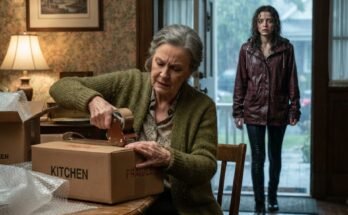
The nurse rotated the old chart toward me and pressed one finger beneath the name signed at the bottom.
I knew the handwriting before she said anything.
Chris.
For six years, I had lived with his version of that night following me everywhere.
I had been tired.
I had been overwhelmed.
I had supposedly mixed up our baby’s medicine, made an unforgivable mistake, and then been too devastated to explain myself clearly.
That was the story Chris gave the hospital.
That was the story he gave our families.
That was the story people remembered after he walked away from me and Julian.
But the medication entry in front of me did not fit that story.
The nurse did not turn it into a dramatic accusation, and she did not claim one old page could explain everything that had happened six years earlier.
She simply pointed out what the record actually showed.
There was an entry connected to our daughter’s medication that did not match the timeline Chris had repeated for years, and his signature was attached to it.
My hands started shaking.
Not because I suddenly understood every detail.
Because for the first time, there was something outside my memory proving that his story had never been as clean as he made it sound.
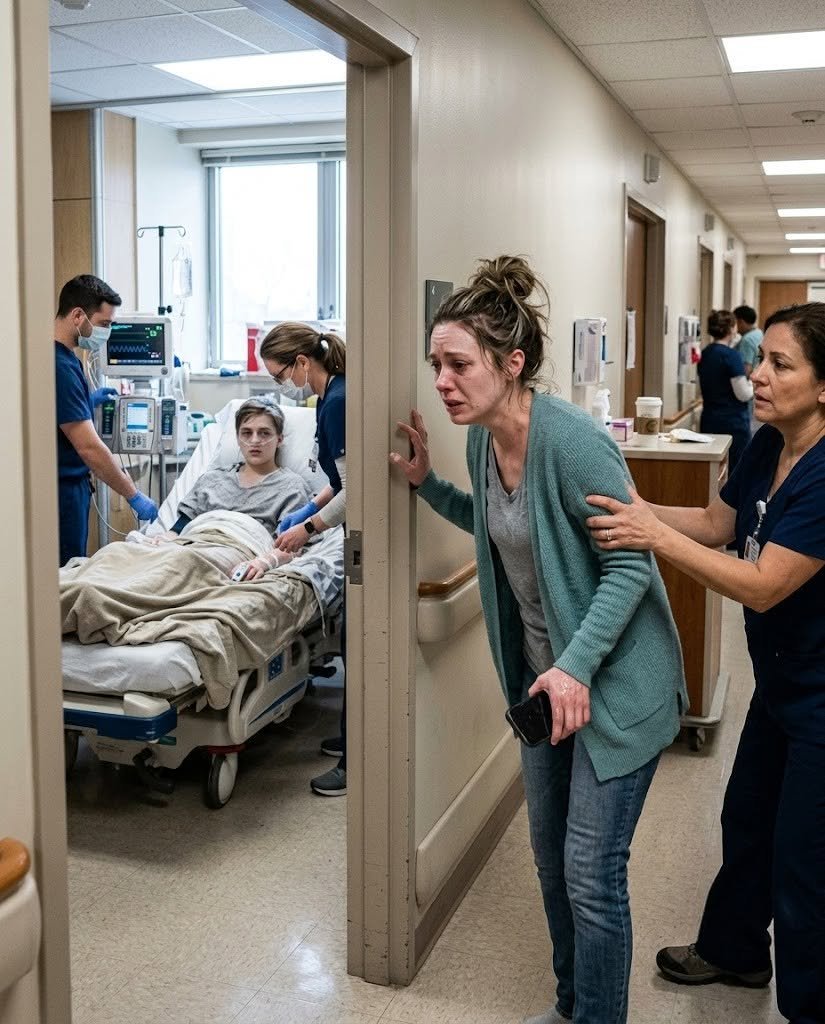
I looked through the glass toward Julian’s room.
He was still pale against the hospital pillow, exhausted from whatever Chris had put into his drink, but he was awake.
That mattered more than anything else.
The old file could wait for another minute.
My son could not.
I went back to his bedside and sat beside him while hospital staff continued handling what had happened during lunch.
Julian watched my face carefully.
He had always done that when he was worried about me.
Even when he was little, he would study my expression before telling me he had broken something or gotten a bad grade, as if he needed to know which version of the world he was stepping into.
Now he was ten years old, lying in a hospital bed after spending one afternoon with the father he had missed for six years.
And somehow he was still worried about me.
“Was it Dad’s name?” he asked.
I did not lie to him.
“Yes.”
His eyes moved toward the blue keychain in my hand.
DAD + SON.
The letters suddenly looked less like a gift than a label Chris had tried to place on an afternoon that had never really been about rebuilding a relationship.
Julian swallowed.
“He kept asking if I remembered her.”
“I know.”
“I thought he was sad.”
That hurt in a way I was not prepared for.
Of course Julian had thought that.
He had wanted his father back.
He had spent years creating explanations children make when adults leave them with an empty space they cannot understand.
Maybe Dad was embarrassed.
Maybe Dad was afraid Mom was still angry.
Maybe Dad did not know how to come back.
Maybe one day Dad would call.
Then Chris finally had called, and Julian had been brave enough to hope.
Chris had taken that hope to lunch with him.
He had brought a cheap blue keychain.
He had smiled across a table.
And according to the security footage, he had waited until his son looked away before putting something into the boy’s cup.
That fact did not depend on memory.
It did not depend on whether anyone believed me.
It was there on the recording.
Chris reached across the table.
Chris moved his hand over Julian’s drink.
Chris stirred it.
Julian drank.
Then Julian became sick.
And Chris, before reaching for his collapsing son, picked up his phone.
I kept coming back to that phone.
For six years, Chris had told people he had panicked when our baby stopped breathing.
I had believed that part even after our marriage fell apart, because panic was understandable.
Panic was human.
But the man on the restaurant video had not looked confused when Julian became ill.
He had watched him.
Then he had reached for his phone.
I remembered standing in another hospital hallway six years earlier, hardly able to understand the words being said to me, while Chris seemed capable of explaining everything.
He told people I had been exhausted.
He told them I sometimes confused things when I had not slept.
He reminded them that I had handled bottles and medicine during nighttime feedings.
Every statement was close enough to ordinary motherhood to sound believable.
That was what made it so effective.
New parents are tired.
Parents make mistakes.
Medicine bottles sit beside formula, burp cloths, half-finished coffee, and dishes nobody has had time to wash.
Chris did not need to invent a wild story.
He only needed to take the messiness of our real life and point all of it toward me.
I had been too destroyed by our daughter’s death to fight him properly.
Then he left, which somehow made his version seem even more convincing to some people.
Why would a husband leave unless something terrible had happened?
Nobody seemed interested in asking why he had been so ready with an explanation.
Nobody except, years later, my son.
Julian shifted against the pillow.
“I remembered the bottle before,” he said.
I squeezed his hand.
“You were four.”
“I told people.”
“You did.”
His face tightened.
“They didn’t believe me.”
I wanted to tell him they had believed he was grieving and confused, because that was the kinder version.
But children notice when adults soften the truth.
So I gave him the part that mattered.
“They should have listened more carefully.”
He nodded once.
For years, I had replayed his childhood sentence in my mind.
Daddy touched her bottle.
At the time, I had been surrounded by adults telling me that Julian was traumatized, that four-year-olds mixed memories together, and that I should not build meaning around something he might not understand.
I had accepted that because I was barely functioning.
I had also accepted it because Chris had already made me doubt myself.
That may have been the cruelest part of what he did.
He did not simply convince other people that I was responsible.
He taught me to question whether I could trust my own memory.
Now the hospital had three separate pieces that could no longer be treated like random grief.
There was the restaurant video showing Chris putting something into Julian’s drink.
There was Julian’s account of Chris repeatedly questioning him about what he remembered from his sister’s final night.
And there was the old medication entry carrying Chris’s signature, an entry that did not fit the story he had used to blame me.
None of those things required me to deliver a speech.
For once, I did not need to convince anyone.
The facts were already in the room.
Chris tried anyway.
From outside Julian’s room, I heard his voice rise and then drop again.
He kept insisting the substance in Julian’s cup had been vitamins.
He said the footage looked worse than it was.
He said everyone was making assumptions because Julian had gotten sick afterward.
Then he returned to the accusation that had protected him for six years.
He said I had a history of making medication mistakes.
But this time, the old accusation did not clear space for him.
It collided with the record.
The hospital staff already knew Julian had not become dangerously ill because of an ordinary lunch.
They had the footage.
They had the timing.
They had the old chart.
Most importantly, Julian was old enough to speak for himself.
When someone asked whether his father had told him what was being put into the cup, Julian said no.
When asked whether he had requested vitamins, he said no.
When asked what Chris had been talking about before he became sick, Julian gave the same answer he had already given me.
His sister.
The bottle.
What he remembered.
I watched my son answer those questions and realized Chris had made one mistake he could not talk his way around.
He had assumed Julian was still the frightened four-year-old he remembered.
He was not.
Julian was ten.
He remembered more than Chris expected.
He noticed more than Chris expected.
And when Chris stepped toward his hospital bed and called him confused, Julian looked directly at him and said one word.
“No.”
That word stayed with me.
It was not loud.
It was not dramatic.
It did not need to be.
For years, Chris had controlled our family’s story by speaking first and speaking confidently.
Julian ended that pattern with a single refusal.
No, he was not confused.
No, Chris did not get to explain his memory for him.
No, the story was not going to be rewritten again simply because Chris sounded calm while telling it.
The old hospital page was reviewed again alongside the newer information.
I learned quickly that reopening the past did not mean someone could instantly answer every question about our daughter’s death.
Records from six years earlier had limits.
Memory had limits.
Some details had never been documented because nobody had known they might matter later.
But the central contradiction was now impossible for me to ignore.
Chris had spent years describing me as the person responsible for the medication mistake.
Yet his own name appeared where his story had trained everyone to look for mine.
I sat beside Julian while that realization settled into me.
I expected anger.
Instead, what came first was exhaustion.
Six years of it.
Six years of avoiding certain family gatherings because I could feel people measuring my hands around their babies.
Six years of hearing a conversation stop when I entered a room.
Six years of wondering whether Chris had left because he truly believed I was responsible or because blaming me had given him a reason to disappear.
Six years of raising Julian while quietly fearing that one day he would ask whether I had caused his sister’s death.
He never did.
Now I understood why.
Some part of him had carried that kitchen memory the entire time.
He had seen his father with the bottle.
He had heard his father tell him Mommy had made a mistake.
Then he had been warned that talking about it would hurt me more.
That was an unbearable burden to put on a four-year-old.
Julian had thought silence was protection.
Chris had counted on it.
“Why did he ask me about it now?” Julian said.
I could not give him an answer I did not know for certain.
So I did not.
“I don’t know exactly,” I said. “But you telling the truth was the right thing.”
He looked at our hands.
“I told him I remembered the bottle.”
“I know.”
“And then he did that to my drink.”
There was no safe way to soften the sequence.
I moved my chair closer to the bed.
“You don’t have to figure out why tonight.”
Neither did I.
That became important.
For years, Chris had forced me into explanations.
Explain why you were tired.
Explain which medicine you touched.
Explain why you cannot remember the exact minute.
Explain why your son said something different.
Explain why your husband would accuse you if it were not true.
I was finished treating his accusations like questions I owed him answers to.
The hospital could document what happened to Julian.
The footage could show what Chris did at the restaurant.
The old file could be reviewed for what it actually contained.
Julian could tell his own memory in his own words.
I did not need to fill every blank before protecting my son.
That decision was simpler than anything else that day.
Chris would not be alone with Julian again.
Whatever explanations came later, whatever the old records ultimately established, that boundary did not depend on Chris agreeing with it.
Julian was quiet for a long moment.
Then he looked at the blue keychain still resting against my palm.
“I don’t want that.”
I opened my hand.
The little metal ring was warm from being held so tightly.
Six hours earlier, Julian had probably seen it as proof that his father wanted a future with him.
Now he could barely look at it.
“You don’t have to keep it,” I said.
He nodded.
I set it inside the clear bag holding his belongings rather than throwing it away in front of him.
It was his choice to make when he was ready.
That night, the room finally grew quieter.
A paper cup of coffee went cold beside me while Julian drifted in and out of sleep.
Every so often, he opened his eyes to make sure I was still there.
I was.
Around us, ordinary hospital sounds continued as though our lives had not just split open again.
Shoes moved along the hallway.
A cart rolled past the door.
A monitor kept its steady rhythm beside Julian’s bed.
The first time I had sat beside a child in a hospital, I left without my daughter and with a story about myself that someone else had written.
This time was different.
My son was alive.
My son had spoken.
And the person who had spent six years teaching everyone to doubt me had been caught on camera doing something no accusation could explain away.
I thought that would feel like victory.
It did not.
There is no victory in discovering that the person you once trusted may have built your worst years on a lie.
There is no satisfying triumph in watching your child realize the father he missed may have returned because of what the child remembered rather than because he loved him enough to come home.
What I felt was smaller and more useful than triumph.
I felt certain.
Certain that Julian deserved to be believed.
Certain that I would not let Chris isolate him with questions again.
Certain that the old accusation no longer had the right to run my life simply because it had been repeated for six years.
Later, Julian woke and asked for water.
I helped him sit up, watched him take a careful sip, and put the cup back where he could reach it.
His eyes landed on the belongings bag.
The blue keychain was visible through the plastic.
“Mom?”
“Yeah?”
“When we go home, can we leave that here?”
I looked at him.
He was tired, frightened, and still pale, but there was nothing confused about his face.
“If that’s what you want.”
“It is.”
So I stopped treating the keychain like something that needed a bigger meaning.
It was not proof that Chris had loved him.
It was not proof that Chris had never loved him.
It was simply an object Chris had handed Julian on an afternoon when Julian had offered him trust.
What mattered was what Chris had done with that trust afterward.
Julian reached for my hand again.
This time, he did not mention his father.
He asked whether we could have breakfast at home when he was better.
The question nearly broke me because it was so ordinary.
Not justice.
Not revenge.
Not the six-year-old file.
Breakfast.
I told him yes.
He wanted pancakes.
I said we could make them too big and burn the first batch like we usually did.
He smiled for the first time since I had arrived.
That was the moment I understood what I wanted our life to become after all of this.
Not a permanent investigation.
Not a family organized around what Chris had done.
Not a childhood where Julian had to keep proving what he remembered.
I wanted mornings.
School days.
Grocery runs.
Homework at the kitchen table.
Arguments about screen time.
Burned pancakes.
The ordinary things Chris had nearly taken from us by dragging one terrible night back into our son’s life.
The old file still mattered.
The video mattered.
The medication entry mattered.
Julian’s memory mattered most of all because it belonged to him, and nobody would be allowed to tell him again that he had imagined what he saw simply because the truth was inconvenient for an adult.
As I sat beside him, I thought about the woman I had been six years earlier.
She had stood in a hospital believing that grief had somehow made her unreliable.
She had listened while her husband explained her mistakes to everyone around her.
She had watched him leave and wondered whether losing him was another punishment she deserved.
I wished I could tell her what I knew now.
She did not have to win every argument that night.
She only had to survive long enough for the truth to stop depending entirely on her voice.
Six years later, a restaurant camera captured what confidence once hid.
A ten-year-old boy refused to let his father rewrite his memory.
An overlooked hospital entry forced people to examine an old story again.
And a blue keychain that was supposed to symbolize a father returning to his son ended the day sealed inside a plastic belongings bag because the son no longer wanted to carry it.
Before Julian fell asleep again, he tightened his fingers around mine.
I tightened mine back.
For six years, Chris had made me live inside his version of what happened to our family.
That night, beside my son’s hospital bed, I finally understood that his version was no longer the only one anyone could see.