My wife came through the back door, noticed the wedding ring in my palm, took one look at our daughter’s tear-soaked face, and then focused on her mother holding my phone instead of me.
She did not start with the missing ring.
She did not ask why our daughter was crying.
She did not ask why I looked like I had run straight through the house without even thinking about the lawn mower still chugging outside.
Her attention stayed on the phone in her mother’s hand, because somehow that single detail told her this had already moved beyond an argument.
Her mother had taken something that did not belong to her again.
Only minutes earlier, I had still been outside mowing the lawn.
The mower was loud enough that I almost missed the first sound from inside the house, but then I heard my daughter cry in a way that made me release the handle and run.
I did not stop to shut anything down properly.
I just moved.
The back door was open, the smell of fresh-cut grass came in with me, and the mower kept coughing behind me while I followed the sound of my daughter’s voice.
What I found inside made everything else disappear.
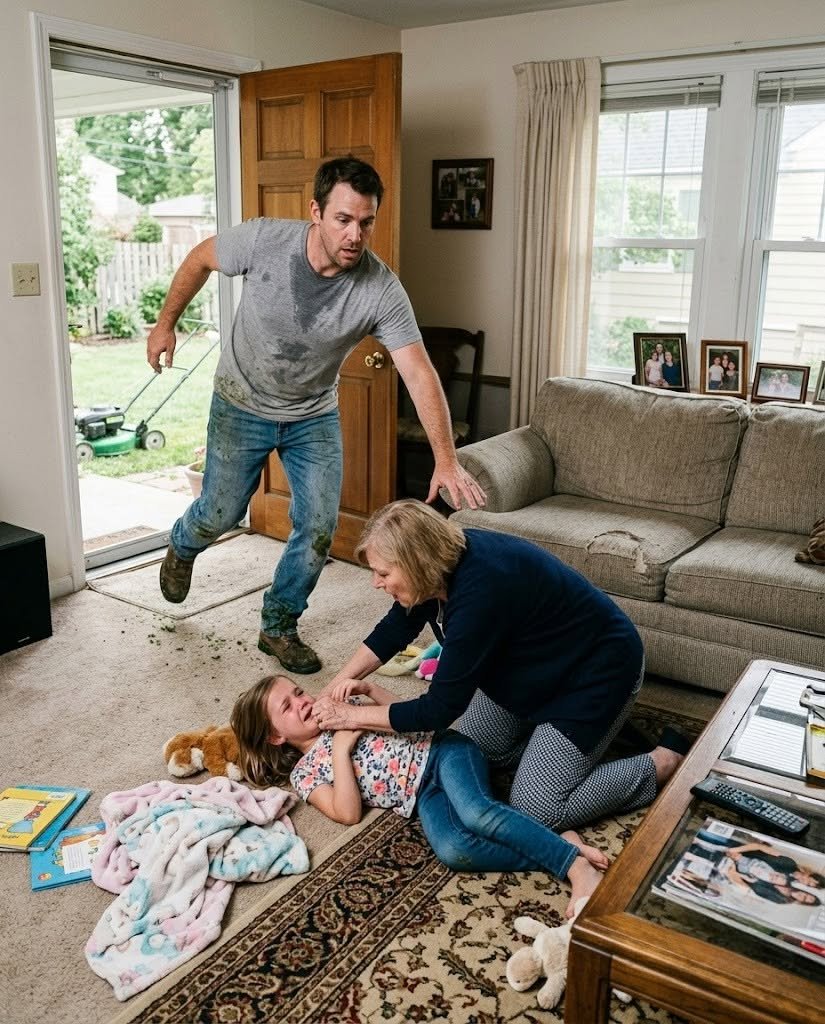
My mother-in-law had my daughter pinned to the floor.
One hand was over my daughter’s mouth.
She was leaning close enough for my daughter to hear every word when she hissed, “You saw nothing. Say it. Say you saw nothing.”
I pulled her away before I had even fully understood what I was seeing.
“What are you doing?” I demanded.
My mother-in-law laughed.
Not nervously.
Not apologetically.
She laughed like I had walked into something ridiculous and was too foolish to understand it.
“She’s lying,” she said. “She always lies.”
My daughter was crying so hard she could barely breathe evenly, but she still managed to get the words out.
“Dad, check her purse.”
That changed my mother-in-law’s face.
The confidence did not vanish completely, but something in it tightened.
I looked toward the purse.
My daughter moved behind me, pressing close enough that I could feel her shaking against my leg, and I realized she was not only upset about whatever she had seen.
She was afraid of what would happen if she said it out loud.
That mattered.
A child crying after being caught doing something wrong looks one way.
A child trying to make herself smaller behind her father because an adult has just covered her mouth looks different.
I went to the purse.
My mother-in-law watched me.
My daughter watched me.
I opened it.
Under the wallet was a folded tissue.
Inside that tissue was my wife’s wedding ring.
For a second, the ordinary details of the morning collided in my head.
My wife had been looking for that ring since breakfast.
She had not known where it went.
Now I was standing in the house with it in my hand after finding it hidden inside her mother’s purse.
My mother-in-law immediately reached toward the bag.
I pulled it away.
“I found it,” she said quickly. “I was keeping it safe.”
That explanation might have sounded almost reasonable if I had walked in five minutes later.
It might have sounded reasonable if I had found the ring without hearing my daughter cry.
It might have sounded reasonable if my mother-in-law had simply handed it to me herself.
But I had not walked in five minutes later.
I had seen her hand over my daughter’s mouth.
I had heard the words she was forcing my daughter to repeat.
And now I had found the exact object my daughter had told me to look for.
My daughter shook her head.
“No. You took it.”
My mother-in-law turned toward her immediately.
“Stop lying.”
I stepped between them before she could say anything else.
“Don’t talk to her.”
My mother-in-law looked at me instead.
“You’re really going to believe a child over me?”
That question was supposed to put me back in the position she wanted.
Adult against child.
Authority against uncertainty.
Her word against someone younger, frightened, and easier to dismiss.
But the problem was that I was no longer being asked to choose between two unsupported stories.
I had already seen something with my own eyes.
The ring was already in my palm.
My daughter pressed both hands against my back and whispered, “I saw her take it from Mom’s room.”
My mother-in-law laughed again.
This laugh was different.
“She follows me everywhere,” she said. “She gets into things. You know how children are.”
I looked down at my daughter.
She had stopped trying to hide completely behind me.
She was still terrified, but she stepped far enough to the side that she could speak directly.
“You told me Mom would think I stole it.”
That sentence landed harder than finding the ring.
Until then, the missing ring could still be framed as an object dispute.
Maybe someone picked it up.
Maybe someone intended to return it.
Maybe there was an explanation I had not heard yet.
But telling my daughter that her own mother would blame her changed the shape of the entire situation.
My mother-in-law did not answer.
My daughter swallowed and continued.
“She said if I told you, she’d say I was lying again.”
Again.
That word stayed with me.
My daughter was not describing one disagreement that had suddenly gotten out of control.
She was describing something she already expected.
She already knew what accusation would come next.
She already knew which adult would supposedly refuse to believe her.
She already knew she could be blamed before anybody else even heard the truth.
And the worst part was that my mother-in-law had demonstrated the exact pattern in front of me.
My daughter accused her of taking the ring.
My mother-in-law called her a liar.
My daughter revealed the threat.
My mother-in-law tried to send her away.
“Go to your room,” she said, pointing toward the hallway.
“No,” I said.
I did not shout it.
I did not need to.
My mother-in-law heard me perfectly.
My daughter heard me too.
That mattered more.
I crouched beside her so I was not talking down at her while everyone else stood over her.
“Do you want to stay in here with me, or go outside?” I asked.
“With you.”
“Okay.”
It was a small exchange, but it changed the balance of the room.
For the first time since I had run inside, nobody else was deciding where my daughter had to stand or what she had to say.
She chose.
She stayed.
I stood with the wedding ring still resting in my palm.
My mother-in-law’s expression shifted again.
“You have no idea what she’s been doing,” she said. “I’ve been trying to help you two with her.”
That was another attempt to move the conversation.
Suddenly the issue was not the ring.
Suddenly it was not the purse.
Suddenly it was not what I had seen when I entered the house.
Suddenly my daughter herself was supposed to be the problem.
“By holding your hand over her mouth?” I asked.
“I was trying to calm her down.”
My daughter answered before I could.
“No, you weren’t.”
Three words.
Nothing polished.
Nothing dramatic.
Nothing that sounded practiced.
And I believed her.
Maybe that sounds obvious from the outside.
Standing inside that room, though, I understood how much pressure had already been placed on her to make even those three words difficult.
She had been told she would be blamed.
She had been told she would be called dishonest.
She had watched an adult hide her mother’s wedding ring and then turn the accusation toward her.
When she tried to speak, that adult had physically covered her mouth.
So when she said, “No, you weren’t,” she was doing more than contradicting an explanation.
She was refusing the version of events somebody else was trying to force onto her.
I reached for my phone.
My first thought was my wife.
Whatever explanation came next, whatever my mother-in-law wanted to claim, I was not going to make my daughter stand there and defend herself alone while the person being accused controlled the conversation.
My wife needed to know what had happened in her own house.
She needed to know where her ring had been found.
Most of all, she needed to hear what our daughter had said without somebody cutting her off.
My mother-in-law saw the phone in my hand.
“Don’t make this bigger than it is.”
That sentence told me almost as much as everything before it.
If there was a harmless explanation, calling my wife should not have been a threat.
If the ring had truly been found and kept safe, there was no reason to stop me from telling its owner.
If my daughter was inventing the whole thing, another parent entering the conversation should have helped establish that.
Instead, my mother-in-law wanted delay.
I unlocked the screen.
“Give me five minutes,” she said.
“No.”
I had barely gotten the word out before she moved.
She snatched the phone straight from my hand and backed toward the hallway.
For an instant, I did not move because the action was so direct that it stripped away the last pretense of an ordinary family disagreement.
She was no longer just asking me to hear her explanation.
She had taken the device I was about to use to call my wife.
She had decided that she should control whether that call happened.
My daughter tightened her grip on my shirt.
My mother-in-law looked at the screen in her hand and insisted she could explain if I would only listen.
But by then the list of things requiring explanation had grown much longer than a missing ring.
Why was the ring in her purse?
Why had my daughter watched her take it?
Why had she told my daughter that her mother would blame her?
Why had she threatened to call her a liar?
Why was she covering a child’s mouth when I came inside?
Why was she trying to send that child out of the room before the story could be heard?
And now, why had she taken my phone the second I tried to bring my wife into the conversation?
She could explain one fact at a time if she wanted.
The pattern was getting harder to explain away.
Then my wife walked through the back door.
She came into a room where nothing looked normal anymore.
I had her wedding ring in my hand.
Our daughter was beside me with the aftermath of crying still written all over her face.
Her mother stood several steps away holding a phone that clearly was not hers.
My wife looked at the ring first.
Then she looked at our daughter.
Then her eyes settled on her mother and the phone.
I expected the ring to be the first question.
It was the thing she had been searching for since breakfast.
It was the object at the center of the accusation.
It was physical proof that at least part of our daughter’s story had led exactly where she said it would.
But my wife understood something I had only fully understood seconds earlier.
The phone mattered because it showed what was happening right now.
The ring could be explained away with a story about finding it.
The purse could be explained away with a story about keeping it safe.
Even the argument could be distorted afterward into competing memories about who said what.
Taking my phone while I was trying to call my wife was different.
There was no old misunderstanding buried inside it.
It was happening in the present.
Her mother had the phone.
I did not.
My daughter had watched her take it.
My wife had walked in before anyone could rewrite that part.
She did not begin by demanding a full account from me.
She did not tell our daughter to calm down.
She did not give her mother five minutes to arrange the facts into something easier to accept.
She focused on the action she could see for herself.
Her mother’s expression dropped.
That tiny change told me she had expected more room to maneuver before my wife came home.
Maybe she expected me to listen longer.
Maybe she expected our daughter to be sent away.
Maybe she expected to hand the phone back before anyone else saw it in her possession.
I could not know what she had expected, and I did not need to invent an answer for her.
What mattered was what had already happened.
My daughter had spoken.
The ring had been found.
The explanation had shifted.
The attempt to isolate our daughter had failed.
And when I tried to contact my wife, the phone had been taken from me.
For most of that morning, the conflict had looked like it was about a piece of jewelry.
It was not.
The ring was only the first thing we could hold in our hands.
The deeper problem was control: control over what my daughter was allowed to say, control over whether she would be believed, control over who got blamed, and finally control over whether I could even make a phone call without permission.
My wife had entered late enough to miss the beginning but early enough to see that final piece with her own eyes.
That was why she did not start where the rest of us had started.
She started with the one fact nobody in the room could reasonably dispute.
Her mother was standing there with my phone.
And before anyone could drag the conversation back toward excuses, accusations, or whether a frightened child was supposedly trustworthy enough to believe, my wife made it clear what needed explaining first.
The question was no longer simply how her wedding ring had ended up inside her mother’s purse.
The question was why, when our daughter finally spoke and I tried to call my wife, her mother had needed my phone out of my hand.