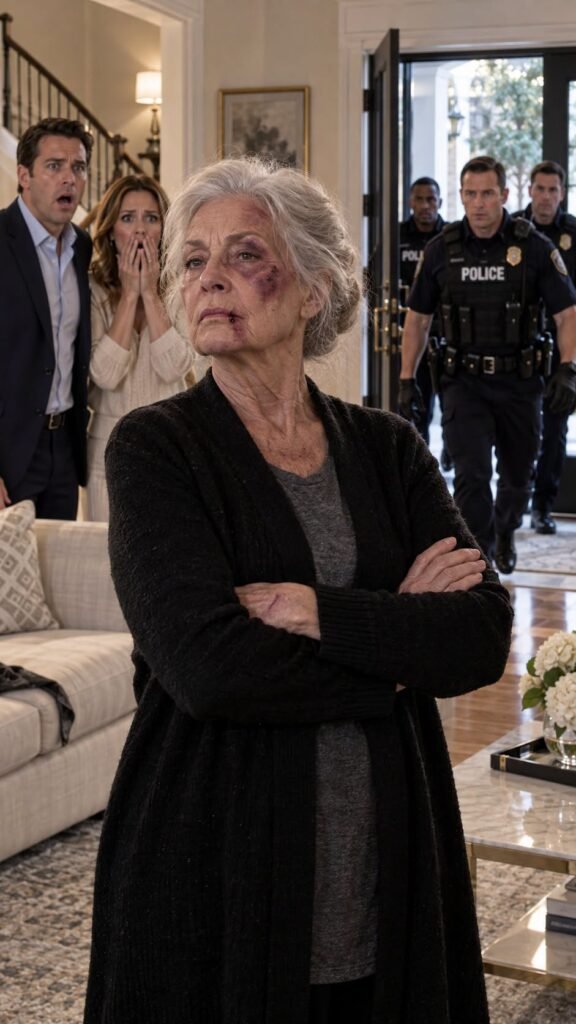
The slap cracked through the farmhouse kitchen so loudly that even the old clock seemed to stop. Blood warmed the corner of my mouth while my son stared at me as if I were already dead. “You senile old woman,” Preston hissed. “This farm is rotting, and so are you.”
His wife, Colleen, stood beside him in a cream coat that cost more than my first tractor. She did not look shocked. She looked impatient. “Sign the sale papers,” she said, tapping a folder on the table. “The developer’s offer expires tonight.” Outside the window, rain silvered the fields my husband, Walter, and I had worked for forty-three years.
Every fence post had passed through his hands. Every apple tree marked a season of our marriage. He had died six months earlier in the north pasture, beneath the oak where he once proposed to me. That morning, I had found his old gloves on the workbench, still shaped like his fingers. I had pressed them to my chest and promised that no bulldozer would flatten the life we built.
The farmhouse was not an investment. It was our first winter, Preston’s childhood, Walter’s final breath, and every ordinary miracle between them. I pressed a napkin to my lip. “The farm is not for sale.” Preston laughed without humor. “Dad left it to all of us.” “No,” I said. “Your father left it to me.” Colleen rolled her eyes. “You can barely manage your medication. We’re trying to save you from yourself.”
That was their favorite sentence lately. They had moved into the guesthouse after Walter’s funeral, supposedly to help. Within weeks, Preston had taken over the mail, changed the online banking passwords, and convinced neighbors that grief had confused me. Colleen began photographing cracked paint and loose boards, building a case that I was incapable of maintaining the property. They thought age had made me slow. It had only made me patient.
I rose from the floor, wiped the blood from my mouth, and reached for the landline. Preston smirked. “Calling the sheriff? Tell him you fell.” I dialed a number from memory. When a woman answered, I said, “Judith, begin the transfer.” Silence filled the kitchen. Then Judith Farrow, my attorney for thirty-one years, replied, “Are you certain, Beatrice?”
I looked at my son. “Yes. Activate Walter’s instructions. Freeze every account connected to the family holding company. File the protective order. And send the recording.” Preston’s smile twitched. Colleen folded her arms. “What recording?” I hung up. For the first time that evening, I smiled. “The one from the kitchen camera your father installed before he died.”
Preston’s face lost its color. Then his phone began to ring.
The first call came from the bank. Preston answered on speaker. The branch manager informed him that his business line of credit had been suspended pending a fraud review. His accountant and truck financier called next. Colleen’s phone started ringing too. “What did you do?” she snapped. I sat calmly at the table. “I stopped protecting you.”
Two years earlier, Preston had opened a farm equipment company using Walter’s name and reputation. We guaranteed the loan because we believed he wanted to build something honest. Instead, he used company funds for vacations, designer clothes, and failed fitness studios registered under Colleen’s brother. Walter discovered the missing money three months before his death. He did not confront Preston immediately.
My husband loved our son beyond reason. He hired forensic accountants, copied records, and placed the farm inside the Langley Agricultural Trust. I was named sole trustee. Preston would inherit only if he completed five clean years managing his company and never pressured me to sell the land. The final condition was Walter’s idea. “If he values money more than blood,” Walter had told me, “make sure he loses both.”
Preston slammed his phone down. “Dad would never do that.” I opened the drawer beside me and removed a sealed envelope. His name was written across it in Walter’s hand. Preston tore it open. As he read, his anger turned to panic. The letter explained the trust, the audit, the conditional inheritance, and the security system Walter installed after hearing Preston discuss selling the farm without my consent.
Colleen snatched the pages. “This is manipulation,” she said. “He was sick.” “No,” I replied. “He was dying. That made him careful.” Headlights swept across the windows. Two sheriff’s deputies entered with Judith and a social worker. Preston spoke first. “My mother is confused. She attacked me.” Judith placed a tablet on the table and played the footage.
Video showed Preston blocking the door, Colleen pushing the contract toward me, and the slap that knocked me down. His words echoed from the speakers. You senile old woman. The deputy looked at my split lip. “Mr. Langley, step away from your mother.” Preston’s arrogance cracked. “This is my property too.” Judith shook her head. “It has never been your property.”
She handed him a notice removing him from the guesthouse and barring him from trust land. Another document notified him that the trust had called his company’s debt because he violated its fraud clauses. Colleen stared at the papers. “You can’t destroy us over one argument.” “One argument?” I asked. Judith opened a second file. Inside were copies of checks bearing my forged signature, applications falsely declaring me incompetent, and emails between Colleen and the developer.
They had promised to deliver the farm within thirty days, then planned to place me in a private facility three counties away. Preston went still. That was when he understood. They had not targeted a helpless widow. They had confessed their scheme to the trustee who controlled their future.
The hearing took place three weeks later in a county courtroom. Preston wore a gray suit, still expecting rescue. Colleen whispered to their attorney. Behind them, bank investigators and the developer waited with evidence. I entered with Judith. Preston looked at the fading bruise along my jaw. “Mom, please. We can fix this.” I stopped beside his table. “You had six months to be my son,” I said. “Now you can be a defendant.”
The judge reviewed the footage, forged checks, competency petition, and hidden developer agreement. The most damaging evidence was an email Colleen had sent Preston. Once the old woman is declared unfit, we sell immediately. She can spend the rest of her life somewhere she cannot interfere. Colleen cried. Her tears did not move me. The developer testified that Preston accepted a two-hundred-thousand-dollar advance against property he did not own.
The bank investigator explained how he diverted funds and forged collateral documents. Walter’s accountants showed the theft totaled nearly nine hundred thousand dollars. Preston’s lawyer asked for mercy. Judith asked for accountability. The judge granted me a permanent protective order, upheld the trust, voided every attempted transaction, and referred the fraud charges for prosecution. Preston and Colleen were ordered to repay the stolen funds. Their vehicles, investment condo, and business assets were seized under the civil judgment.
Outside the courtroom, Preston caught me outside. “Mom!” he shouted. “You’re taking everything.” I turned. “No, Preston. You took everything your father and I gave you and gambled it away. I am only refusing to pay for your cruelty.” Colleen pointed at me, mascara streaking her face. “You’ll die alone on that farm.” I looked toward the fields beyond the courthouse hill. “Alone is not the same as unloved.”
Preston received four years in prison after pleading guilty to fraud, elder abuse, and assault. Colleen avoided prison by cooperating, but lost her real estate license and declared bankruptcy. Their marriage collapsed before sentencing. Six months later, spring returned to the farm. I used the recovered money to restore the barns and establish the Walter Langley Foundation, providing emergency housing and legal aid to elderly people facing financial abuse.
The guesthouse became a refuge for widows and widowers whose families tried to steal their homes. On the anniversary of Walter’s death, I carried two cups of coffee to the oak tree. I placed one beside his photograph and watched sunlight move across the fields. “You were right,” I whispered. “He chose money.” The wind stirred the grass. For years, I believed revenge would feel like fire. Instead, it felt like a locked gate, a safe home, and freedom from fear.
Behind me, volunteers repaired the old fence while laughter drifted from the guesthouse. I touched my wedding ring and smiled. Preston tried to erase my memories for profit. In the end, I kept the farm, protected Walter’s legacy, and turned my son’s betrayal into shelter for people he would have called weak. The land was still mine. So was my life.