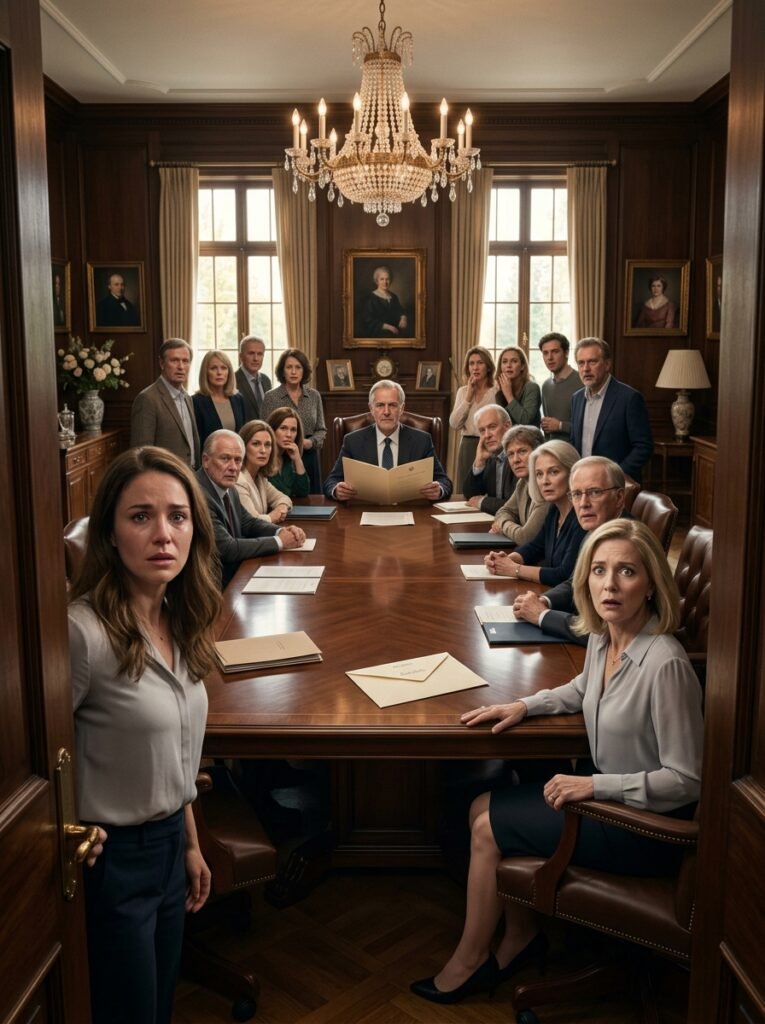
The grand foyer of the Hart estate buzzed with the chaotic, eager energy of twenty extended relatives. They sipped coffee beneath a massive crystal chandelier, waiting for the arrival of Mr. Sterling, the estate attorney. Today was the reading of the Last Will and Testament of my grandmother, Eleanor Hart.
I had arrived early, hoping for a quiet moment before the chaos began. Instead, my mother, Sylvia, intercepted me in the hallway outside the study.
“You’re not going in there,” she said, blocking the door with her arm.
“Mom, I have every right to be at this reading.”
“Listen to me very carefully,” Sylvia said, her voice low so the relatives nearby wouldn’t hear. “Mother’s mind was going at the end. She was weak, sentimental, and easily influenced by your little act. Whatever she wrote in that will doesn’t matter — I’ve already spoken to the family, and I am the sole surviving daughter. If you try to claim even a single cent, I will make sure you regret it.”
Before I could respond, she stepped inside the study and pulled the heavy door shut behind her. I heard the lock click.
I stood in the hallway, stunned, listening to the murmur of voices on the other side of the door — voices that belonged in that room as much as mine did, if not more.
I knocked. No one answered.
Ten minutes later, the door opened and my aunt Marjorie stepped out, avoiding my eyes.
“Sylvia said you weren’t feeling well and asked to be excused,” she said quietly. “She said you’d explain later.”
I hadn’t said anything of the sort.
Inside, I could hear Mr. Sterling beginning to read the will. Through the door, his voice was steady and formal as he moved through the preliminary language. Then I heard my mother’s voice cut in.
“Before you continue, Mr. Sterling, I should mention that my daughter isn’t feeling well today. She sends her apologies and asked that everything be handled without her.”
There was a pause.
“That’s unfortunate,” Mr. Sterling said. “Because your mother’s will specifically requires her presence for the reading of Section Four.”
I heard chairs shift.
“I’m sure that’s not necessary,” Sylvia said quickly. “I can sign on her behalf, as her—”
“Mrs. Hart-Whitfield,” Mr. Sterling said, “you are not her legal representative, and Eleanor was very specific about this clause. If your daughter is not present, Section Four cannot be executed today, and the estate remains frozen pending a rescheduled reading — with a probate judge present, if necessary.”
That was when I stopped waiting politely in the hallway. I knocked, firmly this time, and pushed the door open before anyone could stop me.
Twenty faces turned toward me. My mother’s went pale.
“I’m here,” I said. “I was never unwell. I was locked out.”
Mr. Sterling looked at Sylvia, then at me, then back down at his folder.
“Well,” he said, “then we can proceed.”
He opened the file.
“Eleanor Hart left a letter to be read aloud, addressed to whoever attempted to keep her granddaughter from this reading.”
Sylvia’s face drained of all color.
Mr. Sterling began to read.
“‘If my daughter Sylvia has done what I suspect she will do — kept my granddaughter away, out of fear or greed — then let this be known: I changed my will eight months ago. Sylvia receives her portion as originally planned. But the house, the accounts, and controlling interest in the family trust go entirely to my granddaughter, on the condition that she was present, of her own will, at this reading.'”
The room went silent.
Sylvia opened her mouth, then closed it.
“She was present,” Mr. Sterling said, looking up. “Just five minutes later than expected.”
What Sylvia Didn’t Know
For a long moment, nobody in the study moved. Twenty relatives sat frozen around the polished conference table, coffee cups halfway to their lips, staring between Sylvia and me as though watching a tennis match they hadn’t realized had started.
Sylvia recovered first.
“That’s absurd,” she said, forcing a laugh that came out thin and unconvincing. “My mother would never cut me out of the house. I lived with her for the last three years of her life. I managed her care. I was the one who—”
“You were compensated for that care, Mrs. Hart-Whitfield,” Mr. Sterling said calmly, sliding another document across the table. “Eleanor arranged a monthly caregiver stipend through the estate, separate from the will itself. That has already been paid in full — sixty-two thousand dollars over three years.”
Sylvia’s mouth opened again, and this time nothing came out at all.
My aunt Marjorie leaned forward. “Sylvia. Did you know about this?”
“Of course not,” Sylvia snapped. Then, quieter: “She never said anything to me about changing it.”
“She wouldn’t have,” Mr. Sterling said. He turned to a fresh page. “Eleanor came to my office alone, eight months ago, without informing anyone in the family. She told me she suspected exactly this kind of situation might occur, and she wanted safeguards in place.”
He looked up, first at Sylvia, then at me.
“She also left something else. A personal letter, addressed only to her granddaughter, to be given to her privately after the reading — not in front of the family.”
He reached into a second folder and handed me a sealed cream-colored envelope with my name written in my grandmother’s familiar, looping handwriting.
I held it without opening it. My hands were shaking.
Sylvia stood up so fast her chair scraped loudly against the hardwood floor.
“This is a mistake,” she said. “She was manipulated. Eight months ago she barely remembered what day it was—”
“Eleanor’s physician provided a full cognitive evaluation dated the same week as this will was signed,” Mr. Sterling said, not unkindly, but firmly. “She was found fully competent. That evaluation is part of the estate file, should anyone wish to contest it in probate court. I’d advise against it. The costs of contesting a will with this level of documentation tend to exceed what’s actually at stake.”
The room was silent again, but it was a different kind of silence now — the kind where twenty people were quietly doing math about who had believed what, and who had gone along with locking a woman’s own granddaughter out of a room to keep her from an inheritance that had, it turned out, already been decided.
My uncle Frank cleared his throat. “Sylvia, you told us at breakfast this morning that she wasn’t coming. You said she’d texted you.”
“She did,” Sylvia said.
“I never texted anyone,” I said. “My phone’s been in my pocket all morning.”
Marjorie looked at her sister with an expression I hadn’t seen her wear before — not quite anger, but something adjacent to it. Disappointment, maybe, sharpened by finally understanding what had actually happened in that hallway.
Mr. Sterling closed his folder.
“I think that concludes the formal reading,” he said. “The house and trust transfer will proceed through the standard thirty-day probate window. Mrs. Hart-Whitfield, if you’d like to discuss your portion of the estate, my office is available Monday through Thursday.”
People began to rise slowly, murmuring, gathering coats and bags, the way people do when they want to leave a room but don’t want to be the first ones to actually do it.
I slipped out into the hallway before anyone could stop me, the envelope still unopened in my hands.
I found a quiet corner near the old library — a room Grandma Eleanor used to read to me in when I was seven, before any of this, before Sylvia decided that love was something to be rationed and inheritance was something to be defended — and I opened it.
Her handwriting filled two pages, unhurried and steady, nothing like a woman anyone could call confused.
My dear girl,
If you’re reading this, it means someone tried to keep you out of that room, and Mr. Sterling did exactly what I asked him to do. I’m sorry I couldn’t be there to see your face. I imagine it was a complicated one.
I want you to know this was never about the house. Houses are just walls. This was about making sure that, for once in your life, someone chose you loudly, in front of everyone, instead of quietly, where it wouldn’t cost them anything.
I sat there for a long while after I finished reading, the sounds of the departing relatives fading through the walls, until the house — my house now — finally went quiet.
The House Was Never the Point
Three weeks after the reading, I sat at my grandmother’s kitchen table — my kitchen table now — sorting through the last of the paperwork Mr. Sterling’s office had sent over. The thirty-day probate window had closed without a single objection filed. Sylvia had threatened to contest it twice in phone calls to my aunt Marjorie, and both times, nothing had come of it.
Marjorie told me later that Sylvia’s own lawyer had advised her against it after reviewing the cognitive evaluation. “Even he said it wasn’t worth the legal fees,” Marjorie said. “That’s saying something.”
I hadn’t spoken to my mother since the reading.
She’d texted twice. The first one read: We need to talk about this like adults. The second, three days later: I don’t understand why you’re punishing me.
I didn’t answer either one. Not out of spite — I’d expected to feel a surge of something sharp and satisfying when this finally happened, some clean sense of winning. Instead what I felt, sitting in that quiet kitchen, was mostly tired. The kind of tired that comes after carrying something heavy for a very long time and finally being allowed to put it down.
Marjorie came by most Sundays after that. She’d bring a pie, or a loaf of bread, and we’d sit at the table where Eleanor used to sit, and she’d tell me stories about my grandmother that I’d never heard — about the specialty bakery Eleanor had run in her twenties before she married, about the year she’d driven cross-country alone at twenty-three, about how she used to say that the measure of a person wasn’t what they did when things were easy, but who they protected when it cost them something.
“She saw this coming,” Marjorie told me one Sunday, stirring sugar into her coffee. “Months before she got sick, even. She told me once, ‘Sylvia loves things. I’m not sure she’s ever learned how to love a person without keeping score.'”
I thought about that a lot, in the weeks that followed. About the difference between the mother I’d spent my whole life trying to earn approval from, and the grandmother who had simply decided, quietly, without asking anyone’s permission, to protect me before she was gone.
Six months later, Sylvia finally called instead of texting. I almost didn’t pick up.
“I’ve been seeing someone,” she said, without any preamble. “A therapist. Marjorie suggested it.”
I didn’t say anything.
“I’m not asking you for anything,” she continued, her voice tighter than I remembered it. “I just wanted you to know that. I’m not calling about the house.”
“Okay,” I said.
There was a long pause.
“I locked you out of that room,” she said finally. “I knew what I was doing when I did it.”
It wasn’t quite an apology. But it was the first true thing she’d said to me in longer than I could remember, and for now, it was enough to leave the door open — just a little — for whatever came next.
I still have my grandmother’s letter. It lives in the top drawer of the desk in the library where she used to read to me, and some mornings, before the house wakes up around me, I take it out and read it again.
Houses are just walls, she wrote. This was about making sure that, for once in your life, someone chose you loudly.
She did. And in the end, that mattered more than anything Mr. Sterling read aloud that day.