“The Recording That Played Itself Back”
I didn’t sleep that night.
Gwen did. For the first time in what looked like months, she slept deeply — curled against my chest on the thin mat in the storage room, her breathing slow and steady, her bald head resting on my arm.
I lay there in the dark and let the rage pass through me the way you let a storm pass — not by fighting it, but by holding still and waiting for the thunder to finish.
Then I thought clearly.
I had mentioned four hundred thousand dollars. It wasn’t real. There was no lump-sum payout. The number was bait — a test I already knew they’d fail, and they had failed it before I finished the sentence.
But the real trap wasn’t the money.
It was the recording.
The moment I walked through the back gate and saw Gwen on her knees, I had pressed record on my phone. Muscle memory from four years of after-action protocols — document everything, report later.
I had forty-three minutes of audio.
Margaret saying Gwen did this to herself. Paige calling her names. Margaret’s immediate pivot to renovations the moment I mentioned four hundred thousand dollars. Paige’s shopping list. Their complete, clinical disinterest in the woman kneeling in the dirt behind the house they lived in for free.
And later that evening — after they assumed I was asleep — I had recorded something worse.
I’d left my phone in the kitchen, voice memo running, and gone to the storage room with Gwen. At 11:14 PM, the audio picked up Margaret and Paige’s voices clearly.
“He’s back for good this time,” Margaret said. “We need to make sure that woman doesn’t start talking.”
“She won’t,” Paige replied. “She knows what happens.”
“If she mentions the hospital, I’ll tell him she went on her own. That she was hysterical. Nobody listens to a sick woman.”
“What about the money? She might tell him nothing went to her.”
“Let her try. It’s her word against ours. And we have the bank account.”
I had listened to that exchange three times before dawn, lying in the storage room with my jaw clenched, watching Gwen sleep.
They had rehearsed this. They had contingencies. They had a system — one that relied on Gwen’s silence, my distance, and the assumption that a soldier overseas would always trust his mother over his wife.
For four years, that assumption had been correct.
Not anymore.
At 5:30 AM, I texted my old squad leader, Davis, who had separated from the Army two years earlier and was now working as a paralegal at a veterans’ legal aid office in Fayetteville.
I told him what I’d found. I sent the recordings. I sent photos of Gwen — her scalp, her arms, the biopsy scar, the storage room.
Davis called me back in eleven minutes.
“Brother,” he said. “This is financial abuse. Possibly medical neglect. And if they were intercepting her access to you — controlling her phone, blocking contact — that’s coercive control. You need a lawyer today.”
“Can you recommend one?”
“I can do better than that. Patricia Webb. She handles military family cases. She’s in Raleigh. I’m texting you her number now.”
By 7 AM, I had an appointment for Thursday.
By 7:15, I was sitting at the kitchen table drinking coffee when Margaret came downstairs in a silk robe.
“Good morning, sweetheart,” she said, kissing my forehead. “Sleep well?”
“Like a rock,” I said.
She smiled.
She had no idea what was coming.
“Ninety-Seven Thousand Dollars and a Hundred-and-Fifty-Dollar Haircut”
Patricia Webb’s office was on the second floor of a brick building near the courthouse. She was in her fifties, direct, composed, and spoke with the precision of someone who had spent decades untangling exactly this kind of damage.
She listened to the recordings without interrupting. She reviewed the photos. She read the bank transfer records I’d printed from my online portal — forty-seven months of deposits, every one routed to Margaret’s account.
Then she sat back.
“Let’s start with the money. How much did you send?”
“Approximately ninety-seven thousand dollars over four years.”
“And how much of that reached your wife?”
“None. As far as I can tell, none of it.”
“Do you have documentation of what the money was spent on?”
“The house renovations. The truck — registered in Margaret’s name. Paige’s wardrobe, electronics, personal expenses. I can see it just by walking through the front door.”
Patricia made a note.
“And your wife’s medical care?”
“Gwen told me she asked Margaret for three hundred dollars to see a specialist. Margaret refused. She was diagnosed with cancer five months ago and has received minimal treatment because she had no money and no access to the funds I was sending.”
Patricia set her pen down.
“How did she pay for the biopsy?”
I paused.
“She cut off her hair and sold it. A hundred and fifty dollars.”
The room was quiet for a long moment.
Patricia didn’t react the way most people would. She didn’t gasp or shake her head. She wrote the number down — $150 — in the margin of her legal pad, and she underlined it.
“That detail,” she said, “will matter in court.”
She walked me through the legal framework. Financial abuse. Misappropriation of funds sent for household and dependent care. Medical neglect — specifically, the deliberate withholding of resources from a person with a known medical condition. Coercive control, evidenced by the monitoring of Gwen’s phone, the restriction of her movement, and the isolation from her spouse.
“The recordings are admissible in this state,” Patricia said. “One-party consent. You were present in your own home. The audio of Margaret and Paige discussing how to manage Gwen’s silence is particularly significant — it demonstrates premeditation and coordination.”
“What can we recover?”
“We’ll file a civil suit for the return of misappropriated funds. Based on the transfer records and the visible assets — the house improvements, the vehicle, Paige’s expenditures — I’d estimate a recoverable amount in the range of fifty to sixty thousand dollars, depending on what’s been spent versus what remains in tangible form.”
“And Gwen’s treatment?”
“That’s the priority. We’ll file for an emergency protective order and establish a separate medical fund. Your military benefits include TRICARE spousal coverage — she should have been enrolled from the beginning. The fact that she wasn’t suggests Margaret may have intercepted or failed to process the paperwork.”
I sat with that.
Margaret had controlled the bank account, the mail, the phone access, and — apparently — the insurance enrollment. She had built a wall between Gwen and every resource I had provided, and she had plastered that wall with silk curtains and gold jewelry so it looked like prosperity instead of theft.
I thought about the storage room. The thin mat. The shattered plate in the dirt.
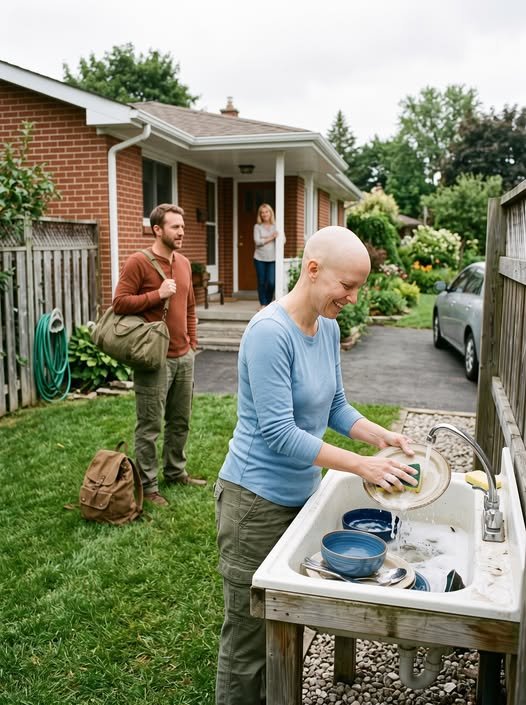
I thought about Gwen kneeling beside a washing basin while my sister shouted from inside a house I had paid for.
I thought about a hundred and fifty dollars. The price of a woman’s hair. The cost of finding out whether you’re going to live or die.
Patricia handed me a folder.
“The demand letter will go out Friday. The protective order should be granted by next week. And I want to schedule Gwen’s oncology appointment for tomorrow if possible.”
“Tomorrow?”
“She’s waited five months, Specialist. She’s not waiting another day.”
I nodded.
She was right.
Gwen had waited long enough.
“The Morning They Lost Everything They Never Earned”
The protective order was served on a Wednesday.
Margaret and Paige were given seventy-two hours to vacate the residence. The house — built with funds I had sent from overseas — was in Margaret’s name, but the civil filing challenged the legitimacy of that arrangement and froze all associated assets pending adjudication.
The truck was impounded as a potentially recoverable asset. Paige’s bank account, seeded almost entirely by transfers from Margaret’s account — which was itself funded entirely by my wire deposits — was flagged by Patricia’s office and included in the claim.
I wasn’t present when the order was served. Gwen and I were at Duke University Hospital, sitting in an oncology consultation room, where a specialist named Dr. Okafor was reviewing Gwen’s scans for the first time with the full benefit of advanced imaging.
The tumor was operable.
That was the word Dr. Okafor used first. Operable. Then treatable. Then — after a careful pause — she said, “If we had seen this five months ago, the conversation would have been simpler. But we are not too late.”
Gwen held my hand so tightly I felt the bones shift.
“Not too late,” she repeated.
“Not too late,” Dr. Okafor confirmed.
Surgery was scheduled for the following week.
That evening, my phone rang. Margaret.
I answered.
“You put us out of our own house?” Her voice was shaking — not with sadness, but with the breathless indignation of a person who has never been told no and cannot process the experience.
“It’s not your house, Margaret. It was built with my money. Money that was sent for Gwen and for our household. Not for trucks and jewelry and Paige’s shopping.”
“I raised you. I fed you. I kept this family together while you were off playing soldier—”
“Playing soldier. That’s interesting. Because every month I was ‘playing soldier,’ I was sending you two to three thousand dollars that you spent on yourself while my wife sold her hair for a medical test.”
Silence.
“She’s a liar, son. She’s always been—”
“Margaret. Stop.”
One word. The voice I’d learned in the Army — not loud, not aggressive, just final. The voice that says this conversation is over and the person speaking has decided how it ends.
“Your attorney will receive the demand letter on Friday. Patricia Webb’s office. You can respond through counsel.”
“I don’t have a lawyer.”
“Then I suggest you find one.”
I hung up.
Paige called twenty minutes later. I let it go to voicemail. The message was forty-five seconds of crying followed by the sentence: “You’re choosing that woman over your own blood.”
I saved the voicemail. Patricia would want it.
That woman.
Paige had said “that woman.” Not Gwen. Not my wife. Not her sister-in-law. “That woman.” The same phrasing she’d used from the kitchen window while Gwen knelt in the dirt picking up broken pieces.
Blood doesn’t entitle you to someone’s loyalty. Behavior does.
And the behavior of my mother and sister — measured across four years, ninety-seven thousand dollars, and five months of withheld medical care — had disqualified them from every claim they believed their bloodline granted.
Gwen’s surgery was performed the following Tuesday at 6 AM.
I sat in the surgical waiting room for four hours and eleven minutes. I drank three cups of coffee that tasted like nothing. I stared at the floor tiles and counted them in rows of twelve because my brain needed something structured to do while my wife was on an operating table fighting for the life my family had tried to let her lose.
Dr. Okafor came out at 10:11 AM.
“Surgery was successful. The tumor has been removed. We’ll begin adjuvant therapy in three weeks, but the margins look clean.”
I stood up. My legs were shaking.
“She’s asking for you,” Dr. Okafor said.
I walked into the recovery room.
Gwen was lying in a clean bed, in a clean gown, with an IV delivering fluids that were meant to help her, not harm her. Her eyes were half-open. A thin smile crossed her face.
“Hey, soldier,” she whispered.
“Hey, beautiful.”
She reached for my hand.
I held it.
And for the first time since I walked behind that house and found her on her knees, I let myself cry.
The House He Built With What Was Left”
The civil case settled four months later.
Margaret agreed to a structured repayment of fifty-two thousand dollars — the recoverable portion of the misappropriated funds, calculated by Patricia’s office based on the transfer records, the asset valuations, and the documented personal expenditures.
The truck was sold. A portion of the house equity was liquidated. Paige returned several items that Patricia’s team identified as purchased directly with my wire transfers.
It wasn’t fast. It wasn’t clean. But the money moved.
Gwen’s treatment continued through the winter. Chemotherapy every other week. Monitoring scans monthly. Dr. Okafor’s team was thorough, and Gwen responded well — steadily, stubbornly, in the quiet, uncomplaining way she had always done everything.
She gained weight slowly. Her appetite returned. One Saturday morning I came downstairs and found her standing at the stove, making eggs in a cast-iron skillet, wearing a cotton headwrap and humming a song I hadn’t heard since before I deployed.
I stood in the doorway and watched.
She turned.
“What?” she said.
“Nothing. Just you.”
I found a house thirty-five minutes outside the city. Small. Two bedrooms. A porch that needed new railing and a yard with enough sun for a garden.
I fixed it myself. Every board, every nail, every cabinet. The hands that had spent four years maintaining equipment in combat zones built a home for my wife. Not with the money I’d sent to Margaret’s account — that money was gone, scattered across renovation materials and luxury goods that would never carry my name.
This house I built with what was left. And what was left was enough.
Gwen planted the garden. Tomatoes. Collard greens. Marigolds along the border because her grandmother had always grown marigolds and she said the smell reminded her of being small and safe.
Some evenings we sat on the porch after dinner and watched the sky change color. We didn’t talk about Margaret. We didn’t talk about the storage room or the basin or the broken plate in the dirt.
We talked about the things we’d grow next season. About whether the fence needed staining. About the neighbor’s dog who kept digging under the gate.
Ordinary things.
After four years of war and five months of watching my wife fight for her life, ordinary was the most extraordinary thing I’d ever known.
Margaret called once in the spring.
I almost didn’t answer. But something in me — something I couldn’t quite name, something between duty and the last residue of a son’s hope — made me pick up.
“How is she?” Margaret asked.
“She’s in remission.”
A long pause.
“I’m glad.”
I waited.
“I don’t expect you to forgive me,” she said.
“I know.”
“But I think about it. Every day.”
“Thinking about it is a start. But Gwen is the one you should be calling.”
Margaret didn’t call Gwen. Not that month. Not the next.
But in June, a small package arrived at our house. Inside was a gold chain — simple, plain, not expensive. Attached to a small card in Margaret’s handwriting: For Gwen. I’m sorry it took me this long.
Gwen held it in her palm.
“Do you want to wear it?” I asked.
She shook her head. She placed it in the top drawer of her dresser, beside the photograph from our wedding day.
“It’s enough to have it,” she said.
And it was.
Gwen’s hair began growing back in late spring — dark, soft, a quarter-inch of stubble that caught the light when she stood in the garden in the morning.
She didn’t cover it anymore. No caps. No wraps. She stood in the sun with her bare scalp and her bare hands in the soil and she looked like what she was — a woman who had been stripped of everything and had grown back from the root.
One evening in August, I was lying in bed watching the ceiling fan turn. Gwen was beside me, reading a library book, her headwrap loose, the faintest new growth visible at her temples.
She looked up.
“Elijah?”
“Yeah?”
“Thank you for coming home.”
I turned off the lamp.
“Thank you for being here when I did.”
The house was quiet. The porch light was on. The garden smelled like tomatoes and marigolds through the open window.
I had spent four years dreaming about this — not the house, not the money, not the truck in the driveway. This. A quiet room. A safe woman. A ceiling fan turning slowly above a bed where nobody was sleeping in a storage room or selling their hair or picking up broken plates in the dirt.
This was what ninety-seven thousand dollars was supposed to buy.
Not granite countertops. Not silk robes. Not gold jewelry around someone else’s neck.
Peace.
And finally, after everything — the deployment, the betrayal, the biopsy scar, the hundred-and-fifty-dollar haircut that saved my wife’s life — we had it.
The fan turned. The garden grew. The woman beside me breathed softly in the dark.
And for the first time in four years, I slept without counting the days until I could come home.
Because I was already there.