I drove to Cooper Lake on a cloudy Tuesday morning because the porch roof at my late wife’s cabin had started leaking.
That was the entire reason for the trip.
Nothing dramatic.
No family meeting.
No confrontation planned.
Just a roof.
Susan had been gone three years, and the cabin was the one place I had deliberately refused to modernize, sell, renovate, or turn into something new.
People told me that was unhealthy.
Maybe it was.
But grief makes ordinary objects carry weight they never had before.
Susan’s coffee mug still hung beside the sink.
A white ceramic mug with a chipped handle she refused to throw away.
Her green raincoat remained on the hook beside the mudroom.
One sleeve always twisted slightly inward.
I knew because I had looked at it every time I visited and never straightened it.
The old porch chair still sat facing the lake.
Susan had bought that chair secondhand because she said new furniture looked uncomfortable until someone had lived in it.
Those things mattered to me.
Not because I believed she was coming back.
I was not confused about death.
I simply was not ready for every place she had touched to become rearranged by people who did not understand what it meant.
So I maintained the cabin.
Paid the taxes.
Checked the insurance.
Fixed what broke.
And otherwise left it alone.
The porch roof had started leaking near one corner after several days of rain.
I loaded tools into my truck.
Replacement flashing.
Sealant.
A ladder.
A tarp in case the weather turned.
Then I drove north toward Cooper Lake.
The sky stayed gray the entire way.
The road narrowed near the water.
Trees crowded closer.
By the time I reached the gravel turnoff, I was thinking mostly about whether the roof decking underneath the leak would need replacing.
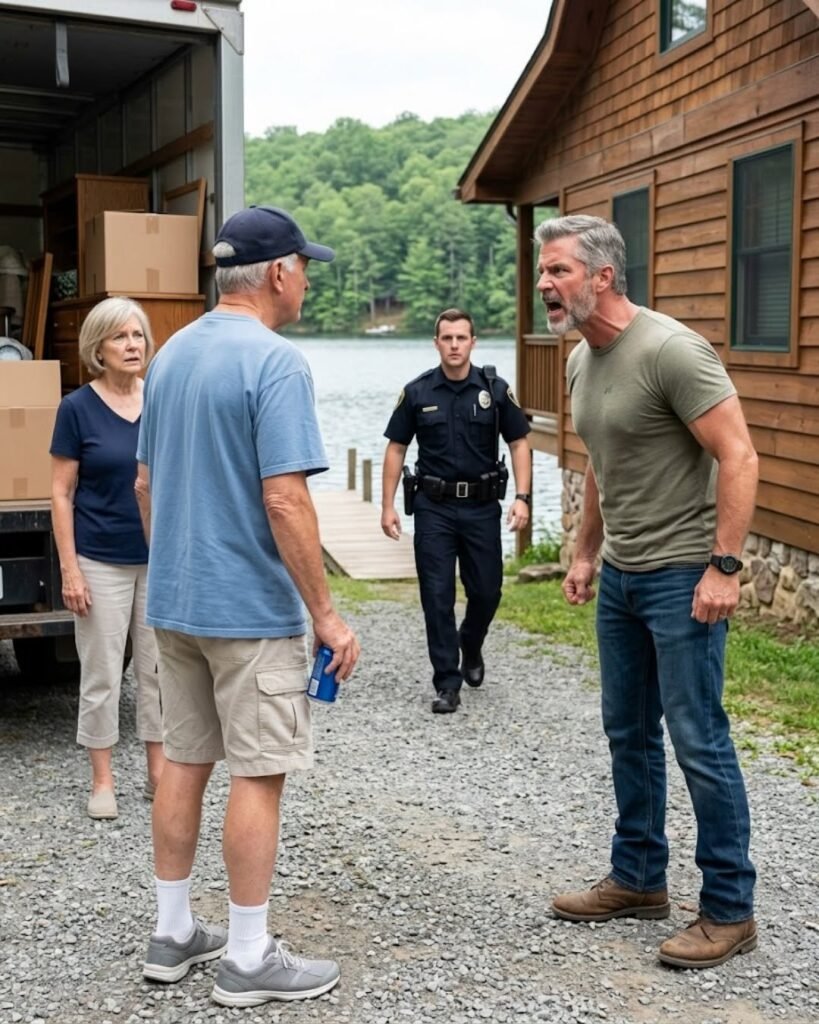
Then I saw the U-Haul.
At first, my brain rejected it.
The truck was backed toward the porch as though somebody had been unloading for a while.
Rear door open.
Ramp down.
Boxes stacked near the steps.
I slowed.
Looked at the mailbox.
Looked at the cabin.
Looked at the trees.
Correct property.
Correct driveway.
Correct porch.
Wrong truck.
For a second, I genuinely wondered whether Hannah had sent somebody ahead without telling me.
My daughter had access to the cabin.
She knew I was coming.
Maybe there had been a misunderstanding.
Then I saw Greg Lawson.
My son-in-law Shawn’s father.
He came through the front door carrying a table lamp I recognized from their house.
Behind him came his wife, Brenda.
She had a cardboard box in her arms.
KITCHEN was written across the side.
I stopped the truck.
Turned off the engine.
Sat there for half a second.
Then got out.
Greg saw me first.
He did not look surprised enough.
That detail stuck with me.
A person who unexpectedly encounters the owner of a house while moving into it usually has questions.
Greg smiled.
Set down the lamp.
Reached into a cooler.
Opened a beer.
“Morning, Walter.”
I stared at him.
“What are you doing in my house?”
Brenda stopped.
The box remained against her chest.
Greg took a drink.
No embarrassment.
No explanation offered quickly.
Just the relaxed confidence of someone who believed the argument had already been settled somewhere else.
“Shawn gave us the door code.”
I looked toward the keypad beside the front door.
“This cabin is going to be ours anyway.”
I thought I had misunderstood him.
“What?”
Greg shrugged.
“Hannah inherits it.”
“That’s not what I asked.”
He looked annoyed now.
“Shawn says they’re going to sign everything over.”
“We figured we’d retire up here.”
We.
Retire.
As though they had spent months choosing curtains for a future everyone had agreed on.
I looked at Brenda.
She would not meet my eyes.
Then back at Greg.
“My daughter’s husband gave you permission to move into property he doesn’t own?”
Greg laughed.
Not loudly.
Enough.
“Walter, come on.”
“No.”
“You’re making this bigger than it is.”
“I’m looking at a moving truck.”
“It’s family.”
There it was.
Family.
The word people use when they want ownership without paperwork.
I walked to the keypad.
For years, the code had been Susan’s birthday.
Four digits I could type without looking.
I entered them.
Nothing.
I tried again.
Still locked.
Greg watched me.
Then smiled.
“Shawn changed it.”
That sentence hit harder than his claim about eventually owning the cabin.
Changed it.
Someone who did not own the property had changed the access code.
I looked at the keypad.
Then entered the last four digits of Shawn’s phone number.
The lock opened.
I stared at it.
That was when the conversation ended for me.
Until then, some part of me had still been willing to believe this was arrogance built on confusion.
Maybe Hannah had said something badly.
Maybe Shawn had misunderstood an inheritance plan.
Maybe Greg had taken a future possibility and treated it like present permission.
Changing the code was different.
Moving boxes were different.
The U-Haul was different.
This was not a theoretical family conversation.
They were occupying the property.
At 10:26 a.m., I called the Forsyth County Sheriff’s Office.
I remember the time because I looked at my phone afterward.
Greg listened.
Then laughed.
“You’re actually calling the police on your own family?”
I looked at him.
“No.”
His smile stayed in place.
“I’m calling them about trespassers.”
That removed the smile slightly.
Brenda set down the kitchen box.
“Greg.”
He waved her off.
“Relax.”
Then to me:
“You’re going to look ridiculous when they get here.”
Maybe.
I did not care.
I had spent enough years working with paperwork, property records, insurance forms, and estate planning after Susan died to understand one thing clearly.
The cabin’s ownership was not a family opinion.
It was documented.
Susan and I had placed the property into the Miller Family Trust twelve years earlier.
We had reasons.
Estate planning.
Continuity.
Avoiding unnecessary confusion later.
At the time, the paperwork felt boring.
Responsible.
Routine.
After Susan died, I became sole trustee.
Hannah was named to inherit the cabin after my death.
After.
Not before.
Not whenever Shawn decided.
Not because his parents wanted a retirement property.
After my death.
I had the trust certificate in my truck because I kept a property file with me whenever I went to the cabin.
Taxes.
Insurance.
Repair records.
Trust documentation.
One habit Susan had teased me about turned out to be useful.
“You carry paper like someone expects civilization to collapse,” she once told me.
Maybe.
That morning, paper mattered.
The sheriff’s SUV arrived eleven minutes after my call.
I saw it turn onto the gravel.
Greg looked toward it.
His confidence returned a little.
He seemed almost eager.
That confused me.
Deputy Brian Miller stepped out.
Professional.
Calm.
No performance.
He looked at the U-Haul.
The boxes.
Me.
Greg.
Brenda.
Then asked everyone to remain outside while he figured out who had authority over the property.
Good.
Facts first.
I handed him my driver’s license.
Property-tax statement.
Trust certificate.
He read carefully.
Asked questions.
“How long has the property been held by the trust?”
“Twelve years.”
“You’re the current trustee?”
“Yes.”
“Any co-trustee?”
“No.”
“Does your daughter currently own an interest?”
“Not an ownership interest that lets her transfer this property now.”
I kept the answer narrow.
I was not there to interpret beyond the documents.
Deputy Miller nodded.
Then turned to Greg.
“You have anything showing permission to occupy?”
Greg folded his arms.
“My son handles the property.”
“That wasn’t my question.”
That was the first moment Greg’s posture changed.
Small.
But noticeable.
Brenda looked at him.
Greg lowered the beer.
Then said:
“Actually, yes.”
He reached into his pocket.
Pulled out a folded document.
I remember thinking how strange it was that he had it on him.
Not in a folder.
Not in the moving truck cab.
In his pocket.
Ready.
He held it out.
“Your son-in-law said this proves the cabin belongs to them.”
Deputy Miller took it.
Unfolded it.
Read.
The first few lines did not change his face.
Then something did.
A small tightening around the eyes.
He looked at the second page.
Then back at the first.
Greg noticed.
“What?”
Deputy Miller did not answer.
I stepped closer.
Not enough to interfere.
Enough to see the title.
Quitclaim deed.
My stomach tightened.
The document purported to transfer the property from the Miller Family Trust to Shawn and Hannah Lawson.
I stared at the names.
This was not some handwritten note.
Not an email.
Not a family agreement.
It looked formal enough at first glance to explain Greg’s confidence.
Then I saw the signatures.
Mine.
Susan’s.
I stopped breathing normally.
My name appeared near the bottom.
A signature resembling mine.
Beside it, Susan Miller.
Her signature.
Or something meant to resemble it.
For a second, grief and anger hit at the same time.
It is difficult to describe what it feels like to see a dead spouse’s name used in the present tense by someone else.
The paper did not know she was gone.
Ink does not understand funerals.
It simply sat there claiming Susan had participated in something impossible.
I looked at the date.
Six months earlier.
Susan had been dead for three years.
I read it again.
Six months.
Three years.
No interpretation required.
Brenda moved closer.
“What is it?”
Greg answered.
“The deed.”
I looked at him.
“Where did this come from?”
“Shawn.”
“Where did Shawn get it?”
He shrugged.
“Hannah signed stuff.”
That was not an answer.
I looked at Deputy Miller.
He was reading the signatures too.
Then my phone rang.
Evelyn Vance.
My attorney.
I almost ignored it.
Then remembered I had left her a message before driving out because I wanted to ask whether the roof repairs required any insurance notice.
Timing.
Sometimes ordinary timing changes everything.
I answered.
“Evelyn.”
“Walter.”
Her voice was immediately serious.
I looked at the deed.
“There’s a problem at the cabin.”
“What kind of problem?”
“My son-in-law’s parents are here with a moving truck.”
Silence.
“They say Shawn gave them permission.”
Another pause.
“There’s a deputy here.”
“Good.”
“And they have a quitclaim deed.”
Evelyn’s tone changed.
“What?”
“Purported transfer from the Miller Family Trust to Shawn and Hannah.”
“Walter.”
I could hear paper moving on her side.
“Who signed it?”
“My name is on it.”
“And?”
I looked at Susan’s signature.
“Susan.”
Evelyn went completely silent.
Then:
“Date?”
I told her.
The silence lasted longer this time.
When she spoke again, every trace of casual conversation was gone.
“Walter, do not let anyone leave with those documents.”
I looked at Deputy Miller.
He still held the deed.
“We have a much bigger problem.”
Greg heard enough to become irritated.
“What is she saying?”
I raised one hand.
Evelyn continued.
“Do not sign anything.”
“I won’t.”
“Do not hand over original trust documents.”
“I won’t.”
“Make sure the deputy documents exactly who produced that deed and where it came from.”
I looked at Greg.
His face had changed.
The beer hung lower in his hand.
Brenda was staring at him.
I put the phone on speaker low enough that the deputy could hear.
Evelyn asked me to read the property description.
I did.
She asked whether the trust name was exact.
It appeared to be.
Whether the signatures had witness or acknowledgment language.
The document contained formal-looking sections.
I answered only what I could see.
She did not speculate.
That mattered.
“Walter, the date beside Susan’s signature is impossible.”
“I know.”
“Do not make accusations beyond that yet.”
“I understand.”
I did.
Anger wanted a name.
Evidence did not have one yet.
The paper was wrong.
That did not automatically tell us who created it.
Greg?
Shawn?
Someone else?
I did not know.
Neither did Evelyn.
Deputy Miller looked toward Greg.
“Sir, who gave this document to you?”
“My son.”
“When?”
“A few days ago.”
“Original or copy?”
Greg hesitated.
“I don’t know.”
That hesitation told me more about how little he had asked.
He had been happy to accept whatever document supported what he wanted.
Retirement at the lake.
Free property.
No questions.
Brenda looked at him.
“You said everything was legal.”
“It is.”
“Greg.”
“It is.”
Deputy Miller folded the document carefully.
“Sir, don’t touch this right now.”
Greg’s expression hardened.
“That’s ours.”
The deputy looked at him.
“The document was presented during an active property dispute. I’m telling you not to interfere while I document what’s here.”
Greg stopped.
Good.
I looked toward the cabin.
The front door remained open.
Inside, moving boxes sat beside Susan’s furniture.
A lamp from Greg and Brenda’s house had been placed on a table Susan bought at an estate sale years earlier.
Their kitchen box sat near the mudroom.
Her green raincoat hung behind it.
That image did something to me.
It was not just property.
I understood legally that sentiment did not determine ownership.
But emotionally, the intrusion felt almost physical.
They had not simply come to a lake house.
They had stepped into the last place I kept Susan’s routines intact.
And someone had apparently used her name to justify it.
Brenda turned toward Greg.
“What did Shawn tell you exactly?”
Greg frowned.
“That Hannah owns this eventually.”
“Eventually isn’t now.”
He looked annoyed.
“You were fine with this in the truck.”
“Because you said the paperwork was done.”
“It is done.”
She pointed toward the deputy holding the deed.
“His dead wife signed it six months ago.”
Greg’s mouth opened.
Then closed.
That was the first time I saw genuine uncertainty.
Before, he had been smug.
Then defensive.
Now confused.
Maybe he really had never checked the date.
That did not make his decision to move in acceptable.
But it changed what I could responsibly assume about the document.
I looked at him.
“Did you know Susan’s name was on that deed?”
He did not answer immediately.
“No.”
Brenda looked at him sharply.
“You didn’t read it?”
“I looked at it.”
“That’s not reading.”
A strange argument to hear from the people unloading a U-Haul into my cabin.
But there it was.
Deputy Miller asked Greg to explain when Shawn gave him the door code.
Greg said the night before.
Changed code too?
He did not know.
Shawn had simply told him the new one.
The last four digits of his phone number.
I felt another wave of anger.
The code had been Susan’s birthday.
Everyone in the immediate family knew that.
Changing it to Shawn’s number was not an administrative detail.
It was symbolic whether he intended it that way or not.
Replacing her.
Replacing me.
Replacing a future inheritance with present control.
I called Hannah.
No answer.
That worried me in a different way.
I tried again.
Voicemail.
“Hannah, call me immediately. I’m at the cabin.”
Nothing accusatory.
Nothing about fraud.
Just call.
Then I called Shawn.
Straight to voicemail.
Greg watched.
“He’s probably in a meeting.”
“Maybe.”
I did not argue.
Evelyn remained on the phone.
She told me she was pulling the trust file.
Checking her records.
Looking for anything that could explain the deed.
She did not find an explanation during that call.
That mattered.
There had been no recent authorized transfer she remembered.
No signature appointment involving Susan, obviously.
No reason for my own signature to appear on a transfer I had never signed.
I looked again at the imitation of my name.
At first glance, it was convincing enough.
But when it is your own signature, you notice rhythm.
Where your hand accelerates.
Where letters collapse.
Which lines never look the same twice.
That signature looked like someone trying to be me.
Too deliberate.
Too clean.
I did not say that as proof.
Only as observation.
The date beside Susan’s name remained stronger than any handwriting opinion.
Impossible.
No expert needed to tell me that a woman dead three years could not sign a deed six months earlier.
Brenda sat on the edge of the U-Haul ramp.
The kitchen box remained unopened.
Greg stood near the cooler.
His beer was now untouched.
Deputy Miller documented.
Names.
Times.
Documents.
Vehicle.
Who entered.
Who had the code.
I watched the process and felt something inside me settle.
Not calm exactly.
Structure.
Grief is chaos.
Property disputes can become chaos.
Family conflict definitely becomes chaos.
Documentation gives chaos edges.
At 10:26 I called.
Eleven minutes later, the deputy arrived.
Trust certificate.
Tax statement.
Changed access code.
Moving truck.
Quitclaim deed.
Susan’s impossible signature.
Those were the facts.
Everything else could wait.
Greg tried once more.
“Walter, we can sort this out without making it ugly.”
I looked at him.
“You were moving into my wife’s cabin without calling me.”
He looked away.
“You changed nothing,” he said. “Shawn did.”
“I’m talking about you.”
His jaw tightened.
“You knew I lived.”
Silence.
“You knew Susan was dead.”
More silence.
“You knew this property had not been handed to you by me.”
He finally answered.
“Shawn said it was handled.”
“You chose not to check.”
That was the part Greg could not escape by blaming his son.
Maybe Shawn had lied.
Maybe there was more to the story.
But Greg and Brenda had still loaded a truck, driven to Cooper Lake, entered using a code supplied by someone who did not own the cabin outright, and begun unpacking without ever calling me.
That decision belonged to them.
Brenda looked toward the porch.
“I told you we should wait.”
Greg snapped:
“Not now.”
She stared at him.
Then stopped speaking.
The family dynamics were beginning to show.
Everyone had relied on somebody else’s certainty.
Greg trusted Shawn.
Brenda trusted Greg.
Maybe Hannah trusted Shawn too.
And Shawn, apparently, believed a document would make the cabin his before the trust said it could be.
Or someone wanted all of us to believe that.
I did not know yet.
That uncertainty mattered.
My phone buzzed.
Not Hannah.
Not Shawn.
Evelyn had sent me an image from her file.
The original trust certificate.
I already had my copy.
Still, seeing the date brought back the day Susan and I signed.
Twelve years earlier.
We had sat in Evelyn’s conference room.
Susan joked about how serious everything looked.
“Walter is only happy when paper has three signatures and a stamp.”
Evelyn laughed.
I did too.
Then Susan signed.
Her real signature.
Fast.
Loose.
Confident.
I looked from the image on my phone to the quitclaim deed in Deputy Miller’s possession.
Even without comparing the writing itself, the dates told the story.
One signature belonged to a living woman in a lawyer’s office twelve years earlier.
The other claimed the same woman had signed something six months ago.
I swallowed.
For the first time that morning, the violation felt larger than the cabin.
Someone had taken Susan’s identity and used it after her death.
Her name.
Her handwriting.
Her legal existence.
As though death made her available.
That made my anger colder.
More useful.
Evelyn called again.
“I found no authorized transfer in our trust file.”
“Understood.”
“Again, that does not tell us who created what you’re looking at.”
“I know.”
“I want the original preserved.”
Deputy Miller heard.
He nodded once.
Greg looked increasingly uncomfortable.
Then Brenda asked:
“Where did Shawn get Susan’s signature?”
Nobody answered.
Because nobody there could.
Not me.
Not Evelyn.
Not the deputy.
Not Greg.
That question became the center of everything.
The U-Haul suddenly mattered less.
The beer mattered less.
Even Greg’s arrogant claim that the cabin would belong to them anyway began to feel like a smaller problem sitting on top of a much larger one.
Someone had produced a transfer document.
Someone had changed the access code.
Someone had told Greg and Brenda the cabin was theirs to occupy.
And somewhere in that chain, a dead woman’s name had been placed on paper as though she were alive.
I looked through the open cabin door.
Susan’s green raincoat hung where it had for three years.
Untouched.
For the first time that morning, I wanted to take it down.
Not because I was ready to change the cabin.
Because I suddenly understood that leaving everything frozen had never been the same thing as protecting it.
Protection required action now.
Documents.
Calls.
Evidence.
Boundaries.
I picked up my property file.
Held it tighter.
Then looked at Deputy Miller.
“What do you need from me?”
That question changed the rest of the morning.
I stopped arguing with Greg.
Stopped trying to understand Shawn before Shawn bothered to call back.
Stopped treating the situation like a family disagreement that could be solved with enough explanation.
It was now a documented property dispute involving an apparently impossible signature.
That was enough.
The deputy continued taking information.
Evelyn continued checking records.
Greg and Brenda stopped unloading.
The boxes stayed where they were.
The U-Haul ramp remained down.
Nothing had been resolved yet.
That mattered too.
No dramatic ending.
No instant confession.
No convenient explanation.
Just a Tuesday morning that began with a leaking porch roof and became something else entirely.
Eventually, my phone buzzed again.
For half a second, I thought it might finally be Hannah.
It wasn’t.
A voicemail notification.
Shawn had not called.
Neither had my daughter.
I looked at the deed again.
Then at Greg.
“Until we know where that came from, nobody gets to pretend this is settled.”
He did not argue.
For the first time since I arrived, he seemed to understand that his son’s confidence was not the same thing as ownership.
The lake beyond the cabin stayed flat and gray.
The wind moved through the trees.
Susan’s porch waited behind the U-Haul.
And I stood in the gravel beside a sheriff’s deputy and listened to my attorney explain the only thing we could say with certainty.
My wife had been dead for three years.
The document claimed she signed six months ago.
Everything after that would have to be proven.
But that one fact was enough to make the entire morning stop being about who planned to retire at Cooper Lake.
Now it was about who had put Susan’s name on that deed—and why.