The Twelve Dollars He Left Me With
Behind him, my black SUV waited at the curb outside St. Vincent’s Hospital. Dominic had the keys, his mother was climbing into the passenger seat, and every movement I made pulled painfully at the incision beneath my dress.
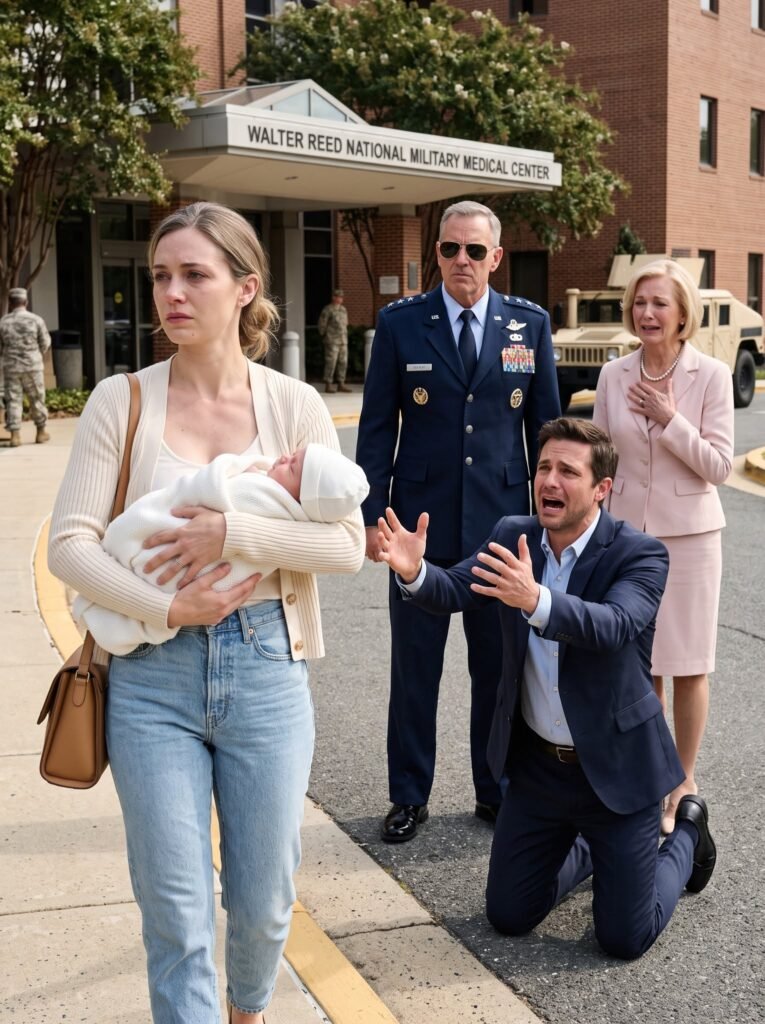
“Please tell me you are joking,” I said.
Dominic checked his watch instead of looking at me. “My mother has a reservation for lunch, Audrey. The bus will get you home.”
Victoria Hale appeared beside him in oversized sunglasses and an expression of practiced impatience. “Dominic, we are already late.”
He opened the SUV door for her.
During my entire pregnancy, he had never opened a door for me.
I adjusted Leo against my shoulder and looked down at the small stack of bills in my palm. “I need the diaper bag.”
Dominic took it from the back seat and dropped it near my feet. When I tried to bend down, pain tore through my abdomen so sharply that the world blurred for a second.
A nurse rushed out of the hospital doors. “Mrs. Hale, please do not bend like that. You are still recovering from surgery.”
Dominic gave an irritated sigh. “Can we stop making this sound so serious?”
The nurse stared at him. I did too.
Then Dominic got into my SUV. Victoria settled comfortably beside him, while his father and sister filled the back seat. A moment later, they drove away laughing, leaving me on the sidewalk with a five-day-old baby, a hospital bracelet, and twelve dollars.
A city bus arrived just as I began to cry.
The driver saw Leo in my arms and lowered the steps. An elderly woman gave up her seat before I could even ask. Her kindness hurt in a way I could not explain, because strangers had shown me more care in thirty seconds than my husband had shown me in months.
As the bus moved through Manhattan, I watched the city blur past the window and finally stopped defending Dominic in my own mind.
I had spent years explaining him away. His temper was stress. His demands were work pressure. His mother’s cruelty was just her personality. His disregard during my pregnancy was temporary.
But there was nothing temporary about leaving a woman recovering from major surgery to ride home alone with a newborn so you could take your mother to lunch.
Dominic thought he knew everything about me. He knew I was Audrey Brooks, that I came from money, and that my father had worked for the government before retiring.
What he did not know was that my father had not been an ordinary government employee.
General Charles Brooks had spent his career in command positions most people only read about. He was a four-star Army general, and I had deliberately hidden the full truth because I wanted Dominic to love me without calculating what my family could do for him.
My father had warned me once, “Let people show you who they are before they learn who stands behind you.”
I understood that warning now.
I called the private number he had given me years earlier. He answered after the first ring.
“Audrey?”
My voice broke. “Dad, I need help.”
His tone changed immediately. “Where are you?”
“On a city bus with Leo.”
There was a silence so deep I could hear only the hum of the road beneath us. Then I told him everything: the surgery, the twelve dollars, Dominic driving away in my vehicle, and the fact that I could no longer imagine returning to my own apartment.
When I finished, Dad asked only one question.
“Do you want to go back?”
I looked down at Leo, asleep against my chest.
“No,” I said. “I want to leave him.”
“Then you have left him.”
At the next stop, two black sedans were waiting at the curb. A woman in a dark suit helped me into a car equipped with a newborn seat, blankets, water, and medication.
My phone began to vibrate.
Dominic had sent a message.
Mom needs the SUV again tomorrow. Do not make plans.
I looked at the screen, then typed only one reply.
You should check the parking lot first.
Because by then, someone was already waiting beside my SUV with the ownership documents Dominic had never bothered to read.
The Car He Thought Was His
Dominic was still inside the restaurant when Aaron Wells arrived in the parking lot. My attorney wore a charcoal suit and carried a leather folder, and he stood beside my SUV with the quiet confidence of someone who did not need to raise his voice to be taken seriously.
When Dominic, Victoria, and the rest of his family came outside, Victoria noticed Aaron first.
“Dominic,” she said, adjusting her sunglasses, “who is that?”
Dominic barely glanced at him. “Probably valet.”
Then Aaron stepped forward. “Mr. Hale?”
Dominic stopped. “Yes?”
“My name is Aaron Wells. I represent Audrey Brooks.”
Dominic laughed as though my name alone made the situation ridiculous. “My wife?”
“Yes,” Aaron said. “This vehicle is registered solely to Mrs. Brooks. She has revoked your permission to drive or possess it.”
For a moment, Dominic only stared at him.
Victoria moved closer. “He is her husband.”
“That does not make him the owner,” Aaron replied.
Dominic took the document from him and scanned the first page. The confidence in his face disappeared as he reached the registration details, the purchase information, and my name printed exactly where it had always been.
“This is a stunt,” he said.
“It is a formal notice.”
“I have the keys.”
“And Mrs. Brooks has requested their return.”
Victoria crossed her arms. “Do you know who my son is?”
Aaron looked at her with polite disinterest. “No, ma’am.”
The answer landed harder than anyone’s raised voice could have. Dominic’s sister looked away, and even his father seemed embarrassed.
Dominic held the keys tightly. “My belongings are in the car.”
“You may remove your personal property,” Aaron said. “Then the vehicle will be collected.”
“Mom has plans tomorrow,” Victoria snapped.
“Not with Mrs. Brooks’s SUV.”
By then, several people had slowed down to watch. Dominic noticed them, and I knew that was the part he hated most. Not the loss of the car. Not the fact that he had abandoned me outside a hospital.
The humiliation.
He finally dropped the keys into Aaron’s open hand.
My phone began ringing almost immediately. Dominic called once, twice, then again and again, but I was sitting in my father’s sedan with Leo asleep in a properly secured car seat. For the first time since leaving the hospital, I was surrounded by people who had thought about what I needed without being asked.
Dad sat across from me in a white shirt and dark trousers, looking less like the general people saw in photographs and more like the father who had once waited outside my college dorm to make sure I got home safely.
“You are shaking,” he said.
“I’m fine.”
“No,” he replied. “You are not.”
That single sentence broke through everything I had been holding together. I looked down at my hands and began to cry, quietly at first, then hard enough that I could barely speak.
“I thought he loved me,” I said.
Dad did not rush to defend me or insult Dominic. He only leaned forward and said, “You deserved better than having to question that five days after giving birth.”
We arrived at a townhouse my father kept through a family trust. A postpartum nurse was waiting with medication, food, clean clothes, and a bassinet already prepared for Leo.
Everything Dominic had failed to consider had been handled within an hour.
My phone rang again. This time, I answered.
“Where are you?” Dominic demanded.
“Somewhere safe.”
“What does that mean?”
“It means Leo and I will not be coming home tonight.”
He laughed without humor. “You are making a scene over a bus ride.”
“No,” I said. “The bus ride made me see the whole marriage clearly.”
His voice sharpened. “You had money. What was the problem?”
“Twelve dollars, Dominic.”
“The fare costs less than that.”
I closed my eyes. There it was—the answer I needed. Not concern about my recovery. Not regret for leaving his newborn son in my arms outside a hospital.
Only arithmetic.
“My attorney will contact you tomorrow,” I said.
“For what?”
“Our separation.”
The silence that followed was long enough for Victoria’s voice to carry through the phone.
“Ask her when we get the SUV back.”
I looked at Leo sleeping beside me.
“The car was never yours,” I said. “And neither was my life.”
Before Dominic could respond, I ended the call.
Ten seconds later, my father looked up from his tablet. “Did he just say you were overreacting?”
I nodded.
Dad’s expression became very still.
Then his phone rang.
He listened for less than a minute before handing it to me. The caller was my new attorney.
“Mrs. Brooks,” she said, “there is something you need to see. Your husband may have been using your private assets to support his business claims.”
The Money He Claimed as His Own
My attorney’s name was Caroline Mercer. She arrived at the townhouse the next morning with a slim laptop, a stack of financial statements, and the kind of calm voice that made every word feel more serious.
“Dominic’s company has been presenting itself as financially secure,” she said. “Several investor materials refer to substantial household assets and family-backed liquidity.”
I looked down at the pages in front of me.
They contained numbers from accounts Dominic had never been authorized to use. My brokerage portfolio. Property held in trusts my father had created years before I met Dominic. Funds that had never belonged to our marriage.
“He showed investors my assets?” I asked.
“He did not explicitly claim they were his,” Caroline said carefully. “But he created the impression that he could rely on them.”
My father sat near the window, silent but alert.
“Can he do that?” I asked.
“Not without consequences,” Caroline replied. “We are sending formal notice to his company and anyone who received those representations. We are not accusing him of anything before the review is complete. We are making the truth clear.”
That was all I wanted.
Not revenge. Not favors from my father. Just the truth, finally written down where Dominic could not talk his way around it.
Over the next two days, his messages changed by the hour. First, he was angry.
Stop behaving like this.
Then he became demanding.
We have obligations. You cannot leave without discussing it.
Then came the familiar manipulation.
My mother is devastated. Leo needs his father.
I read every message and replied to none of them.
The first message that made me cry was the simplest.
I love you.
Three days earlier, that would have been enough to pull me back. I would have convinced myself that the hospital was one bad afternoon and that Dominic could still become the husband I kept hoping to find.
But now I could see that he loved what my life made possible for him. The SUV. The apartment. The image. The access to a financial world he had quietly borrowed from me.
Then he discovered who my father really was.
A photograph from a defense conference appeared online. My father stood at a podium in dress uniform, four stars visible on his shoulders beneath the headline: General Charles Brooks Addresses National Security Leaders.
Dominic called within minutes.
I did not answer, but his messages arrived one after another.
Is that your father?
Why did you never tell me?
Audrey, call me.
I stared at the final question until the answer became clear.
He was not asking why I had stopped trusting him. He was not asking why I had been left on a bus five days after surgery.
He was asking why I had not told him something that could have made me more useful.
Victoria called next.
“Audrey, sweetheart,” she said, using a name she had never once called me during seven years of marriage.
“Victoria.”
“There has clearly been a misunderstanding.”
“No,” I said. “There has been a long pattern.”
She paused. “Dominic feels terrible.”
“He should.”
Her voice grew quieter. “Your father is really General Brooks?”
“Yes.”
“Why did you keep that from us?”
“Because I wanted to know how you would treat me when you believed my family had nothing to offer you.”
Silence filled the line.
“So thank you,” I said.
“For what?”
“For answering that question.”
The next morning, Dominic appeared outside the townhouse holding a large bouquet of flowers. He wore the navy suit I used to love and the expensive watch he had bought after one of his investor dinners.
From the security camera, he looked like a man rehearsing remorse.
The guard refused to let him inside.
“I am her husband,” Dominic said.
“The child and his mother are safe,” the guard replied.
“You cannot keep me from my family.”
That was when my father stepped outside.
Dominic saw him and went still.
“General Brooks,” he said.
Dad stopped several feet away. “Mr. Hale.”
“I think Audrey misunderstood what happened.”
“No,” Dad replied. “She understood it exactly.”
Dominic’s face tightened. “We had an argument.”
“My daughter was recovering from surgery and carrying your newborn son. You drove away in her vehicle to take your mother to lunch.”
“I did not force her onto the bus.”
My father’s expression did not change.
“That is the defense you chose?”
Dominic opened his mouth, but no words came out.
Dad spoke quietly. “Audrey’s legal matters will be handled by her attorney. You will not contact her except through counsel. You will not use my name to excuse the consequences of your own choices.”
Dominic nodded quickly.
Then my father added, “And you will stop telling people I destroyed your business.”
Dominic turned pale.
“Your company’s investors are asking questions because your wife’s attorney corrected false assumptions about her assets,” Dad said. “That is not destruction. That is accountability.”
Dominic looked toward the townhouse windows as if he hoped I might come outside and save him.
I did not.
Later that night, my phone rang again. I answered only because I wanted to hear him explain.
“What did you do?” he demanded.
“I told the truth.”
“You ruined Hale Capital.”
“No, Dominic. You built it on things that were never yours.”
Then he said the one sentence that finally erased every doubt I had left.
“You would have nothing without me.”
I took a breath.
“Exactly what did you think I had because of you?”
He went silent.
And for the first time, he had no answer.
The Business Built on My Name
Caroline’s investigation did not reveal a single dramatic theft. It revealed something more calculated: Dominic had spent years turning my existence into a financial asset.
His investor presentations described Hale Capital as supported by “substantial family resources.” He never wrote that I had guaranteed his company, because he knew I had not. Instead, he let people believe that my accounts, property, and inherited assets stood behind him.
“They invested based on an impression he created,” Caroline explained. “Once we correct that impression, they will decide how they want to proceed.”
I sat with Leo asleep against my chest and felt a strange kind of clarity settle over me. Dominic had not just taken my SUV for granted. He had taken my silence, my privacy, and my desire to keep peace, then used all of it to make himself look important.
My father did not offer to call anyone. He did not threaten Dominic’s investors or use his position to interfere.
“This is your decision,” he said. “Your lawyer. Your case.”
But he looked at Caroline and added, “Make sure the truth is complete.”
Within forty-eight hours, formal letters were sent to Hale Capital and its investors. They stated only the facts: I had not given Dominic permission to use my assets in any business representation, I had never guaranteed his company’s obligations, and my property remained separate.
The reaction was immediate.
One investor postponed a transfer. Another requested amended financial disclosures. Then the company’s board asked Dominic questions he could not answer without admitting exactly how much he had exaggerated.
He called me late that night.
“You contacted my investors,” he shouted.
“No. My attorney corrected statements about my assets.”
“You knew this would hurt my business.”
“I did not know you were using my life to sell yours.”
“It was not like that.”
“Then explain it.”
Dominic went silent.
For years, silence had been his favorite weapon. He used it whenever I asked where money had gone, why he needed my car, or why his mother treated our home like a hotel.
Now it was simply proof that he had no defense.
“We are married,” he finally said. “Everything we have is shared.”
“Not everything.”
“You are hiding behind your father and expensive lawyers.”
I looked down at Leo’s small hand curled against my shirt. “No, Dominic. I am protecting myself because you taught me I had to.”
The next message came from Victoria.
You are destroying the family.
I almost replied, but I stopped. I had spent too much of my marriage trying to explain basic decency to people who treated my pain as an inconvenience.
So I put my phone facedown and fed my son.
Three weeks later, Dominic and I sat across from each other at formal mediation. He brought two attorneys, a stack of folders, and the tired expression of a man who had finally realized charm would not solve a legal problem.
I brought Caroline.
My father did not attend. That was important to me. Dominic had begun telling people that General Brooks was using military influence to punish him, and I wanted the process to show exactly what it was.
A mother protecting herself and her newborn through ordinary legal channels.
Caroline placed a proposed custody schedule, a financial disclosure request, and a temporary separation agreement on the table. Dominic read the first page, then looked at me.
“You are really doing this,” he said.
“Yes.”
“Over one mistake?”
I felt my anger rise, but my voice stayed even. “This is not about one afternoon outside a hospital. It is about every time you made me smaller so you could feel bigger.”
During the break, Dominic followed me into the hallway.
“Did you ever love me?” he asked.
The question hurt because the answer was still true.
“Yes.”
His face softened with hope. “Then how can you do this?”
I looked at him for a long moment.
“Because loving you never required me to disappear.”
Before he could answer, Caroline stepped into the hallway with her phone pressed to her ear. Her expression told me something had changed.
She ended the call and looked directly at Dominic.
“There is an urgent development,” she said. “One of Hale Capital’s investors has provided documents showing that Dominic may have used Audrey’s signature on a financing agreement.”
Dominic’s face went white.
The Life He Could No Longer Borrow
Caroline did not accuse Dominic of forgery in the hallway. She simply took the documents, asked for a forensic review, and told him that any response would need to come through his attorneys.
But Dominic knew what he had done.
The financing agreement contained a signature that looked enough like mine to convince someone who had never seen me sign anything in person. The review later showed I had never been sent the document, never approved it, and had been recovering from childbirth when it was supposedly executed.
Once that evidence surfaced, Dominic’s business problems stopped being something he could blame on me.
Hale Capital lost investors because its own records could not support the image Dominic had sold. The company’s board removed him from daily control while the matter was reviewed, and the financial questions continued through the appropriate legal channels.
I did not celebrate.
I had loved the man who built that company. I had sat beside him at dinners, smiled at people who praised his ambition, and believed him when he said everything he did was for our future.
The truth was that he had been building a future around my resources while making me feel as though I should be grateful to stand beside him.
Our divorce took months. The custody process was difficult, but Dominic’s early behavior mattered: abandoning me after surgery, the threatening messages, the financial misrepresentations, and the way he treated Leo as an argument rather than a child.
The court created a structured parenting plan. Dominic was given a chance to be Leo’s father, but access came with responsibility, consistency, and respect for boundaries he had spent years ignoring.
Victoria tried calling twice after the mediation.
The first time, she left a message saying she missed Leo. The second time, she said the family had been “punished enough.”
I did not return either call.
Missing a child and respecting a child’s mother were not the same thing. Neither was regret and accountability.
My father never asked me to forgive Dominic. He never told me what choice to make, even when he saw how exhausted I was from sleepless nights, legal meetings, and caring for a newborn.
Instead, he came to the townhouse one morning with coffee and held Leo while I took a shower without listening for someone to criticize how long I had been gone.
That was what support looked like.
Six months after I left the hospital, I took Leo to the park for the first time on a warm spring morning. He sat in his stroller wearing a tiny blue hat, watching pigeons move across the path with the complete seriousness only babies can manage.
I thought about the woman I had been outside St. Vincent’s Hospital.
She had been in pain, carrying a newborn, and still wondering whether she was asking too much by wanting her husband to care.
I wished I could stand beside her for one moment and tell her the truth.
You are not difficult for needing help.
You are not dramatic for expecting kindness.
You are not selfish for protecting the life you built.
That afternoon, Dominic sent a message through our parenting app.
I am sorry for what I did. I should have treated you better.
I read it once, then set the phone down.
An apology was not a door back into my life. It was only an acknowledgment that the door had closed for a reason.
Leo stirred in his stroller, and I lifted him into my arms. He pressed his cheek against my shoulder, warm and safe, while sunlight moved through the trees above us.
For the first time in years, I was not trying to become smaller so someone else could feel important.
I was simply Audrey.
And that was more than enough.