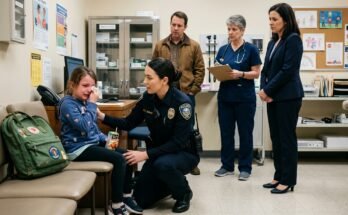
My mom died when I was ten. I remember the hospital room more clearly than I remember her voice some days—the white sheets, the plastic bracelet on her wrist, the way Dad kept saying, “She’s going to be okay,” even after the doctor had stopped looking him in the eye.
After she was gone, the house changed. Dad changed too. He stopped singing in the kitchen. He stopped fixing old radios in the garage.
He moved through life like someone had turned the volume down on the world. When I was fourteen, he married Cheryl. At first, everyone said she was good for him.
She wore pastel dresses to church, brought casseroles to grieving neighbors, and smiled with both hands folded like she had been born for sympathy. But inside our house, when Dad wasn’t looking, Cheryl’s smile disappeared. “You walk like your mother,” she would snap. “You stare like her too.
” She hated my guitar most of all because it had been Mom’s last gift to me. Dad never saw the sharp parts of her.
Or maybe he was too tired to notice. Five years later, Dad died suddenly from a heart attack in the garage, right beside the old workbench where he had once taught me how to sand wood smooth. I was nineteen and alone in a way that felt too familiar. Cheryl did not wait for the funeral flowers to wilt.
Two days after we buried him, she stood in the living room with her arms crossed and said, “You’re not family anymore. Get out.” I stared at her, thinking grief had made me hear wrong. “This is my home.” She laughed. “No. This is my husband’s house.
And now it’s mine.” I left with one duffel bag, my guitar, and the kind of anger that makes your hands stop shaking. I slept in my old car behind a gas station that night. The next morning, I came back to grab the rest of my things before Cheryl could throw them away.
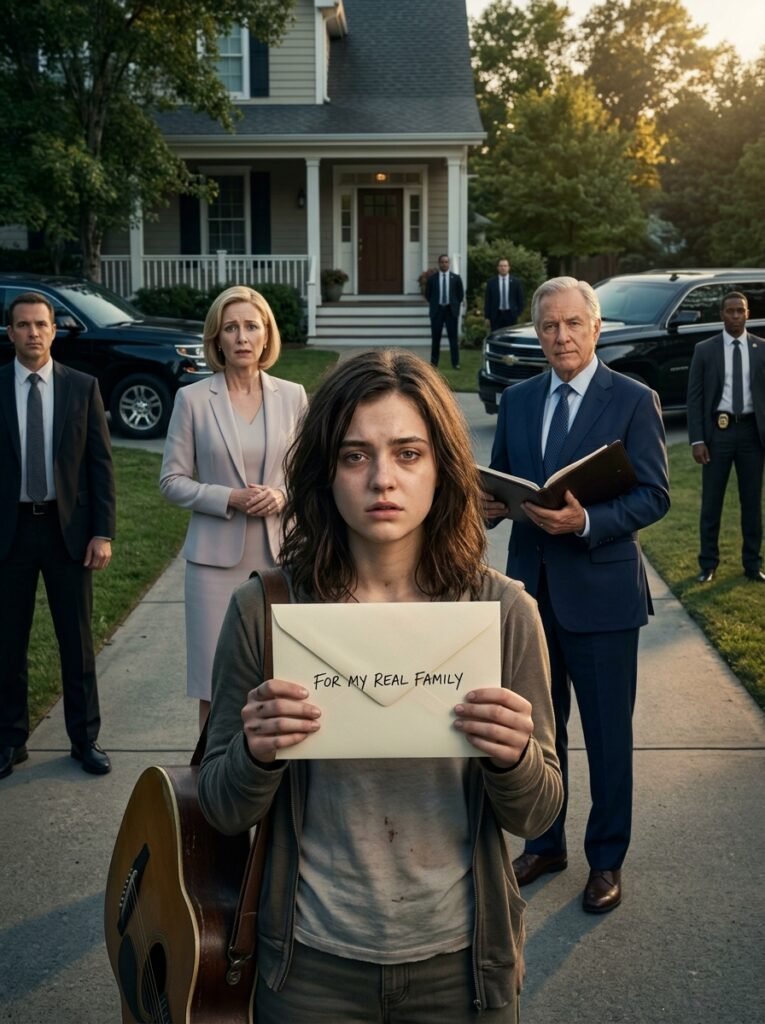
But when I turned onto our street, I hit the brakes. Five black SUVs were parked outside the house. Men in dark suits stood near the porch. At first, I thought Cheryl had called security to keep me away.
Then the front door opened. Cheryl stepped out, pale as paper, her lipstick trembling at the edges. “Oh!” she said too brightly. “I was just about to call you, sweetheart.” Sweetheart. She had never called me that in her life.
I blinked. “What’s going on?” Before Cheryl could answer, an older man in a navy suit walked out behind her holding a leather folder. He looked straight at me and asked, “Are you Lily Carter?” My throat tightened. “Yes.” His expression softened. “I’m Attorney Daniel Whitcomb. I represented your father.” Cheryl’s face twisted. “This is a private matter.” The lawyer ignored her.
“Your father left instructions that could only be opened after his funeral.” I looked from him to the SUVs. “Instructions for what?” He opened the folder slowly. “For you.” Cheryl stepped forward fast. “She doesn’t need to hear this.” The lawyer’s voice turned cold. “Mrs. Carter, if you interrupt again, the officers will remove you from the property.” Officers.
My eyes moved to the men in suits, and for the first time, I saw the badges clipped at their belts. Cheryl’s knees seemed to weaken. Attorney Whitcomb handed me one sealed envelope. On the front, in my father’s handwriting, were four words that made my chest collapse: For my real family.
I sat in my truck staring at the brass key in my palm while the words from Daniel Mercer’s letter burned through everything I thought I knew about my thirty-two years at Hartwell Components. The evidence was never destroyed.
It was hidden in Locker 12. Locker 12 had not been used since the old maintenance wing closed twenty years earlier.
Most employees did not even know it existed, but I did. It stood behind the retired press line, beyond a steel door management kept locked because they claimed the area contained asbestos. I looked back at the loading docks. Only a few cars remained in the parking lot, including Kyle’s silver SUV near the administration entrance. I should have driven home. My daughters were waiting to take me to dinner.
But retirement suddenly felt less important than the truth someone had hidden for twenty-five years.
I slipped the key into my pocket and walked back inside. The plant sounded different after hours. Machines had stopped, fluorescent lights hummed above empty aisles, and my footsteps echoed across the concrete floor. I passed the press that nearly crushed my right hand in 1998.
Even after all those years, the sight of it made my fingers ache. Management had blamed me for bypassing a safety guard.
I knew I had not touched it, but the official report said otherwise. Daniel Mercer, the plant manager then, disappeared three weeks after I signed the settlement. The company claimed he had resigned. Locker 12 stood at the end of the abandoned wing beneath a layer of dust. The brass key turned smoothly. Inside was a metal toolbox, a stack of sealed envelopes, and an old video cassette labeled PRESS 4—JULY 17, 1998. Beneath it sat the original safety report.
I opened it with shaking hands. The inspection had found a defective emergency sensor two weeks before my accident. Replacement parts were ordered, but a senior executive canceled them because shutting down the line would cost the company nearly two hundred thousand dollars. At the bottom was a handwritten instruction: Continue production. If an incident occurs, assign operator error. The signature belonged to Arthur Hartwell, the founder’s son and current chairman of the board. My stomach turned. They had known the machine could hurt someone. They chose production over safety and then destroyed my reputation to protect themselves. A floorboard creaked behind me.
I turned and found Kyle standing in the doorway. His face was pale. “You weren’t supposed to come back inside,” he said. I held up the report. “You knew what was in that envelope?” He closed the door behind him.
“I was told to hand it to you after the party.” “By whom?” “Daniel Mercer.” The name hit me like a second accident. “Daniel disappeared twenty-five years ago.” Kyle shook his head. “No. Hartwell paid him to leave after he refused to sign the false report. He has been collecting evidence ever since.” “Why give it to me now?” Kyle looked toward the toolbox. “Because the company is being sold tomorrow.
Once the sale closes, the old corporate records will be legally transferred and possibly destroyed.” I pulled out my phone. “Then I’m calling the police.” Kyle stepped forward. “Wait. There’s more.” He opened one of the sealed envelopes. Inside were copies of injury reports from seventeen workers. Burns, crushed fingers, damaged lungs, permanent hearing loss. Every incident had been rewritten as employee negligence.
Several names belonged to men who had died believing their injuries were their own fault. “They did this to all of us,” I whispered. Kyle nodded. “And they still are.” Suddenly, the lights went out. Darkness swallowed the wing. A second later, the steel door slammed shut behind Kyle. Someone locked it from the outside.
Smoke began creeping beneath the door. “They’re burning the records,” Kyle said. I grabbed the toolbox while he pulled the fire alarm, but no siren sounded. The system had been disabled. We moved through the smoke toward an emergency exit I remembered from years earlier.
It had been chained shut, but thirty-two years inside that plant had taught me every weakness in the building. I used a steel bar to break the rusted latch, and we stumbled into the loading yard carrying the evidence.
Fire trucks were already approaching. Kyle had secretly sent copies of Mercer’s letter to a federal investigator before giving me the envelope. Agents arrived minutes later and stopped Arthur Hartwell’s security chief near the administration building with gasoline on his clothes and the disabled alarm key in his pocket. By sunrise, federal investigators had sealed the plant. Arthur Hartwell was arrested at the airport while attempting to leave the country. Daniel Mercer returned two days later. He was eighty-one, thin, and walking with an oxygen tank.
He met me outside the courthouse and apologized for waiting so long. “I was afraid they would destroy you completely if I came forward,” he said. “They already took enough,” I replied. “But they don’t get to keep the truth.” The evidence led to criminal charges against three former executives and a class-action settlement for dozens of workers and their families. My original accident report was officially corrected.
The company admitted the press had been defective and that I had been blamed to conceal management’s decision. My settlement included enough money to pay off both my daughters’ homes and establish a fund for injured factory workers. But the money was not the part that mattered most.
Six months later, the city installed a memorial outside the reopened plant listing every worker harmed by Hartwell’s negligence. My name appeared there, not as a careless operator, but as the employee whose evidence finally exposed the truth.
At the dedication ceremony, Kyle handed me the generic retirement plaque I had expected at the party. My name was spelled correctly. Beneath it, someone had added a new line: Thirty-two years of service—and the courage to make them answer for every one. I looked at my daughters, the families of the injured workers, and Daniel Mercer standing beside the memorial.
My retirement party had lasted forty minutes, but the truth hidden in Locker 12 had waited twenty-five years for someone to turn the key.