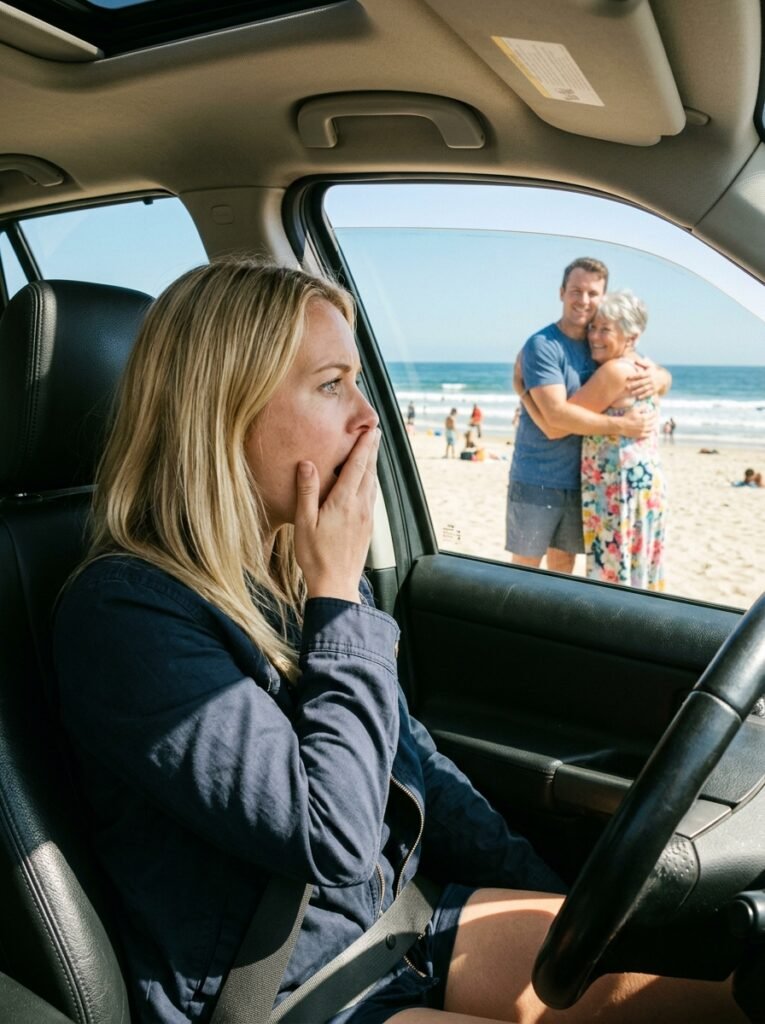
I sat in my car, my heart pounding in my chest. What I saw through the window of my mother-in-law’s house left me speechless. My husband was not alone.
He stood by the window, talking with a woman I didn’t recognize. They seemed deep in conversation, oblivious to the world around them. I wanted to look away, to pretend this wasn’t happening, but I was frozen.
The woman was younger, maybe in her late twenties. She had long, dark hair and wore a bright smile that seemed to light up the room. My husband appeared comfortable and relaxed around her, a look I hadn’t seen on his face for a long time. I was confused, and a thousand questions raced through my mind.
Who was she? What was she doing in my mother-in-law’s house? And why was my husband spending so much time with her?
I watched them for what felt like hours but was likely only minutes. They laughed and talked as if they shared a secret world I knew nothing about. I felt a strange mix of emotions: anger, sadness, and betrayal. My mind wanted to jump to conclusions, but my heart held onto a shred of hope that there was a logical explanation.
I decided to leave before I was seen. I drove home in silence, my mind replaying what I’d witnessed. I needed answers, but I didn’t know how to ask the questions. Confronting my husband felt terrifying, yet ignoring what I’d seen wasn’t an option either.
That evening, my husband returned home, just as he said he would. He greeted me with a kiss and asked about my day. I wanted to scream and demand the truth, but I held back, hoping he might offer an explanation on his own.
We ate dinner in silence. The air was thick with unspoken words, and I struggled to keep my emotions in check. I needed time to think, to figure out my next move. Should I confront him directly? Or should I wait and try to gather more information? My mind was a whirlwind of uncertainty.
As we sat together, I realized I couldn’t go on like this. I needed to know the truth, no matter how painful it might be. I decided to give myself a little time to process everything before approaching him. In the meantime, I vowed to be observant, to notice any little detail that could provide answers.
I went to bed that night feeling heavy with confusion and doubt. Sleep didn’t come easy as my thoughts kept returning to the woman in the window and the easy camaraderie she shared with my husband. What had started as a simple act of curiosity now felt like the beginning of a painful journey toward the truth.
I knew that whatever was happening, I needed to face it head-on. But how? And when? These questions lingered as I finally drifted off into a restless sleep.
This was just the beginning. I knew there was more to uncover, and I was prepared to find out everything. But that would have to wait for another day.
The days that followed felt like walking on thin ice, every step deliberate, every word measured. I threw myself into small, quiet observations—checking his phone when he showered, noting the increasing frequency of texts he’d angle away from me, the way he’d started stepping onto the porch to take certain calls.
On Wednesday, I found a receipt in his jacket pocket. A pharmacy, in the town where his mother lived, dated the previous Saturday. Prenatal vitamins.
My hands went cold.
I sat with that receipt for nearly an hour before I put it back exactly where I’d found it, my mind spinning through every possible explanation and finding none of them comforting. A young woman. Prenatal vitamins. My husband’s mother’s house, transformed suddenly into the site of some secret I couldn’t yet name.
I called my sister that night, unable to hold the weight of it alone any longer.
“You need to just ask him,” she said. “Rip the bandage off, Sarah. This is eating you alive.”
“What if the answer is worse than not knowing?”
“It won’t be. Not knowing is already worse. Trust me.”
But I wasn’t ready. Not yet. Some coward’s instinct told me I needed more than a receipt and a stolen glimpse through a window before I could confront a truth that might unravel everything I thought I understood about my marriage.
So instead, I followed him again.
The second time was easier, in the terrible way that repeating any painful thing becomes easier. I told my husband I was visiting my own mother for the weekend, and instead drove the twenty minutes to his mother’s house, parking further down the street this time, in the shade of an old oak tree where I could watch without being seen.
He arrived within the hour, carrying grocery bags—the ordinary, mundane image of a son helping his aging mother, except for the young woman who opened the door for him before he even knocked, greeting him with the familiar ease of someone who lived there.
I watched him hand her the bags. Watched her rest a hand, briefly, against her lower belly in a gesture I recognized instantly, having seen my own sister make the same unconscious movement three times over three pregnancies.
The woman was pregnant. Visibly, unmistakably pregnant, further along than I’d first realized from the distance of my earlier visit.
I don’t remember driving home. I remember arriving in my own driveway with no memory of the roads I’d taken, my hands shaking so badly I could barely turn the key in the ignition.
That night, when my husband called to check in on my “weekend with my mother,” I nearly told him everything I knew. Instead, I said I was tired, and hung up before my voice could betray me.
I didn’t sleep. I sat at our kitchen table with a legal pad, the same kind I used for work presentations, and wrote down everything I knew, everything I’d seen, everything that didn’t add up. A young pregnant woman living in his mother’s house. Daily visits that had escalated over six months. Prenatal vitamins. The easy, familiar comfort between them that I’d mistaken, at first glance, for something romantic, though now I wasn’t certain what it actually was.
Affair. The word sat heavy on the page, obvious and yet somehow incomplete. If this were simply an affair, why would he bring her to his own mother’s house? Why would his mother, presumably, be complicit in hiding a mistress and her pregnancy from me?
Unless it wasn’t a mistress at all.
I sat back slowly, a different possibility taking shape—one that felt, somehow, both more devastating and more plausible than simple infidelity. A possibility that involved a family secret far older and far more complicated than anything I’d imagined driving home from that window two weeks earlier.
I decided, finally, that I couldn’t uncover the truth from a distance any longer.
Monday morning, once my husband left for work, I drove to his mother’s house one final time.
But this time, I intended to knock on the door.
My mother-in-law, Rosalind, opened the door already looking as though she’d been expecting this exact moment for months, her face draining of color when she saw me standing on her porch alone.
“Sarah,” she said carefully. “This is a surprise.”
“Is it?” I asked. “I think you’ve known I’d come eventually.”
She hesitated, glancing over her shoulder into the house, then stepped back to let me in without another word. The young woman I’d seen twice now through that window sat at the kitchen table, one hand resting protectively over her rounded belly, her expression shifting from curiosity to alarm the moment she registered who I must be.
“You’re Sarah,” she said quietly. It wasn’t a question.
“And you are?”
“Mia,” she said. “I’m—” She glanced at Rosalind, uncertain, as though seeking permission for a truth she’d clearly been asked to keep hidden.
“Sit down, Sarah,” Rosalind said, her voice heavy with something between exhaustion and relief. “I think it’s time you knew everything. I’m sorry it took this long. I begged David to tell you sooner, but he was afraid, and I let my own fear keep me quiet longer than I should have.”
I sat, my heart pounding, bracing myself for whatever devastating truth was about to reshape my marriage.
“David has a sister,” Rosalind said. “A half-sister. Mia’s mother was someone I never told David about, someone from before I married his father. I gave her up for adoption thirty years ago, when I was seventeen and had no way to raise a child alone. I never told anyone. Not David, not his father, not a single soul, until Mia found me eight months ago through one of those genetic testing services.”
I sat frozen, the shape of the truth rearranging itself entirely from what I’d feared.
“She’s not—” I started.
“She’s not having an affair with your husband,” Rosalind said gently. “She’s his sister, Sarah. His half-sister, newly discovered, pregnant and estranged from her own adoptive family after a difficult falling out, with nowhere else to go. David has been coming here every day because he’s been helping me support her through the pregnancy, get her set up with prenatal care, help her find her footing before the baby comes. He wanted to tell you from the very beginning. I asked him not to, at least not until I found the courage to face what I’d hidden for thirty years myself.”
I stared at Mia, seeing now, in the shape of her face, in the particular set of her eyes, an echo of my husband’s own features that I’d somehow missed entirely from the distance of a car window, blinded by an assumption I’d never questioned once it took root.
“Why didn’t he just tell me?” I asked, my voice cracking. “I’ve spent three weeks imagining the worst. An affair. A secret family. I followed him twice, Rosalind. I’ve barely slept.”
“That’s my fault,” Rosalind said, tears finally spilling over. “I asked him to protect my secret a little longer, terrified of how it would look—an old woman’s shame, thirty years buried, suddenly forced into the light. I didn’t think about what my silence would cost you. I’m so sorry, Sarah. Truly.”
Mia reached across the table, her hand trembling slightly. “For what it’s worth, David talks about you all the time. How much he loves you, how guilty he’s felt every single day he’s had to lie about where he was going. He wanted to bring you here himself, months ago. I’m the one who kept asking for more time, needing to figure out my own life first before adding anything else complicated to the mix.”
I sat there, feeling the strange, disorienting vertigo of watching an entire imagined narrative collapse and rebuild itself in real time—not into betrayal, but into something more complicated and, ultimately, more forgivable: a family’s tangled, imperfect attempt to protect an old secret while quietly doing right by someone who needed help.
David came home early that evening, his face pale when he found me sitting at our own kitchen table with the same legal pad from the night before, though now the words on it had a very different meaning than they had that morning.
“Rosalind called me,” he said quietly, sitting down across from me. “She told me you came by. That she finally told you everything.”
“You should have told me,” I said, my voice steady despite the emotion still churning beneath it. “Weeks ago. Months ago, even, the day Mia first showed up. I imagined the worst, David. I followed you. Twice.”
“I know,” he said, his voice breaking. “I wanted to tell you so many times. Every night I came home and lied about where I’d been, it felt like poison. But my mother was so ashamed, so afraid of what you’d think of her, and I kept telling myself just one more week, until I’d tell you properly, and then the week would pass and I’d lose my nerve all over again.”
“I need you to understand what those three weeks did to me,” I said. “The fear. The sleepless nights. I sat in my car outside your mother’s house, convinced I was watching my marriage fall apart, and the entire time, you were just trying to help your sister.”
“I’m sorry,” he said. “I should have trusted you with it from the start. I should have trusted that you’d understand, instead of assuming silence would protect anyone. It just protected the lie a little longer, and cost you everything real in the meantime.”
We sat together for a long time that evening, working through the wreckage of assumptions and secrets that had nearly cost us something neither of us actually wanted to lose. It wasn’t a simple conversation, and the trust didn’t rebuild itself overnight—some part of me needed weeks to fully release the fear those two window-glimpses had planted so deeply.
But slowly, we did rebuild it. David brought me to meet Mia properly the following weekend, and I found myself, unexpectedly, genuinely fond of her—a young woman navigating an enormous life change with remarkably little support, grateful beyond words for a brother she’d only just discovered and a mother-in-law she barely knew who’d nonetheless opened her home without hesitation.
Mia’s daughter was born five months later, a healthy girl with the same eyes I’d first noticed on her mother’s face across Rosalind’s kitchen table. David held his niece for the first time with an expression of pure, uncomplicated joy, and I stood beside him, feeling the particular relief of a fear finally, fully laid to rest.
Rosalind, for her part, spent those months slowly shedding thirty years of shame, finding in her granddaughter’s arrival something closer to redemption than she’d ever expected to feel. She told me once, sitting in her garden with the baby asleep against her chest, that keeping that secret for three decades had cost her more than she’d ever let herself admit, and that watching her family finally, fully know each other felt like putting down a weight she hadn’t realized she’d been carrying her entire adult life.
I think about that first terrible drive home often—the cold certainty of betrayal I’d felt watching my husband through a stranger’s window, the sleepless nights spent imagining the worst version of a story I didn’t yet have all the pieces to. I learned, in the end, that suspicion left unexamined has a way of writing its own devastating narrative long before the truth ever gets a chance to speak.
David and I are stronger now than we were before any of this began—not because the secret didn’t cost us anything, but because working through the wreckage of it, together, taught us both something we hadn’t fully understood before: that the truth, however complicated or long-hidden, is almost always kinder in the end than the silence built to protect it.