My grandma spent $30,000 to join our family’s Europe trip. But at the airport, my dad said, “I forgot your ticket—just go home.” The way everyone avoided her eyes told me it wasn’t an accident. I stayed with her.
Three weeks later, my parents came back—and the whole family froze, like they were holding their breath, when they saw me standing beside a man. Because…That morning at the airport had started out so normal it almost felt harmless—the steady rattle of suitcase wheels, the burnt-coffee smell drifting from a kiosk, the overhead voice repeating gate changes like a lullaby.
My aunt was fussing with everyone’s documents like she was running a school field trip. My cousins didn’t look up from their screens. Nobody looked up for my grandma either, not really. Grandma Hazel was the kind of woman who still kept paper plates under the sink for church potlucks and wrote grocery lists on the back of old envelopes. She lived in a quiet Tennessee town where neighbors waved from porches and the mailbox row felt like a tiny daily roll call.
She’d worked for years, saved quietly, and never asked her kids for anything—so when my parents announced a big Europe trip and said it would be “the whole family,” she lit up in a way I hadn’t seen since I was little.
Then came the strange part: the sudden sweetness.
My dad started calling her more. My mom’s voice softened into something almost rehearsed. Even my aunt sent gifts and long messages, the kind that ended with, We’re finally doing this together. I told myself it meant they were making up for lost time.
I wanted to believe that. I wanted Grandma to believe it more.
At the check-in counter, the lie showed its face.
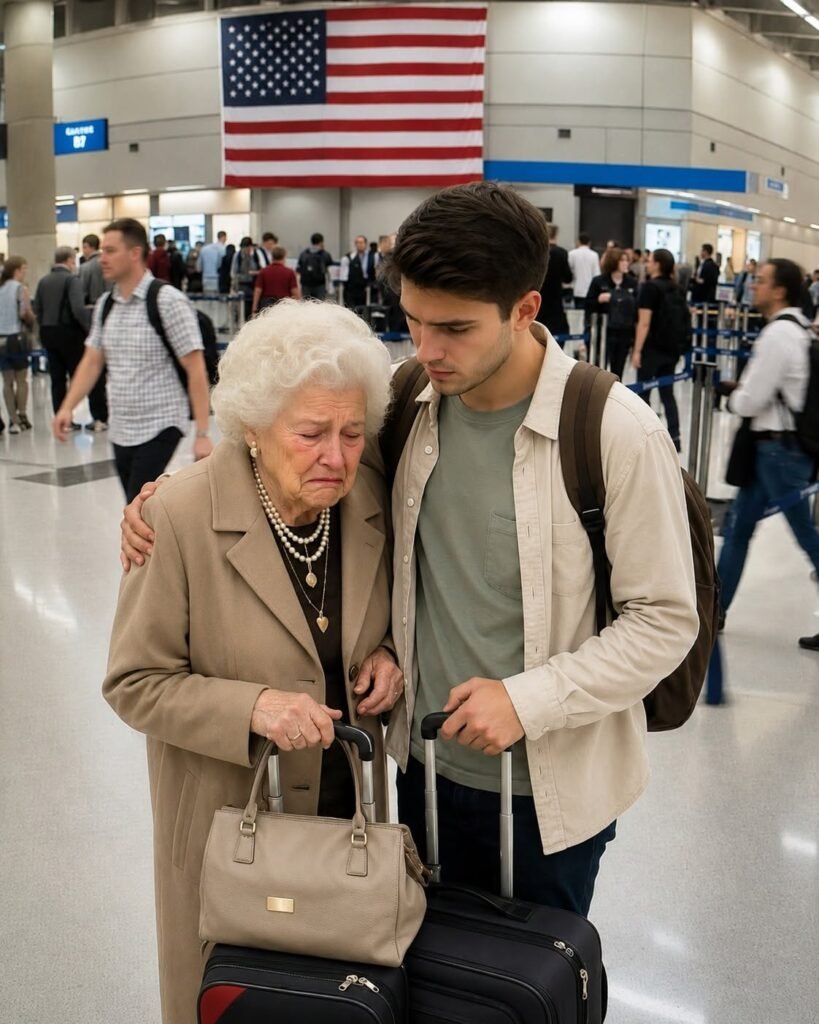
Grandma stepped forward with her old green suitcase and asked, polite as always, “Where’s my ticket?”
My dad didn’t panic. He didn’t scramble. He didn’t even look embarrassed.
He sighed like she’d asked for something inconvenient and said, “I forgot your ticket—just go home.”
It wasn’t the sentence that shattered me first.
It was the silence after it.
My mom stared at her phone like the screen could save her. My aunt adjusted her purse strap and looked over Grandma’s shoulder. My cousins suddenly found the floor very interesting. No one met Grandma’s eyes. No one said, Wait—this isn’t right.
Grandma’s fingers tightened around the suitcase handle. Her shoulders moved once, the smallest tremor, and then she made that soft, careful smile people wear when they refuse to fall apart in public. In that moment, I understood something ugly: this wasn’t a mistake. It was a plan everyone knew, and Grandma was the only one who didn’t.
So I stayed.
I didn’t argue in the terminal. I didn’t give anyone the satisfaction of a scene. I just picked up Grandma’s suitcase, guided her away from the counter, and got her out of that bright, unforgiving space. On the ride back, she stared out at the interstate like it had answers. She didn’t ask for an apology. She didn’t even ask why. That quiet was heavier than any shouting.
The next three weeks felt like a different life. Morning tea. Soft routines. A neighborhood so calm it made the betrayal feel louder. One afternoon, I opened her mailbox and found a glossy travel flyer wedged inside like a joke. Grandma didn’t comment. She only folded it once—neat, precise—and set it on the table like she was putting away a feeling.
Then the day my parents returned, I went to the arrivals area alone.
Families stood around with balloons and cardboard signs. People cheered. Luggage thumped. A child laughed near the sliding doors. And I stood there, still as a post, with a man beside me—pressed shirt, calm eyes, a lanyard clipped cleanly at his waist, his posture so steady it made my heartbeat feel loud.
When my parents and aunt finally walked out with their suitcases, they were smiling—already mid-story, already reliving their trip.
Then they saw me.
And then they saw him.
My dad’s smile didn’t fade slowly. It snapped off. My mom’s hand tightened around her bag strap. My aunt stopped walking like her feet forgot what to do next.
The man beside me didn’t rush. He didn’t raise his voice. He simply shifted one small step forward—just enough to make them understand this wasn’t going to be waved away like a “mix-up” anymore.
And right before he spoke, the whole family went perfectly, painfully still.
“Mr. Bennett?”
My father swallowed.
The man beside me opened a slim leather folder.
“My name is Daniel Reeves. I’m a forensic investigator with Cumberland Financial Crimes.”
My aunt’s suitcase tipped sideways.
Nobody reached for it.
Dad looked at me.
Not Daniel.
Me.
“What did you do?”
That question told me more than any confession could have.
Not What’s this about?
Not Is Grandma okay?
What did you do?
I felt something inside me settle.
“I listened.”
Dad’s face hardened. “To what?”
“Grandma.”
Mom finally found her voice.
Her words came out thin.
“Where is Hazel?”
“Home.”
Mom’s eyes darted toward Daniel.
“We should talk privately.”
“We will,” Daniel said. “But first, Mr. Bennett, I need to confirm you’ve received notice that accounts associated with the European travel payments have been placed under temporary review.”
Dad’s face lost color.
My aunt whispered, “What accounts?”
He shot her a look.
Too fast.
Daniel noticed.
So did I.
My heart began pounding.
I had known something was wrong.
I hadn’t known how wrong.
It started two days after they left.
Grandma and I were drinking tea when she pulled an envelope from the kitchen drawer.
“I suppose they’ll send back whatever wasn’t used.”
“What wasn’t used?”
“My thirty thousand.”
The mug stopped halfway to my mouth.
“What thirty thousand?”
Grandma looked confused.
“For Europe.”
I put the cup down.
“You paid thirty thousand dollars?”
“Your father said that was my share.”
I stared at her.
“For one person?”
“He said hotels were expensive.”
“Grandma.”
Her smile disappeared.
I asked how she’d paid.
Three transfers.
Ten thousand dollars each.
All sent to an account Dad had given her.
I asked whether she’d received receipts.
She brought me a folder.
Grandma kept everything.
Bank statements.
Printed emails.
Handwritten notes from phone calls.
Even the brochure Dad had given her.
I spent two hours at her dining table.
Then I found the first crack.
The travel company listed on the brochure didn’t exist.
The address belonged to a mailbox rental store.
The confirmation number was meaningless.
And Grandma’s name wasn’t on a single hotel reservation she had been sent.
The next morning, we went to her bank.
By afternoon, their fraud department had called Daniel.
And by the end of the first week, Daniel had discovered Grandma wasn’t the only one whose money had gone into that account.
Now Dad stood in the airport staring at the man who knew.
“You investigated me while I was overseas?”
Daniel’s expression didn’t change.
“Your mother’s bank reported suspected elder financial exploitation.”
“That’s ridiculous.”
“Is it?”
Dad stepped toward me.
“You put her up to this.”
“No.”
“You’ve always hated how this family works.”
I almost laughed.
“I didn’t know stealing from Grandma was how this family worked.”
Mom flinched.
My cousins stood several feet behind her.
Neither said a word.
My aunt whispered, “Stealing?”
Dad spun toward her.
“Don’t.”
Daniel’s eyes sharpened.
“What exactly shouldn’t she say?”
Dad grabbed his suitcase.
“We’re leaving.”
Two uniformed airport officers appeared near the doors.
They didn’t approach.
They didn’t need to.
Dad saw them.
His hand slowly released the suitcase handle.
Daniel closed the folder.
“Mr. Bennett, nobody is arresting you at this moment. But I strongly suggest you cooperate.”
At this moment.
The phrase landed.
Mom started crying.
Quietly.
Dad looked at her with disgust.
“Stop.”
That made me angrier than anything he’d said to me.
“Don’t talk to her like that.”
His eyes snapped toward mine.
“You have no idea what you’ve done.”
“Then tell me.”
Silence.
People flowed around us.
Reunions.
Hugs.
Welcome-home signs.
All that happiness passing within feet of our family while ours stood cracking open under fluorescent lights.
My aunt suddenly sat on her suitcase.
“I gave you twelve thousand.”
Dad closed his eyes.
Mom covered her mouth.
My aunt stared at him.
“For the hotels.”
No answer.
“Michael.”
Dad looked away.
Her voice rose.
“You told me everybody was paying you because you got the group rate.”
Daniel reopened his folder.
“When did you transfer the money?”
Dad stepped between them.
“Laura, shut up.”
My aunt recoiled.
Daniel said, “Ms. Bennett, don’t answer here if you’re uncomfortable. We can take a formal statement.”
She stared at Dad.
Something old moved behind her eyes.
Not just shock.
Recognition.
“How much did Mom give you?”
Dad’s jaw tightened.
My aunt looked at me.
I answered.
“Thirty thousand.”
She stood so fast the suitcase rolled backward.
“You said you were covering Mom.”
Mom whispered, “Laura.”
“No.”
Aunt Laura turned on her.
“You knew?”
Mom’s face collapsed.
And there it was.
The worst possible answer.
Not spoken.
Visible.
Laura took one step backward.
“Oh my God.”
My cousins finally looked up from their phones.
Dad said, “Nobody stole anything.”
Daniel waited.
Dad’s voice grew louder.
“The money paid for the trip.”
“Grandma didn’t go.”
“Because there was a booking problem.”
I stared at him.
“You told her to go home.”
“I was stressed.”
“You didn’t even check.”
“We were going to miss the flight.”
“You had three weeks to buy her a ticket.”
His mouth opened.
I kept going.
“You had her passport details six months ago. You collected thirty thousand dollars. You printed a fake travel-company brochure.”
His face changed.
That one hit.
Daniel looked at me.
I hadn’t told Dad how much we knew.
Good.
“Fake?” Laura whispered.
Dad glared at me.
“Who told you that?”
I felt cold all over.
“You just did.”
He froze.
Daniel’s expression remained neutral, but I saw the smallest movement of his pen.
Dad realized his mistake.
He turned toward the exit.
This time, one of the officers stepped forward.
“Sir, Investigator Reeves has asked that you remain available for questioning.”
Dad laughed.
A harsh, ugly sound.
“This is a family disagreement.”
Daniel’s voice lowered.
“No, sir. It stopped being that when money crossed accounts under false representations.”
Mom started crying harder.
Dad rounded on her.
“Tell them.”
She shook her head.
“Tell them the money was for the family.”
Mom stared at the floor.
“Carol.”
Her shoulders trembled.
“I can’t.”
The airport seemed to go silent again.
Dad whispered, “What?”
Mom lifted her face.
Mascara had gathered beneath one eye.
“I can’t keep doing this.”
For the first time, Dad looked afraid.
Not of Daniel.
Of her.
“Carol.”
She pulled something from her handbag.
A folded hotel receipt.
Then another.
Then a stack.
“I kept them.”
Dad’s face emptied.
Laura whispered, “Kept what?”
Mom’s hand shook so badly the papers rattled.
“The real receipts.”
Daniel stepped closer.
Dad moved between them.
“No.”
Mom recoiled.
And I saw it.
Not for the first time in her life.
For the first time in mine.
Fear.
She was afraid of my father.
Daniel saw it too.
“Mrs. Bennett, would you like to speak somewhere else?”
She nodded.
Dad grabbed her wrist.
“You’re my wife.”
I moved before I thought.
So did Laura.
But Daniel was faster.
“Take your hand off her.”
Dad stared at him.
One airport officer approached.
Dad released Mom.
Red marks remained around her wrist.
Nobody spoke.
Mom looked down at them.
Then she did something tiny.
She stepped away from Dad.
One step.
It was barely two feet.
But watching her do it felt like watching someone cross an ocean.
Daniel took the receipts.
“What do these show?”
Mom’s lips trembled.
“We didn’t spend thirty thousand on Hazel.”
“How much?”
“Maybe four.”
My stomach turned.
Four thousand.
Grandma had paid thirty.
“And the rest?” Daniel asked.
Mom looked at Dad.
He shook his head once.
Warning.
She closed her eyes.
“He used it to cover his business debts.”
Laura made a strangled sound.
Dad exploded.
“Our debts!”
Everyone jumped.
His voice echoed off the terminal ceiling.
“Our house. Our life. Your credit cards. Your children’s tuition. Everybody stands there judging me, but I’m the one who’s held this family together for twenty-five years!”
I had never seen his face like that.
Veins standing in his forehead.
Eyes bright with fury.
“You think money appears from nowhere? You think Mom needs thirty thousand sitting in an account? She barely leaves Tennessee!”
I couldn’t breathe.
There it was.
Not denial.
Justification.
Daniel asked quietly, “So you considered her savings available to you?”
Dad realized too late what he’d admitted.
He looked around.
Mom.
Laura.
His children.
Me.
No one came to rescue him.
He whispered, “You don’t understand.”
I thought of Grandma at the airport.
Her green suitcase.
That careful smile.
The way she had protected him even in humiliation by refusing to make a scene.
“I understand enough.”
Dad looked at me.
“You chose her over your own parents.”
“No.”
My voice shook.
“I chose the person you abandoned.”
He stared at me.
And something behind his eyes shut.
Daniel and the officers escorted my parents to a private interview room.
Laura went voluntarily.
My cousins followed her.
I stayed behind.
For several minutes, I stood beside the luggage carousel while strangers collected bags around me.
My knees started shaking.
I sat down.
I had imagined that moment for three weeks.
I thought exposing the truth would feel powerful.
It didn’t.
It felt like discovering your childhood home had termites.
The house might still be standing.
But now you knew what had been eating it.
Daniel found me twenty minutes later.
He sat beside me.
“You did well.”
“I feel sick.”
“That’s normal.”
“Is he going to prison?”
“I don’t know.”
I looked at him.
He didn’t offer false certainty.
I appreciated that.
“But this is bigger than the thirty thousand,” he said.
“How much bigger?”
He hesitated.
“We identified six transfers into the same account over eighteen months.”
“From who?”
“Your grandmother.”
My stomach dropped.
“No.”
“She doesn’t remember all of them.”
“How much?”
“Just over eighty-seven thousand dollars.”
The carousel blurred.
I gripped the edge of the bench.
“She only told me about thirty.”
“We know.”
“Why didn’t you tell her?”
“Because we weren’t sure yet.”
I thought of Grandma counting coupons.
Saving leftovers in glass containers.
Waiting until winter sales to buy a coat.
Eighty-seven thousand dollars.
Then Daniel said, “There’s something else.”
I looked at him.
“Your father had power of attorney.”
I stared.
“Grandma never mentioned that.”
“She may not have understood what she signed.”
“When?”
“Eight months ago.”
The sudden sweetness.
Dad calling more.
Mom visiting.
Laura sending gifts.
My skin went cold.
Daniel continued.
“The document gives him broad financial authority.”
“Can he take her house?”
“Not legally for his own benefit. But if he’s already abusing the authority, we need to move quickly.”
I stood.
“I need to get home.”
Daniel drove me.
Grandma was sitting on the porch when we arrived.
Two glasses of sweet tea waited on the little table.
She looked at Daniel’s government car.
Then at me.
Her smile faded.
“What happened?”
I sat beside her.
For a second, I was eight years old again.
Skinned knee.
Grandma waiting with a washcloth.
I didn’t know how to reverse the roles.
So I took her hand.
“Dad took more than the trip money.”
Her fingers went still.
“How much?”
I told her.
She didn’t gasp.
Didn’t cry.
She stared toward the mailbox.
A cardinal hopped along the fence.
“Eighty-seven thousand?”
“Yes.”
Her thumb rubbed once across my knuckles.
“I thought I was getting forgetful.”
My chest tightened.
“What?”
Grandma looked at me.
“There were times I’d check my account and think there should be more.”
Her voice was soft.
“Michael would tell me we’d already discussed it. He’d say I’d agreed to help.”
She swallowed.
“I started writing things down because I thought my mind was going.”
I couldn’t speak.
Grandma looked toward the kitchen window.
“He’d get impatient when I asked twice.”
Her hand trembled.
“He told me maybe it was time I let him handle things.”
Daniel stood several feet away.
Even he looked stricken.
Grandma whispered, “I believed him.”
I moved closer.
“No.”
She looked at me.
“He made you doubt yourself.”
Her eyes filled.
One tear slipped down.
She wiped it away almost angrily.
“That’s worse than the money.”
I knew.
Money could be returned.
What do you give someone back after convincing her she can’t trust her own mind?
Daniel arranged an emergency review of the power of attorney.
By the next afternoon, it was revoked.
Grandma’s accounts were secured.
Her house was protected.
Then the investigation widened.
Dad’s business wasn’t merely struggling.
It was collapsing.
For two years, he’d borrowed money to cover losses, then borrowed more to hide the borrowing.
Grandma’s savings became his emergency fund.
The Europe trip had been his most brazen attempt.
The family vacation was real.
Grandma’s place on it never was.
He had charged everyone inflated “group costs,” then used the difference to make a loan payment due while they were overseas.
And the fake brochure?
Dad had created it himself.
The evidence came from his own laptop.
His downfall wasn’t a clever trap.
It was his own arrogance preserved in documents.
Emails.
Transfers.
False invoices.
A forged signature.
And eventually, a recording.
Mom had made it.
That was the hidden truth none of us expected.
Two months before Europe, she had confronted him in their kitchen.
She’d suspected Grandma’s money was being used.
Dad admitted it.
Mom recorded seventeen minutes on her phone.
She didn’t go to police.
She didn’t stop the trip.
She didn’t warn Grandma.
She kept the recording because, in her words, “I needed proof I wasn’t imagining who he had become.”
When prosecutors played part of it for us, I watched Grandma’s face.
Dad’s recorded voice filled the conference room.
“She has more money than she’ll ever use.”
Then Mom:
“It’s Hazel’s.”
Dad laughed.
“Eventually it’ll be ours anyway.”
Grandma closed her eyes.
Nobody moved.
Laura covered her mouth.
Mom sat at the far end of the table.
She looked smaller than I remembered.
Then Dad’s voice said the sentence that ended any possibility of misunderstanding.
“Once we’re back from Europe, I’ll tell her the refund got delayed. She’ll forget about it.”
Grandma opened her eyes.
Mom began to sob.
Not loudly.
Her shoulders simply folded.
“I’m sorry.”
Grandma looked at her for a long time.
“Did you know they weren’t taking me?”
Mom nodded.
The room became unbearably still.
“How long?”
“Two weeks before.”
Grandma’s chin trembled.
“And you let me pack.”
Mom covered her face.
That was the wound.
Not the eighty-seven thousand.
Not the power of attorney.
Grandma packing her green suitcase while Mom knew.
“I was afraid of him.”
Grandma nodded slowly.
“I believe you.”
Mom looked up.
Hope flickered.
Then Grandma continued.
“But you were willing for me to be hurt so you wouldn’t have to be.”
Mom’s face collapsed.
Grandma’s voice never rose.
“I can understand your fear, Carol. Understanding isn’t the same as excusing what you did with it.”
Nobody breathed.
Mom whispered, “Will you ever forgive me?”
Grandma stared at the table.
“I don’t know.”
It was the most honest thing anyone had said in months.
Dad was charged with financial exploitation of an elderly person, forgery, fraud, and offenses tied to the misuse of Grandma’s financial authority.
His company entered bankruptcy.
The house he had spent years using as proof of success was sold.
His country-club membership disappeared.
So did the leased luxury SUV.
Friends who had toasted him in photographs suddenly couldn’t remember the last time they’d spoken.
But the punishment that mattered happened before sentencing.
Grandma gave a victim statement.
She wore a blue dress.
Pearl earrings.
Nothing dramatic.
She stood at the front of the courtroom with both hands resting on the podium.
Dad sat behind his attorney.
He couldn’t look at her.
Grandma waited.
Eventually, he did.
“You told people I was getting confused.”
Dad’s face tightened.
“You told me too.”
Her fingers pressed into the wood.
“I started putting labels on drawers because I thought forgetting where things were meant something was wrong with me.”
I saw Dad’s attorney lower his eyes.
“I took a memory test at the senior center without telling anyone.”
Grandma paused.
“Do you know what the woman there told me?”
Dad said nothing.
“She told me I was fine.”
A tiny laugh escaped Grandma.
It broke my heart.
“I went home relieved. And then you called that night and told me we’d already discussed giving you ten thousand dollars.”
Her voice faltered.
For the first time, she looked away.
“I sat at my kitchen table and wondered whether the test was wrong.”
Dad’s face changed.
Grandma looked back at him.
“You didn’t just take my money, Michael.”
Her eyes filled.
“You made me afraid of myself.”
Silence.
Dad whispered, “Mom.”
She raised one hand.
He stopped.
“I love you.”
His face crumpled.
Grandma’s did too.
“But loving you does not require me to stand between you and the consequences of what you chose.”
Dad started crying.
Grandma stepped away from the podium.
She didn’t look triumphant.
She looked tired.
I met her at the aisle.
She took my hand.
We walked out together.
Dad accepted a plea agreement that included prison time, restitution, and permanent restrictions on managing Grandma’s finances.
His business was gone.
His reputation was gone.
Most importantly, his access to Grandma was no longer something he controlled.
She decided what contact existed.
For six months, she chose none.
Mom moved into a small apartment.
At first, Grandma wouldn’t see her either.
Mom didn’t demand forgiveness.
That helped.
She started therapy.
Got a job at a medical billing office.
Sent Grandma one handwritten letter each month.
No excuses.
No pressure.
Grandma kept them unopened in a kitchen drawer.
Then one Sunday she opened the first.
She read all six.
I found her afterward sitting at the table.
“You okay?”
“No.”
I sat beside her.
She slid one letter toward me.
“I don’t want to hate her.”
“You don’t have to decide today.”
Grandma looked at me.
“That’s what everybody keeps telling old people. Don’t decide too fast.”
A spark returned to her eyes.
“I don’t have forty years to think about everything.”
I laughed despite myself.
She smiled.
Then grew serious.
“I want to see her.”
Mom came the following Saturday.
She stood on the porch holding nothing.
No flowers.
No gifts.
Grandma opened the door.
For several seconds, neither moved.
Mom whispered, “Hi, Hazel.”
Grandma stepped aside.
“Tea?”
Mom started crying before she crossed the threshold.
Their conversation lasted three hours.
I stayed upstairs.
I heard crying.
Once, Mom raised her voice.
Grandma raised hers back.
Good.
Healing didn’t sound like politeness anymore.
When Mom left, her eyes were swollen.
Grandma hugged her.
Briefly.
Not absolution.
A beginning.
Laura’s reckoning was different.
She hadn’t known about the theft.
But she’d known Grandma had no ticket.
Dad told her two days before departure that Grandma was “too much work” and he’d invented a booking problem.
Laura had said nothing.
She came to Grandma’s house with the green suitcase.
“I should’ve stayed too.”
Grandma touched the handle.
“Yes.”
Laura cried.
Grandma let her.
“I kept thinking Michael would fix it somehow.”
“He didn’t.”
“I know.”
Grandma looked at her daughter.
“Next time somebody is being cruel, don’t wait to see whether the cruel person fixes it.”
Laura nodded.
“There won’t be a next time.”
Grandma sighed.
“Honey, there’s always a next time. Maybe not with me. That’s why you need to learn.”
Laura began volunteering at the senior center that had tested Grandma’s memory.
She didn’t announce it.
Grandma learned because Mrs. Peterson from church saw her there.
That mattered.
My cousins apologized too.
One admitted Dad had told them Grandma changed her mind about Europe.
The other confessed he’d heard the airport plan the night before and hadn’t challenged it.
Grandma didn’t let age excuse cowardice.
But she didn’t freeze them forever in their worst moment either.
“Do better while I’m alive,” she told them. “Don’t bring flowers later and call that love.”
Then came the thirty thousand dollars.
Through restitution and recovered funds, Grandma eventually received most of what Dad had taken.
I assumed she’d put it back into savings.
Instead, one morning she placed a travel brochure beside my cereal.
Italy.
Switzerland.
France.
I stared at her.
“No.”
Grandma smiled.
“Yes.”
“Grandma.”
“I bought two tickets.”
My throat tightened.
“Two?”
“Unless you’re going to abandon me at the airport.”
I laughed.
Then cried.
Then laughed harder because she did.
We left that spring.
At the airport, Grandma wore white sneakers and carried the same green suitcase.
When we reached check-in, she stopped.
Her hand tightened around the handle.
I saw the memory pass through her.
Bright terminal.
Dad’s voice.
Everyone looking away.
I didn’t touch her immediately.
I waited.
Grandma took one breath.
Then another.
She stepped forward.
“Tickets, please,” the agent said.
Grandma handed over both passports herself.
When the boarding passes printed, she stared at hers.
Her name.
Her seat.
Her destination.
Real.
She ran one finger across the paper.
“You okay?”
She nodded.
“Just checking.”
In Rome, Grandma ate gelato for breakfast.
In Switzerland, she complained that mountains were “showing off.”
In Paris, she stood beneath the Eiffel Tower and stared upward for so long I thought her neck would hurt.
I took photographs.
Not hundreds.
Enough.
One evening, we sat beside the Seine while the sky turned lavender.
Grandma held a paper cup of coffee between both hands.
“Your grandfather wanted to bring me here.”
I looked at her.
She rarely talked about him.
“He did?”
“We never had the money.”
She smiled.
“Then when we finally did, his heart wasn’t good enough.”
The river moved quietly.
“I thought that was the end of it.”
She looked at the lights appearing along the water.
“Funny thing about endings.”
“What?”
“People declare them too early.”
I leaned my head against her shoulder.
She rested her cheek against my hair.
Then she told me the final secret.
The one that changed how I understood why she had paid that ridiculous thirty thousand dollars in the first place.
“I knew it was too much.”
I sat up.
“What?”
“The trip.”
She looked almost embarrassed.
“Thirty thousand. I’m old, not stupid.”
“Then why did you pay?”
Grandma watched a sightseeing boat move beneath the bridge.
“Because your father called me the night before I transferred the first ten.”
I waited.
“He was crying.”
My stomach tightened.
“He said the business was struggling. Said he felt like he’d failed everybody.”
“Grandma—”
“I know.”
She lifted a hand.
“I know what he did afterward.”
Her voice softened.
“But at the beginning, I thought he was asking without being able to ask.”
The realization came slowly.
“You knew some of the money might help him.”
“I suspected.”
“Why?”
She looked at me.
“Because he’s my son.”
I didn’t know what to say.
Grandma’s eyes filled with reflected city lights.
“I would’ve given him money.”
That was the tragedy.
“He didn’t have to steal it,” she whispered. “He didn’t have to make me feel foolish. He could’ve sat at my kitchen table and said, Mom, I’m scared.”
Her fingers tightened around the cup.
“I might’ve helped him.”
She swallowed.
“But he wanted my money without needing my mercy.”
There it was.
The whole story.
Dad hadn’t destroyed himself because Grandma refused to help.
He destroyed himself because pride made honesty feel more humiliating than theft.
Grandma had spent months thinking she’d been foolish for trusting him.
But trust hadn’t been her weakness.
His inability to deserve it was his.
I took her hand.
“Do you regret paying?”
She considered.
“I regret what he did with my love.”
A pause.
“I don’t regret loving him.”
We sat there until the lights came on across Paris.
Three years passed.
Dad wrote Grandma from prison.
At first, she returned the letters unopened.
Then one arrived without excuses.
No explanation of his business.
No complaints about the sentence.
No request for money.
Just six pages.
He told her about the airport.
He said he’d known for weeks she had no ticket.
He admitted he’d watched her pack during a video call and almost confessed.
He didn’t.
He wrote:
I was afraid if I admitted I needed help, you would see me as small. So I made you small instead.
Grandma read that sentence three times.
Then she folded the letter.
“That’s the first true thing he’s said.”
She visited him once.
I drove her.
She made me wait outside.
When she returned ninety minutes later, her eyes were red.
“How was it?”
She buckled her seat belt.
“He looks older.”
I waited.
“He apologized.”
“Did you forgive him?”
Grandma looked through the windshield.
“I told him forgiveness is not a key to his cell.”
Then she turned toward me.
“But I told him he can become someone worth knowing when he comes out.”
That was Grandma.
Boundary and mercy in the same hand.
Dad served his sentence.
Mom rebuilt her life.
She and Grandma eventually developed something quieter than the relationship they’d had before.
Less performance.
More truth.
They cooked together sometimes.
Argued sometimes.
Mom stopped asking Grandma whether she had taken her medication in that slow, infantilizing voice she used to use.
Grandma stopped pretending everything was fine when it wasn’t.
Laura became the person who spoke first when something felt wrong.
It irritated everyone occasionally.
Grandma loved it.
Daniel Reeves disappeared from our lives once the case ended.
Or almost.
Every Christmas, Grandma sent his office pecan brittle.
The first year he called to thank her.
The second year he mailed the container back filled with homemade cookies from his wife.
By the third year, it had become a ridiculous interstate dessert exchange.
Grandma called it “federal relations.”
And me?
I learned that staying at the airport had changed me too.
Before that morning, I thought loyalty meant keeping families together.
Now I knew sometimes loyalty means refusing to participate in the thing holding a family together.
A lie.
Fear.
Money.
Silence.
Grandma turned eighty-four on a bright September afternoon.
We held the party in her backyard.
Paper plates.
Church friends.
Neighbors.
Laura brought potato salad.
Mom baked the cake.
My cousins hung lights between the trees.
Dad came too.
He had been out for seven months.
He arrived alone.
No expensive car.
No polished performance.
He stood at the gate holding a small wrapped box.
Everyone noticed.
Conversation softened.
Grandma saw him.
For one second, the old airport silence returned.
That held breath.
That uncertainty.
Then Dad walked toward her.
He stopped several feet away.
“Happy birthday, Mom.”
Grandma studied him.
“Thank you.”
He held out the box.
“You don’t have to take it.”
She did.
Inside was an old envelope.
Grandma frowned.
Then opened it.
Two airline tickets.
Not Europe.
Memphis to Charleston.
A simple weekend trip.
Dad rubbed his palms against his trousers.
“I paid for both.”
Grandma stared at him.
“I checked.”
A tiny smile appeared.
“Three times.”
People laughed softly.
Dad didn’t.
His eyes filled.
“If you don’t want to go, I understand.”
Grandma looked at the tickets.
Then at her son.
“Why Charleston?”
“Because Dad always wanted to see Fort Sumter.”
Grandma’s mouth trembled.
Dad whispered, “And because it’s close enough that if I annoy you, you can come home.”
Grandma laughed.
A real laugh.
Dad started crying.
She stood.
He didn’t move toward her.
That mattered.
He waited.
Grandma crossed the distance herself.
She put one hand against his cheek.
“My boy.”
Dad closed his eyes.
“I’m sorry.”
“I know.”
“I can’t give you back those years.”
“No.”
“I can’t undo what I did.”
“No.”
His shoulders shook.
Grandma pulled him into her arms.
Not because the past had disappeared.
Because it hadn’t.
That was why the hug meant something.
Around them, nobody applauded.
Nobody reached for a phone.
We let the moment belong to them.
Later, after sunset, Grandma and I sat on the porch.
The party had thinned.
Dad was helping fold chairs.
Mom and Laura were arguing over food containers.
My cousins were taking down lights.
Grandma held the Charleston tickets.
“You going?”
She gave me a sideways look.
“Maybe.”
“Make him sweat?”
“Absolutely.”
I laughed.
Then she became quiet.
“You know what I remember most about that first airport?”
I expected her to say Dad’s words.
The humiliation.
The ticket.
“What?”
“You picking up my suitcase.”
I looked at her.
“That’s it?”
“That’s it.”
She rubbed her thumb along the edge of the boarding pass.
“Everybody else was looking away.”
Her eyes found mine.
“You didn’t.”
My throat closed.
“I didn’t know what else to do.”
“Exactly.”
She smiled.
“Most important things aren’t complicated until people start explaining why they can’t do them.”
The porch light glowed above us.
Crickets sang beyond the yard.
Inside, Mom laughed at something Laura said.
Dad carried a stack of folding chairs toward the garage.
Ordinary sounds.
A family no longer pretending it had never broken.
Grandma leaned back.
“I spent years thinking family meant the people who would never leave you.”
She looked toward the yard.
“I was wrong.”
“What does it mean?”
“The people who come back honestly.”
I thought about that.
Then she nudged my knee.
“And the ones who stay when leaving would be easier.”
I rested my head against her shoulder.
The same way I had beside the Seine.
Her hair smelled faintly of lavender.
A year later, Grandma’s health began slowing her down.
Nothing dramatic.
Just time collecting its payment.
She gardened less.
Napped more.
Started letting me carry groceries without arguing.
Mostly.
One winter evening, we sat at her kitchen table sorting photographs from our Europe trip.
Rome.
Switzerland.
Paris.
Then I found one I didn’t remember taking.
Grandma at the airport on the morning of our second trip.
Green suitcase beside her.
Boarding pass in hand.
She wasn’t looking at the camera.
She was looking at me.
“What?”
Grandma smiled.
“I asked a lady behind us to take it.”
“Why?”
She turned the photograph over.
On the back, in her handwriting, were seven words.
The day I learned I could leave too.
I stared at it.
Grandma touched my hand.
“That first airport, they left me.”
She tapped the photograph.
“The second time, I left the fear.”
My eyes filled.
She squeezed my fingers.
“Keep that one.”
I did.
Years later, it sits framed on my desk.
Not the Eiffel Tower.
Not Rome.
Not some perfect family photograph.
An old woman with a green suitcase and a real boarding pass.
Because that was the trip that mattered.
Grandma Hazel taught me that dignity doesn’t always roar.
Sometimes it picks up a suitcase.
Sometimes it cancels a power of attorney.
Sometimes it testifies.
Sometimes it says, I love you, but no.
Sometimes it accepts an apology without pretending there was never a wound.
And sometimes it buys another ticket.
The last trip Grandma and I took wasn’t overseas.
We drove through Tennessee in spring.
Dogwoods blooming.
Windows cracked.
Old country music playing softly.
She insisted we stop at a roadside diner because a sign advertised “THE SOUTH’S BEST PIE.”
It wasn’t.
Grandma announced this loudly enough for the waitress to hear.
The waitress laughed.
We ate every bite anyway.
On the drive home, Grandma fell asleep beside me.
Her hand rested near the window.
Sunlight moved across the wrinkles in her skin.
I looked at her and thought about the woman standing in that first airport terminal.
Small beneath fluorescent lights.
Humiliated.
Abandoned.
I had believed I was saving her when I stayed.
I understood now how incomplete that was.
Grandma had saved me too.
From becoming someone who looked away.
She woke when we turned onto her street.
“Home?”
“Home.”
I pulled into the driveway.
Dad’s truck was already there.
He had come to repair the porch step.
Mom was inside making tea.
Laura had left tomatoes from her garden on the counter.
Grandma looked at all of it.
Then at me.
“Not bad.”
“What?”
“The ending.”
I smiled.
“You think this is the ending?”
She opened the car door.
“No, honey.”
She reached for her green suitcase.
I took it first.
Grandma rolled her eyes.
Then she let me.
We walked toward the porch together.
Dad heard us and stood.
Mom appeared behind the screen door.
Nobody looked away.
Nobody pretended.
Nobody rushed to make the past prettier than it had been.
Grandma climbed the repaired step.
Dad held the door.
She paused beside him.
“Charleston next month?”
His face lit.
“Really?”
“Don’t make me regret it.”
“I won’t.”
Grandma pointed at him.
“And I’m holding my own ticket.”
Dad laughed through wet eyes.
“Yes, ma’am.”
She went inside.
I followed with the suitcase.
The screen door closed softly behind us.
Tea was already steaming on the table.
Sunset poured gold through the kitchen window.
Grandma sat in her usual chair.
Dad took the one across from her.
Mom placed cups between them.
Nobody needed a speech.
The room had spent too many years full of things nobody said.
Now silence could finally mean peace.
Grandma reached across the table.
Dad looked at her hand.
Then took it.
She reached for mine with the other.
I held on.
And for a few quiet seconds, the family that once stood in an airport pretending not to see an old woman’s humiliation sat around a scratched kitchen table and looked directly at one another.
Not healed perfectly.
Not innocent again.
Something better.
Honest.
Outside, a cardinal landed on the fence.
Grandma noticed.
She smiled.
“Well.”
Dad glanced toward the window.
“What?”
“Nothing.”
She squeezed our hands.
“Just making sure everybody’s here.”
We were.
And this time, no one was leaving her behind.