My Brother-in-Law Threatened Me in Front of My Daughter He Didn’t Know I Was a Special Ops Major
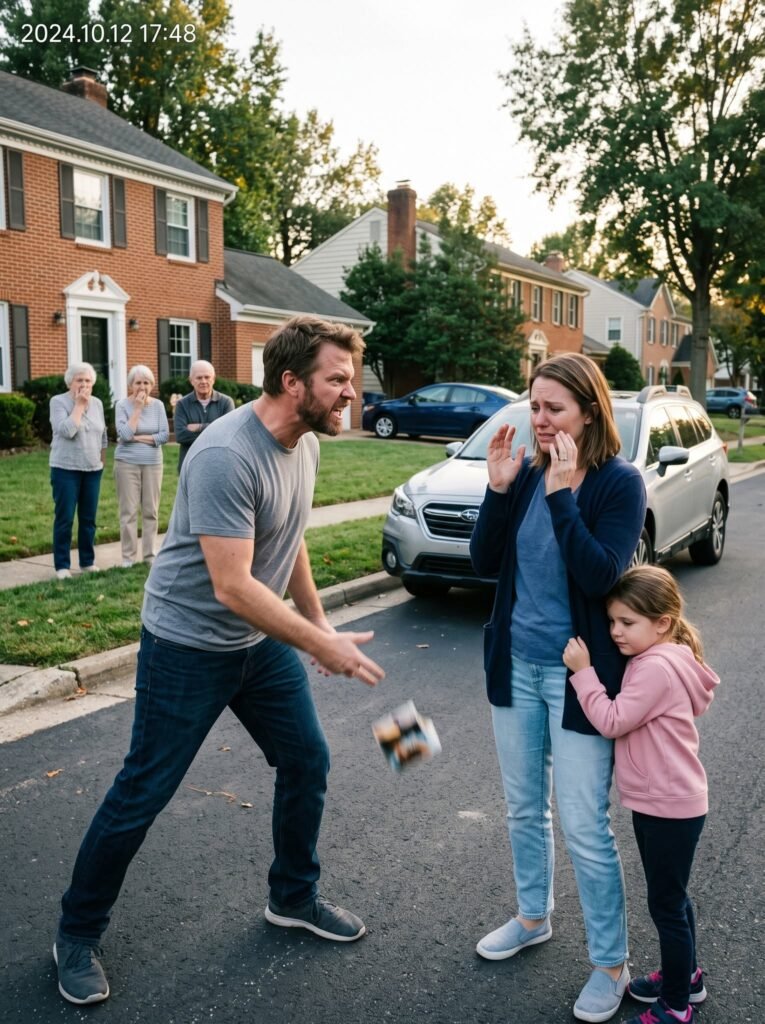
The black MMA gloves landed at my boots with a dull leather thump, and my eleven-year-old daughter stopped breathing, like she was afraid even that small sound might make things worse.
Travis Caldwell stood ten feet away on the grass, rolling his shoulders under a sleeveless shirt while four men from his fighting gym watched from behind him.
“Put the gloves on, almighty sister-in-law,” he shouted. “Or should I snap your arm and send you to the hospital in front of your daughter?”
His father, Grant, laughed beside the barbecue. “Teach this pathetic desk soldier a lesson,” he called. “Show her who runs this neighborhood.”
Forty people had gathered for the Labor Day cookout at the end of our suburban street, but nobody joined his laughter. Paper plates sagged in people’s hands. Burgers cooled beside open bags of chips. The sprinkler kept hissing over Mr. Palmer’s lawn as if nothing had changed.
Everything had changed.
My daughter, Sophie, stood at the edge of the crowd twisting the bottom of her T-shirt between both hands. She wasn’t watching Travis. She was watching me, searching my face for proof that I could keep her safe.
“Sophie,” I said, never taking my eyes off my brother-in-law, “go stand beside Mr. Palmer.”
Her sneakers scraped across the pavement behind me.
Travis laughed and bounced on the balls of his feet. “That’s right,” he said. “Move the kid so she doesn’t have to watch her mom beg.”
I bent down and picked up the gloves. I did not put them on. I held them loosely at my side and looked at the man who had just threatened to cripple me in front of my child.
“Take one more step toward my daughter, Travis.”
His grin widened. Mine did not.
To most of the neighborhood, I was Claire. The quiet single mother who worked in records management for a federal agency and drove an SUV old enough to still have a cassette deck.
I bought curtains at thrift stores, drank coffee from a chipped mug, and spent Saturday mornings helping Sophie build forts out of fallen branches near the fence. My civilian profile listed me as an administrative support specialist.
That description was accurate in the same way that calling a hurricane a change in weather is accurate. The rest of my service history required clearances that Grant Caldwell’s money would never buy.
Travis knew none of that. My sister Natalie had known only fragments, because I’d spent years teaching my family not to ask questions I wasn’t permitted to answer. She knew I’d served. She believed I’d spent most of it behind a desk. And that was the version of me she had apparently handed to her husband as entertainment.
Natalie stood beside Grant in an expensive summer dress, arms folded tight beneath her chest. She didn’t look frightened by Travis’s threat. She looked pleased that the attention wasn’t on her. That hurt more than the gloves had.
Travis took one step forward.
I dropped the gloves back onto the grass. The leather landed between us.
“I warned you,” I said.
“You warned me?” He pointed at himself and laughed. “You think because you filled out paperwork for the military, you can talk to me like that?”
One of the gym men shifted uncomfortably. This had probably been sold to them as a friendly demonstration, the kind of dumb backyard challenge built around bragging rights and beer. Now there was a child hiding behind a lawn chair while a grown man threatened her mother. It no longer looked like sport.
Mr. Palmer stepped closer to Sophie and put himself between her and the lawn. “That’s enough, Travis,” he said.
Grant rounded on him instantly. “Stay out of family business.”
“It stopped being family business when he threatened her in the street,” Mr. Palmer replied.
Travis’s eyes flicked toward Sophie. It lasted less than a second, but I saw the calculation in it. He understood that my attention was split between him and my daughter, and he believed that made me weaker. He moved toward the pavement. I stepped into his path.
His grin came back. “There she is,” he said. “Finally ready to do something.”
“No,” I told him. “I’m ready to stop something.”
He shoved me with both hands. It wasn’t a testing push. He put his weight into it, trying to send me backward in front of the whole neighborhood.
I turned with the force instead of fighting it, guided his right wrist past my shoulder, and stepped behind his balance before he understood that he’d lost it. His own momentum carried him down.
One second he was standing over me. The next, a knee hit the grass and his right arm was secured behind him at an angle that controlled the joint without damaging it.
I kept my weight low and my hand open. I did not punch him. I did not twist harder than necessary. I did not give him the injury he had promised me.
Travis made a furious sound and tried to surge up. I adjusted my position by less than an inch. He stopped moving.
“Do not fight the pressure,” I said quietly. “You’ll hurt yourself.”
The crowd had gone so still that the sprinkler sounded deafening. Grant dropped his plastic cup. Natalie unfolded her arms. The four gym men no longer looked amused. One of them raised both hands and backed away. “This wasn’t what he told us,” he said.
Grant pointed at me like I’d staged the whole thing. “You all saw that,” he shouted. “She attacked him.”
“No,” Mr. Palmer said. “We saw him shove her after threatening to break her arm.”
Several neighbors spoke at once, each confirming the same sequence. The gloves. The threat. The step toward Sophie. The shove. Grant’s face hardened as he understood the crowd wasn’t going to repeat his version just because he said it louder.
Travis tried to turn his head toward me. “You got lucky,” he hissed.
I leaned close enough that only he could hear. “Luck would have been you listening the first time.”
His breathing went rough and embarrassed. Men like Travis often mistake restraint for hesitation, because they’ve never learned how much control restraint actually takes. I’d spent years making decisions in places where one unnecessary movement could cost someone their life.
Holding an angry man safely on a suburban lawn was not difficult. Doing it while my daughter watched was.
“Sophie,” I called.
“I’m here,” she answered from behind Mr. Palmer. Her voice shook, but she answered.
“That’s my girl. Stay where you are.”
Travis jerked again at the sound of her voice. I tightened the hold just enough to stop the movement. “You will remain still,” I told him. “When I release you, you will step away from my daughter and leave my property line. Do you understand?”
“You don’t give me orders.”
“Then we can stay like this until the officers arrive.”
His body stiffened. Someone nearby had already called for help, which was the sensible response to a public threat involving a child.
Grant heard me and started talking faster. “This is ridiculous. Travis was joking. Everyone here knows he was joking.”
“No,” Natalie said. Her voice was quiet, but it cut through the noise.
Grant turned toward her. “What did you say?”
Natalie looked at her husband on the ground, then at Sophie behind the lawn chair. “He wasn’t joking.”
Travis stopped struggling. Grant’s expression shifted from anger to warning. “Natalie.”
She flinched at the sound of her own name, and I understood something I should have seen earlier. Her folded arms hadn’t been confidence. They’d been armor. The satisfied line of her mouth had been the face of someone trying desperately to stay on the winning side of a dangerous man.
That didn’t excuse what she’d done. It only explained why she’d done it.
Natalie looked at me. “He planned this,” she said. “He’s been talking about it for two weeks.”
A murmur moved through the neighbors. Travis cursed under his breath. Natalie kept going, maybe because stopping would have meant losing the nerve to continue.
“He said you acted like you were better than him. That you ignored him when he bragged about his fights. Grant told him the whole neighborhood needed to see you put in your place.”
Grant took a step toward her. “You’re confused.”
Natalie stepped back. “No, I’m not.” For the first time that afternoon, she sounded certain. She pointed toward the gloves on the grass. “They bought those yesterday. Travis practiced what he was going to say. They told the gym guys Claire had challenged him and then backed out.”
The men behind Travis looked at one another. The largest of them pulled a set of car keys from his pocket. “We were told this was agreed sparring,” he said. “We’re leaving.”
Grant blocked him with an outstretched arm. “You’re not going anywhere until you explain what you saw.”
“I saw Travis threaten a woman in front of her kid and shove her first.” The man moved around Grant. The others followed.
Travis heard their shoes crossing the pavement and finally understood that the audience he’d assembled was walking out on him. “Get off me,” he said.
“Tell me you understand the condition.”
His jaw pressed into the grass. “I understand.”
“Say it clearly.”
“I’ll stay away from Sophie.”
I released him and stepped back immediately, keeping myself between him and my daughter. Travis rose too fast, humiliated and red-faced. For half a second, his right shoulder pulled back.
His father shouted, “Don’t let her embarrass you!”
That was the moment Travis made his last mistake. He listened to Grant. He lunged.
This time I did not take him to the ground. I redirected his arm, planted an open hand against the center of his chest, and stopped him hard enough to break his forward drive without touching his face or his throat. His feet tangled beneath him and he stumbled backward into an empty folding table. The table collapsed.
Plastic cups bounced across the lawn and a tray of burned onions slid harmlessly into the grass. Travis stayed upright, but the shock on his face was unmistakable. He had thrown everything he had into that charge, and I’d stopped it without throwing a punch.
“Stand down,” I said. The command came out in a voice I hadn’t used at home in years. It wasn’t loud. It didn’t need to be. Travis froze. So did Grant. My posture, my tone, and the precision of what had just happened finally forced them to reconsider the woman they thought they’d cornered.
Natalie stared at me. “Claire,” she whispered, “what did you do in the military?”
I kept my attention on Travis. “My job.”
“What job?” Grant demanded. The question carried less authority than it had a minute ago.
I heard vehicles turning onto the street in the distance. Travis heard them too. His breathing changed.
I could have humiliated him then. I could have listed assignments and qualifications and commands and years of service until every person on that lawn understood exactly how wrong he’d been. Instead I gave him the only information that mattered.
“I spent eighteen years learning how to end dangerous situations,” I said. “Today I chose to end this one without injuring you.”
His eyes dropped to the gloves.
Grant tried one more time to seize control. “Anybody can claim anything,” he said. “She’s a clerk.”
I looked at him for the first time. “My rank is major.”
The words settled over the lawn. Natalie covered her mouth. Travis stared at me like the person in front of him had replaced the sister-in-law he thought he knew.
Grant gave a brittle laugh. “A major in records management?”
“Special operations,” I said. I offered no unit name, no mission details, no stories polished for an audience. The truth didn’t require decoration.
Travis looked at his taped hands, then at the woman he’d called weak. For the first time all afternoon, he had nothing to say.
When the responding officers arrived, the scene was still easy to read. The gloves lay on the grass where Travis had thrown them.
The collapsed table showed where he’d charged the second time. Dozens of witnesses could describe the threat and the shove in the same order. I gave a factual statement and nothing more.
Travis tried to claim we’d agreed to fight, but the gym men had already left their names and confirmed that he’d lied to them about the arrangement.
Grant interrupted so many times that an officer finally instructed him to step back. Natalie stood alone near the grill, looking smaller than she had when the whole thing started.
Sophie stayed beside Mr. Palmer until I was allowed to go to her. Then she ran. I caught her with both arms, and the force of her body against mine nearly broke the control I’d held all afternoon.
“Are you hurt?” she asked into my shoulder.
“No.”
“Did you hurt him?”
“No.”
She pulled back and searched my face. “You could have.”
It wasn’t admiration in her voice. It was fear of what power might do to a person.
I brushed a strand of hair off her cheek. “Yes,” I said. “That’s why it mattered that I didn’t.”
Her breathing slowed. Behind us, Travis was being escorted away from the center of the gathering while Grant argued about reputation and misunderstanding and family loyalty. Natalie didn’t defend either of them. She walked toward me, then stopped several feet away.
“I’m sorry,” she said.
I kept one arm around Sophie. The apology was too small for what she’d allowed, and all three of us knew it.
“You watched him threaten me in front of my daughter,” I said.
Her eyes filled, but I didn’t rescue her from the truth. “I know.”
“You helped him believe it would be safe.”
“I know.”
Sophie pressed closer to my side. Natalie looked at her and began to cry. “I thought if I laughed with them, they wouldn’t turn on me.”
And there it was. The fuller truth behind the expensive dress and the folded arms and the satisfied expression. She hadn’t joined the cruelty because she felt powerful. She’d joined because she was afraid of becoming its next target. Fear explained her choice. It did not erase it.
“You don’t get to use my child as the shield that keeps them from choosing you,” I said.
Natalie nodded. “I understand.”
“No. You understand the sentence. Understanding the damage will take longer.”
She lowered her head. I told her she could not come into my home that night, and could not contact Sophie until I decided it was appropriate.
I also told her that if she believed she was unsafe, she could ask Mr. Palmer to stay nearby while she gathered what she needed and found somewhere else to go. I would not pretend nothing had happened. And I would not abandon her to men who rewarded obedience with temporary protection.
Both of those things could be true at once. She accepted the boundaries without bargaining, which was the first responsible thing she’d done all day.
The cookout ended quietly. Neighbors folded chairs, collected plates, and carried food back toward their houses while the sun dropped behind the roofs. Mr. Palmer picked up the black gloves with two fingers and asked what I wanted done with them.
“Leave them there for now,” I said.
Sophie looked at them as we walked home. “Were you really a special operations major?”
“I am a major,” I said. “Some of the work was with special operations.”
“Why didn’t you tell me?”
“Because I wanted you to know me as your mom before you knew me as anything else.”
She thought about that as we crossed the driveway. “Did Aunt Natalie know?”
“Not all of it.”
“Did you hide it because it was secret?”
“Some parts were secret. Some parts were private.”
“What’s the difference?”
I opened the front door and let her step inside first. “A secret protects information,” I said. “Privacy protects a life.”
For four months I’d been trying to build us a private life in that neighborhood. Ordinary mornings, grocery lists on the fridge, school projects spread across the kitchen table, coffee from the same chipped mug.
I’d believed that keeping my past locked away was the only way to protect those things. That evening I understood that Sophie didn’t need a mother with no past. She needed a mother who could explain why strength should have limits.
We sat at the kitchen table while the last daylight faded through the thrift-store curtains. I told her I had led people in dangerous places.
I told her I had made mistakes, followed orders, questioned orders, and learned that courage is rarely as loud as television makes it look. I didn’t give her details she was too young to carry. I gave her the truth she needed.
The strongest person in a conflict is not always the one who can cause the most pain. Sometimes it’s the one who can stop.
Natalie didn’t come back that night. She stayed with a friend from work and sent me one message saying she was safe. I didn’t answer right away.
The next morning she sent another, accepting the boundary I’d set and asking whether she could write Sophie an apology without expecting a response. I agreed, on the condition that the letter contain no excuses and no request for forgiveness.
Three days later, Sophie read it at the kitchen table. Natalie admitted that she had laughed when she should have intervened, that she had helped Travis turn a family gathering into a trap, and that fear did not make her actions harmless.
Sophie folded the letter carefully. “Do I have to forgive her?”
“No.”
“Can I forgive her later?”
“Yes.”
“Can I still be mad if I forgive her?”
“Yes.”
She put the letter in a drawer beside her school supplies. For the first time since the cookout, her shoulders came down.
Travis never apologized. Grant sent two angry messages accusing me of destroying the family and humiliating his son. I saved them and blocked his number.
The neighborhood did not treat me like a hero afterward, which was exactly what I wanted. Mr. Palmer still complained about squirrels in his flower beds. The woman across the street still left for work every morning with a paper coffee cup balanced on the roof of her car until someone reminded her.
Children still rode bikes through the cul-de-sac before dinner. Life came back. But not quite the way it had been. People stopped mistaking quietness for permission.
A week after the cookout, Mr. Palmer brought the MMA gloves to my porch in a plain grocery bag. He said the officers no longer needed them and asked whether he should throw them away. Sophie stood behind me in the doorway. I looked at the gloves, then at her.
“Not ours,” I said.
I gave the bag to Natalie when she came by later to collect the last of her things from the Caldwell house. She’d moved out, but she didn’t present it as some grand act of courage. She only said she was beginning to understand how many times she had mistaken temporary peace for safety.
I handed her the bag. “What are these?”
“The gloves Travis threw at me.”
Her face tightened. “What should I do with them?”
“That’s between you and him.”
She nodded and carried them away. The object that had been meant to force me into Travis’s rules left my porch unopened and powerless.
Two months later, Sophie joined a youth self-defense class at a community gym. Not because I wanted her to fight. Because I wanted her to understand distance, boundaries, balance, and the confidence to use her voice before a threat ever became physical.
On her first day she stood beside me in worn sneakers and a gray T-shirt, nervous but determined. The instructor offered her a pair of padded training gloves. Sophie looked at them, then looked at me.
“Do I have to wear these?”
“For this class, yes.”
She smiled a little. “Are you going to tell everyone you were a major?”
“No.”
“Special operations?”
“No.”
“What are you going to tell them?”
I took a seat against the wall while she joined the other kids on the mat. “I’m going to tell them I’m Sophie’s mom.”
That seemed to satisfy her.
The class began with no punches, no threats, and no audience waiting for someone to be humiliated. The children practiced planting their feet, raising open hands, and saying one word clearly enough to be heard across the room.
“Stop.”
Sophie’s first attempt was quiet. Her second was stronger. On the third, every head in the room turned. She glanced toward me, not searching this time for proof that I could keep her safe, but checking whether I’d seen her begin to believe she could protect her own boundaries too.
I nodded. She turned back to the instructor and raised her hands again.
Months later, when people asked Sophie what happened at the Labor Day cookout, she never talked about the takedown, or my rank, or the moment Travis learned that the woman he’d called defenseless had commanded soldiers in places he could barely imagine. She remembered one simpler thing.
Her uncle threw a pair of gloves at my feet and demanded that I fight by his rules.
I picked them up.
And then I chose not to put them on.