The 8:15 to Philadelphia
Part One: The Video
The first thing I heard that morning was my brother laughing.
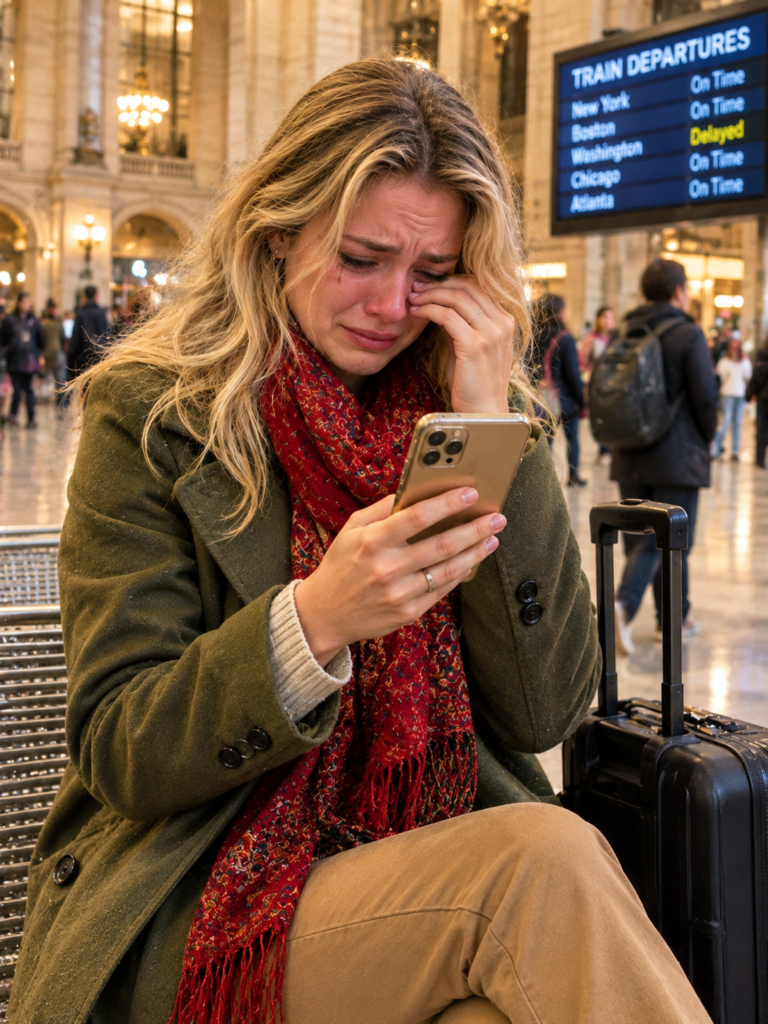
I was standing under the departure board at the Harrisburg Transportation Center on a Tuesday in late September, holding a paper cup of coffee from the kiosk by the stairs and watching the board for the 8:15 Keystone to Philadelphia. I had my navy blazer on and a leather portfolio under my arm, and my stomach was doing the slow, nervous rolls it does before anything important. My phone buzzed. A video in the family group chat.
Benton was sitting at our mother’s kitchen table in his work jacket, holding a printed sheet of paper up to the camera. I recognized it before I recognized anything else. It was my train reservation.
“Hope you enjoy your trip, Delaney,” he said, grinning. “Oh, wait. You might want to check that ticket first.”
Behind him, our mother was laughing. Not a little chuckle. A real laugh, with her hand over her mouth, the way she laughs at a sitcom. Then my cousin Reid leaned into the frame from the side, his face too close to the lens.
“Man,” Reid said. “I wish we could see her face when she finds out.”
The video ended on the three of them laughing.
I watched it twice before I understood what they were telling me.
My name is Delaney Pike. I was twenty-nine that fall. For six years, I’d worked in operations for a regional healthcare company in central Pennsylvania, handling staffing schedules and vendor contracts and budgets for eleven outpatient clinics between Harrisburg and York. I wasn’t married. I didn’t have children. I rented a small one-bedroom apartment in Camp Hill with a balcony that looked out on a parking lot and a single tomato plant I talked to more than I’d admit.
According to my family, those three facts meant I had more money and more free time than everybody else. Which meant I was the one who paid.
Part Two: The Oldest
My mother, Lorraine, raised four children in a three-bedroom house on a narrow street in Mechanicsburg. It had a skinny front porch with a glider, a maple tree that dropped leaves into the gutters every October, and a basement that flooded whenever it rained more than an inch. My father left when I was thirteen. He moved to Florida with a woman from his bowling league and sent child support for two years and then stopped.
Mom worked the customer service desk at the Giant grocery store on Trindle Road for twenty-two years, until her knees got too bad for standing all day.
I was the oldest. Benton came three years after me. Hadley, five years after. And Mason, the baby, who went to Ohio State, stayed in Columbus after graduation, and mostly avoided family arguments by being four hundred miles away from them.
Benton was always the funny one. He could imitate our high school principal so well that Mr. Kauffman himself once laughed. He could talk his way out of a speeding ticket in under two minutes. He could make Mom laugh when the electric bill was overdue and the basement was full of water.
I was the one who remembered when the electric bill was due.
When I was sixteen, Mom started leaving bills beside my cereal bowl in the morning. The electric bill, with a sticky note on top in her loopy handwriting. Can you call them about an extension, honey? You’re better at this than me. By eighteen, I knew how to negotiate a payment arrangement with PPL Electric better than I knew how to put on eyeliner.
I didn’t resent it back then. She’d worked hard. She’d been left with four kids and a flooding basement. I understood that a house full of children could eat through a paycheck before Friday.
What I didn’t understand was how easily helping became my permanent job.
Part Three: The Payments
I graduated from Shippensburg University with a business degree, found an entry-level job at the healthcare company, and slowly worked my way up into operations management. My supervisor told me once that I was unusually calm when things went wrong. Three clinics short-staffed on a Friday afternoon. A vendor who didn’t deliver. A pipe burst in the waiting room in Lebanon.
I almost laughed. I’d been training for that job since I was sixteen, sitting at the kitchen table with a cordless phone and an electric bill.
The first time I helped Mom with the mortgage, I was twenty-three.
She called me crying on a Wednesday night. She was eleven days behind, and the bank had sent a letter, and she was terrified of losing the house. I had a savings account I’d been building for two years for a used car. I transferred nine hundred dollars from it that night.
She promised she’d pay me back after tax season.
Tax season came. She needed help with her property taxes instead.
By the next year, I was sending eleven hundred dollars a month toward her mortgage and household bills. On the first of every month, automatically. We stopped calling it a loan somewhere along the way. Nobody ever sat me down and asked if I could keep doing it. It just kept happening.
Benton started a contracting business when he was twenty-four. Decks, drywall, kitchen remodels. Pike Home Improvement, on the door of his pickup in red vinyl letters. He was good with his hands when he showed up. But he had a habit of buying expensive equipment before he had enough jobs to pay for it.
When his truck’s transmission went, I covered it. When a customer in Hampden Township was ninety days late paying, I lent him money for supplies. Eventually, I added him as an authorized user on one of my credit cards for real business emergencies. I set a spending limit. I told him to keep receipts.
He agreed without looking up from his phone.
My cousin Reid, my mother’s sister’s son, lost his apartment in 2022. We grew up together. Summers riding bikes along the Conodoguinet Creek, building forts in his backyard. He asked me for six hundred and fifty dollars a month until he got back on his feet.
I agreed to six months.
Four years later, the transfer was still going out on the first of every month.
Hadley was different. She had two kids: Nora, who was eight, and Caleb, who was five. She worked part-time at a dental office in Camp Hill. Their father paid child support when he felt like it. Sometimes she genuinely needed help keeping food in the refrigerator.
I never once minded buying groceries for those kids. Nora liked the little clementines that come in mesh bags. Caleb would eat peanut butter sandwiches for every meal if somebody let him.
But even Hadley had gotten used to treating my money as something that was just there.
Part Four: Teasing
At Christmas every year, Mom told everybody how proud she was of Benton for working for himself. She told Reid how brave he was for starting over. Then she’d turn to me and ask if I could pick up the grocery bill for Christmas dinner, because I’d always been so good with money.
For years, I told myself that’s just what families do.
And there were good memories mixed in with everything else. Benton taught me to change a tire the week I bought my first car, a 2009 Corolla, in the parking lot of the AutoZone on the Carlisle Pike. He made me do it three times until I could do it in under fifteen minutes. Mom sat beside me in the emergency room at Holy Spirit Hospital when I broke my wrist sophomore year of college, holding a vending-machine coffee she never drank, for six hours.
Those memories mattered. They were part of the reason I kept saying yes long after the requests stopped sounding temporary.
But Benton had another habit that followed us out of childhood.
He liked embarrassing me.
At my twenty-fifth birthday dinner at the Olive Garden in Mechanicsburg, he told the whole table I’d cried when I failed my first driving test. At Thanksgiving two years ago, he played a recording on his phone of me singing Kelly Clarkson in the shower when I was fifteen. Somehow, he still had it.
Mom always laughed. Oh, Delaney, don’t be so sensitive. He’s only teasing.
If I asked him to stop, Benton would hold up both hands and announce to the room that somebody had lost her sense of humor.
The more uncomfortable I got, the funnier he thought it was.
Part Five: Two Appointments
That September, for the first time in a long time, I had something important happening that belonged entirely to me.
A healthcare system in Philadelphia had reached out to me about a regional director of operations position. Twelve clinics across southeastern Pennsylvania. The salary was almost thirty thousand dollars more than I was making. Better retirement. Better everything.
I’d done two video interviews. The final one was in person, at their offices on Market Street, Wednesday at ten. No, Tuesday. Tuesday at eleven. I’d planned to take the 8:15 train to give myself time to find the building and calm down.
I had a second appointment that same afternoon in Philadelphia. With a title company.
My grandmother Evelyn, my mother’s mother, died in March. She was eighty-eight. She’d owned a small farm outside Carlisle, forty-two acres off Ritner Highway, with a weathered white farmhouse and a red bank barn and a stone springhouse at the bottom of the hill. Nobody had farmed it in fifteen years. The farmhouse had been empty since she moved into a nursing home in Carlisle three years before she died.
After her funeral, I started getting letters about the property. Confusing ones. From an estate lawyer in Carlisle. From something called the Evelyn R. Hollinger Revocable Trust. And, in August, from a title insurance company in Philadelphia, saying they needed me to appear in person with identification to review some documents before a pending transaction could proceed.
I had no idea what any of it meant. I figured Grandma had left some loose end. A missing signature. A form nobody had filed.
I wasn’t expecting anything valuable. It was an old farmhouse with a sagging porch.
Part Six: The Credit
When Mom found out I was going to Philadelphia, she offered to book my train ticket herself.
“I’ve got that travel credit from when I canceled my trip to see your aunt Patty,” she said on the phone. “It expires in October. You can just send me the difference. No sense letting it go to waste.”
I booked nothing. She did it all. She emailed me a printout of the confirmation from her own Amtrak account. I sent her forty-two dollars for the difference by Venmo that afternoon.
The night before the trip, I ironed my navy blazer. I polished my black flats. I packed a folder with copies of my résumé and the stack of letters about Grandma’s farm.
At 9:27, Mom called.
“Don’t oversleep tomorrow,” she said. “You know how you get when you’re nervous.”
I told her my alarm was set for six.
She asked whether I’d be home Wednesday in time for dinner. Benton wanted everybody to come over. She was making her meatloaf.
I said I’d try.
What I didn’t know was that twenty minutes after that phone call, at 9:47 p.m., somebody logged into my mother’s Amtrak account and canceled my ticket.
Part Seven: The Counter
At the station that morning, after I watched Benton’s video twice, I walked straight to the ticket counter.
The clerk was a woman in her sixties with narrow reading glasses and a little silver necklace shaped like a heart. Her name tag said Bernadette. She typed in my confirmation number. She frowned. She looked at her screen again.
“I’m sorry, honey,” she said. “This reservation was canceled last night.”
“I didn’t cancel it,” I said.
She turned her monitor a little so I could see it. Canceled 9:47 PM. Refund issued to original payment method.
The original payment method was my mother’s travel credit.
The 8:15 was sold out. My discounted fare couldn’t be restored. I could buy a seat on the 10:40, but it would cost almost twice what I’d paid, and it would get me to Philadelphia at 12:20. Over an hour after my interview started.
I thanked Bernadette. I stepped away from the counter. I sat down on a cold metal bench by the tall windows and watched the 8:15 board without me.
My phone rang.
It was Benton.
Part Eight: “Don’t Get Dramatic”
“Did you see the video?” he asked. He was laughing. In the background, I could hear Reid laughing too, and the clatter of dishes. They were still at Mom’s kitchen table.
“Why did you cancel my ticket?” I asked.
“Because you take everything so seriously,” Benton said. “Come on, Del. It was a prank.”
I told him about the interview. Eleven o’clock. Thirty thousand dollars more a year. I told him about the title company, the letters about Grandma’s farm.
“So reschedule,” he said. “You’re acting like somebody died.”
Behind him, Mom said something I couldn’t hear, and they both laughed again.
Then Benton said, “Wait. Are you crying?”
I looked across the station. An older man was helping his wife adjust the strap on her overnight bag. A little girl in a pink jacket was holding her father’s hand by the entrance to the platforms, bouncing on her toes, watching the trains.
“I’m not crying,” I said.
“Well,” Benton said. “Don’t get dramatic about it.”
I hung up.
Part Nine: The Bench
For a while, I just sat there on that cold metal bench with my coffee going cold in my hands.
I thought about the nine hundred dollars I sent Mom when I was twenty-three, from the savings account for a car I never bought. I thought about Benton’s transmission, and his supply money, and the credit card. I thought about Reid’s rent, on the first of every month, for four years. I thought about all the Friday afternoons I’d spent at my desk moving money from one account to another so somebody else wouldn’t have to worry.
I thought about my brother asking if I was crying, and laughing when he did.
Then I opened my banking app.
My regular family support came to more than twenty-eight hundred dollars a month. That was before the extra requests. Some months, it was closer to four thousand, when Benton had a slow stretch, or Mom’s furnace needed a part, or Reid’s car broke down.
I’d been putting more money into their households every month than I was putting into my own future. My retirement account had less in it than my credit card balance, and most of my credit card balance was Benton’s.
I opened the notes app and wrote everything down. Every arrangement.
Mom — mortgage contribution, $1,100/month, 1st.
Mom — household account, $300 every payday.
Benton — authorized user card, avg. $600/month.
Reid — rent transfer, $650/month, 1st.
Hadley — groceries, about $200/month.
I checked which payments had cleared and which ones were scheduled for the next few weeks.
Then I called my bank.
Part Ten: The Changes
The representative’s name was Marcus. He had a calm, kind voice. He asked me security questions. My mother’s maiden name. The street I grew up on. I answered them while I watched the last passengers board the 8:15 on the platform below.
I told him I needed to remove authorized access from my accounts and stop several voluntary recurring transfers.
He walked me through it, one thing at a time.
I canceled Benton’s card. I asked for a new account number on my own card, just to be safe. I stopped Reid’s transfer, which was scheduled for October 1st. I ended the automatic deposits into the household account Mom used.
For Mom’s mortgage contribution, I let the current month’s payment go through. I scheduled it to stop after that, so she’d have thirty days to figure something out.
I didn’t touch the grocery money for Hadley’s kids.
Nora and Caleb hadn’t canceled my train ticket.
Marcus confirmed every change and emailed me written notices. I saved them all in a folder, with the relevant statements.
I wasn’t trying to take back money I’d already given. I’d given it. It was gone. I just wanted to stop giving away money I hadn’t even earned yet.
Part Eleven: Hadley
At 9:26, Hadley texted me.
Benton says you’re sulking. Mom wants to know if you’re coming home.
I texted back that I’d bought a ticket on a later train and was going to Philadelphia.
Her reply came almost instantly.
Seriously? You’re spending more money just to prove a point?
I stared at those words for a long time.
A replacement train ticket was irresponsible. But my brother’s dinners at Applebee’s on my credit card were family loyalty.
I bought the 10:40 ticket anyway.
Then I called the recruiter in Philadelphia, a friendly woman named Tamara Okeke. I told her there’d been a problem with my train reservation. I didn’t explain what. She was understanding. She said the hiring director, a man named Dr. Paul Abernethy, could see me the next morning at nine instead.
Then I called the title company.
Part Twelve: The Title Company
A woman named Gloria Fenstermacher answered. She was the senior title officer handling Grandma’s property. When I said I was delayed and needed to move our afternoon appointment, her voice changed.
“Ms. Pike,” she said. “Please make sure you come tomorrow. There are some documents I need you to review in person. Today, ideally. Tomorrow at the very latest.”
“Is there a problem with my grandmother’s property?” I asked.
She hesitated.
“I’d rather explain when you’re here,” she said carefully. “But I wouldn’t postpone this meeting again. Not even by one day.”
“Why not?” I asked.
There was a pause.
“Because the closing,” Gloria said, “is scheduled for Thursday morning.”
I didn’t know what closing she meant. I asked. She wouldn’t say more over the phone.
“Tomorrow, Ms. Pike,” she said. “As early as you can. Bring two forms of photo ID.”
By the time I boarded the 10:40, Benton had posted three more jokes in the family group chat. A GIF of a crying baby. A picture of a train leaving a station, captioned bye Del. A screenshot of my canceled reservation with a laughing emoji.
I didn’t answer any of them.
I put my phone on silent. I opened my interview folder on the little tray table. I watched the Pennsylvania farmland roll past the window, the red barns and the corn stubble and the Susquehanna River glinting silver in the morning sun.
For the first time in years, I’d made a financial decision without asking myself how angry my family would be.
I didn’t know yet how much that decision was going to change.
Part Thirteen: Market Street
I spent Tuesday night in a cheap hotel near Thirtieth Street Station, with my blazer hanging on the back of the bathroom door to steam out the wrinkles. I didn’t sleep much.
Wednesday morning at nine, I walked into the offices of Delaware Valley Health Partners on the nineteenth floor of a glass tower on Market Street. Dr. Paul Abernethy was in his sixties, silver-haired, with reading glasses on a cord and a habit of leaning back in his chair to listen.
He asked me about the hardest operational problem I’d ever solved.
I told him about the Friday last winter when a water main broke in the street outside our clinic in Lebanon, flooding the waiting room two hours before a full day of patients, including four kids getting chemotherapy. I told him how I found another clinic with space, rerouted every patient, arranged a van, got the chemo pharmacy to transfer the drugs, and had everybody seen by four o’clock.
He nodded. Then he asked, “Where did you learn to stay calm like that?”
I thought about it for a moment. I thought about lying.
“At my mother’s kitchen table,” I said. “When I was sixteen. Calling the electric company about extensions.”
Dr. Abernethy looked at me over his reading glasses for a long time.
“That’s the most honest answer anyone’s ever given me to that question,” he said.
Part Fourteen: Gloria
The title company was on the eleventh floor of an old stone building on Chestnut Street, six blocks away. I walked there in the September sunshine with my portfolio under my arm. Gloria Fenstermacher met me at the reception desk. She was in her fifties, small and sharp-eyed, with silver-streaked dark hair in a bun and a cardigan the color of plums.
She checked both my IDs carefully. My driver’s license and my passport. She held each one up beside my face. Then she led me to a small conference room with a long table and closed the door.
There was a thick folder on the table.
“Ms. Pike,” she said. “Sit down, please. This is going to take a little while.”
She opened the folder.
“Your grandmother, Evelyn Hollinger,” Gloria said, “placed her farm into a revocable living trust in 2019. Three years before she moved into the nursing home. Are you aware of that?”
“No,” I said.
Gloria turned a document toward me. The Evelyn R. Hollinger Revocable Trust. Twelve pages. Grandma’s signature at the bottom, shaky but unmistakable.
“When she died in March,” Gloria said, “the trust became irrevocable. The farm passes according to its terms.” She turned to a page with a paragraph highlighted in yellow. “Read this, please.”
Upon my death, the real property known as Hollinger Farm, 1840 Ritner Highway, Carlisle, Pennsylvania, comprising 42.3 acres, shall be distributed in its entirety to my granddaughter, Delaney Ann Pike.
I make this gift because Delaney visited me every Sunday for six years. She never once asked me for anything.
I read it three times.
I had visited Grandma every Sunday. That part was true. After church, I’d drive out Ritner Highway to the farm and sit with her on the porch. Later, when she moved into the nursing home, I’d go there instead. We did crossword puzzles. She told me stories about my grandfather, who died before I was born. She taught me to make her shoofly pie.
Nobody else came on Sundays. Mom came at Christmas and Easter. Benton came once, to ask if he could take the old tractor.
“The successor trustee,” Gloria said quietly, “who has the legal authority to manage and distribute the property, is you.”
Part Fifteen: The Closing
“I don’t understand,” I said. “Why did you need me to come in person?”
Gloria took a breath. She turned another document toward me.
It was a single page. Resignation of Successor Trustee and Appointment of Successor.
It said that I, Delaney Ann Pike, voluntarily resigned as successor trustee of the Evelyn R. Hollinger Revocable Trust, and appointed my mother, Lorraine Pike, as trustee in my place.
At the bottom was a signature. Delaney A. Pike.
It wasn’t my signature.
It looked like it. Somebody had practiced. But I make a big loop on the D and I always cross the t in Pike — there isn’t a t in Pike. I always put a little hook at the end of the e. The signature on the page had no hook.
Below it was a notary stamp. Notarized this 14th day of August by Tiffany Sauder, Notary Public, Cumberland County.
I knew that name. Tiffany Sauder was my cousin Reid’s girlfriend. She worked at a bank branch in Mechanicsburg.
“Two weeks after this resignation was recorded,” Gloria said, “your mother, acting as trustee, signed an agreement to sell Hollinger Farm. To a company called Keystone Logistics Development.”
She turned another page.
“For one million, four hundred thousand dollars,” she said.
I stared at her.
“The I-81 corridor,” Gloria said. “Warehouse developers have been buying up every farm between Carlisle and Shippensburg for five years. Your grandmother’s land is a quarter mile from the interstate exit. It’s worth a great deal to the right buyer.”
“The closing,” Gloria said, “is scheduled for Thursday morning. Tomorrow. Here. In this room.”
My hands were shaking on the table.
“So why didn’t you just close it?” I asked.
Gloria looked at me for a long moment.
“Because,” she said, “when I review a trustee resignation, I check the notary’s journal. Pennsylvania notaries have to keep one. And Ms. Sauder’s journal says you appeared before her at her bank branch in Mechanicsburg at 2:15 p.m. on August 14th.”
She folded her hands.
“I called your employer,” she said. “Very discreetly. They confirmed that on August 14th, at 2:15 p.m., you were leading a vendor meeting in Lancaster. With nine witnesses and a badge log.”
Part Sixteen: Why the Train
I sat in that conference room on the eleventh floor of a stone building on Chestnut Street and couldn’t breathe.
“I sent you a letter in August,” Gloria said. “Asking you to come in person with identification. Because I had a resignation with your name on it, and a notary journal that didn’t make sense. I needed to see you face to face. I needed to hear you say whether you’d signed it.”
“I didn’t,” I said. “I’ve never seen it before in my life.”
Gloria nodded slowly. “I didn’t think so,” she said.
“And if I hadn’t come?” I asked.
“If you hadn’t come by Thursday morning,” Gloria said, “I’d have had a difficult choice. My company’s lawyers might have let it close with an indemnity. Or we’d have delayed and the buyer might have sued.” She paused. “Your mother’s attorney called me twice last week. Asking whether there’d be any problem closing on schedule. He was very anxious about Thursday.”
I thought about the 8:15. The cancellation at 9:47 p.m. Mom’s phone call twenty minutes earlier. Don’t oversleep. You know how you get when you’re nervous. Asking if I’d be home Wednesday for meatloaf.
The appointment with the title company was Tuesday afternoon. If I missed the train, I’d miss it. I’d have to reschedule. Maybe Friday. Maybe next week.
By then, the farm would be sold.
“It wasn’t a prank,” I said quietly.
Gloria didn’t say anything.
“They needed me to miss the appointment,” I said.
Part Seventeen: The Call to Benton
Gloria Fenstermacher stopped the closing that afternoon. She called Keystone Logistics’ attorney and told him there was a problem with the trustee’s authority and a probable forgery, and that her company would not insure the title. She called the Cumberland County Recorder of Deeds. She gave me the name of an attorney in Carlisle, a woman named Joan Brubaker, who’d handled the original trust for my grandmother.
“Ms. Pike,” Gloria said, as she walked me to the elevator. “I’m very sorry. I know this is your family.”
“Thank you,” I said. “For checking the journal.”
She smiled. “I’ve been doing this for twenty-six years,” she said. “You’d be amazed how often family is the problem.”
I sat on a bench in Washington Square, across from the title company’s building, under a big sycamore tree. I called Benton.
He answered on the first ring. “Del! Finally! What did you do to my card? It got declined at Home Depot this morning. In front of a client.”
“I canceled it,” I said.
“You what?”
“Benton,” I said. “Did you know about the farm?”
There was a pause on the line.
“What farm?” he said.
Part Eighteen: What Benton Didn’t Know
He didn’t know.
I could hear it in his voice. I’ve known my brother for twenty-six years. He’s a terrible liar. He can talk his way out of a speeding ticket because he believes everything he says while he’s saying it. But when he doesn’t know something, he goes quiet in a particular way.
He went quiet.
“Grandma’s farm?” he said finally. “Out on Ritner Highway? What about it?”
So I told him.
The trust. The paragraph. Because Delaney visited me every Sunday for six years. The resignation with my forged signature. Tiffany Sauder’s notary stamp. Keystone Logistics. One million, four hundred thousand dollars. The closing on Thursday.
When I was done, there was nothing on the line for a long time but traffic.
“Mom asked me to cancel your ticket,” Benton said finally. His voice sounded strange. “Monday night. After she got off the phone with you. She said it’d be funny. She said you needed to loosen up. She gave me her Amtrak password.” He swallowed. “Reid filmed the video. He said you’d freak out.”
“Did Mom tell you why?” I asked.
“She said you’d been acting stuck-up,” Benton said. “Since you got the Philadelphia interview. She said you thought you were better than us.” He stopped. “Del. I swear to God. I thought it was a joke. I didn’t know about any farm.”
“Reid knew,” I said.
“How do you know?”
“Because his girlfriend notarized my forged signature,” I said. “In August.”
Benton didn’t say anything at all.
Part Nineteen: Mom
I didn’t go home for meatloaf on Wednesday.
I stayed in Philadelphia. On Thursday morning, at nine o’clock, when the closing was supposed to happen, I was sitting in Joan Brubaker’s office, on a video call, from my hotel room. Joan was seventy-one, a small, fierce woman with white hair who’d drafted wills for half of Cumberland County for forty years. She’d drafted Grandma’s trust herself.
“Evelyn told me why she was doing it,” Joan said, looking at me over her reading glasses on my laptop screen. “In 2019. She sat in my office and said, My daughter will try to sell it the minute I’m gone. Lorraine sees dollar signs. Delaney sees the springhouse.”
I put my hand over my mouth.
“She left you a letter,” Joan said. “In my file. With instructions to give it to you if Lorraine ever tried to interfere with the trust.” She held up a cream-colored envelope to the camera. “I’ll mail it to you today.”
Mom called me that afternoon.
I almost didn’t answer. Then I did.
“Delaney,” she said. Her voice was shaking. “The closing didn’t happen. The lawyer from Keystone called me. He said there’s a problem with the trust. He said the title company found…” She stopped.
“Found what, Mom?” I asked.
She didn’t answer.
“You canceled my ticket,” I said. “So I’d miss the title company. So the farm would close before I could stop it.”
“It was a prank,” Mom said. “Benton…”
“Benton didn’t know,” I said. “You gave him your password. You told him it would be funny. You told him I needed to loosen up.”
Silence.
“Tiffany Sauder notarized a signature with my name on it,” I said. “On August 14th. At 2:15 in the afternoon. While I was in a meeting in Lancaster with nine people.”
Part Twenty: Why
My mother started crying on the phone. Not the laughing kind from the video. The real kind.
“Do you know what it’s like,” she said, “to raise four kids alone? With a basement that floods? On a cashier’s salary?” She was sobbing. “My mother never helped me. Not once. Not when your father left. Not when the furnace died. She sat on that farm with forty acres and a barn and never sold one acre to help her own daughter.”
“I’ve been paying your mortgage for six years, Mom,” I said quietly.
She didn’t answer.
“And then she died,” Mom said, “and Joan Brubaker called me and told me she’d left the whole thing to you. Not me. Her own daughter. You. Because you visited on Sundays.” She laughed, a terrible broken sound. “Like Sundays were the only thing that counted.”
“They were the only thing she asked for,” I said.
“Reid found the buyer,” Mom said. “In June. He was doing some drywall work for a guy who works for Keystone. They said the land was worth a fortune. Reid said if I could get the trust in my name, I could sell it, pay off the house, pay off everybody’s debts. Benton’s business. Reid’s car. Everything.” She was quiet for a moment. “He said Tiffany could notarize it. He said you’d never even notice. You never go out to the farm anymore.”
“I go every month,” I said. “To check on the house. I mow around the springhouse.”
My mother didn’t say anything.
“And the train,” I said.
“Reid’s idea,” Mom said. “When Gloria Fenstermacher’s letter came to you in August, and you told me about the Philadelphia appointment, Reid said we had to make sure you didn’t make it before Thursday.” She was crying. “I didn’t think it was that bad, Delaney. It was just a train.”
Part Twenty-One: The Letter
Grandma’s letter came on Saturday, in Joan Brubaker’s office envelope, to my apartment in Camp Hill.
I opened it at my little kitchen table with a cup of coffee. Grandma’s handwriting, careful and shaky, in blue ink on her old stationery with the violets in the corner.
My dear Delaney,
If Joan has given you this, then your mother has done something with the farm she shouldn’t have. I’m sorry, child. I knew she might. I love her. She’s my daughter. But Lorraine has always believed that somebody else’s money would fix what’s wrong with her life. Her father’s. Mine. Yours.
I’m leaving you the farm because you came on Sundays. Every Sunday for six years. You never asked me for one thing. You just sat on the porch and did the crossword and listened to me talk about your grandpa. You let me teach you shoofly pie. You were the only one who ever asked about the springhouse.
Your grandpa built that springhouse in 1952, stone by stone, from the creek. We kept our milk and butter cold in it for thirty years. It’s the first place I ever kissed him.
Don’t sell it to the warehouse people, Delaney. I know they’ll come. They’ve been coming for years. Your mother will tell you it’s foolish to keep it. Maybe it is. But some things aren’t worth what somebody’s willing to pay for them. They’re worth what they cost you to keep.
You’ve been carrying your family on your back since you were sixteen. I watched it. I’m sorry I didn’t say anything. Put them down for a while, child. Sit on the porch.
Love,
Grandma Evie
Part Twenty-Two: What Happened
The Cumberland County district attorney’s office opened an investigation in October. Gloria Fenstermacher had already filed a report about the forged resignation and the notary journal.
Tiffany Sauder confessed within a week. She told investigators that Reid had brought her the resignation form already signed, and asked her to notarize it and write my name in her journal. He’d promised her ten thousand dollars from the sale. She lost her notary commission and her job at the bank. She pleaded guilty to a misdemeanor and got probation.
Reid was charged with forgery. A felony. He pleaded guilty in January. He was sentenced to two years of probation and ordered to pay restitution for Joan Brubaker’s legal fees and the title company’s costs.
My mother wasn’t charged. The district attorney said there wasn’t enough evidence that she knew the signature was forged, as opposed to believing Reid’s story that I’d signed it. Joan Brubaker told me privately that she didn’t believe that for a second. But I didn’t push it.
She’s my mother.
Part Twenty-Three: Benton
Benton came to my apartment in Camp Hill on a Saturday in October. He’d never been there before. In three years, he’d never once visited.
He stood in my doorway in his work jacket, holding a cardboard box.
“Can I come in?” he asked.
He sat at my little kitchen table. He put the box on it. Inside was every receipt from my credit card for the last two years. Home Depot. Lowe’s. Sunoco. Applebee’s. Dick’s Sporting Goods. Organized by month, in rubber bands.
“I kept them,” he said. “You told me to keep receipts. I kept them.” He looked at the box. “I just didn’t stop spending.”
He pushed a piece of paper across the table. It was a spreadsheet, printed out, with columns and totals.
$14,276.18.
“That’s how much I put on your card that wasn’t business,” Benton said. “Dinners. Gas for my personal truck. A fishing rod.” He swallowed. “I’m going to pay it back. Two hundred a month. It’ll take me six years.”
Then he said something I never expected to hear from my brother.
“I’m sorry, Del,” he said. “For the video. For the train. For asking if you were crying.” He looked at me. “For every time I made you the joke. The driving test. The shower recording. All of it.”
He put his face in his hands.
“Mom used me,” he said quietly. “To keep you away from the title company. And I let her, because it was funny. Because you’re always the one who can take it.” He looked up at me. “You shouldn’t have to take it.”
Part Twenty-Four: Philadelphia
Tamara Okeke called me the following Monday. Dr. Abernethy wanted to offer me the job. Regional director of operations, twelve clinics, starting in January.
I took it.
I moved to Philadelphia in December, to a small apartment in a rowhouse in Fishtown with a tiny backyard where I planted a tomato plant in the spring. I took the Market-Frankford line to work every morning. I learned where to get the best roast pork sandwich.
I still drive out to Carlisle once a month.
Part Twenty-Five: The Farm
I didn’t sell Hollinger Farm.
Keystone Logistics Development came back in November, after the forgery mess was sorted out, and made me an offer directly. One million, six hundred thousand dollars. More than they’d offered my mother.
I said no.
Joan Brubaker helped me put an agricultural conservation easement on the land through the Cumberland County Farmland Preservation Program. The county paid me to give up the right to develop it, forever. It can never be warehouses. It will always be a farm.
I lease the forty acres to a young Amish couple named Eli and Rebecca Stoltzfus, who were looking for land to start a dairy. They farm it with draft horses. They keep their milk cold in Grandpa’s springhouse, the way Grandma did, in the stone channel where the creek water runs through.
The farmhouse is still empty most of the time. But Benton’s been fixing it up. On weekends, when he doesn’t have jobs. He rebuilt the sagging front porch in October. He replaced the rotten windows in November. He’s doing the kitchen this winter, slowly, with secondhand cabinets he found at a Habitat ReStore.
He won’t let me pay him. “Two hundred a month off what I owe,” he says. “Plus labor. We’ll call it even in about four years.”
Part Twenty-Six: Hadley
Hadley called me the week after the forgery came out.
“Del,” she said. “I didn’t know. About the farm. About any of it. I swear.”
“I know,” I said.
She was quiet for a long time.
“I texted you that you were spending money to prove a point,” she said. “Over a train ticket. While Mom and Reid were trying to steal Grandma’s farm.” She was crying. “I’m sorry. I’m so sorry.”
I still buy Nora’s clementines and Caleb’s peanut butter. I don’t send money to Hadley anymore. I send it straight to the grocery store. A gift card every month, for the Giant on Trindle Road. The same store where Mom used to work the customer service desk.
Hadley got a full-time job in January at the dental office. With benefits. She says she’s going to pay for her own groceries by summer.
Part Twenty-Seven: Mom
My mother sold the house in Mechanicsburg in the spring.
Without my eleven hundred dollars a month, she couldn’t keep up with the mortgage. She sold it to a young couple with a baby on the way. She moved into a one-bedroom apartment in a senior complex in Camp Hill.
She didn’t call me for four months.
Then, in April, she wrote me a letter. A real one, on paper, mailed to my rowhouse in Fishtown.
Delaney,
I’m seeing a counselor. Hadley made me. She’s helping me understand some things about myself that I’ve been running from since your father left.
She asked me to write down the moment I first started leaning on you. I think it was the electric bill on your cereal bowl. When you were sixteen. I remember putting it there and thinking, she’s so good at this, she won’t mind.
You minded. You just never said so. And I never asked.
I’m sorry about the train. I’m sorry about the farm. I’m sorry about Tiffany and the signature and laughing in that video while you sat at the station. I’m sorry I was jealous of my own mother for loving you.
She was right to leave it to you. You were the one who came on Sundays.
Mom
I haven’t written back yet. But I put her letter in the same folder as Grandma’s.
Part Twenty-Eight: Sunday
Last Sunday, I drove out to the farm on Ritner Highway.
It was the first warm day of spring. The fields were green. Eli Stoltzfus was out in the far pasture with his Belgian draft horses, plowing. His wife, Rebecca, was hanging laundry on a line by the barn.
Benton’s truck was in the driveway. He was on the front porch, the one he rebuilt in October, sanding the railing.
He looked up when I pulled in.
“Hey, Del,” he said.
“Hey,” I said.
I went inside to the kitchen. He’d finished the cabinets. Secondhand oak from the ReStore, refinished and hung, with new hardware. The old farm sink was still there. Grandma’s sink.
I made two cups of coffee in the little percolator I keep there. I brought them out to the porch. I handed one to my brother.
We sat on the top step, side by side, drinking coffee, looking out at the fields.
After a while, Benton said, “Can I tell you something?”
“Sure.”
“I used to think you were the boring one,” he said. “The one who paid the bills and remembered the due dates. I thought I was the fun one.” He looked at his coffee. “I didn’t get it until this winter. Out here. Fixing Grandma’s porch.”
“Get what?” I asked.
He was quiet for a long time.
“Somebody’s got to be the one who comes on Sundays,” he said. “Everybody else gets to be fun because somebody’s holding everything up.”
I didn’t say anything. I just leaned my shoulder against his.
Down at the bottom of the hill, the creek was running high with spring rain, rushing through the stone channel in Grandpa’s springhouse, the way it has every spring since 1952.
I’d brought a crossword puzzle from the Sunday Inquirer. I took it out of my bag and spread it on my knee.
“Seven letters,” I said. “Something kept cold, for later.”
Benton thought about it.
“Promise,” he said.
I counted the boxes. It fit.