The Envelope in My Mailbox
The sirens woke me at 6:12 in the morning.
I know the exact time because the first thing I saw when I opened my eyes was the red numbers on the clock beside my bed. The second thing I saw was blue light. Red and blue, flashing across my bedroom ceiling, over and over, bouncing off the walls.
For a second, I didn’t understand where I was.
Then the baby kicked, hard, right under my ribs, and I remembered everything. I was thirty-four weeks pregnant. I was alone. And the sirens weren’t going past my house.
They had stopped outside it.
I rolled out of bed the way you have to when you’re that pregnant. Onto my side first, then pushing up with both arms, then sitting on the edge of the mattress for a second while the room tilted. My back was screaming. My ankles were still swollen from the day before, puffy and tight, like somebody had stuffed them with wet sand.
Somebody pounded on my front door.
Not a knock. A pound. Three times, hard enough to rattle the little glass window beside it.
My heart dropped straight into my stomach.
I pulled on my robe. It didn’t close anymore over my belly, so I just held it shut with one hand. I walked down the hallway in my bare feet, past the room that was supposed to be a nursery and was still full of unopened boxes, past the stack of mail on the hall table that I hadn’t been brave enough to open.
The pounding came again.
“Coming,” I said. My voice cracked. “I’m coming.”
I opened the door.
A sheriff was standing on my porch. A real one. Tan uniform, gold star on his chest, a wide-brimmed hat in his hand. He was maybe sixty, tall and thin, with a gray mustache and a face that looked like it had been left out in the sun for a few decades.
Behind him, two patrol cars were parked at the curb with their lights still going. A young deputy was standing by one of them, talking into the radio on his shoulder.
And across the lawn, next door, an ambulance was parked in Mrs. Higgins’s driveway.
No lights on the ambulance. No siren. The back doors were open. Two paramedics were standing beside it, not moving fast.
Not moving fast at all.
“Ma’am,” the sheriff said flatly. “We need to ask you some questions about Mrs. Higgins.”
My stomach twisted.
“What happened?”
He paused.
“She was found dead this morning.”
The world went silent. I don’t know how else to say it. The sirens were still going, the radio was still crackling, a dog was barking somewhere down the street, but I couldn’t hear any of it. It was like somebody had turned the volume of the whole world down to zero.
“I…” I grabbed the doorframe. “I just helped her yesterday.”
His expression didn’t change.
“We know,” he said. “That’s exactly why we’re here.”
My knees began to shake.
“Did I do something wrong? I only mowed her lawn. That’s all. I just mowed her lawn—”
“Then you won’t mind explaining this,” he interrupted.
He turned and pointed toward the end of my driveway.
Toward my mailbox.
It was a plain black metal mailbox on a wooden post that my ex had put in crooked three years ago. The little red flag was up. I never put the flag up. I never sent anything. I couldn’t afford stamps for half the bills I already owed.
My blood ran cold.
“Go ahead,” the sheriff said. “Open it.”
“What’s in it?”
“I’d like you to open it, ma’am. With me standing here.”
I walked down the driveway in my bare feet. The concrete was already warm. It was going to be another hot day. The deputy by the patrol car stopped talking into his radio and watched me. Across the lawn, one of the paramedics turned to look.
I got to the mailbox. My hands were shaking so badly I could barely lift the lid.
I had no idea what I’d find.
Inside was a thick yellow envelope. A big one, the kind you’d mail a stack of papers in. It was stuffed so full that the flap barely closed. Someone had written my name across the front in careful, shaky, old-fashioned handwriting.
Hannah.
I pulled it out. It was heavy. The flap came open in my hands.
Inside were stacks of money. Hundred-dollar bills, wrapped in rubber bands. More cash than I’d ever seen in my life.
And on top of the money, a folded sheet of pale blue stationery. The top line was written big enough that I could read it without even unfolding it.
If you are reading this, dear girl, I am already gone.
I screamed.
I need to back up. Because that envelope doesn’t make any sense unless you know about Tuesday.
And Tuesday doesn’t make any sense unless you know about Kyle.
Kyle and I were together for four years. We bought the house on Maple Court two years ago, a little yellow ranch with a chain-link fence and a big oak tree in the back. It was more than we could afford, but Kyle said it was an investment. Kyle said a lot of things.
He was a charming guy. That was the problem. Everybody liked him. My friends liked him. My mom, before she passed, liked him. He could talk anybody into anything. He talked me into the house. He talked me into moving two hours away from everybody I knew, because that’s where his job was. He talked me into putting the mortgage in my name, because his credit was “a little messy right now.”
When I found out I was pregnant, I was so happy I cried. I’d wanted a baby for years. I wrapped the test in tissue paper and put it in a little gift box and gave it to him at dinner.
He opened it. He looked at it for a long time.
Then he put it down on the table and said, “I can’t do this.”
“Do what?”
“This.” He waved his hand at the test, at me, at the whole kitchen. “I’m not ready, Hannah. I’m not a dad. I’m not built for this.”
“We’ve talked about this for two years.”
“You talked about it. I just didn’t argue.”
He left that weekend. He took his truck, his TV, the good frying pan, and half the money in our joint savings account. He left the mortgage. He left the bills. He left a note on the fridge that said, I’m sorry. I’ll send money when I can.
He never sent money.
The last I heard, he was in Arizona with a woman named Destiny who sold essential oils online.
I tried. I want you to know that. I really tried.
I worked as a receptionist at a dental office. It was a decent job, but it wasn’t enough to cover a mortgage alone. I picked up weekend shifts at a grocery store, scanning groceries until my feet went numb. I sold everything I didn’t need. The guest bed. My grandmother’s china. The bike I never rode.
It wasn’t enough.
By month five, I was behind on the mortgage. By month six, I was behind on the electric bill. By month seven, the dental office cut my hours because business was slow, and the grocery store let me go because I couldn’t stand for eight hours anymore without my back giving out.
The letters started piling up on the hall table. Past Due. Final Notice. Urgent: Please Respond. I stopped opening them. I’d pick them up off the floor under the mail slot and put them on the stack without looking. Like if I didn’t read them, they weren’t real.
I stopped answering the phone when I didn’t recognize the number.
I stopped sleeping.
Some nights, I’d lie in bed with my hand on my belly, feeling the baby move, and I’d whisper, “I’m sorry. I’m so sorry. I don’t know how to do this.”
She’d kick back. Like she was saying, Figure it out, Mom.
Last Tuesday felt like rock bottom.
It was ninety-five degrees. The air conditioning in my house had died three weeks before, and I couldn’t afford to fix it. I’d been sitting in the living room with a wet washcloth on the back of my neck and a box fan pointed at my face, trying to fill out a form for government assistance that kept asking me the same questions in different ways.
My back was killing me. The baby had dropped lower that week, and she was sitting on some nerve that sent a hot, sharp pain down my left leg every time I moved wrong.
Then my phone rang. I didn’t recognize the number. I answered it anyway, because I was tired of being scared.
“Is this Hannah Pierce?”
“Yes.”
“This is Marcy calling from First Valley Mortgage. I’m calling to inform you that as of today, foreclosure proceedings have officially begun on your property at 212 Maple Court.”
I didn’t say anything.
“Ma’am? Are you there?”
“I’m here.”
She kept talking. Something about a notice of default. Something about ninety days. Something about options I might want to explore. Her voice was so calm. So polite. Like she was telling me about a sale on paper towels.
“Do you have any questions?” she asked at the end.
“I’m eight months pregnant,” I said.
There was a pause.
“I’m very sorry, ma’am,” she said. And she did sound sorry. “Is there anything else I can help you with today?”
I hung up.
I sat there in my hot living room with the box fan blowing in my face and the form on my lap, and I tried to breathe, and I couldn’t. My chest felt like somebody was sitting on it. The walls felt too close. The air felt too thick.
I stepped outside because I couldn’t breathe.
That’s when I saw Mrs. Higgins.
I’d lived next door to her for two years, but I didn’t really know her. We waved. We said “good morning.” Once, last winter, she’d left a plate of cookies on my porch with a note that said Welcome to the neighborhood, which was strange because I’d already lived there for over a year. Kyle had thrown them away. “You don’t know what’s in those,” he said. “She’s old. She probably forgot what sugar looks like.”
I knew her husband had died in the spring. I’d seen the hearse. I’d seen the cars lined up on the street for the funeral. I’d meant to bring something over. A casserole. A card. Anything. But I was drowning, and I never did.
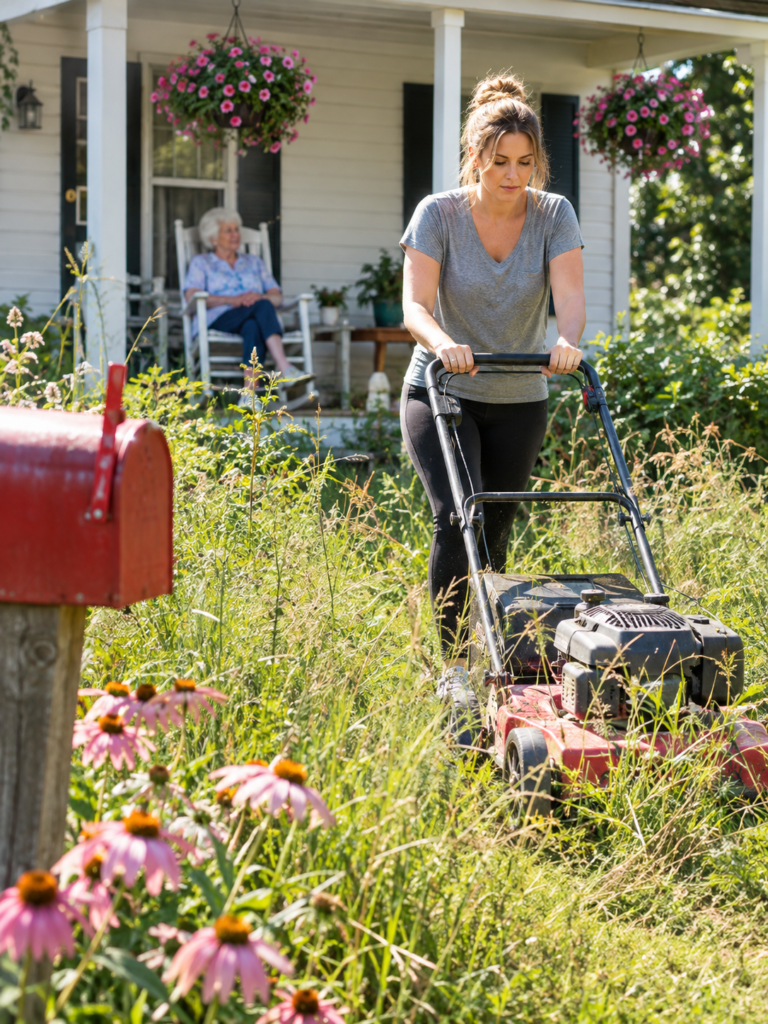
Now she was out in her front yard in the blazing heat, pushing a lawnmower.
She was eighty-two. I knew that because I’d seen it in her husband’s obituary. Walter James Higgins, 84, survived by his wife of sixty-one years, Ruth. She was tiny. Maybe five feet tall. Maybe ninety pounds. She was wearing a sun hat that was too big for her head and a flowered housedress and white sneakers with Velcro straps.
The lawnmower was old and rusty. The kind you push, with a motor that sounds like a coughing old man. It was the kind of mower that was hard to push even for a grown man on flat ground.
Her grass was nearly up to her knees. Nobody had cut it since Walter died. It was full of weeds and dandelions and some kind of tall, feathery stuff that swayed in the hot breeze.
She’d push the mower two feet. Stop. Lean on the handle and breathe. Push it two more feet. Stop again.
I watched her do that four times.
I should have gone back inside. I had enough problems of my own. I had a foreclosure notice. I had a stack of unpaid bills. I had a baby coming in six weeks and no crib and no car seat and no idea how I was going to pay for any of it.
But I couldn’t.
I don’t know why. Maybe it was the way she kept stopping to breathe, the same way I’d been stopping to breathe all day. Maybe it was the sun hat. Maybe it was because I knew exactly what it felt like to be alone in a house that used to have two people in it.
I walked across the lawn.
“Mrs. Higgins?”
She looked up. Her face was bright red under the sun hat, and her glasses had slid down her nose. She squinted at me.
“Oh,” she said. “You’re the girl next door.”
“Hannah.”
“Hannah.” She nodded, like she was filing it away. “I’m sorry. I’m terrible with names.”
“That’s okay.” I looked at the mower. “Can I help you with that?”
She looked at my belly. Then at my face. Then back at my belly.
“Good heavens, no,” she said. “Look at you. You’re about to pop.”
“I’ve got six weeks.”
“You shouldn’t be pushing anything heavier than a shopping cart.”
“You shouldn’t be pushing anything in this heat,” I said. “You’re eighty-two.”
She stared at me. Then she laughed. It was a surprised, crackly little laugh, like a door that hadn’t been opened in a long time.
“Well,” she said. “Aren’t you a sassy thing.”
“Please,” I said. “Let me do it. Go sit on the porch. Drink some water. I’ll be quick.”
She hesitated. I watched her pride fight with her tiredness. Her hands were shaking on the handle of the mower. There was sweat running down the side of her face.
Her tiredness won.
“All right,” she said. She let go of the handle. “But I’m making you lemonade.”
“You don’t have to—”
“I’m making you lemonade,” she said firmly. “It’s the law.”
I gently took the mower from her. She was right. It was heavy. It was heavy and old and it pulled to the left, and the motor kept choking out every few minutes so I’d have to stop and yank the cord again.
It took me three hours.
I’m not proud of how long it took. A healthy person could have done it in forty-five minutes. But I had to go slow. I had to stop every few rows and put my hands on my lower back and breathe through the pain shooting down my leg. I had to stop twice to sit on her front step because I got dizzy. Once, the baby kicked so hard I had to bend over and hold my stomach until it passed.
My ankles swelled up like balloons. My shirt was soaked through. Sweat dripped into my eyes and made them sting. The grass was so long it kept clogging the mower, and I had to turn it off and pull wet clumps out of the blade with my hands.
Mrs. Higgins sat on her porch in a white rocking chair the whole time. She watched me like a hawk. Every twenty minutes, she’d call out, “Come drink something!” and I’d walk over, and she’d hand me a big glass of lemonade with too much sugar in it, and I’d drink the whole thing in one go.
The third time, she made me sit down beside her.
“You look like you’re about to faint,” she said.
“I’m fine.”
“You’re not fine. Sit. Five minutes. The grass isn’t going anywhere.”
I sat. The rocking chair next to hers was bigger. Heavier. It had a faded blue cushion on the seat with a dent worn into it.
“That was Walter’s,” she said, watching me. “Sixty-one years he sat in that chair. Every evening. Watching the street.”
I started to get up. “I’m sorry. I didn’t—”
“Sit down,” she said. “It’s nice to see somebody in it.”
We sat there together for a minute, rocking. The street was quiet. A sprinkler was ticking somewhere down the block.
“When are you due?” she asked.
“September eighth.”
“Boy or girl?”
“Girl.”
She smiled. “Do you have a name?”
“Not yet. I keep changing my mind.”
She nodded. She looked at my left hand. At the pale strip on my ring finger where my engagement ring used to be. I’d sold it in May. I got four hundred dollars for it. Kyle had told me it cost three thousand.
“The young man,” she said carefully. “The one with the truck. I haven’t seen him in a while.”
“He left.”
“When?”
“When I told him I was pregnant.”
She was quiet for a long time. Then she reached over and put her small, dry hand on top of mine on the arm of the chair.
“His loss,” she said.
“That’s what everybody says.”
“Everybody’s right,” she said. “Everybody’s right more often than you’d think.”
When I finished, it was almost six o’clock. The sun was going down, and the heat was finally starting to break. The lawn looked good. Not perfect. There were a few crooked lines where the mower had pulled left. But it was short and neat and green, and you could see the flower beds again, and the little stone birdbath in the middle that had been completely hidden by weeds.
I pushed the mower back into her garage. When I came out, she was standing at the bottom of her porch steps, waiting for me.
She took my hand. Both of her hands, wrapped around mine. They were small and cool and very strong.
She squeezed.
“You’re a good girl,” she said softly. “Don’t forget that.”
I didn’t know what to say. It felt like such an odd thing to say to a grown woman. Like something you’d tell a child.
But it made my throat tight. Because I couldn’t remember the last time anybody had told me I was good at anything.
“Thank you, Mrs. Higgins.”
“Ruth,” she said. “Call me Ruth.”
“Thank you, Ruth.”
She didn’t let go of my hand right away. She stood there holding it, looking at me with her faded blue eyes, like she was trying to memorize my face.
“Go home,” she said finally. “Put your feet up. Drink some water. And Hannah?”
“Yes?”
“Things have a way of working out,” she said. “Even when it doesn’t look like they will. Especially then.”
I didn’t think much of it.
I went home. I took a cold shower. I lay on my couch with my feet up on three pillows and the box fan blowing on me, and I fell asleep before it was dark.
I woke up around eleven. I had to pee. When you’re thirty-four weeks pregnant, you always have to pee.
On my way back from the bathroom, I stopped at the kitchen window to get a glass of water. The window looks out over the side yard, toward Ruth’s house.
Her porch light was on.
And she was out there. Walking slowly across her newly mown lawn in a long pink bathrobe, holding something against her chest with both arms. She was moving very carefully, the way you walk when you’re old and it’s dark and you’re afraid of falling.
She was walking toward my driveway.
I watched her for a second. I thought maybe she was bringing back a dish, or dropping off more cookies, or maybe she’d gotten confused and thought it was morning. Old people do that sometimes. My grandmother used to.
Then my back seized up, and a hot bolt of pain shot down my leg, and I had to grab the edge of the sink and breathe through it. When I looked up again, she was already walking back toward her own house.
I thought about going out to check on her. I really did.
But I was so tired. So, so tired.
I drank my water. I went back to bed.
I barely slept. I kept waking up. Hot. Uncomfortable. Worried about the mortgage. Worried about the baby. Worried about everything.
I didn’t worry about Ruth.
I’ve thought about that a lot since.
“Ma’am. Ma’am, you need to calm down.”
I was sitting on my driveway. I didn’t remember sitting down. I just remembered screaming, and then my legs giving out, and then the sheriff was crouching in front of me, and the young deputy was running over from the patrol car.
The yellow envelope was in my lap. Money had spilled out onto the concrete. Stacks of hundred-dollar bills with rubber bands around them, lying in the morning sun.
“Is she all right?” the deputy said. “Should I call the paramedics over?”
“I’m fine,” I gasped. “I’m fine. I’m fine.”
“You’re breathing too fast,” the sheriff said. “Slow down. In through your nose. Come on. With me.”
I did it. In through my nose. Out through my mouth. The baby was kicking like crazy. I pressed my hand against my stomach.
“What is this?” I said. “What is this?”
“That’s what I was hoping you’d tell me,” the sheriff said.
He picked up the blue letter from where it had fallen. He didn’t open it. He just held it.
“My name is Dale Brennan,” he said. “I’ve been the sheriff in this county for twenty-two years. I’ve known Ruth Higgins for most of my life. She was my Sunday school teacher when I was eight.” He paused. “At five o’clock this morning, I got a call from her nephew, Travis. He’d come by to check on her, and he found her in bed. She’d passed in her sleep.”
I put my hand over my mouth.
“And then,” Sheriff Brennan said, “Travis went out to the shed in her backyard. And he came running back into the house screaming that she’d been robbed. He said his uncle Walter kept money in coffee cans in that shed. Old-fashioned. Didn’t trust banks. Travis said there should have been more than forty thousand dollars out there. He said the cans were empty.”
He looked down at the money on my driveway.
“And then he said the only person who’d been at her house in the last twenty-four hours was the pregnant girl next door. Who spent all afternoon in the yard. Right next to the shed.”
My blood went cold all over again.
“I didn’t take anything,” I said. “I swear to God. I didn’t even go near the shed. I put the mower in the garage. That’s all. I don’t know anything about any coffee cans.”
“Then how’d forty thousand dollars end up in your mailbox, Ms. Pierce?”
“I don’t know!“
He looked at me for a long time. His face didn’t give anything away.
Then he held up the letter.
“Mind if I read this?” he asked. “Out loud. With my deputy here as a witness.”
I couldn’t talk. I just nodded.
He unfolded it. He put on a pair of reading glasses from his shirt pocket. He cleared his throat.
Dear Hannah,
If you are reading this, dear girl, I am already gone. Please don’t be frightened. I have been ready for a while now. My heart has been failing since the spring, and the doctor says it won’t be long. I’d rather go in my own bed than in a hospital, and I have a feeling I will.
I have watched you for a long time. Longer than you know. I saw the young man leave. I saw you carrying the groceries in by yourself, and then carrying fewer of them. I saw the man from the power company. I saw you sitting on your back step at night, crying, with your hand on your stomach. I heard you through the fence, telling your baby you were sorry.
I wanted to help. But I didn’t know how to offer without shaming you. You have a proud face. I know that face. I used to wear it.
Then today, you walked across the grass and took that awful machine out of my hands, and you pushed it for three hours in the heat with your belly out to here, and I thought: well, Ruth, there’s your answer. She’s already decided to be kind to you. The least you can do is be kind back.
This money was Walter’s. He didn’t trust banks, bless him. He kept it in coffee cans in the shed for fifty years. It was supposed to be for a rainy day. Walter never believed in rainy days. He thought every day was fine.
This is your rainy day, Hannah. Take it. Pay your house. Buy a crib. Buy that child a good car seat. Don’t you dare give it back.
I have left a copy of this letter with my lawyer, Harold Pike, along with other papers. Travis will not like this. Travis has never liked anything I did. If he makes trouble, you tell him to go talk to Harold.
You’re a good girl. Don’t forget that.
With love,
Ruth Higgins
Nobody said anything for a long time.
The deputy had taken his hat off. He was holding it against his chest. The paramedics next door had stopped moving. A car went by slowly on the street, the driver craning his neck to look at the patrol cars.
Sheriff Brennan folded the letter back up. He took off his reading glasses and put them in his pocket.
“That’s her handwriting,” he said quietly. “I’d know it anywhere. She used to write Bible verses on the chalkboard every Sunday.”
I was crying. I didn’t even know when I’d started.
“I didn’t know,” I said. “I didn’t know she was sick. I didn’t know she was watching. I didn’t know any of it.”
“I believe you.”
“Last night,” I said. “I saw her. Around eleven. Walking across her lawn in her bathrobe. Carrying something. I thought she was confused. I almost went out. I didn’t. I was tired. I should have gone out. If I’d gone out—”
“She’d still be gone,” Sheriff Brennan said. His voice was gentle now. “Her heart gave out, Ms. Pierce. There’s nothing you could have done. She knew it was coming. She said so herself.”
“She walked all the way over here in the dark to put it in my mailbox. She could have fallen. She could have—”
“She did what she wanted to do,” he said. “Ruth always did what she wanted to do. Trust me. I got sent to the corner in her Sunday school class more times than I can count.”
I laughed through my tears. I didn’t mean to.
He crouched down again, slowly. His knees cracked. He started gathering the money off my driveway and putting it back in the envelope.
“Here’s the thing, Ms. Pierce,” he said. “I believe you. I believe this letter. But Travis Higgins is going to be over here in about ten minutes, and he’s going to be screaming about theft and forgery and whatever else he can think of. And as long as there’s a complaint, I can’t just hand forty thousand dollars in cash to the neighbor and walk away.”
“What does that mean?”
He sealed the envelope.
“It means I have to take this with me,” he said. “Into evidence. Until it’s sorted out. I’m sorry.”
He stood up. He held out his hand to help me off the ground.
I took it. And as he pulled me up, I felt it. A deep, tight cramp low in my belly. It lasted for a few seconds. Then it went away.
I didn’t say anything.
But I put my hand on my stomach, and I held it there.
Travis Higgins showed up nine minutes later.
He came barreling up the street in a black pickup truck with a lift kit and oversized tires, the kind that makes a lot of noise and doesn’t need to. He parked half on my lawn. He jumped out before the engine had even stopped.
He was maybe forty-five. Big, soft around the middle, with a red face and a baseball cap pulled low. He was wearing a golf shirt that was too tight across his stomach.
“Is that her?” he yelled, pointing at me. “Is that the thief?”
“Travis,” Sheriff Brennan said. “Calm down.”
“Don’t tell me to calm down, Dale! My aunt’s lying dead in there, and this—this girl—” He was walking toward me. Fast. “You took advantage of her! She was eighty-two years old! She didn’t know what she was doing!”
The deputy stepped in front of me. “Sir, you need to back up.”
“I know what you did,” Travis said, over the deputy’s shoulder. His face was purple. “You wormed your way in there. Mowing her lawn. Playing the sad little pregnant girl. Making her feel sorry for you. And then you cleaned her out.”
“I didn’t take anything,” I said. My voice was shaking. “She gave it to me. She wrote a letter—”
“She didn’t write anything! She could barely hold a fork! You wrote it! You forged it!”
“That’s enough, Travis,” Sheriff Brennan said.
“It’s not enough! That’s my family’s money! My uncle’s money! Sixty years he saved that!”
“It was Ruth’s money,” the sheriff said. “Walter left everything to Ruth.”
“And Ruth was leaving it to me!” Travis’s voice cracked. “I’m all she had! I’m the only family she’s got left! I came by every single month! I checked on her!”
“When did you check on her last, Travis?” Sheriff Brennan asked quietly.
Travis stopped.
“What?”
“When did you last come by? Before this morning.”
“I… Last week. Last month. I don’t know. I’ve been busy. I’ve got a business to run.”
“Her lawn was up to her knees,” the sheriff said. “Did you notice that last time you came by?”
Travis’s jaw worked. He didn’t answer.
“Because this girl noticed,” Sheriff Brennan said. “And she’s eight months pregnant. And she did something about it.”
Travis stared at him. Then he turned and pointed at me.
“This isn’t over,” he said. “I’m getting a lawyer. I’m getting the best lawyer in the state. I’m going to prove you stole from her. And I’m going to make sure you go to jail. You hear me? You and that baby both.”
He got back in his truck and slammed the door. He peeled out so fast that his tires tore two long brown ruts through my lawn.
The deputy let out a long breath. “Well. He’s pleasant.”
Sheriff Brennan didn’t say anything. He was watching the black truck disappear around the corner.
Then he turned to me.
“Go inside, Ms. Pierce,” he said. “Lock your door. Get some rest. I’ll be in touch.”
“What happens now?”
“Now,” he said, “I talk to Harold Pike.”
The cramps came back that afternoon.
Not bad ones. Just tight, squeezing feelings low in my stomach, every hour or so. I called my doctor’s office. The nurse asked me a lot of questions. How often. How long. Any bleeding. Any fluid.
“It sounds like Braxton-Hicks,” she said. “Practice contractions. They’re very common. Especially with stress. Have you been under a lot of stress lately?”
I laughed. I couldn’t help it.
“Try to rest,” she said. “Drink water. If they get closer together or stronger, come in right away.”
I rested. I drank water. I lay on the couch with the box fan and stared at the ceiling.
Every time I closed my eyes, I saw Ruth. Walking across her lawn in the dark in her pink bathrobe. Holding that envelope against her chest. Taking slow, careful steps so she wouldn’t fall.
Things have a way of working out. Even when it doesn’t look like they will.
She knew. When she said that to me, she already knew what she was going to do. She’d already decided.
And I’d just thanked her and gone home to take a shower.
The next few days were some of the worst of my life.
Travis didn’t just get a lawyer. He got loud.
He posted about me on the neighborhood Facebook group. He didn’t use my name, but he didn’t have to. Elderly widow on Maple Court robbed by NEIGHBOR who pretended to be her friend. Watch out for people who “help.” They’re not always what they seem. It had over two hundred comments by the end of the day.
Some people defended me. A lot of people didn’t.
The woman across the street, who used to wave at me every morning, stopped waving. When I went out to get my mail on Thursday, she was watering her roses. She saw me and turned around and went inside.
Someone left a note in my mailbox on Friday. Typed. No name.
Shame on you.
I sat on my kitchen floor and cried for an hour.
The mortgage company sent another letter. I opened this one. I made myself. It said I had eighty-seven days to pay the full amount I was behind, plus fees, or the house would go to auction.
The full amount was fourteen thousand, two hundred dollars.
The envelope Ruth left me had over forty thousand in it.
And it was sitting in an evidence locker at the county sheriff’s office.
On Saturday morning, someone knocked on my door. Gently this time.
I looked through the peephole. It was an old man in a wrinkled seersucker suit and a straw hat, holding a leather briefcase. He had white hair and very bushy eyebrows and a face like a friendly turtle.
I opened the door.
“Ms. Pierce?” he said. “My name is Harold Pike. I was Ruth Higgins’s attorney for thirty-one years. May I come in?”
He sat at my kitchen table. He looked around at the stack of unopened mail on the counter and the box fan and the dishes in the sink, and he didn’t say anything about any of it. I liked him for that.
I made him a glass of iced tea. It was the only thing I had.
He opened his briefcase and took out a thick manila folder.
“First,” he said, “I want to say I’m very sorry about what’s been happening. Dale Brennan told me. The Facebook business. The note in your mailbox.” He shook his head. “Travis has always been like this. Ever since he was a boy. He thinks the louder he yells, the more right he is.”
“Is he going to sue me?”
“He can try,” Harold said. “He won’t get anywhere.”
He opened the folder.
“Ruth came to see me three weeks ago,” he said. “She’d just gotten some bad news from her cardiologist. She knew she didn’t have long. She wanted to put her affairs in order.”
He slid a piece of paper across the table to me. It was a copy of the letter from my mailbox. Word for word. Same pale blue stationery. Same shaky handwriting.
“She wrote this in my office,” he said. “In front of me. And in front of my secretary, who is a notary. It’s dated and signed and witnessed.” He tapped the bottom of the page. “The only thing she didn’t know when she wrote it was your name. She left a blank. She said, ‘I’ll fill it in when I’m sure.’”
I looked at the top of the page. The copy said, Dear ________.
“She wrote it three weeks ago,” I said slowly. “Before the lawn. Before she even knew my name.”
“She knew who she wanted to give it to,” Harold said. “She just didn’t want to be wrong. She told me she was waiting for a sign.” He smiled a little. “Ruth was very big on signs.”
I didn’t know what to say. I just stared at the blank line where my name should have been.
“There’s more,” Harold said.
He took out another envelope. Cream-colored this time, sealed, with my name on the front. In Ruth’s handwriting.
“She left this with me as well,” he said. “She said, ‘If Travis makes a fuss, and he will, give this to the girl. So she understands why.’”
I didn’t open it while he was there. I couldn’t. My hands were shaking too much.
After he left, I sat at my kitchen table for a long time with the envelope in front of me. The baby was quiet for once. The house was quiet. The only sound was the box fan.
Then I opened it.
It was three pages long. Her handwriting got shakier as it went along.
Dear Hannah,
If Harold has given you this, then Travis is making trouble. I’m sorry. He’s my late husband’s sister’s boy, and I have tried to love him for forty-five years. Some years I did better than others.
I want to tell you a story. I’ve never told anybody but Walter. Not even Harold knows all of it.
In the spring of 1962, I was nineteen years old and pregnant and alone.
The father was a boy named Eddie who worked at the gas station in the town where I grew up. He had nice hair and a nice car and a lot of nice things to say. When I told him about the baby, he said, “That’s your problem, Ruthie,” and he was gone by the end of the week. Moved to Detroit, I heard. I never saw him again.
My father put me out of the house. He said I had shamed the family. My mother cried, but she didn’t stop him. I took the bus to the city with twelve dollars and one suitcase. I rented a room in a boarding house on Fourth Street from a woman named Mrs. Odessa Hale.
Mrs. Hale was seventy-something years old. A widow. Tough as an old boot. She had the best garden on the whole block, and she was too old to take care of it anymore.
One day in June, I saw her out in the heat, trying to hoe her tomato beds. She could barely lift the hoe. And I was seven months along, with my back aching and my ankles swollen, and I had my own troubles. I had no job. I had no money. I had no idea how I was going to feed a baby.
But I went out there and took the hoe out of her hands, and I finished that garden for her.
It took me all afternoon.
I had to put the letter down. I had to put my hand over my mouth.
I picked it back up.
When I was done, she took my hand, and she said, “You’re a good girl. Don’t forget that.”
The next week, I was behind on my rent. I was sure she would put me out. Instead, I found an envelope under my door. Two hundred dollars. That was a fortune in 1962. There was a note inside. It said, “For the baby. Pay it forward someday.”
I had my son in August. I named him Joseph. Mrs. Hale was the first person to hold him after me.
She let me stay in that room until Joseph was two, and she charged me half rent the whole time, and she watched him while I worked at the diner. When I met Walter, she was the one who told me to marry him. “That boy looks at you like you hung the moon,” she said. “Don’t be a fool.”
Walter adopted Joseph when he was three. He loved him like his own. Joseph grew up to be a fine man. He was a schoolteacher. He died of a heart attack when he was fifty-four, eleven years ago. I thought I would die too. I didn’t. I kept waking up.
Walter and I never had other children. The doctors said it wasn’t meant to be. So when Joseph died, there was nobody left but Walter and me. And Travis, who came by to look at our house like he was measuring it for curtains.
I told Walter about Mrs. Hale’s two hundred dollars when we were first married. I told him I owed it to somebody. He said, “Then we’ll save it up, and we’ll pay it back with interest, when the right person comes along.” He started putting money in those coffee cans. A little every week. For fifty years.
He never found the right person. He got sick. He passed in April. At the end, he held my hand and said, “Ruthie, you still owe Mrs. Hale.” And I said, “I know, Walt. I’ll find her.”
Then I looked out my window, and there you were. Carrying your groceries in by yourself. Crying on your back step at night.
I think I knew from the first time I saw you. But I’m an old woman, and I’m stubborn, and I wanted to be sure. So I waited.
And then you walked across my lawn and took the mower out of my hands.
I don’t believe in coincidences, Hannah. I believe in Mrs. Hale’s tomato garden, and in my overgrown lawn, and in two women sixty years apart who were too proud to ask for help and too kind not to give it.
That money isn’t charity. It’s a debt. Sixty years old. I’m only giving back what was given to me.
And someday, when your girl is grown, and you’re old, and you see some young woman struggling in the heat, I hope you’ll know what to do.
You’re a good girl. Don’t forget that.
It took me a long time to believe it about myself. Please don’t take as long as I did.
With all my love,
Ruth
I read it four times.
Then I folded it up and held it against my chest, and I sat at my kitchen table in the heat, and I cried harder than I’d cried when Kyle left. Harder than I’d cried when the foreclosure call came.
Because for the first time in eight months, I didn’t feel alone.
A woman I’d barely known had been watching me from her window. Worrying about me. Waiting for me. Planning for me.
And an old woman named Odessa Hale, who died long before I was born, had somehow reached across sixty years and put her hand on my shoulder.
Harold called me on Monday.
“Travis’s lawyer is claiming undue influence,” he said. “He’s saying Ruth was old and sick and confused, and you took advantage of her. He’s asking a judge to freeze the money until there’s a full investigation.”
“But she wrote the letter three weeks before she even met me.”
“She wrote a letter with a blank space,” Harold said. “His lawyer says anybody could have filled in that blank. Including you.”
My stomach dropped. “So what do we do?”
“We prove it was her,” he said. “That she put it in your mailbox herself. That you didn’t take it.”
“How? She’s gone. There’s nobody who saw her except me. And nobody’s going to believe me.”
Harold was quiet for a moment.
“Do you have any cameras?” he asked. “At your house? Some of the young folks have those doorbell things now.”
I opened my mouth to say no.
Then I closed it.
Kyle.
Kyle had installed a doorbell camera two years ago, right after we moved in. He’d been paranoid about package thieves. It had a little lens pointed right at the front walk. Right at the driveway.
Right at the mailbox.
I’d forgotten it was even there. I hadn’t opened the app in months. I didn’t even know if it still worked. I didn’t know if I’d been paying for it. The subscription might have been on Kyle’s card.
“Hold on,” I said.
I dug my phone out of the couch cushions. I scrolled through my apps with shaking fingers until I found it. A little icon of a doorbell. I pressed it.
It asked for a password.
I tried my birthday. Wrong. I tried Kyle’s birthday. Wrong. I tried our anniversary. Wrong.
“Hannah?” Harold said on the phone. “Are you still there?”
I tried the name of Kyle’s truck. He’d named it. It was called Big Red.
The app opened.
It was still recording. The subscription was on Kyle’s credit card, and he’d never canceled it. Apparently, he’d forgotten about it too.
I scrolled back through the saved clips. Tuesday. Tuesday night.
There were a lot of them. The camera recorded every time something moved. A cat. A car’s headlights. A moth flying too close to the lens.
At 9:03 p.m., a black pickup truck with a lift kit and oversized tires pulled up in front of Ruth’s house. You could just see it at the edge of the frame.
At 9:04, Travis got out and went up to her front door.
At 9:31, he came back out. He was walking fast. The camera didn’t have sound, but I could see his arms moving. Waving. Pointing back at her house. He stood on her front walk and shouted something back at the door. Then he got in his truck and slammed the door and drove away fast.
He’d been there. Tuesday night. Hours before she died. And he’d never mentioned it. Not to the sheriff. Not to anybody. He’d told everyone that I was the only person at her house in the last twenty-four hours.
I kept scrolling.
At 11:14 p.m., the camera caught movement.
It was grainy and dark and a little blurry. But you could see it. A tiny figure in a long bathrobe, walking slowly across the newly mown lawn from the direction of Ruth’s house. Taking careful, shuffling steps. Stopping once to rest.
Holding something against her chest with both arms.
She walked all the way to the end of my driveway. She stopped at the mailbox. She stood there for a moment.
Then she opened the lid, and she put the envelope inside, and she closed it again.
And then she did something I’ll never forget.
She reached out and put the little red flag up.
Then she put her hand flat on top of the mailbox. Just for a moment. Like she was saying goodbye to it.
She turned around, and she walked slowly back across her lawn, and she went inside, and her porch light went off.
That was the last time anybody ever saw her alive.
“Hannah?” Harold said. “Hannah, are you there?”
I couldn’t answer him. I was sitting on my couch with my phone in my hand, watching it again. And again. Watching her put her hand on the mailbox.
“I’ve got it,” I finally whispered. “I’ve got her. On camera. She put it there herself.”
The hearing was scheduled for Thursday afternoon. The funeral was Thursday morning.
I went to the funeral. People told me I shouldn’t. Harold said Travis would be there, and it might get ugly. Sheriff Brennan said I’d been through enough. The doctor’s nurse said I should be resting.
But I went. I had to.
It was a small church on the edge of town. White wooden walls. Stained glass windows. It was hot inside, and the ceiling fans were turning slowly, pushing the warm air around. There weren’t many people. Some old women from the church. Harold Pike, in a black suit instead of seersucker. Sheriff Brennan, sitting in the back row with his hat in his lap.
And in the front row, alone, Travis.
I sat in the back, on the other side of the aisle from the sheriff. I tried to make myself small. As small as you can be when you’re thirty-five weeks pregnant.
The pastor was an older man with a kind face and a gentle voice. He talked about Ruth. About her garden. About her Sunday school class. About the sixty-one years she was married to Walter. About her son, Joseph, who was buried next to Walter in the cemetery out back.
“Ruth used to say,” the pastor said, “that the measure of a life is what you give away. Not what you keep.”
I heard Travis snort in the front row. Loud enough that a few of the old women turned to look at him.
At the end, the pastor asked if anyone wanted to say a few words.
Nobody moved.
Then Travis stood up.
He walked to the front of the church. He stood behind the pulpit. His face was red and sweaty. He looked out at everybody.
“My aunt Ruth,” he said, “was a good woman.”
His voice was loud. Too loud for the little church.
“She was a trusting woman. Too trusting. That was her problem.” He looked right at me. “And some people take advantage of that. Some people see a lonely old widow and they think, there’s an easy mark.”
“Travis,” Harold said from his pew. “This isn’t the place.”
“It’s exactly the place!” Travis’s voice rose. “She’s sitting right there! In the back! Pretending to grieve! The woman who stole forty thousand dollars from my aunt!”
Every head in the church turned to look at me.
I felt my face burn. I wanted to run. I wanted to sink through the floor.
Instead, I stood up.
I don’t know where it came from. My knees were shaking. My back was on fire. But I stood up, holding the back of the pew in front of me.
“I didn’t steal anything,” I said. My voice was quiet, but the church was so silent it carried. “She gave it to me. She wrote me a letter. She told me why.”
“She was confused!“
“She wasn’t confused,” I said. “She knew exactly what she was doing. She’d known for three weeks.”
“You don’t know anything about her! You met her once!“
“That’s true,” I said. “I only met her once. And you knew her forty-five years.” I looked right at him. “So why didn’t you mow her lawn?”
The church went dead silent.
Travis’s mouth opened and closed.
“And why,” I said, “didn’t you tell anybody you were at her house on Tuesday night? At nine o’clock? Yelling at her on her front porch?”
His face went white.
“I have it on camera,” I said. “You. At her door. For almost half an hour. And then you walking out and shouting back at her. And then you driving off.” I took a breath. “And two hours later, I have her. Walking across the lawn in her bathrobe. Putting the envelope in my mailbox. By herself. And putting the flag up.”
In the back row, Sheriff Brennan slowly stood up.
“Travis,” he said. “What were you and Ruth arguing about on Tuesday night?”
Travis stared at him. His lips were moving, but nothing came out.
“She told me,” Harold said quietly, from his pew. “She called me Wednesday morning. Very early. Before she…” He paused. “She said Travis came over asking about Walter’s money. Again. Wanting it now, not after she was gone. She said he’d been asking every month since the funeral. She said he’d told her she was too old to be sitting on that kind of cash, and she might as well hand it over while she was alive to see him enjoy it.”
Travis’s face crumpled into something ugly.
“She said no,” Harold said. “And she said she’d already found someone who needed it more.”
“That’s a lie,” Travis whispered.
“It’s in my notes,” Harold said. “Dated and timed. She called me at 6:10 a.m. on Wednesday. She said, ‘Harold, I did it. I found her. I’m so tired, but I found her. Walt would be proud.’”
I sank back down into the pew. My legs wouldn’t hold me anymore.
Then I felt it.
A deep, hard squeeze across my whole belly. Much stronger than the practice ones. It wrapped all the way around my back and pulled tight like a belt, and I gasped out loud, and grabbed the pew.
And then, a second later, I felt something warm and wet.
I looked down.
My water had broken. All over the floor of the church.
“Oh my Lord,” one of the old women said.
Sheriff Brennan was beside me in about two seconds. I don’t know how he moved that fast. He crouched down in front of me.
“Hannah,” he said. “Is it time?”
“It’s too early,” I gasped. “It’s five weeks early. It’s too early.”
“Okay. Okay. We’re going to the hospital right now.”
“I don’t have a bag. I don’t have anything. I don’t have a car seat—”
“Don’t worry about that,” he said. “Can you walk?”
Another contraction hit. I bent over and grabbed his arm so hard I left nail marks. He didn’t flinch.
“Okay,” he said when it passed. “We’re going to walk. Slow. I’ve got you.”
He helped me up. Harold took my other arm. Together, they walked me down the aisle of that little white church, past all the old women from Ruth’s Sunday school class, who were standing up in their pews and reaching out to touch my shoulder as I passed. God bless you, honey. You’ll be fine. Breathe, sweetheart.
At the front of the church, Travis was still standing at the pulpit. He watched us go. He didn’t say anything. He just stood there with his hands gripping the wood, and his face didn’t look angry anymore.
It just looked lost.
Sheriff Brennan drove me to the hospital in his patrol car. With the sirens on.
I remember thinking, even between contractions, how strange it was. Five days ago, sirens had woken me up and I’d thought my life was falling apart. Now, sirens were carrying me to the hospital to have my baby.
“You doing okay back there?” he called over his shoulder.
“No!”
“Good! Honesty’s good!”
I laughed. Then another contraction hit, and I stopped laughing and started swearing. Loudly. Words I’d never said in front of a police officer before.
“Ruth would have washed your mouth out with soap,” he said.
“Ruth isn’t here!“
He was quiet for a second. Then he said, “Oh, I don’t know about that.”
My daughter was born at 7:43 that evening.
Four pounds, eleven ounces. Tiny. So tiny. She came out screaming, which the doctor said was a very good sign. They let me hold her for thirty seconds, just long enough to see her face, red and wrinkled and furious, with a shock of dark hair plastered to her head. Then they took her away to the NICU, because she was early and her lungs needed some help.
I lay in the hospital bed afterward, alone, staring at the ceiling.
I’d done it. I’d had a baby. By myself. With no husband. No mom. No family. Just a sheriff I’d met five days ago, who’d paced in the waiting room for eight hours, and a lawyer with bushy eyebrows who’d brought me a vending machine sandwich.
A nurse came in to check on me. She was young, with purple scrubs and a kind face.
“She’s doing great,” she said. “Breathing on her own already. She’s a fighter.”
“Can I see her?”
“In a little while. You need to rest first.” She checked my IV. “Has she got a name yet? We need it for the paperwork.”
I thought about it.
I’d been changing my mind for months. Olivia. Emma. Charlotte. Nothing ever felt right.
I thought about an old woman in a flowered housedress and a sun hat that was too big for her head. About a pink bathrobe and slow, careful steps across a dark lawn. About a hand resting on top of a mailbox, saying goodbye.
“Ruth,” I said. “Her name is Ruth.”
The nurse smiled. “That’s pretty. Kind of old-fashioned.”
“Her middle name is Odessa.”
The nurse looked at me a little funny. “That’s… unusual.”
“It’s a long story,” I said.
They let me see her around midnight.
She was in a little plastic incubator with holes in the sides, wearing nothing but a diaper that was way too big for her and a tiny knit hat. There were wires stuck to her chest and a little tube taped under her nose. She was sleeping.
I put my hand through one of the holes. I touched her fingers. They were so small. Smaller than anything I’d ever seen.
She opened her hand and grabbed onto my finger.
“Hi, Ruthie,” I whispered. “Hi, baby. I’m your mom.”
She held on.
I stood there for an hour. My back hurt. My legs hurt. Everything hurt. I didn’t care.
“There was a lady,” I told her. “Next door. She was old, and she was lonely, and she was very, very stubborn. And she saved us. She saved both of us. I only knew her for one afternoon.”
The machines beeped softly. Down the hall, another baby was crying.
“I’m going to tell you all about her,” I said. “Every single thing. So you know where your name came from.”
Ruthie squeezed my finger.
Sheriff Brennan came by the next morning. He had a bunch of grocery store flowers in one hand and a plastic bag in the other.
“How’s the little one?”
“She’s good. They think she can come off the oxygen tomorrow.”
“That’s great. That’s really great.” He set the flowers down on the tray table. Then he held up the plastic bag. “Harold asked me to bring you this.”
Inside was the yellow envelope. Sealed. Heavy.
I stared at it.
“The judge released it this morning,” the sheriff said. “Harold showed him the video from your doorbell camera. And Ruth’s phone call. And the signed letter from three weeks ago.” He paused. “Travis dropped his complaint. His lawyer told him he’d lose, and he’d end up paying your lawyer’s fees on top of it. So he dropped it.”
I held the envelope in my lap. I didn’t open it.
“There’s something else,” the sheriff said. He sat down in the chair beside my bed. He turned his hat around in his hands. “Travis came to see me last night. After the hospital. He came to my office.”
“What did he want?”
“He wanted to know about the baby. If you were okay.” Sheriff Brennan looked at his hat. “He said he saw your face in the church. When the contractions started. He said it reminded him of something. His mother, when she had his little sister. She was early too. The baby didn’t make it.” He was quiet for a moment. “He said he forgot that Ruth was the one who sat with his mom in the hospital, all night, every night, for two weeks. His own mom. His dad was drunk somewhere. And Ruth sat with her.”
I didn’t say anything.
“He said he didn’t want the money anymore,” the sheriff said. “He said he didn’t know what he wanted. I think he’s a man who’s been angry so long, he forgot why.”
He reached into his coat pocket and pulled out something small. He put it in my hand.
It was a wedding ring. Plain gold, very thin, worn down almost to nothing on one side.
“It was Ruth’s,” he said. “Travis said the funeral home gave it to him. He said he didn’t feel right keeping it. He said to give it to the baby.”
I held it in my palm. It was warm from his pocket.
“He wanted me to tell you something,” the sheriff said. “He said, ‘Tell her I’m sorry. Tell her Aunt Ruth was right about her.’”
Ruthie came home three weeks later.
The first thing I did with Ruth’s money was pay off the mortgage arrears. All fourteen thousand, two hundred dollars. I walked into the bank with a cashier’s check and slid it across the counter to a woman in a gray suit, and she looked at my account, and she looked at the check, and she said, “Well. That should do it.”
I walked out into the parking lot and sat in my car and cried for twenty minutes.
The second thing I did was buy a car seat. A good one. The best one they had. The kind with the little cup holder and the extra padding for newborns. Then I bought a crib, and a changing table, and a rocking chair, and a stack of tiny onesies, and a white knit blanket with ducks on it.
I got the air conditioning fixed.
I put the rest in the bank. A real bank. With an account that had Ruthie’s name on it.
I kept one hundred-dollar bill. I didn’t spend it. I put it in a frame on the wall of Ruthie’s nursery, next to Ruth’s letter. The one from the mailbox.
You’re a good girl. Don’t forget that.
The house next door sat empty for a while.
Travis put it up for sale in October. He came by to meet the realtor one Saturday. I was on my porch with Ruthie in the stroller, rocking her back and forth, trying to get her to sleep.
He saw me. He stopped on the sidewalk. For a long time, neither of us said anything.
Then he walked over. Slowly. His hands in his pockets.
He stood at the bottom of my porch steps. He looked at the stroller.
“Is that her?” he asked.
“That’s her.”
He came up one step. Then another. He looked down into the stroller. Ruthie was asleep, with her fist pressed against her cheek and her mouth open.
“She’s small,” he said.
“She’s getting bigger. She was four pounds when she was born. She’s almost seven now.”
He nodded. He kept looking at her.
“What’s her name?” he asked. Even though I was pretty sure he knew.
“Ruth,” I said. “Ruth Odessa.”
His face did something complicated. He looked away, out at the street.
“Aunt Ruth used to babysit me,” he said. “When I was a kid. My mom worked nights. Aunt Ruth would make me grilled cheese sandwiches cut into triangles and let me stay up to watch The Tonight Show. I thought she was the coolest person in the world.” He cleared his throat. “I don’t know when I stopped thinking that.”
“She never stopped loving you,” I said. “She said so. In one of her letters. She said she tried for forty-five years.”
He laughed. It came out broken. “Some years better than others, I bet.”
“That’s exactly what she said.”
He wiped his eyes with the back of his wrist, fast, like he hoped I wouldn’t notice. Then he looked back at me.
“I was awful to you,” he said. “At the church. On Facebook. The note in your mailbox. That was me. I’m sorry.”
“I know.”
“I don’t know why I did it. I guess I just… I thought, she gave it to some stranger. And not to me. And it made me feel like…”
“Like she didn’t love you,” I said.
He nodded. He couldn’t talk.
“She did,” I said. “She just knew you didn’t need it. Not the way I did.”
He stood there on my porch step for a long time. Then he reached out and, very carefully, with one thick finger, touched the top of Ruthie’s tiny knit hat.
“Take care of her,” he said.
“I will.”
He walked back down the steps and across the lawn to Ruth’s house, where the realtor was waiting.
He didn’t look back. But when he got to her porch, he stopped for a moment. And he put his hand on the arm of Walter’s old rocking chair.
Just for a second. Just like she’d put her hand on my mailbox.
It’s been almost two years now.
Ruthie is walking. Running, actually. Running everywhere, as fast as her chubby little legs will carry her, with no idea where she’s going and no fear of anything. She has dark curly hair and a big laugh and a very strong opinion about bananas, which is that she wants all of them, all the time.
I have a new job. A better one. I’m the office manager at Harold Pike’s law firm. He called me up a few months after Ruthie was born and said his secretary was retiring, and did I want the job, and I said I didn’t know anything about law, and he said, “Neither do most of my clients. You’ll fit right in.”
Sheriff Brennan comes by for dinner every other Sunday. He brings Ruthie stuffed animals shaped like police dogs. She calls him “Dale-Dale.” He pretends not to love it. He loves it.
The house next door sold to a young couple with two little boys and a golden retriever. They’re nice. They wave. The boys play in the yard where I mowed that day, and sometimes Ruthie stands at the fence and watches them with her fingers hooked through the chain link.
But this story isn’t really about any of that.
This story is about last Saturday.
It was hot. Not ninety-five, but close. I was pushing Ruthie in her stroller around the block, trying to get her to nap, when I turned the corner onto Birch Street.
And I saw a young woman out in her front yard.
She was maybe twenty-two. Maybe younger. She was wearing a stained T-shirt and cutoff shorts, and she had a baby on her hip. A little one. Maybe three months old. The baby was crying. The young woman was trying to jiggle her with one arm and drag a heavy black garbage bag down the driveway to the curb with the other.
The bag was too heavy. It kept catching on the concrete. She’d pull it a few feet. Stop. Adjust the baby. Pull it a few more feet.
There was an envelope sticking out of her mailbox. A big red one. I didn’t have to see it up close to know what it was.
Final Notice.
I stopped the stroller.
The young woman looked up and saw me watching. Her face got hard. Proud. Defensive. The way your face gets when you’re drowning and someone sees.
I knew that face. I used to wear it.
“Can I help you?” she said. Not friendly.
I looked at her. I looked at the crying baby. I looked at the garbage bag.
Then I set the brake on Ruthie’s stroller.
“Actually,” I said, “I was going to ask you the same thing.”
She stared at me.
I walked up her driveway. I took the garbage bag out of her hand. It was heavy, and it smelled terrible, and I dragged it the rest of the way to the curb. Then I walked back and took the baby from her, just for a second, and bounced her on my shoulder the way I used to bounce Ruthie at three in the morning, and the baby hiccuped twice and stopped crying.
The young woman just stood there with her mouth open.
“How’d you do that?” she said.
“Practice,” I said. I handed the baby back. “I’m Hannah. I live over on Maple. What’s your name?”
“Kayla.”
“How old is she?”
“Eleven weeks.”
“She’s beautiful.”
Kayla looked down at her baby. Then back at me. Her eyes were red around the edges. Her chin was shaking. “Why are you being nice to me?”
I thought about it.
I thought about an old woman in a sun hat pushing a rusty mower. About a young woman in 1962 hoeing a tomato garden seven months pregnant. About a widow named Odessa Hale and two hundred dollars under a door. About a pink bathrobe and a red flag on a mailbox, and a hand resting on top of it, saying goodbye.
“Somebody was nice to me once,” I said. “When I needed it. I’m just paying it back.”
Kayla didn’t say anything. She held her baby a little tighter.
I reached into my back pocket. I had a card there. I’d started carrying them. Just in case. It had my name and phone number on it, and on the back, in my handwriting, one line.
I handed it to her.
She turned it over and read it. Her face crumpled. She put her hand over her mouth.
“If you need anything,” I said. “Anything at all. You call me. Okay?”
She nodded. She couldn’t talk.
I walked back down her driveway. I took the brake off Ruthie’s stroller. Ruthie had woken up and was looking at me with her big, serious brown eyes.
“Hi, baby,” I said. “You ready to go home?”
She reached up and grabbed my finger. She held on.
As I pushed the stroller down Birch Street, I looked back over my shoulder, just once. Kayla was still standing in her driveway with her baby on her hip, holding my card in her other hand, reading the back of it over and over.
I didn’t have to see it to know what it said.
I’d written it on a hundred of those cards by then. I’d written it on the inside of Ruthie’s baby book, and on the frame of the picture in her nursery, and on the first page of the savings account passbook with her name on it.
You’re a good girl. Don’t forget that.
It took Ruth sixty years to believe it about herself.
It took me thirty-four weeks and one very long afternoon in the heat.
I hope it takes Kayla less.