The Dog
Bryce was nine when the grass fire caught him in March.
It was a Tuesday. The fourteenth. Burning season in the Flint Hills of Kansas, when every rancher in three counties sets fire to his pasture to burn off the old grass and the cedar trees, so the new bluestem comes up green and sweet for the cattle. You can see the smoke from fifty miles away. At night the hills glow orange like somebody spilled coals across them.
Everybody out here grows up with it. Nobody’s afraid of it. That’s the trouble.
The Hensley place, south of us, was burning that afternoon. A controlled burn. Or it was supposed to be.
The wind shifted around three-thirty. It came out of the southwest at thirty miles an hour, gusting forty, and that fire jumped the firebreak on the north side of Hensley’s pasture like it was nothing. It came across the county road and into the strip of tall grass between the road and our house.
I was at work. I’m the head cook at Elk Bend Elementary. I was scrubbing the steam table when the fire whistle went off on top of the town water tower.
Josh was at work too. At the feedlot east of town.
Bryce was home. With his sixteen-year-old cousin, Kaylee, babysitting. And our dog.
Kaylee told me the rest later. Sitting on a bench in the hallway of the burn unit at three in the morning, crying so hard she could barely breathe.
She saw the smoke coming over the hill. She grabbed Bryce by the arm and ran him out to her car. She did everything right. She got him buckled in the back seat. She was starting the engine.
And Bryce looked out the window and saw Biscuit.
Biscuit is a yellow lab mix. Seven years old. We got her from the shelter in Emporia the year Bryce was two. She sleeps at the foot of his bed. She walks him to the school bus every morning and is waiting at the end of the driveway every afternoon.
She was standing in the backyard, by the fence. Barking at the smoke. Not moving. The way dogs do when they’re scared and don’t know which way to run.
The fire was coming across the pasture behind her. Maybe a hundred yards away. Moving fast.
Bryce unbuckled his seat belt. He opened the car door. Kaylee screamed his name.
He ran back for the dog.
He got to her. He got his arms around her. He was trying to drag her toward the car, and she was fighting him, the way scared dogs do, and the wind gusted.
The fire came through the tall grass along our back fence in about four seconds.
Kaylee said it sounded like a train. She said the smoke came down so thick she couldn’t see the house, couldn’t see the yard, couldn’t see anything. She was screaming Bryce’s name. She was calling 911 with her hands shaking so hard she dropped her phone twice.
Two of our volunteer firemen carried him out of the smoke.
Dale Prather and Mike Danner. They were on the brush truck, the first one out of the Elk Bend station. They’d been fighting the Hensley fire for an hour already when the call came about a child at our place.
They came across the pasture in the brush truck with the pump going. They found Bryce face down in the grass by the back fence. He was lying on top of Biscuit. Covering her with his own body.
Dale picked him up. Mike grabbed the dog. They ran.
Burns on both arms and across his chest.
Second degree, mostly. Some third, on his left forearm, where he’d had it wrapped around Biscuit’s neck. The fire had gone right through his sweatshirt.
Biscuit had singed fur and a burned paw. That was all. He’d covered her that well.
The ambulance from Cottonwood took him to the hospital in Emporia. Emporia took one look and put him on a helicopter to Wichita.
I got to Emporia twenty minutes after the helicopter left. I stood in the parking lot of Newman Regional in my school cafeteria apron and watched it get smaller and smaller in the sky, heading south.
Chapter Two: Eleven Days
Eleven days in the burn unit in Wichita.
The burn center at the big hospital on St. Francis Street. Sixth floor. The nurses there are the kindest people I’ve ever met in my life and also the toughest. They have to be. Burn care hurts. Every single day, they have to take off the bandages and clean the wounds and scrub away the dead skin, and the kids scream, and the nurses keep going.
Bryce screamed the first three days. Then he stopped screaming and just cried. Then, by the end of the first week, he didn’t even cry. He just held my hand and squeezed it so hard my fingers went numb.
He had skin grafts on the fifth day. On his left forearm, where the burns were deepest. They took skin from his thigh and laid it over the burns like patches on a quilt.
The surgeon was a tall woman named Dr. Okafor, with gray braids and reading glasses on a chain. She sat with me in the family lounge afterward and drew me a picture on a napkin of how the graft would take.
“He’s going to heal,” she said. “He’s going to have scars. He’s going to need compression garments for a year, maybe two. Physical therapy, so the skin doesn’t tighten up and limit his movement. But he’s going to heal.”
I put my face in my hands.
“He ran back for his dog,” I said. “He’s nine years old and he ran back into a fire for his dog.”
Dr. Okafor was quiet for a moment.
“I’ve been doing this twenty-two years,” she said. “Most of the kids I see got burned doing something stupid. Fireworks. Gasoline. Climbing a power pole.” She put her hand on my arm. “Your son got burned doing something brave. That doesn’t hurt any less. But it’s different.”
Josh drove back and forth every night so he wouldn’t lose his job at the feedlot.
Two hours each way. Elk Bend to Wichita. He’d work his shift at the feedlot from five in the morning until three in the afternoon, feeding eight thousand head of cattle, and then drive straight to Wichita in his work clothes. He’d sit with Bryce from five until eleven. Then he’d drive home and sleep for four hours and do it all over again.
The feedlot only gave him two days off. They’d already lost three hands that winter and couldn’t spare him.
“If I miss more, they’ll replace me,” he said. “And then we lose the insurance.”
So he drove. Every night. Eleven nights. Almost five thousand miles.
I stayed in Wichita. I slept in the chair next to Bryce’s bed. The school gave me two weeks of emergency leave. Mrs. Abernathy, the principal, drove down on the third day with a bag of my clothes and a cooler full of food the lunch ladies had sent.
I took one look at that cooler and cried. Turkey sandwiches. Chicken salad. Chocolate chip cookies. Three of them had written notes on paper napkins. We love you, Cass. Hang in there. Bryce is a hero.
Back home in Elk Bend, the town held a chili supper.
I didn’t know about it until it was over. Josh told me on the phone the next night, standing in the hospital parking garage.
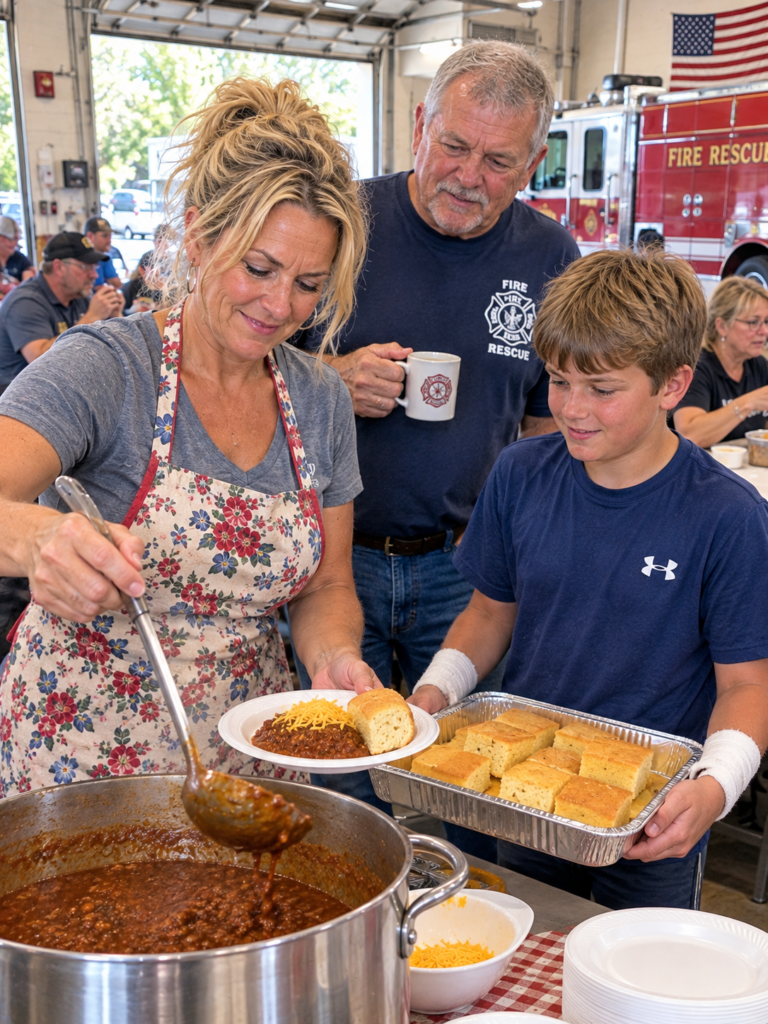
The fire department organized it. In the station bay, where they park the trucks. They pulled the trucks out onto the apron and set up folding tables inside. The Methodist ladies made chili. The Baptist ladies made cornbread. The American Legion donated pie.
There was a coffee can at the door. A big red Folgers can with a piece of paper taped on the front. FOR BRYCE WELLER. Somebody’s daughter had drawn a picture of a fire truck and a dog on it with markers.
Three thousand, one hundred dollars. In one night.
Elk Bend has six hundred and forty people. Most of them ranchers or feedlot hands or school employees or retired. Three thousand, one hundred dollars is a lot of money in Elk Bend.
“Rodney counted it,” Josh said on the phone. “He’s the treasurer. He said he’d put it in the department account and write us a check.”
“Rodney?” I said.
“He was there all night,” Josh said. “He took the door.”
Rodney is Josh’s older brother.
We came home on the twelfth day. Bryce rode in the back seat with his arms wrapped in white gauze, propped up on pillows. Biscuit was waiting at the end of the driveway, the way she always did, with a bandage on her front paw.
She saw the car and went crazy. Barking and wagging and running in circles. Bryce was crying before we even stopped.
“Can I hold her?” he asked. “Mom, please. Can I?”
The nurse had said no pressure on the grafts. I didn’t care. I got Bryce out of the car and sat him on the porch steps, and Josh brought Biscuit over, and she put her head in Bryce’s lap and lay there, perfectly still, for an hour.
She didn’t jump on him once. She knew.
Chapter Three: The Porch
Two weeks later, Rodney stood on my porch with his cap in his hands.
It was a Thursday afternoon. I was home with Bryce. He was in the living room on the couch, watching cartoons, with his arms propped on pillows. Biscuit was lying on the floor beside him.
I heard Rodney’s pickup in the driveway. A white Ford with a Elk Bend Volunteer Fire Department decal on the back window. I went out on the porch.
He got out. He didn’t come up the steps. He stood at the bottom of them, in his feed store cap and his canvas coat, and took his cap off and held it in both hands.
Rodney Weller is forty-four. Six years older than Josh. He runs the John Deere parts counter at the implement dealer in Cottonwood. He’s been a volunteer fireman in Elk Bend for twenty-two years and the department treasurer for nine.
He’s a careful man. Quiet. Keeps his books in a ledger in a three-ring binder, in pencil, because pencil you can erase. He’s never been married. He lives alone in our father-in-law’s old house on the edge of town.
He looked at the porch boards. He didn’t look at me.
“Cass,” he said.
“Rodney.”
“How’s he doing?”
“Healing,” I said. “Slowly. He’s got PT twice a week in Emporia.”
He nodded. He kept turning his cap around in his hands.
“The board moved the supper money to the truck fund, Cass,” he said.
I didn’t understand at first.
“What?”
“The chili supper money. The three thousand, one hundred.” He swallowed. “The board voted Tuesday night. To put it in the truck fund.”
I stared at him.
“It was for Bryce,” I said. “It said so on the can. Somebody drew a picture of a dog.”
“I know it did.”
“Then how…”
“The brush truck failed its pump test,” Rodney said. He was talking fast now, like he’d practiced it. “In February. The annual service test. The pump won’t hold pressure. It’s a 1998 Ford with the original pump, and it’s worn out.”
“I don’t…”
“The state fire marshal’s office does inspections,” he said. “And the ISO does ratings. For insurance. If our brush truck can’t pass the pump test, they could downgrade the department’s rating. And if they do that, every homeowner’s insurance premium in Elk Bend goes up. Everybody’s. Hundreds of dollars a year.”
He finally looked up at me.
“A new pump is eleven thousand dollars,” he said. “We had seven thousand, nine hundred in the truck fund. The supper money gets us to eleven.”
I stood there on my own porch and couldn’t breathe.
“Bryce has insurance,” Rodney said. Quietly. “The truck doesn’t.”
He said it like he believed it. Like it was simple. Like it was the only way the math could come out.
I thought about Dale and Mike, coming across that pasture in that brush truck. With the pump going. That old, worn-out pump that couldn’t hold pressure.
I thought about Bryce face down in the grass.
“Was it legal?” I asked finally. My voice sounded strange. “To move it?”
Rodney looked at his cap.
“The money was given to the department,” he said. “Not to you directly. It went into the department account. Under the bylaws, the board can allocate department funds. So yes. It was legal.” He took a breath. “I checked. I called the county attorney.”
“You called the county attorney,” I said. “Before you came here.”
He didn’t answer.
I didn’t scream. I want that on the record. Bryce was inside on the couch. The window was open. I wasn’t going to let him hear me scream at his uncle.
“Get off my porch, Rodney,” I said.
He looked at me for a long moment. Then he put his cap back on. He walked back to his white Ford with the fire department decal.
He stopped at the truck door. He turned around.
“I’m sorry, Cass,” he said.
Then he got in and drove away.
Chapter Four: Out of Pocket
The money was given to the department. Not to us.
That’s what it came down to. I looked it up myself, at my kitchen table that night, on my laptop. I read the department bylaws, which are posted on the county website. I read the Kansas statutes on volunteer fire departments.
Rodney was right. The board had the authority. Moving the money was his legal call.
Cruel, maybe. Not a crime.
Our insurance has a seven-thousand-dollar out-of-pocket limit.
That’s the family maximum. Through the feedlot’s group plan. After you hit seven thousand dollars in deductibles and copays, they pay a hundred percent for the rest of the year.
We hit it in four days.
Four days. The helicopter alone was thirty-one thousand dollars. Our share of it was the deductible, and the deductible was half our out-of-pocket. Then the ER in Emporia. Then the burn unit. Then the surgery.
By the end of the fourth day in Wichita, we owed seven thousand dollars. To the hospital. On payment plans that would take us four years.
And the insurance didn’t cover everything after that, either. Not really.
Bryce’s compression garments. Custom-made sleeves and a vest, fitted to his body, that he has to wear twenty-three hours a day for a year so the scars don’t thicken. They have to be replaced every three months because he’s growing. Four hundred and twenty dollars a set. Insurance covered two sets a year. He needs four.
The silicone gel sheets for his scars. Not covered.
Gas to Emporia for physical therapy, twice a week. Sixty miles round trip.
Gas to Wichita for follow-ups with Dr. Okafor. Two hundred and forty miles round trip.
Josh’s lost hours at the feedlot. The two days they gave him off were unpaid.
My two weeks of leave from the school. Unpaid.
I added it up at the kitchen table on a legal pad. I’m a school cook. I’m good at numbers. I order food for two hundred and forty kids on a federal budget of three dollars and seventy-six cents per child per day. I know how to stretch a dollar.
Over the next year, beyond our insurance, Bryce’s care was going to cost us about six thousand, four hundred dollars.
Three thousand, one hundred would have been half.
Josh didn’t speak to his brother for a week.
He didn’t speak to anybody much. He went to work. He came home. He sat with Bryce on the couch and watched cartoons. He took Biscuit for walks down the county road at night, alone.
When Rodney called, Josh let it go to voicemail. Rodney called four times. Josh deleted all four messages without listening to them.
Then, on the eighth night, Josh came in from walking the dog and sat down across from me at the kitchen table.
I was paying bills. The hospital. The pharmacy. The compression garment company in Kansas City.
He watched me for a while.
“He’s not a thief, Cass,” he said.
I didn’t look up.
“I know he’s not,” I said.
“He’s scared of that truck,” Josh said.
I set down my pen.
“Scared of it?”
Josh looked at the window. At the dark pasture behind our house. At the black, burned strip of grass along the back fence where the fire came through. It was starting to green up now. New grass coming up through the ash.
“You know about Dad,” he said.
“I know he died in a grass fire,” I said. “In 2011. Before we got married.”
“Rodney was on the truck,” Josh said.
He told me the rest that night. At our kitchen table. I’d been married to him for eleven years and I’d never heard it.
April 2011. The big fire in the Hensley pasture. The same pasture. A wildfire that got away from somebody’s burn pile and took out four thousand acres before they stopped it.
Josh’s father, Harlan Weller, was fire chief then. He was sixty-one. He’d been on the department for thirty-five years.
Rodney was thirty, running the pump on the old brush truck. The same truck. That 1998 Ford.
Harlan was out ahead of the truck with a hose line, on foot, fighting the fire head. The wind shifted. The fire turned. Harlan called for more water.
And the pump quit.
“Lost pressure,” Josh said. “Just died. Rodney said it made this sound, like a cough, and the hose went limp in Dad’s hands. And the fire came over him.”
I put my hand over my mouth.
“Rodney spent thirty seconds trying to get it restarted,” Josh said. “Thirty seconds. Then he jumped off the truck and ran out to Dad. He pulled him out with his bare hands.” Josh’s voice cracked. “Dad died two days later. In the same burn unit in Wichita. Sixth floor.”
He looked down at the table.
“The pump got rebuilt after that,” he said. “Patched up. It’s been running on patches for thirteen years. And every year, Rodney’s begged the county commission for money for a new one. Every year, they say no.”
“And then Dale and Mike went out in it,” Josh said quietly. “To get Bryce. With that same pump. And it held. This time it held.”
He looked at me.
“Rodney’s been in that station every night since,” Josh said. “Since March. Sitting in the bay with that truck. Doug Kemper saw his light on at two in the morning.”
I sat at my kitchen table with the bills spread out in front of me and didn’t say anything for a long time.
“Josh,” I said finally. “I’m not going to call the newspaper. I’m not going to post anything on Facebook. I’m not going to say a word about your brother to anybody.”
“Okay.”
“But I’m not going to sit here either,” I said.
Chapter Five: The Locker
I didn’t call anybody.
I didn’t post anything.
I’m a school cook.
I make chili for two hundred and forty kids every other Thursday. It’s on the menu. It’s the most popular lunch we serve. The kids line up for it. The teachers line up for it. Mrs. Abernathy comes down from her office for it.
My chili recipe is my grandmother’s. Ground beef and onions and kidney beans and tomatoes, and a spice blend she never wrote down that I learned by standing on a step stool in her kitchen when I was six. I make it in a forty-gallon steam kettle. I know exactly how much meat feeds how many people.
On a Monday morning in April, I called the locker.
Elk Bend Meat Locker, on Main Street. Owned by the Kraus family since 1946. It’s where every rancher in the county gets their beef processed.
Hank Kraus answered.
“Hank,” I said. “It’s Cass Weller. I need sixty pounds of hamburger.”
There was a pause.
“Sixty pounds?” he said.
“Sixty.”
“That’s a lot of chili, Cass.”
“I’m feeding a lot of people,” I said.
Another pause. A longer one.
“I heard about the money,” Hank said quietly. “From the first supper.”
“I’m not talking about that, Hank,” I said. “I’m just ordering hamburger.”
He didn’t say anything for a long time.
“I’ll have it ready Friday,” he said finally. “No charge.”
“Hank, no…”
“Cass,” he said. “Bryce sat in my shop every Saturday last summer while you did the grocery shopping. Helped me wrap steaks. Kid wrapped a better steak than my own son.” He cleared his throat. “Sixty pounds. No charge. Don’t argue with me.”
Then I asked Earl.
Earl Haskins is the fire chief. He took over after Harlan Weller died in 2011. He’s sixty-eight now, a retired rancher, with a white mustache and a navy blue department jacket he wears everywhere, even to church.
I found him at the station on Tuesday evening. He was in the bay, working on the brush truck. The old 1998 Ford, red and dented, with ELK BEND VFD in gold letters on the side. He had the pump housing open and was looking at it with a flashlight.
He heard me come in. He straightened up. He wiped his hands on a red rag.
“Cass,” he said.
“Earl.”
“I want to ask you for the bay,” I said. “One more Saturday.”
He looked at me.
“For what?”
“A chili supper,” I said. “Another one. I’ll cook. I already ordered the meat.”
He didn’t say anything. He looked at me a long time. His eyes went to the brush truck. To the pump housing. Then back to me.
“For Bryce,” he said.
“For Bryce.”
I thought he was going to say no. I thought he was going to say it would cause a fuss. That it would look bad for the department. That Rodney was the treasurer, and the board had voted, and it would split the town.
He folded his red rag. He put it in his back pocket.
“You can,” he said.
I let out a breath.
“And I’ll take the door myself,” Earl said.
Chapter Six: Saturday
We set it for the last Saturday in April.
I didn’t advertise it. I didn’t make flyers. I didn’t post on the Elk Bend Community page on Facebook.
I told the lunch ladies at school. They told their husbands. Their husbands told the men at the co-op. The men at the co-op told their wives. The wives told the Methodist women and the Baptist women and the Catholic Altar Society.
By Wednesday, everybody in Elk Bend knew.
The church ladies brought cinnamon rolls.
Seven pans from the Methodists. Five from the Baptists. Four from the Altar Society. Big ones, the size of your hand, with white icing dripping down the sides. They brought them Saturday morning in the back of their cars and stacked them on a folding table by the door.
The Legion brought pie. Again.
The Hensleys brought ice tea. Three big orange water coolers full of it.
Old Mrs. Hensley drove it over herself. She’s eighty-one. It was her pasture fire that came across the road. She stood in the station bay holding a sleeve of paper cups and cried so hard her son had to come take the cups from her.
I cooked all day Friday in the school kitchen. Mrs. Abernathy gave me a key. Sixty pounds of hamburger, browned in batches on the big flat-top grill. Forty pounds of onions. Twenty-four number ten cans of kidney beans and twenty-four of tomatoes. My grandmother’s spices.
I filled the forty-gallon steam kettle. Then I filled the big roasters. Then I filled every slow cooker I could borrow from the lunch ladies.
Josh helped. He carried the cans and stirred the kettle and didn’t say much. Around nine o’clock Friday night, he stopped stirring and looked at me across the steam.
“Does Rodney know?” he asked.
“I don’t know,” I said. “I didn’t tell him.”
Bryce wanted a job.
He’d been home three weeks. He was going stir-crazy on the couch. He wasn’t supposed to go back to school until May, because of the infection risk.
“I want to help, Mom,” he said Saturday morning. “Please. I can do something.”
I called his nurse in Wichita. A man named Terrence, who’d taken care of Bryce on nights in the burn unit and given him his personal cell number.
“Can he help at a supper?” I asked. “Serving food?”
“As long as he keeps his gauze clean,” Terrence said. “And he doesn’t touch anything hot. And he takes a break every hour. And he wears his compression sleeves under the gauze.”
“Okay.”
“And tell him I said hi,” Terrence said. “Tell him the dog kid from 614 says hi.”
So he passed out cornbread from a pan.
I set him up at the end of the serving line. On a stool, so he wouldn’t get tired. With a big sheet pan of cornbread cut into squares and a pair of tongs.
Both forearms wrapped white in fresh gauze. His blue compression sleeves showing at the wrists. A little fire department T-shirt Earl gave him, three sizes too big, that came down to his knees.
He held those tongs like they were the most important job in the world.
By suppertime, every folding table was full.
The station bay at Elk Bend VFD holds forty-eight people at folding tables if you squeeze. They’d brought in more tables from the Legion hall. And more chairs from the Methodist church. And people were still standing along the walls.
Ranchers in from the pasture burns, still smelling like smoke. Their faces streaked black, their jeans grimy. They came straight from the burns, because it was burning season and they couldn’t stop. They sat down at the tables in their work clothes, smelling like the thing that burned my son.
Teachers. All twenty-two of them from Elk Bend Elementary.
Kids from my lunch line. Dozens of them. Holding their bowls out, saying, Hi, Mrs. Weller, Hi, Mrs. Weller, like it was Thursday at school.
The brush truck was parked at the back of the bay. Its doors open. Its old pump housing still apart where Earl had been working on it.
Kids kept going over to look at it. A little girl named Hadley, maybe six, stood in front of it for a long time and then came back to the line.
“Is that the truck that saved Bryce?” she asked me.
I looked at the old red Ford. Dented and faded.
“Yes, honey,” I said. “That’s the one.”
Earl stood at the door.
He’d set up a folding chair and a card table. On the card table was the same red Folgers can from the first supper. Somebody had taped a new piece of paper on the front. Bryce had drawn it himself, that morning, with his gauze-wrapped hands holding the marker very carefully.
A fire truck. And a yellow dog.
And underneath, in big shaky nine-year-old letters: THANK YOU.
Earl didn’t sit down. He stood behind that card table for three hours in his navy blue department jacket, and he shook every hand that came through that door, and he looked every person in the eye.
Chapter Seven: Rodney Walks In
At ten after five, Rodney walked in.
I saw him first. I was at the steam kettle, ladling chili into bowls. I looked up and he was standing in the doorway of the station bay. In his canvas coat and his feed store cap.
He stopped just inside the door. By Earl’s card table.
The whole bay went quiet.
Not all at once. It started near the door. People at the tables closest to him stopped talking. Then the ones next to them. Then the next ones. It went across that station bay like a wave. Forks stopped. Spoons stopped. Conversations stopped in the middle of words.
Two hundred people in the Elk Bend fire station bay, and you could have heard a pin drop on the concrete.
Everybody knew. Of course they knew. It’s Elk Bend. Six hundred and forty people. Everybody knew where the first supper money went. Everybody knew who moved it.
Earl looked at him. Rodney looked at Earl.
Neither one of them said anything.
Rodney reached into his coat pocket. He took out an envelope. A plain white one, thick. He put it in the Folgers can on Earl’s card table.
Earl watched him do it. He didn’t say anything.
Then Rodney took off his cap. He hung it on a hook by the door, next to the department turnout coats.
He didn’t sit down.
He walked across that silent station bay. Past every table. Past the ranchers smelling like smoke, and the teachers, and the kids from my lunch line.
Nobody said a word. Nobody looked at him. Everybody looked at their chili.
He walked straight to the serving table where I was standing. He went around behind it.
He picked up the second ladle.
Nobody asked him to.
He didn’t ask me. He didn’t say anything to me. He didn’t even look at me. He just picked up that ladle and took a bowl off the stack and filled it from the steam kettle and held it out to the next person in line.
The next person in line was Doug Kemper. A rancher from west of town. Sixty, with a sunburned neck and soot on his face from the burns.
Doug looked at the bowl in Rodney’s hand. He looked at Rodney.
He didn’t take it.
He stood there for a long time. Rodney held the bowl out. His hand didn’t move. It didn’t shake.
The whole bay was watching.
Finally, Doug took the bowl. He didn’t say thank you. He didn’t say anything. He took it and walked to his table and sat down.
The next person in line stepped up.
Rodney filled another bowl.
Chapter Eight: The Second Ladle
He served for three hours.
From ten after five until eight o’clock. He never stopped. He never sat down. He never took a break. He never once said anything to anybody except “Here you go” when he handed them a bowl.
People took his chili and wouldn’t look at him.
That’s the truth. Most of them. They’d take the bowl and look at the chili, or look at me, or look at Bryce at the end of the line with his tongs and his cornbread. Anywhere but at Rodney.
Some of them took it and set it down hard on their tray. One woman, the mother of a girl in Bryce’s class, took her bowl from my ladle instead. She reached right past Rodney’s held-out bowl and took one from me.
Rodney didn’t react. He just set his bowl down on the table and filled another one for the next person.
A few said thank you anyway.
That was harder to watch.
Old Mrs. Hensley. Eighty-one. Her pasture fire. She came through the line on her son’s arm. She took the bowl from Rodney’s hands. And she looked up at him with her watery old eyes.
“Thank you, Rodney,” she said. Very quietly.
He nodded. He couldn’t speak.
She held the bowl a second longer than she needed to. Then she let her son lead her away.
I stood beside him in my gray apron and blue T-shirt and kept ladling.
Neither of us said a word. Three hours. Shoulder to shoulder. Two ladles going into the same steam kettle, one after the other. Dip, fill, hand. Dip, fill, hand.
Once, around six-thirty, the kettle was getting low. I turned to get the next roaster from the back table. Before I could lift it, Rodney set his ladle down and picked it up himself and carried it over and emptied it into the kettle. Then he set the empty roaster on the back table and picked up his ladle again.
He didn’t look at me. I didn’t look at him.
But I noticed.
Bryce noticed too.
He was at the end of the line on his stool, handing out cornbread. Every person who came through, he’d pick up a square with his tongs and set it carefully on the edge of their tray. “Here’s your cornbread.” Every time. Like it was important.
He kept looking down the line. At his Uncle Rodney.
Around seven, during a lull, he called down to me.
“Mom,” he said. “Why’s Uncle Rodney sad?”
Rodney’s ladle stopped. Just for a second. Then it kept going.
“He’s just tired, honey,” I said.
Bryce looked at his uncle for a long time. He didn’t believe me. Nine-year-olds never do.
Dale and Mike sat at his table.
Dale Prather and Mike Danner. The two who carried Bryce out of the smoke. They came through the line at seven-fifteen, after they got off the Hensley burn. Still in their yellow turnout pants, their faces black with soot. They smelled like smoke so strong it made my eyes water.
Dale took his bowl from me. Mike took his from Rodney.
Mike looked at Rodney for a long moment. Then he nodded. Just once.
Then Rodney did something.
He reached down the serving table to Bryce’s cornbread pan. He took the tongs out of Bryce’s hand, gently. And he dug into the very corner of the pan. The two corner pieces. The crusty ones, with the brown edges on two sides.
He put one on Dale’s tray. One on Mike’s.
Then he handed the tongs back to Bryce.
Those had always been his.
The corner pieces. Everybody in Elk Bend knew that. At every potluck, every funeral dinner, every fire department fish fry for twenty-two years, Rodney Weller got the corner pieces of the cornbread. It was a joke. The Methodist ladies used to save them for him. They’d cut the pan and set the corners aside on a napkin with his name on it.
He gave them to Dale and Mike.
Dale looked down at the corner piece on his tray. Then up at Rodney.
He didn’t say anything. But he picked it up and took a bite, standing right there by the serving table. And he nodded at Rodney while he chewed.
Then the two of them went and sat down at the table nearest the brush truck. In their turnout pants. Eating chili with soot on their faces. Right under the old red Ford that carried them across that pasture.
Chapter Nine: The Can
At eight o’clock, Earl shut the door.
He swung the big bay door down. It rattled and clanged on its tracks. The station went dim except for the overhead fluorescent lights.
The whole bay went quiet again. People set down their spoons.
Earl came back to the card table by the door.
He picked up the coffee can.
It was full. I could see that from across the room. Stuffed full. Bills sticking up out of the top. Envelopes. Checks folded in half.
Earl held it in both hands. He held it out in front of him, the way you’d carry something in church. The way you carry a casket.
He carried it past the red truck.
He walked slowly. Down the length of the station bay. Past every table. Past the ranchers and the teachers and the kids from my lunch line. Past Dale and Mike, eating their corner pieces.
Everybody watched him go.
At the serving table, Rodney set his ladle down.
He set it down carefully. On a paper towel, so it wouldn’t drip. Then he put both hands flat on the table and stood there. Waiting.
I set mine down too.
Earl stopped in front of me in his navy department jacket.
He held the can out with both hands. Across the serving table. Over the steam kettle.
I looked at it. At Bryce’s drawing taped on the front. The fire truck. The yellow dog. THANK YOU.
I didn’t take it.
Then Earl turned to his treasurer.
He turned all the way around. So he was facing Rodney. Holding that coffee can out in front of him.
And he said it loud enough for the whole station to hear.
“Rodney,” Earl said. “The Kansas Forest Service called me Tuesday.”
Rodney didn’t move.
“The volunteer fire assistance grant,” Earl said. “The one we applied for in January. The fifty-fifty match. For the pump.” He paused. “It came through. Fifty-five hundred dollars from the state.”
The bay was dead silent.
“Fifty-five hundred from the state,” Earl said. “Plus the seven thousand, nine hundred that was already in the truck fund before March.” He looked at Rodney. “That’s thirteen thousand, four hundred. The pump’s eleven thousand.”
He let that sit.
“We never needed the supper money, son,” Earl said quietly. “Not one dime of it.”
Rodney stood there with his hands flat on the serving table.
His face went white. Then red. Then white again.
“I didn’t know,” he said. His voice was barely a whisper. “When I moved it. I didn’t know the grant would come through.”
“I know you didn’t,” Earl said. “You couldn’t have. Nobody did.”
“I just…” Rodney’s voice broke. “I just saw that truck sitting there. With that pump. And I thought…”
He couldn’t finish.
Earl set the coffee can down on the serving table. Right between me and Rodney.
“So here’s what’s going to happen,” Earl said. Still loud. To the whole station. “Monday morning, the treasurer is going to write a check from the truck fund. For three thousand, one hundred dollars. Made out to Cass and Josh Weller. That’s the first supper’s money, going back where it belongs.”
Nobody moved.
“And tonight,” Earl said, “this money,” he tapped the coffee can, “goes where it was given. To Bryce. All of it. Every dime.”
He looked at Rodney.
“And the treasurer’s going to count it,” Earl said. “Right now. In front of everybody. Out loud.”
Chapter Ten: The Count
Rodney looked at the coffee can for a long time.
Then he reached into the back pocket of his jeans. He took out a small spiral notebook and a pencil. The same kind he uses for the department ledger. The kind you can erase.
He set the notebook on the serving table. He opened it to a blank page.
Then he dumped out the can.
Bills spilled across the serving table. Ones and fives and tens and twenties. Checks folded in half. Envelopes. Coins rolled off the edge and onto the concrete floor, and two of the kids from my lunch line scrambled to pick them up and bring them back.
There was a lot of it. More than the first supper. You could see that.
Rodney started counting.
He counted out loud. Like Earl told him. In his quiet, careful voice. Every bill.
“One. Two. Three. Four. Five.”
The ones went in a stack. Then the fives. Then the tens. He wrote each total in the notebook in pencil.
Nobody in that station made a sound. Two hundred people sitting at folding tables, in the smell of chili and smoke, listening to a man count money out loud.
“One hundred twelve dollars in ones,” Rodney said. He wrote it down.
“Three hundred forty-five in fives.”
“Eight hundred and sixty in tens.”
The twenties took a long time. There were a lot of them. Rodney counted them in stacks of five. A hundred dollars. Two hundred. Three hundred.
Bryce got down off his stool at the end of the line. He came and stood beside me. He leaned against my hip with his white gauze arms and watched his uncle count.
“Two thousand, four hundred and twenty in twenties,” Rodney said.
Then the checks.
He unfolded each one. He read the amount out loud. He didn’t read the names. He just read the numbers.
“Twenty-five dollars. Fifty dollars. One hundred dollars. Fifty dollars. Two hundred dollars.”
One from the Elk Bend Feeders cattle company. Five hundred dollars. Rodney read it out loud and a few people at the tables started clapping. Then stopped, like they weren’t sure if they were allowed.
One from the Hensley Ranch. Rodney looked at it for a long time. Then he read it out loud.
“One thousand dollars.”
Old Mrs. Hensley, at her table by the door, put her hand over her mouth.
Then there was one more envelope.
A plain white one. Thick. Sealed.
Rodney picked it up. He held it in his hand. He didn’t open it.
I knew what it was. I’d watched him put it in the can when he walked in.
He looked at it. Then he looked at me.
“This one’s mine,” he said quietly.
He opened it.
Twenties. A thick stack of them.
He counted them out loud. Like all the others. In stacks of five.
“One hundred. Two hundred. Three hundred.”
All the way up.
“Three thousand, one hundred dollars,” Rodney said.
His voice broke on the last word.
The station was silent.
“I took it out of my savings,” Rodney said. To me. Not to the room. Just to me. “On Thursday. When I heard you were doing the supper. I knew the board wouldn’t move it back. I didn’t know about the grant. I just…” He swallowed. “I couldn’t let you do this without it.”
I stared at him.
“Rodney,” I said. “That’s your money.”
“It was always Bryce’s,” he said. “I just held on to it for a while.”
He turned back to his notebook. He added up the column. In pencil. He checked it twice, the way he always does, moving his lips.
Then he looked up at the room.
“Total tonight,” Rodney said. “Eleven thousand, eight hundred and sixty-four dollars.”
Nobody moved for a second.
Then Dale Prather stood up at his table by the brush truck. In his turnout pants, with soot on his face. He started clapping.
Mike Danner stood up beside him. Then Doug Kemper, who wouldn’t take Rodney’s bowl. Then old Mrs. Hensley, on her son’s arm. Then the teachers. Then the Methodist ladies. Then the ranchers smelling like smoke.
Then the whole station. Two hundred people on their feet, clapping. The sound bouncing off the concrete walls and the metal roof and the old red truck.
I didn’t clap. I couldn’t. My hands were shaking too hard.
I turned and looked at my brother-in-law. Standing behind the serving table in his canvas coat, with his pencil and his notebook and eleven thousand dollars spread out in front of him.
He was crying. Silently. Not wiping it away.
Bryce let go of my hip. He walked around the serving table to his uncle. He stood in front of him and looked up.
Then my son, with both his arms wrapped in white gauze, put them very carefully around his Uncle Rodney’s waist. And held on.
Chapter Eleven: The Truck
Josh found us in the back of the station after everyone left.
It was almost ten. The tables were folded and stacked against the wall. The chili kettle was empty and soaking. The church ladies had taken their cinnamon roll pans home.
Rodney was sitting on the running board of the brush truck. The old red Ford. Bryce was asleep in the cab, curled up on the bench seat under Earl’s navy jacket, with Biscuit lying across his feet. Josh had brought the dog from home, because Bryce asked.
I was sitting on an overturned five-gallon bucket across from Rodney.
Josh walked across the empty bay. He stopped in front of his brother.
They looked at each other for a long time.
Then Josh sat down on the running board next to Rodney. Their shoulders touching.
Neither one of them said anything for a while.
“I told her,” Josh said finally. “About Dad. About the pump.”
Rodney nodded slowly.
“I figured,” he said.
“I never told anybody,” Rodney said. “Not really. Not what it was like. Standing on that truck. Hearing that pump cough.” He looked down at his hands. “I can still hear it. Every time I close my eyes.”
Josh put his hand on his brother’s shoulder.
“Thirty seconds,” Rodney said. “I spent thirty seconds trying to restart it. Thirty seconds I could’ve been running to him.”
“It wouldn’t have mattered, Rod,” Josh said. “The coroner said.”
“I know what the coroner said.”
“And then the call came about Bryce,” Rodney said. “In March. And I was at the parts counter in Cottonwood. I heard it on the scanner. Child in a fire at the Weller place. And I knew Dale and Mike were taking the brush truck. That truck. With that pump.”
He looked at me.
“I drove fifty miles an hour on a gravel road to get there,” he said. “I got there just as they were bringing him out. I saw them carrying him. And I looked at that truck with its pump running, holding pressure, doing its job.” His voice cracked. “And all I could think was, what if it hadn’t. What if it coughed. What if I’d been standing there watching it happen again. To my nephew.”
“So when the board met in April,” Rodney said, “and the pump had failed the service test, and the truck fund was short, I stood up and said, move the supper money. I said it. Me. Nobody else wanted to. I talked them into it.” He shook his head. “I told myself Bryce had insurance. I told myself the truck didn’t. I told myself a hundred kids could die if that pump failed again and only one kid needed that money.”
He looked at the cab of the truck. At Bryce, asleep under Earl’s jacket.
“I told myself I was saving somebody,” he said. “That’s what Dad would’ve done.”
“Rod,” Josh said. “Dad would’ve passed the hat for the pump. And left the boy’s money alone.”
Rodney put his face in his hands.
“I know,” he said. “I know he would have.”
I got up off my bucket. I went over and sat down on the other side of him. On the running board. So he was between me and Josh.
“Rodney,” I said. “Look at me.”
He lifted his face.
“You came in tonight,” I said. “Nobody asked you to. You put three thousand, one hundred dollars of your own money in that can. And you stood there for three hours while people wouldn’t look at you, and you kept ladling.”
He didn’t say anything.
“That’s what your dad would’ve done,” I said. “That part. Right there.”
He cried then. Really cried. Sitting on the running board of that old red brush truck, between his brother and me, at ten o’clock at night in an empty fire station.
Josh put his arm around him. I put my hand on his back.
And in the cab of the truck above us, my son slept on the bench seat under the fire chief’s jacket, with his dog across his feet and his white gauze arms tucked under his chin.
Chapter Twelve: Next March
The new pump went in the brush truck in June.
A Hale HP200, rated for two hundred gallons per minute. Rodney drove to the dealer in Salina to pick it up himself. Dale and Mike installed it in the station bay over three Saturdays, with Earl supervising from a lawn chair.
It passed the service test on the first try. The state fire marshal’s inspector said it was the best-maintained brush truck he’d seen in a volunteer department all year.
Elk Bend kept its fire rating. Nobody’s homeowner’s insurance went up.
Rodney wrote the check on Monday morning, like Earl said. Three thousand, one hundred dollars, from the truck fund, made out to Cass and Josh Weller. He brought it to our house himself and handed it to me on the porch.
He didn’t stand at the bottom of the steps this time. He came all the way up.
Then he resigned as department treasurer at the next board meeting. Earl tried to talk him out of it. The board voted not to accept it. Rodney wouldn’t budge.
“I made a call I shouldn’t have made,” he said. “Somebody else should hold the money for a while.”
They elected Mike Danner. Mike asked Rodney to train him on the ledger. Rodney did. In pencil.
Between the two suppers, Bryce’s fund came to fourteen thousand, nine hundred and sixty-four dollars.
We paid off the hospital. Every dime. We paid for all four sets of compression garments for the year, and the silicone gel sheets, and every tank of gas to Emporia and Wichita. We paid back Josh’s lost hours and my unpaid leave.
There was money left over. About four thousand dollars.
I didn’t know what to do with it. It wasn’t ours. It was the town’s. So I sat down at my kitchen table with a legal pad and figured it out.
In September, I took it to the Elk Bend Community Foundation. The little one the Methodist church runs out of an office behind the sanctuary.
I asked them to set up a fund. For burn victims. For any family in Chase County who ends up on the sixth floor in Wichita and can’t cover the gas, or the compression garments, or the unpaid days off. A few hundred dollars. Enough to get through.
We named it the Biscuit Fund. Bryce’s idea.
Bryce went back to school in May. He wore his compression sleeves every day under his T-shirts. Some of the kids stared at first. Then Hadley, the six-year-old from the supper, told everybody in the lunch line that Bryce Weller saved his dog from a fire and the firemen carried him out and there’s a picture of him on a coffee can.
After that, nobody stared. They asked to see his scars. He showed them. He was proud of them.
Dr. Okafor says he’s healing beautifully. The grafts took. The skin on his arms is pink and shiny and a little tight, but he has full movement. He can throw a baseball. He can hold a dog.
It’s March again now. Burning season.
The hills around Elk Bend are smoking again. At night you can see the lines of fire across the pastures, orange and glowing, moving slow under the stars. The whole county smells like smoke.
Bryce is ten. He’s grown three inches. His arms are healed. He still wears the compression sleeves at night.
Last Saturday, the fire department had their spring fish fry. In the station bay. The same folding tables. The same coffee urns. The new pump shining on the old red brush truck, parked at the back of the bay with its doors open for the kids to climb in.
I worked the serving line. Gray apron. Blue T-shirt. A big pan of catfish and a bigger pan of fries.
Rodney worked it with me. Second ladle. Coleslaw. Like always now.
Bryce was at the end of the line on his stool. He’d asked for his job back. Cornbread. With his tongs.
He set a square on every tray that came through. “Here’s your cornbread.” Every time.
Dale and Mike came through around six, still smelling like smoke from the Hensley burn. They took their catfish. Their coleslaw from Rodney.
Then they got to Bryce.
Bryce looked up at them.
Then he set down his tongs. He reached into the corner of the cornbread pan, carefully, with his healed pink hands. The two corner pieces. The crusty ones, brown on two edges.
He put one on Dale’s tray. One on Mike’s.
Dale looked down at the corner piece. Then he looked at Rodney, standing behind the serving table with his ladle.
Rodney nodded once.
“He asked me last week,” Rodney said quietly. “If he could have the corners. To give away.”
Dale and Mike went and sat down at the table under the brush truck. In their turnout pants, with soot on their faces. Eating their corner pieces.
Bryce picked up his tongs again. The next person stepped up.
It was Rodney. He’d set his ladle down and come around the end of the table. He held out his tray.
Bryce looked at him. Then down at his pan. The corners were gone. The edges were gone. All that was left were the plain middle pieces, soft and ordinary.
Bryce picked one up with his tongs. A middle piece. Plain.
He set it on Rodney’s tray.
“Here’s your cornbread, Uncle Rodney,” he said.
Rodney looked down at it for a long time. Then he picked it up and took a bite, standing right there by the line.
“Best piece in the pan,” he said.
Across the station, Earl stood at the door in his navy blue jacket, shaking hands.
On the card table beside him sat a red Folgers can. The same one. Rodney had kept it. He’d washed it out and put it on a shelf in the station office.
It wasn’t for Bryce anymore. Bryce didn’t need it.
The paper taped on the front was new. Bryce had drawn it with markers that morning, at our kitchen table, with Biscuit lying across his feet.
A red fire truck with a shiny pump. A yellow dog. And underneath, in ten-year-old letters, not quite so shaky now:
THE BISCUIT FUND. FOR WHOEVER’S NEXT.