The Tally Book
Part One: The Sandhills
If you’ve never seen the Sandhills of Nebraska, it’s hard to explain them.
Twenty thousand square miles of grass-covered dunes, rolling like a green ocean frozen in place. No trees except the ones somebody planted around a house a hundred years ago. Lakes in the valleys that shine like coins when the sun hits them. A sky so big it makes you feel like an ant on a dinner plate.
It’s cattle country. It always has been. The grass is too fragile to plow. If you break the sod, the wind takes the sand and the hills start to move. So people here raise cattle the way their great-grandparents did. On horseback. With neighbors.
My name is Rachel Andersen. I’m forty-four years old.
I wasn’t born in the Sandhills. I grew up in Omaha, in a split-level house in a subdivision with a two-car garage and a mailbox shaped like a fish. My father sold insurance. My mother taught piano. The closest I’d ever been to a cow before college was the steak at the Drover restaurant on my sixteenth birthday.
Then I met Kyle Andersen at the University of Nebraska in Lincoln.
He was sitting in the back row of a statistics class wearing a cowboy hat, which in Lincoln in 1999 was enough to make everyone stare. He had sunburned hands and a slow smile and he took notes in a little green notebook instead of a laptop.
I asked him why he wore the hat.
“Habit,” he said. “My dad says a man who takes his hat off indoors is either in church or in trouble.”
“Which one is statistics?” I asked.
He laughed so loud the professor stopped talking.
His family had ranched outside Mullen, Nebraska, since 1919. Eleven thousand acres of Sandhills grass. Three hundred cows. A white farmhouse with a red barn and a windmill and a row of cottonwoods his great-grandmother planted the year they homesteaded.
He brought me home for Thanksgiving our junior year. We drove five hours west from Lincoln on Highway 2, past towns with names like Dunning and Thedford and Seneca, each one smaller than the last.
When we came over the last hill and I saw the ranch spread out in the valley below, I started to cry. I don’t know why. I’d never seen anything so lonely or so beautiful.
Kyle pulled over and waited.
“You okay?” he asked.
“I think I’m going to live here someday,” I said.
He didn’t say anything. He just took my hand.
We married in 2004. I was twenty-three. Kyle’s parents gave us the house and moved to a little place in town.
I spent the first two years learning everything I didn’t know. Which was everything.
I learned to ride. I learned to drive a feed truck in a blizzard. I learned to pull a calf at two in the morning in a February storm with my arm inside a cow up to the shoulder. I learned to tell a heifer from a steer, a bull from a cow, and a good neighbor from a bad one.
Some of the old-timers never quite trusted me. To them, I’d always be Kyle’s wife from Omaha. The city girl. The one who didn’t know which end of the horse the hay went in.
Part Two: Earl
We hired Earl Hollister in 2014.
Kyle’s father had run the place with Kyle until 2013, when his heart gave out. Kyle needed help. A ranch this size takes at least two full-time people, three during calving and branding.
Earl was fifty-eight then. He’d grown up on a ranch north of Valentine that his family lost in the farm crisis of the 1980s. He’d worked for other people ever since. Six different ranches in thirty years. He came with good references and the best roping hand any of us had ever seen.
He was a big man, quiet, with a gray handlebar mustache and a face like weathered fence wood. He wore the same thing every day. Wrangler jeans, a pearl-snap shirt, a silver-belly hat that was older than our daughters.
His wife, Norma, was the opposite. Small and round and talkative, with curly white hair and reading glasses she lost about six times a day. She worked mornings at the school cafeteria in Mullen and made the best potato salad in Hooker County.
They moved into the hired man’s house a quarter mile down the lane. Norma planted geraniums in the window boxes the first week.
Earl was good. I want to be fair about that.
He knew cattle the way some people know music. He could look at a pasture and tell you how many head it would carry, how long the grass would last, and which cow was going to calve first. He could rope a running calf by both hind feet from forty feet away without looking like he was trying.
He taught both our girls to rope.
Kenzie was four when he started. Brynn was two. He’d set up a sawhorse with a plastic calf head in the yard and stand behind them, guiding their small hands on the rope.
“Swing it like you’re stirring soup,” he’d say. “Big and slow. Let the rope do the work.”
By the time Kenzie was ten, she could rope a running calf. By the time Brynn was eight, she could too. They followed Earl around like ducklings. They called him Uncle Earl.
Norma made them cookies every Saturday. Snickerdoodles. She let them help roll the dough in cinnamon sugar.
For twelve years, Earl and Norma were part of our family. At least, that’s what I believed.
Every spring, Earl organized the branding.
Out here, you don’t hire a crew. You trade with neighbors. When it’s time to brand your calves, the neighbors come help you. When it’s time to brand theirs, you go help them. It’s been that way since the first homesteaders. A branding crew is the oldest form of currency in the Sandhills.
And Earl made the calls.
Every year, about two weeks before our branding, he’d sit at our kitchen table with a list and the landline phone. He’d call Walt Hagen and the Kreutzer brothers and Marvin Dye and Lyle Bosworth and the rest of them. He’d talk about the weather and the grass and somebody’s new pickup. Then he’d say, “We’re branding Saturday the eighteenth. You coming?”
And they’d come. Every year.
Norma would make potato salad for forty. I’d make sloppy joes and three sheet cakes. Kyle would keep the tally book, counting every calf, every steer, every heifer, writing it down in a little green notebook like the one he carried in college.
At the top of the first page, every year, in Earl’s handwriting, it said:
Andersen Ranch Branding. Foreman: Earl Hollister.
Part Three: Chemo
Kyle got sick in December.
It started with a cough that wouldn’t go away. Then night sweats. Then a lump in his neck that he ignored until I made him go to the doctor in North Platte.
Non-Hodgkin’s lymphoma. Stage three.
The oncologist said it was treatable. She said the odds were good. But it meant chemotherapy every three weeks for six months. At the cancer center in North Platte, a hundred and fifteen miles south.
The first round knocked him flat. He was sick for a week. He lost twenty pounds in a month. His hair came out in the shower in February.
By March, he couldn’t lift a saddle on chemo weeks. Some days, he couldn’t walk to the barn.
So I ran the ranch.
With Earl.
I’d always done the books. Kyle never liked paperwork. He said numbers made his eyes cross. So I paid the bills, did the taxes, tracked the cattle sales and the hay purchases and the vet bills.
But Earl handled the grazing leases and the hunting.
We lease out our north pasture every summer. Three thousand acres of good grass along the Dismal River. Yearling outfits pay to graze their cattle on it from May to October.
We also lease hunting rights in the fall. Mule deer, whitetails, pheasant. Hunters come from Omaha and Denver and as far away as Texas. They pay good money for a week on Sandhills ground.
For twelve years, Earl had managed both. He’d find the leasers, negotiate the price, collect the checks, and hand me the totals for the books.
I never questioned it. Why would I? Earl was family.
That spring, I spent most of my time in North Platte. Driving Kyle to chemo. Sitting in the infusion room with him while the bags dripped. Sleeping in the hotel next to the hospital on the bad weeks.
Earl ran things at home. Kenzie and Brynn helped after school. Norma brought casseroles and checked on the girls when I was gone overnight.
I came home on weekends and caught up on the books.
Part Four: The Phone Call
I found it on a Tuesday in late April.
I was at the kitchen table doing the quarterly taxes. Kyle was asleep upstairs, three days out from his fourth round of chemo. The girls were at school.
The phone rang. The landline.
“Mrs. Andersen? This is Pat Brennan. Brennan Cattle Company, out of Broken Bow.”
I knew the name. Brennan had been leasing our north pasture for years.
“I’m calling about the summer grazing lease,” he said. “We’d like to renew. Same terms as last year, if that works for you. Forty-two thousand for the season.”
I stopped writing.
“I’m sorry,” I said. “How much?”
“Forty-two thousand,” Pat said. “Same as last year. Same as the year before. Is that a problem?”
I looked down at the ledger in front of me.
Last year’s grazing lease. North pasture. Brennan Cattle Company.
$18,000.
In my own handwriting. From the number Earl had given me.
“No,” I said slowly. “No problem. Let me check with Kyle and call you back.”
I hung up the phone.
I sat at the kitchen table for a long time.
Then I went to the filing cabinet in the office and pulled out every bank statement I had from the last five years.
It took me two days to find all of it.
The grazing lease from Brennan. Forty-two thousand a year, every year. Earl had told me eighteen.
The hunting leases. A group from Denver who’d been coming for six years. They’d paid fourteen thousand last fall. Earl had told me six.
A second hunting group from Texas. Eleven thousand. Earl had told me they’d canceled.
I called Pat Brennan back. I asked, very carefully, if he could send me copies of his canceled checks from the last four years.
“Sure,” he said. “Is something wrong?”
“I’m just updating our records,” I said.
The copies came in the mail on Saturday.
Every check was made out to Andersen Ranch. Every check had been endorsed on the back by E. Hollister. And every check had been deposited into an account at the Cherry County Bank in Valentine.
We’d never banked in Valentine. Not once. Our bank was in Mullen.
I added it up at the kitchen table at midnight while everyone slept.
Four years. Grazing leases and hunting money.
One hundred and ninety thousand dollars.
I sat there with the calculator and the canceled checks and I didn’t cry.
I thought about Earl in our yard with Kenzie and Brynn, guiding their small hands on the rope. Swing it like you’re stirring soup.
I thought about Norma’s snickerdoodles. About twelve years of potato salad.
I thought about Kyle upstairs, a hundred and fifty pounds, bald, sleeping off his fourth round of chemo. About the medical bills piling up on the counter. About the second mortgage we’d taken out in January because the insurance didn’t cover everything.
And I thought about Earl cashing checks in Valentine while my husband sat in an infusion chair in North Platte.
Part Five: Nine Days
I drove to Mullen on Monday morning to see the Hooker County Attorney.
Her name was Ann Sorensen. She was fifty, with short gray hair and reading glasses on a beaded chain. She’d grown up on a ranch south of Thedford. She’d been county attorney for eleven years.
She read every page I brought her. Every bank statement. Every canceled check. It took her forty minutes.
When she was done, she took off her glasses.
“Rachel,” she said. “This is felony theft. Over a hundred thousand dollars. It’s going to take some time.”
“How much time?” I asked.
“I need to subpoena the bank records from Cherry County,” she said. “The account in Valentine. That’ll take a week, maybe two. Once I have those, I can file charges.”
She looked at me over the desk.
“Until then,” she said, “I need you to keep quiet. Don’t confront him. Don’t let him know you know. If he finds out, he could empty that account.”
“Our branding is on May eighteenth,” I said. “Three hundred cows. He’s the one who sets it up.”
Ann nodded slowly.
“The law moves in seasons, Rachel,” she said. “Calves don’t wait. I know that. I’ll move as fast as I can.”
So for nine days, I said good morning to him.
Every morning, I walked down to the barn at six. Earl would be there saddling his horse. He’d tip his silver-belly hat and say, “Morning, Rachel. How’s Kyle?”
And I’d say, “He’s hanging in there, Earl. Thanks for asking.”
I watched him rope calves in the pasture. I watched him show Brynn how to doctor a calf with pinkeye. I watched him laugh with Kenzie about a horse that kept trying to bite him.
On Wednesday, Norma brought a pan of snickerdoodles to the house. “For the girls,” she said. “And a chicken pot pie for you and Kyle. You look worn out, honey.”
I thanked her. I put the snickerdoodles on the counter. I couldn’t eat any of them.
On Thursday, Earl sat at my kitchen table with his list and the landline phone.
“Branding’s a week from Saturday,” he said. “I’ll start making calls.”
I stood at the stove with my back to him, stirring a pot of chili. I listened to him call Walt Hagen. The Kreutzer brothers. Marvin Dye. Lyle Bosworth. Seven others.
“Andersen branding, Saturday the eighteenth,” he said, every time. “You coming?”
They said yes. Every one.
I didn’t sleep much those nine days.
I lay awake beside Kyle, listening to him breathe. Sometimes I’d hear him get up in the night and go to the bathroom to be sick. I’d hold his forehead over the toilet the way you’d hold a child’s.
I didn’t tell him. Not yet. He had enough to carry.
Part Six: Friday at Six
The charges were filed Friday at four.
Ann Sorensen called me herself.
“The bank records came in this morning,” she said. “It’s all there. Every deposit. He opened that account in Valentine four years ago. He’s withdrawn about a hundred and forty thousand. There’s about fifty left.”
She paused.
“The sheriff froze the account an hour ago,” she said. “Charges are filed. Felony theft by deception. A warrant will issue Monday.”
“Thank you, Ann,” I said.
“Rachel,” she said gently. “Your branding’s tomorrow, isn’t it?”
“It is.”
She was quiet for a moment.
“I’m sorry,” she said.
I called Earl to the house at six.
He came up the lane in his old Ford pickup, the way he had a thousand times. He took off his hat at the door. He sat down at my kitchen table.
I set the copies of the canceled checks in front of him.
He looked at them for a long time.
He didn’t say anything. He picked up the top one and turned it over. He looked at his own signature on the back. E. Hollister.
He set it down. He picked up the next one. And the next.
The kitchen clock ticked. Upstairs, I could hear the girls arguing about who got the shower first.
Then he slid them back across the table to me.
“You’d never have missed it, Rachel,” he said.
I stared at him.
“Never have missed it,” I repeated.
“Eleven thousand acres,” Earl said. “Three hundred cows. Kyle’s family has had this place for a hundred years. You’d never have missed it.”
“Kyle has cancer,” I said quietly. “We took out a second mortgage in January. I’ve been driving a hundred and fifteen miles each way to North Platte every three weeks for five months. I’d have missed it, Earl.”
He looked at the table.
“My family had a place,” he said. “North of Valentine. Four generations. We lost it in eighty-five. The bank took it. I was twenty-nine.”
He looked up at me.
“I’ve worked for other people for forty years,” he said. “Six ranches. Twelve years here. I’ve done everything. Every calving, every branding, every blizzard. Your husband couldn’t have run this place without me.”
“So you paid yourself,” I said.
He didn’t answer.
“The county attorney filed charges this afternoon,” I said. “The account in Valentine is frozen. The sheriff will be out Monday.”
Earl’s face didn’t change. But his hands tightened on the edge of the table.
“You’re done here, Earl,” I said. “You and Norma can have until the end of the month to move out of the house. But you’re done.”
He sat there for a long moment.
Then he reached into his shirt pocket. He took out a ring of keys. The barn. The tack room. The fuel tank. The feed truck. The gate to the north pasture.
He set them on top of the canceled checks.
He stood up.
At the screen door, he turned around.
He looked at me. His face was red under his mustache. His eyes were hard.
“Who do you think is going to show up tomorrow?” he said. “Three hundred cows. You think you and two little girls and a sick man can brand three hundred calves?”
He put on his hat.
“Those men come because I call them,” he said. “Not because of you. You’re Kyle’s wife from Omaha. You always will be.”
The screen door slapped shut behind him.
Part Seven: 4 AM
I didn’t sleep.
I lay in bed beside Kyle and stared at the ceiling. I’d told him that evening, after Earl left. I’d sat on the edge of the bed and laid it all out. The phone call from Brennan. The canceled checks. The account in Valentine. Nine days of saying good morning.
He’d listened without interrupting. When I was done, he closed his eyes.
“Twelve years,” he said.
“I know.”
“He taught the girls to rope.”
“I know.”
He was quiet for a long time.
“I’m sorry I wasn’t here,” he said. “I’m sorry you had to carry this alone.”
At three-thirty, I gave up.
I went downstairs in my bathrobe. I made a pot of coffee. I sat at the kitchen table with the list Earl had used to call the neighbors. Eleven names. Eleven phone numbers. In his handwriting.
I thought about calling them. All of them. At four in the morning. Explaining. Begging.
Those men come because I call them.
I picked up the phone. I set it down.
What would I say? Earl stole a hundred and ninety thousand dollars from us, and he’s been charged, and I fired him last night, but could you please still come brand my calves?
These men had known Earl for thirty years. They’d roped with him, drunk coffee with him, sat in church with him. Most of them had probably never said more than fifty words to me.
At four o’clock, I heard a sound behind me.
Kenzie was standing in the kitchen doorway. Already dressed. Wranglers, boots, a pearl-snap shirt, and her old felt hat. The one Earl had given her for her twelfth birthday.
She was sixteen. Tall and lean like her father, with his slow smile and my stubbornness. She’d been roping since she was four.
She sat down at the table across from me. She poured herself a cup of coffee. She’d started drinking coffee at fifteen. I’d stopped fighting it.
“We’ll do it, Mom,” she said.
I looked at her.
“Me and Brynn,” she said. “We’ll just go slower. We’ll rope them one at a time. We’ll do the cutting and the vaccinating ourselves. It’ll take two days instead of one. But we can do it.”
“Kenzie,” I said. “It’s three hundred calves.”
“I know how many it is,” she said. “I’ve been counting them since March.”
She took a sip of coffee.
“Uncle Earl taught me to rope,” she said quietly. “I’m not going to stop roping because he turned out to be a thief.”
Brynn came down the stairs right behind her.
She was fourteen. Shorter than her sister, with freckles and a long red braid down her back. She was wearing her boots and her chaps and carrying her rope over her shoulder.
“I’m doing the vaccine gun,” she announced. “Kenzie always hogs it.”
“I do not,” Kenzie said.
“You do,” Brynn said.
I laughed. I couldn’t help it. I’d been awake for twenty-two hours and my world had fallen apart and my daughters were arguing about the vaccine gun.
Then I heard something else on the stairs.
A slow step. Then a pause. Then another step.
Kyle was coming down the stairs.
One step at a time. His hand on the wall. He was wearing jeans that hung off his hips and a flannel shirt that had fit him in December. A knit cap over his bald head.
It took him almost two minutes to reach the bottom.
He stopped in the kitchen doorway, breathing hard. He was pale. His hand shook on the doorframe.
“Kyle,” I said. “Go back to bed.”
“No,” he said.
He walked to the table. He sat down slowly in his chair at the head of it.
“I can’t lift a saddle,” he said. “I can’t rope. I can’t hold a calf.”
He reached into his shirt pocket. He took out a little green notebook and a pen.
“But I can keep the book,” he said. “Somebody’s got to count.”
Part Eight: Headlights
At 5:15, Brynn went still at the window.
She’d gone to look at the weather. To see if the wind was up. She stood with her hand on the curtain, looking out at the dark.
“Mom,” she said. “There’s headlights.”
I got up and went to the window.
It was still dark. The sky in the east was just starting to turn gray. Out on the county road, a mile away, where it came over the hill from the south, there was a set of headlights.
One set.
Coming toward us slowly.
Then another set came over the hill behind it.
Then a third.
Then a fourth.
Kenzie came to the window. Then Kyle, holding on to the counter.
We stood there in the kitchen, the four of us, watching the headlights come.
Five. Six. Seven.
Pickups with stock trailers behind them. Horse trailers. The headlights strung out along the county road like a necklace, coming over the hill one after another.
Eight. Nine.
They turned into our lane.
They came up the long gravel drive past the cottonwoods and the windmill. They pulled into the yard and parked in a row beside the corrals. Engines ticking in the cold morning air.
Walt Hagen got out first.
He’s seventy-four. He got a new hip in February. He climbed down out of his old Chevy slowly, holding on to the door. He was wearing his chaps and his spurs and a sheepskin coat that was probably older than me.
He looked toward the house. He saw me standing in the kitchen window in my bathrobe.
He tipped his hat.
I went out on the porch.
The air was cold and still. The sky was turning pink in the east. You could hear horses stamping in the trailers and men talking low beside the trucks.
Walt walked up to the bottom of the porch steps. He stopped.
“Morning, Rachel,” he said. “Heard you were short a man.”
Part Nine: Nine
There were nine of them.
Walt Hagen. Tom and Luke Kreutzer, brothers in their fifties from the ranch west of us. Marvin Dye and his son-in-law, Cody. Lyle Bosworth, who’s sixty-eight and still breaks his own horses. Roy Halvorsen. Hank Petersen. And Jim Cole, who drove up from south of Thedford, forty miles in the dark.
Men who had known Earl Hollister thirty years.
Men who’d roped beside him at every branding in Hooker County since before my girls were born.
They unloaded their horses. They saddled up. They pulled their ropes and branding irons and vaccine guns out of their trucks.
Nobody said anything about Earl.
Nobody asked what happened. Nobody asked why he wasn’t here.
Nobody said his name all day.
I stood on the porch in my bathrobe, holding a cup of coffee, trying not to cry.
Walt climbed the steps slowly. He stood next to me. He looked out at the yard. At the men saddling horses in the gray light.
“How did you know?” I asked quietly.
Walt took a long time to answer.
“Norma called,” he said.
I turned and stared at him.
“Last night,” Walt said. “About nine-thirty. She called every man on the list.”
He looked at his boots.
“She said Earl came home and told her what he did,” he said. “All of it. The checks. The account in Valentine. That you’d fired him.”
He swallowed.
“She said she didn’t know,” Walt said. “Not one dime of it. She said she’d been wondering for years how they could afford the new truck and the trip to Branson. Earl told her it was money from his brother.”
“She was crying,” Walt said. “Couldn’t hardly talk. She said, Rachel needs a crew tomorrow. Please don’t let her do it alone.”
He looked at me.
“Every man she called said yes,” he said. “Every one.”
I didn’t know what to say.
“I’m sorry, Walt,” I finally said. “About Earl. I know he’s your friend.”
Walt was quiet for a long moment.
“He was,” he said. “Forty years.”
He looked out at the corrals.
“But Kyle’s dad helped me brand every spring for thirty-five years,” he said. “And Kyle’s helped me for twenty. And you brought a ham and two pies to my wife’s funeral in 2019 and stayed to wash dishes until ten o’clock at night.”
He looked at me.
“I don’t brand for Earl, Rachel,” he said. “I never did. I brand for the Andersens.”
Part Ten: First Light
We gathered the pairs at first light.
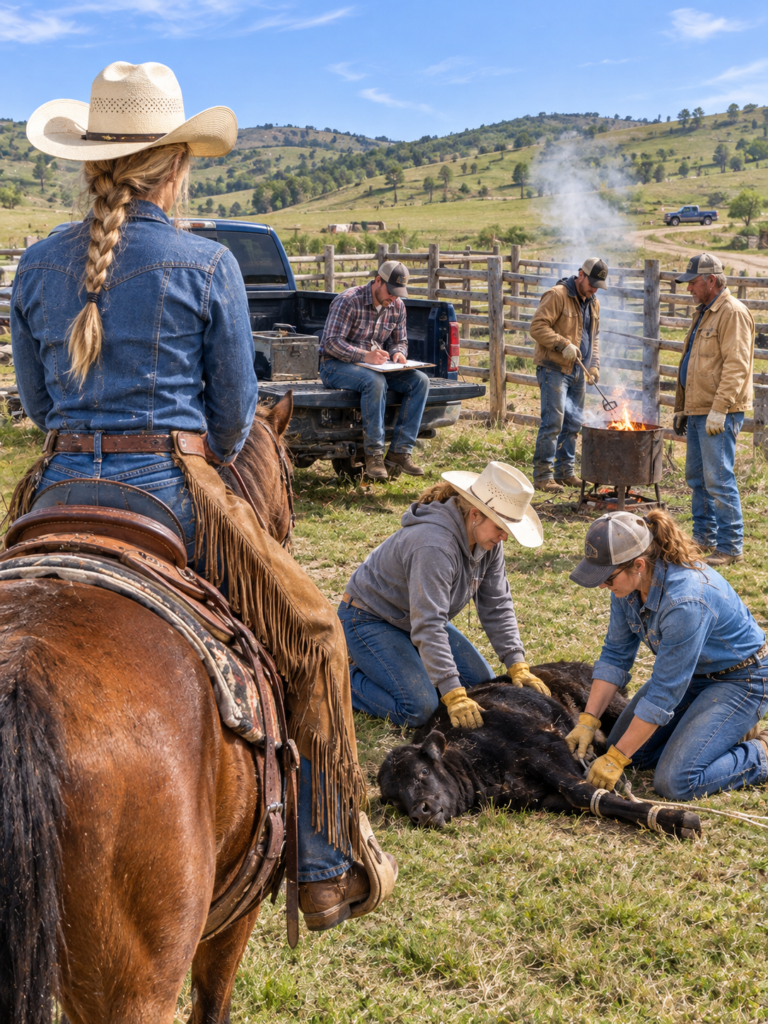
Eleven riders spread out across the east pasture in a long line. Kenzie and Brynn rode with the men, on their own horses, in their own hats. I rode in the middle on Duke, my old sorrel gelding.
The cows came in slow and bawling, their calves trotting beside them. Three hundred pairs moving across the green hills toward the corrals, dust rising gold in the low sun.
It took two hours.
We sorted the calves from the cows in the alley and pushed them into the old wooden corral by the barn. The one Kyle’s grandfather built in 1948, with cedar posts and pine rails worn smooth by seventy-five years of cattle.
The cows stood outside the fence, bawling for their calves. The calves bawled back.
Tom Kreutzer built the fire.
He used cedar and cottonwood from the woodpile behind the barn. By seven o’clock, it was going strong. The branding irons sat in the coals, their handles sticking out like spokes on a wheel.
The smoke rose straight up in the still air. A single gray column against the blue sky. You could probably see it from three miles away.
Kyle sat on the tailgate of our pickup, parked right by the corral gate.
He had a wool blanket over his shoulders. Gray, with a red stripe. His mother’s old blanket. A thermos of coffee beside him. His little green tally book open on his knee.
He was pale. He was shaking a little. But he was smiling.
I rode Duke into the corral.
The calves milled around, nervous, kicking up dust. I shook out my rope. I swung it the way Earl had taught my girls. Big and slow. Let the rope do the work.
I threw a loop at the hind feet of a black baldy calf trotting along the fence.
I caught both heels.
I dallied the rope around the saddle horn. Duke backed up the way he was trained. I dragged the calf across the dirt toward the fire, toward the crew waiting by the irons.
Kenzie and Brynn ran out in their jeans and hats.
Kenzie grabbed the front legs. Brynn grabbed the back. They laid the calf down on its side, gently, and held him there.
Lyle Bosworth put the brand on his left hip. The Andersen brand, a lazy A over a bar, registered with the state in 1919. Marvin Dye gave him his shots. Brynn handed Marvin the vaccine gun with a look that said she’d be taking it back in a minute.
Ten seconds. The calf jumped up and trotted back to the herd, bawling.
“One,” Kyle called out from the tailgate.
He wrote it in the book.
Part Eleven: The Pickup on the Road
We fell into a rhythm.
Rope, drag, hold, brand, vaccinate, release. Over and over. The riders took turns roping. Walt Hagen roped with his new hip, slow and steady, never missing. Kenzie roped six calves in a row and the men cheered every one.
Brynn finally got the vaccine gun and refused to give it up.
“Twenty-two,” Kyle called out.
“Thirty-eight.”
“Fifty-one.”
A little after nine, I rode Duke out of the corral to let him rest for a minute. I stopped by the fence and took a drink from my water bottle.
I looked past the corral.
Past the barn and the windmill and the cottonwoods.
Out to the far gravel road. The county road that runs along the north edge of our property, a half mile away.
One pickup sat on the road.
An old Ford. Faded blue. Parked on the shoulder, facing our place.
The engine was off. Nobody got out.
I didn’t need to see the driver.
I knew that pickup. I’d watched it come up our lane a thousand times. I’d seen it parked beside the barn every morning for twelve years.
Earl was sitting in it. Watching.
I didn’t wave. I didn’t ride toward the road. I didn’t do anything.
I just sat on Duke and looked at it for a long moment.
Walt saw it too.
He was standing by the fire with a branding iron in his hand. He looked out at the road. He looked at the blue pickup for maybe five seconds.
Then he turned his back to the road.
He picked up an iron from the coals. He walked over to the calf Kenzie and Brynn were holding.
He put the brand on.
One by one, the other men saw the pickup. Tom Kreutzer. Lyle Bosworth. Hank Petersen. Jim Cole.
Each one looked at it for a moment.
Then each one turned his back to the road and went back to work.
Nobody said a word.
Nobody had to.
Part Twelve: The Tally Book
At the first break, Kyle waved me over to the tailgate.
It was ten-thirty. We’d branded a hundred and twelve calves. The men were standing around the fire drinking coffee from thermoses, telling stories about horses that bucked them off in 1987.
I rode Duke over to the pickup. I climbed down.
Kyle had the new tally book open to the first page.
It was a brand-new notebook. I’d bought it at the farm supply store in Mullen in April. Green cover. The same kind he’d carried since college. The same kind his father had carried. The same kind his grandfather had carried.
He’d been writing the count on the second page. Leaving the first page blank.
For twelve years, the top of that first page had started with Earl’s name.
In Earl’s hand. Every spring. Earl would take the book from Kyle at the beginning of the day and write across the top in his big, blocky letters:
Andersen Ranch Branding. Foreman: Earl Hollister.
Then he’d hand it back to Kyle to keep the count.
Kyle uncapped his pen.
His hands were thin. The chemo had taken the meat off them. The veins stood out like blue rivers. His fingers shook a little as he held the pen.
He bent over the notebook.
He wrote something across the top of the first page.
Slowly. Pressing hard. The way his father taught him. So it would last.
It took him almost a minute.
Then he turned the book around.
He held it out to me.
At the top of the first page, in Kyle’s careful handwriting, it said:
Andersen Ranch Branding. May 18.
Foreman: Rachel Andersen.
I stared at it.
I couldn’t speak.
“Kyle,” I finally said. “I’m not—”
“You are,” he said.
He looked at me with his tired, sunken eyes. Under his knit cap, he was still the boy in the cowboy hat in the back of the statistics class.
“You’ve been running this place since December,” he said. “You ran it while I was in North Platte. You found what Earl did. You went to the county attorney. You said good morning to him for nine days so the money wouldn’t disappear.”
He tapped the page.
“You roped the first calf this morning,” he said. “You’re the foreman, Rach.”
“Twenty-one years,” Kyle said quietly. “You’ve been Kyle’s wife from Omaha. To Earl. To half the men in this county.”
He looked out at the crew standing around the fire.
“Not anymore,” he said.
I took the notebook from him.
I held it in my hands. I looked at my name at the top of the page. In my husband’s handwriting.
Then I looked out at the yard. At the fire with its single column of smoke. At nine neighbors and my two daughters standing in the dust of a seventy-five-year-old corral.
At a blue pickup on the far road, still sitting there.
Walt Hagen had been watching from the fire. He walked over to the tailgate slowly, his new hip stiff from standing.
He looked at the notebook in my hands.
He read the top of the page.
He didn’t say anything for a long moment.
Then he took off his hat.
“Ma’am,” Walt said. “What do you want us to do next?”
Part Thirteen: Norma
We branded until two in the afternoon.
Three hundred and four calves. Kyle counted every one. He filled four pages of the green notebook with little tally marks in groups of five.
My arms ached from roping. My hands were blistered. My jeans were covered in dirt and worse.
I’d never been so happy in my life.
At noon, a car came up the lane.
Not a pickup. A small white Buick with a dented fender. It pulled into the yard and parked beside the house.
Norma Hollister got out.
She was wearing a flowered apron over a blue dress. Her curly white hair was pinned up. Her reading glasses were pushed up on top of her head.
She was carrying a big glass bowl covered in aluminum foil.
She stood beside her car for a long time. She didn’t walk toward the corrals.
I climbed off Duke. I walked across the yard.
Norma watched me come. Her eyes were red and swollen. She looked like she hadn’t slept either.
When I reached her, she held out the bowl.
“Potato salad,” she said. Her voice cracked. “For the crew. I made it last night. I didn’t know if I should bring it.”
I took the bowl.
Then I set it on the hood of her Buick, and I hugged her.
She broke down. Right there in the yard. Sobbing into my shoulder, her small body shaking.
“I didn’t know, Rachel,” she said. “I swear to God, I didn’t know. Twelve years. I didn’t know.”
“I know,” I said. “Walt told me. I know.”
“He came home last night,” Norma said. “And he sat at the kitchen table. And he told me everything. And I looked at him and I didn’t know who he was.”
She pulled back and wiped her eyes.
“Forty-one years,” she said. “I’ve been married to that man for forty-one years.”
She looked out toward the county road. The blue pickup was still sitting there.
“He’s been out there since eight o’clock,” she said. “He won’t come home. He won’t come here. He just sits there.”
“Why did you call the neighbors?” I asked.
Norma looked at me.
“Because you’ve been driving to North Platte every three weeks for five months,” she said. “Because your husband is sick. Because your girls call me Aunt Norma and they’ve eaten my snickerdoodles every Saturday since they were in diapers.”
She took a shaky breath.
“And because I wasn’t going to let my husband take one more thing from you,” she said.
We carried the potato salad to the long table I’d set up in the machine shed. Sloppy joes and baked beans and three sheet cakes. The men lined up with paper plates.
Every one of them said, “Thank you, Norma,” when they reached the potato salad.
She stood behind the table with her serving spoon and her red eyes. She said, “You’re welcome,” to every one of them.
Part Fourteen: The Last Calf
At two o’clock, there was one calf left.
A little red heifer. The smallest one in the herd. She’d been dodging ropes all day, ducking behind her mother, slipping between the rails.
“Mom,” Kenzie said. “Can Dad rope this one?”
I looked at Kyle on the tailgate.
He hadn’t been on a horse since December. He couldn’t lift a saddle. His hands shook holding a pen.
“Kenzie,” I said. “Your dad’s too sick.”
“He doesn’t have to ride,” Kenzie said. “He can rope from the ground. I’ll hold the horse. Brynn and I will do the rest.”
Kyle had heard. He looked at his daughter for a long moment.
Then he set down the tally book.
He stood up from the tailgate. Slowly. Holding on to the side of the truck. His mother’s blanket slid off his shoulders.
Walt Hagen walked over. He held out his own rope. Old, worn smooth, the color of honey.
“Use mine,” he said. “It’s broke in.”
Kyle walked into the corral.
It took him a long time. Every step looked like it hurt. The men stopped talking. Norma stood at the fence with her hand over her mouth.
He stood in the middle of the corral with Walt’s rope in his hands. The little red heifer trotted along the fence, watching him.
He shook out a loop.
He swung it. Big and slow. Let the rope do the work.
His first throw missed.
His second throw missed.
He stood there breathing hard. Sweating under his knit cap. His hands shaking.
Nobody moved. Nobody said anything.
His third throw caught her by both hind heels.
The whole crew erupted. Walt threw his hat in the air. The Kreutzer brothers whooped. Brynn screamed so loud the horses jumped.
Kenzie and Brynn ran in and laid the little heifer down. Lyle handed me the branding iron.
I put the brand on her left hip. The lazy A over a bar. Brynn gave her the shot. The heifer jumped up and trotted back to her mother, bawling.
Kyle stood in the middle of the corral, holding Walt’s rope, tears running down his face.
He walked back to the tailgate. Slowly. He sat down. He picked up the tally book.
He wrote one more mark.
“Three hundred and four,” he said.
When I looked out at the county road, the blue pickup was gone.
Part Fifteen: After
Earl pleaded guilty in September.
Felony theft by deception. Ann Sorensen offered him a plea deal. Five years probation, restitution of the full hundred and ninety thousand dollars, and a felony record.
The fifty thousand in the frozen account came back to us that fall. The rest, he’s paying at eight hundred dollars a month. He’ll be paying until he’s seventy-eight.
He works at the sale barn in Valentine now. Sorting cattle. He doesn’t rope anymore.
At the sentencing, he stood up in the Hooker County courtroom in a borrowed suit.
He didn’t look at me. He looked at the judge.
“I took money from a family that trusted me,” he said. “While the man who hired me was fighting cancer. I told myself I’d earned it. I told myself they’d never miss it.”
He swallowed.
“I was wrong,” he said. “About both.”
He looked at me then. Just once.
“I taught those girls to rope,” he said quietly. “I hope they remember that part. I hope that part’s still worth something.”
I didn’t answer him. Not then.
But I’ve thought about it a lot.
Norma left him in October.
She moved into a little apartment in Mullen, above the hardware store. She still works at the school cafeteria. She still makes snickerdoodles every Saturday.
She brings them out to the ranch. Every week. For the girls.
Part Sixteen: Remission
Kyle finished chemo in June.
His scan in July came back clean. In October, clean again. In January, the oncologist in North Platte looked at his blood work and smiled.
“Remission,” she said.
His hair grew back in August. It came in gray. He says it makes him look distinguished. The girls say it makes him look like Walt Hagen.
By fall, he could lift a saddle again. By Christmas, he was riding.
By March, he was roping.
We didn’t hire a new ranch manager.
I run the place now. With Kyle. Side by side. I do the grazing leases and the hunting contracts myself. I’ve raised the north pasture to forty-five thousand. Pat Brennan says it’s still the best grass in the county.
Kenzie wants to study ranch management at the University of Nebraska. Brynn wants to be a large-animal vet.
They both still rope every day.
Part Seventeen: Next May
This spring, I made the calls myself.
I sat at my kitchen table two weeks before branding with a list and the landline phone. Eleven names. Eleven phone numbers. In my own handwriting.
I called Walt Hagen first.
“Walt,” I said. “It’s Rachel. We’re branding Saturday the seventeenth. You coming?”
He laughed.
“Ma’am,” he said. “I’ll be there at five.”
Every one of them said yes.
And two more I hadn’t called. Pat Brennan drove up from Broken Bow with his son. And Ann Sorensen, the county attorney, showed up at six in the morning in jeans and boots, saying she hadn’t been to a branding since she left her daddy’s ranch at eighteen.
Norma came at noon with potato salad. Enough for forty.
She stood behind the long table in the machine shed with her serving spoon. Every man who came through the line said, “Thank you, Norma.”
She smiled at every one of them.
Kyle didn’t sit on the tailgate this year.
He rode. On his old buckskin gelding, Chief. He roped calves all morning beside his daughters. He missed a few. He caught most.
Walt Hagen sat on the tailgate this year. His new hip was bothering him. He kept the tally book.
At the first break, Walt waved me over.
He had the green notebook open on his knee. Brand-new. Blank first page.
He held out the pen.
“This one’s yours to write, ma’am,” he said.
I took the pen.
I wrote across the top of the first page. Slowly. Pressing hard. So it would last.
Andersen Ranch Branding. May 17.
Foreman: Rachel Andersen.
Then, underneath, I wrote something else.
Kyle saw me doing it. He rode over to the tailgate and looked over my shoulder.
Crew:
Walt Hagen. Tom Kreutzer. Luke Kreutzer. Marvin Dye. Cody Dye. Lyle Bosworth. Roy Halvorsen. Hank Petersen. Jim Cole. Pat Brennan. Ann Sorensen.
Kenzie Andersen. Brynn Andersen. Kyle Andersen.
Norma Hollister — potato salad.
Kyle read it twice.
“You’re putting everybody’s name on the first page?” he asked.
“Every year,” I said. “From now on.”
He looked at me.
“Why?” he asked.
I looked out at the corral.
At the fire, with its single column of smoke rising straight up in the still May air. At my daughters in their hats, laughing with the Kreutzer brothers. At Walt on the tailgate with his bad hip and his honey-colored rope.
At the far gravel road. Empty.
“Because Earl was wrong,” I said.
Kyle waited.
“He said those men came because he called them,” I said. “But they didn’t. They came because your grandfather branded for their grandfathers. Because your dad branded for their dads. Because you branded for them.”
I looked down at the names on the page.
“Nobody runs a branding alone,” I said. “Not a foreman. Not anybody. It takes all of us.”
Kyle smiled. That slow smile from the back row of statistics class.
“You learned that from the Sandhills,” he said.
“I learned it from Norma,” I said. “And from nine men who showed up at five-fifteen in the morning without being asked.”
I closed the tally book. I handed it back to Walt.
“Start counting,” I said.
Walt grinned. He uncapped his pen.
I climbed onto Duke. I rode into the corral. I shook out my rope.
I swung it. Big and slow.
I let the rope do the work.
“One,” Walt called out from the tailgate.
And he wrote it down.