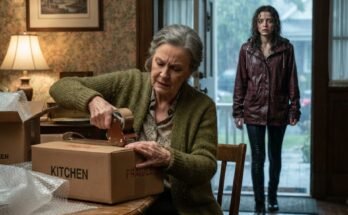
The green paint on the kitchen wall had been peeling near the baseboard since I was twelve years old, and my brother Dale never let me forget that the house itself was going to Dale, lock, stock, and barrel. The lawyer had a neat little knot in his silk tie that didn’t move an inch while he read off the numbers, dividing up seventy-four years of Grandfather’s life like he was splitting a pizza at a bowling alley.
Dale got the lake cabin with the screened-in porch where we used to clean perch on Sunday mornings. My sister Beth got the ninety thousand dollars sitting in three separate certificates of deposit at the county bank. I got a heavy cedar crate that smelled of dried mud and cedar shavings, stuffed full of twelve old wooden duck decoys with paint flaking off their backs like dead skin.
“They were his pets,” Dale said, and he gave that wet little snort he always used when he thought he was being clever. “You can set them on your front porch, Ruby. Give the blue jays something to look at.”
Beth didn’t even look up from her phone while she signed the release forms, her red fingernails clicking against the laminate table like tiny hammers. She had already mapped out which kitchen cabinets she was going to rip out first with her share of the money.
Grandfather had been dead three days, and they were already acting like he was just an ATM that had finally run out of paper. I didn’t say a word. I just loaded the heavy wooden crate into the trunk of my ninety-eight Corolla and drove back to my little rented duplex behind the feed store, my teeth gritted so hard my jaw ached all the way home.
The next afternoon, the transmission in the Corolla let go with a dry, metallic scream right in the middle of the left-hand turn lane on Route 6. I coasted into a gravel pull-off with smoke curling up from under the hood and my last seventy-four dollars in a zippered coin purse. The mechanic down at the garage wiped his grease-stained hands on a blue rag and told me straight out that I was looking at seven hundred dollars just for the parts to get it moving again.
I sat in the driver’s seat with my forehead pressed against the steering wheel for a long time, listening to the radiator hiss.
That was when I looked back in the hatch and saw the corner of the cedar crate sticking out from beneath an old wool blanket.
I didn’t even want to touch them, but I was desperate and stubborn in that particular way you get when you are tired of being the poor relation. I picked the heaviest bird out of the crate, a pintail with most of its neck feathers worn down to bare pine, and wrapped it in a greasy flannel shirt so it wouldn’t scratch the passenger seat. Route 6 is lined with little junk shops that smell like mothballs and damp wool, but Halloran’s Antiques was the only one with an iron bell hanging over the door that actually sounded like silver when you pushed it open.
The bell chimed, and a tall man with white hair sticking out in tufts above his ears looked up from a stack of ledgers behind a glass case. He didn’t smile, just watched me walk over the worn pine floorboards with my arms wrapped tight around the bundled shirt.
“Help you?” he asked. His voice sounded like gravel shifting under a heavy truck tire.
I laid the bundle down on the glass case and peeled back the flannel, revealing the graying wood and the cracked white paint on the tail feathers. “I need seven hundred dollars,” I said, and my voice sounded smaller than I wanted it to. “For a car transmission. My grandfather just passed, and these were his. I figured someone might want a garden ornament.”
Halloran didn’t reach for it right away. He just stared at the bird’s head, his fingers freezing over the corner of his ledger. Then he leaned over the counter, his glasses sliding halfway down his nose, and picked the decoy up by its breast with the kind of careful reverence I had only ever seen old men use when they were lifting a newborn baby out of a basket.
He didn’t say anything for three long seconds, and honestly that felt worse than if he had laughed me out of the shop. He turned the heavy wooden bird upside down, squinting at the flat belly where the keel had once been screwed in.
“Ma’am,” he whispered, and his voice dropped so low I had to lean across the glass to catch the words. “Do you know who carved these?”
I blinked at him, my fingers tightening on the edge of the counter. “My grandpa. He whittled on the back porch when his joints weren’t acting up.”
Halloran shook his head slowly, and his eyes didn’t leave the belly of the duck. “Your grandfather wasn’t just whittling, honey. Not with a hand like this.”
He carried the decoy into the back room without another word, leaving me standing there by the cash register with my heart hammering against my ribs like a trapped bird. I heard drawers sliding open, pages turning with a sharp, dry rustle, and the low mutter of an old man talking to himself in the gloom. When he came back out, he had a heavy leather-bound book open to a page filled with black-and-white photographs of wooden ducks that looked exactly like the one sitting on his counter.
He laid the book down beside my pintail. The photo on the left showed a set of twelve mallards and pintails displayed in a glass case at some exhibition in Baltimore back in nineteen-fifty-six. Underneath the photo, in faded ink, was a name I had never heard my grandfather use once in my entire life.
“E.V.,” Halloran said, tapping his finger against the page. “Elias Vance. He vanished from the Eastern Shore right after the winter of fifty-nine. Every collector from here to Boston has spent forty years looking for the lost Chesapeake series. They thought he drowned in the marsh after the storm took his boat.”
My knees felt weak, and I had to grab the edge of the wood counter to keep my balance. “No,” I breathed. “My grandfather was Arthur Vance. He worked the auto parts warehouse in town for thirty years. He had a limp and he smelled like pipe tobacco.”
“People change their names when they leave a life behind,” Halloran said gently. He looked up at me, his eyes sharp and steady behind his thick lenses. “Look at the belly of that bird. Look at those initials burned into the pine with a hot wire.”
I leaned over and squinted at the grain. There, hidden right inside the circle where the lead weight used to be, were the tiny, precise letters E.V., crossed with a small anchor that matched the drawings in the back of Halloran’s reference book. The paint flaking off the back wasn’t just old house paint; it was lead-white over burnt umber, applied with the kind of meticulous patience that only a man who had nothing left to lose could manage.
“He left me twelve of them,” I whispered. “My brother got the cabin. My sister got the cash.”
Halloran let out a short, dry laugh that sounded like dry leaves scraping across concrete. “Your brother got a leaky roof and your sister got ninety thousand paper dollars that’ll be gone by Thanksgiving. You, young lady, are sitting on the better part of half a million dollars if these are all in the same condition.”
The drive back home didn’t feel real. The Corolla’s transmission was still shot, so I called a tow truck and sat in the cab of the flatbed all the way to my duplex, holding the cedar crate on my lap like it was made of thin glass. Every bump in the road made my stomach twist, but for the first time in my life, I wasn’t thinking about bills or rent or the way Dale looked down his nose at my worn-out shoes.
That evening, after the tow truck driver left and the streetlights flickered on down by the feed store, I carried the heavy cedar crate into my kitchen and set it on the laminate table. I didn’t call Dale. I didn’t call Beth. I didn’t want their voices or their snorting laughs anywhere near the small kitchen table where I finally understood why Grandfather had spent every Tuesday afternoon sitting in silence with me while I did my spelling homework on the back steps.
I started lifting the decoys out one by one, setting them in a neat row across the table under the harsh light of the fluorescent tube. Pintail, canvasback, mallard, teal. Each one had the same burnt initials on the bottom, the same subtle curve to the neck that made them look like they were about to stretch their wings and rise off the wood.
At the very bottom of the crate, underneath a layer of stained newspapers from nineteen-sixty-two, my fingers caught on something stiff and folded. It was a brown manila envelope, sealed with dried glue that gave way with a soft crack when I slipped my thumb beneath the flap.
Inside was a single sheet of heavy linen paper, covered in Grandfather’s familiar, cramped handwriting, written the year before he died.
*Ruby,* the note said. *You were the only one who didn’t ask what anything was worth. Keep your chin up.*
I sat there at the kitchen table until two in the morning, listening to the hum of the refrigerator and watching the way the kitchen light caught the grain of the wood on the pintail sitting right beside my coffee mug. I didn’t cry, and I didn’t feel angry anymore.
Two weeks later, after Halloran put me in touch with a quiet, respectable auction house in Philadelphia, the first three decoys sold to a museum curator from Annapolis. The check cleared before my morning shift at the diner, and I paid cash to have the roof on the duplex repaired and a brand-new transmission put into the Corolla, with enough left over to never have to worry about the grocery bill again.
Dale called me on a Tuesday afternoon, sounding greasy and important, asking if I had managed to get rid of those old wooden ducks yet so he could use my back steps to store some old tires.
“No, Dale,” I said, looking out the kitchen window at the autumn wind shaking the branches of the maple tree by the fence. “I haven’t sold them.”
“Well, don’t throw them in the trash,” he laughed. “Trash day is Thursday.”
“I know,” I said, and I hung up the phone without another word.
Now, a single polished mallard sits on the sturdy oak mantelpiece in my living room, its grain catching the evening light as the sun goes down behind the feed store. It doesn’t look like junk anymore. It looks like history, and it looks like the only inheritance that ever truly mattered.