One hand beneath her.
One hand across her back.
And then he whispered,
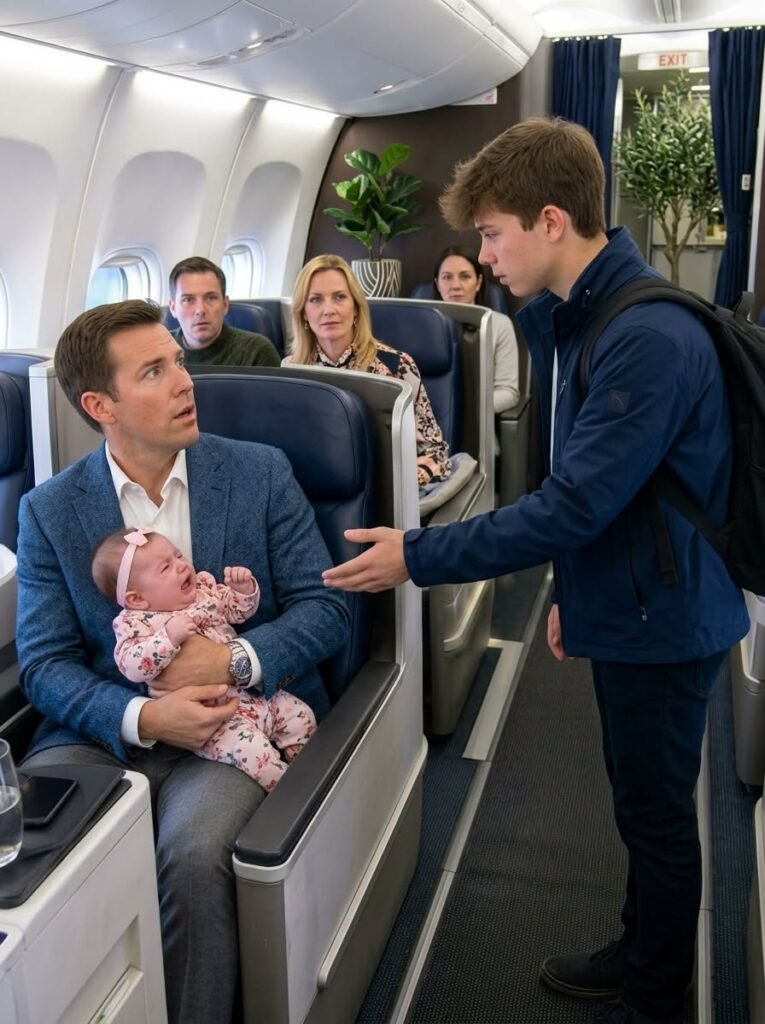
“Hey, little one.”
Nora cried.
Mason began rocking almost imperceptibly.
“You’re okay.”
Her cries continued.
Then Mason hummed.
Three notes.
A pause.
Four more.
A simple melody.
Nothing Henry recognized immediately.
Mason repeated it.
Again.
Again.
Nora’s crying changed.
The sharp screams became broken whimpers.
Henry froze.
Mason continued humming.
Nora’s fists slowly opened.
Her shoulders loosened.
Twenty seconds later, she stopped crying.
The cabin became so quiet that Henry could hear the engines.
Mason kept rocking her.
Nora blinked up at him.
Then closed her eyes.
Henry could not move.
Elena covered her mouth.
The woman wearing headphones removed them.
Even the doctor in 3A looked over.
Henry whispered,
“How did you do that?”
Mason smiled faintly.
“I didn’t really do anything.”
“You’ve been holding her for thirty seconds.”
Mason looked down at Nora.
“She wasn’t asking for something new.”
He paused.
“I think she was looking for something familiar.”
Henry felt something tighten in his chest.
“What does that mean?”
Mason’s expression changed.
He suddenly seemed older than sixteen.
“She misses her mother.”
Henry stared at him.
The words hit harder than they should have.
“How would you know that?”
Mason stopped rocking for half a second.
Then continued.
“I know what it sounds like when someone realizes a person isn’t coming back.”
Henry’s eyes narrowed.
“What happened to you?”
Mason looked away.
“My mom died when I was thirteen.”
Henry’s anger disappeared.
Mason continued quietly.
“My sister Lily was still a baby. She cried for weeks afterward. Sometimes nothing helped.”
“And that song?”
“My mother used to hum it to her.”
Henry looked at Nora.
“But Nora has never heard it.”
Mason didn’t answer.
Not immediately.
Something passed across his face.
Fear.
Henry noticed.
Before he could question him, Nora shifted.
Mason adjusted her blanket.
A few minutes later, Nora was asleep.
Completely asleep.
Henry took her carefully.
He lowered her into the bassinet.
She didn’t wake.
Henry turned back.
“Thank you.”
Mason nodded.
“No problem.”
He reached for his backpack.
“You’re traveling alone?”
“Yeah.”
“To Zurich?”
“Yes.”
“Family there?”
Mason’s fingers tightened around one backpack strap.
“My little sister.”
Before Henry could ask more, Mason stepped backward.
“I should go back.”
He turned.
The backpack caught on the corner of a seat.
The zipper opened.
A notebook fell out.
Then a charging cable.
Then a photograph.
It landed face-up on the carpet.
Henry automatically bent to pick it up.
He saw Claire.
And stopped breathing.
She looked younger in the picture.
Maybe two years earlier.
Her hair was tied back.
She wore jeans and a gray sweater.
Her arm rested around the shoulders of a much younger Mason.
Both were smiling.
Henry slowly raised his eyes.
Mason had gone completely pale.
“Where did you get this?”
Mason didn’t answer.
Henry looked at the photograph again.
There was no mistaking Claire.
His Claire.
He turned it over.
Four words.
Written in blue ink.
Protect him for me.
Henry knew that handwriting.
He had seen it on birthday cards.
Grocery lists.
Notes taped to his laptop.
The itinerary in his briefcase.
His hands went cold.
“Mason.”
The boy looked trapped.
“Who were you to my wife?”
No one in first class pretended not to listen anymore.
Mason glanced at the sleeping baby.
Then at Henry.
“She told me you didn’t know.”
“Know what?”
“About me.”
The words landed badly.
Henry’s expression hardened.
“What exactly does that mean?”
Mason immediately understood.
“No. Not like that.”
“Then explain.”
Mason took a breath.
“I met Claire three years ago.”
He pulled the backpack closer.
“My mother was sick.”
Henry said nothing.
Mason continued.
“She had cancer. By the end, she was in and out of the hospital all the time. My dad had left years earlier. It was mostly me, my mom and Lily.”
Lily.
The baby sister.
“When Mom had treatments, I watched Lily in the family waiting area. One night Lily wouldn’t stop crying. I was thirteen. I hadn’t slept. I hadn’t eaten since that morning.”
His voice remained steady.
But Henry could see the effort it took.
“People kept walking past. Then Claire sat down beside me.”
Henry’s throat tightened.
Mason almost smiled.
“She asked if I wanted help.”
“What was Claire doing there?”
“Visiting someone from a volunteer program.”
Henry frowned.
Claire volunteered?
He knew she donated.
He knew she attended charity dinners.
But this sounded different.
Mason continued.
“She bought me a sandwich. Then she held Lily while I ate.”
Henry looked toward Nora’s bassinet.
The parallel hit him immediately.
“She came back the next week,” Mason said. “Then again.”
“Why?”
“I asked her the same thing.”
“What did she say?”
Mason’s eyes became wet.
“She said nobody should have to be thirteen and pretend they aren’t scared.”
Henry looked away.
That sounded exactly like Claire.
Painfully like Claire.
Mason continued.
“When my mom got worse, Claire helped us find an attorney. She helped my aunt get temporary guardianship paperwork ready. She arranged rides so I could stay in school.”
“She paid for it?”
“Some of it.”
Henry almost smiled despite himself.
Of course she had.
“She never told me.”
“She didn’t want you to know.”
Henry looked back sharply.
“Why?”
Mason hesitated.
“Because she said you would try to fix everything.”
Henry actually laughed once.
It was a broken sound.
“She knew me.”
Mason nodded.
“She said you were a good man. But that when something hurt you, you attacked the problem until there was nothing left to attack.”
That also sounded like Claire.
“She wanted me to learn how to stand on my own,” Mason said. “Not become somebody’s charity project.”
Henry stared at the picture.
“When did she give you this?”
“Four months ago.”
“Why does the back say protect him for me?”
Mason slowly unzipped another compartment of his backpack.
From inside, he removed a white envelope.
Henry saw his name immediately.
Henry.
Claire’s handwriting.
His knees almost failed him.
“Where did you get that?”
“She gave it to me with the picture.”
“When?”
“Before Nora was born.”
Henry’s voice dropped.
“Why?”
Mason looked terrified of the answer.
“She knew the pregnancy had become more complicated.”
Henry went still.
Claire had told him there was increased risk.
But she had minimized it.
The doctors had minimized it.
Everyone had told him not to panic.
Claire most of all.
“She told me not to open the envelope,” Mason said. “She said if she was okay after Nora was born, I had to give it back and we would laugh about how dramatic she’d been.”
Henry could barely speak.
“And if she wasn’t okay?”
“She told me to find you.”
Henry stared at the unopened envelope.
“Why didn’t you?”
“I tried.”
“When?”
“After the funeral.”
Henry looked up.
“I was there.”
The statement stunned him.
Mason swallowed.
“I stayed across the street.”
“Why didn’t you come inside?”
“Because there were cameras everywhere. Security. Reporters. People in black cars.”
His jaw tightened.
“And I looked at everybody going in and thought… what am I doing here?”
Henry had no answer.
“I’m nobody to you,” Mason said. “Claire was the only person who knew me.”
“You were important to her.”
“I didn’t know if that made me important to you.”
The words landed harder than any accusation.
Henry looked at the envelope again.
“Why are you going to Zurich?”
Mason hesitated.
Then Henry understood.
“Your sister.”
Mason nodded.
“Lily has a heart condition.”
The cabin seemed suddenly colder.
“She was born with it. It got worse last year. Claire found a specialist in Zurich who agreed to take her case.”
“And Claire paid?”
“She covered what insurance wouldn’t. Quietly.”
“When is the surgery?”
“Wednesday.”
Henry stared at him.
It was Monday night.
“Where is Lily now?”
“My aunt went ahead with her last week.”
“And you?”
“I had final exams. Claire bought this ticket months ago so I could join them.”
Henry glanced toward economy.
“This flight?”
“Yes.”
Something clicked.
Claire had planned everything.
The family trip.
Mason’s flight.
The timing.
Perhaps even the introduction.
“You were supposed to meet us in Zurich.”
Mason nodded slowly.
“She wanted to introduce us after Nora was born.”
Henry sat down.
His legs no longer trusted him.
All this time he had believed Claire’s life was completely intertwined with his.
They shared a house.
A marriage.
Friends.
Calendars.
Plans.
Yet there had been an entire quiet corner of Claire’s life he had never seen.
Not betrayal.
Not deception.
Kindness.
Private kindness.
The kind that demanded no recognition.
Henry looked at the envelope.
“May I open it?”
Mason almost laughed through his tears.
“It has your name on it.”
Henry broke the seal.
Inside were two pages.
He recognized Claire’s handwriting immediately.
He read silently.
Then stopped after the first line.
His eyes closed.
Mason waited.
Henry started again.
Claire had written the letter during the final month of her pregnancy.
She told Henry she hoped he would never read it.
She told him Mason had entered her life during a period when she had begun to question what privilege meant.
She wrote that Mason had spent his childhood taking care of people when adults should have been taking care of him.
Then came the sentence that made Henry grip the paper.
If you are reading this, please do not rescue him. See him. There is a difference.
Henry swallowed.
Claire explained that Mason hated asking for help.
That he was brilliant at school.
That he wanted to study biomedical engineering because of Lily’s heart condition.
That he had spent years convinced he had to become an adult before childhood was finished with him.
And then Claire wrote about Nora.
Henry’s eyes moved faster.
She had visited Mason shortly before the birth.
She had confessed that despite all the parenting books she had read, she was terrified she would not know how to comfort her own child.
Mason had laughed.
Then he taught Claire the lullaby his mother had sung to Lily.
Claire had begun humming it at night.
To Nora.
Before Nora was born.
Henry’s hands started trembling.
He looked toward the bassinet.
Nora wasn’t responding to Mason because of magic.
She recognized the melody.
She had heard it for weeks from inside Claire’s body.
The teenager had not introduced Nora to something new.
He had given her back one tiny piece of her mother.
Henry covered his mouth.
Mason looked down.
“That’s why she stopped crying,” he whispered.
Henry could not answer.
He remembered Claire sitting in bed during the final weeks of pregnancy.
Reading.
Folding baby clothes.
Sometimes humming.
Henry had heard the melody.
He simply never paid attention.
He had been answering emails.
Reviewing contracts.
Taking calls.
He had been physically beside his wife while missing something she was giving their daughter every night.
A memory Nora somehow still carried.
Henry’s eyes filled.
He read the final paragraph.
Claire asked him to make sure Mason had choices.
Not money without purpose.
Not favors without dignity.
Choices.
Then the last line:
And Henry, if grief makes you believe you have nothing left to give Nora, remember this: children do not need perfect parents. They need someone who stays. Stay.
Henry lowered the letter.
For several seconds, he could not speak.
Then Nora made a tiny sound in the bassinet.
Henry immediately looked over.
She remained asleep.
He turned back to Mason.
“Why didn’t you give me this before the flight?”
Mason shrugged.
“I kept thinking I would.”
“You’re sitting thirty seats behind me.”
“I didn’t know that until I saw you board.”
“And you still said nothing.”
“What was I supposed to say?”
Mason’s voice cracked for the first time.
“Hi, Mr. Whitman. Your wife was my friend, my sister might need more money for surgery, and she left me a letter telling you to protect me?”
Henry said nothing.
“I didn’t want that to be why you met me.”
“So why did you come up here?”
Mason glanced at Nora.
“Because she was crying.”
That was all.
He had not come for money.
Not for the letter.
Not for access to a billionaire.
He had come because a baby needed help.
Just as Claire had once helped him.
Henry stared at the sixteen-year-old.
And suddenly he understood why Claire had cared about him.
A few hours later, most of the cabin was asleep.
Henry wasn’t.
Neither was Mason.
Henry had asked the crew to move Mason into an empty seat nearby.
This time, Mason accepted.
They talked quietly through the night.
About Claire.
About Lily.
About grief.
Mason told Henry that Claire had never treated him like a tragic story.
When his grades slipped after his mother died, she did not tell him he was brave.
She told him to do his homework.
When he tried quitting school to work full-time, she threatened to personally drag him back into class.
Henry laughed harder at that than he had laughed in weeks.
“Yeah,” he said. “That sounds like her.”
Mason smiled.
For a moment, Claire felt present between them.
Not as a photograph.
Not as a grave.
As a person.
Later Nora woke.
Henry’s body immediately tensed.
She began fussing.
Mason started to stand.
Henry raised one hand.
“Wait.”
He lifted Nora himself.
He held her against his chest.
Then he tried the melody.
The first notes were terrible.
Mason winced.
Henry gave him a look.
“That bad?”
“Pretty bad.”
Henry tried again.
Mason quietly corrected him.
“Slower.”
Henry repeated it.
Nora’s crying softened.
Henry’s face changed.
Again.
The melody.
The rhythm.
The gentle rocking.
Nora settled against him.
This time Henry was the one who calmed her.
His eyes filled.
He kissed his daughter’s forehead.
“I’m here,” he whispered.
And for the first time, the words did not sound like an apology.
Across from him, Mason looked away to give him privacy.
Henry noticed.
That small act decided something.
Not a business decision.
Not a financial one.
A human one.
When the plane began descending toward Zurich, Henry called his assistant using the onboard connection.
His voice had changed back into the tone executives around the world recognized.
Focused.
Precise.
But his request was different.
“I need everything available on the pediatric cardiac team treating Lily Brooks.”
He listened.
“No publicity.”
Another pause.
“No press release. No foundation announcement. Nothing with my name.”
Mason looked over.
Henry continued.
“I also want our legal team to confirm that Lily’s treatment cannot be interrupted because of Claire’s death or any frozen personal accounts.”
He listened again.
“And arrange transportation for Mason from the airport.”
Mason stood.
“Mr. Whitman—”
Henry held up one finger.
Then finished the call.
Mason looked frustrated.
“Claire told you not to rescue me.”
“She did.”
“This feels a lot like rescuing.”
Henry folded his phone away.
“No.”
He looked directly at him.
“She told me to give you choices.”
Henry pointed toward the airport lights appearing below the clouds.
“So here are your choices. You can take the car or not. You can let my attorneys deal with the hospital billing or you can continue fighting insurance companies yourself. You can accept help with school or refuse it.”
Mason stared at him.
“But Lily’s surgery is happening.”
“Because Claire already made that choice.”
Mason tried not to cry.
Failed.
He sat back down.
Henry looked out the window.
“And before you argue again, I’ve spent twenty years arguing professionally.”
That earned a laugh from Mason.
Nora woke as the wheels touched the runway.
She made one small complaining sound.
Henry automatically began humming.
Mason smiled.
The plane landed in Zurich just after sunrise.
At the gate, first-class passengers collected their luggage.
Several approached Mason.
One shook his hand.
Another quietly told him he was a good young man.
Mason looked embarrassed by the attention.
Henry waited beside Nora’s carrier.
For once, he was not rushing anywhere.
Mason lifted his backpack.
The same old backpack that had carried Claire’s photograph across the Atlantic.
“Ready?” Henry asked.
Mason nodded.
They walked off the plane together.
Three days later, Lily underwent surgery.
It lasted nearly six hours.
Mason spent most of that time sitting beside his aunt in a hospital waiting room, bouncing one knee until Henry finally put a hand on his shoulder.
Henry had no meeting there.
No business reason to stay.
But he stayed.
Just as Claire had told him to.
When the surgeon finally appeared, Mason stopped breathing.
The operation had gone well.
Lily was stable.
Mason folded forward and covered his face.
His aunt began crying.
Henry closed his eyes.
Then Mason hugged him.
It happened so suddenly that Henry barely reacted at first.
Then he put both arms around the boy.
Neither spoke.
They didn’t need to.
Months passed.
Lily recovered.
Mason returned to school.
Henry kept his promise to Claire.
He did not turn Mason into a publicity story.
There were no magazine interviews.
No photographs outside the hospital.
No articles about a billionaire’s generosity.
Instead, Henry did something Claire would have preferred.
He listened.
Mason wanted to attend college.
Henry helped him understand scholarships.
Mason wanted to study biomedical engineering.
Henry introduced him to researchers, but made him earn his own internship.
When Mason rejected an offer that felt like charity, Henry did not force him.
Sometimes they argued.
Often, actually.
Claire would have loved that.
And Nora?
Nora grew.
The lullaby remained hers.
Henry sang it badly at first.
Then less badly.
By the time she was old enough to speak, she called Mason “Mase.”
By the time she could walk, she followed him through Henry’s house whenever he visited.
And every year on Claire’s birthday, Henry, Mason, Lily and Nora went somewhere together.
No photographers.
No speeches.
They simply told stories about her.
Years later, when Mason graduated at the top of his university class in biomedical engineering, Henry sat in the audience with Nora beside him.
Lily sat on Nora’s other side.
When Mason crossed the stage, Nora screamed his name louder than anyone in the auditorium.
Henry laughed.
Then he looked at the empty seat they had deliberately left beside them.
Claire’s seat.
For a second, Henry remembered that night above the Atlantic.
The crying baby.
The exhausted father.
The teenager from economy.
The photograph falling onto the floor.
Four words written on the back.
Protect him for me.
For years Henry had believed that was Claire’s final request.
Eventually he understood something else.
Claire had not only been asking Henry to protect Mason.
In her own way, she had been asking Mason to protect something too.
The part of Henry that grief was threatening to destroy.
His ability to trust.
To notice people.
To accept help.
To remain present for his daughter.
Mason had walked into first class believing he was only calming a crying baby.
But he had given Nora back the sound of her mother.
And he had given Henry something money could never purchase.
A way forward.
One rainy evening, almost eighteen years after that flight, Henry was cleaning out an old desk when he found the photograph again.
Claire and sixteen-year-old Mason.
He turned it over.
The ink had faded slightly.
Protect him for me.
Nora, now eighteen, happened to walk into the room.
She picked up the photograph.
“I love this one.”
Henry smiled.
“You know this picture changed my life.”
Nora shook her head.
“No.”
Henry looked at her.
“What?”
She pointed at Mason’s face.
“He changed your life.”
Henry considered that.
Then smiled.
“You might be right.”
Nora studied the photograph.
“Do you ever wonder why Mom put Mason on the same flight as us?”
Henry frowned.
“What do you mean?”
“Mason told me years ago. Mom changed his ticket two weeks before I was born.”
Henry stared at her.
“What?”
“She moved him from a flight the next day onto ours.”
Henry’s heart began beating faster.
Claire had deliberately placed Mason on the same Boston–Zurich flight.
But why?
Nora handed him the photograph.
“She knew you’d meet.”
Henry shook his head.
“She couldn’t have known she would die.”
“No.”
Nora smiled sadly.
“But maybe she knew you two needed to meet anyway.”
Henry looked at Claire’s handwriting again.
And suddenly remembered something.
The envelope.
He still had it.
He opened the old safe in his study and removed Claire’s letter.
He had read it hundreds of times.
But this time he noticed something he had overlooked for eighteen years.
At the bottom of the second page, beneath her signature, Claire had written one tiny sentence in the margin.
So small Henry had always assumed it was part of the page crease.
He moved closer to the lamp.
Then read it.
P.S. Henry, ask Mason to teach you the lullaby. You’re terrible at singing, but Nora won’t care.
Henry stared at the sentence.
Then started laughing.
Not softly.
Not politely.
He laughed until tears rolled down his face.
Nora laughed too, even though she was crying.
And from the doorway came another voice.
“She wasn’t wrong.”
Henry looked up.
Mason was standing there.
No worn sneakers anymore.
No old backpack.
Dr. Mason Brooks had arrived for dinner straight from the medical research center he now directed—a center developing new cardiac technologies for children born with conditions like Lily’s.
Henry pointed at him.
“You knew about this line?”
Mason grinned.
“For eighteen years.”
“You never told me?”
“Claire told me you had to find some things yourself.”
Henry shook his head.
“That woman is still controlling my life.”
Nora wrapped her arm around him.
“No.”
She looked at Claire’s photograph.
“She’s reminding us how she lived hers.”
The room became quiet.
Henry looked at Mason.
Then Nora.
Then the old photograph.
Eighteen years earlier, everyone aboard that flight had believed they were witnessing a poor teenage boy perform a small miracle for a billionaire.
But they had misunderstood.
The miracle was never that Mason could quiet a crying baby.
The miracle was that years earlier, when Mason had been a frightened thirteen-year-old holding his own crying sister in a hospital, Claire Whitman had stopped.
She had noticed him.
She had sat down.
She had helped.
And kindness, Henry finally understood, rarely ended where it began.
It traveled.
From one grieving child to another.
From Claire to Mason.
From Mason to Nora.
From Nora back to Henry.
Across hospitals.
Across years.
Across an ocean.
One person helped another.
Then that person helped someone else.
Until a single act of compassion returned to the family that had first given it away.
Henry had spent most of his life believing power meant controlling what happened next.
Claire had taught him something different.
Sometimes the most powerful thing a person could do…
was notice someone who needed help.
And stay.