At 67, I sold my house and bought an RV to finally explore the breathtaking canyons out west. Along the way, I met a charming widower who invited me to dinner. But when I overheard his daughter whisper, “What if she recognized you?” I froze. What was he hiding from me?
“Have you completely lost your mind? What if she recognized you?”
I stopped outside the bathroom, my hand resting on the doorframe. The voice belonged to Hannah, the daughter of the man I’d been seeing for several weeks.
Robert answered in a sharp whisper.
“Quiet! She didn’t recognize me, and that’s how it needs to stay!”
My heart skipped a beat.
“But she deserves to know the truth about you and what you did!” Hannah insisted. “You can’t hurt her like this. She needs to know that you…”
“Hannah, please.”
“No, Dad. You don’t get to pretend it never happened.”
I stood frozen in Robert’s hallway, wondering what kind of man I’d allowed into my life.
Three weeks earlier, I hadn’t even known he existed.
At 67, I’d finally done something my family considered reckless.
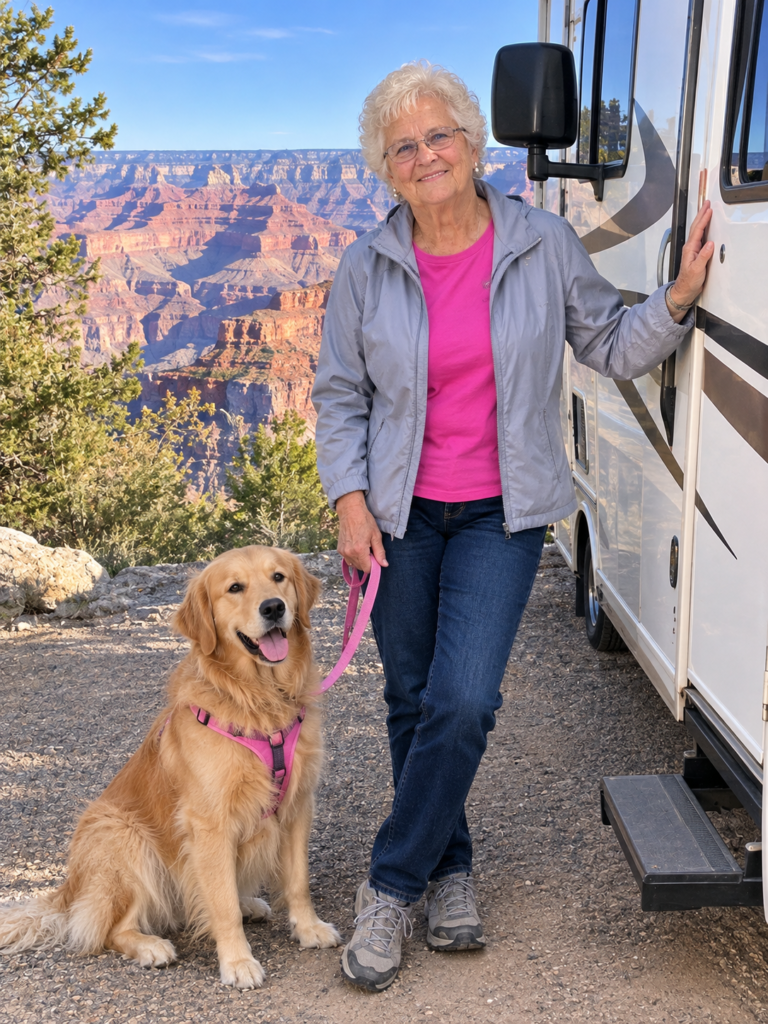
I’d sold my house, bought a small RV, and set off across the country with my dog, Rex.
My husband had died 10 years earlier.
Afterward, my children moved to different states, and our house became unbearably quiet.
Every morning followed the same pattern.
I’d make breakfast, do chores, call one of my children, walk Rex, and watch television until bedtime.
Retirement had given me freedom, but I wasn’t using it.
One morning, sitting alone at the kitchen table, I asked myself why I was living as though my life had already ended.
My husband and I had always dreamed of seeing the breathtaking canyons out west.
We’d talked about driving across the country, stopping wherever we pleased, and waking up somewhere new each morning.
But there had always been reasons to wait.
Then he was gone.
I decided I was finished waiting.
My children worried when I announced my plans.
“Mom, you’re selling the whole house?” my daughter asked.
“Yes.”
“To live in a vehicle?”
“To travel in one.”
I’d set aside money for emergencies and could settle somewhere later.
Eventually, they accepted that I was serious.
I packed two suitcases, loaded Rex into the passenger seat, and drove away.
For the first time in years, I felt excited about tomorrow.
Two weeks into my journey, I reached Arizona.
After finally seeing the breathtaking scenery we’d dreamed about, I stopped at a roadside diner for lunch.
I ordered pancakes and coffee and settled beside the window.
A few minutes later, an older man approached.
“Excuse me, ma’am. All the other tables are taken. Would you mind if I sat here?”
“Not at all.”
He introduced himself as Robert.
He was 70, with silver hair, kind eyes, and a wonderful laugh.
We began talking.
He asked about my RV, and I told him about selling my house.
“That’s quite a decision,” he said.
“Most people think I’ve lost my mind.”
“Maybe you’ve finally found it.”
I laughed.
Before I knew it, two hours had passed.
Robert told me he’d lost his wife many years earlier and raised their only daughter, Hannah, alone.
He lived in a nearby mountain town and enjoyed hiking and repairing old furniture.
There was something comforting about him.
When he asked whether I’d like to have dinner the following evening, I said yes.
One dinner became another.
We walked through parks, visited little shops, and spent afternoons talking over coffee.
Robert never complained when I needed to check on Rex or explore on my own.
I’d planned to leave the area after a few days, but I stayed several weeks.
Then Robert invited me to his house for dinner.
“I’d like you to meet Hannah,” he said.
“Does she know about me?”
“Of course.”
He smiled, though something in his expression changed.
“She’s just protective.”
I thought that was understandable.
But when we arrived, Hannah’s reaction surprised me.
She was in her late 30s, with dark hair and serious eyes.
The moment Robert introduced us, her smile vanished.
“Have we met?” she asked.
“I don’t believe so.”
Robert quickly touched her shoulder.
“Let’s get dinner on the table.”
Throughout the meal, Hannah barely spoke.
Whenever I mentioned my travels, she watched me strangely.
When I talked about working at a community center before retirement, she dropped her fork.
“Which community center?” she asked.
I told her the town where I’d worked years earlier.
Robert immediately changed the subject.
By dessert, I felt unwelcome.
I excused myself to use the bathroom.
That’s when I overheard their argument.
Now, standing in the hallway, I heard Hannah say something that made my breath catch.
“She was the only person who believed in me, Dad. And you made sure I never saw her again.”
Robert answered quietly.
“I know.”
“You humiliated her. She was trying to help us.”
I stepped into the kitchen.
“Help you with what?”
Both turned.
Robert’s face drained of color.
Hannah stood so quickly her chair scraped the floor.
I looked at Robert.
“Who do you think I am?”
He opened his mouth, but nothing came out.
Hannah answered instead.
“Did you ever work at a community center in a small Midwestern town?”
“Yes.”
“About 20 years ago?”
I nodded.
“I worked there for almost 15 years.”
She pressed a hand against her mouth.
“My name was Hannah then too. I attended an after-school program.”
I studied her face.
Something about her eyes seemed familiar.
Then she said, “You helped me apply for a scholarship.”
A memory stirred.
A quiet teenage girl sitting alone, filling the margins of her worksheets with drawings.
A girl who never raised her hand, even when she knew the answers.
“Hannah?” I whispered.
She nodded.
Then another memory returned.
A furious father standing in the community center lobby, accusing me of interfering with his daughter.
I remembered his raised voice and the humiliation of being confronted in front of my coworkers.
But I hadn’t remembered his name.
Robert was older, thinner, and missing the thick dark beard he’d worn then.
“That was you?”
He lowered his head.
“Yes.”
I pulled out a chair.
“You’d better explain.”
Twenty years earlier, I coordinated educational programs for teenagers.
Hannah was one of our quietest students.
She was bright, particularly in mathematics, but rarely volunteered for anything.
One afternoon, I found her staring at an application for a summer science program.
“Why haven’t you filled it out?” I asked.
“Because I won’t get in.”
“How do you know?”
She shrugged.
“Kids like me don’t get picked for things like that.”
I encouraged her to apply.
When she admitted she couldn’t afford the program, I showed her the scholarship information.
Over several weeks, we worked on her application.
She was accepted.
I remembered how she’d cried when she received the letter.
But I also remembered what happened afterward.
Her father arrived at the center, furious.
He accused me of making Hannah believe her family wasn’t good enough.
He said I was filling her head with dreams he couldn’t afford.
When I explained that the scholarship covered the program, he told me to stay away from his daughter.
Then he withdrew her from our activities.
I’d been upset for days.
Eventually, other responsibilities took over.
I never saw Hannah again.
Now she sat across from me, an adult woman with tears in her eyes.
“I tried to come back,” she said.
Robert closed his eyes.
“Dad wouldn’t let me.”
I looked at him.
“Why?”
He rubbed his hands together.
“After my wife died, I was terrified of failing Hannah. I worked constantly, but there was never enough money.”
“That doesn’t explain why you treated me that way.”
Robert took a breath.
“When she started talking about you, every conversation seemed to be about something you could do for her that I couldn’t.”
I stared at him.
“She needed help with an application.”
“I understand that now.”
“And you thought I was trying to replace you?”
He nodded.
“I was jealous.”
Hannah shook her head.
“Dad, I never wanted another parent. I wanted you to be proud of me.”
Robert looked down.
“I’m sorry.”
I thought about the weeks we’d spent together.
The conversations, the walks, the way he’d made me feel understood.
“You recognized me at the diner?”
“Not immediately. But when you mentioned your old job, I remembered.”
“And you said nothing.”
“I was ashamed.”
“Yet you kept asking me out.”
“I liked you. I thought if I told you, you’d leave.”
“You let me grow attached to you while hiding something you knew mattered.”
“I never meant to hurt you.”
“But you were willing to risk it.”
Hannah stood and said, “There’s something I want to show you.”
She disappeared down the hallway and returned with a small envelope.
Inside was a folded piece of paper.
She handed it to me.
The handwriting was mine.
“Hannah, you have a wonderful mind. Don’t let fear convince you that your dreams are too big. Keep learning, keep asking questions, and remember that you deserve the chance to try.”
I read the words twice.
“I wrote this?”
Hannah nodded.
“You gave it to me when I submitted my application.”
I remembered writing encouragement on students’ assignments, but not this particular note.
“I kept it after Dad made me leave.”
Her voice trembled.
“Whenever I thought I wasn’t smart enough, I read it.”
I looked at the worn folds.
She’d carried that paper for two decades.
“What happened after you left the center?” I asked.
“I went to the summer program.”
I turned toward Robert.
“You let her attend?”
He nodded.
“The scholarship was already arranged. I realized taking that away would be cruel.”
Hannah gave a sad smile.
“But he still wouldn’t let me contact you.”
She explained that the program changed everything.
She met teachers who encouraged her, made friends who shared her interests, and began imagining a future beyond her hometown.
Eventually, she earned a college scholarship.
Today, she taught mathematics at a public high school.
I stared at her.
“You’re a teacher?”
“Yes.”
“That’s wonderful.”
She laughed through her tears and said, “I wanted to tell you for years.”
For 10 years, I’d been telling myself that my most meaningful days were behind me.
I’d spent so much time thinking about what I’d lost that I’d forgotten how many lives had crossed mine.
Here was a woman whose future had been shaped by a few afternoons of encouragement.
Hannah reached for my hand.
“You once told me that being afraid didn’t mean I wasn’t capable.”
I smiled faintly.
“That sounds like something I would’ve said.”
“I tell my students the same thing.”
Robert remained silent.
After a while, Hannah turned toward him.
“There’s something else you need to tell her.”
He looked at his daughter.
“Hannah…”
“No. You’ve had weeks.”
Robert took a breath.
“After I confronted you at the center, the director called me.”
I remembered that conversation vaguely.
“She said I’d been unfair and asked me to reconsider because Hannah was doing well in your program.”
“And?”
“I refused.”
Hannah stared at him.
“You told me the center didn’t want me back.”
Robert nodded.
“You told your daughter we rejected her?” I asked.
“I didn’t want her asking to return.”
Hannah pulled her hand away.
For years, she’d believed the adults at the center had accepted her father’s decision and forgotten about her.
Now she knew someone had tried to bring her back.
“Why would you tell me that?” she whispered.
Robert’s voice broke.
“Because I was afraid you’d choose them over me.”
“You were my dad. I wasn’t choosing anyone over you.”
He covered his face and whispered, “I’m sorry.”
Hannah stood and walked to the window.
I felt angry enough to leave immediately.
But I understood that part of this conversation belonged to them.
I rose.
“I need some air.”
Robert started to stand.
“Please, let me explain.”
“You’ve explained plenty.”
I picked up my bag.
“Hannah, thank you for telling me the truth.”
She turned.
“Will I see you again?”
“I’d like that.”
Outside, the evening air was cool.
I drove back to the campground, where Rex greeted me enthusiastically. I sat beside him on the RV steps.
Robert had been kind to me, but he’d hidden a past he knew mattered.
Worse, he’d allowed his daughter to believe something untrue for years because he couldn’t bear the thought of her finding support elsewhere.
The next morning, Robert called.
He left a message apologizing and asking whether we could talk.
Instead of answering, I took Rex for a walk and thought about what I wanted.
I’d sold my house because I was tired of living according to everyone else’s expectations.
I wasn’t going to spend my new life protecting a man’s feelings at the expense of my own.
That afternoon, I called Hannah.
We met at a quiet café.
She apologized for her behavior at dinner.
“I recognized your name when Dad mentioned you,” she explained. “Then I saw you and knew. I was angry that he hadn’t told you.”
“You don’t need to apologize for wanting the truth.”
We talked for nearly three hours.
She told me about her students, her work, and the science program she’d attended.
I told her about my children, my husband, and the RV.
Before we parted, she handed me the old note.
“I want you to have this.”
“Keep it,” I said. “It belongs to you.”
She nodded.
“Then take a picture.”
I did.
That evening, I finally called Robert.
We met at the diner where we’d first spoken.
He looked tired.
“I owe you an apology,” he said.
“More than one.”
He nodded.
“I was wrong to confront you years ago. I was wrong to lie to Hannah. And I was wrong to hide everything when we met again.”
“Why didn’t you tell me sooner?”
“Because I liked the person you thought I was.”
I considered that.
“Robert, I liked that person too.”
He looked down.
“But now I know you made some cruel choices. I need time to decide what that means for us.”
“I understand.”
“And Hannah deserves more than an apology. You need to repair what you can with her.”
“I know.”
He didn’t ask me to stay.
Two days later, I prepared to continue my journey.
Hannah came to the campground to say goodbye. She brought a small notebook.
“For your travels,” she said. “I thought you might want to write down the places you see.”
Inside the cover, she’d written: “Keep going. Your story isn’t finished.”
I laughed softly.
“That sounds familiar.”
“I learned from a good teacher.”
We hugged.
As I climbed into the RV, she asked whether she could call me sometimes.
“I’d love that.”
Robert sent one final message wishing me a safe journey.
I replied with a simple thank-you.
I didn’t promise anything more.
Perhaps we’d speak again someday.
Perhaps we wouldn’t.
For now, I had places I still wanted to see.
That evening, Rex and I stopped beside a quiet stretch of desert.
I made coffee in my tiny kitchen and opened Hannah’s notebook.
For years, I’d measured my days by the people who were no longer beside me.
But meeting Hannah reminded me that some of the things we give others continue growing long after we’ve forgotten them.
I wrote about the breathtaking canyons, the diner, and the woman who’d carried my words for 20 years.
Then I turned to a fresh page.
Tomorrow, I would drive somewhere new.
And for the first time in a long while, I wasn’t wondering whether the best part of my life was over.
I was looking forward to finding out what came next.