“Emma, please tell me you’re not taking that thing to graduation.”
My daughter was standing in front of the hallway mirror, straightening a blue graduation cap on the head of a life-size cardboard cutout of a teenage boy.
She didn’t even turn around.
“His cap is crooked, Mom.”
“Emma. I’m serious.”
“So am I.”
She tugged the tassel to the left side. Then to the right. Then back to the left. She fluffed out the shoulders of the matching blue gown she’d draped over the cardboard and pinned in the back with safety pins. She stepped back and looked at the whole thing.
For a moment, she smiled.
Then she turned toward me, and her eyes were shining.
“Mom,” she whispered. “Promise me you won’t tell anyone. Please. Not before. Not during. Not after. I need to do this myself.”
I wanted to argue.
I wanted to tell her to leave the cutout at home. I wanted to tell her she’d get laughed at. I knew exactly how cruel eighteen-year-olds could be when somebody did something they didn’t understand. They’d film it. They’d post it. They’d make it into a joke that would follow her for years.
But I knew why she’d made that cardboard boy.
I was the only person in the world who knew why.
“I promise,” I said.
I had no idea how hard keeping that promise would be.
My name is Melinda Shaw. I’m forty-six years old. I work as a pharmacy technician at the Walgreens on Route 9.
I’ve been a single mother since my children were three. Their father, Greg, left when the doctors told us our son would need his second open-heart surgery. He said he couldn’t watch it again. He moved to Arizona. He sends a check every month and a birthday card most years, and he came to the funeral, and he cried in the back row and left before the cemetery.
So for most of their lives, it was just the three of us.
Me. Emma.
And Felix.
The cardboard cutout in my hallway was Felix.
Life-size. Five foot eleven. Grinning.
Emma had ordered it from a print shop downtown two months before graduation. I found out about it the way you find out about most things your teenagers do. By accident. I was emptying her jacket pockets before I put it in the wash, and I found a receipt.
Shapiro Print & Copy. 1 custom cutout, full-size, foam board backing. $89.00. Pickup: May 30.
Eighty-nine dollars. She’d paid for it out of her own money. From her job at the public library, shelving books three afternoons a week for eleven dollars an hour.
I didn’t say anything about the receipt. I put it on her dresser and waited.
That night, she came into the kitchen while I was making dinner and stood in the doorway for a long time.
“You found it,” she said.
“I found it.”
“Are you mad?”
I turned around and looked at her. She looked so much like him in that moment. Same dark eyebrows. Same way of chewing on her bottom lip when she was nervous.
“Tell me why,” I said.
And she did.
But I’m getting ahead of myself.
To understand why my daughter carried a cardboard boy into her high school graduation, you have to understand the boy.
Felix and Emma were born seven minutes apart on a snowy night in February.
Felix came first. He was smaller than his sister by almost a pound, and he was blue. Not a little blue. Really blue. The nurses whisked him away before I even got to see his face.
Emma came seven minutes later, pink and furious and screaming her head off.
They told me about Felix’s heart the next morning.
A congenital defect. A hole in one wall and a valve that didn’t form right and a word I couldn’t pronounce for the first year. Tetralogy of Fallot. He’d need surgery. Probably several surgeries. He’d need medication for the rest of his life. He’d need to be watched.
“Can he have a normal life?” I asked the cardiologist. Dr. Haskins. A gentle, gray-haired man with very cold hands.
He was quiet for a moment.
“He can have a good life,” he said carefully. “That’s what we’re going to aim for.”
I didn’t notice he hadn’t said normal.
Felix had his first surgery at four months old. His second at three years. That was the one that made Greg leave.
His third at eleven.
In between, there were a hundred appointments. A thousand pills. Echocardiograms and EKGs and blood draws. Long nights in the cardiac unit at Children’s, sleeping in the chair beside his bed while Emma slept at my mother’s.
And through all of it, I tried so hard to give both of them an ordinary childhood.
Birthday parties. Halloween costumes. Trips to the beach. Little League, for a while, until the coach got nervous.
Some of it worked. Some of it didn’t.
But the one thing that always worked, the one thing that was always normal, was the two of them.
They competed with each other from the day they could crawl.
Who could crawl to the dog faster. Who could climb the stairs first. Who could eat more pancakes. Who could stay up later. Who could hold their breath longer in the bathtub. That one I put a stop to quickly.
When they got older, it was who could run faster to the mailbox. Who could finish a book first. Who could get a better grade on their spelling test.
Felix usually lost the running races. His heart wouldn’t let him run very far. But he never once let that stop him from trying.
“I’m saving my energy,” he’d say, gasping, when Emma beat him to the mailbox for the hundredth time. “For the important races.”
“What important races?”
“I’ll let you know.”
Emma always won at running. Felix always won at math. They split the spelling tests about fifty-fifty. They argued about it constantly.
“I got ninety-eight,” Emma would announce at dinner.
“I got ninety-eight point five,” Felix would say.
“There’s no such thing as point five.”
“There is when you get extra credit.”
“Mom! He’s lying!”
“I’m not lying, Mom. Tell her about the extra credit.”
I always told them they were both brilliant. They both rolled their eyes.
There was one thing they argued about more than anything else.
Who would cross the graduation stage first.
They started arguing about it in eighth grade, at their middle school promotion ceremony. The school had them walk in alphabetical order. Shaw, Emma. Then Shaw, Felix. Emma went first.
Felix was outraged.
“I’m older,” he said in the car on the way home. “By seven minutes. I should go first.”
“It’s alphabetical,” Emma said. “E comes before F. Learn the alphabet.”
“Seven minutes, Emma. I was here first. I had to wait for you.”
“You were blue.”
“I was distinguished.”
They argued about it all through freshman year. It became a running joke. Every time anything came up about high school graduation, one of them would bring it up.
“High school’s going to be different,” Felix said. “I’m going to talk to the principal. Seven minutes. It’s a matter of principle.”
“Alphabetical,” Emma said. “You’re going to lose.”
I’d sit there and listen to them and smile.
Because neither of them would ever admit what was obvious to me.
They just wanted to walk together.
During sophomore year, Felix’s health got worse.
It started in October. He was tired all the time. Out of breath walking up the stairs. His lips had a bluish tint again, the way they did when he was a baby. Dr. Haskins ran tests. More tests. Then more.
His heart was failing. The old repairs weren’t holding. The valve was leaking. His heart was getting bigger and weaker, trying to do a job it couldn’t do anymore.
They put him in the hospital for two weeks in November. Then again for three weeks in January. Then for six weeks in March and April.
He missed weeks of school. Then months.
His teachers sent his assignments home. Every Friday, Emma would go from classroom to classroom after school, collecting worksheets and reading assignments and lab handouts. She’d bring them to the hospital in her backpack. Then the next Friday, she’d carry his finished work back.
Even when he was exhausted, even when he could barely hold a pencil, Felix insisted on keeping up.
“Felix,” I’d say. “Honey. You don’t have to do this. Your teachers understand. You can catch up later.”
“I can’t let Emma beat me at everything,” he’d joke, propped up on three pillows with an oxygen tube under his nose and a chemistry worksheet balanced on his knees.
Emma, sitting in the chair by the window doing her own homework, wouldn’t even look up.
“Too late,” she’d say.
He’d throw a pillow at her. She’d throw it back.
The nurses loved them. They called them the Shaw Show.
Felix drew cartoons in the margins of everything. That was his thing. Little stick figures doing ridiculous things. A stick figure being chased by a giant chemistry beaker. A stick figure fighting a math equation with a sword. A stick figure of his history teacher, Mr. Delgado, riding a horse into battle wearing a toga.
Mr. Delgado sent one of his worksheets back with a note at the top. Historically inaccurate. Napoleon would not have worn a toga. A+ for creativity though.
Felix laughed so hard he set off the alarm on his heart monitor. A nurse came running.
“Sorry,” he said, gasping. “Napoleon joke.”
One afternoon in April, after a hard appointment, after Dr. Haskins had sat down with us in his small office and used the words transplant list for the first time, Felix asked Emma to do something for him.
“Can you get me the graduation stuff? From the school office?”
“Graduation?” Emma said. “That’s two years away.”
“I know. I just want to see it.”
So the next day, Emma went to the main office and asked for the graduation packet. The one they give out to seniors. The secretary looked at her funny but gave it to her.
Emma brought it to the hospital that afternoon.
Felix spread the pages out across his blanket. The schedule. The rules. The cap and gown order form. The seating chart. The map of the gym.
He read every page. Slowly. Carefully. Like it was a treasure map.
“It says here,” he said, “that students line up in alphabetical order.”
“Ha,” Emma said. “Told you.”
“Hm.” He frowned at the page. “Think they’ll let me walk with a wheelchair? If I’m too tired?”
He said it lightly. But his voice was too careful. I was sitting in the corner, and I heard it.
“Obviously,” Emma said without missing a beat.
“And if they don’t?”
“Then I’ll push you across the stage myself.”
Felix grinned.
“Then make sure you don’t crash me into the principal.”
“No promises.”
I laughed with them. I remember laughing. It felt good to laugh in that room.
I couldn’t have imagined how desperately I’d someday wish that conversation had come true.
Felix kept that graduation packet on his bedside table for the rest of his time in the hospital. When he came home in May, he put it in his school folder. The green one, where he kept the assignments he was planning to finish. He told me once he’d read it so many times he had the seating chart memorized.
Felix died six months later.
On a Tuesday in October. In the cardiac ICU at Children’s.
He’d been on the transplant list for five months. A heart never came. His body just couldn’t wait anymore.
Emma was holding one of his hands. I was holding the other.
He was sixteen.
I’m not going to write much about that day. I can’t. Even now.
I’ll just say that Emma didn’t let go of his hand for a long time after. A nurse tried to gently pry her fingers off, and she said, “No. Not yet.” And the nurse let her stay.
And I’ll say that in the car on the way home, at two in the morning, Emma looked out the window and said, very quietly, “He went first.”
I looked over at her.
“He finally went first,” she said. “He beat me at something.”
And then she cried for the first time.
For weeks after the funeral, Emma barely spoke.
She went to school. She did her homework. She helped with the dishes and fed the cat and took out the trash without being asked. She was polite and quiet and very, very careful.
But she wasn’t there. Not really.
I’d come home from work and find her sitting on the floor of Felix’s bedroom. Just sitting. Surrounded by his things. His sneakers. His sketchbooks. His old basketball, the one he was terrible at but kept playing with anyway. His green school folder.
Sometimes she’d be reading through his notebooks. Turning the pages slowly. Looking at his little cartoons in the margins.
Sometimes she’d just be sitting there. Staring at the wall.
I tried not to rush her.
I was struggling with my own grief. Some nights I’d sit on the floor of his room too, after she went to bed. I’d hold his pillow and smell it. It smelled like his shampoo for about three months. Then it didn’t anymore. That was a terrible day.
What frightened me most was that Emma stopped talking about her future.
Before Felix got sick, she’d had big plans. She wanted to go to college somewhere far away. Boston, maybe. Or Chicago. She wanted to study education. She wanted to be a teacher. A fourth-grade teacher, she always said, because fourth graders were old enough to be interesting but young enough to still be nice.
She wanted to travel. She had a list taped to the inside of her closet door. Places I’m Going. Ireland. Japan. Peru. The Grand Canyon.
After Felix died, the list came down. I found it in the trash.
Whenever I mentioned college, she’d change the subject. Whenever I mentioned graduation, she’d get up and leave the room.
Her guidance counselor called me in the fall of her junior year. Mrs. Patterson. A kind woman with short gray hair and a cat calendar on her wall.
“Emma hasn’t signed up for the SAT,” she said. “She hasn’t looked at a single college. She told me she might just stay home and work for a while.” She paused. “Melinda, she has a 3.9. She could go anywhere.”
“I know,” I said. “I’m trying.”
“Is she okay?”
“No,” I said honestly. “But she’s getting there. I think.”
I assumed time would help.
That’s what everybody told me. Give it time. Time heals.
Then, in January of her senior year, Emma came home from school holding a folder.
She put her backpack down on the kitchen table and sat down across from me. I was going through bills.
“Mom,” she said. “Do you think the school would mention Felix at graduation?”
I looked up.
“Maybe,” I said. “Have you asked?”
She nodded.
“I emailed Principal William.”
She opened the folder and showed me. She’d printed out the email.
It was short and polite. She’d written it carefully. You could tell she’d rewritten it several times.
Dear Principal William,
My name is Emma Shaw. I’m a senior. My twin brother, Felix Shaw, was a student here until he died two years ago from a heart condition. He was supposed to graduate with our class this June.
I was wondering if it would be possible for the school to mention his name during the graduation ceremony. It doesn’t have to be long. Just a short acknowledgment of students who should have graduated with us but couldn’t. I know there were two other students in our class who passed away, too.
Thank you for considering this.
Sincerely,
Emma Shaw
Under it, she’d printed his reply.
Dear Emma,
Thank you for your email, and please accept my condolences on the loss of your brother.
Our graduation ceremony is reserved for recognizing the students who are receiving their diplomas. We have found that including memorials can shift the focus of the day and can be difficult for some families. I hope you understand.
Best regards,
Principal William
I read it twice.
“Oh, honey,” I said.
Emma shrugged. She was trying to look like she didn’t care.
“It’s fine,” she said. “I’ll think of something else.”
She thought of something else.
In February, she emailed him again. She asked if the school could include Felix’s photograph somewhere near the entrance of the gym. Just a small one. A framed picture on a table.
That request was declined too.
The school was putting together a display of all the current graduates. Senior photos on a big board by the doors. Principal William said he didn’t want to cause any confusion about who’d completed the graduation requirements.
In March, Emma asked one more time.
Could she carry a photograph of Felix while she walked across the stage to get her diploma? Just a small one. Just in her hand.
Principal William said no. He said the ceremony had to remain consistent for everyone. If he made an exception for her, he’d have to make exceptions for everybody.
“Did you explain to him why it matters?” I asked her. She was sitting at the kitchen table, reading his third reply.
“Three times, Mom,” she said. “I explained it three times.”
“Let me talk to him. I’ll set up a meeting. I’ll go in there with you.”
“No.”
“Emma—”
“No, Mom.” She looked up at me. Her eyes were fierce. “I can talk to him myself. I don’t need you to fix it.”
At the time, I thought she was just being stubborn. Proud. Eighteen.
I didn’t understand.
Not yet.
Then, in April, I found the receipt in her jacket pocket.
Shapiro Print & Copy. 1 custom cutout, full-size.
“Tell me why,” I’d said, standing at the stove.
So she told me.
“I’m not trying to make a scene,” she said. “I’m not trying to get attention. I just…” She stopped. “Mom, I just want him to be there. I want him to walk with me. That’s all I ever wanted.”
“I know, sweetheart.”
“They won’t say his name. They won’t put up his picture. They won’t let me carry a little one.” She looked down at her hands. “So I’m making a big one.”
I didn’t say anything for a long time.
Then I asked, “Where are you going to get a cap and gown for him?”
She almost smiled.
“I ordered two,” she said. “In January. When I ordered mine. I told the lady on the phone it was for my brother. She didn’t ask any questions.”
“How much was that?”
“Forty-six dollars.”
“Emma.”
“I’ve been saving my library money,” she said. “I wanted to do it myself. I don’t want you to pay for it. It has to be from me.”
I put down my spoon. I came around the table and hugged her. She let me.
“Promise me something,” she said into my shoulder. “Don’t tell anyone. Not Principal William. Not Grandma. Not anybody. I want to do this myself.”
On the night of May 30, she went downtown and picked up the cutout.
She carried it into the house wrapped in brown paper. She took it straight up to Felix’s room and closed the door.
I heard her crying in there for a long time.
When she finally came out, I asked if I could see it.
She opened the door.
He was standing by the window. Life-size. Grinning.
She’d chosen a photograph from the spring of sophomore year. One I’d taken myself. A sunny afternoon in May, right after he came home from the hospital. He was sitting on our back porch steps in his favorite gray hoodie. His hair was thinner than it had been. His cheeks were pale. You could see the tiredness under his eyes if you knew where to look.
But he was grinning. A huge, goofy, lopsided grin.
Because Emma, standing behind me, had just said something completely ridiculous. I don’t even remember what it was. Something about Napoleon.
I remembered that afternoon perfectly. I remembered him laughing so hard he started coughing.
I put my hand over my mouth.
“Is it okay?” Emma asked quietly. “Did I pick the right one?”
“You picked the right one,” I whispered.
Three nights before graduation, I woke up at around one in the morning and saw light coming from under Felix’s bedroom door.
I got up and opened it quietly.
Emma was sitting on the floor in the middle of the room. Surrounded by boxes. The boxes I’d packed up a year earlier, when I finally couldn’t stand to see his things just sitting there anymore. She’d pulled them all out of the closet and opened them.
His notebooks. His sketchbooks. His old report cards. His folders. Papers everywhere.
“Emma? What are you doing?”
She looked up, startled.
“I’m looking for something,” she said.
“At one in the morning?”
“I couldn’t sleep.”
“What are you looking for?”
She hesitated.
“Just something of his,” she said. “I’ll put everything back. I promise.”
I stood there for a moment. Then I nodded and went back to bed.
I didn’t think much about it.
I didn’t know what she was looking for.
Not until graduation.
Graduation day was a Saturday. The second Saturday of June. Hot and bright, with a blue sky and not a single cloud.
The ceremony was in the school gym at two o’clock. The air conditioning had broken the day before, so every door was propped open and big industrial fans were roaring in every corner.
We pulled into the parking lot at 1:15. Emma had insisted on getting there early.
She got out of the car. She opened the back door and very carefully pulled out the cutout.
Felix, in his blue cap and gown. She’d pinned the gown tight so it wouldn’t flap. She’d hot-glued the cap to the top of his head so it wouldn’t blow off.
She held him with one arm around his cardboard shoulders. Like you’d hold somebody’s arm walking into a party.
I watched her from the other side of the car.
She took a deep breath.
“Okay,” she said. “Let’s go.”
The moment we walked into that gym, people started staring.
It was full already. Parents and grandparents in the bleachers, fanning themselves with programs. Little brothers and sisters running around. Graduates in their blue caps and gowns, lining up along the back wall, laughing and taking selfies.
And then they saw Emma.
Walking across the gym floor in her blue cap and gown. Carrying a life-size cardboard boy in a matching blue cap and gown.
It got quiet near us. Then it got louder.
“Is that her cardboard boyfriend?” somebody laughed.
A group of girls near the back started giggling.
“Oh my God. That’s so creepy,” one of them said. She was tall and blonde with perfect curls. She pulled out her phone.
Several more students turned to look. A boy with a buzz cut nudged his friend and pointed. Somebody started recording.
“Who even is that?”
“Is she okay?”
“That’s literally the weirdest thing I’ve ever seen.”
Emma heard every word. I know she did. I was walking right behind her. I saw the back of her neck turn red.
But she didn’t stop. She didn’t turn around. She didn’t say anything.
She just reached up and straightened the cardboard boy’s graduation cap.
And kept walking.
Then Principal William spotted her.
He was standing near the stage in a dark suit and a blue tie, talking to two teachers. He was in his late fifties, tall and thin, with silver hair and rimless glasses. He’d been the principal at Westbrook High for eleven years. He was known for being strict but fair. He ran a tight ship. Parents liked him.
He saw Emma. He saw the cutout.
His face went tight.
He walked across the gym floor toward her. Fast. His shoes squeaked on the polished wood.
“Emma,” he said. “Absolutely not.”
People nearby turned to watch.
“This is a graduation ceremony,” he said, lowering his voice but not by much. “Not a joke.”
“It’s not a joke, sir,” Emma said.
“Then remove it. Right now. You’re embarrassing yourself, and you’re disrupting the ceremony for everybody else.”
Emma held onto Felix’s shoulders.
She shook her head.
“Please, sir,” she said quietly. “I just want him to walk across the stage with me.”
Principal William looked at the cutout. Something flickered across his face. Just for a second.
I don’t think he recognized it. I think he was too angry to really look.
“Put that thing away,” he said. “Or you won’t be walking across that stage at all.”
A few students laughed again.
The blonde girl with the phone said something to her friend, and they both giggled.
That did it.
I stood up. I’d already sat down in the front row of the bleachers, and I stood right back up. I was going to march down there and tell him everything. I was going to tell the whole gym. I was going to grab that microphone and say that’s my son, you ignorant people, that’s my son and he died, and she’s been asking you for six months.
I took one step forward.
And Emma turned around.
She looked right at me across the gym floor. And she gave me a tiny shake of her head.
Just one. Barely a movement at all.
No.
Our promise.
I stood there with my heart pounding and my hands shaking.
Then I sat back down.
It was one of the hardest things I’ve ever done in my life. Harder than some of the hospital days. Sitting there. Watching. Doing nothing.
I watched my daughter carry her brother to the side of the gym. I watched her carefully lean him against the wall beside the big double doors, under one of the roaring fans. I watched her straighten his cap one more time.
Then she walked to the back of the room and got in line with the other graduates.
Nobody stood next to her.
The ceremony started at two o’clock sharp.
The band played “Pomp and Circumstance.” The graduates walked in two by two and took their seats in the rows of folding chairs on the gym floor. Emma sat in the second row. Alone at the end.
There were speeches.
The valedictorian talked about following your dreams. The class president talked about the senior prank where they filled the principal’s office with balloons. The superintendent talked about the future.
I barely heard any of it.
My eyes kept drifting to the side of the gym. To the cutout leaning against the wall beside the doors. The fan was blowing on his gown, and every few seconds, the edge would flutter.
Felix. In his cap and gown. Grinning at nothing.
Two years earlier, I’d never imagined seeing that face on cardboard.
I’d imagined seeing it on a stage. In a real gown. With a real diploma in his hand. Crossing first, probably, because he’d have talked his way into it somehow.
They started calling names.
Alphabetical order, of course.
Adams, Caroline. Alvarez, Jonathan. Baker, Thomas.
One by one, students walked up the stairs onto the stage. Shook Principal William’s hand. Took their diplomas. Turned and smiled for the photographer. Walked off the other side while their families cheered and whooped in the bleachers.
Martinez, Sofia. Nguyen, David. Patel, Riya.
It took a long time. The fans roared. People fanned themselves with their programs.
Roberts, Katherine. Santos, Michael.
Then Principal William leaned into the microphone.
“Shaw. Emma.”
Emma stood up.
But she didn’t walk toward the stage.
She turned around and walked the other way. Toward the side of the gym. Toward the double doors.
People started whispering.
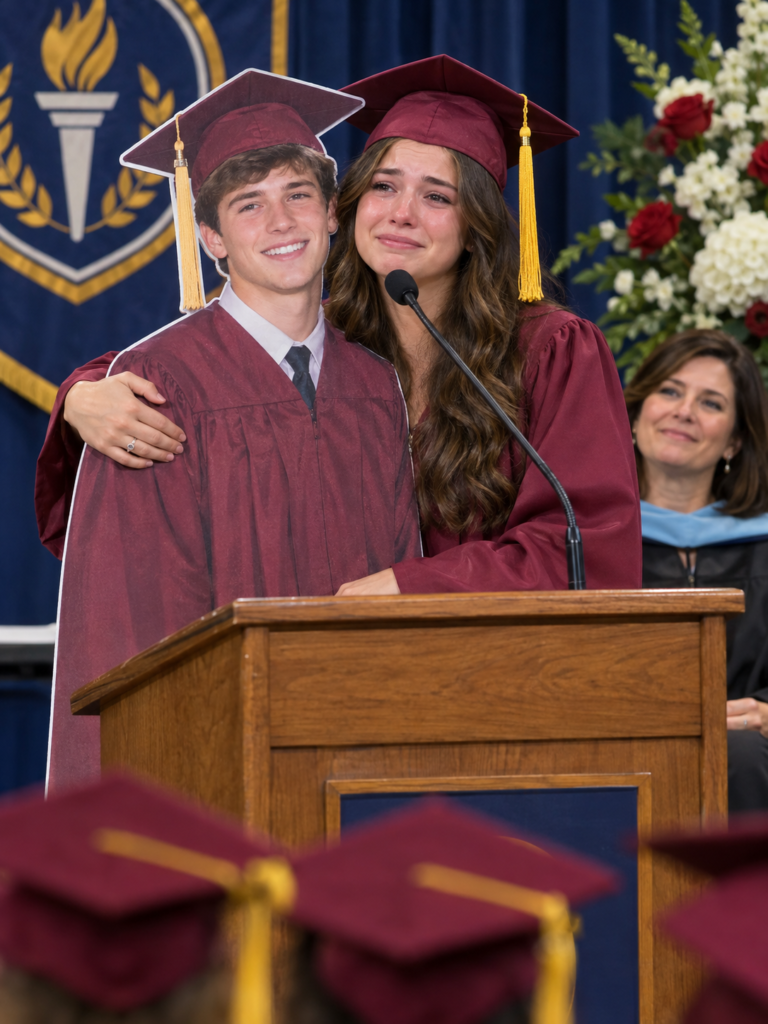
She reached the wall. She picked up the cutout. She put her arm around his cardboard shoulders again.
“Emma!” Principal William snapped into the microphone. His voice boomed through the whole gym. “I told you to leave that thing!”
Emma didn’t answer him.
She carried Felix across the gym floor. Right down the middle aisle between the rows of graduates. Everybody turned in their seats to watch.
She stopped beside a second microphone. A standing one near the bottom of the stage stairs, where the valedictorian had given her speech.
“Please, sir,” she said. Her voice came out through the speakers. A little shaky. “Just give me thirty seconds.”
Principal William came down the stairs toward her. He reached for the microphone.
But Emma spoke first.
“Before you laugh at him again,” she said, “there’s something I need to tell you about the boy in this picture.”
The gym went quiet.
Emma reached into the front of Felix’s cardboard gown. She’d tucked something in there. Inside the fold, behind a safety pin.
She pulled out a folded piece of paper.
She held it out to Principal William.
He stood there for a moment. Then he took it. He looked down at it, frowning, ready to be annoyed.
He glanced at the top of the page.
Then he looked up at the cardboard boy.
Then back at the page.
His expression changed.
I watched it happen from the front row of the bleachers. I watched all the anger slide off his face, like water off a window. I watched it go pale. I watched his mouth open a little.
“Where did you get this?” he said quietly.
Emma looked at him.
“It belonged to him,” she said.
Principal William looked at the paper again.
From where I was sitting, I could see it. A single sheet of paper. Cream-colored. With a blue letterhead at the top.
And handwriting. Neat, slanted, blue ink.
I recognized it.
I’d seen that handwriting before. Two years earlier. In a hospital room.
And suddenly, I understood.
Three nights earlier. Emma on the floor of Felix’s room at one in the morning. All the boxes pulled out of the closet.
I’m looking for something.
That’s what she’d been looking for.
“That’s a private letter,” Principal William said. His voice was low. But the microphone was right there, and it picked it up.
“It was written to him,” Emma said. “I think that makes it his.”
The gym was completely silent now. Even the little kids running around in the back had stopped. The only sound was the fans.
Principal William looked up. He looked across the gym, right at me in the front row.
“Melinda,” he said. “Did you know about this?”
I stood up.
But before I could say anything, Emma answered for me.
“Mom knew I was bringing him,” she said. “She didn’t know about the letter. Nobody did.”
“Emma.” Principal William lowered his voice. “Perhaps we should discuss this privately.”
“I tried discussing it privately,” Emma said. “In January. And February. And March.”
Principal William said nothing.
Emma turned and faced the microphone.
She faced the whole gym. The bleachers full of parents. The rows of graduates in their blue caps. The blonde girl with her phone still raised.
“His name was Felix,” she said.
Her voice shook.
“And he wasn’t my boyfriend.”
She paused. She looked down at the cutout. At his grinning cardboard face.
“He was my twin brother.”
A murmur spread through the gym.
It started near the front and rolled backward through the bleachers like a wave.
“Wait,” somebody said, out loud. A boy in the third row. “Felix? Felix Shaw?”
“Felix Shaw had a twin?”
“Oh my God. I forgot about Felix.”
Emma kept going.
“He was supposed to graduate with us today,” she said. “He was supposed to be sitting right there, in the second row. Next to me. But he died. Two years ago. In October. Sophomore year.”
The blonde girl with the phone slowly lowered it.
Emma rested one hand on Felix’s cardboard shoulder.
“Some of you remember him,” she said. “Some of you probably don’t. Some of you moved here after. But he went here. He sat in these classrooms. He sat in Mr. Delgado’s history class and drew cartoons of Napoleon in a toga. He did the same homework we did. Even when he was in the hospital, he did it. Every week. I carried it back and forth.”
Her voice cracked.
“He was part of this class.”
I stood there in the front row, staring at my son’s smiling face.
Somebody behind me in the bleachers had started to cry. I could hear it. Quiet, muffled.
I didn’t turn around.
“I didn’t want a special graduation for Felix,” Emma said into the microphone. “I need everybody to understand that. I know he didn’t finish school. I know he didn’t earn the credits. I know he can’t get a diploma. I’m not asking for that.”
Her voice trembled.
“I just wanted somebody to remember that he was supposed to be here.”
Principal William stood beside her, still holding the letter.
Emma turned and looked at him.
“And you did remember him,” she said. “Once.”
She held out her hand for the letter.
Principal William hesitated.
Then he gave it back to her.
Emma unfolded it carefully. The paper was soft and wrinkled from being folded and unfolded so many times. Felix had read it a lot.
“This letter,” she said, “was written to Felix during sophomore year. When he was in the hospital. For six weeks. In March and April. He kept it in his school folder. Right next to the assignments he was going to finish.”
She took a breath.
She began to read.
“Dear Felix,
Your teachers have told me how hard you’re working, despite everything you’re facing. Mr. Delgado tells me your history work is excellent. Ms. Rivera tells me you’re ahead of half the class in chemistry, from a hospital bed. I am not surprised.
Your determination and your dedication make you a valued member of our school community.”
She paused.
Her voice got very quiet.
“Whatever the future holds, I hope you will always remember that you have a place among your classmates.”
She looked up.
“It was signed,” she said, “by Principal William.”
Nobody laughed.
Nobody said anything at all.
Principal William stood there beside her in his dark suit and blue tie, and he stared down at the gym floor.
I remembered that letter.
It had come in the mail at the hospital in early April. Addressed to Felix Shaw, Room 418, Cardiac Unit, Children’s Hospital. Cream-colored envelope with the school’s blue logo in the corner.
Felix had opened it in bed with the oxygen tube under his nose. He’d read it. Then read it again. Then he’d held it up and waved it at me.
“See, Mom?” he’d said. His face was lit up. “See? The principal knows I’m still part of the class.”
He’d made Emma read it. He’d made the nurses read it. He’d made Dr. Haskins read it.
Then he’d tucked it into his green school folder. Right beside his chemistry worksheet. Right beside the graduation packet.
“For later,” he said.
After he died, I’d packed that folder away in a box in his closet. With everything else. I hadn’t been able to look at it.
I hadn’t known Emma had found it.
Until now.
“Mr. William,” Emma said. She turned to face him. “You told my brother he would always have a place here.”
Principal William raised his eyes from the floor.
“I remember writing it,” he said quietly.
“Then why,” Emma said, “was it so hard to let me remember him today?”
He didn’t answer.
“I asked for his name to be mentioned,” Emma said. “Just his name. You said no. I asked about a photograph by the door. You said no. I asked if I could carry a little picture of him in my hand. You said no.”
Her voice steadied. She wasn’t shaking anymore.
“Every time I asked,” she said, “I was told no.”
Principal William pressed one hand to his forehead.
“Emma,” he said. “I was trying to keep the ceremony fair. For everyone.”
“Fair to whom?” Emma asked.
The question hung in the air.
It just hung there, in that hot gym, with the fans roaring and three hundred people holding their breath.
Fair to whom?
“I’m not asking you to pretend Felix graduated,” Emma said. “I’m asking you to remember that he was here.”
In the bleachers around me, I saw several parents wiping their eyes. An old man two rows up had taken off his glasses and was pressing a handkerchief to his face. A mother near the end of my row had her arm around her son, a graduate’s little brother, holding him close.
But Emma wasn’t finished.
“There’s something else I need to explain,” she said.
She turned toward the cutout. Toward Felix.
“My brother hated it when people felt sorry for him,” she said.
She smiled faintly.
“He got so annoyed. When we’d go to restaurants, and the waiter would ask me what he wanted to eat. Like being sick meant he couldn’t answer questions. He’d always say, I can talk, you know. My heart’s broken, not my mouth.”
A few students laughed. Softly. Surprised.
“He wanted people to remember that he was funny,” Emma said. “That he loved school. That he drew cartoons on every single worksheet. That he was terrible at basketball but played anyway, every lunch period, until he couldn’t anymore.”
A boy in the second row nodded. He was nodding hard.
Emma’s smile faded.
“Before he died,” she said, “he asked me not to put his picture somewhere just to make people feel sorry for him.”
I remembered that conversation.
It was August. Two months before the end. He was home from the hospital for a little while, between stays. He was in his bed. It had been an exhausting afternoon. Two appointments and a blood draw and a long car ride.
Emma was sitting cross-legged on the end of his bed, helping him with a summer reading assignment.
Suddenly, out of nowhere, he looked up from his book.
“Em,” he said. “What are you going to do if I don’t make it to graduation?”
Emma’s whole body went stiff.
“Stop talking like that,” she said.
“I’m serious.”
“Felix, stop. You’re going to make it. You’re on the list. They’re going to find you a heart.”
“Maybe,” he said. “Maybe not. I just want you to promise me something.”
She didn’t say anything. She was staring at the book in her lap.
“Just don’t turn me into some sad picture that everybody stares at,” Felix said. “Like at the funeral home. Like those pictures they put on easels by the front door, and everybody walks past and goes oh, so sad.” He shook his head. “I don’t want to be that. Make sure they remember I was actually part of the class. Not some kid who died. Part of the class.”
Emma had looked up at him for a long time.
“Okay,” she’d said. “I promise.”
I’d been standing in the hallway outside his door with a laundry basket. I’d heard every word. I’d gone downstairs and sat on the basement steps and cried.
I hadn’t understood how heavily that promise weighed on her. Until now.
“I thought about what he said for a long time,” Emma said into the microphone. “A really long time. Like two years.”
She glanced at the cutout.
“And I know this looks ridiculous,” she said. “I know it does. Believe me. I know how it looks.”
She almost smiled again.
“Honestly? Felix would’ve probably made fun of it himself. He would’ve said, Seriously, Em? Cardboard? I’m way better looking than that.”
A gentle laugh passed through the gym. Real laughter, this time. Not mean.
“But when the school wouldn’t let me include even a little picture,” Emma said, “I didn’t know what else to do.”
She reached over and straightened his gown.
“So I made him big enough,” she said, “that nobody could overlook him.”
I put my hand over my mouth.
I couldn’t stop it. I was crying so hard my shoulders were shaking. The woman beside me, someone I didn’t even know, put her hand on my back.
Emma looked up into the bleachers. Right at me.
“Mom,” she said into the microphone, “I’m sorry I didn’t tell you about the letter.”
I shook my head. Hard. I couldn’t speak. I just shook my head.
Don’t be sorry. Don’t ever be sorry.
She turned back to Principal William.
“I wasn’t planning a speech,” she said. “I swear I wasn’t. I hoped you’d let me carry him across the stage. That’s all. Just walk across with him and get my diploma. That’s all I wanted.”
“Then why did you bring the letter?” he asked quietly.
Emma swallowed.
“Because I wanted to be ready,” she said. “In case you stopped me again.”
She looked down at the letter in her hand.
“And because I needed to know,” she said, “whether your promise still meant anything.”
For a long moment, nobody moved.
Not Emma. Not Principal William. Not the three hundred people in the bleachers. Not the graduates in their folding chairs.
The fans roared.
Then Principal William stepped up to the microphone.
He stood there for a while. He took off his glasses and folded them and put them in his jacket pocket. He looked at the cutout. At Felix’s grinning face.
Then he spoke.
“Emma,” he said. “I owe you an apology.”
His voice carried through the whole gym. Every word.
“I remember Felix,” he said. “I remember him very clearly. I remember his teachers coming to me, one after another, telling me about the boy in the hospital who was keeping up with all his work. Who was drawing Napoleon in a toga.” He almost smiled. “I remember Mr. Delgado showing me that drawing. We had it on the bulletin board in the teachers’ lounge for a month.”
He looked down at the floor.
“And I remember writing that letter. I remember sitting at my desk and writing it by hand, because it felt too important to type.”
He was quiet for a moment.
“When you contacted me about graduation,” he said, “I treated your requests like scheduling problems. Like logistics. I was worried about precedent. About consistency. About doing things the way they’ve always been done.” He shook his head slowly. “I didn’t think about what I’d promised your brother. I didn’t even remember it. Not once.”
Emma listened. She didn’t say anything.
“I was wrong to dismiss you,” Principal William said. “Three times. And I was especially wrong to embarrass you today. In front of everyone. In front of your mother.”
He took a deep breath.
“I’m sorry,” he said. “I am truly sorry.”
Emma looked down at Felix’s photograph.
Her chin was trembling. She pressed her lips together hard.
Principal William stepped back from the microphone. He stepped aside. Out of the way. He gestured toward the stage stairs.
“If you’d still like to walk across the stage with your brother,” he said quietly, “you may.”
For a moment, Emma couldn’t move.
She just stood there, holding the letter, with one hand on the cardboard shoulder. I could see her trying to breathe.
Then she nodded.
“Thank you,” she whispered.
She tucked the letter carefully back inside Felix’s gown. She reached up and straightened his cap. One more time.
Then she lifted him. Put her arm around his shoulders.
And she started walking toward the stairs.
As she reached the bottom step, a boy in the second row stood up.
I vaguely recognized him. Tall, lanky, with red hair and a sunburned nose. It took me a second. Then I remembered.
Owen Bradley. He’d been Felix’s lab partner in freshman biology. He’d played basketball with him at lunch. He’d come to the hospital twice, sophomore year, and brought a bag of Sour Patch Kids and a stack of comic books.
He’d been at the funeral. He’d been one of the pallbearers.
Owen stood up in the second row and started clapping.
Slowly. By himself.
Then the girl next to him stood up. Then the boy behind him.
Then another. And another.
Soon, most of the graduating class was standing.
It wasn’t coordinated. Nobody planned it. Some of them clapped right away. Others stood up slowly, looking around, not sure what they were supposed to do, and then started clapping too.
Then the bleachers started. Parents. Grandparents. Little brothers and sisters. People standing up and clapping who’d never met Felix in their lives.
The blonde girl with the phone was standing. She wasn’t recording anymore. She was clapping, and her face was wet.
But nobody laughed.
Not one person.
Emma climbed the stairs. Slowly. Carefully. Holding Felix so he wouldn’t bump against the railing.
She walked across the stage.
Principal William had gone back up the other stairs and was waiting in the center, at the little table with the stacks of diplomas. He waited until she reached him.
He picked up her diploma. He held it out to her.
“Congratulations, Emma,” he said.
She took it with one hand.
With the other hand, she held her brother steady.
I pulled out my phone.
My hands were shaking so badly I almost dropped it. I could barely see the screen through the tears.
But I held it up. And I took the picture.
The picture I’d imagined taking for eighteen years.
My daughter, standing on the stage in her blue cap and gown, holding her diploma.
And beside her, smiling his big, goofy, lopsided grin, her twin brother.
It wasn’t the picture we’d planned.
In the picture we’d planned, he was real. He was healthy. He was shoving her out of the way so he could go first. He was holding his own diploma and arguing about whether he’d gotten a 98.5.
But it was theirs.
And it was beautiful.
The rest of the ceremony went by in a blur.
Simmons, Rachel. Taylor, Andrew. Wilson, Grace.
Emma sat back down in the second row. She leaned Felix against the empty folding chair beside her.
Nobody moved him.
When the last name was called and the class stood to turn their tassels, Emma reached over and turned Felix’s tassel too. From right to left.
When they threw their caps into the air, she didn’t throw hers. She held onto it. She just sat there in her chair, holding her cap in her lap and her other hand on the cardboard shoulder, while blue caps rained down all around them.
After the ceremony, I found her near the gym doors.
She’d leaned Felix against the wall again, in the same spot as before, under the fan.
And there was a line.
Kids from her class. Coming up to her one at a time.
Owen Bradley was first. He hugged her for a long time. He didn’t say anything. Then he turned to the cutout and put his hand on its shoulder.
“Hey, buddy,” he said quietly. “We made it.”
Then he walked away fast so nobody would see his face.
A boy with glasses came up next. Then a girl with braids. Then a whole group from the drama club.
Several of them apologized for laughing.
The blonde girl with the phone came up near the end. Her name was Madison. She stood in front of Emma with her arms crossed tight over her chest.
“I’m so sorry,” she said. “I didn’t know. I moved here junior year. I never met him. I thought it was some kind of joke. A prank or something.” Her voice cracked. “I deleted the video. I swear. I deleted it before you even finished talking.”
Emma looked at her for a long moment.
“It’s okay,” she said quietly.
“It’s not okay.”
“No,” Emma agreed. “But thank you for saying sorry.”
Madison nodded. Then, after a second, she reached out and touched the edge of Felix’s gown.
“He looks nice,” she said. “He has a nice smile.”
“He did,” Emma said.
Principal William waited until the line was gone.
He’d been standing by the stage for a long time, talking to parents. Shaking hands. But I’d seen him glancing over at us.
When the last of Emma’s classmates left, he walked across the gym toward us.
He stopped in front of me.
“Melinda,” he said. “I’m deeply sorry about today. About all of it.”
I looked at him.
I wanted to be angry. I’d been angry for six months. Ever since Emma showed me that first email.
But he looked so tired. He looked like a man who’d just realized something terrible about himself.
“I nearly broke my promise to Emma,” I said. “When you threatened to stop her from graduating. I was halfway out of my seat.”
He gave a small nod.
“I saw you,” he said.
“Felix loved this school,” I said. “Do you know that? Even when he couldn’t come. Even from the hospital. He asked about his teachers every single day. He asked about his classmates. He asked who was dating who and what Mr. Delgado wore to school that day.”
Principal William looked down.
“I should have remembered that,” he said quietly.
He cleared his throat.
“I’d like to talk with the staff,” he said, “about a permanent remembrance. Something here, at the school. For Felix. And for the other students we’ve lost over the years. Something that stays.”
Emma had been listening from the wall beside Felix. She stepped forward.
She studied him for a long moment.
“Please don’t do it,” she said, “just because everybody heard what happened today. Please don’t do it because it looks bad.”
Principal William shook his head.
“I won’t,” he said. “I promise you I won’t. And I’d like you and your mother to help decide what’s appropriate. What he would have wanted. You knew him. I didn’t. Not really.”
Emma nodded slowly.
“Felix would’ve liked that,” she said.
Then she added, very quietly, “I just wish you’d listened before today.”
Principal William didn’t argue with her.
He didn’t make an excuse. He didn’t explain. He just looked at her.
“So do I,” he said.
We drove home with Felix in the back seat, buckled in with the seatbelt. Emma insisted.
“He’s not riding in the trunk,” she said. “Not today.”
At a red light on Main Street, a man in the car next to us looked over and saw a cardboard boy in a cap and gown buckled into our back seat. He stared. Then he slowly gave us a thumbs-up.
Emma laughed so hard she cried.
That evening, Emma’s phone wouldn’t stop buzzing.
Messages from classmates. Dozens of them. People she barely knew. People who’d sat next to Felix in seventh-grade English or played pickup basketball with him or had him as a lab partner.
They were sharing memories.
I remember he used to draw cartoons in the margins of every worksheet. One time he drew Ms. Rivera as a superhero and she put it on her wall.
Felix helped me with algebra in 8th grade. I was failing. He stayed after school with me for like two weeks. I never thanked him.
He was SO bad at basketball lol. But he never stopped playing. He’d miss every shot and laugh about it. Every single shot.
He gave me his last Sour Patch Kid once. I know that sounds stupid. But it was the blue one. Everybody knows the blue ones are the best.
I sat behind him in 9th grade history. He used to pass me notes with drawings of Mr. Delgado as Napoleon. I still have one. Do you want it?
Emma showed me every single message. She’d come running into the kitchen, holding out her phone. “Mom. Mom. Look at this one.”
She read them out loud. Some of them made her cry. Some of them made her laugh.
For the first time in two years, talking about Felix made her smile more than it made her cry.
Later that night, I went upstairs to check on her.
Her bedroom door was open a crack. I pushed it open.
She was sitting on the floor beside the cutout. Felix was leaning against her dresser. She’d taken off his cap and set it on the carpet beside her own. Two blue caps, side by side. Her diploma was lying across her knees.
“Are you okay?” I asked.
She nodded.
Then she shook her head.
“I don’t know,” she said.
I sat down on the floor next to her. My knees cracked. I leaned my back against her bed.
“Did today turn out the way you hoped?” I asked.
She thought about it.
“Mostly,” she said.
She touched her diploma with her fingertips. Ran her thumb along the edge of the leather cover.
“I thought,” she said slowly, “that walking across that stage without Felix would mean leaving him behind. Like, if I graduated, I was moving on. Going somewhere he couldn’t go. Leaving him in high school forever.”
I waited.
“But when I got my diploma,” she said, “I was happy, Mom. Really happy. Standing up there. I was so happy.”
“Of course you were, sweetheart.”
She looked down. She looked ashamed.
“And then I felt guilty,” she whispered. “Because how can I be happy? When he’s not here? How is that fair?”
I took her hand.
“Do you remember,” I asked, “what Felix told you? That night in August? When you two were talking about graduation?”
She stared at me.
“You heard that?”
“I was in the hallway. With the laundry.”
She looked away. Her eyes were filling up.
“Not the part about the sad picture,” I said gently. “The other part. The part after.”
I remembered every word.
He’d been quiet for a moment after she promised. Then he’d reached over and poked her in the shoulder with his finger, the way he always did when he wanted her attention.
“And promise me something else, Em,” he’d said. “If I don’t get to do all the things we planned, don’t spend your whole life feeling bad because you still can. Okay? That’d be so annoying. I’d haunt you.”
Emma closed her eyes now. Tears ran down her cheeks.
“He made me promise,” she whispered.
“I know.”
“I’ve been trying so hard to remember him,” she said. “I’ve been trying so hard to keep my promise. The first one. About not being a sad picture.” She wiped her face with the back of her hand. “I forgot about the second part. I forgot all about it.”
“You can miss him,” I said, “and still have a wonderful life. Both. At the same time. That’s allowed.”
She leaned her head against my shoulder.
She looked over at the cutout. At Felix’s grin.
“I wish he’d been there for real,” she said.
“Me too, sweetheart,” I said. “Me too. Every single day.”
We sat there quietly for a long time.
The house was so quiet. I could hear the crickets outside her window. The refrigerator humming downstairs.
Then Emma picked up her diploma and looked at it. Really looked at it. Opened the cover. Read her own name printed inside.
Emma Grace Shaw.
“Mom?” she said.
“Yeah?”
“Do you think Felix would’ve been proud of me?”
I looked over at my son’s smiling face. At the bluish tint in his lips that the photograph had caught, if you knew where to look. At the tired eyes. At the huge, goofy grin.
“He would’ve bragged about you to everyone,” I said. “Every single person. He would’ve stood up on his chair in the second row and screamed your name.”
Emma laughed. A real laugh.
“He would’ve said he could’ve gotten better grades,” she said.
“Absolutely,” I said. “Ninety-eight point five.”
“There’s no such thing as point five!”
“There is with extra credit.”
She laughed again. Then she leaned against my shoulder, and I put my arm around her, and we sat there on her bedroom floor with her twin brother leaning against the dresser, watching over us.
Then, after a while, she said something that made my heart stop.
“Mom? Do you think it’s too late to apply anywhere?”
I turned and looked at her.
“For college?”
She shrugged. Very casually. Like it was nothing.
“Mrs. Patterson said there are some places that still take applications in the summer. For spring semester. And there’s the community college. I could start there. Do two years. Then transfer.”
“You want to go to college?”
“I always wanted to go to college,” she said quietly. “I just stopped letting myself want it.”
She reached over and picked up Felix’s graduation cap. She turned it over in her hands.
“I want to be a teacher,” she said. “Fourth grade. Like I always said.”
“Fourth graders are old enough to be interesting,” I said, “but young enough to still be nice.”
She smiled.
“Exactly.”
She talked for an hour after that.
About classes she wanted to take. Child development. Children’s literature. Art. She wanted to take an art class. Felix would have wanted her to take an art class.
About places she still wanted to visit.
“Ireland,” she said. “Japan. Peru. The Grand Canyon.”
“You threw that list away,” I said. “In the trash.”
She looked at me, startled.
“You saw that?”
“I took it out,” I said. “I flattened it. It’s in my nightstand.”
She stared at me. Then she started to cry again. But she was smiling while she cried.
“Can I have it back?” she asked.
“It was always yours, baby.”
I listened to her talk until almost midnight.
For two years, I’d been so afraid.
Afraid that moving forward meant losing what was left of Felix. That every step Emma took away from that hospital room would be a step away from her brother. That if she graduated and went to college and traveled and fell in love and became a teacher, she’d leave him behind. That he’d fade.
I’d been afraid of it for myself too. Every time I laughed at something on TV. Every time I had a good day at work. Every time I didn’t think about him for an hour. I’d feel the guilt come crashing in.
But sitting there on Emma’s bedroom floor that night, watching her imagine her future with her brother’s photograph propped up beside her, I finally understood.
Felix had never needed his sister to stop living for him.
He’d wanted her to keep going.
He’d told her so. Don’t spend your whole life feeling bad because you still can. I’d haunt you.
And somehow, in that hot gym, with three hundred people watching and a cardboard boy under her arm, she’d found a way to take him with her.
Without leaving herself behind.
In August, Principal William called me.
He’d met with the staff. They’d talked about it all summer. They had an idea, and they wanted to know what Emma and I thought.
We went to the school on a Tuesday afternoon. The halls were empty. The floors were freshly waxed and smelled like lemon.
He took us to the main hallway, near the front entrance. The one every student walks through every single morning.
On the wall, there was a new bulletin board. Big. Framed in dark wood.
At the top, in blue letters, it said:
ALWAYS A PLACE AMONG YOUR CLASSMATES.
The board was empty.
“We’d like it to be a place for memories,” Principal William said. “Not a sad place. Not a memorial wall with dates and black ribbons. A place for the students we’ve lost. To show who they were. What they made. What they loved. And it’ll change. Every year, the students can add to it.”
Emma stood in front of the empty board for a long time.
“Can it have cartoons?” she asked.
Principal William smiled.
“It should definitely have cartoons,” he said.
The next week, Emma brought in a box.
Felix’s sketches. His worksheets with the margins full of stick figures. The chemistry beaker chasing a stick figure across the page. The math equation with a sword. Mr. Delgado riding a horse in a toga. And Madison’s contribution, which she’d mailed to us after the graduation: a folded-up note from ninth grade with a drawing of Mr. Delgado as Napoleon.
Mr. Delgado came in on his day off to help her pin them up. He stood in front of the toga drawing and laughed so hard he had to wipe his eyes.
“Historically inaccurate,” he said. “Still an A-plus.”
In the very center of the board, Emma pinned the letter. The cream-colored one, with the blue letterhead. Signed by Principal William.
She’d put it in a clear plastic sleeve so it wouldn’t get damaged.
Whatever the future holds, I hope you will always remember that you have a place among your classmates.
Emma started at the community college in September.
She takes three classes. Child Development. Introduction to Education. And Drawing I, on Tuesday and Thursday nights.
She’s terrible at drawing. She’ll be the first to tell you. Her stick figures look like pretzels.
But she keeps going.
“Felix was terrible at basketball,” she says. “He kept playing.”
The cardboard cutout lives in Felix’s room now.
Standing by the window. Wearing his blue cap and gown. The tassel turned to the left.
Some mornings, I go in there and open the curtains so the sun hits his face.
Some mornings, I don’t. And that’s okay too.
The photograph I took that day is framed on the mantel in our living room. Right in the middle.
Emma on the stage. In her blue cap and gown. Holding her diploma in one hand.
And beside her, holding onto her arm, her big brother. Seven minutes older. Grinning like he’d just won something.
People who come to our house always stop and look at it.
Sometimes they ask about it. Sometimes they don’t.
When they do, Emma tells them.
She doesn’t tell them about the hospital, or the heart, or the waiting list, or that Tuesday in October.
She tells them he was funny. That he loved school. That he drew Napoleon in a toga and was terrible at basketball and gave away the last blue Sour Patch Kid.
She tells them he was part of the class.
And then she tells them that in the end, after all those years of arguing, they finally got to walk across the stage together.
“He went first, technically,” she always adds. “Seven minutes. He’d want you to know.”