The Afternoon I Came Home Early
I can still remember that day as clearly as if it happened yesterday.
It was a Tuesday in late April. I worked as a maintenance technician at the water treatment plant on the east side of town, and they sent us home at two o’clock because a pump failed and the whole east building lost power. I remember being happy about it. I thought I’d surprise everybody. Pick up the little ones from daycare early. Maybe take the kids for ice cream.
I pulled into the driveway at two-twenty. Brenda’s minivan was there. So was something else. A silver Lexus I knew very well, parked on the street, right in front of our mailbox.
Craig’s car. From next door.
I didn’t think anything of it. I swear I didn’t. Craig was over at our house all the time.
The front door was unlocked. The house was quiet. Too quiet for a house with seven children in it, but most of them were at school, and the baby was at daycare, and Brenda had said she’d be doing laundry.
I set my lunch box on the kitchen counter. I heard a laugh upstairs. Brenda’s laugh. The light, high one she used to use with me, back when we were dating.
I went up the stairs. The bedroom door was half open.
And I walked in on my wife, Brenda, with our neighbor Craig, in our bedroom. In our bed. Under the quilt my mother made us for our tenth anniversary.
It felt as though the floor had disappeared beneath my feet.
Craig grabbed for his shirt. He went red all the way down his neck. He couldn’t look at me.
Brenda didn’t grab for anything. She sat up, pulled the sheet around herself, and looked straight at me. Then she got up, wrapped my bathrobe around her, and put her hands on her hips.
“Well,” she said. “What did you expect, Dan?”
I couldn’t speak. I just stood there in the doorway in my work clothes with my keys still in my hand.
“You never gave me the kind of life I deserve,” she said. “Never. Not once in sixteen years. Craig gives me everything I want. We even went to Cabo last month.”
Cabo. Last month.
She told me she went to her sister’s in Phoenix for five days. She asked me to take the week off work to watch the kids. I did. I burned my vacation days making pancakes and driving carpools and sitting up at night with Maisie, who had an ear infection.
Brenda was in Cabo. With Craig.
Craig Whitmore wasn’t just the man who lived next door. He was my best friend. We’d coached Little League together for six years. He was godfather to my son Noah. When my dad died, Craig drove me to the funeral home because I couldn’t see straight enough to drive.
He had a big house with a pool, a car dealership on Route 9, and no kids. He used to say he envied me. “You’ve got the real treasure, Danny,” he’d say, standing at the grill with a beer. “All these kids. That’s real wealth.”
I guess he decided he wanted some of mine.
My voice shook when I finally found it.
“Brenda,” I said. “For God’s sake. How could you do this to our family? We have seven children. Maisie just turned two.”
Brenda didn’t even hesitate.
She pulled her suitcase out of the closet. The big blue one we used for the trip to the Outer Banks, the one time we ever took all the kids to the beach. She started throwing her clothes into it. Shirts, jeans, shoes, the jewelry box from her dresser.
“You’ll manage just fine on your own,” she said, without looking at me. “You always do. Mr. Responsible.”
“Brenda, the kids…”
“I need to create a life for myself, Dan.” She zipped the suitcase. “I’ve spent sixteen years wiping noses and making sandwiches. I’m thirty-eight. If I don’t go now, I never will. The kids would only hold me back.”
She said it like she was talking about a bad haircut. Like the kids were a mistake she’d finally decided to fix.
Craig had his shirt on by then. He came around the bed and stood behind her. He still wouldn’t look at me.
“Dan,” he said quietly, to the floor. “I’m sorry, man. It just happened.”
“It didn’t just happen,” I said. “You went to Cabo.”
He didn’t say anything else.
Brenda picked up her suitcase. She walked right past me in the doorway. She brushed my shoulder with hers. She went down the stairs and out the front door and across the lawn to the silver Lexus.
Craig followed her. He got in the driver’s side.
And they vanished. Without another word. Down our street, around the corner, gone.
I stood in my bedroom doorway, alone, holding my keys. On the floor by the bed, there was one of Maisie’s pink socks. Brenda had stepped right over it on her way out.
Chapter Two: The First Nights
Can you imagine seven young children waking up in the middle of the night, crying and asking where their mother is?
I didn’t have to imagine it. I lived it.
That first night, I told them Mom was visiting Aunt Sharon. I didn’t know what else to say. I didn’t even know what was true yet. Brenda wasn’t answering her phone. Craig’s house next door was dark.
Jacob, my oldest, was fourteen. He looked at me across the dinner table that night, at the frozen pizza I’d burned on one side, and he knew. I watched him know. He didn’t say anything in front of the others. He just got up and started cutting the pizza into slices for the little ones.
Here’s who we were back then.
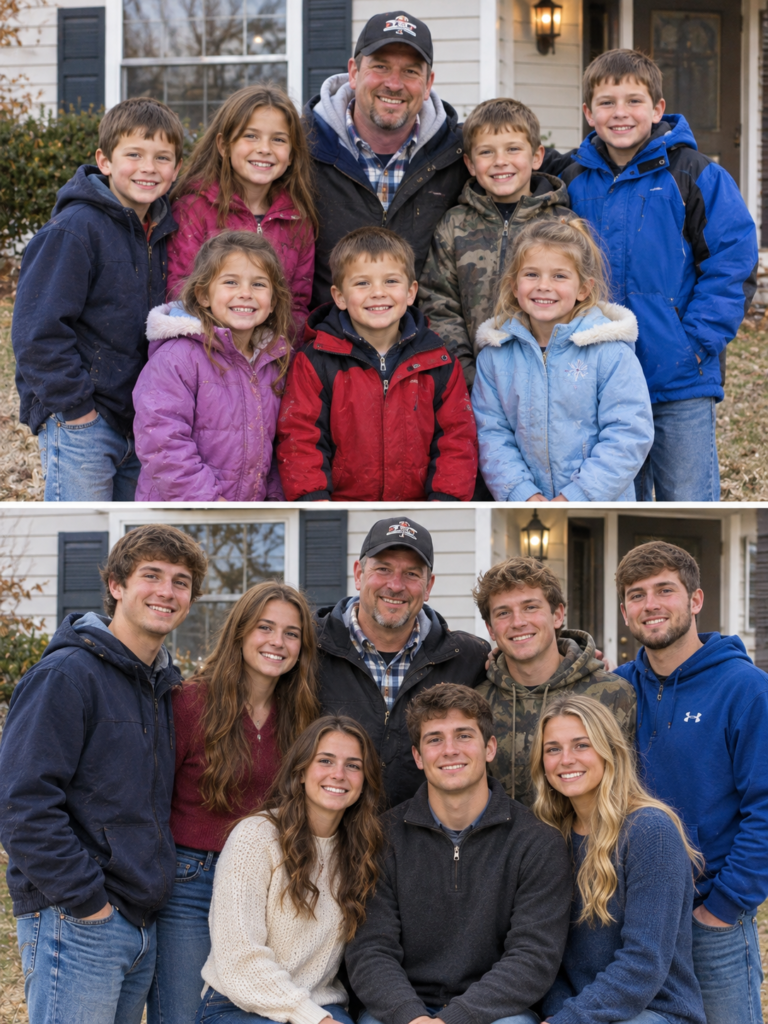
Jacob, fourteen. Quiet, serious, my right hand from that very first night. Rachel, twelve. Smart, bossy, already reading books for grown-ups. The twins, Sam and Noah, nine. Two halves of one noisy, sticky, mud-covered boy. Grace, seven. Shy, artistic, always drawing horses. Toby, five, who still slept with a stuffed bear named Mr. Buttons.
And Maisie. Two years and three weeks old. Blonde curls, chubby cheeks, and the word “no” in every sentence.
Seven kids. Four bedrooms. One bathroom and a half. A three-bedroom split-level on Pinecrest Drive with a mortgage I could barely afford and a backyard with a swing set I built myself from a kit.
And one father, who had no idea what he was doing.
At 2:40 the first morning, Maisie woke up screaming.
I went into her room. She was standing up in her crib, holding the rails, her face red and wet.
“Mama,” she sobbed. “Mama, Mama, Mama.”
I picked her up. I held her against my chest and walked back and forth in the dark. She kept crying. She kept saying it.
“Mama.”
“I know, baby,” I said. “I know. Daddy’s here.”
She cried for an hour and ten minutes. Then she fell asleep with her face in my neck, still hiccupping.
By the time I put her back down, Toby was standing in the doorway with Mr. Buttons.
“Is Mommy coming back?” he asked.
Brenda called on the fourth day. From a number I didn’t recognize.
“I’m in Charlotte,” she said. “Craig sold the house. We’re starting over.”
“Brenda, the kids are asking for you every night. Maisie screams for you.”
“She’ll forget,” Brenda said. “She’s two. She won’t even remember me.”
“Do you hear yourself?”
“I’m not doing this, Dan. I called to tell you I’m filing for divorce. My lawyer will be in touch. You can have the house. You can have the kids. I don’t want anything.”
“You don’t want anything,” I repeated.
“I want a life,” she said. “That’s what I want. A real one. Goodbye, Dan.”
She hung up.
The divorce was final seven months later. Brenda didn’t contest custody. She didn’t ask for visitation. The judge asked her lawyer three times if she was sure. Her lawyer said yes three times.
She was ordered to pay child support. Four hundred and twelve dollars a month, based on the part-time job she’d listed on her financial affidavit. For seven children.
She paid it for five months. Then she stopped.
I could have gone after her. I could have hired a lawyer, gone back to court, had her wages garnished. But I didn’t have the money for a lawyer, and I didn’t have the time to sit in a courthouse, and I didn’t want to beg her for anything.
So I let it go. And I went to work.
Chapter Three: Three Jobs
Those years were brutally hard. I’m not going to pretend they weren’t.
At first I worked two jobs. My regular shift at the water plant, seven in the morning to three-thirty in the afternoon. Then four nights a week, from six until ten, I stocked shelves at the Kroger on Hamilton Road.
It wasn’t enough. Not with seven kids. Shoes alone could break you. Seven kids grow out of shoes every six months, and you can only hand down so many pairs before the soles fall off.
So after a year, I took a third job. Saturdays and Sundays, I cleaned gutters and mowed lawns and fixed people’s leaky faucets. I put an ad on the bulletin board at the hardware store. Dan’s Handyman Service. No Job Too Small. I made about four hundred dollars a weekend, cash.
I slept four or five hours a night. Sometimes less.
I learned to braid hair. Badly at first. Rachel taught me, standing on a chair behind Grace in the bathroom, guiding my big clumsy fingers. “Over, under, over, Dad. No, the other over.”
I learned to make spaghetti for nine. Nine, because I always made enough for one extra in case one of the kids brought a friend home. I learned that boxed macaroni and cheese goes further with a can of tuna in it. I learned to cut coupons and shop the clearance rack and buy the day-old bread at the bakery outlet on Thursdays.
I learned which kid needed a hug and which kid needed to be left alone. I learned that Grace got stomachaches before tests and Noah lied when he was scared and Toby needed a nightlight until he was nine.
I learned to cry in the shower, so the kids wouldn’t hear.
I couldn’t have done it without my mother-in-law.
That surprises people. They expect Brenda’s mother to take Brenda’s side. But Ruth Anders was nothing like her daughter.
Ruth was sixty-five when Brenda left. A retired school nurse, widowed, living alone in a little brick house across town. She came over the third day after Brenda walked out. She stood on my porch with two grocery bags and a casserole dish.
“I’m so sorry, Daniel,” she said. Her eyes were red. “I raised her better than that. I swear I did.”
She came over three afternoons a week after that. For nine years. She picked the little ones up from school. She helped with homework. She taught Grace to sew and Rachel to cook and the twins how to fold a fitted sheet, which I still can’t do.
She never once said a bad word about Brenda in front of the kids. Not once.
“Your mother made a choice,” she’d say, when they asked. “It wasn’t about you. It was never about you. You’re the best thing she ever did, whether she knows it or not.”
I never remarried. I tried dating once or twice. It never went far.
The first woman I asked out, a nice nurse named Kim from Grace’s pediatrician’s office, asked how many kids I had on our first date. When I said seven, she laughed. She thought I was kidding. When she realized I wasn’t, she finished her salad very quickly and said she had an early morning.
After that, I stopped trying. My world became my kids. I gave them everything I had.
And I wouldn’t change a single minute of it.
In the beginning, Brenda contacted me now and then. A text on Christmas. Merry Christmas to the kids. A phone call on Jacob’s sixteenth birthday that lasted four minutes. A card for Rachel’s high school graduation with a fifty-dollar bill inside and no message.
Over time, even those stopped. By the fifth year, there was nothing. No calls. No cards. No texts.
I heard things, occasionally. A friend of a friend. Brenda and Craig had moved from Charlotte to Charleston. Craig had opened a new dealership. They had a house on the water. They posted pictures on Facebook from Hawaii, from Paris, from a cruise to the Bahamas.
I didn’t look at them. Not often, anyway.
She made her choice. I couldn’t understand it. But I didn’t have it in me to hate her. I was too tired to hate anybody.
Chapter Four: Ten Years
A decade went by.
You don’t notice it while it’s happening. You’re just getting through the days. Making lunches, signing permission slips, driving to practices, paying the electric bill. And then one day you look up and they’re grown.
Jacob is twenty-four now. He’s an electrician. He bought his own house two streets over with a big yard for his dog. He still comes by every Sunday to fix something I didn’t know was broken.
Rachel is twenty-two. She graduated from the state university in May with a degree in criminal justice and started work as a paralegal at a family law firm downtown. She wants to be a lawyer. She’s going to be a scary one.
Sam and Noah are nineteen. Sam’s at community college studying HVAC. Noah enlisted in the Air Force last year. He’s stationed in Texas, and he calls me every Sunday night.
Grace is seventeen. A senior. She got into an art program at a college in Savannah with a partial scholarship. She still draws horses.
Toby is fifteen. He’s six feet tall now. He sleeps without a nightlight. But Mr. Buttons is still on the shelf above his bed, and nobody is allowed to make fun of it.
And Maisie.
Maisie turned twelve yesterday.
She’s not the chubby toddler who said “no” to everything anymore. She’s tall and skinny, with straight blonde hair she keeps in a ponytail and braces with purple bands. She plays clarinet in the middle school band. She’s on the math team. She wants to be a veterinarian, or maybe an astronaut, depending on the day.
She doesn’t remember her mother. Not at all. She was two when Brenda left. All she knows of Brenda comes from a handful of photographs in an album in the hall closet and the stories her brothers and sisters tell.
But she’s never asked me much about her. Not really. Only once, when she was eight, and she’d made a Mother’s Day card at school and didn’t know who to give it to.
She gave it to Grandma Ruth.
Ruth died in June. Four months ago. A stroke, in her sleep, at seventy-five.
It hit all of us hard. Harder than I expected. She’d been there every week for ten years. She’d taught every one of my kids to make her famous apple cake. She’d sat in the bleachers at every game and the audience at every concert.
At her funeral, all seven of my kids sat in the front pew. Jacob gave the eulogy. He made it through most of it before he broke down, and then Rachel stood up and finished it for him.
Brenda didn’t come to her own mother’s funeral. She sent a wreath. White lilies. The card said With love, Brenda and Craig.
I put it at the back of the room.
Ruth left a will. She’d had it drawn up three years before she died by a lawyer named Martin Feeney, who’d done her husband’s will too.
She left her little brick house and everything in it to be sold, and the money to be divided equally among her seven grandchildren. After everything, the estate came to about four hundred and ten thousand dollars. A little over fifty-eight thousand each.
For the five who were adults, the money went straight to them. For Toby and Maisie, who were still minors, the will named a custodian to hold their shares under the Uniform Transfers to Minors Act until they turned twenty-one.
The custodian she named was me.
There was a line in the will about Brenda too. Just one sentence. Martin Feeney read it out loud in his office, with all of us sitting around his conference table.
I leave nothing to my daughter, Brenda Anders Whitmore, who chose a different life, and who I pray finds peace in it.
Brenda found out about the will in August. Martin Feeney sent her a copy, because the law required it. She called his office and screamed at his secretary for twenty minutes. She threatened to contest it. Feeney told her she was welcome to try.
She didn’t try. Not then.
I didn’t hear anything else from her. I thought that was the end of it.
I didn’t know she’d already found another way.
Chapter Five: The Birthday
Maisie’s twelfth birthday was a Saturday in late October. Bright and cool and clear, with the maple tree in the backyard gone orange and red.
She wanted a barbecue. Nothing fancy. Hot dogs and burgers on the grill, potato salad, a cake from the bakery at Kroger with purple frosting. She invited six girls from the math team and band. Plus the whole family.
Jacob came with his girlfriend, Tasha. Rachel came straight from the office in her work blazer. Sam came with his guitar. Grace and Toby were already home. Noah couldn’t get leave from Texas, but he called on video, and Maisie propped her phone up against the ketchup bottle so he could see the party.
It was a good day. One of the best days. I remember standing at the grill, flipping burgers, listening to the girls shrieking on the trampoline Jacob bought Maisie three years ago, and thinking, we made it. We actually made it.
Around four o’clock, someone knocked on the front door.
I almost didn’t hear it over the music. Sam was playing his guitar on the back porch, and the girls were singing along, terribly.
I wiped my hands on a dish towel and went through the kitchen to the front hall. I figured it was a neighbor. Or another one of Maisie’s friends, running late.
I opened the door.
Brenda and Craig were standing on my porch.
My stomach tightened. Everything in my body went cold and then hot.
She looked older. Fifty now. But expensive older. Her hair was a shade of honey blonde that probably cost two hundred dollars every five weeks. She wore white jeans and a cream-colored sweater and big gold earrings and sunglasses pushed up on her head. Her face was smooth in a way faces don’t usually get on their own.
Craig stood behind her. He looked worse than she did. He’d put on forty pounds and lost most of his hair. He was wearing a golf shirt with a dealership logo on it. He was holding the handlebars of a brand-new bicycle. Purple, with a white basket on the front and a big bow on the seat.
Brenda smiled at me. Like we’d seen each other last week at the grocery store.
“Hello, Dan,” she said.
I didn’t say anything. I couldn’t.
She didn’t wait for an invitation. She walked straight past me into the house. Like it was still hers. Like she’d just stepped out to get the mail ten years ago and was coming back in.
She didn’t even look at me as she passed.
Craig followed her, wheeling the bike. He didn’t look at me either. Ten years, and he still couldn’t look at me.
Chapter Six: The Presents
Maisie was in the kitchen.
She’d come in from the backyard to get another piece of birthday cake. She was standing at the counter with a paper plate in one hand and the cake knife in the other, reaching for a corner piece with extra frosting.
She looked up when Brenda came around the corner.
And she froze.
The knife stopped in midair. Her whole body went still. She stood there in her purple birthday T-shirt that said BIRTHDAY GIRL in glitter letters, staring at a woman she had last seen when she was two years old.
I know she recognized her. From the pictures in the hall closet. From the stories. I watched it happen on her face.
Brenda smiled. A big, warm smile. She spread her arms wide.
“Maisie,” she said. “Oh my God. Look at you. Sweetheart, you’re so beautiful.”
Maisie didn’t move.
“I know this is a surprise,” Brenda said. She took a step closer. “I know. But I’ve been thinking about you every single day. Every day for ten years. And I said to Craig, it’s her birthday, I can’t miss another one.”
She took another step.
“Sweetheart,” she said, “we can finally be a family again.”
Then she turned around and waved Craig forward.
He wheeled the purple bicycle into the kitchen doorway. It barely fit. He had to tip it sideways to get the handlebars through.
“Look at all the presents I’ve brought you,” Brenda said. “See? I left to create a better life. And now I can give you all these wonderful things.”
She opened her designer handbag. She pulled out a box. A brand-new tablet. The newest model. The expensive one with the pencil that writes on the screen.
She put it in Maisie’s hands, right on top of the paper plate with the cake.
My heart dropped.
It was the exact tablet Maisie had been wanting. She’d talked about it for months. She wanted it for drawing, because Grace showed her how to make digital art. She’d put a picture of it on the refrigerator with a magnet, half as a joke, half not.
It cost eleven hundred dollars. I knew because I’d looked. I’d stood in the electronics aisle at Best Buy in August and looked at it for a long time.
And then I’d bought her a used one off Facebook Marketplace for a hundred and eighty dollars. It was wrapped and sitting on the dining room table right now, with a card. I’d been so proud of finding it.
Now I felt sick.
By then, the whole party had noticed.
Rachel was standing in the back door, still in her blazer, with a hot dog in one hand. Her face had gone completely white. Jacob came in behind her and stopped dead.
Toby came out of the living room. Grace came down the stairs. Sam set his guitar down on the porch. All of them, my whole family, standing at the edges of the kitchen, staring at their mother.
Rachel’s eyes met mine across the kitchen. She shook her head, very slightly.
I didn’t know what it meant.
Maisie looked down at the tablet in her hands. She looked at the purple bicycle. She looked at the woman standing in front of her with her arms open.
Then Maisie smiled.
Not a big smile. A small one. Polite. The kind of smile she gave her teachers when they handed back a test.
“Mom,” she said. “Thank you. I’m happy to see you too.”
Brenda’s face lit up.
“But there’s something I’d like you to look at first,” Maisie said. She set the tablet down on the counter, carefully, beside the cake. “I have something saved on my phone.”
Chapter Seven: The Screen
Maisie reached into the back pocket of her jeans and pulled out her phone. It was an old one. Rachel’s hand-me-down, with a cracked corner and a purple case covered in stickers.
She tapped the screen a few times. Her fingers were perfectly steady.
Then she held the phone out to her mother.
Brenda took it, still smiling. She glanced down at the screen. Craig leaned in beside her, his chin almost on her shoulder, to see what was on it.
Brenda’s face turned white.
Not pale. White. Like somebody had pulled a plug and drained all the blood out of her at once. Her mouth fell open. The phone shook in her hand.
Craig’s face scrunched up like he’d just taken a huge bite out of a lemon. He stepped back. He looked at the floor.
For three seconds, nobody in that kitchen breathed.
Then Brenda screamed.
“How dare you, you little brat!”
It was so loud the dishes rattled. It was so loud the girls on the trampoline stopped bouncing. Every single guest at that party, all six of Maisie’s friends, Jacob’s girlfriend, the neighbors who’d wandered over for a burger, came running into the house to see what was going on.
They crowded into the kitchen doorway and the dining room. A dozen faces.
Brenda didn’t notice them. She was staring at her twelve-year-old daughter with a face so twisted I barely recognized it.
“You went through my messages?” she shrieked. “You saved them? Who told you to do that? Who put you up to this?”
Maisie didn’t flinch. She didn’t cry. She stood there in her BIRTHDAY GIRL T-shirt with her hands at her sides.
“Nobody went through anything,” she said quietly. “You sent it to me.”
“I did not…”
“You did, Mom,” Maisie said. “Tuesday night. At 11:47. You meant to send it to him.” She pointed at Craig. “But you sent it to me instead. Then you deleted it. But I’d already seen it. So I took a picture.”
Brenda lunged forward. She grabbed for Maisie’s arm.
I was across that kitchen before I knew I was moving. I don’t remember the steps. I only remember suddenly being between them, with my back to Maisie and my hand up, flat, in front of Brenda’s face.
“Don’t,” I said.
My voice was very quiet. I’d never heard it like that before.
“Don’t you touch her.”
Brenda stopped. She stared at me. Her chest was heaving.
Behind me, Jacob had moved too. He was beside me. Six foot two, a hundred and ninety pounds of electrician, with his arms crossed. Then Toby was on my other side. Then Sam. Then Grace.
Rachel walked around the counter. Very calmly. She held out her hand to Brenda.
“I’ll take that phone, please,” she said. “That’s my sister’s. And it’s evidence.”
Brenda looked at her. At her oldest daughter, in a lawyer’s blazer, holding out her hand.
She gave her the phone.
“Dad,” Rachel said, turning to me. “You need to see this. I’m sorry. I was going to tell you tonight. After the party. Maisie wanted to wait until after her birthday.”
She held the phone out to me.
I looked down at the screen.
Chapter Eight: What Maisie Saved
It was a screenshot of a message thread. On a social media app. The kind kids use.
The name at the top of the thread said Mom with a little heart emoji. The profile picture was Brenda in sunglasses on a beach.
I scrolled up. I couldn’t stop myself.
There were dozens of messages. Going back to the middle of August. All from Brenda to Maisie.
The first one said: Hi sweetheart. This is your mom. I know this might be a surprise. I think about you every day. I just want to get to know you. Please don’t tell your dad yet. He’s still very angry with me and I don’t want to upset him.
Maisie had written back: Hi. How did you find me?
Your sister Grace’s page. I’m so proud of you girls.
Then more. Every few days. Brenda asking about school. Brenda sending pictures of her house in Charleston, with a pool and a dock and a view of the water. Brenda saying she had a bedroom ready, painted purple, Maisie’s favorite color.
Brenda asking: Do you ever think about what it would be like to live with me? You’d have your own room. Your own bathroom. A pool. We could go shopping every weekend. You deserve nice things, baby. Your dad has done his best but you deserve better.
Then, in September, the messages changed. They got more specific.
Has your dad ever left you home alone at night? Because he works so much?
Do you ever not have enough food?
Has he ever yelled at you?
Maisie answered honestly. She was eleven. She didn’t know.
Sometimes when he works late Toby watches me.
We always have food. Dad makes a lot of spaghetti lol.
He yelled at me once when I ran into the street.
And Brenda wrote back: Oh, sweetheart. That’s not okay. You should never be left with your brother. You deserve a parent who’s there for you.
Then the last one. The one from Tuesday night. At 11:47.
It was long. It didn’t sound like the others. It didn’t have any hearts or emojis.
She’s eating it up. Lawyer says the texts about being left with the brother and the yelling are perfect for neglect. File Monday after the party. Once we get custody of her, we get control of the kid’s money from Mom’s estate. 58K plus the boy’s share if we push for him too. Enough to cover the note on the lot until the bank backs off. Don’t worry about the brat. She’s a means to an end. Two years till she’s 14 and can pick, so we have to move fast before she figures it out.
Underneath it was a gray line that said: This message was deleted.
But Maisie had taken a screenshot before it disappeared.
I read it twice. Then a third time.
The kitchen was dead silent. A dozen people standing there. Maisie’s friends from the math team, twelve years old, staring with their mouths open. Jacob’s girlfriend with her hand over her mouth. Old Mrs. Patterson from across the street, holding a paper plate with a hot dog on it.
I looked up at Brenda.
She wasn’t white anymore. She was red. Bright red. All the way down her neck.
“That’s out of context,” she said. “That’s private. She had no right.”
“You sent it to her,” I said.
“By accident!”
“You sent it to our daughter,” I said. “On her phone. Calling her a brat. A means to an end.”
Craig finally spoke. He was standing by the purple bicycle with his hands up, like a man backing away from a dog.
“Dan, look, it’s not like it sounds. Brenda gets emotional. We were stressed. Things have been really tight…”
“The note on the lot,” I said. “What lot?”
He closed his mouth.
Rachel answered for him. Very calmly. In her paralegal voice.
“Whitmore Motors in Charleston,” she said. “The dealership. It’s in default. The floor plan lender filed suit against Craig in August for one point two million dollars. It’s public record. I looked it up on Wednesday.” She looked at Craig. “The bank’s going to take the lot by Christmas unless you pay down the note. Isn’t that right?”
Craig didn’t answer.
“And the house on the water,” Rachel said. “There’s a lis pendens on it. A foreclosure notice. Recorded September eighth.”
Chapter Nine: Get Out
Brenda turned to me. Her voice went soft. Pleading. The voice she used to use to get me to take her side in arguments with her mother.
“Dan,” she said. “Please. Let’s talk about this privately. Not in front of all these people.”
“You walked into my house,” I said. “Uninvited. On our daughter’s birthday. In front of all these people.”
“I’m her mother.”
“You’re the woman who gave birth to her,” I said. “That’s not the same thing.”
She flinched like I’d slapped her.
I’d never said anything like that to her. Not in ten years. Not when she left. Not when she stopped paying child support. Not when she skipped her own mother’s funeral.
But I’d never seen her try to hurt one of my kids before.
“Here’s what’s going to happen,” I said. “You’re going to pick up your bicycle. And your tablet. And you’re going to walk out my front door. And you’re not going to come back.”
“You can’t keep me from my daughter.”
“Watch me,” I said.
“I’ll take you to court,” Brenda said. Her voice was rising again. “I’ll file. Monday. Just like I said. You’ve left her alone with a teenager. You yell at her. You work three jobs and you’re never home. Any judge in this state…”
“Is going to read that message,” Rachel said quietly.
Brenda turned on her. “You stay out of this.”
“I’m not in it,” Rachel said. “I’m just telling you. My firm does custody cases every day. If you file a motion to modify custody based on neglect, that message comes in as Exhibit A. Every judge in this county is going to read the words ‘means to an end’ with your name on them.” She paused. “And then they’re going to read the part about wanting Grandma’s money.”
Brenda opened her mouth. Nothing came out.
Then she turned around and looked at Maisie. Behind me. Peeking out from behind my arm.
“Maisie,” she said. “Baby. You know I didn’t mean it. I was angry. Craig and I were fighting that night. I love you. I came all this way to see you.”
Maisie stepped out from behind me.
She looked at her mother for a long time. She was so small. Twelve years old. But she stood up very straight.
“You came because of Grandma Ruth’s money,” she said. “It’s in the message. You said so.”
“That’s not…”
“It’s okay,” Maisie said. “I’m not mad. I just wanted you to know that I know.”
She walked over to the counter. She picked up the box with the tablet in it. She held it out to her mother.
“I can’t take this,” she said. “Thank you. But I can’t.”
Brenda didn’t take it.
So Maisie walked over to Craig. She held it out to him instead. He took it. He didn’t look at her either. He couldn’t look at anybody in my family. He never could.
Then Maisie went to the purple bicycle. She took the bow off the seat. She folded it carefully and put it in the basket.
“You can take that back too,” she said. “It’s really pretty. But I already have a bike. Dad fixed it.”
Brenda stood in my kitchen. In front of a dozen people. Holding her designer handbag.
For a moment, I thought she was going to cry. I saw something in her face, just for a second. Something cracked. Something that might once have been sorry.
Then it was gone.
“You turned them all against me,” she said to me. “You poisoned them. For ten years.”
“I never said one word against you,” I said. “Not one. Ask them.”
She looked around the kitchen. At Jacob. At Rachel. At Sam and Grace and Toby. At Maisie, standing next to the bicycle.
Nobody said anything.
They didn’t have to.
Brenda turned and walked out of the kitchen. Down the front hall. Out the front door. She didn’t close it behind her.
Craig wheeled the bicycle back out. He had to tip it sideways again to get it through the doorway. One of the pedals scraped the wall and left a black mark.
At the front door, he stopped. He turned around. For the first time in ten years, Craig Whitmore looked me in the eye.
“I’m sorry, Dan,” he said. “For all of it. For back then. For today.”
“I know you are,” I said.
He walked down my front steps and across my lawn to a black Mercedes parked on the street. The same spot where he used to park his silver Lexus.
They drove away.
Chapter Ten: After the Party
The party didn’t really recover. How could it?
Maisie’s friends’ parents started showing up early to pick them up. I think some of the girls had texted home. One mom came to the door and asked if everything was all right, and I said it was, and she looked at me for a long moment and then hugged me. I’d never met her before.
By six o’clock, it was just family. Sitting around the dining room table. The purple birthday cake still half-eaten on the counter.
Noah called back on video from Texas. Somebody had texted him. He was in uniform, in some kind of break room. His face was furious.
“Is Maisie okay?” he said. “Somebody put her on the screen.”
Maisie leaned into the phone. “I’m okay, Noah.”
“You sure, Mouse?”
“I’m sure.”
He stared at her through the screen for a long time. Then he said, “You’re the bravest one of all of us. You know that?”
After everyone left, I sat with Maisie on the back porch steps. It was getting dark. The air smelled like charcoal and fallen leaves. Somewhere down the street, a dog was barking.
I didn’t know how to start. So I just said it.
“Why didn’t you tell me, Mais?”
She was quiet for a while. She picked at a loose thread on her sock.
“Because she said not to,” she said. “In the first message. She said you were still angry, and it would upset you.” She looked down. “And I wanted to know her, Dad. Just a little. Everybody else remembers her. Jacob and Rachel and the twins. Even Toby remembers some. I don’t remember anything.”
“I know, honey.”
“I thought maybe she was sorry,” Maisie said. “I thought maybe she really did think about me every day.”
Her voice cracked on the last word.
I put my arm around her. She leaned against me. She was getting so tall. Her head came up to my shoulder now.
“When did you tell Rachel?” I asked.
“Wednesday morning,” she said. “After I got that last message. I didn’t understand all of it. The note and the lot and stuff. But I understood ‘means to an end.’ We learned that in English. It means you’re using somebody.”
She wiped her eyes on her sleeve.
“Rachel said to save everything. Every single message. And not to delete anything. And not to write back. She said she’d tell you. But I asked her to wait until after my birthday.” She looked up at me. “I didn’t want my birthday to be about her. I wanted it to be about us.”
I held her for a long time. I didn’t trust my voice.
“And then she showed up,” I said finally.
“And then she showed up,” Maisie said. She almost laughed. “With a bike. And the tablet I wanted.” She shook her head. “Dad, I saw the used one on the dining room table. The one you wrapped. I knew it was the tablet. I could tell by the shape.”
My throat closed up.
“I like that one better,” she said. “I really do.”
“Mais…”
“I mean it.” She looked up at me. “That one’s from you.”
Chapter Eleven: The Filing
Brenda filed anyway.
On Monday morning, her lawyer in Charleston, through a local attorney here, filed a motion to modify custody in our county family court. It said I had neglected Maisie by working excessive hours and leaving her in the care of a minor sibling. It said I had used “harsh verbal discipline.” It asked for primary custody to be transferred to Brenda.
It also asked the court to appoint Brenda as custodian of Maisie’s inheritance, “in the best interest of the child,” because I had “a documented history of financial hardship.”
Rachel read it at our kitchen table that night. Her jaw got tighter with every page.
“She’s not even hiding it,” she said. “She asks for the money in the same motion.”
“Can she do that?” I asked. “Can she take Maisie’s money?”
“No,” Rachel said. “Grandma named you as the custodian in her will. That’s not something a family court judge can just change because Brenda asks. She’d have to show you’ve misused it. And you haven’t touched a dime.” She set the papers down. “But Dad, you need a lawyer. A real one. Not me. I’m a paralegal, and I’m too close to this.”
Rachel’s boss was a family law attorney named Mike Delaney. Sixty-one years old. Silver hair, bow ties, and a reputation in the county courthouse for being the most polite man who ever destroyed you on cross-examination.
He read the motion. He read the screenshots. He read Ruth’s will, and Brenda’s original divorce decree, and the court records showing she’d stopped paying child support nine and a half years ago.
Then he took off his reading glasses and set them on the table.
“Mr. Hollis,” he said. “In thirty-four years of family law practice, I don’t believe I’ve ever been handed a gift quite like this one.”
He did three things.
First, he filed a response to Brenda’s motion, attaching every single message Maisie had saved. All of them. From the first one in August to the deleted one at 11:47 on Tuesday night.
Second, he filed a motion for child support arrears. Brenda had been ordered to pay four hundred and twelve dollars a month. She’d paid five months and then stopped. That left one hundred and fourteen months unpaid. Forty-six thousand, nine hundred and sixty-eight dollars. Plus statutory interest.
“Fifty-two thousand, give or take,” Mike said. “She’s been living on the water in Charleston while you worked three jobs. The law has a long memory about these things.”
Third, he asked the court to appoint a guardian ad litem for Maisie. An independent lawyer whose only job would be to find out what Maisie wanted and what was best for her.
The guardian ad litem was a woman named Janet Okafor. She visited our house twice in November. She sat at the kitchen table with Maisie and talked for an hour each time, alone, with the door closed. She talked to me. She talked to Toby. She talked to Maisie’s teachers and her school counselor and the band director.
She asked me about the three jobs. I told her the truth. I told her I’d quit the Kroger job four years ago, when Jacob started earning and helping out. I told her I’d quit the weekend handyman work when Toby turned thirteen. I told her that for the last two years, I’d worked one job, and I was home every night by four.
She asked Toby about watching Maisie. Toby told her the truth too. He’d watched her maybe a dozen times. Always on nights Dad worked overtime. Always with Grace or Jacob a phone call away.
“She’s twelve,” Toby said, and shrugged. “Mostly she watches me. She makes sure I do my homework.”
Janet Okafor laughed so hard she had to put her pen down.
The hearing was in December. Two weeks before Christmas.
Brenda flew up from Charleston. She came alone. No Craig. She sat at the table across the aisle from Mike and me, in a navy suit, with her local lawyer, a nervous young man who kept shuffling his papers.
Judge Carmen Moreno read everything. The motion. Our response. The guardian ad litem’s report. The screenshots.
Then she looked up over her glasses at Brenda.
“Mrs. Whitmore,” she said. “Did you write these messages?”
Brenda’s lawyer stood up. “Your Honor, my client would like to clarify…”
“I asked your client,” the judge said.
Brenda looked at the table.
“Yes, Your Honor,” she said.
“Including the one sent on October twenty-first at 11:47 p.m.?”
“I was upset. It was taken out of…”
“Including,” the judge said, “the phrase ‘she’s a means to an end’?”
Brenda didn’t answer.
Chapter Twelve: The Chair
Judge Moreno ruled from the bench.
She denied Brenda’s motion to modify custody in its entirety. She found that there was no evidence of neglect, and substantial evidence that Maisie was “a well-adjusted, thriving child in a loving and stable home.”
She denied Brenda’s request to be named custodian of Maisie’s inheritance. She noted, dryly, that the request “speaks for itself.”
She granted our motion for child support arrears. She entered a judgment against Brenda for forty-six thousand, nine hundred sixty-eight dollars, plus interest, and ordered it paid from any assets Brenda had or might later receive.
And then she did one more thing. She looked straight at Brenda.
“Mrs. Whitmore,” Judge Moreno said. “I’ve been on this bench for nineteen years. I’ve seen parents fight over children in every way you can imagine. But I’m not sure I’ve ever seen a parent use a child the way you tried to use your daughter.”
Brenda’s face was very pale.
“Your daughter’s guardian ad litem asked her what she wanted,” the judge said. “I’m going to read you her answer. With her permission.” She picked up the report. “Quote. ‘I want to stay with my dad. I don’t hate my mom. I hope she’s okay. If she ever wants to know me for real, not for money, she can write me a letter. I’ll read it. But I’m not going anywhere.’ End quote.”
The judge set the report down.
“That’s a twelve-year-old,” she said. “I’d suggest you think about that on your flight home.”
Brenda didn’t say anything to me on the way out of the courtroom. She walked past me in the hallway with her head down.
I found out later what happened to her. Rachel follows these things. The bank took Craig’s dealership in January. The house on the water was sold at foreclosure in March. Craig filed for bankruptcy in April. The last anyone heard, he was selling used cars on commission at a lot outside Columbia.
Brenda left him in May. She moved into a one-bedroom apartment in Charleston and got a job doing reception at a dental office.
Her wages are being garnished now. Two hundred and eighty dollars a month. For the child support she never paid. It’ll take her about fourteen years to pay it all.
I put every dollar of it into a college fund. For Maisie.
It’s October again now. Maisie’s thirteenth birthday was last Saturday.
We had a barbecue in the backyard. Hot dogs and burgers. Potato salad. A cake from the Kroger bakery with purple frosting. Sam played his guitar. Noah flew home on leave, in uniform, and Maisie screamed so loud when he came through the door that the neighbors called to check on us.
Nobody knocked on the front door who wasn’t invited.
That night, after everyone went home, I was cleaning up the dining room.
There’s a chair at the end of our table. The one closest to the kitchen. It was Brenda’s chair. The one she sat in for sixteen years. After she left, nobody ever sat in it. Not once in eleven years. We’d just pull out the other eight chairs and leave that one pushed in.
I’d never really noticed. It was just how things were.
That night, I found Maisie sitting in it.
She had the old tablet in her lap. The used one from Facebook Marketplace. The screen had a small crack in one corner now, and the case was covered in stickers. She was drawing a horse. Grace taught her how.
She looked up when I came in.
“Is this okay?” she asked. “Me sitting here?”
I looked at my daughter. Thirteen years old, in Brenda’s chair, at the end of the table, in our little split-level on Pinecrest Drive.
I thought about the night Brenda left. Seven kids crying in the dark. Maisie in her crib, holding the rails, screaming for her mama.
I thought about Brenda in my bedroom, with her hands on her hips. You never gave me the kind of life I deserve.
I’d spent eleven years believing her a little. Believing that maybe I’d failed somehow. That if I’d made more money, or been more exciting, or bought her a trip to Cabo, she would’ve stayed. That I’d given my kids less than they deserved.
“Dad?” Maisie said. “Is it okay?”
I pulled out the chair next to her. I sat down.
“It’s your chair now,” I said. “If you want it.”
She thought about that. Then she turned the tablet around and showed me what she was drawing.
It wasn’t a horse.
It was our house. The little split-level with the swing set out back and the maple tree, red and orange. And in front of it, a long line of stick figures, holding hands. Nine of them. Tall ones and short ones. One with a guitar. One in a uniform. One with a ponytail and purple braces.
And on the end, a tall one with a spatula, standing at a grill.
At the top of the picture, in purple letters, she’d written three words.
THE BETTER LIFE.
I looked at it for a long time. Then I put my arm around my daughter, in her chair, at our table, and I didn’t say anything at all.
There wasn’t anything left to say. She’d already said it.