Two Highlights
Part One: The Rules
Morgan was eleven, and for six years it had been just the two of us.
We lived in a two-bedroom apartment on the second floor of an old brick building in Tacoma, Washington, with a view of a parking lot, a laundromat, and on clear days, if you leaned out the kitchen window and squinted, a tiny white corner of Mount Rainier. The radiator clanked in winter. The kitchen faucet dripped no matter what I did to it. Morgan had decorated his bedroom door with stickers of every NBA team except the Lakers, because he said a man has to have principles.
He was the sort of kid who hugged me every morning before school, quick and hard, around the waist, and then glanced over his shoulder to make sure none of his friends had seen. If anyone was within fifty yards of the car, the hug became a fist bump. If the coast was clear, I got the whole thing.
Dinner was our time together. That was the one rule I never bent, no matter how late my shift ran or how much homework he had. We sat at the little round table by the kitchen window, phones in a basket on the counter, and we each shared the best and worst parts of our day. One highlight. One lowlight. That was the rule.
Morgan usually bent it and told two highlights.
“That’s against the rules,” I’d say.
“You’re the mom,” he’d say, pointing his fork at me. “Change the rules.”
I’d smile and shake my head. “Nice try.”
He never seemed to have much trouble finding highlights. A good grade on a spelling test. A three-pointer at recess. A dog he’d seen on the walk home that looked exactly like a dust mop. He’d tell them all with his whole body, waving his hands, knocking over his milk at least once a week.
The lowlights were harder for him. He’d shrug and push his peas around his plate. “Nothing, really,” he’d say. Or he’d pick something small and safe. We had a sub in math. The vending machine ate my quarter.
I knew why. I’d known since the day I met him. Morgan had learned very young that when you don’t say the bad things out loud, nobody can take anything away from you because of them.
Part Two: How We Met
I’m Khloe Reyes. I’m thirty-nine years old, and I work as a 911 dispatcher for Pierce County. Four ten-hour shifts a week, sitting in a dark room full of glowing monitors, answering phones on the worst day of strangers’ lives. I talk people through CPR on their husbands. I keep frightened teenagers on the line while the deputies are on their way. I’m good at staying calm. You have to be.
I’ve never been married. For most of my twenties, I thought I would be. Then I turned thirty-two and realized I’d spent so long waiting for my life to start that I’d forgotten it already had. So I stopped waiting.
I got licensed as a foster parent the next year.
I met Morgan at a holiday party in December, seven years ago, before I’d been matched with any child at all. The foster agency held it every year in the fellowship hall of a Lutheran church on the east side of Tacoma: a big room with folding tables and paper snowflakes taped to the windows and a Santa who was really a retired electrician named Gus. There were crafts and games and a cookie table, and a ticket system so kids could win little prizes. Each kid got ten tickets at the door. Volunteers like me ran the booths.
I was working the ring toss. And I noticed a little boy sitting by himself on the edge of the stage.
He was four and a half, small for his age, in a sweatshirt two sizes too big with the sleeves rolled up four times. He had dark curly hair that needed cutting and big serious brown eyes. He wasn’t playing anything. He was just sitting on the stage with his knees pulled up to his chest, watching the other kids.
When my shift at the ring toss ended, I walked over and sat down next to him.
“Hi,” I said. “I’m Khloe. Don’t you want to play?”
He looked at me for a long moment, deciding whether I was safe.
“I don’t have tickets,” he said finally. “A big kid took them.”
I went and bought him a giant cookie. They were selling them at the cookie table for the agency’s scholarship fund, three dollars each, chocolate chip cookies as big as a dinner plate, wrapped in plastic with a curly red ribbon. I gave it to him and sat back down. I didn’t give him any of my own tickets. I’ve never known exactly why. I think I just sensed that what he needed most wasn’t to play the games. It was for somebody to sit with him while he watched them.
He ate the whole cookie in silence, very slowly, sitting beside me on the edge of the stage. When he finished, he folded the plastic wrapper into a tiny square and put it in his pocket.
“Thank you,” he said. Then, after a pause: “Are you a mom?”
“Not yet,” I said.
He looked at me with those big serious eyes. “You’d be good at it,” he said.
His name was Morgan. His caseworker, a tired, kind woman named Theresa Kim, found me at the end of the party and told me a little bit about him. He’d been in the system since he was two. Four placements in two and a half years. His mother had struggled with addiction, and his father wasn’t in the picture. He was quiet and polite and didn’t cause trouble. He’d been passed around so many times that he’d stopped unpacking his things.
I called Theresa the next morning. Four months later, Morgan moved into my apartment. Two years after that, on a rainy Tuesday in a courtroom in Tacoma, he became Morgan Reyes.
The folded cookie wrapper from that night is in a picture frame on his bedroom wall. He put it there himself.
Part Three: The Fair
For the past two weeks, all Morgan talked about was the fall fair at Whitman Elementary.
It was an annual thing, held on the Friday before Halloween in the school gym. The PTA ran it to raise money for field trips. There were carnival games and a bounce house in the corner, a cakewalk, face painting, a raffle, and a lunch of pizza from the place on Sixth Avenue. And, most importantly, according to my son, the giant cookies.
“There’s pizza, games, prizes, and giant cookies, Mom,” he told me at dinner on a Wednesday. “Real giant cookies. As big as your face.”
“Sounds like a very serious educational event,” I said.
“Extremely educational,” Morgan said. “There’s a math game where you guess how many jelly beans are in a jar. That’s estimation.”
He talked about it every night. Which games had the best prizes. Whether he should do the cakewalk or the duck pond first. Whether the giant cookies would be chocolate chip or M&M this year. His friend Jaylen said M&M. His friend Aiden said chocolate chip. It was the subject of intense debate in the fifth-grade cafeteria.
Whitman is a Title I school, which means most of the families there don’t have much money. Mine included. Seventy-eight percent of the kids get free or reduced lunch. The fair was cheap, a dollar a ticket, most games one or two tickets, the pizza two dollars a slice, the cookies three. But even a cheap fair costs money, and I knew some kids would go with nothing.
I tried not to think about it too much. I couldn’t fix it. I could only take care of my own.
Part Four: Fifty Dollars
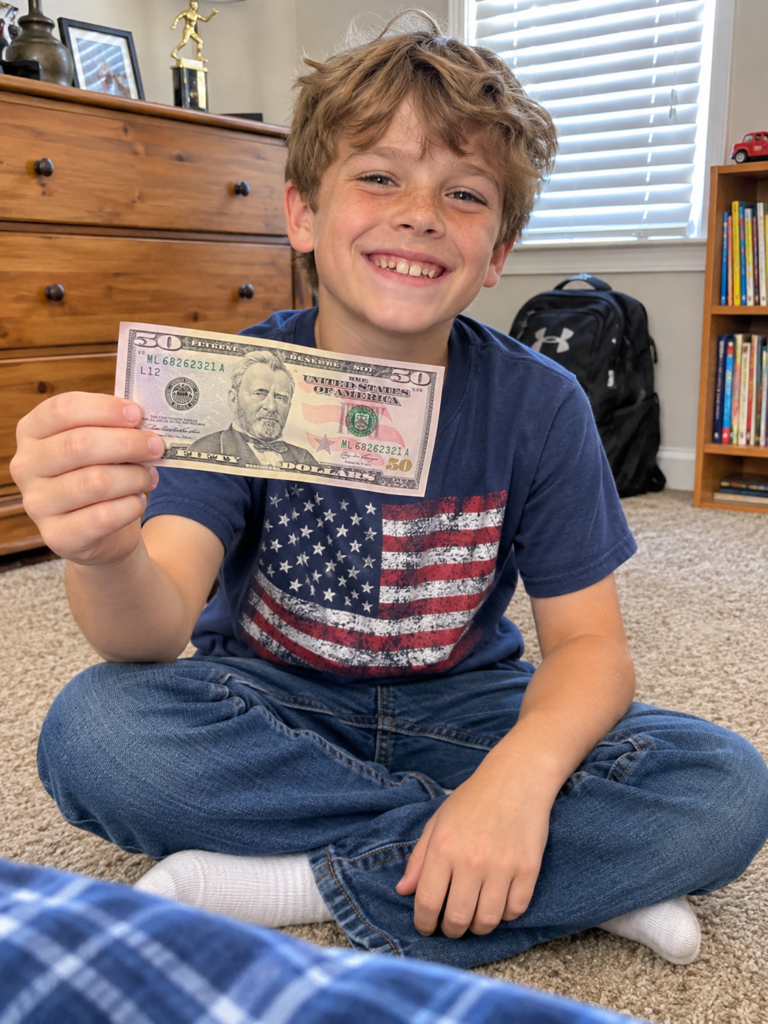
The evening before the fair, I found Morgan on his bedroom floor counting his savings.
He kept it in a coffee can with a Seattle Sounders sticker on the lid. Birthday money from my sister, a few dollars from returning soda cans, a five-dollar bill he found in a parking lot and was still a little guilty about. He’d spread it all out on the carpet in neat little stacks.
Twelve dollars and forty cents.
He looked up when I came in. “I’ve got twelve,” he said. “That’s twelve tickets. Or four cookies. Or two cookies and six tickets. Or…” He frowned, doing math. “Pizza’s two dollars.”
I’d had a good month. Lots of overtime at the dispatch center during a windstorm that knocked out power across half the county. I’d paid the rent and the car insurance and put a little away, and I had a fifty-dollar bill in my wallet I’d been holding on to for no reason in particular.
I sat down on the floor beside him. I took out my wallet. I handed him the fifty.
His eyes got big.
“No way,” he said.
“It’s yours,” I said.
“All fifty?” he said. He held it by the corners like it might break.
“All fifty,” I said. “Buy what makes you happy.”
He looked at the bill. Then he looked at me. His face was suddenly very serious, the same serious face he had on the edge of the stage when he was four.
“What if I spend it on something dumb?” he asked.
“Then you learn a fifty-dollar lesson,” I said.
He thought about that. Then he grinned.
“You’re my favorite mom,” he said.
“I’m your only mom,” I said.
“Still counts,” he said.
The next morning, he put the bill carefully inside the zipper pocket of his backpack, folded in half, with his twelve dollars and forty cents wrapped around it with a rubber band. He checked it twice before we left the apartment. He checked it again in the car.
When I pulled up to the drop-off line at Whitman, he unbuckled his seat belt and grabbed his backpack. The coast was not clear. Jaylen was standing right by the front doors. So I got a fist bump.
“Don’t spend it all on cookies!” I said as he climbed out.
He turned around on the sidewalk and grinned at me through the open door.
“No promises!” he said.
He ran toward the school with his backpack bouncing. Jaylen yelled something, and Morgan yelled something back, and they disappeared through the front doors together.
I drove to work. I worked my shift. A car accident on I-5. A grandmother who’d fallen and couldn’t get up. A teenager who’d called because his little brother had swallowed a battery. The money slipped from my mind completely.
Until 2:18 that afternoon.
Part Five: 2:18
I was on my lunch break in the dispatch center’s break room, eating a turkey sandwich at the little table by the vending machines, when my cell phone rang.
It was a number I recognized. Whitman Elementary. My stomach tightened. When you work at 911, a phone call from your kid’s school at two in the afternoon is never good news. It’s always a fall from the monkey bars or a fever or a fight.
“Hello?”
“Ms. Khloe?”
It was Mrs. Quinn, Morgan’s fifth-grade teacher. Bernadette Quinn had been teaching at Whitman for twenty-six years. She was sixty, round and gray-haired, with reading glasses on a beaded chain and a voice like a librarian’s. Firm, but kind. Morgan adored her. She called all the parents by their first names, with Ms. or Mr. in front, as though we were all her students too.
But her voice was different today. Tight. Shaky.
It made me sit up straighter.
“Yes,” I said. “Is Morgan okay?”
“He’s fine,” Mrs. Quinn said quickly. “He’s fine. He’s not hurt.”
Then she started crying.
Anxiety hit me like a wave. I’ve heard a thousand people cry on the phone in my job. I know the difference between scared crying and sad crying. This wasn’t either one. It was something else, something I couldn’t place.
“Mrs. Quinn,” I said. “What happened?”
“I’m sorry,” she said. I could hear her trying to pull herself together. “I’m so sorry. I just… I didn’t expect this. Twenty-six years, and I didn’t expect this.”
She took a shaky breath.
“Morgan had fifty dollars with him today,” she said. “Right?”
“Yes,” I said. “I gave it to him. For the fair.”
Another pause. I could hear noise in the background. The fair. Kids shouting, music playing, the hum of a bounce house blower.
“Ms. Khloe,” Mrs. Quinn said. “Please get here as fast as you can.” Her voice cracked. “You should see what he did with the money.”
Part Six: The Gym
I told my supervisor it was a family emergency. I drove from the dispatch center to Whitman in nineteen minutes, a drive that usually takes twenty-five, imagining every possible disaster.
That someone had taken the money from him. That he’d lost it and was devastated. That he’d spent it on something terrible, something forbidden. That he’d gotten in a fight over it. My mind went to the worst places, the way it does after nine years of answering 911 calls.
I parked crooked in the visitor lot and ran to the front doors.
Mrs. Quinn was waiting for me by the gym doors, in a cardigan with little orange pumpkins on it, dabbing at her eyes with a tissue. Her reading glasses were pushed up on her head. Her face was blotchy.
“Where’s Morgan?” I asked.
She didn’t answer right away. She just nodded toward the double doors of the gym.
“Inside,” she said.
I pushed open the doors.
The gym was loud and bright and full. Orange and black streamers hung from the basketball hoops. The bounce house was wobbling in the far corner, full of shrieking kindergartners. There were booths along the walls, painted cardboard signs on folding tables: DUCK POND, RING TOSS, FISHING GAME, BEANBAG TOSS, FACE PAINTING. The smell of pizza and popcorn was everywhere.
I scanned the room for my son.
And then I saw him, and my stomach dropped.
Part Seven: The Bleachers
Morgan was sitting on the bottom row of the bleachers on the far side of the gym.
He wasn’t playing any games. He wasn’t in line for pizza or the bounce house. He wasn’t holding a giant cookie.
He was sitting on the bottom bleacher with his hands empty in his lap, surrounded by kids.
There were maybe fourteen of them. Little kids and big kids, from first grade up to fifth. Some I recognized, some I didn’t. They were sitting on the bleachers around him and on the floor in front of him, and every one of them was holding something. A slice of pizza on a paper plate. A giant cookie in plastic with a curly ribbon. A strip of orange tickets. A plastic spider ring from the duck pond. A little boy in the front had his face painted like a tiger and was holding a goldfish in a plastic bag, staring at it like it was the most precious thing he’d ever seen.
And in the middle of them all sat my son, with nothing.
My first thought, God forgive me, was that they’d taken it from him. That a group of kids had cornered him and made him buy them things. That’s what nine years of 911 calls does to you. You always think of the worst thing first.
Then I saw his face.
He was smiling. Not his normal goofy grin. A quiet smile. The one I’d only seen a few times in six years. The one he had on the night of his adoption hearing, when the judge banged the gavel and said, Congratulations, Morgan Reyes.
Beside him, on the bleacher, sat a small boy I didn’t recognize. Maybe ten. Thin, with sandy blond hair that hadn’t been cut in a while and a jacket a size too small, the cuffs ending above his wrists. He was holding a giant cookie in both hands, still wrapped in its plastic and curly red ribbon. He wasn’t eating it. He was just holding it, looking at it, the way you’d hold something you were afraid someone might take away.
He had big serious eyes.
I felt something turn over in my chest.
Part Eight: What He Did
Mrs. Quinn had come up beside me. She put her hand on my arm.
“I was on lunch duty,” she said quietly. “At eleven-thirty, when the fair opened, I saw Morgan go to the ticket table. He bought fifty tickets. All fifty dollars.” She shook her head. “I thought, Well, that’s a lot of ring toss.”
She dabbed her eyes.
“Then I watched him walk away from the ticket table,” she said, “past every game, past the pizza, past the cookie table. Straight to the bleachers.”
The bleachers, it turned out, were where the kids without money sat.
Nobody had planned it that way. Nobody had said anything. But every year at the Whitman fall fair, a group of kids ended up on the bottom row of the bleachers, watching. Kids whose parents couldn’t spare the money. Kids whose parents forgot. Kids who’d lost their money or had it taken. Kids in foster care, whose foster families didn’t know about the fair or didn’t care.
They’d sit there for the whole three hours. Watching the other kids play.
“I’ve seen it for twenty-six years,” Mrs. Quinn said, and her voice broke. “I’ve bought a few kids pizza here and there. Snuck them a ticket or two. But I never…” She stopped. “I never sat down with them.”
“Morgan sat down,” she said.
She watched him across the gym.
“He sat down right in the middle of them,” Mrs. Quinn said, “and he took out his fifty tickets, and he started counting them out. Three for you. Three for you. Three for you. He went down the whole bleacher. Then he had a few left over, so he went to the ticket table with his own twelve dollars and bought twelve more.”
She shook her head.
“Then he walked them to the pizza line,” she said. “Then the cookie table. He made sure every kid got a slice of pizza and a cookie. He didn’t buy anything for himself. Not one thing. Not one ticket, not one bite of pizza. When the man at the cookie table asked him if he wanted one, he said, No thanks, I’m good.”
I couldn’t speak. I just stood there in the doorway of the gym with my hand over my mouth.
“That’s not why I called you,” Mrs. Quinn said softly.
I looked at her.
“I called you,” she said, “because of what he said to Eli.”
Part Nine: Eli
“Eli Parker,” Mrs. Quinn said. She nodded at the small blond boy beside Morgan, the one holding the cookie he wouldn’t eat. “He’s new. He started at Whitman three weeks ago. He’s in my class.”
She lowered her voice.
“He’s in foster care,” she said. “He’s living at the Harbor House group home on Pacific Avenue. Fourth placement this year. He doesn’t talk to anybody. He eats lunch by himself. He hasn’t said ten words in class since he got here.”
I knew Harbor House. Every foster parent in Tacoma knows Harbor House. It’s an emergency shelter for kids between placements, a big old Victorian with a chain-link fence and a basketball hoop with no net. Kids stay there for weeks, sometimes months, while caseworkers try to find somewhere for them to go. It’s clean and safe and the staff are kind. And it is not a home.
Morgan spent eleven days there when he was three, between his second and third placements. He doesn’t remember it. I do. I’ve read his file.
“Eli was the last one Morgan got to,” Mrs. Quinn said. “He was sitting at the far end of the bleacher, all by himself. Morgan sat down next to him and held out three tickets, and Eli shook his head. Wouldn’t take them. Wouldn’t even look at him.”
She wiped her eyes again.
“So Morgan just sat there with him,” she said. “For a long time. Not saying anything. And then he got up and went to the cookie table and bought a giant cookie, and he came back and gave it to Eli. And Eli took it.”
She smiled through her tears.
“And then Eli said, Why are you doing this?”
I held my breath.
“And Morgan said…” Mrs. Quinn’s voice broke completely. She had to stop. She pressed the tissue against her mouth. When she could talk again, she said it very quietly.
“He said, When I was four, I didn’t have any tickets either. And a lady sat down next to me and bought me a giant cookie. And then she became my mom.”
Part Ten: The Cookie
I don’t remember crossing the gym. I remember the noise fading out, the music and the shrieking kids and the bounce house blower, until all I could hear was my own heartbeat.
Morgan saw me coming. His face changed. For a second he looked worried, the way he does when he thinks he’s in trouble. He looked down at his empty hands. Then he looked back at me.
“Mom,” he said. “I know you said buy what makes me happy.”
I knelt down in front of him on the gym floor.
“I spent it on something dumb,” he said, a little uncertainly.
I put both my hands on his cheeks.
“Did it make you happy?” I asked.
He thought about it, very seriously. Then he looked around at the fourteen kids on the bleachers. At the little tiger with his goldfish. At a first-grade girl with her face painted like a butterfly, sharing her pizza with her little brother. At Eli, beside him, still holding the giant cookie in both hands.
“Yeah,” Morgan said quietly. “It made me really happy.”
I pulled him into my arms right there on the gym floor, in front of everybody, and he didn’t even check to see if his friends were watching. He just hugged me back. The whole thing.
Over his shoulder, I looked at Eli.
He was watching us. He had the same face Morgan had on the edge of that stage seven years ago. Wary. Careful. Deciding if I was safe.
I let go of Morgan and turned to the small blond boy.
“Hi,” I said. “I’m Khloe. I’m Morgan’s mom.”
Eli looked at me. He didn’t say anything.
“You know,” I said, nodding at the cookie in his hands, “you’re allowed to eat that. It’s yours. Nobody’s going to take it.”
Eli looked down at the cookie. Then he looked at Morgan.
“It’s true,” Morgan said. “Nobody takes stuff here. Mrs. Quinn won’t let them.”
Slowly, very slowly, Eli untied the curly red ribbon. He unwrapped the plastic. He broke off a tiny piece of the cookie and put it in his mouth.
Then he did something that made Mrs. Quinn, standing behind me, burst into fresh tears.
He broke the cookie in half. And he held out the other half to Morgan.
“You didn’t get one,” he said.
Morgan looked at the half-cookie. Then he looked at me.
“Go ahead,” I said. My voice was thick. “That’s not a fifty-dollar lesson. That’s a priceless one.”
Morgan took the half-cookie. The two boys sat side by side on the bottom bleacher of the Whitman Elementary gym and ate it together, in silence, very slowly.
When Eli finished, he folded the plastic wrapper into a tiny square and put it in his pocket.
Part Eleven: Dinner
That night at dinner, I didn’t ask for a highlight and a lowlight.
I just watched my son eat his spaghetti. He was quiet. Tired. He’d been at the fair until four, and then he’d insisted on staying to help the PTA moms take down the booths and stack the folding tables, and then he’d walked Eli to the van from Harbor House that came to pick him up.
“Morgan,” I said finally. “Can I ask you something?”
He looked up.
“Why didn’t you keep any for yourself?” I asked. “Not even one ticket? Not even a cookie?”
He was quiet for a long time. He pushed his spaghetti around his plate.
“I was going to,” he said finally. “I had it all planned. Two cookies, one slice of pizza, and the rest for games. I even made a list.” He reached into his pocket and pulled out a crumpled piece of notebook paper. A list in his messy fifth-grade handwriting. Cookie (M&M). Cookie (chocolate chip). Pizza (pepperoni). Duck pond. Ring toss x3. Cakewalk.
He set it on the table.
“And then I walked in the gym,” he said, “and I saw the bleachers.”
“There were so many of them, Mom,” he said. “Just sitting there. Watching. Like I used to.”
He looked down at his plate.
“You remember the holiday party,” he said. “When I was four.”
“I’ll never forget it,” I said.
“I remember sitting on that stage,” Morgan said. “I remember watching everybody play. I remember thinking, Nobody even sees me.”
He looked up at me.
“And then you saw me,” he said. “You came over and sat down. And you didn’t make a big deal about it. You didn’t say, Oh, you poor thing. You just sat down and gave me a cookie and stayed there.”
I couldn’t say anything. I just held his hand across the table.
“When I saw Eli,” Morgan said, “sitting by himself at the end of the bleachers, it was like looking at me. He even had a sweatshirt that didn’t fit right.” He shook his head. “I couldn’t play the ring toss, Mom. Not with him sitting there.”
He picked up his fork again.
“That’s my highlight,” he said. “Sitting with Eli.”
He paused.
“And my lowlight,” he said. “Is that he has to go back to Harbor House.”
Part Twelve: Harbor House
I lay awake that night for a long time.
I’d been a foster parent for seven years. But I’d only ever fostered one child, Morgan, and then adopted him. After that, I’d let my license lapse. I’d told myself it was because the apartment was too small, because my shifts were too long, because I couldn’t afford a second child on a dispatcher’s salary. All true. But I also knew the real reason. I was afraid. Afraid of loving another child who might be taken away. Afraid of disrupting what Morgan and I had built.
I lay there and thought about Eli, holding a cookie he wouldn’t eat. Breaking it in half. Folding the wrapper into a tiny square.
At three in the morning, I got up and found Theresa Kim’s phone number in my old contacts.
Theresa was still with the agency. She was the regional supervisor now, gray-haired and even more tired than I remembered. She called me back on Monday morning.
“Khloe Reyes,” she said. “How’s my favorite success story?”
“He’s good,” I said. “He’s really good. Theresa, I need to ask you about a boy named Eli Parker.”
There was a long pause on the line.
“How do you know Eli?” she asked.
I told her about the fair. About the bleachers and the fifty dollars and the giant cookie broken in half. She was quiet the whole time.
When I finished, she let out a long breath.
“Eli’s ten,” she said. “He’s been in care since he was six. Four placements this year alone. The last family sent him back after two months. Said he was too quiet, too withdrawn. Said he wouldn’t bond.” She sighed. “He’s been at Harbor House for five weeks. We don’t have anywhere to put him.”
“What happens to him?”
“If we can’t find a placement in the next month or so,” Theresa said, “he’ll probably go to a residential facility in Yakima. A group setting. Different school, different town. Away from everything he knows.”
“Theresa,” I said. “My license lapsed four years ago. What would it take to get it back?”
She was silent for a long time.
“Khloe,” she said gently. “Are you sure? You know what it’s like. You know how hard it is. A ten-year-old with Eli’s history…”
“I know,” I said. “I’m not sure about anything. I just want to know what it would take.”
“Home study,” Theresa said. “Background check. Training refresher. A bigger apartment, probably. He’d need his own room, or at least his own bed in a shared room with a child of the same sex.” She paused. “And you’d need to talk to Morgan.”
“I know,” I said.
“Because Khloe,” Theresa said, “this isn’t just your decision. You’d be giving Morgan a brother. Or taking him away again, if it doesn’t work out.”
Part Thirteen: Two Highlights
I talked to Morgan at dinner that night.
I didn’t make a speech. I just said it. I told him I’d called Theresa. I told him about Harbor House and the facility in Yakima. I told him I was thinking about getting my foster license back.
And I told him I wanted to know what he thought before I did anything.
He set down his fork. He looked at me for a long moment across our little round table.
“You mean Eli could live here?” he said. “With us?”
“Maybe,” I said. “It’s not up to just us. There’s a lot of paperwork. A lot of people have to say yes. And it might not work out, Morgan. Sometimes it doesn’t. Eli’s been hurt a lot. He might not trust us. He might be angry. He might not want to stay.”
“I know,” Morgan said quietly. “I was like that.”
“And if he came,” I said, “things would change. You’d have to share me. Share your room, at least for a while. Share dinner.” I swallowed. “Share everything we’ve built.”
Morgan thought about it. He thought about it for a long time, very seriously, the way he thinks about everything important.
Then he said, “Mom. Can I tell you two highlights tonight?”
I almost laughed. “Morgan, this is serious.”
“I know,” he said. “That’s why I need two.”
I sighed. “Okay,” I said. “Two highlights.”
“My first highlight,” Morgan said, “is that you’re thinking about it. Because you didn’t have to. You could’ve just said, That’s sad, and gone to bed.”
He took a breath.
“My second highlight,” he said, “is that I already know what I’d say if you ask me.”
“What would you say?”
He looked at me with his big serious brown eyes.
“I’d say there’s room,” he said. “There’s always room. That’s what you said to me the first night, remember? When I didn’t unpack my bag?”
I did remember.
The first night Morgan came to live with me, he was four and a half. He’d arrived with one black garbage bag of clothes, which is how a lot of foster kids arrive. I’d shown him his room with a new bed and a new comforter with rocket ships on it and an empty dresser for his things.
He didn’t unpack. He put his garbage bag in the corner of the room and sat on the bed and looked at it.
“You can put your things in the dresser,” I told him. “There’s room.”
“What if I have to leave?” he asked.
I sat down beside him on the bed. “Then we’ll pack them back up together,” I said. “But until then, there’s room. There’s always room.”
It took him three weeks to unpack that garbage bag.
Part Fourteen: The Paperwork
It took three months.
Three months of home study visits from a social worker named Paul who wore sweater vests and asked a lot of questions about our fire escape plan. Three months of background checks and fingerprinting and forty hours of refresher training on Saturday mornings in a conference room at the agency. Three months of searching for a bigger apartment we could afford.
We found one in January. A three-bedroom on the ground floor of an old house in the Stadium District, with a backyard the size of a postage stamp and a kitchen with a window that looked out on a cherry tree. It was a hundred and eighty dollars a month more than our old place. I picked up an extra shift every other week to cover it.
Morgan picked the smaller bedroom. “Eli should get the one with the window,” he said. “He’s never had a window.”
We were allowed to visit Eli at Harbor House twice a week while the paperwork went through. Theresa set it up. Supervised visits, an hour at a time, in the common room with its worn green couch and its basket of donated board games.
The first visit, Eli barely talked. He sat on the far end of the couch with his knees pulled up to his chest, the way Morgan used to sit on the edge of that stage. Morgan sat on the other end. They played Uno for an hour. Neither of them said more than ten words.
The second visit, Eli talked a little. About his school. About a dog he used to have, before. About the basketball hoop at Harbor House with no net.
The fifth visit, Eli asked Morgan if it was true. If the lady really became his mom after the cookie.
“Yeah,” Morgan said. “It took a while. But yeah.”
Eli looked at me across the common room. Then he looked back at Morgan.
“How long is a while?” he asked.
The ninth visit, Eli brought something with him. He took it out of his pocket and set it on the coffee table between them.
It was a tiny folded square of plastic. A cookie wrapper, with a little bit of curly red ribbon still stuck to it.
“I kept it,” Eli said. He didn’t look at anybody. “From the fair.”
Morgan stared at it. Then he looked at me. His eyes were wet.
“I kept mine too,” he said to Eli. “It’s in a frame on my wall. You can see it. If you come.”
Part Fifteen: The Bag
Eli moved in on a Saturday in February.
Theresa drove him over in the agency’s white minivan. I watched from the front window as she parked at the curb. Morgan was standing on the porch in his coat, hopping from foot to foot in the cold, the way he used to wait for the school bus.
The van door slid open. Eli climbed out.
He was carrying one black garbage bag.
Morgan ran down the porch steps. He stopped in front of Eli on the sidewalk. For a second, the two of them just stood there looking at each other.
Then Morgan reached out and took one side of the garbage bag. Eli kept the other. They carried it up the porch steps together, between them, and into the house.
I showed Eli his room. The one with the window looking out on the cherry tree, bare in February but with tiny buds already starting. A new bed. A new comforter. Eli picked it from a catalog during our seventh visit: navy blue with white stars. An empty dresser.
He put his garbage bag in the corner of the room. He sat down on the bed and looked at it.
“You can put your things in the dresser,” I said. “There’s room.”
Eli didn’t say anything for a long time.
“What if I have to leave?” he asked.
Before I could answer, Morgan came and sat down beside him on the bed.
“Then we’ll pack them back up together,” Morgan said. “But until then, there’s room.”
He looked at Eli.
“There’s always room,” he said. “That’s the rule.”
Part Sixteen: The First Dinner
That night, the three of us sat down to dinner at our little round table in the new kitchen, with the window looking out on the cherry tree. We’d had to buy a third chair. It didn’t match the other two. Morgan said that made it special.
I’d made spaghetti, because it’s Morgan’s favorite and because Theresa told me it was the only food in Eli’s file that he’d ever been described as eating “with enthusiasm.”
Eli ate slowly. Carefully. He kept one arm curled around his plate the whole time, the way kids do when they’ve had food taken from them. Morgan noticed. He didn’t say anything about it. Neither did I.
When we were almost done, Morgan put down his fork.
“Okay,” he said. “It’s time for the rules.”
Eli looked up, wary. Rules. I knew what that word meant to a kid who’d been in four placements in a year. Rules meant chances to fail. Rules meant reasons to be sent back.
“It’s not a bad rule,” Morgan said quickly. “It’s the dinner rule. Everybody says one highlight and one lowlight from their day. The best thing and the worst thing.”
Eli looked at me. “Do I have to?”
“No,” I said. “You never have to. You can just listen if you want.”
“I’ll go first,” Morgan said. “My highlight is Eli moved in. My lowlight is the moving guys scratched my Lakers sticker.” He paused. “Which is fine, actually, because I don’t like the Lakers anyway.”
I laughed. Eli almost smiled.
“My highlight,” I said, “is that there are three chairs at this table. My lowlight is that none of them match.”
Then Morgan and I both looked at Eli.
He was quiet for a long time. He looked at his plate. He looked at the window. He looked at the mismatched third chair he was sitting in.
“Can I say two highlights?” he asked finally, very quietly. “Instead of a lowlight?”
Morgan’s mouth fell open. He looked at me.
I looked at Eli. Ten years old, in a borrowed sweatshirt that fit right for once, with his arm still curled around his plate.
“That’s against the rules,” I said gently.
Then I looked at Morgan.
“You’re the mom,” Morgan said, very quietly. He smiled at me across the table, that rare, quiet smile. “Change the rules.”
I thought about it for a long moment. About the dinner rule I’d made six years ago, when it was just the two of us and Morgan never once told a real lowlight. About a little boy on the edge of a stage who thought nobody saw him. About fifty dollars and fourteen kids on a bleacher and a cookie broken in half.
“Okay,” I said. “New rule. Everybody gets two highlights.”
Eli looked at me in disbelief. Then he looked at Morgan, who was grinning so wide it looked like his face might crack.
“Go ahead, Eli,” I said.
He took a breath.
“My first highlight,” he said, “is the room with the window.”
He paused. He looked down at the tiny folded cookie wrapper that he’d set beside his plate, the way some people set down a phone.
“My second highlight,” he said, “is that somebody sat down.”
Part Seventeen: One Year Later
Eli’s adoption was finalized a year and a half later, on a sunny Tuesday in June, in the same courtroom in Tacoma where Morgan became Morgan Reyes. The same judge, even. She remembered Morgan. She asked him if he was here to adopt somebody this time.
“Kind of,” Morgan said.
When she banged the gavel and said, Congratulations, Eli Reyes, Eli burst into tears. Morgan threw his arms around him in front of everybody. He didn’t check once to see who was watching.
He’s eleven now. Morgan’s twelve. They share a love of basketball and an intense dislike of the Lakers and absolutely nothing else. Morgan is loud. Eli is quiet. Morgan knocks over his milk at least once a week. Eli folds his napkin into perfect triangles. They fight about the TV remote and whose turn it is to take out the trash and whether pineapple belongs on pizza.
Eli’s cookie wrapper is in a frame on his bedroom wall now. Right next to the window with the cherry tree. Morgan helped him hang it.
They match.
Eli still keeps one arm around his plate at dinner sometimes. But not as often. And last month, for the first time, he told a lowlight.
I got a C on my math test, and I thought you’d be mad.
“Are you mad?” he asked me, looking down at his plate.
“No,” I said. “I’m glad you told me.”
He looked up, surprised. Then he smiled. Not his careful smile. A real one.
“Okay,” he said. “Then my highlight is I told you.”
Part Eighteen: The Bleachers Again
This fall, the Whitman Elementary fair was the Friday before Halloween, same as always. Orange and black streamers on the basketball hoops. The bounce house in the corner. Giant cookies at the cookie table.
M&M, this year. Jaylen was right after all.
Morgan’s in middle school now, but he asked to come back and help. Eli’s in fifth grade at Whitman, in Mrs. Quinn’s class, same as Morgan was.
The night before the fair, I found both of them on Eli’s bedroom floor, counting money.
They’d been saving for two months. Birthday money. Can returns. Morgan had been mowing lawns for the neighbors. Eli had been walking Mrs. Patterson’s dog next door for two dollars a walk. They’d spread it all out on the carpet in neat little stacks.
Seventy-three dollars and fifteen cents.
They looked up when I came in.
“We’re going to need more,” Morgan said seriously. “There were fourteen last year. Mrs. Quinn says there might be more this year. Two new kids from Harbor House.”
Eli nodded. “And we want everybody to get two cookies,” he said. “Not one. Two.”
I sat down on the floor between my sons.
I took out my wallet. I handed them a fifty-dollar bill.
Morgan grinned. “You’re our favorite mom,” he said.
“I’m your only mom,” I said.
Eli looked at me with his big serious eyes. Then he smiled.
“Still counts,” he said.
At the fair the next day, I volunteered at the cookie table. From there, I could see the whole gym.
At eleven-thirty, when the doors opened, I watched my sons walk to the ticket table together and buy a hundred and twenty-three dollars’ worth of tickets. I watched them walk past the duck pond and the ring toss and the bounce house.
Straight to the bleachers.
There were eighteen kids sitting on the bottom row this year. Little kids and big kids, first grade to fifth. Watching.
I watched Morgan and Eli sit down right in the middle of them. Not standing over them. Not handing things out like a charity drive. Sitting down, the way somebody once sat down beside each of them.
I watched them count out tickets. Three for you. Three for you. Three for you.
And at the very end of the bleachers, by herself, sat a little girl. Maybe seven, with braids that needed redoing and a jacket too thin for October, her knees pulled up to her chest.
Eli saw her first.
He got up from the bleacher. He walked to the cookie table, to me. He held out six dollars.
“Two cookies, please,” he said. “M&M.”
I handed him two giant cookies in plastic with curly red ribbons. He didn’t say anything else. He walked back across the gym, and he sat down next to the little girl at the end of the bleachers.
He didn’t say anything to her at first. He just sat there.
After a long time, he held out one of the cookies.
I couldn’t hear what they said from the cookie table. But I saw the little girl look at the cookie. Then at Eli. Then back at the cookie.
I saw her ask him something.
And I saw my son, ten years old, who once kept one arm curled around his plate at every meal, lean over and say something back to her, very quietly.
Then the little girl took the cookie. And she smiled.
That night at dinner, I asked Eli what he’d said to her.
He was quiet for a long time, pushing his spaghetti around his plate. Then he looked up at me, and at Morgan beside him, and he told me.
“She asked why I was doing it,” he said. “I told her somebody sat down next to my brother once. And then my brother sat down next to me.”
He shrugged, like it was the simplest thing in the world.
“I told her that’s how it works,” he said. “Somebody sits down. And then you just keep passing it on.”
Morgan looked at his brother across the table. Then he looked at me.
“Mom,” he said. “Can I have two highlights tonight?”
I smiled.
“Everybody gets two highlights,” I said. “That’s the rule now.”
“I know,” Morgan said. “I just like hearing you say it.”