My daughter was born at 4:52 on a Tuesday morning, and the first person who held her, after me, was my mother-in-law.
I didn’t hand her over. Beverly just took her.
The nurse had laid Wren on my chest, all slippery and furious and perfect, and I was crying so hard I could barely see her. Roland was standing beside the bed with his phone in his hand. He’d been taking pictures. He’d been texting.
I didn’t know he’d texted his mother at 4:30 to tell her we were close.
I didn’t know she’d been sitting in the waiting room since three.
The door opened. Beverly Tran came in. Sixty-two years old, with her silver hair perfectly set and her pearls on, at five in the morning. She crossed the room in four steps and held out her arms.
“Oh, let me see her,” she said. “Let Grandma see.”
The nurse hesitated. She looked at me.
Before I could say anything, Beverly lifted my daughter off my chest.
Just like that. My skin was suddenly cold where Wren had been.
“Oh, she’s a Tran,” Beverly said. She held Wren up to the light from the window. “Look at that chin. That’s Roland’s chin. That’s his father’s chin.” She looked over at me. “She doesn’t look like you at all, dear. Isn’t that lucky?”
Roland laughed.
I didn’t.
I lay in that hospital bed with blood still on the sheets, with my arms empty, and watched my mother-in-law walk my six-minute-old daughter to the window to show her the sunrise.
“Roland,” I said. “Can I have her back?”
He looked at me. Then at his mother.
“In a minute, Simone,” he said. “Mom’s been waiting all night.”
Beverly stayed for six hours.
She held Wren for most of them. She told the nurses how to swaddle her. She told me I was holding her wrong. She told Roland I should probably use formula because “some women just don’t make enough, and it’s nothing to be ashamed of.” She told the lactation consultant that I was “very emotional” and might need “something to calm down.”
When she finally left, she kissed Roland on both cheeks. She kissed Wren on the forehead.
She didn’t kiss me. She patted my foot through the blanket on her way out.
“Get some rest,” she said. “You look terrible.”
After she left, Roland fell asleep in the chair by the window. Snoring.
I held my daughter in the dark and looked at my phone.
There was one text I’d been waiting for. One I didn’t think would come. I’d sent a single photo the hour before. Wren, wrapped in the hospital’s striped blanket, with her eyes squeezed shut and her mouth open in a yawn.
No message. Just the picture. To a number I hadn’t texted in almost two years.
At 6:14 in the morning, my phone buzzed.
Is she healthy? Are you?
That was all.
I stared at it for a long time.
My father has never been a man of many words. He signs contracts worth hundreds of millions of dollars with three-sentence emails. He gave the eulogy at my mother’s funeral in under two minutes.
I typed back: Yes. Both healthy.
The dots appeared. Disappeared. Appeared again. For almost five minutes.
Then: Good.
And nothing else.
I put my phone down. I looked at my daughter. I thought about the last time my father and I had been in a hospital together.
Then I made myself stop thinking about it.
My name is Simone. I was born Simone Caldwell.
If you’ve ever driven through Atlanta, you’ve probably seen my last name. On the side of trucks. On warehouses near the airport. On a wing of the children’s hospital. On a building downtown with forty floors and a lobby made of white marble.
My father is Malcolm Caldwell. He built Caldwell Freight from one rented truck in 1981. Now it’s one of the largest logistics companies in the Southeast. Thousands of trucks. Dozens of warehouses. I don’t know how much money he has. I’ve never asked. It’s the kind of number that stops meaning anything.
I grew up in a big brick house on a quiet street off Peachtree Road, with old oak trees out front and a gate at the bottom of the driveway. I had a room with a window seat that looked out over my mother’s rose garden.
My mother’s name was Celeste. She was a high school English teacher before she married my father, and she never stopped being one, really. She read to me every night until I was twelve. She corrected my grammar at dinner. She planted the rose garden herself, on her knees, in an old straw hat, while the gardeners my father hired stood around looking embarrassed.
She was the warm one. My father was the busy one.
He loved us. I believe that. But he showed it the only way he knew how. By working. By building. By making sure we’d never want for anything. He missed dinners. He missed recitals. He missed parent-teacher conferences and school plays and the time I broke my wrist falling off the jungle gym in third grade.
“Your father’s building something,” my mother would say. “For us. He’ll be here when he can.”
He was always somewhere else.
When I was fourteen, my mother found a lump.
She died two years later. I was sixteen.
My father wasn’t there.
He was in Chicago. Closing the biggest deal of his career. A merger. He’d been flying back and forth for weeks. The doctors had said she had a little more time. A few weeks, maybe. He thought he could get back.
She died on a Thursday afternoon in March. In the hospice room at Emory. I was holding her hand. Our housekeeper, a kind woman named Marisol, was holding the other one.
Raymond was in the hallway.
Raymond Ellis had been my father’s driver since I was thirteen. He was a tall, quiet man with gray at his temples and a calm voice and big, gentle hands. He drove me to school every day. He picked me up from practice. He knew the name of every one of my friends.
That afternoon, when my mother stopped breathing, I walked out of that hospice room into the hallway, and Raymond was standing there.
He didn’t say anything. He just opened his arms. And I walked into them. And he held me while I screamed.
My father landed in Atlanta at nine that night. He came straight to the hospice from the airport. He stood in the doorway of my mother’s room in his gray suit with his briefcase still in his hand.
He looked at her for a long time. He didn’t cry. He didn’t say anything.
Then he looked at me.
“I’m sorry,” he said. “I’m sorry I wasn’t here, Simone.”
I didn’t answer. I walked past him out into the hallway, where Raymond was still waiting.
After that, my father disappeared into his work completely.
He was home less than ever. When he was home, he was in his study with the door closed. We’d pass each other in the kitchen at midnight. He’d ask how school was. I’d say fine.
He sent Raymond to everything.
Raymond came to my high school graduation and sat in the third row in a charcoal suit and clapped when they called my name. He drove me to college at Spelman. He carried my boxes up to my dorm. He came to my college graduation too. He took me to lunch afterward at a little soul food place on Auburn Avenue and told me my mother would have been proud.
My father sent flowers. Two dozen white roses. With a card that said, Congratulations. Proud of you. — Dad.
He was in Singapore.
The summer I turned twenty-two, my father called me into his study. He’d had a position created for me at Caldwell Freight. Executive training program. A corner office within five years. A seat on the board within ten.
“This is what I built,” he said. “For you. It’s all for you.”
“I don’t want it,” I said.
He looked at me like I’d slapped him.
“I want to teach,” I said. “Like Mom.”
“You can’t be serious.”
“I’ve already accepted a job,” I said. “Fourth grade. At a public school in Decatur. I start in August.”
He didn’t speak for a long time.
“You’ll make forty thousand dollars a year,” he said finally.
“I know.”
“You’re a Caldwell, Simone.”
“I know,” I said. “That’s the problem. I don’t want to be a Caldwell. I want to be somebody who shows up.”
I watched that land on him. I watched his face close.
I moved out that week. Into a one-bedroom apartment in Decatur with a window unit that rattled. I started using my middle name with the parents at school. Simone Grace. When I filled out forms, I left the box for family contacts blank.
I told myself I didn’t need his money. I told myself I didn’t need him.
I was right about the money.
I met Roland Tran when I was twenty-seven.
He was a financial advisor at a firm in Buckhead. Handsome. Charming. Easy to talk to. He came to my school’s career day to talk to fourth graders about saving money, and he brought a giant plastic piggy bank, and the kids loved him.
He asked me out in the parking lot afterward.
On our third date, he asked about my family.
“My mom died when I was sixteen,” I said. “My dad and I aren’t close. He’s retired. In logistics. We don’t really talk.”
That was all. It wasn’t a lie, exactly. My father had stepped back from day-to-day operations by then. And we didn’t talk.
I didn’t tell Roland who my father was. I didn’t tell anyone anymore. I’d spent my whole childhood watching people’s faces change when they heard the name Caldwell. Teachers who were suddenly nicer. Boys who were suddenly interested. Friends whose parents suddenly wanted to have dinner.
I wanted somebody to love me without knowing.
Roland did. Or I thought he did.
We got married two years later. A small wedding. A garden in Inman Park. Sixty people. Mostly Roland’s family. His mother, Beverly. His sister, Faye, and her husband. His aunts and uncles and cousins.
I invited my father. I sent the invitation to the house on Peachtree. I wrote a note. I’d like you to be there.
He sent a gift. A beautiful antique silver tea set that had belonged to my grandmother. With a card. I’m sorry. I’m in London. — Dad.
Raymond came. He sat in the back row in his charcoal suit. Roland’s family asked who he was. I said he was an old family friend.
At the reception, I heard Beverly talking to one of Roland’s aunts by the cake table.
“Her own father didn’t even come,” Beverly said. “Can you imagine? Poor girl. No family at all. Just that old man in the back. Roland’s really all she’s got.”
I stood behind a pillar and listened to that. And I didn’t correct her.
I should have.
For six years, I was Roland’s wife with no family.
Beverly never let me forget it.
She called me “the teacher” to her friends. She said things like, “Simone’s from a very modest background,” in a voice that made modest sound like a disease. She gave me cookbooks for Christmas. She gave me a book about “running an elegant household on a budget.” She corrected my table manners. She mentioned, often, how lucky I was to have married into a family like theirs.
The Trans weren’t rich. Roland’s father had owned a dry-cleaning business. Beverly had sold it after he died. They were comfortable. Beverly lived in a nice house in Dunwoody and drove a Lexus.
But she treated me like I’d crawled out of a ditch.
And Roland let her.
He never defended me. Not once. When she said something cruel, he’d laugh, or change the subject, or say later, in the car, “That’s just how Mom is. She doesn’t mean anything by it.”
When I said I wanted to keep teaching after we got married, Beverly said Roland made enough for both of us. When I said I wanted to keep my apartment’s old couch, Beverly said it looked like it came from a thrift store. Which it did.
Roland always agreed with her. Eventually.
We bought a house in Smyrna. Beverly picked out the paint colors. We went to her house for dinner every Sunday. She sat at the head of the table. Roland sat at her right hand.
I sat wherever there was room.
When I got pregnant, Beverly was thrilled. Not for me. For Roland. For the Tran name.
She bought everything. The crib. The stroller. The car seat. She chose the nursery colors. She chose the bedding. She brought over her own baby blanket from 1964 and told me Wren would sleep under it.
I didn’t fight her. I was tired. I was so tired all the time.
Roland wanted to name the baby Beverly.
I said no. It was the only thing I said no to.
I named her Wren. Wren Celeste.
After my mother.
We brought Wren home on a Thursday.
The first six days were a blur. I don’t remember most of them. I remember feeding her every two hours. I remember my body aching in places I didn’t know could ache. I remember bleeding through my pajamas at three in the morning. I remember standing in the shower crying and not knowing why.
Roland went back to work on Monday. Three days after we got home.
“I can’t take more time,” he said. “Paternity leave is unpaid after the first week. And Mom says you’ll be fine. She did it with two.”
Beverly came over on Tuesday. She held Wren for an hour. She told me the house was a mess. She told me I should put on some makeup before Roland got home. She told me I’d better get my figure back fast because “men notice these things.”
Then she went home.
My neighbor, an older woman named Mrs. Adeyemi, left a pot of chicken soup on our front porch on Wednesday. With a note. For the new mama. Eat something. — R.A.
I cried over that soup.
On the evening of the sixth day, I was standing beside the kitchen island, warming it up.
Wren was six days old when Roland came downstairs wearing his navy dinner jacket.
I was standing at the stove. My hospital bracelet was still around my wrist. I hadn’t been able to bring myself to cut it off. Wren was asleep against my chest in the wrap carrier.
“Faye’s having everyone over,” Roland said. He reached for my car keys on the hook by the door. “Mom leaves for Savannah tomorrow. She’s going to stay with Aunt Glenda for a month.”
“What time are we going?” I asked.
He hesitated.
“It would be easier if you stayed home,” he said.
I looked at him. I waited for him to say more.
“The drive’s too much for Wren,” he continued. “Faye’s house is going to be crowded. All the cousins. You should rest.”
His SUV was at the dealership getting new brakes. He’d been using my Camry all week. The infant seat base was strapped into the back. Wren’s diaper bag was on the passenger seat. Her car seat was in the backseat. Everything I’d need if I had to take her anywhere.
“You’re taking my car?” I said.
“Just for a few hours.”
“And leaving us here?”
Roland glanced at his phone instead of answering.
“It’s just a family dinner, Simone,” he said. “Please don’t make this difficult.”
Family dinner.
I stood there in my stained pajama pants with my daughter against my chest and my hospital bracelet on my wrist.
The front door closed behind him.
A moment later, through the kitchen window, I watched my car back down the driveway. Carrying everything I needed to travel safely with my newborn.
Before the garage door had even fully closed, my phone lit up.
It was a private message. From Beverly.
He deserves one peaceful night away from you.
I read it standing at the stove.
Then a photograph appeared in the family group chat. Faye posted it.
Roland was sitting at Faye’s long dining table. Right next to his mother. Beverly had her hand on his arm. She was laughing.
There were seven places set. Seven plates. Seven wine glasses. Beneath warm pendant lights.
Beverly. Roland. Faye. Faye’s husband, Derek. Roland’s aunt Glenda. Uncle Paul. Cousin Mariah.
There was no empty plate.
There was no place for me.
There was no place for Wren.
Under the photo, Faye had written, Family’s all here!
I read it twice.
Family’s all here.
The soup was boiling over on the stove. I turned it off.
I looked down at my daughter, asleep against my chest. Six days old. Her tiny fist curled against my collarbone.
And something in me went very quiet. Very still.
It was the same quiet I felt at sixteen, standing in a hospice hallway, when my father finally arrived five hours too late with his briefcase still in his hand.
The quiet of knowing exactly who isn’t coming.
I carried Wren upstairs. I laid her gently in the bassinet next to our bed. She stirred. She made a small sound. She went back to sleep.
I packed.
Diapers. A box of formula, in case my milk wasn’t enough. Two changes of clothes for her. One for me. The breast pump. My toothbrush.
And the yellow blanket.
It was a soft cotton blanket, pale yellow, with little white ducks around the edge. The hospital had given it to us. It was the first thing Wren was ever wrapped in. Before Beverly took her. Before anybody else touched her.
I’d hidden it in my dresser drawer when Beverly brought over her 1964 baby blanket and told me Wren would sleep under that instead.
I put the yellow blanket in the bag.
My hands were shaking when I zipped it closed.
Then I sat down on the edge of the bed. I picked up my phone. I scrolled to a contact I hadn’t called in almost two years.
Dad.
My thumb hovered over it for a long time.
I thought about Chicago. The briefcase. The white roses. The silver tea set. I’m sorry. I’m in London.
I thought about Raymond’s arms in a hospice hallway.
I thought about the text at 6:14 in the morning. Is she healthy? Are you?
I pressed call.
It rang once.
“Simone?”
My father’s voice. Deep. Careful. Like he was afraid I might hang up.
My voice was steady. I don’t know how.
“Dad,” I said. “Come get me.”
He didn’t ask me to explain.
He didn’t ask what happened. He didn’t ask where Roland was. He didn’t say I told you so or why now or what about your husband.
There was a single beat of silence. Then:
“Is the baby safe?”
“Yes.”
“Are you safe?”
“Yes.”
“I’m sending Raymond,” he said. “He’ll be there in thirty minutes. Don’t carry anything heavy. You’re six days postpartum. Let him carry everything.”
I couldn’t speak. He knew. He knew how many days.
“Simone?” he said.
“Yes.”
“Thank you for calling me,” he said quietly.
Then he hung up.
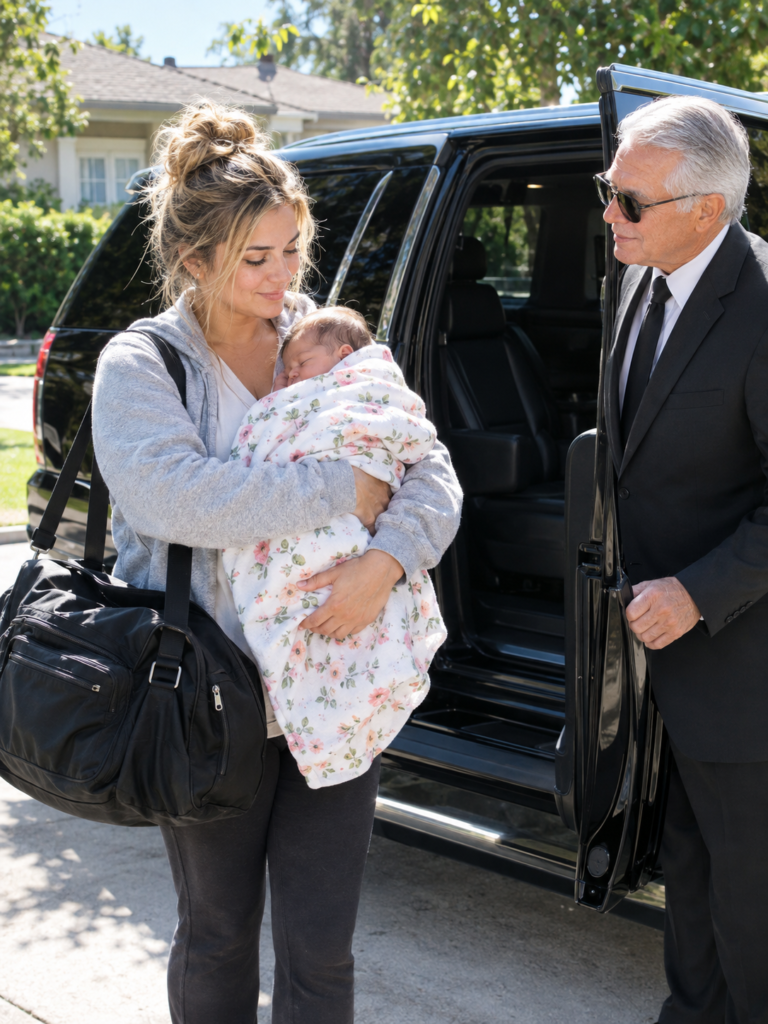
Thirty minutes later, headlights swept across the living room wall.
A black Cadillac Escalade pulled up in front of the house.
Raymond stepped out onto the driveway. He was wearing a charcoal coat. He was sixty-eight now. His hair was all gray. He walked a little slower. But it was Raymond. The same Raymond.
He came up the front steps. He stopped at the door. He looked at me standing there in my pajamas, with Wren in the carrier on my chest and the diaper bag on my shoulder and my hospital bracelet on my wrist.
His face did something I’d seen only once before. In a hospice hallway, sixteen years ago.
“Hello, Simone,” he said gently.
Seeing his familiar face nearly shattered the calm I’d been holding together all evening.
“Hi, Raymond.”
“Your father asked me to bring this,” he said.
He held out a cream-colored envelope. Heavy paper. My full name was written across the front in my father’s precise, slanted handwriting.
Simone Celeste Caldwell.
Not Tran. Caldwell.
I slipped it into my bag without opening it.
“May I see her?” Raymond asked.
I turned so he could see Wren’s face.
He looked at her for a long time. His eyes got wet.
“She has your mother’s nose,” he said.
Nobody had said that. Not once in six days. Beverly said she was all Tran. Roland said she looked like his father.
Raymond looked at her and saw my mother.
While Raymond went back to the Escalade to secure a second infant car seat in the back, a brand-new one my father had apparently sent him to buy on the way, I went into the kitchen.
I took a piece of paper from the pad by the phone. I wrote a note.
Roland,
Wren and I are safe. We’re staying with my family.
When you’re ready to explain why your mother counts as family and we do not, you may call me.
— Simone
I put it on the kitchen island. Under the light. I took my house key off my key ring and put it on top.
Then I walked outside.
Raymond took the diaper bag from my shoulder. He helped me ease Wren out of the carrier and into the car seat. He checked the straps three times. He tucked the yellow blanket around her.
He held the door for me while I climbed into the back seat beside her.
We pulled away from the curb.
I didn’t look back at the house.
What I didn’t know was that our driveway camera had already sent an alert to Roland’s phone.
Roland had installed it the year before. He liked to check it from work. He got a notification every time anything moved in the driveway.
He was eating dessert when it buzzed. Faye had made a peach cobbler. Beverly’s favorite.
Faye told me all of this later. Months later. She said she’d never forget his face.
She said he opened the notification without thinking. The way you check a phone. And then his fork stopped. Halfway to his mouth. A piece of cobbler hanging off it.
He was watching a live video. A tall gray-haired man in a charcoal coat, carrying a diaper bag down the front steps of his house. Loading it into the back of a black Cadillac Escalade. Opening the back door for a woman with a baby.
“Whose car is that?” Beverly asked. She was leaning over his shoulder.
Roland didn’t answer. He was already dialing.
My phone rang as we turned onto the highway.
“Where are you going?” Roland said. He sounded out of breath.
“Somewhere Wren and I are both considered family,” I said.
“Simone, this was one dinner.“
“No,” I said quietly. “This was simply the first time I stopped pretending.”
He went silent.
In the background, I could hear voices. Beverly. Faye. Somebody asking what was going on.
“Who is that man?” Roland asked. “In the driveway. Who is he?”
“My father’s driver,” I said.
Another pause. A long one.
“Your father,” Roland said slowly, “has a driver?“
I looked at Wren, asleep in her car seat beside me. Her tiny fist curled around the edge of the yellow blanket.
“I need to take care of our daughter,” I said. “Good night, Roland.”
I hung up.
We drove beneath the old oak trees lining Peachtree Road. Through the iron gates at the bottom of the long driveway. Past my mother’s rose garden, dark now, the bushes cut back for winter.
The house was lit up. Every window on the first floor.
And upstairs, in my old bedroom, a lamp was glowing in the window seat.
Raymond pulled up to the front steps. He came around and opened my door. He lifted Wren’s car seat out, carefully, like it was full of eggs.
The front door opened.
It wasn’t my father.
It was Gregory, the house manager. He’d worked there since I was nineteen. He was older now too. He smiled at me. A real smile.
“Welcome home, Miss Caldwell,” he said.
“Where’s my father?”
Gregory hesitated. “In his study,” he said. “He asked me to tell you that he didn’t want to overwhelm you. He said you should go upstairs and rest. He said he’d be here whenever you were ready. Even if that’s never.”
I stood in the front hall of the house I grew up in. The marble floor. The curved staircase. The portrait of my mother over the fireplace in the next room, the one he’d had painted when they got married.
Even if that’s never.
“Okay,” I said.
Raymond carried Wren upstairs. I followed him.
My old bedroom looked exactly the same. The window seat. The bookshelves. My mother’s old reading lamp on the nightstand. The bed was made with fresh white sheets. There were clean towels folded on the dresser. A robe. Slippers. A new toothbrush still in its package.
And on the nightstand, a bottle of water and a little dish of the lemon drops I used to eat when I was a kid.
But that wasn’t what made me stop in the doorway.
There was a door on the far wall. It used to lead to a guest room. My mother used it as a sewing room.
The door was open.
I walked through it.
It had been turned into a nursery.
Not just a nursery. A beautiful one. Soft cream walls. A white crib by the window, with a mobile of paper birds hanging over it. Little wrens. Brown and white, with their tails tipped up. A rocking chair with a cushion that was clearly my mother’s old embroidery. A changing table stocked with diapers and wipes and creams. A small bookshelf full of children’s books.
On the dresser, there was a vase of fresh white flowers.
Roses. From my mother’s garden. Out of the greenhouse, because it was November.
I stood in the middle of that room and couldn’t breathe.
“When?” I whispered. “When did he do this?”
Raymond set Wren’s car seat down gently on the floor.
“He started in May,” Raymond said. “When your aunt Paula told him you were expecting.”
May. Six months ago. Before I’d even told him myself. Before I sent the photo at 6:14 in the morning.
“He picked out the birds himself,” Raymond said quietly. “He went to three different stores. He kept asking the sales lady if these were really wrens or just generic brown birds.” He almost smiled. “He wanted them to be wrens.”
“How did he know the name?”
“Paula told him,” Raymond said. “In September. He’s been working on this room every weekend since. Gregory said he wouldn’t let the decorators touch the mobile. He hung it himself. Took him two hours. He doesn’t know how to use a drill.”
I sat down in the rocking chair. My mother’s embroidery under my hands.
“Raymond,” I said. “Why didn’t he call me? Why didn’t he say anything?”
Raymond looked at me for a long time.
“Because he was waiting for you to call him,” he said. “He said you’d made it very clear, the day you left, that he never showed up. He said he didn’t want to force himself on you. He said the least he could do was be ready if you ever asked.” He paused. “He said, If she calls, I’ll be there in thirty minutes. If she doesn’t, at least the room will be there.“
Only then did I open the envelope my father sent.
Inside was a brass key. Old. Heavy. With a little tag on it in my mother’s handwriting.
Simone’s room.
I remembered that key. My mother gave it to me when I was twelve, when I told her I wanted a lock on my door like a grown-up. I’d lost it years ago. When I moved out, I couldn’t find it anywhere.
He’d had it all along.
There was a note with it. A small card. In my father’s precise, slanted handwriting.
Your room is ready. Everything else can wait until you are.
That was all.
I held the brass key in one hand and the card in the other and cried in my mother’s rocking chair while my daughter slept in her car seat under a mobile of paper wrens.
Back at our house in Smyrna, Roland found my note beneath the kitchen light.
He’d driven home from Faye’s in my Camry. Beverly and Faye followed him in Beverly’s Lexus.
He read the note standing at the kitchen island. Beverly and Faye stood behind him.
When you’re ready to explain why your mother counts as family and we do not, you may call me.
“Well,” Beverly said. “That’s very dramatic.”
Roland didn’t answer her.
He picked up his phone. He scrolled through his contacts. To a number he’d saved six years ago, the week before our wedding, when I gave it to him “in case of emergency.” He’d never once called it.
Simone’s Father.
He pressed call.
A man answered on the second ring. Smooth. Polite.
“Caldwell residence.”
Roland hesitated.
“Caldwell?” he said.
“Yes, sir. This is Gregory. How may I help you?”
“I’m looking for Simone Tran,” Roland said.
“Miss Caldwell and her daughter are resting, sir,” Gregory said. “Mr. Caldwell has asked that they not be disturbed tonight. If you’d like to leave a message, I’d be happy to take it.”
Roland stood in his kitchen with the phone against his ear.
Faye told me later that it was Derek, her husband, who said it first. Standing in the doorway. Looking at his own phone, where he’d just typed in a search.
“Caldwell,” Derek said. “Roland. Malcolm Caldwell? Caldwell Freight?“
He turned his phone around. A photo. A Forbes profile. A gray-haired man in a dark suit, standing in front of a forty-story building downtown.
“That’s her father?” Derek said. “Her father who’s retired in logistics?“
Beverly sat down very slowly on one of the kitchen stools.
I didn’t sleep much that night.
Wren woke up at eleven. Then at one-thirty. Then at three-fifteen.
At three-fifteen, I was sitting in my mother’s rocking chair, feeding her, when I heard footsteps in the hallway.
Slow. Careful. Like somebody trying not to wake anyone.
They stopped outside the nursery door.
“Simone?” my father said quietly. “Is everything all right? I heard her.”
I looked up.
He was standing in the doorway. In a navy bathrobe. He was seventy-one now. He’d had a heart attack two years before, I’d learned from Aunt Paula. A bypass. He was thinner. His hair was white. He looked older than I’d ever seen him.
He looked unsure. My father, who’d walked into boardrooms full of billionaires and never once looked unsure in his life.
“She’s just hungry,” I said.
He nodded. He didn’t come in. He just stood there in the doorway.
“Do you need anything?” he asked. “Water? Something to eat? I can…” He stopped. “Gregory showed me how to warm a bottle. Last week. In case. I practiced.”
“You practiced warming a bottle?”
“Six times,” he said. “I burned my wrist twice testing it.” He held up his left wrist. There was a small pink mark on it. “The nurse at the hospital said to test it on your wrist. She didn’t say how long to wait.”
I laughed. I didn’t mean to. It just came out.
My father almost smiled.
“Can I come in?” he asked.
I looked at him for a long moment.
“Yes,” I said.
He sat down on the floor. Right there on the nursery carpet, next to the rocking chair. In his bathrobe. With his back against the wall.
He didn’t say anything for a long time. He just watched Wren eat.
“She has your mother’s nose,” he said finally.
“That’s what Raymond said.”
“Raymond’s right,” my father said. “Raymond’s usually right.” He looked at his hands. “Raymond’s been right about a lot of things. For a long time.”
“Like what?”
He was quiet for a while.
“Like that I should have been there,” he said. “In March. When your mother died. Raymond called me in Chicago. Twice. He said, Malcolm, you need to come home now. Today. And I said the doctors said there was time. And I said the deal would fall apart without me. And I said I’d be there in a few days.” He swallowed. “He called a third time at noon. He didn’t say anything. He just stayed on the line. And I said, Raymond, I’ll be there tomorrow. And he said, No, sir, you won’t. And he hung up.”
I stopped rocking.
“I’ve thought about that every day for sixteen years,” my father said. “No, sir, you won’t. He was right. I wasn’t there. Raymond was. Marisol was. You were. Holding her hand.” His voice cracked. “And I was in a conference room in Chicago signing papers.”
“You never told me that,” I said.
“I never told anyone,” he said. “I was ashamed. I’ve been ashamed for sixteen years. That’s why I couldn’t look at you. After. Every time I looked at you, I saw that hallway. I saw you walking past me to Raymond. And I knew I deserved it.”
Wren had fallen asleep against me. Milk on her lip.
“So you sent Raymond,” I said quietly. “To everything. Graduation. College. My wedding.”
“I sent Raymond,” my father said, “because I didn’t think I’d earned the right to be there. And because I was a coward. And because the only thing I knew how to do was build things.” He looked up at the paper wrens hanging over the crib. “I built a whole company so my girls would never want for anything. And it turned out the only thing either of them ever wanted was for me to show up.”
He told me about the heart attack.
Two years ago. In his office. Alone. At eleven at night. His assistant had gone home. Nobody knew. He crawled to the phone and called 911 himself.
“I lay on that floor waiting for the ambulance,” he said. “And I thought, if I die right here, my daughter won’t even know. Nobody’ll call her. She’ll read it in the newspaper.” He shook his head. “I made it. They opened up my chest and fixed me. And when I woke up, the first thing I asked the nurse was whether anybody had called my daughter.” He looked at me. “Nobody had. Because I’d never listed you. You weren’t my emergency contact. Raymond was.”
I didn’t know what to say.
“After that,” he said, “I stepped back from the company. I hired a CEO. I started going to a counselor. A grief counselor. Sixteen years late.” He almost laughed. “She asked me what I regretted most. I said, Chicago. She said, And what are you going to do about it? And I said, There’s nothing I can do. It’s done.” He looked at the floor. “She said, Is it? Your daughter’s still alive.“
“So you built a nursery,” I said.
“So I built a nursery,” my father said. “When Paula told me you were pregnant. I thought, maybe I can’t fix Chicago. But maybe, if she ever needs somewhere to go, I can be ready. For once in my life, I can already be there when she gets there.” He looked up at me. “And then tonight, you called.”
“Dad, come get me,” I said quietly.
“Dad, come get me,” he repeated. His eyes were wet. “You don’t know what those words meant to me. Thirty minutes. I told Raymond to go and I sat in my study and I watched the clock. I couldn’t breathe until Gregory came in and said you were upstairs.”
I handed him the baby.
I don’t know why. I didn’t plan to. I just stood up and held her out.
He looked at her like she was made of glass. Like she might break if he breathed wrong.
“I don’t know how,” he said.
“Support her head,” I said. “That’s all. Just support her head.”
He held out his arms. I put her in them. He cradled her against his bathrobe. Stiffly. Awkwardly. Like a man holding a bomb.
Wren didn’t wake up. She just sighed and pressed her face into his chest.
My father looked down at her.
And I watched my father, Malcolm Caldwell, who built a shipping empire and signed mergers with three-sentence emails and gave my mother’s eulogy in under two minutes, start to cry.
Silently. Sitting on the floor of a nursery he’d built with his own hands, in a navy bathrobe, with a burn mark on his wrist from practicing bottles. Holding his granddaughter for the first time.
“Hello, Wren,” he whispered. “I’m your grandfather. I’m sorry I’m late. I’m going to try very hard not to be late anymore.”
Roland called sixteen times the next day.
I didn’t answer. I texted him once. We’re fine. I need some time.
Beverly called too. Her messages had changed overnight.
The first one, at 8:12 a.m., said: Simone, dear, I think there’s been a terrible misunderstanding. Please call me.
The second one, at 10:30, said: I had no idea about your father, sweetheart. Why didn’t you tell us? We would have done so many things differently.
The third one, at noon, said: Roland is beside himself. You should come home. A baby needs both parents. I’m sure your father would agree. Perhaps we could all have dinner? I’d love to meet him.
I read that one out loud at the breakfast table. My father was sitting across from me, reading the newspaper. Wren was asleep in a bassinet next to my chair.
He lowered the newspaper.
“She’d love to meet me,” he said.
“Apparently.”
“Six days after you gave birth,” he said slowly, “she texted you that her son deserved one peaceful night away from you.”
I stared at him.
“Raymond told me,” he said. “Last night. He saw it on your phone when you were getting into the car. You’d left it on the seat.” He folded the newspaper very carefully. “I’m sorry. I shouldn’t have asked him. But I needed to know what happened.”
“It’s okay,” I said.
He looked at the phone on the table.
“We would have done so many things differently,” he read. He looked up at me. “You understand what she’s saying, don’t you? She’s saying she would have been kind to you. If she’d known you had money.”
“I know.”
“That’s not kindness, Simone,” my father said. “That’s accounting.”
Roland came on the fourth day.
He drove up to the gate at the bottom of the driveway. Gregory called up to the house. Roland was asking to see me.
I almost said no.
Then I thought about my father, standing in the doorway of a hospice room with his briefcase in his hand. Five hours late. And me walking past him.
I thought about sixteen years.
“Let him in,” I said.
He came up the front steps slowly. Like he was walking into a church. He looked up at the house. The columns. The windows. The roses.
He looked terrible. He hadn’t shaved. He was wearing the same navy dinner jacket from Faye’s party. I don’t think he’d changed it.
Gregory showed him into the front hall. I was waiting at the bottom of the stairs. With Wren in my arms.
Roland stopped. He looked at the marble floor. The curved staircase. The portrait of my mother over the fireplace.
“You grew up here,” he said.
“I did.”
“You never told me.”
“No.”
“Why?”
I looked at him for a long time.
“Because I wanted to know who you’d be,” I said, “if you thought I didn’t have anything.”
He flinched.
“And now I know,” I said.
We sat in the library. Gregory brought coffee. Roland didn’t touch his.
“I’m sorry,” he said. “About the dinner. About the car. About all of it. It was Mom’s idea. She said you’d be more comfortable at home. She said you’d be too tired. She said—”
“Roland,” I said. “Stop.”
He stopped.
“Your mother texted me,” I said. “Before the garage door even closed. He deserves one peaceful night away from you.“
His face went white.
“She did what?”
I held out my phone. He read it. I watched him read it twice.
“I didn’t know,” he said. “I swear to God, Simone. I didn’t know she said that.”
“I believe you,” I said. “But it doesn’t matter.”
“How can it not matter?”
“Because you took my car,” I said. “You took the car seat and the diaper bag. You left your six-day-old daughter and your wife, who was still bleeding, alone in the house without a way to leave. And you went to a dinner where there were seven plates. And none of them were for us.” I took a breath. “You didn’t need your mother’s text to do that. You did that all by yourself.”
Roland put his face in his hands.
“For six years,” I said, “I’ve been your wife with no family. Your mother called me the teacher. She told your aunt at our wedding that you were all I had. She picked our paint colors. She picked our crib. She took Wren out of my arms in the delivery room before I’d held her for three minutes.” My voice cracked. “And every single time, you laughed, or you changed the subject, or you said, That’s just how Mom is.“
“I know,” he said.
“I didn’t need your mother to love me,” I said. “I needed you to stand next to me while she didn’t.”
Roland stayed for two hours.
At some point, my father came into the library. He didn’t knock. He just walked in and stood by the fireplace with his hands in his pockets.
Roland stood up so fast he knocked over his coffee cup.
“Mr. Caldwell,” he said. “Sir. I’m—it’s an honor to finally—”
“Sit down, Roland,” my father said.
Roland sat down.
My father didn’t sit. He stood by the fireplace under my mother’s portrait and looked at my husband for a long time.
“I’m going to tell you something,” he said finally. “And then I’m going to leave you two alone. Because this is between you and my daughter. Not me.”
Roland nodded.
“Sixteen years ago,” my father said, “my wife was dying. My daughter was sixteen. And I was in Chicago. Closing a deal. Because I told myself it was for them. I told myself there’d be time.” He looked up at the portrait. “There wasn’t. My wife died holding my daughter’s hand and the housekeeper’s hand. And my driver was the one who held my child in the hallway afterward.”
Roland didn’t say anything.
“I told myself I was building something for my family,” my father said. “And I was. I built a lot. And I lost the only thing that mattered.” He turned and looked at Roland. “You took her car to a dinner six days after she gave birth. Because your mother wanted one peaceful night. Because it was easier. Because you didn’t want to make it difficult.”
His voice was very quiet.
“Every man who loses his family,” my father said, “does it one easy night at a time. I know. I’m the expert.”
He walked to the door. He stopped.
“Don’t be me, son,” he said. “It’s very lonely in a house this big.”
He left.
Roland didn’t say anything for a long time after my father left.
“What do you want me to do?” he asked finally. “Tell me. I’ll do anything.”
I looked at Wren, asleep in my arms.
“I want you to figure out who your family is,” I said. “Not me. You. You have to figure it out yourself. If I tell you, it doesn’t count.”
“You’re my family,” he said. “You and Wren. Of course you are.”
“Then why weren’t we at the table?”
He didn’t have an answer.
“I’m going to stay here for a while,” I said. “I don’t know how long. My father wants to help with the baby. I want to let him. I need to let him.”
“And us?”
“I don’t know,” I said honestly. “You can come see Wren whenever you want. You’re her father. That doesn’t change. But you and me…” I shook my head. “I need to see what you do. Not what you say. What you do.”
Roland went to see a counselor the next week. A family therapist. On his own. Nobody made him.
He called me after the first session. He was quiet on the phone.
“She asked me to draw a picture of my family,” he said. “Like a little kid. With crayons. On a piece of paper.” He laughed weakly. “I drew my mom in the middle. Really big. And Faye next to her. And Aunt Glenda. And then I drew you and Wren in the corner. Small. Off to the side.”
I didn’t say anything.
“I didn’t even notice I did it,” he said. “Until she held it up. And I looked at it. And I thought, that’s the dinner. That’s Faye’s table. Seven plates. Mom in the middle.” He swallowed. “And you in the corner. Not even at the table.”
“Yeah,” I said quietly. “That’s the dinner.”
“I’m going to draw it again,” he said. “Next week. And the week after that. Until I get it right.”
He came to see Wren every other day. He drove across Atlanta in rush hour. He sat in the nursery in my mother’s rocking chair and held his daughter and fed her bottles.
My father was usually there too. The first few times, the two of them barely spoke. My father would read the newspaper in the corner. Roland would rock the baby. They’d nod at each other.
The fourth time, my father came in with a bottle. He tested it on his wrist. He waited exactly four seconds. He handed it to Roland.
“Four seconds,” my father said. “Not two. It needs time to cool on your skin. I learned the hard way.”
He showed Roland the burn mark on his wrist. Almost faded now.
Roland looked at it. Then at my father.
“You practiced?” he said.
“Six times,” my father said. “Before she ever got here.”
Roland was quiet for a long time.
“I never practiced anything,” he said. “I just figured my mom would show Simone.”
Beverly called me again in December. Three weeks after the dinner.
This time, I answered.
“Simone,” she said. Her voice was different. Smaller. “I’d like to apologize.”
I didn’t say anything.
“About the text,” she said. “And the dinner. And…” She stopped. “And six years. Roland told me what the counselor said. About the picture. And the corner.” She took a breath. “I didn’t know who you were. Your father. All of that. And I know how it looks. That I’m calling now. Now that I know.”
“How does it look, Beverly?”
“Like I only care because you have money,” she said.
“Do you?”
There was a long silence on the line.
“I don’t know,” Beverly said finally. “That’s the truth. I’ve been asking myself that for three weeks. And I don’t know.” She paused. “My husband’s mother treated me the same way. When I married into the Trans. I was a waitress. From a little town in South Carolina. She called me the waitress until the day she died.” Her voice cracked. “I promised myself I’d never do that to my son’s wife. And then I did it. Exactly. Word for word. I called you the teacher.“
I sat down on the edge of my bed.
“I’m not asking you to forgive me,” Beverly said. “I’m just asking if I can see my granddaughter sometime. Even if you’re there the whole time. Even if your father’s there. Even if I have to sit in the corner.”
I looked at Wren, asleep in her crib under the paper wrens.
“You can see her,” I said. “In January. Here. And Beverly?”
“Yes?”
“You’re going to hold her when I hand her to you,” I said. “Not before.”
There was a long pause.
“Yes,” Beverly said quietly. “That’s fair.”
I went home in February.
Not to the house in Smyrna. Roland sold it. He said he couldn’t stand to look at the driveway anymore.
We bought a smaller house in Decatur. Near the school where I used to teach. Three bedrooms. A big backyard with a fig tree. I picked the paint colors.
Roland and I are still working on it. Some days are hard. Some days I look at him and see the man who took my car keys off the hook and said please don’t make this difficult. Some days I see the man who sits on the nursery floor at three in the morning, singing off-key, so I can sleep.
We see the counselor together now. Every other Thursday. Roland still draws his family every few weeks. Just to check.
Last month, he showed me the newest one.
There was a table. A long one. With pendant lights over it.
And around it, there were people. Him. Me. Wren in a high chair. My father in a dark suit, very tall, very stiff, with a tiny burn mark drawn on his wrist. Raymond in his charcoal coat. Gregory. Faye and Derek. Aunt Paula. Beverly, smaller now, sitting at the far end of the table.
And at the very head of the table, where Beverly used to sit, Roland had drawn an empty chair. With a little rose on the seat.
“Who’s that for?” I asked.
“Your mom,” he said. “Celeste. Wren’s named after her. I figured she should have a seat.”
I didn’t say anything. I couldn’t.
I counted the plates. Roland had drawn every single one.
There were twelve.
My father comes over every Sunday now.
Not for dinner. For the whole day. He drives himself. He sends Raymond home. “Raymond has done enough of my showing up,” he says. “It’s my turn.”
He takes Wren for walks in her stroller around the neighborhood. He knows all the neighbors’ names now. Mrs. Adeyemi, who left the soup, gave him her recipe. He made it for us last week. It was terrible. We ate every drop.
He reads to Wren. The same books my mother used to read to me. He reads slowly, in his deep careful voice, and he does all the voices badly, and Wren laughs at him.
Last Sunday, he was sitting on the floor of the living room with her. She’s four months old now. She can almost sit up by herself. She was holding on to his finger and pulling herself forward, and he was holding very still so she wouldn’t fall.
“Simone,” he said, without looking up. “Can I ask you something?”
“Of course.”
“That night,” he said. “When you called. Why did you call me?” He looked up. “You had your aunt Paula. You had friends. You could have gone to a hotel. You haven’t called me in two years. Why me?”
I thought about it.
I thought about standing in my kitchen with my daughter against my chest and my hospital bracelet on my wrist, looking at a photo of seven plates and no place for us.
I thought about the text at 6:14 in the morning. Is she healthy? Are you?
“Because you asked,” I said. “The day she was born. You were the only one who asked if I was okay. Not just her. Me.”
My father looked at me for a long time.
“Roland’s mother took her out of my arms,” I said. “Roland was texting. The nurses were busy. And at six in the morning, the one person who’d never shown up for anything asked if I was okay.” My voice cracked. “I didn’t know what to do with that. So I waited six days. And then I needed somebody. And I thought, he asked.“
My father didn’t say anything.
He looked down at Wren, holding his finger, pulling herself forward an inch at a time.
“It took me sixteen years to learn to ask,” he said quietly. “I’m glad I finally got it right once.”
My hospital bracelet is in a drawer in Wren’s room now. In the top drawer of the dresser my father picked out. Next to the yellow blanket with the ducks around the edge, and the brass key with my mother’s handwriting on the tag.
Simone’s room.
My father gave me the key back for good. “It’s your room,” he said. “It’ll always be your room. Use it whenever you want. Or never. That’s up to you.”
I go over on Tuesdays. With Wren. We sit in the window seat in my old bedroom and look out at my mother’s rose garden. My father’s been taking care of it. He bought a straw hat. He kneels in the dirt with the gardeners standing around looking embarrassed.
Last Tuesday, he cut a white rose and brought it up to the nursery. He put it in the vase on the dresser.
“Your mother would have liked her,” he said, looking at Wren in her crib. “She would have loved her.”
“I know,” I said.
“She would have been at the hospital,” my father said. “She’d have been there at three in the morning in her pearls. Like Roland’s mother.” He paused. “But she’d have handed the baby back to you.”
I laughed. Then I cried a little. Then I laughed again.
My father put his hand on my shoulder. Awkwardly. Like a man who’s still learning.
“Thank you for calling me,” he said. “That night. I don’t think I ever said that properly.”
“You did,” I said. “On the phone. Before you hung up.”
“I want to say it again,” he said. “Every time. For as long as I live.” He squeezed my shoulder. “Thank you for letting me come get you.”
Down in the garden, a little brown bird landed on the edge of the birdbath. It hopped. It tipped its tail up. It looked around.
A wren.
My father saw it at the same time I did.
“Is that a real one?” he asked. “Or a generic brown bird?”
“That’s a real one, Dad,” I said.
He smiled. It changed his whole face.
“Good,” he said. “I’d hate to have gotten it wrong.”