“Verna. I’ve met someone. We’re going to Cabo for a while. Don’t call. You’ll be fine. You have your little job. D.”
That was the whole note. Four lines in his slanted handwriting on the back of an envelope from the electric company. It was stuck to the refrigerator door with the orange pumpkin magnet our grandson Caleb made in kindergarten, the one with one googly eye missing.
It was the first of December. A Tuesday. I’d come home from work at 5:40, like always, and the house was too quiet. No TV going in the den. No smell of the cigar Delmar swore he didn’t smoke anymore. His truck wasn’t in the driveway, but that wasn’t unusual. His truck was hardly ever in the driveway that year.
I hung up my coat. I set my purse on the counter. And then I saw the note.
I read it standing up. Then I read it again. Then I pulled out a kitchen chair and sat down, still wearing my work shoes, my name badge still clipped to my cardigan.
My name is Verna Pruitt. I was sixty years old that December. I live in Greeley, Colorado, in the same brick ranch house on Sixteenth Street where we raised our two boys. I married Delmar Pruitt when I was twenty six, and on that Tuesday evening, I’d been married to him for thirty four years.
I sat at the table for a long time. The refrigerator hummed. Outside, a neighbor’s dog was barking at something.
Then I walked down the hall to our bedroom.
His side of the closet was half empty. His good boots were gone. His suits were gone, all three of them, but he’d left the brown corduroy jacket I bought him for our twentieth anniversary. His golf clubs were gone from the corner of the garage, along with the big rolling suitcase we’d bought for our trip to Branson in 2015.
He’d taken the Christmas cash out of the coffee can over the stove, too. Four hundred dollars I’d been saving for the grandkids’ presents. The lid was sitting on the counter beside the empty can.
I went back to the kitchen. I sat down at the table again.
And then, because I’m the kind of person I am, I opened my laptop and checked my retirement account.
I should explain about that account.
Delmar sold farm equipment for most of his life. Tractors, combines, balers, irrigation pivots. He worked out of the Case dealership on Highway 85 for twenty two years, then moved to a Deere lot in Kersey. He was a good salesman. Big laugh, big handshake, could talk to a wheat farmer about weather for two hours and leave with a signed contract for a $300,000 combine. In good years, he made very good money. In bad years, when the price of corn fell or a drought hit or the farmers held on to their old equipment one more season, he made almost nothing.
I worked at the same bank for thirty five years. First National Bank of the Front Range. I started as a teller at twenty five, right out of community college, standing behind the counter at the branch on Tenth Avenue counting out twenties for people cashing their paychecks. I moved to the back office. Then to loan processing. Then, twelve years ago, to the bank’s fraud and security department, where I’ve been ever since.
Steady. Quiet. Boring, Delmar called it.
He loved to say it at parties. We’d be standing around someone’s kitchen at a Christmas get together, and he’d put his arm around my shoulders and squeeze a little too hard and say, “My wife counts other people’s money for a living.” Then he’d wink at whoever was listening. “Her little job.”
Everyone laughed. I laughed too. That’s what you do.
My little job paid for both our sons’ braces. It paid for the new roof in 2009 after the hailstorm, when Delmar’s commission checks dried up for eight months. It paid for his truck. Twice. The first time when the transmission went on his old Silverado in the middle of a bad year, and the second time when he decided he needed a new Ram with leather seats “to look professional” for his customers.
And every single month, for thirty five years, I took a piece of my paycheck and put it into my own retirement account. A traditional IRA, in my name only, held right there at my bank. In the early years, it was fifty dollars a month. Later, when the boys were grown and I’d gotten some raises, it was three hundred, then five hundred. The bank matched a little through its own plan, and when I changed jobs inside the bank, I rolled that over into the IRA too. I never touched it. Not when the roof caved. Not when Delmar’s commission dried up. Not when he wanted the Ram. I paid for those things out of my checking account and my overtime, and I left the IRA alone.
By the time I turned sixty that September, it had $186,214 in it.
It was the one thing in my life that was entirely mine.
I logged in. I typed my password with fingers that felt very far away.
Balance: $0.00.
I stared at the screen. I refreshed the page. Still $0.00.
I clicked on the transaction history. On Sunday, November 29, two days earlier, a full distribution request had been processed online for $186,214.08. Federal tax withholding had been waived on the request. The full amount was scheduled to go out by international wire transfer to an account at a bank in San José del Cabo, Baja California Sur, Mexico. Beneficiary name: Crystal R. Dunbar.
I knew that name.
The distribution form was attached as a scanned PDF. I opened it.
At the bottom, on the signature line, was my name. Verna L. Pruitt.
Except I had never signed it.
I’ve spent twelve years in the fraud department looking at signatures. Thousands of them. Checks, loan documents, power of attorney forms, withdrawal slips. I’ve been trained by the FBI’s questioned document examiners at a two week course in Quantico. I’ve testified in Weld County District Court eleven times. I can tell you that most people who forge a signature make the same mistakes. They go too slowly. They’re copying a shape instead of writing a name, so the line shakes a little at every curve. They lift the pen in places a real signer never would. They get the size right and the rhythm wrong.
My real signature starts with a big looping V that leans hard to the right, because I learned cursive from Sister Agnes at St. Peter’s in 1972 and she slapped your knuckles if you wrote straight up and down. My L in the middle is tiny, almost a dot. And I end Pruitt with a flat little tail on the last t that runs off to the right, because I’ve been signing it in a hurry at the bottom of bank documents for thirty five years.
The signature on that form had a V that stood up almost straight. The L was a full, careful loop. The tail on the t was missing. There was a tiny blob of ink at the beginning of the P where the pen had paused and then started again.
It wasn’t even a good forgery.
Below my forged signature was a notary stamp. Ronald J. Kessler, Notary Public, State of Colorado. My commission expires March 2028.
Ronnie Kessler. Delmar’s best friend since high school. He sold insurance out of a little office next to the Burger King on Eighth Street. He’d been best man at our wedding.
I sat back in my chair.
I didn’t cry. I want to be honest about that. I think people expect you to cry, and maybe I should have. But mostly what I felt was a strange, cold calm. The same calm I feel at work when I open a case file and see something wrong.
I picked up my phone and called my oldest son.
Travis is thirty two and lives in Fort Collins with his wife, Jenna, and their two kids. He’s an electrician, steady like me, slow to anger like me. When I told him, he didn’t say anything for a few seconds.
Then he said, “Mom. He did what?”
I read him the note. I told him about the account.
“Call the police,” he said. His voice was shaking. “Right now. Mom, call the police right now, I’m getting in the car.”
“Don’t get in the car. It’s snowing on 34. I’m all right.”
“You’re not all right. He stole your retirement.”
“I know,” I said. “I’m going to handle it.”
“Mom…”
“Travis. I’ll call you back in an hour. I promise.”
After he hung up, I sat there for another minute. I knew exactly what I was supposed to do. I’d told a hundred victims what they were supposed to do. Call the bank. Call the police. Don’t contact the person who did it.
I called Delmar’s cell phone instead.
I don’t know why. I think part of me needed to hear him say it.
He answered on the second ring. I could hear the ocean behind him. Waves. Music, the kind with steel drums. And a woman laughing, close to the phone.
“Verna,” he said. “I told you not to call.”
“You took my retirement.”
He sighed, like I’d asked him to take out the trash. “Our retirement. We’re married. What’s yours is mine.”
“It was in my name, Delmar. You signed my name.”
He laughed.
“Prove it,” he said. “Look, I worked hard my whole life. Thirty years busting my tail on those lots. I deserve to enjoy it. And you’ll be fine. You’ll keep counting pennies at the bank until you’re seventy. You love that place. You’ll be fine.”
The woman in the background said something. I couldn’t hear the words, but I heard the tone. Teasing. Delmar laughed again.
“Don’t call me again,” he said. “Merry Christmas, Verna.”
He hung up.
I set the phone down on the table next to the note with the pumpkin magnet.
I didn’t cry. I didn’t scream. I didn’t throw anything.
“Okay,” I said to the empty kitchen.
What Delmar didn’t know, what he’d never bothered to know in twelve years, was what my little job actually was.
He thought I was still a teller. Or a clerk. Somebody who sat at a desk and moved paper around. When I got promoted to the fraud department in 2014, I came home and told him at dinner, and he said, “That’s nice, Vern. Pass the potatoes.” He never asked about it again. When I flew to Quantico for the document examination course, he told his friends I was “at some bank training thing in Virginia.” When I testified in court the first time, in a case where a home health aide had forged an elderly woman’s checks for two years and stolen $91,000, he didn’t come. He had a golf tournament.
I’m the person at First National who investigates forged signatures. I’m the person they call when a wire transfer looks wrong. I’ve worked with the Greeley Police Department, the Weld County Sheriff’s Office, and the FBI. I’ve helped put people in prison for exactly what my husband had just done.
And I know something most people don’t.
An international wire transfer isn’t instant. People think it is, because they see movies where someone presses a button and the money vanishes into a Swiss bank account. That’s not how it works. An international wire from a small regional bank like ours doesn’t go straight to Mexico. It goes through what’s called an intermediary bank first, a big correspondent bank that handles the currency exchange and passes it along. That takes time. Usually one to three business days, sometimes longer when there’s a holiday or the receiving bank is slow.
And on a large distribution from a retirement account, sent to a foreign account in a name that isn’t the account holder’s, there are compliance checks. Holds. Reviews.
There’s a window. A small one.
Delmar had submitted that form on a Sunday. Banks don’t process wires on Sundays. So the request would have sat in the queue until Monday morning. Then it would have gone through review. If it went out Monday afternoon, it might still be sitting at the intermediary bank in Houston.
It was Tuesday night, 6:28 p.m.
That night, I made three phone calls.
The first was to my own bank’s after hours fraud hotline. A young man named Kevin answered. I gave him my employee number, 40177, and my account number, and I told him exactly what I wanted. An immediate fraud recall on the outgoing international wire. A hold on the account. A flag on any other accounts connected to my name or Delmar’s.
Kevin was quiet for a second. “Mrs. Pruitt? From the fraud team? Verna?”
“Yes, Kevin.”
“Oh my gosh. Okay. Okay.” I heard him typing fast. “The wire shows released at 3:14 p.m. yesterday. To JPMorgan Chase in Houston as intermediary. It doesn’t show credited to the beneficiary yet. I’m initiating the recall now and sending a fraud notice to Chase. I’m also calling Marisol.”
Marisol Reyes is my supervisor. She’s fifty one, from Pueblo, and she has the patience of a saint and the instincts of a bloodhound. She called me twelve minutes later, from her kitchen, with her kids yelling in the background.
“Verna,” she said. “Tell me everything.”
I told her.
“That son of a…” She stopped herself. “Okay. I’m calling Chase’s wire fraud line myself. Don’t you worry. You know how this works. We have a shot.”
“I know.”
“Are you okay?”
“I don’t know yet,” I said, and it was the first true thing I’d said all night.
The second call was to Detective Ray Salazar of the Greeley Police Department’s financial crimes unit. I’d worked with Ray on maybe two dozen cases over the years. He’s in his late forties, quiet, with a gray mustache and a habit of tapping his pen against his teeth when he thinks. He gave me his personal cell number years ago after a big elder fraud case and told me to call him anytime.
He answered on the first ring. “Verna. What’s going on?”
When I finished telling him, he was silent for a long time.
“Your own husband,” he said finally.
“Yes.”
“And Ronnie Kessler notarized it.”
“Yes.”
“Kessler,” Ray said slowly. “The insurance guy on Eighth?”
“That’s him.”
“Okay,” Ray said. “I’m going to need the distribution form, the note, his phone number, and the account information for the beneficiary. I’ll come by in the morning. Don’t touch the note. Don’t call him again.”
“I already called him once.”
Ray sighed. “Of course you did. What’d he say?”
“He said, ‘Prove it.’”
There was a pause on the line. Then Ray Salazar laughed. Not a mean laugh. A tired, almost happy one.
“He said that to you?” he said. “To you? Oh, Verna. That poor dumb man.”
The third call was to a lawyer.
Joan Albrecht had done the paperwork when my mother passed in 2018. She was in her sixties, sharp as a tack, and she had a reputation in Weld County as the divorce attorney husbands least wanted to see across the table. It was 7:40 at night when I called her office. I left a voicemail. She called me back at 7:52 from her car.
“Verna Pruitt,” she said. “I remember you. Your mother’s estate. What can I do for you?”
I told her.
“Good God,” Joan said. “Are you safe? Is he there?”
“He’s in Cabo.”
“Good. Keep him there. Don’t touch any joint accounts. Don’t move anything. Write down everything you remember. I’ll see you in my office at noon tomorrow.”
Then I put my phone on the charger, took off my work shoes, took a hot shower, and went to bed.
I slept for nine hours. I don’t think I’d slept nine hours since Travis was born.
The next morning, Ray Salazar came by at eight with a younger officer and a box of evidence bags. He photographed the note on the refrigerator. Then he carefully peeled it off and put it in a plastic sleeve, pumpkin magnet and all.
“I’ll need to keep the magnet for now,” he said apologetically. “Fingerprints.”
“Caleb made that,” I said. “My grandson.”
“I’ll make sure you get it back.”
He looked around the kitchen. At Delmar’s empty coffee mug in the sink. At the coffee can on the counter with the lid off.
“He took the grandkids’ Christmas money too?”
“Four hundred dollars.”
Ray shook his head slowly. “Thirty four years,” he said. “Verna, I’m really sorry.”
“Me too,” I said.
I went to work that day. Marisol tried to send me home, and I wouldn’t go. I sat at my own desk in the fraud office on the third floor, with my coffee and my reading glasses, and I worked my own case. Not officially. Marisol made very sure the official case was assigned to someone else, a sharp young examiner named Dante Okafor. But Dante sat right next to me and asked questions, and I answered them.
At 10:47 that morning, Marisol walked over to my desk holding a printout.
“Chase has it,” she said.
I looked up.
“The wire hit Chase in Houston yesterday afternoon. Their compliance system flagged it for review before releasing it to the Mexican bank. Large amount, IRA distribution, foreign beneficiary not matching the account holder name. It’s been sitting in their pending queue since 4:00 yesterday.” She smiled, a slow, big smile. “Our recall request reached them at 7:06 last night. They’ve frozen it. It never left the country, Verna. It never got to Cabo.”
I put my hand over my mouth.
“Chase’s fraud team needs our formal indemnity letter and a copy of the police report,” Marisol said. “Ray’s already sending it. Then they’ll send it back to us. Could take a few days. But it’s coming home.”
I sat there in my chair for a long moment. People in the office had stopped working. Dante was grinning at me. A woman from loan servicing named Bev, who I’d known for twenty years, started clapping, and then a few other people did too.
I stood up. I said, “Thank you.” And then I went into the ladies’ room and locked myself in the last stall and finally cried for about fifteen minutes. When I came out, I fixed my lipstick and went back to my desk.
At noon, I sat in Joan Albrecht’s office downtown, a corner room full of plants and law books, and told her everything again.
She took notes on a yellow legal pad in shorthand. When I finished, she leaned back in her chair.
“First things first,” she said. “We file for divorce this week. On what grounds doesn’t matter in Colorado. It’s no fault. But I’m also going to file for temporary orders. Exclusive use of the house, since he’s abandoned it. A freeze on any other marital assets so he can’t touch them. And a restraining order preventing him from contacting you directly about anything except through me.”
“He drained our joint savings too,” I said. “I checked this morning. We had $24,800. He took $24,500 on November 27.”
Joan wrote it down. “That’s a joint account, so technically he can withdraw it. But a judge will see it for what it is. Dissipation of marital assets. He’ll have to account for every dollar.”
“And the IRA?”
“The IRA is in your name. A spouse doesn’t have the right to take money out of the other spouse’s individual retirement account. Ever. Not without your signature. Which he forged.” Joan put down her pen. “That’s not a divorce issue, Verna. That’s a crime. Forgery. Theft. Possibly identity theft. And whoever notarized that form without you present is in serious trouble too.”
“Ronnie Kessler,” I said.
Joan raised her eyebrows. “Ronnie Kessler from Kessler Insurance?”
“Delmar’s best man.”
She shook her head. “I’ve known Ronnie for twenty years. He sold me my first car insurance policy. He’s not a criminal mastermind. He’s going to fold the second someone puts a badge in front of him.”
She was right.
Ray Salazar walked into Kessler Insurance on Wednesday afternoon. By Thursday morning, Ronnie had come into the police station with his own lawyer and given a full statement.
Ray told me about it on the phone that evening.
“He was sweating so much he soaked through his shirt,” Ray said. “He said Delmar came to his office on Saturday, the twenty eighth, with the form already signed. Said you were home sick with the flu and couldn’t come in. Said you’d signed it at the kitchen table, and he just needed it notarized so you could move the money for a big Christmas surprise. Ronnie asked to see your ID. Delmar had your driver’s license.”
My stomach turned. “My license is in my purse.”
“Your old one?”
I thought about it. When I renewed my license two years earlier, I’d put the old one in the junk drawer in the kitchen, the way you do. I never thought about it again.
“Probably my old one,” I said.
“Ronnie stamped it,” Ray said. “He knows he wasn’t supposed to without you there. He said he’d done it for Delmar before, once or twice, on equipment loan paperwork, and nothing ever happened. He said Delmar’s his oldest friend and he didn’t think twice.” He paused. “His notary commission is gone. The Secretary of State’s going to revoke it. And the DA is going to charge him with official misconduct, at a minimum. He’s cooperating fully.”
“What about Crystal Dunbar?” I asked.
“Crystal Dunbar,” Ray said. I could hear him flipping pages. “Forty four years old. Front office manager at the Deere dealership in Kersey where Delmar works. Divorced. Opened that account at Banco del Pacífico in Cabo in October while she was on a vacation down there. Delmar’s name isn’t on it. Just hers.” He paused. “We’ve talked to her ex husband. He says she’s been talking about moving to Mexico for years. He says she likes, quote, men who think they’re rich.”
I almost laughed.
“Is she involved in the forgery?”
“Can’t say yet,” Ray said. “But receiving stolen funds into your own account is a problem. Even if you’re in Mexico.”
My younger son, Wade, called me on Thursday night.
Wade is twenty nine. He lives in Denver and works in sales for a beer distributor. He’s always been Delmar’s boy. Same big laugh, same easy charm, same way of walking into a room like he owns it. When he was little, he followed his dad around the equipment lots in a tiny John Deere cap. When he was a teenager, he and Delmar went hunting every November and came home with stories and no deer.
“Mom,” he said. “Travis told me. Are you seriously calling the cops on Dad?”
“Your father stole my retirement, Wade. He forged my signature.”
“I know, I know, he screwed up. Big time. But Mom. Dad in jail? Come on. Can’t you guys just work this out? Get a lawyer, split everything, whatever. You don’t have to make it a criminal thing.”
“I didn’t make it a criminal thing,” I said. “Your father did, when he signed my name.”
Wade was quiet. Then he said, “He called me. Last night. From Cabo. He said you were trying to ruin him. He said he was going to pay you back. He said the money was half his anyway because he paid for half our lives.”
“Did he tell you he left a note on the fridge?” I asked. “Did he tell you what it said?”
“No.”
So I read it to him. Every word. You’ll be fine. You have your little job.
Wade didn’t say anything for a long time.
“He wrote that?” he finally said.
“He wrote that.”
“Mom… I gotta go.”
He hung up. I didn’t hear from him again for almost a week.
On Friday afternoon, the bank’s legal department sent two letters by overnight courier.
The first went to Crystal Dunbar’s account address on file in Mexico, and a copy to her home address in Evans, Colorado. It was a formal notice that the wire transfer of $186,214.08 intended for her account had been recalled as fraudulent and returned to the originating bank, and that she would be named in any civil proceedings regarding the attempted transfer.
The second went to Delmar, at our home address on Sixteenth Street, because that was the address on every account he held with us. Delmar banked at First National, too. He had his personal checking there, a business credit card he used for client lunches, and his truck loan. He’d always said it was “convenient,” having everything at the same place as me.
The letter was very short and very formal. I knew because I’d seen a hundred like it. It informed him that, due to a pending investigation into fraudulent activity involving accounts at First National Bank of the Front Range, the bank was exercising its right to close all of his deposit accounts, freeze his credit card, and conduct a review of his auto loan for possible acceleration. It gave a phone number for the bank’s legal department. It also informed him that the attempted international wire transfer of $186,214.08 from the account of Verna L. Pruitt had been successfully recalled and the funds returned in full to the account holder.
It was signed by Marisol.
I didn’t know it then, but by Friday, Delmar was already in trouble in Cabo.
He’d been expecting the money to land in Crystal’s account Monday or Tuesday. When it didn’t come through, she called her bank, and they told her the transfer was “under review.” By Thursday, when the recall went through and Banco del Pacífico got notice of fraud from Chase, they froze Crystal’s account entirely.
Meanwhile, Delmar had been charging everything at their oceanfront resort to his First National business credit card. The Friday morning after the bank froze it, his card was declined at the hotel restaurant. Then his debit card was declined at the front desk. Then the resort asked him to settle his bill, which by then was $6,800, with another form of payment.
Crystal, I heard later, packed her bag that afternoon and checked herself out of the room.
She flew back to Denver on Saturday. Alone. Ray told me she called her ex husband from the airport and asked him to pick her up.
Delmar put the rest of the hotel bill on an old personal credit card he still had from a different bank, which nearly maxed it out. He was stuck in Cabo until Sunday, when he managed to change his return ticket. He flew into Denver late Sunday night on a red eye, got his truck out of long term parking, and drove up Highway 85 in the dark through the snow.
He got to Greeley at about 6:45 Monday morning. He drove to the house. He pulled the mail out of the box at the curb, because he always did that, and found the envelope from First National with his name on it.
He read it standing in the snow on our front walk.
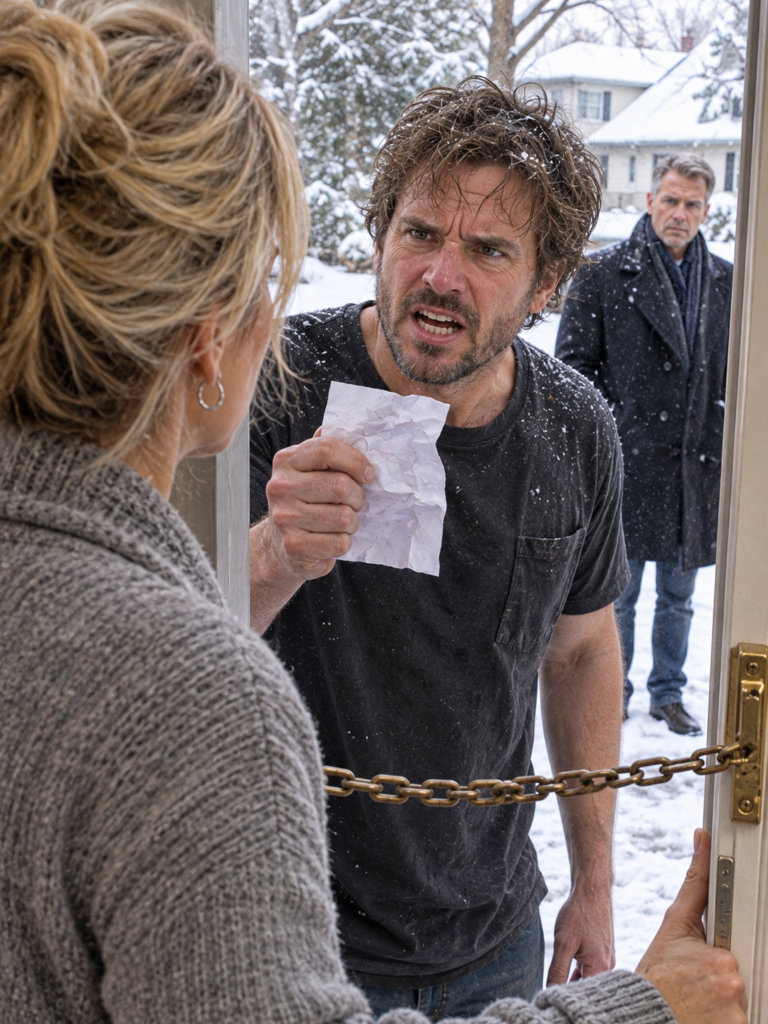
On the fifth morning, Monday, December 7, at 7:02 a.m., someone pounded on my front door.
I was already up. I was at the kitchen table in my bathrobe with my coffee and my reading glasses, looking over the temporary orders Joan had filed on Friday. When I heard the pounding, I knew who it was before I even stood up.
I walked to the front door and looked through the peephole.
It was Delmar.
He was sunburned. Badly. His nose was peeling, and his forehead was bright red. He hadn’t shaved in days. He was wearing a wrinkled Hawaiian shirt covered in orange hibiscus flowers, khaki shorts, and the brown leather loafers he always wore to church. It was twenty one degrees outside, and four inches of snow were piled up on the porch railing behind him.
No girlfriend.
He was holding a crumpled envelope in his right hand. It had the First National Bank of the Front Range logo in the corner. His hand was shaking.
I opened the door. I left the chain on.
“Verna,” he said. His voice cracked in the middle. “What did you do?”
I looked at him through the four inch gap in the door. Thirty four years. The man I married at St. Peter’s Catholic Church when I was twenty six, in my mother’s dress, with my hair curled and Ronnie Kessler standing next to him at the altar. The father of my sons. The man who once drove four hours through a blizzard to bring me home from my sister’s when my car broke down. The man who left a note on my refrigerator that said You’ll be fine.
“Good morning, Delmar,” I said.
“What did you do?” He held up the crumpled letter. “They closed my accounts. All of them. My credit card got declined in front of the whole restaurant. The hotel threw me out. Crystal’s account is frozen. She left me at the resort, Verna. She just left.” He was breathing hard. “And this says the money came back. To you. All of it. How?”
“I made some phone calls,” I said.
“What phone calls?”
“The kind I make at my little job.”
He stared at me.
“You never asked what I did,” I said quietly. “In twelve years, Delmar. Not once. I told you the night I got promoted, and you said, ‘Pass the potatoes.’ I’ve worked in the fraud department at that bank since 2014. I investigate forged signatures. That’s my job. That’s what I do all day.”
The color drained out of his face. Even under the sunburn, I watched it go.
“I didn’t know,” he said.
“I know you didn’t. You never wanted to.”
He took a step closer to the door. “Verna. Honey. Okay. Okay, I made a mistake. A really stupid mistake. I lost my head. Crystal, she was… I don’t know what I was thinking. It’s over with her. It was over before it started. Let me come inside. It’s freezing out here. We can talk about this. We can work this out.”
“No,” I said.
“Vern, come on. Thirty four years. You can’t just…”
“You forged my name, Delmar.”
He stopped.
“You took my old driver’s license out of the junk drawer,” I said. “You signed my name on a distribution form for every dollar I saved in thirty five years. Your best friend stamped it. You sent it to a woman’s bank account in Mexico. You took the four hundred dollars I was saving for Caleb and Emma’s Christmas presents out of the coffee can. And you left me a note on the refrigerator that said I’d be fine.”
He opened his mouth.
“And then when I called you,” I said, “you told me to prove it.”
Behind him, a gray sedan pulled up to the curb in front of the house. The engine stopped.
A man in a dark wool coat got out of the driver’s side and closed the door. He stood for a moment in the snow, adjusting his gloves. He had a gray mustache. He was carrying a manila folder under one arm.
I knew him.
Delmar heard the car door and turned around. When he saw the man walking up our front walk, his whole body went stiff.
“Mr. Pruitt,” Detective Ray Salazar said, stopping at the bottom of the porch steps. “Glad I caught you. I was hoping you’d come home.”
“Who are you?”
Ray held up his badge. “Detective Ray Salazar. Greeley Police Department, financial crimes.” He glanced at me through the gap in the door. “Morning, Verna.”
“Morning, Ray.”
Delmar looked back and forth between us. “You know him?”
“We’ve worked together,” I said, “for about nine years.”
Ray climbed the porch steps slowly. A second patrol car pulled up behind his sedan, and two uniformed officers got out and waited by the curb.
“Delmar Pruitt,” Ray said, “I have a warrant for your arrest on charges of forgery, theft over a hundred thousand dollars, and criminal impersonation.” He opened his folder and showed Delmar a piece of paper. “A judge signed it Friday afternoon. Ronald Kessler gave us a full statement on Thursday. So did Crystal Dunbar, on Saturday night, when she got back from Mexico.”
Delmar made a sound like he’d been punched in the stomach.
“Crystal talked to you?”
“For about two hours,” Ray said. “She was very cooperative. She says you told her the IRA was your money. That it was a joint account. She says she didn’t know you forged anything. She showed us your texts.” He paused. “Including the one from November 28, the day before you submitted the form. You wrote, ‘Vern will never even notice till tax time. She doesn’t look at that stuff.’”
I closed my eyes for a second. When I opened them, Delmar was staring at me through the gap in the door.
“Verna,” he whispered. “Please. Don’t let them do this.”
“I’m not doing anything, Delmar,” I said. “You did.”
Ray took the cuffs off his belt. “Mr. Pruitt, please turn around and put your hands behind your back.”
Delmar didn’t move for a moment. Then he slowly turned around, facing the snowy front yard, and put his hands behind his back. The crumpled letter from the bank fell out of his fingers and landed on the welcome mat.
Ray cuffed him gently, the way you’d help an old man into a coat. Then he read Delmar his rights in the same calm, tired voice he’d used on the phone with me Tuesday night.
When he was finished, Ray looked at me through the door.
“I’ll call you later today,” he said.
“Thank you, Ray.”
“He’s going to need a coat,” Ray said. “He’ll freeze in that shirt.”
I closed the door. I went to the hall closet and took down the brown corduroy jacket Delmar had left behind. The one I bought him for our twentieth anniversary. I opened the door again, took the chain off, and held it out to Ray.
Ray draped it over Delmar’s shoulders.
Delmar looked at me one last time over his shoulder as the officers walked him down the steps. He looked old. Sunburned and unshaven and shivering in his Hawaiian shirt and church loafers and the corduroy jacket, being walked to a patrol car on Sixteenth Street at seven in the morning while the neighbors came out on their porches in their bathrobes to watch.
Mrs. Ochoa from across the street was standing on her porch holding a cup of coffee. She raised it to me.
I nodded back.
Then I picked up the crumpled letter off the welcome mat, went inside, and closed the door.
Delmar spent two nights in the Weld County Jail before a judge set his bond at $25,000. He couldn’t pay it. He didn’t have any money. His accounts were closed. His credit cards were maxed out or frozen. His truck loan was under review.
On Wednesday, Wade drove up from Denver and paid the bond company the ten percent fee himself, $2,500, so his father could get out.
He called me afterward from the parking lot of the jail.
“I paid his bond,” he said.
“I figured someone would.”
“He’s staying with Ronnie’s brother in Evans,” Wade said. “Ronnie won’t let him in the house.” He was quiet for a moment. “Mom, they let me read the complaint. The police one. It had the texts in it. The ones he sent Crystal.”
I waited.
“There was one from Thanksgiving,” Wade said. His voice was thick. “He sent it from the bathroom while we were eating. It said, ‘Only one more month of this boring life. Turkey’s dry. Vern’s talking about her garden club again. Kill me now.’”
I closed my eyes.
Thanksgiving. Both boys had been there. Travis and Jenna and the kids. Wade with his girlfriend. I’d cooked for two days. Delmar had stood at the head of the table and carved the turkey and made a toast. He’d raised his glass and said, “To family. There’s nothing more important.” Everyone had clinked glasses. Then, apparently, he’d gone to the bathroom and texted Crystal that the turkey was dry.
“I’m sorry, Mom,” Wade said. He was crying now. “I’m so sorry I said what I said. I didn’t know. I didn’t want to know.”
“I know, honey,” I said. “Neither did I. For a long time.”
Christmas came three weeks later.
Joan’s temporary orders had been granted. The house was mine to live in until the divorce was final. Delmar couldn’t contact me except through his attorney. The judge ordered him to account for every penny of the $24,500 he took from our joint savings. It turned out he’d spent $9,200 of it on airline tickets, the resort deposit, and a diamond tennis bracelet he’d given Crystal in Cabo. She’d given the bracelet back to the police as part of her statement. It was sitting in an evidence bag somewhere in the Greeley Police Department.
My retirement money came back into my IRA on December 15. Every cent. $186,214.08. The bank’s legal department worked with the IRS custodian rules to reverse the distribution entirely, so I wouldn’t owe a dime in taxes on money I never touched. Marisol walked over to my desk and handed me the confirmation printout herself.
“Merry Christmas, Verna,” she said.
I had it framed. It’s hanging in my kitchen next to the calendar.
On Christmas Eve, both my boys came home.
Travis and Jenna drove down from Fort Collins with Caleb and Emma in the back seat. Wade came up from Denver alone. He showed up at the door two hours early carrying four grocery bags and a frozen turkey breast, and he said, “Mom, sit down. I’m cooking this year.”
“You don’t know how to cook.”
“I watched YouTube,” he said. “Sit down.”
The turkey was dry. Very dry. Nobody said a word about it.
After dinner, we sat around the tree in the living room, and Caleb and Emma tore open their presents. I’d bought them with my own Christmas bonus, after all. Caleb got a remote control monster truck. Emma got an art set with ninety six colored pencils. Caleb drove his truck straight into the tree and knocked off two ornaments, and everybody laughed, and for a minute I forgot that anything was wrong.
Later, after the kids were asleep on the couch under a blanket, Travis came and sat beside me at the kitchen table.
“Mom,” he said. “Can I ask you something?”
“Of course.”
“Why didn’t you ever tell Dad? About your job? I mean, I knew. Wade knew. We all knew you worked in fraud. Why didn’t Dad know?”
I thought about that for a long time.
“I did tell him,” I said finally. “He just didn’t listen. And after a while, I stopped trying to make him listen. I think I liked having one thing that was mine. Something he couldn’t make fun of at parties. Something he didn’t think was worth knowing about.” I looked down at my hands. “I guess I didn’t realize what that said about our marriage until it was too late.”
Travis put his arm around me.
“For what it’s worth,” he said, “I’ve always thought your job was the coolest thing in the world.”
I laughed. “You did not.”
“I did. When I was twelve, I told everybody at school my mom was a bank detective.”
“Oh, Travis.”
“Caleb tells everybody that now too,” he said. “He told his whole class last week that Grandma catches bad guys with handwriting.”
On the first Monday in January, Ray Salazar brought back Caleb’s pumpkin magnet. He’d made sure it was released from evidence after they’d dusted it for prints. He handed it to me at my desk at the bank in a little plastic bag.
“Told you I’d get it back,” he said.
I put it back on my refrigerator that night. Right in the middle of the door. Without the note.
Delmar’s attorney called Joan in February.
He was a young man from Loveland named Bradley Hirsch, and according to Joan, he sounded very nervous on the phone. He made her an offer. If I agreed to write a letter to the District Attorney asking for the charges to be dropped or reduced, Delmar would give me the house free and clear in the divorce. He’d also agree not to claim any interest in my IRA, or in my bank pension, and he’d pay the remaining $15,300 from the joint savings back to me over two years.
Joan called me at work to tell me about it.
“What do you want to do?” she asked.
“What would you do?”
“Me? I’d tell him to take a long walk off a short pier,” Joan said. “But it’s not my decision. And for the record, the house is probably yours anyway. Your IRA is definitely yours anyway. The only thing he’s actually offering you is the savings, which he stole. He’s trying to buy his way out of prison with your own money.”
I thought about it for a long time that night, sitting at my kitchen table with Caleb’s pumpkin magnet in front of me on the refrigerator.
The next morning, I called Joan back.
“Tell Mr. Hirsch,” I said, “that the criminal case isn’t mine to drop. It belongs to the People of the State of Colorado. I’m a witness. That’s all.”
“And the divorce?”
“The divorce, we’ll handle in court like everybody else.”
Joan laughed. “You’re a tough cookie, Verna Pruitt.”
“I learned from the best,” I said. “Sister Agnes. St. Peter’s School. 1972.”
In March, Delmar pleaded guilty.
His attorney worked out a deal with the District Attorney’s office. He pleaded guilty to one count of forgery and one count of theft between $100,000 and $1 million, which in Colorado is a class three felony. The criminal impersonation charge was dropped as part of the deal. In exchange, the DA would recommend a sentence of four years in the Department of Corrections, with a possibility of early parole, followed by three years of mandatory parole, plus full restitution of the joint savings and the costs of the investigation.
Ronnie Kessler pleaded guilty to official misconduct and lost his notary commission permanently. He got a year of probation and a fine of $5,000. He sent me a handwritten letter in April. It was two pages long, on yellow legal paper. He said he’d known Delmar for forty five years and never once in all that time had Delmar asked him for something this big. He said he should have called me. He said he’d never forgive himself. He said he was sorry.
I believed him. I put the letter in a drawer.
Crystal Dunbar was never charged. The DA decided there wasn’t enough evidence that she knew the money was stolen. But she lost her job at the Deere dealership in Kersey when the owner found out, and the last I heard, she’d moved to Arizona to live with her sister.
The sentencing hearing was on a Thursday morning in April, in Courtroom 4C of the Weld County Courthouse. I’d testified in that same courtroom three times before. I knew where the light came in through the tall windows in the afternoon. I knew the water fountain in the hallway outside only worked if you held the button down with both thumbs.
But I’d never sat in the front row before. Not as the victim.
Travis sat on one side of me. Wade sat on the other. Joan sat behind us. Marisol and Dante came too, on their lunch hour, and sat in the back row in their bank lanyards.
Delmar came into the courtroom in an orange jumpsuit. They’d taken him into custody at the plea hearing in March, when his bond was revoked after he tried to call me twice from his cousin’s phone in violation of the protection order. He’d lost weight. His sunburn had faded months ago. His hair was grayer. He didn’t look like the big laughing salesman from the farm equipment lot anymore. He looked like a tired sixty two year old man.
When the judge called on me to give my victim impact statement, I stood up with one piece of paper in my hand and walked to the podium.
I didn’t read from the paper. I’d written it out, but when I got up there, I just folded it in half and held it.
“Your Honor,” I said. “My name is Verna Pruitt. I was married to Delmar Pruitt for thirty four years. I worked at First National Bank of the Front Range for thirty five.”
I looked at Delmar. He was staring at the table in front of him.
“For most of our marriage, my husband called my career my little job. He said it at parties. He said it at family dinners. He said it in front of our sons. He said it so many times that I think after a while, I started believing it too. That what I did didn’t really matter. That my money was just extra. That my retirement was just a little savings account I could always build up again later.”
I paused.
“And then he left a note on my refrigerator that said, ‘You’ll be fine. You have your little job.’ And he took every dollar I’d saved in thirty five years and tried to send it to Mexico.”
The courtroom was very quiet.
“I want to tell the court something about my little job,” I said. “My little job is catching people who forge signatures and steal money from people who trust them. I’ve done it for twelve years. I’m good at it. And I want to say for the record that my little job is the reason my retirement came back. Not luck. Not a miracle. My job. The job my husband never once asked me about.”
I looked at Delmar one more time.
“I don’t hate you, Delmar,” I said. “I thought I would. But I don’t. I just don’t know you. I don’t think I’ve known you for a long time.”
He lifted his head and looked at me. His eyes were red.
“I’m going to be fine,” I said. “You were right about that. You just had no idea why.”
I walked back to my seat. Wade took my hand and held it the whole rest of the hearing.
The judge sentenced Delmar to four years in the Colorado Department of Corrections, with credit for time served, followed by three years of parole. He ordered Delmar to pay $15,300 in restitution to me for the remaining joint savings, plus $4,100 for the costs of the investigation. He also ordered him to have no contact with me for the length of his sentence and parole unless I initiated it.
When the bailiff led Delmar out the side door, he looked back once at the front row. At me. At Travis. At Wade.
Wade looked back at him and didn’t look away.
Our divorce was finalized in June. Joan got me everything Bradley Hirsch had offered back in February, and then some. The house on Sixteenth Street was mine. My IRA was mine. My bank pension was mine. Delmar’s truck was repossessed by First National in May, which I had nothing to do with, I promise. The loan went into default while he was in custody. The bank’s collections department handled it, two floors down from my office. I didn’t even look at the file.
The judge split the rest of what little was left. A few small investment accounts. Delmar’s 401(k) from the Case dealership, which turned out to have only $31,000 in it, because he’d borrowed against it three times over the years and never paid it back. I didn’t know about that either. I didn’t fight over it. I let him have it. He was going to need it more than I was.
The last thing Joan handed me at our final meeting was a small brown envelope.
“Ray Salazar dropped this off,” she said. “He said the case is closed, and he thought you’d want it.”
Inside, in a plastic evidence sleeve, was Delmar’s note. The one that had been held up on my refrigerator by Caleb’s pumpkin magnet. Verna. I’ve met someone. We’re going to Cabo for a while. Don’t call. You’ll be fine. You have your little job. D.
I took it home and sat at my kitchen table with it for a long time.
Then I got out a pair of scissors and carefully cut off the last line. You’ll be fine. I threw the rest of it away.
I kept that one line in my wallet behind my driver’s license. My new one. I keep my old ones locked up now.
I retired in September, on my sixty first birthday. On my own terms. Nobody pushed me, and nobody took anything from me first.
I could have kept working. Marisol begged me to stay. She said I was the best document examiner in northern Colorado and she’d give me Fridays off if I’d stick around another two years. But I’d done thirty six years by then, and my IRA had grown to over $200,000 with the market that year, and my pension had kicked in, and I wanted to see what it felt like to wake up without an alarm clock.
The bank threw me a retirement party in the big conference room on the fifth floor. There was a sheet cake from the King Soopers bakery that said HAPPY RETIREMENT VERNA in blue frosting, with a picture of a magnifying glass on it, because Dante thought that was funny. Travis and Jenna came with the kids. Wade came up from Denver. Ray Salazar came in his dark wool coat and stood in the back eating cake with a plastic fork.
Marisol gave a speech. She talked about the 2016 case where I’d caught a man forging his elderly mother’s signature on reverse mortgage papers, and the 2019 case where I testified for four hours against a bookkeeper who’d stolen $340,000 from a family farm co op. She talked about how I’d trained every examiner on the team. Then she raised her coffee cup.
“To Verna,” she said. “And to her little job.”
Everybody laughed. And this time, I laughed too, because it was finally funny.
That night, after everyone went home, I stood in my kitchen in my bathrobe with a cup of decaf. The house was quiet. Not empty quiet, the way it had been that night in December. Just peaceful.
I opened the junk drawer and got out a pen and a notepad. I tore off one sheet and wrote on it, in my real handwriting, with my big leaning V and my tiny little L and the flat tail running off the end of the last t.
“Verna. You did it. You’re fine. V.”
Then I stuck it to the refrigerator door, right in the middle, under Caleb’s orange pumpkin magnet with one googly eye missing.
I stood there and read it twice.
Then I turned off the kitchen light, and went to bed, and didn’t set an alarm.