What He Carried
A Story About the Weight of Other People’s Cruelty, and the Man Who Finally Stood Between It and the Woman He Loved
There is a particular kind of cruelty that wears the costume of care.
It doesn’t arrive with a sneer or a raised voice. It arrives with a smile. It arrives with the specific performance of someone who has convinced themselves that what they’re doing is actually a kindness, or a joke, or a wake-up call, or any number of other words that allow them to look in a mirror without seeing what they are.
It knows exactly where to find the wound. It has done its research. It goes directly to the most tender place and then holds up its hands and says: what? I was just trying to help.
Patricia Caldwell had been doing this version of cruelty to me for six months.
Not always. Not every day. She was too careful for that. She spaced it out with warmth and helpfulness and the occasional genuine kindness, so that when she landed one of her small precise strikes, I was always slightly off-balance — surprised, again, that the pleasant woman who had helped me address wedding invitations was also the woman who could hand me a glass of wine with innocent eyes and say oh, I keep forgetting.
She didn’t keep forgetting.
Patricia never forgot anything.
But I’m getting ahead of myself.
Let me tell you about the ten years first. Because the ten years are the point. The ten years are what this whole story is actually about.
My name is Ellie. Ellie Marsh, soon to be Ellie Caldwell, on a Saturday morning in June that I had been planning for eight months and dreaming about for considerably longer.
I was twenty-six when I got sober.
I am thirty-six now.
The decade between those two numbers contains the full arc of what I am: the person I became in the rubble of the person I had almost completely destroyed, rebuilt over years of difficult, unglamorous, uncinematic work. Recovery is not what movies make it look like. There is no single revelatory moment, no bottom so dramatic that the only direction available is up. There is, instead, a long accumulation of small choices, most of them painful, many of them made in bathrooms or parking lots or the back of group meetings at ten o’clock at night in fluorescent-lit church basements.
I was working two jobs when it started.
My father had left when I was twenty-two — not dramatically, not in a scene that anyone could use as a narrative, just gradually, inexplicably gone, first from the house and then from the phone calls and then from the birthday cards, until the absence was simply a fact we all lived with. My mother was managing debt that had accumulated the way debt accumulates when one income disappears and the fixed costs of a life don’t adjust to match it. I was the oldest. I was the one who could work. I was the one who could help.
I told myself I was handling it.
I was not handling it.
One glass of wine at night, to take the edge off after the second shift, had become two and then three and then a habit I stopped counting because counting was too honest. By twenty-five I was hiding bottles. By twenty-six I had lost the first job and was close to losing the second and my mother had started looking at me with the specific expression she wore when she was afraid to say something that needed to be said.
The woman who helped me get sober was named Carol, and she ran an AA meeting on Tuesday nights in the basement of St. Augustine’s on Clemens Street, and she was fifty-eight years old and had been sober for twenty-four years and she told me, at my first meeting, that I didn’t have to do this in one piece. That it was okay to put it down in pieces.
I’m going to tell you that the first piece I put down was the drinking.
The rest of the pieces — my father’s leaving, my mother’s fear, the particular shame of being twenty-six and having a problem that felt like weakness when it was actually illness, the work of reassembling a life from what the drinking had left — those took longer. Years, really. And some of them I’m still putting down.
But I hadn’t touched alcohol in ten years.
Ten years, two months, and sixteen days at the time of my wedding morning.
Not that I was counting.
Kevin found me at thirty-three.
Not in the romantic accidental way of movies — we were introduced by a mutual friend at a dinner party in April, and we talked for two hours about a documentary we had both seen, and he asked for my number before the dessert course because he said he could tell we weren’t going to run out of things to say.
He was right.
He is, as people go, one of the better ones.
I don’t say this as someone who has never doubted it. I’ve had relationships that looked good from the outside and were quietly damaging, and I’ve had enough therapy to understand my own patterns of misreading people, and I was careful with Kevin in a way I had not been careful before. I watched him under ordinary circumstances and difficult ones. I watched what he did when things were inconvenient. I watched what he did when he thought no one was observing.
He was consistently the same person.
This is rarer than it sounds.
I told him about the drinking on our fourth date, because by then I understood he was someone I might need to account for, and I had a policy about this: I would not be ashamed of my recovery, and I would not present it as a thing to be revealed strategically at some ideal moment. It was part of who I was. If someone couldn’t hold that, better to know early.
I told him the whole story.
He listened without interrupting, which was the right thing to do, and when I finished, he said: Thank you for telling me. And then he asked one question: What do you need from me, to make this work?
That was it.
No performance of sympathy. No minimizing. No oh, everyone has their thing. Just: what do you need.
I told him.
He did it.
For two years, he did exactly what I had asked — not perfectly, because perfection is impossible and he was a person, not a wish fulfillment — but consistently, with care, in the way of someone who had decided this mattered and was acting accordingly.
His mother was different.
Patricia Caldwell was sixty-one, elegant in the way of women who have worked at elegance, and she was the kind of person who could fill a room with warmth and then redirect that warmth with surgical precision to exclude one specific person without anyone quite being able to explain what had just happened.
She loved her son.
This I believed without reservation. She loved Kevin with the particular intensity of a mother who had invested a great deal of herself in her child and found the investment well-made and was not entirely ready for the dividend to be paid to someone else.
She was not, in the beginning, cruel to me.
She was studied. Polished. She asked me questions with the attentiveness of someone gathering information, and she answered my questions about Kevin’s childhood with the warmth of someone who enjoyed the topic. She helped with wedding planning in concrete, useful ways. She had opinions that were sometimes wrong but were delivered without aggression.
For the first few months of the engagement, I thought we might be okay.
Then Kevin mentioned my sobriety at a family dinner, when his aunt asked why I wasn’t drinking, and Patricia looked at me across the table with the specific expression of a person who has just been given information they are going to file carefully and use later.
Ten years? she said. That’s impressive. Although I suppose you never really know when someone might slip.
The words landed with the precision of something thrown by a person who knew the target.
Kevin told her immediately to stop, and she did stop — the immediate thing, the explicit statement — and made the face of someone who hadn’t realized they’d said anything offensive. But the note had been struck, and it hung in the room, and I understood something in that moment that I would spend the next six months confirming: Patricia knew exactly where I was vulnerable, and she had just told me she knew.
The wine offers that came after had the same quality — always innocent, always deniable, always timed for moments when Kevin was slightly out of earshot or occupied with something else. Oh, I keep forgetting. It’s such good vintage, are you sure? The champagne at the wedding might test your willpower — this last one said with a laughing self-deprecation that made it impossible to respond to directly without looking like I was overreacting.
I talked to Kevin about it.
He believed me, which mattered. He spoke to her, which changed things for approximately two weeks before they reverted. He spoke to her again, more seriously, and she gave a performance of contrition that I recognized as a performance but that Kevin, who wanted very much to believe his mother was capable of improvement, accepted with hope.
He kept hope about his mother.
I kept documentation, which is the sober woman’s version of hope.
I told myself: we get through the wedding and then we have our own life. We get through the wedding and I figure out how to set limits that hold. I can do this. I have survived harder things.
I still believed this on the morning of my wedding.
Before I saw the veil.
Patricia had offered to collect it from the seamstress.
I had said yes, because she had offered with the specific warmth of an olive branch, and because I had been trying to meet her gestures with equivalent good faith, and because the seamstress’s shop was across town and my morning was full. She was taking the garment bag. She was making herself useful. This was, I told myself, the version of Patricia that I could work with.
She arrived at the bridal suite at nine-fifteen.
She was smiling.
My bridesmaids — my best friend Cara, and my friend Joanne from work, and my cousin Deb — were in the suite, doing the ordinary work of wedding mornings: hair and makeup and the specific energy of women helping someone get ready for something important. The suite was warm and good-smelling and exactly what a wedding morning should be.
Patricia came in with the garment bag and the smile and the words: I added a little personal touch.
Cara told me later she had a feeling when she saw Patricia’s face. The specific feeling of recognizing something before you understand it, the way you recognize a sound before you identify what’s making it.
Patricia unfolded the veil.
Cara gasped.
I stared.
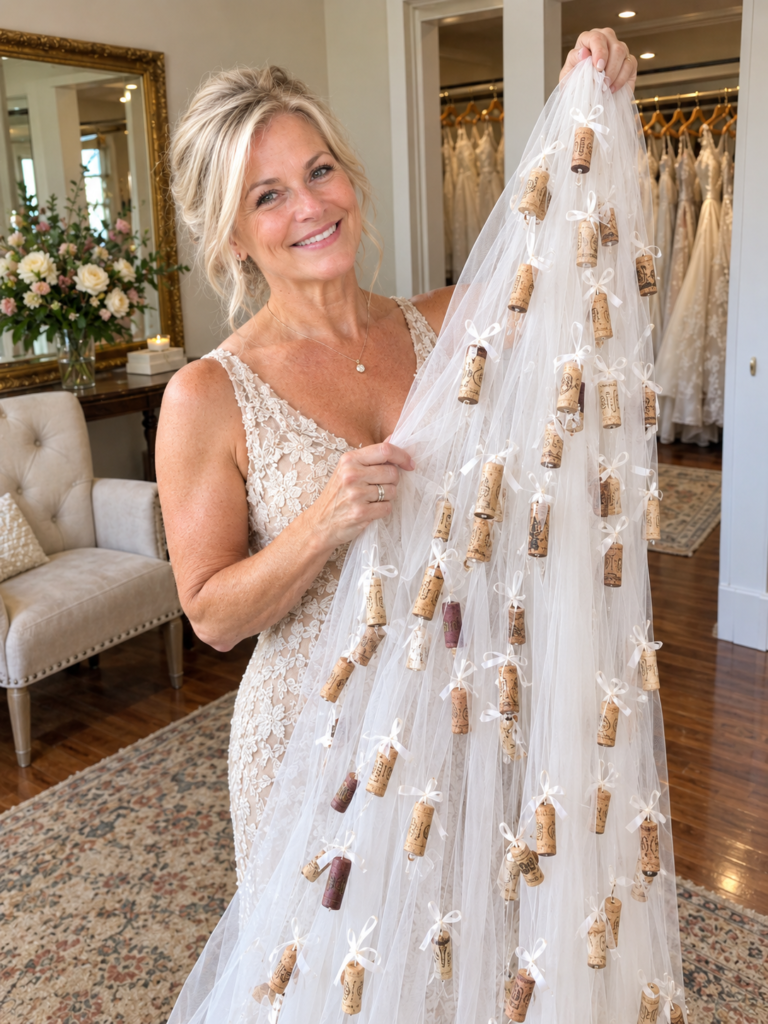
Along the delicate lace edge of the veil — the veil I had chosen with my mother, on a Saturday in February, in a small shop that smelled like silk and the particular careful hope of people preparing for a day that matters — there were wine corks. Dozens of them. Tied with thin ivory ribbons, which was the detail that made it somehow worse. She had not thrown them at the veil. She had placed them. She had cut lengths of ribbon and tied them in small bows and attached them one by one along the lace, which meant she had held the veil in her hands and decorated it with the evidence of the thing that had almost killed me.
Some of the corks still had winery names stamped across them.
Vineyard labels.
The names of specific wines.
She had not gone to the trouble of finding plain corks. She had used the real ones.
She was watching my face when I understood what I was looking at.
She was laughing.
Oh, don’t look so horrified. I thought your veil should tell your story.
I found that I could not speak.
This happens sometimes, when something is so precisely aimed that it temporarily disables the mechanisms of response. The part of me that knew what to say was offline. I was standing in my bridal suite in my wedding dress, holding the veil I had chosen with my mother, looking at the wine corks someone had tied to it in small ivory bows, and I had no language for what I was experiencing.
You knew what those years did to me, I finally said.
Exactly. She lifted one cork between two fingers. Ten years sober deserves a souvenir.
Take them off.
She rolled her eyes.
Honestly, if you’re truly over it, why does this bother you so much?
The door opened.
Kevin came in looking for his mother because the photographer needed the family assembled downstairs.
He was in his wedding suit. He looked exactly as he should look on his wedding morning, which was like someone who had made a decision he was certain about and was ready to act on it.
He saw me clutching the veil.
He saw the corks.
He crossed the room.
He didn’t rush, which was its own thing, the specific deliberateness of someone who is not going to let the situation control their pace. He took the veil gently from my hands. He looked at each cork along the edge — turned the veil, examined the ribbon, read the winery names.
He looked at his mother.
Patricia smiled.
My little surprise. Cute, isn’t it?
Kevin did not answer.
I watched him standing there, holding the veil, and I watched his face do something I had not seen it do before, something that required a moment to name. It was not anger exactly — anger in Kevin looked different, had a heat to it that you could read from across the room. This was colder than anger. More deliberate.
He reached into his jacket.
He took out his phone.
Patricia was still smiling.
He found a contact and called it, and when the call connected he said: Carol. Hi, it’s Kevin. I’m at the venue. I need to ask you something. A pause. Has anyone been in contact with you this week about picking up the veil?
Patricia’s smile changed.
Carol — the seamstress, not the Carol from my meetings, another Carol, the kind of coincidence that happens in life — said something that caused Kevin to say: I see. Thank you. Yes, I’ll explain later. He ended the call.
He looked at his mother.
The seamstress will confirm that you picked up the veil three days ago. Not this morning. He turned the veil slightly. You had three days with this.
Patricia opened her mouth.
You’ve had three days to do this, Kevin said. Which means you had three days to think about it. Which means this wasn’t impulsive. He set the veil down on the table beside him, very carefully. This was planned.
Cara had gone completely still near the window. Joanne and Deb weren’t moving either.
Kevin, honestly, it’s just a—
It’s not just anything, he said.
His voice was quiet.
This was the thing about Kevin that people didn’t always expect — he didn’t raise his voice when he was most serious. He got quieter.
I know what your story is, Mom. I know what you think sobriety means. I know you think if Ellie were truly recovered, she wouldn’t react to this. I know you’ve been testing her for six months. He paused. I’ve been letting it go because I hoped you’d stop. I should not have let it go.
Patricia said: I was just—
You were just telling Ellie what you think of her. On our wedding morning. He looked at the veil. On the morning she’s supposed to be walking toward me.
I was not going to cry.
I had made an internal agreement with myself about this, about crying on my wedding morning, and I was holding to it with everything I had.
Kevin reached into his jacket again.
He took out a pocket knife.
It was small, the kind with multiple attachments, the kind that had been his grandfather’s and that he carried on important occasions the way some people carry lucky objects. Patricia had given it to him, actually — she would have recognized it.
He opened the small blade.
He began, very carefully and deliberately, to cut the ribbons.
One by one.
Each cork fell to the table.
Patricia watched.
Nobody in the room said anything.
He worked his way along the entire length of the veil’s edge, cutting each ribbon, letting each cork fall, the sound of them hitting the table the only sound in the room. It took perhaps four minutes. He was thorough. He didn’t hurry. When the last cork was off, he closed the knife and put it back in his pocket.
He picked up the veil.
He looked at it carefully — examining the lace edge, checking for any damage from the ribbons or the weight of the corks.
He brought it to me.
This is your veil, he said. It’s exactly what you chose.
He held it out to me.
I took it.
He turned back to his mother.
I love you, he said. I need you to understand that this doesn’t change that. But I also need you to understand that I’m not going to let you treat Ellie like her sobriety is something to be used against her. Not today. Not ever. He paused. If that’s something you can’t agree to, I need to know that now. Before we go downstairs.
Patricia’s face was doing many things at once.
She was not accustomed to Kevin.
That was the precise thing — not accustomed to this Kevin, to the one who said the full sentence clearly and waited for a response.
I was just trying to—
To what?
She stopped.
To what, Mom? Tell me what you were trying to do. Say it exactly.
The silence stretched.
Patricia looked at me, and I looked at her, and I watched something in her face — not contrition, not yet, maybe not ever, but something — something shift. Some reassessment.
I didn’t think it would—
It doesn’t matter what you thought it would do, Kevin said. It matters what it did. He looked at the corks on the table. Ellie has been sober for ten years. Do you know what that actually means? Do you know what it costs? Every single day?
Patricia was quiet.
She didn’t choose to have a problem. She chose to address it. For ten years she’s been making that choice. And you thought her wedding veil was a good place for a joke about it.
I wasn’t joking, Patricia said, and for the first time her voice had lost something — the protective gloss of deniability, the comfortable armor of a woman who had been performing innocence for six months. I thought — I thought if she was really past it, something like this wouldn’t—
Test her, Kevin said. You thought you’d test her.
She didn’t deny it.
You’ve been testing her for six months. And you still don’t trust her. He looked at her steadily. The question isn’t whether Ellie passes your test, Mom. The question is whether you deserve to be in a room with her.
Cara, near the window, made a small sound that was not quite a word.
I want to tell you what happened next, but first I want to tell you about the corks.
Not the corks on the veil — the corks on the table, the ones Kevin had cut off one by one and let fall.
I looked at them while Kevin and Patricia were talking.
Twenty-three of them.
Some from California, some from France, one from a winery in Oregon I vaguely recognized the name of. Real wine corks, pulled from real bottles, the evidence of Patricia’s homework. She had not bought novelty corks. She had collected real ones, over some period of time, and she had cut the ribbons and tied each one by hand, which meant she had held each one and made a decision.
Twenty-three times she had made the decision to keep going.
I thought about this.
I thought about ten years of my own decisions, the daily ones, the accumulated weight of ten years of choosing the thing that was harder than the alternative. I thought about Carol in the basement of St. Augustine’s, about the word pieces, about putting it down in pieces.
I thought about what Patricia had said: Ten years sober deserves a souvenir.
She had meant it as a wound.
Standing there, holding my veil, watching Kevin say the things that needed saying, I found — and this surprised me, because I had not expected to feel anything but rage — I found that the thing she had said was actually almost true.
Not the corks. Not her version of it. But the idea underneath, the ruined, misused idea: ten years sober deserves to be acknowledged.
She was right about that. She was so profoundly wrong about everything else that the small rightness of it was almost invisible. But it was there.
Patricia left the bridal suite.
Not with a scene — Kevin offered to call someone to drive her home if she needed time, and she said she was fine, and she went. She did not slam doors. She did not make pronouncements. She left with the specific quiet of a person who has been seen clearly for the first time and needs to go somewhere and sit with what that feels like.
I did not know, in that moment, what she would do with what she’d been given. I still don’t, fully. Recovery is not linear, and I know this about my own process, and I try to hold it about other people’s processes too, even the people who have hurt me.
What I knew was that she had left.
Kevin turned back to me.
The bridesmaids were very still in the way of people who have just witnessed something significant and are giving it appropriate space.
Ellie, he said.
I’m okay, I said.
He looked at me.
I know, he said. I just needed to say your name.
This was such a Kevin thing to say that I laughed, despite everything, the real laugh that arrives without permission and tells you something about where you actually are.
He smiled.
Can I— He looked at the veil in my hands. Do you want to wear it? If you don’t, we can figure something else out. Cara has bobby pins.
I’d have to have about fifty, Cara said, from the window. Which I do.
I looked at the veil.
I had chosen it with my mother. In February, in the small shop, we had gone through six or seven options and this one had been the right one, the one she had teared up over and tried to hide, and I had not tried to hide my own tears because there was no point, and the seamstress had given us both tissues and pretended not to notice.
My mother was downstairs waiting.
The veil was clean.
The corks were on the table.
I’ll wear it, I said.
Kevin held it while Cara arranged it. He stood there, his wedding suit perfectly pressed, his grandfather’s knife in his pocket, holding the veil in both hands like it was something that needed to be held carefully.
When Cara finished pinning it, he stepped back.
You look— He stopped.
What?
Exactly right, he said. You look exactly right.
My mother was waiting in the hallway outside the suite.
She looked at my face when I came out, the way mothers look at faces they have been reading for thirty-six years, and she said: What happened?
I told her the short version.
She listened. Her expression did several things. Then she said: Do you want me to go downstairs and say something to that woman?
No, Mom.
Are you sure?
Very.
She looked at me for a moment.
You’re wearing the veil.
Yes.
She touched the lace edge.
Good, she said.
We walked to the top of the stairs together.
The photographer was waiting. The ceremony was in forty minutes. Downstairs, I could hear the sounds of the people who had come — friends, family, the accumulation of thirty-six years of a life, all gathered in this specific place on this specific morning.
How are you? my mother asked.
I thought about it honestly.
Good, I said. Actually good.
She looked at me.
Your sobriety, she said. That’s what she used against you.
Tried to.
That’s the thing she picked.
Yes.
My mother’s face did something then that I don’t have precise words for. Something that was not quite grief and not quite pride and was made of both.
I want to tell you something, she said.
Okay.
When you were twenty-six. When it was very bad. Before you got help. She paused. I was so frightened. And then you got help, and every year after that I kept thinking: she did this. She did the hardest thing. I didn’t know how to say it to you — you seemed like you didn’t want it made into a thing. She looked at my hands. But it was always in me. How proud I was. How much I admired you.
I took a breath.
Patricia thought she was using it against me, I said.
I know.
She thought it was a weakness.
I know.
She didn’t understand that it’s the opposite of that, I said.
My mother looked at me.
No, she said. She didn’t.
I will tell you about the moment before I walked in.
The music had started — the piano arrangement we had chosen, something quiet and particular that had been playing at a restaurant on our second date and that I had mentioned to Kevin nine months into the relationship and that he had somehow remembered. The kind of remembering that tells you something is real.
My mother was beside me.
I was holding her arm.
Through the open doors, I could see the aisle, the flowers, the people arranged in rows — and at the far end, Kevin, standing at the altar with his best man beside him and his face turned toward the door.
He saw me.
I saw him see me.
He had the expression of someone who had said everything that needed to be said and was now simply here, present, for what came next.
I thought about the corks on the table in the bridal suite.
Twenty-three of them.
I thought about ten years.
Not the bad years — the good ones. The years of building, the slow patient work of putting a life together piece by piece, the Tuesdays in church basements and the mornings that were hard and the mornings that weren’t and the ten years, two months, and sixteen days of every single day choosing.
Patricia had thought those years were a weakness she could decorate a veil with.
What they were, actually, was the reason I was standing here.
The reason I had been careful enough to wait for someone like Kevin. The reason I had been present enough to recognize him when he appeared. The reason I understood, in a way I might not have understood without those years, what it meant to commit to something long-term and do the work and not abandon it when it was hard.
Patricia had tried to make my story into a joke.
My story was the reason I could walk down this aisle.
My mother squeezed my arm.
Ready?
I thought about Carol. About you can put it down in pieces.
Yes, I said.
We walked.
The reception was in the same venue’s garden.
It was June and warm and the garden had been strung with lights that looked, in the gathering dusk, like something out of a story people tell children about what the world could look like.
I danced with my mother, and with Cara, and with Kevin’s father who was a gentle, quiet man who apologized to me at the bar and said: I didn’t know until Kevin told me this morning. I want you to know that’s not — that’s not something I would have sanctioned. I told him I knew, and I did.
Patricia was there.
She sat at the family table, and she was not unkind to anyone, and she did not make any scenes, and she did not approach me.
At the end of the evening, when the dancing was done and the cake was cut and the guests were beginning to drift toward their cars, she found me near the exit.
I will tell you what she said because it matters.
She said: I didn’t understand what I was doing.
I looked at her.
I thought— She stopped. I thought if I could provoke a reaction, it would prove that you weren’t—that you were still vulnerable. I thought Kevin was being naive about you. She paused. I know that doesn’t explain it. It certainly doesn’t excuse it.
No, I agreed.
I’m sorry. She said it plainly. Not with tears, not with the performance of remorse. Just the words. I was wrong. And I was wrong in a way that—Kevin made me understand what it actually cost you. What it still costs you.
I looked at her for a moment.
I’m not going to pretend this is resolved, I said.
I know.
What you did this morning was—it was designed to hurt me on a day when I was already exposed. That’s going to take some time.
I understand.
Kevin and I are going to need boundaries about this going forward. Real ones, that are respected.
I know, she said again.
If you can respect them, we can figure out how to have a relationship.
She nodded.
I looked at her.
Patricia.
Yes.
Ten years sober doesn’t mean I’m not still doing the work. It means I’ve been doing the work every day for ten years. That’s not a weakness. That’s how it works.
She was quiet.
I know that now, she said.
Good.
I went back to the party.
Kevin found me on the dance floor ten minutes later.
We were the only ones still dancing — the last song of the night, something slow, the kind of song that works for weddings because it doesn’t require anything except being in the same space as the person you chose.
How are you? he said.
I talked to your mother.
I know. She texted me.
What did she say?
That you were harder on her than she deserved, in a good way.
I laughed.
That’s not exactly what happened.
I know. He looked at me. Are you actually okay?
I thought about the question honestly, the way I had learned to think about hard questions, without shortcuts.
This morning was awful, I said. And then it got better. And you did something important. I looked at him. You chose me. In front of your mother, clearly, without making me feel like a burden. You just chose me.
You’re not a burden, he said.
I know that now, I said. You made it very clear.
He held me closer.
The corks are in a box in the suite, he said. I wasn’t sure if you wanted to throw them away or—
I’ll decide later, I said.
Okay.
We danced.
The lights in the garden made everything slightly warmer than it actually was, the specific quality of lights chosen for the purpose of making an evening feel like a memory while it’s still happening.
Kevin, I said.
Yeah.
The thing you said to your mother. About it costing something. Every day.
Yes.
You actually understand that, don’t you? You don’t just say it.
He thought about it.
I understand it the way someone understands something they’ve watched from the outside for three years, he said. Which isn’t the same as knowing it from the inside. But I’ve been paying attention.
You have.
You’ve taught me more about what it takes to build something than anyone I’ve ever met, he said. Not by explaining it. Just by doing it.
I put my face against his shoulder.
The song was ending.
Somewhere behind us, the last guests were saying their goodbyes, the sounds of an evening concluding, the specific warmth of people who have been together for something and are now moving back toward their separate lives, carrying the evening with them.
We left the venue at midnight.
The corks were in a box in the car.
I held the box on my lap on the drive.
Kevin drove, and I sat with the box, and at some point he said: You don’t have to decide tonight.
I know.
What are you thinking?
I thought about it.
I’m thinking that she was right about one thing, I said.
He glanced at me.
Ten years sober does deserve to be acknowledged, I said. Not like she did it. But it deserves something.
What kind of something?
I looked at the box.
I don’t know yet. Something that’s mine. Not something that was done to me.
He nodded.
Okay.
We drove in the quiet that was comfortable, the quiet of people who have been through something and don’t need to fill it with words.
At some point I said: I love you.
I love you, he said.
You did the right thing today.
You deserved the right thing.
I looked at the box on my lap.
The corks inside it.
Twenty-three wine corks that had been meant to be a wound.
I thought about what I would do with them.
Not tonight. But eventually.
There is a shelf in our house now.
I built it over the course of a weekend in July, with some help from my father-in-law who turned out to know a great deal about carpentry and was glad to be useful. It is not a complicated shelf. It is a simple wooden shelf, about three feet wide, mounted on the wall in what we call the study, which is the room where Kevin grades papers and I do my reading.
On the shelf, there is a small glass jar.
Inside the jar are twenty-three wine corks.
Not in ivory ribbons. Just the corks, in a jar, on a shelf, where I can see them.
Kevin asked me once why I kept them.
Because they belong to me, I said. Not to her version of my story. My version.
What does your version say?
I thought about it.
That I’ve been doing this work for ten years, I said. That the work is ongoing. That the corks are proof not of weakness but of the territory I’ve been through. I looked at the jar. She thought they’d remind me of what I used to be. They remind me of how far I’ve come.
He looked at the jar.
Same corks, he said.
Different story.
That was it, really.
That was the thing.
You cannot always control what people do with your story. You cannot always prevent someone from picking up the evidence of your hardest years and using it as ammunition. But you can decide what it means. You can build the shelf. You can put the jar on it. You can make it yours.
Patricia and I have a relationship now.
It is not warm, exactly. It is careful. It has limits that are respected, most of the time, because Kevin enforces them with the same quiet clarity he used in the bridal suite. We have had two difficult conversations and one that surprised me by being almost easy. She has not repeated what she did on the wedding morning, and I believe — most days I believe — that she has understood something she didn’t understand before.
I am not waiting for her to become someone she isn’t.
But I am willing to see what she does with what she’s been given.
That willingness is its own kind of recovery.
The jar is still on the shelf.
Some mornings I walk past it without looking.
Some mornings I stop.
On the mornings I stop, I count them — twenty-three, always twenty-three — and I remember the wedding morning, and the bridal suite, and the corks falling onto the table one by one as Kevin cut the ribbons.
I remember walking down the aisle in my veil, which was clean and perfect and exactly what I had chosen.
I remember putting my hand in Kevin’s when I reached him, and the way he held it, and the expression on his face, which was the expression of someone who had done what needed doing and was now simply here for what came next.
I think about ten years.
Not as a burden.
As a fact of what I am.
I think about Carol in the basement of St. Augustine’s, about you can put it down in pieces.
I have been putting it down in pieces for ten years.
Some pieces I am still putting down.
The jar is on the shelf.
The shelf is mine.
Ten years, two months, and sixteen days.
And counting.
Not because I’m afraid.
Because it matters.
Because the work matters.
Because I do.