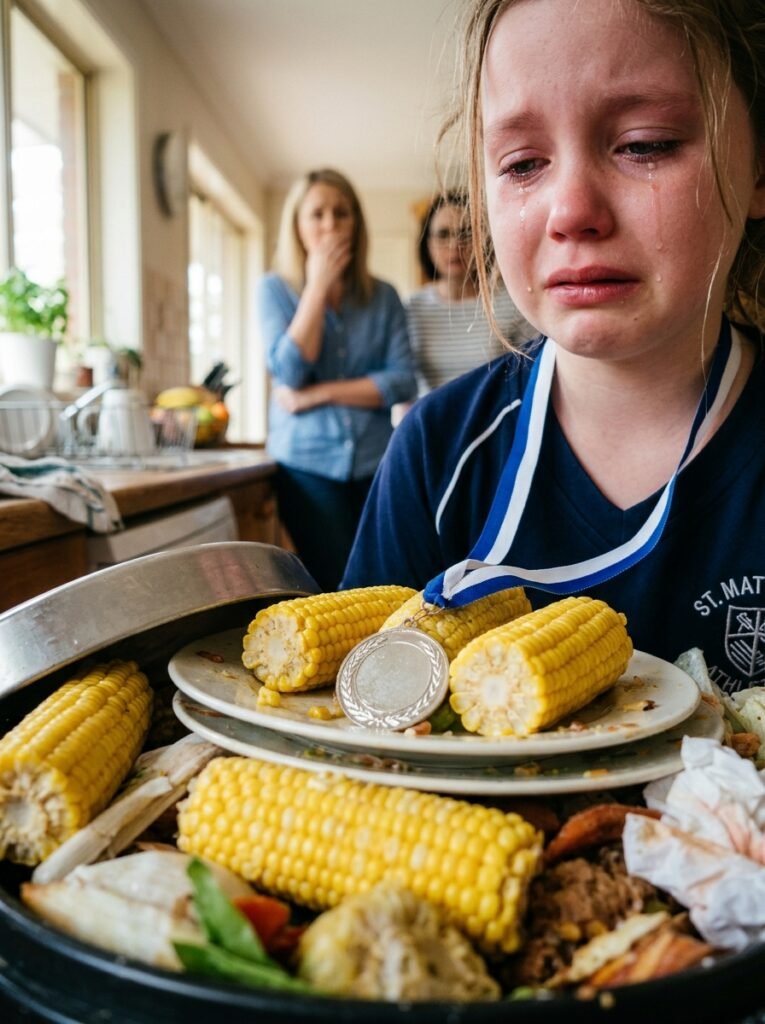
Ella extended the sticky medal toward Tyler, but before he could respond, Karen stepped between them.
Ella did not pull her hand back.
The medal hung from its twisted blue ribbon, still smeared from the barbecue trash, and Tyler stared at it like he understood exactly what his cousin was about to ask.
Karen lifted one hand toward Ella.
“That’s enough,” she said.
Ben moved first.
He did not touch his sister, but he stepped sideways until he was standing between Karen and his daughter.
“No,” he said. “Ella gets to finish.”
Karen gave him an incredulous look.
The version of Ben she knew would have softened that sentence immediately.
He would have added something like, We’re all upset, or Let’s not make this bigger than it is.
This time, he added nothing.
Ella looked around him at Tyler.
“Do you actually want me to stop running?”
Tyler’s face went red again.
“No.”
Ella swallowed.
“Do my medals make you feel like a failure?”
“No.”
Karen turned sharply toward her son.
“Tyler, you don’t have to pretend—”
“I’m not pretending.”
His voice cracked on the last word, and that seemed to embarrass him more than anything else that had happened.
He stood up from the couch and shoved his phone into his pocket.
“I hate when people compare us,” he said. “But Ella isn’t the one doing it.”
That landed differently.
Karen had built the entire confrontation around the idea that she was defending her son.
Now he was standing ten feet away telling everyone that the defense itself was part of the problem.
Diane set the pitcher of lemonade on the counter.
“Tyler,” she said carefully, “your mother was only trying to protect your feelings.”
He looked at his grandmother.
“Then she should’ve asked me what my feelings were.”
Mark had come in from the grill by then.
He stood near the patio door with the spatula still in his hand, taking in the trash can, the dirty medal, and Ben planted firmly between Karen and Ella.
Nobody needed to explain what had happened anymore.
The evidence was literally hanging from Ella’s fingers.
Karen looked at Tyler as if he had betrayed her.
That was the part that finally made me understand what Ben had been trying not to see for years.
Karen did not simply want Tyler protected.
She wanted everyone else to accept her definition of protection, even when the person she claimed to be protecting rejected it.
She wanted the family to organize itself around whichever feeling she declared most urgent.
And Diane had spent years helping her do it by calling every boundary an overreaction.
Ella was still waiting.
She held the medal a little farther toward Tyler.
“Then I want you to have this for a second.”
Karen stepped forward again.
Ben’s arm lifted slightly across Ella’s path, not restraining her, just making sure Karen stayed back.
Tyler approached his cousin.
Ella placed the medal in his palm.
It was not ceremonial.
It was sticky.
The ribbon was stained.
Tyler looked down at it and rubbed his thumb carefully along the metal edge.
“Mom did this because of me,” he said.
“No,” Ella answered. “She said she did. That’s different.”
For a 12-year-old who had spent the entire afternoon shrinking herself so nobody else would feel uncomfortable, it was the strongest thing she had said.
Tyler looked at Karen.
“You don’t get to use me for this.”
Karen’s jaw tightened.
“I’m your mother. I know when something is hurting you.”
“Then listen when I tell you what isn’t.”
Diane tried once more to bring the temperature down.
“We are not going to destroy a family over three medals.”
Ben turned toward her.
“Nobody is destroying a family over medals.”
His voice stayed low.
“We’re deciding what happens when an adult deliberately humiliates a kid and another adult tells that kid to absorb it because she’s supposedly strong enough.”
Diane looked toward Ella.
For the first time that day, she seemed uncomfortable meeting her granddaughter’s eyes.
“I didn’t mean it that way.”
Ella said nothing.
Ben did not rescue his mother from the silence.
That mattered.
For years, he had been the one who translated ugly behavior into softer language.
Karen was stressed.
Diane was trying to keep everyone together.
Tyler was sensitive.
This wasn’t the right time.
There was always a reason the person who got hurt should wait for a better moment to object.
Ben had finally stopped translating.
Karen pointed toward his phone.
“Fine. You’re angry. But cancel the code change.”
Ben shook his head.
“No.”
“The lake house has nothing to do with Ella’s track medals.”
“You’re right.”
Karen blinked, apparently surprised he had agreed with her.
Ben continued.
“The lake house has to do with access. I gave you access because I trusted you to treat my family with basic respect. You just showed me that you think access to things I own is permanent, while respect for my kid is optional.”
Karen looked toward Diane for backup.
Diane started, “Benjamin—”
“Mom, no.”
Two words.
No anger.
No negotiation.
Diane stopped.
Tyler handed the medal back to Ella.
“You should keep running,” he said.
Ella stared at it.
“I don’t know if I want to.”
“Okay,” Tyler said. “But don’t quit because of me.”
That was the first thing anyone had said all afternoon that seemed to reach her.
Her shoulders loosened a fraction.
Not much.
Enough that I noticed.
Karen noticed too.
“So that’s it?” she demanded. “Everybody is going to act like I’m some monster because I threw three little medals away?”
Ben’s face changed at the word little.
I thought that might finally be the moment he yelled.
He didn’t.
He crouched beside the trash can instead.
There were still two medals inside.
He rolled up his sleeves and reached through greasy paper plates and corn husks until he found the first ribbon.
Then the second.
He lifted both out, one in each hand.
Barbecue sauce had dried along the edge of one medal.
A ribbon clung wetly to his wrist.
He did not complain.
He carried them to the kitchen sink.
Ella followed him.
So did I.
For the next several minutes, the argument continued behind us, but Ben did not participate.
He ran warm water over a dishcloth and carefully wiped the first medal while Ella worked on the second.
I cleaned the one Tyler had returned.
The three of us stood shoulder to shoulder at Diane’s sink while Karen argued about lake weekends ten feet away.
The contrast was almost absurd.
Karen was talking about what she had lost.
Ben was cleaning what his daughter had nearly decided no longer mattered.
Ella rubbed one thumb across the face of her medal.
“Dad?”
“Yeah?”
“Were you serious before?”
He looked at her.
“About what?”
“About making Mom and me tolerate stuff.”
His hand stopped moving.
He set the medal carefully on the towel beside the sink.
“Yes.”
Ella waited.
Ben could have explained himself.
He could have told her that his sister had always been difficult, that his mother hated conflict, that he had spent most of his life learning how to keep family gatherings from exploding.
Instead, he gave his daughter the answer she actually needed.
“I was wrong.”
Ella’s eyes filled, but she did not cry.
“I thought you didn’t notice.”
Ben closed his eyes for half a second.
That hurt him more than anything Karen had said.
“I noticed,” he said. “I just kept thinking noticing was enough if I talked to you about it afterward. It wasn’t.”
Ella looked down at the ribbon.
“Sometimes I don’t want to come here.”
“Then we won’t come just because people expect us to.”
Diane heard that.
She came into the kitchen immediately.
“Ella, honey, you know Grandma loves having you here.”
Ella leaned against the counter.
“I know.”
Diane seemed relieved too quickly.
Then Ella continued.
“But I don’t like having to be less happy so everybody else stays happy.”
Diane’s expression tightened.
There was no accusation in Ella’s voice.
That made it harder to dismiss.
She was not performing anger.
She was describing the rule she had learned from the adults around her.
Be proud, but not enough to upset someone.
Win, but don’t enjoy winning too visibly.
Bring your medals because Grandma asked, then be prepared to apologize if somebody resents them.
Karen came to the kitchen doorway.
“This is getting ridiculous.”
Ben turned around.
“We’re leaving.”
Karen scoffed.
“Of course you are. Sarah gets upset and suddenly everyone has to march out behind her.”
I had barely spoken since Ben came inside.
Now I looked at her.
“Ella asked to stop competing after what you did. This isn’t about me being upset.”
Karen opened her mouth.
Tyler spoke from behind her.
“And it’s not about me either.”
Karen turned.
Her son had picked up his framed baseball photo from the achievement table.
He held it under one arm.
For the first time, the space beside Ella’s empty medal spot looked as strange as it should have looked from the beginning.
“What are you doing?” Karen asked.
Tyler shrugged.
“Taking mine down.”
“Why?”
“Because if hers was showing off, then mine is too.”
Diane immediately said, “Nobody said your picture was showing off.”
Tyler looked at her.
He did not need to answer.
The unequal rule was sitting right there between them.
Ella’s medals had been treated as a threat.
Tyler’s photo had been treated as normal.
Karen had claimed the difference existed for Tyler’s benefit.
Tyler had just refused that benefit.
He walked over to Ella.
“Can I carry one?”
She hesitated before handing him the cleanest medal.
Not as a gift this time.
Just to carry it.
That distinction seemed important to both of them.
Ben dried the other two medals and put them back in the soft blue pouch Ella had brought.
Then he zipped it closed and handed it to her.
Karen followed us toward the front door.
“So I’m just banned from Silver Lake now?”
Ben picked up our keys from the entry table.
“You don’t have access unless Sarah or I give you written permission. That’s what I told Rob.”
“For how long?”
Ben looked at Ella before answering.
“I’m not setting a date today.”
Karen laughed once without humor.
“That’s insane.”
“Maybe. But it’s clear.”
Diane stood near the hallway, arms folded tightly across herself.
“What about the rest of us?”
Ben answered carefully.
“The house is mine, Mom. I let everybody use it because I wanted it to feel shared. I’m not using it as punishment for every person in this family. But nobody gets to treat permission like ownership anymore.”
That was a harder boundary than simply locking Karen out.
It meant Ben was admitting something about himself too.
He had confused generosity with avoiding uncomfortable conversations.
He had given access freely, then acted surprised when people began treating his consent as a technicality.
The same thing had happened emotionally for years.
He kept giving ground because reclaiming it felt rude.
Then one afternoon his daughter stood over a trash can with a medal in her hand and said she was done competing.
The cost finally became visible.
We walked outside.
Tyler came with us as far as the driveway.
Karen called his name from inside.
He ignored her for a moment.
He handed Ella the third medal.
“Text me if you run again,” he said.
Ella looked down at the medal and then back at him.
“You don’t have to come watch or anything.”
“I know.”
“Okay.”
“Okay.”
It was awkward, which somehow made it better.
Nobody gave a speech about cousins supporting cousins.
Nobody hugged because the moment demanded a photograph.
Tyler just stood beside our SUV while Ella returned the medal to its pouch.
Before she climbed into the back seat, she said, “Your baseball picture is good, by the way.”
Tyler looked embarrassed.
“Thanks.”
Then he went back inside carrying the empty frame space of his own choice, not his mother’s version of what he needed.
On the drive home, Ella kept the blue pouch on her lap.
For several miles, nobody talked about track.
Ben drove with both hands on the wheel.
I could tell he wanted to say something to Ella, but for once he did not rush to fill the quiet with a solution.
Eventually she spoke first.
“Do I have to decide today?”
“About competing?” I asked.
She nodded.
“No,” Ben said.
“What if I quit?”
“Then you quit because you want to quit,” he answered.
“What if I don’t?”
“Then you don’t.”
Ella traced the zipper on the pouch.
“Karen will say the whole lake-house thing happened because of me.”
Ben’s grip tightened slightly on the steering wheel.
“She might.”
Ella watched him in the mirror.
“Isn’t that basically true?”
“No. What happened today showed me a problem that was already there. You didn’t create it by getting hurt.”
He paused.
“And the lake house isn’t the important part anyway.”
Ella looked unconvinced.
To her, it was hard not to see the size of the consequence.
Karen loved those weekends.
Diane planned family time around them.
The house represented summers, traditions, and years of Ben saying yes because saying no felt selfish.
But Ben was right about one thing.
The codes were only the visible boundary.
The real change had happened in Diane’s kitchen when he stopped asking his daughter to help him manage his sister.
At home, we laid all three medals on an old towel across the kitchen counter.
The ribbons needed more cleaning.
One still smelled faintly like barbecue sauce even after Ben had washed it twice.
Ella looked at them for a long time.
Then she carried the pouch upstairs without putting the medals inside.
I did not ask what that meant.
Neither did Ben.
That evening, he sat at our kitchen table with his phone turned face down beside him.
“I should’ve done this years ago,” he said.
I knew he was not talking only about Silver Lake.
“Probably.”
He gave me a tired look.
“You’re not going to make that easier for me?”
“You asked for honesty.”
A small smile touched his mouth and disappeared.
“Fair.”
Then he said, “I kept thinking peace was the same thing as keeping everyone in the room.”
I leaned back in my chair.
“Sometimes keeping everyone in the room just means the person with the least power has nowhere to go.”
Ben looked toward the stairs.
That night, he did not call Karen.
He did not call Diane either.
There was nothing left to negotiate while Ella was still deciding what the afternoon had taken from her.
The next morning, the medals were still on the kitchen counter.
Ella came down in an oversized T-shirt and stood over them while eating toast.
She picked up the medal Karen had thrown deepest into the trash.
The ribbon was permanently stained near one edge.
I offered to replace it.
Ella shook her head.
“Not yet.”
She carried the medal to the table and set it beside her breakfast plate.
For the next few days, that was all she did.
She did not announce that she had forgiven anyone.
She did not announce that she had changed her mind about track.
She simply stopped hiding the medals upstairs.
Ben noticed but did not comment.
So did I.
Several days later, Ella came into the garage while Ben was sorting a pile of things near the door.
She had her running shoes in one hand.
They were not new.
The soles were worn unevenly, and one lace had been replaced with a slightly different shade after the original snapped.
Ben looked at the shoes, then at her.
“You need a ride somewhere?”
Ella shook her head.
“I just want to run around the neighborhood.”
He nodded.
“Okay.”
She waited.
“You’re not going to ask if I’m competing again?”
“Nope.”
“Why not?”
Ben picked up a cardboard box and moved it against the wall.
“Because running today doesn’t have to decide anything about tomorrow.”
Ella thought about that.
Then she sat on the garage step and put on her shoes.
Ben went back to sorting the box.
He did not hover.
He did not turn her return to running into a family victory.
When Ella stood, she tightened her ponytail and walked toward the driveway.
At the edge of the garage, she stopped.
“Dad?”
He looked up.
“If I race again, I want you and Mom there.”
“We’ll be there.”
“And Tyler can come if he wants.”
Ben nodded.
“That’s your call.”
She looked down at her shoes.
“I don’t want Karen there.”
Ben did not ask whether she was sure.
He did not explain how Karen might feel.
He did not tell her that excluding family could create another fight.
“Okay,” he said.
Ella looked at him for another second, almost as if she were checking for the rest of the sentence.
There wasn’t one.
She stepped onto the driveway and started running.
Slowly at first.
No stopwatch.
No medal waiting at the end.
No audience telling her how proud or humble she was allowed to feel.
Just Ella choosing whether to take the next stride.
The Silver Lake boundary stayed in place.
Ben did not turn it into a threat he could withdraw once everyone calmed down, because that would have taught Karen that every firm decision was only the opening bid in another family negotiation.
He also did not make the house the center of every conversation afterward.
The point was not to make Karen suffer enough.
The point was to stop making access automatic.
Diane had a harder time with that distinction.
She wanted a date when everything would return to normal.
Ben told her there was no date because normal was exactly what they were changing.
He was willing to see his mother.
He was willing to let Ella decide what contact felt comfortable.
He was not willing to restore a family privilege simply because the absence of that privilege made Karen angry.
For Ella, the more important change happened closer to home.
Her achievements stopped being treated like volatile objects that had to be presented carefully enough not to injure somebody else’s confidence.
When she talked about a good practice, we listened.
When she had a bad one, we listened to that too.
When Tyler texted her about running, she answered him without needing us to manage the relationship for them.
The cousins had never actually needed one child diminished for the other to feel safe.
That had been an adult story imposed on them.
Weeks after the barbecue, I found Ella at the kitchen table threading the three medals back into the blue pouch.
She had cleaned them again herself.
Two looked almost exactly as they had before.
The third still had that faint stain on the ribbon.
I picked it up.
“Still don’t want a replacement?”
Ella shook her head.
Then she took the medal from my hand and tucked it into the pouch beside the others.
This time, she did not zip the pouch closed and hide it upstairs.
She carried it to the shelf near the kitchen where we kept everyday family things—keys, mail, school papers, whatever needed to be grabbed on the way out the door.
She set the blue pouch there in plain sight.
Then she picked up her running shoes and called toward the garage for Ben.