I was 15 the first time I realized just how disposable I was to my own family.
My name’s Brian, and back then, I thought I understood what it meant to be part of a family. You grow up thinking you can trust the people around you. Your mom, your dad, your siblings. That even if things weren’t always perfect, blood meant something. That family had your back, especially when the world didn’t.
I wasn’t naive, not completely, but I definitely wasn’t prepared for what happened that night or what came after.
At first glance, we probably looked like a normal family from the outside. Dad was this towering presence, loud, opinionated, a bit old school. He believed in tough love, though most of the time the love part felt optional.
Mom was quieter, softer, the one who made sure things didn’t fall apart. She was always the buffer between Dad and us kids.
My older brother, Jake, was 17 and knew how to play everyone like a game of chess. And then there was me, 15, average in most ways. I didn’t cause trouble. I kept to myself, and I tried, really tried, to stay out of the crossfire. But that didn’t stop me from becoming the perfect scapegoat.
Jake and I used to be close when we were younger. I mean, we fought like any siblings, but we’d build forts in the backyard, stay up late talking about video games, even team up when our parents argued.
But somewhere around the time Jake hit puberty and realized he could manipulate people, things shifted. He figured out that he could get away with nearly anything as long as he spun the right story.
And Dad, God, Dad ate it up.
Jake could lie through his teeth and still walk away with a pat on the back while I got grilled for things I didn’t even do.
It started small. A broken lamp here, a missing charger there. Jake would say, “Brian did it.” And that was that. No questions, no chance to explain.
I’d get grounded or lectured, and Jake would smirk when no one was looking. I told Mom a few times, hoping she’d see through it, but she’d just sigh and tell me to be the bigger person.
“He’s older, but he’s still figuring things out,” she’d say. “Just ignore him, Brian. It’s not worth the fight.”
But it was. It was worth the fight. I just didn’t know how to win.
Things really came to a head in early October, right as the weather was starting to turn. That week had been tense. Dad was stressed about work. Jake was acting weird, and Mom had been staying late at her job.
I could feel something building, like a storm you can’t see but just know is there.
And then Friday happened.
I got home from school like normal, dropped my bag, grabbed a snack, and went to my room to play some guitar. I was learning this one song I’d been obsessed with for weeks. And for once, I felt calm, peaceful, like maybe the weekend would be quiet.
I was halfway through the chorus when I heard Dad yelling my name from downstairs. Not just calling, yelling. The kind of tone that curdles your stomach instantly.
“Brian, get down here now.”
I froze. I hadn’t done anything. I ran through everything in my head. Did I forget to do the dishes? Was there a chore I missed?
I set the guitar down gently and headed downstairs, heart thutting in my chest.
Dad was standing in the living room, arms crossed, face red. Jake was sitting on the couch, staring at the floor, playing the innocent act he’d perfected over the years.
There was a shattered picture frame on the coffee table. A photo of our family, now splintered across the glass like some kind of metaphor.
“You think I’m stupid?” Dad snapped the second I stepped into the room. “Jake told me everything. You broke this and tried to lie about it. Then you laughed in his face when he asked you to help clean it up.”
My jaw dropped. “What? No. I don’t—”
“Don’t you dare lie to me,” he cut in, voice booming. “Jake saw you throw your backpack at it when you got home. Then you walked away like it was nothing.”
I looked at Jake, eyes wide. “That’s not true. I didn’t even come into the living room. I went straight upstairs.”
Jake didn’t look at me. Didn’t say a word. Just kept staring at the floor, biting his lip like he was the victim here.
I turned back to Dad, trying to stay calm. “I swear I didn’t do it.”
“Of course you did,” he barked. “You’re always careless, always looking for attention. You think this is a joke? Breaking things, lying about it.”
“I didn’t.”
“Enough. Go to your room and don’t expect to come out for the rest of the weekend.”
“But—”
“I said, go.”
I bit down on the urge to argue more. I knew from experience that nothing I said would matter. Once Dad made up his mind, that was it.
I glanced at Jake one last time before turning around. His face was blank, but I caught the tiniest twitch of a smile as I walked away.
That night, I sat on my bed in silence. No music, no distractions. Just me and the growing sense that something was broken. Really broken. And not just the picture frame.
I kept thinking, why would Jake do that? What did he get out of it? Did he actually enjoy watching me get punished?
I didn’t sleep much.
And the weekend only got worse.
Every time I came downstairs, I was met with cold stairs or clipped words. Jake strutdded around like a golden child, offering to help with dinner or take out the trash like he was some kind of saint. And Dad lapped it up.
I could feel myself shrinking inside my own home, like I didn’t belong anymore.
It wasn’t until Monday morning that I found out what really happened.
I was grabbing my backpack from the hallway when I heard Jake in the kitchen talking to someone on the phone.
“Nah, it was easy,” he said, laughing softly. “I just told him Brian did it. He flipped out like always.”
My heart stopped.
I stepped closer, barely breathing.
“Yeah, dude. He didn’t even question it. Grounded him for the whole weekend. I didn’t even have to fake being upset. Worked like a charm.”
I stepped into the doorway.
Jake jumped, phone slipping slightly from his ear. His eyes met mine. And for a second, we just stared at each other. No words, no excuses.
Then he smiled, shrugged. “Oops.”
I don’t know what came over me, but I just turned around and left. I didn’t say anything to him. Didn’t yell or punch a wall or cry.
I just walked out the front door and kept walking.
I didn’t know where I was going, and I didn’t care. My chest felt hollow. My throat was tight. I didn’t want to be in that house for another second.
It was raining, cold and steady. The kind of rain that seeps into your clothes and chills you to the bone.
I didn’t bring a jacket. Didn’t even grab my phone.
I was three blocks away when I heard my name.
“Bryant.”
I turned, and there was Dad standing under an umbrella, face twisted in anger.
“What the hell do you think you’re doing?”
I didn’t answer.
“You think you can just storm off like some dramatic little brat? Get back to the house.”
“No,” I said, barely above a whisper.
“What did you say?”
I looked him in the eye. “I’m not going back.”
He stared at me like I’d grown a second head. Then his voice dropped to a low growl.
“You’re not welcome in this house if you’re going to act like this.”
I didn’t fight back. I just nodded, turned around, and walked.
I didn’t see where he went. I just kept walking.
Two weeks later, I came back. Not because I forgave anyone, but because I didn’t have much choice.
I’d been staying with my friend Carson’s family, sleeping on a pullout couch in their basement. His parents were kind, but I knew I couldn’t stay forever.
I needed clothes. I needed my school books. I needed, I don’t know, closure, maybe.
When I stepped through the door, it was like nothing had changed. Jake was on the couch eating chips and playing video games.
Dad was in the kitchen laughing with some of his co-workers from the auto shop. They were loud, cracking jokes and telling stories.
And then I heard it.
“Yeah. Kicked him out in the rain,” Dad was saying, chuckling. “Little punk thought he could defy me. Let him walk. Maybe that taught him something.”
The guys laughed.
I stood frozen in the hallway, every word sinking in like a stone.
And then I saw her.
“Mom.”
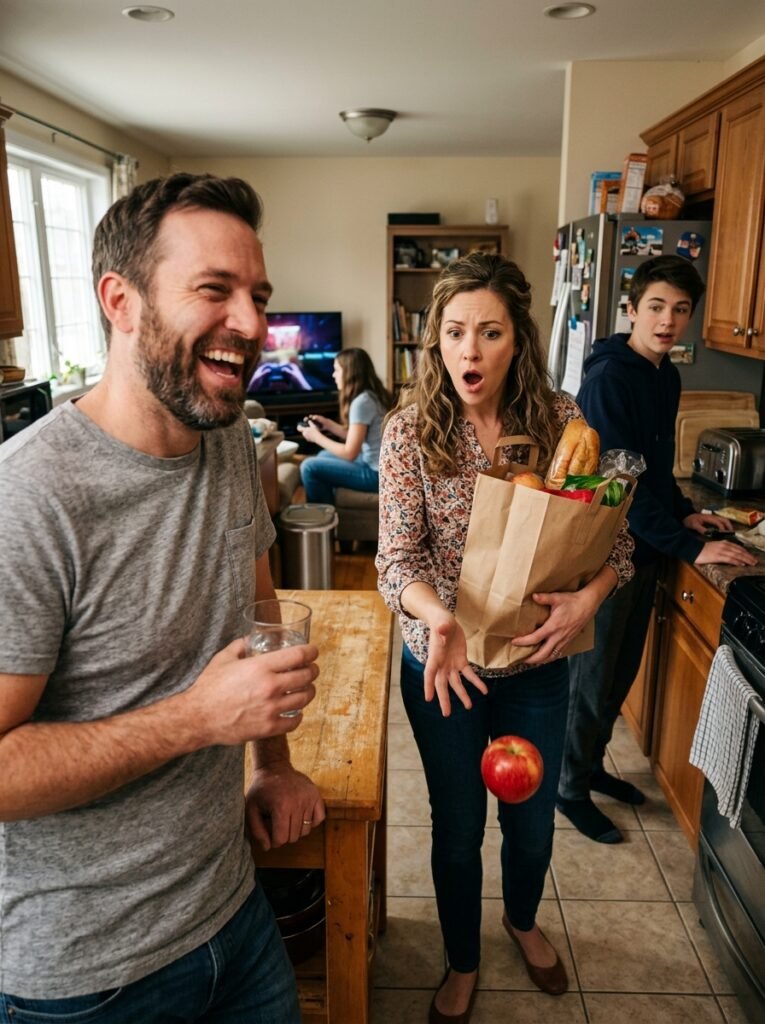
She was standing just behind Dad, holding a grocery bag in one hand.
And the look on her face, I’ll never forget it.
She’d heard every word.
And for the first time in a long time, I saw something change in her eyes. Something sharp, something cold.
And I knew everything was about to shift.
I didn’t move. I couldn’t. My feet were frozen to the floor as I watched Mom stare at Dad like she’d never seen him before.
She didn’t say anything at first. She just stood there with her keys still in hand, the grocery bag starting to slip from her fingers.
I remember watching an apple roll out and hit the floor.
No one noticed. Not Dad, not Jake, not the co-workers still howling with laughter. But I did.
And I knew something irreversible had just cracked open.
Then, quietly, Mom set the rest of the bag down and turned around.
She walked past me without saying a word, but for a split second, our eyes met.
I expected disappointment or maybe guilt. The kind of look she usually gave me when Dad was being harsh.
But this time it was different.
It was fire.
I didn’t see what happened next. At least not right away.
I grabbed a hoodie from the stairs and left again. Not sure where I was going.
I ended up sitting behind the corner store a few blocks away, just watching the rain hit puddles for what felt like hours. My phone was dead. I was soaked through again.
But I felt still.
For the first time in weeks, I wasn’t anxious or hurt or confused.
I was angry.
Not the kind of anger that burns out quick, but the kind that sinks into your bones. Slow, steady, focused.
When I finally came back home later that night, something had shifted in the air.
The living room was quiet. The guests were gone. Jake’s game console had been unplugged, and Mom was sitting at the kitchen table, sipping tea like she hadn’t just watched her husband laugh about exiling his kid in the pouring rain.
“Come sit,” she said without looking up.
I hesitated. “Is Dad—”
“He’s in the garage. Don’t worry.”
I sat. The tea in front of me was still steaming.
“You didn’t tell me,” she said. “You didn’t say what he said to you that night.”
“I figured you already knew.”
“I didn’t,” she said quietly. “Jake told me you stormed out after breaking something and screaming at Dad.”
I looked down, jaw clenched. “Of course he did.”
“But then I heard what your father said today,” she added, her voice flatter now. “And suddenly a lot of things made sense.”
We sat in silence.
“I’m sorry,” she said, and I flinched.
Not because of the apology, but because it sounded real. Too real, like she’d finally seen everything I’d been quietly living through.
I didn’t say anything. I didn’t know what to say.
But that moment should have been the start of things getting better.
It wasn’t.
Because that was the moment Jake realized he was losing control, and he did not take it well.
The next few weeks were a slow, suffocating spiral.
Mom started questioning things more, asking Jake for his side and mine, checking in with me privately, giving me the benefit of the doubt in a way I wasn’t used to.
At first, it felt like I was finally being seen, but it also painted a target on my back.
Jake didn’t like the attention being taken off him. He was used to being the golden child, the one who could do no wrong, the favorite, the future.
And suddenly, Mom wasn’t hanging on his every word. Suddenly, she was spending more time with me, asking about school, watching my guitar practice, making sure I had dinner before disappearing for the night.
Jake noticed.
He started small, petty sabotage. My phone charger would vanish from my room. My homework mysteriously went missing.
One day, I found all my socks soaking wet in the bathroom sink.
I didn’t have proof, but I knew it was him. His smug little smirk when I came downstairs looking for my stuff told me everything.
I tried to ignore it. I told myself he’d get bored eventually.
But Jake wasn’t wired like that.
If he couldn’t be adored, he’d settle for being feared. And when he couldn’t control the narrative, he’d burn the whole thing down.
One night, I came home from school to find Dad pacing in the living room with this wild look in his eyes.
Jake was sitting on the stairs, head bowed like some sad little martyr.
“Where is it?” Dad snapped the second he saw me.
“Where’s what?”
“You know exactly what.”
“I really don’t.”
“The $200 from my top drawer,” he said. “Gone.”
My stomach dropped. Not because I took it, but because I knew where this was going.
“I didn’t take anything,” I said. “Why would I even—”
“Jake saw you going into our room yesterday.”
“I was looking for Mom.”
“Don’t lie to me.”
I looked at Jake, who had the gall to look hurt.
“I saw him go in after school. I didn’t think anything of it until I overheard him on the phone bragging about having cash for a new amp.”
My mouth went dry.
“I—what? That’s not—”
“I’m done with the lies!” Dad shouted. “I should have never let you back in this house.”
“I didn’t—”
“You think I’m stupid? You think I wouldn’t notice when money goes missing the same day you’re bragging about gear?”
“I never said that. Ask Carson. Ask literally anyone. I haven’t been saving for anything. I’ve been working at the corner store every weekend to pay for that amp. You can check with Mr. Hernandez.”
“Yeah.” Dad scoffed. “We’ll see what your manager says.”
He stormed off.
I stood there trembling, not from fear, but fury.
And Jake, Jake just smiled and walked past me like nothing happened.
That night, I sat in bed staring at the ceiling, thinking about all the times I let things go, all the times I didn’t push back.
Every lie Jake told. Every punishment I took. Every time Dad believed him without question.
I realized something important.
They wanted me to stay quiet. They needed me to.
But I wasn’t going to anymore.
The next day at school, I went to the guidance counselor.
I told her everything, not just about the money, but about the months leading up to it. The pattern, the lies, the treatment at home.
She listened. She wrote things down. She nodded a lot, but I didn’t know if any of it meant anything.
Still, it felt good to say it out loud.
When I came home that afternoon, Dad was waiting for me with his arms crossed.
Jake was already on the couch eating chips like nothing happened.
“You told your school we were abusing you,” Dad growled.
I froze.
“Your counselor called. Said they’re opening a case. Said someone’s coming to do a home visit.”
Jake was smirking now. “Nice one, Brian. Real mature.”
Dad took a step closer.
“You think this is a game? Bringing strangers into our house. You want to humiliate your family? Fine. But you better pray they find something, because if they don’t, you’re out for good.”
I looked at Mom, who had just walked into the room carrying laundry. Her eyes were wide.
“You threatened him?” she asked.
“He’s trying to ruin us,” Dad barked. “He wants to tear this family apart because he’s too lazy to take responsibility.”
“He’s 15,” she snapped. “You’re a grown man. You don’t get to threaten your child just because he finally spoke up.”
That shut everyone up, but not for long.
Two days later, the social worker came.
She talked to all of us separately, asked questions, took notes. I told her everything again. She was patient, but her face gave nothing away.
I didn’t know if she believed me. I didn’t know if anything would come of it.
But Jake did.
And he panicked.
The next morning, I woke up to chaos.
Mom was yelling. Dad was roaring. Jake was crying.
I came downstairs and saw it.
Mom holding Jake’s phone open to a group chat.
There were screenshots, photos, messages, stuff Jake had been saying to his friends.
Things like, “Watch this. I’m going to get Brian kicked out again and my dad believes anything I say.”
El Mayo.
There were videos, too. One of him pretending to cry after breaking a plate. Another of him mocking me after I got grounded.
It was all there.
Everything.
I stood there frozen as Jake tried to defend himself.
“It was just jokes. They’re my friends. None of it’s real.”
But Dad wasn’t listening. Mom wasn’t either.
And for once, for once, the silence wasn’t mine to carry.
I thought this would be the moment things finally turned around. That Jake would face consequences. That maybe, just maybe, I’d be believed without having to drag the truth into the light.
But what happened next?
That was worse than anything I’d imagined.
Because instead of punishment, instead of an apology, instead of justice, they made me the problem again.
And what they did next.
That was the breaking point.
It’s funny how people always say the truth will set you free. Like the moment you drag it into the light, everything wrong will suddenly flip itself right.
I used to believe that for a long time.
I held on to this quiet hope that if I just waited long enough, stayed patient, and kept my head down, the truth would eventually fight for me.
But it didn’t.
Not at first.
After the group chat was exposed, after Mom saw the messages and the videos and every bit of smug manipulation Jake had stashed on his phone, I expected something, anything, to shift.
There was yelling. There was crying. There were threats thrown like knives across the living room.
But in the end, nothing really changed. Not in the way that mattered.
Because somehow I still ended up being the one blamed.
It started with Dad.
He didn’t say a word at first. Just stared at Jake, then at me, like the weight of the truth was too heavy for him to admit he’d been wrong for years.
Then he shook his head and muttered something that still haunts me.
“You could have handled this privately.”
I blinked. “What?”
“You didn’t have to humiliate your brother like that. You went through his phone. You think that’s okay?”
“I didn’t go through anything. Mom did. And what are you even talking about? He’s the one who set me up for months. Lied. Got me kicked out. He said it himself. He did it all on purpose.”
“He’s a kid,” Dad snapped. “He’s still learning. You should have talked to me like a man instead of crying to your school.”
My heart dropped.
There it was.
The wall.
Even with all the proof laid out in front of him, even with Jake’s own words echoing through the house, Dad couldn’t see past his pride.
He didn’t want the truth.
He wanted control.
And in his eyes, I had broken the chain.
Mom tried to stand up for me. At first, she defended me that morning, challenged Dad in a way I’d never seen before.
But it didn’t last.
By dinner, she was quiet again, distant.
When I asked if she was okay, she just looked tired.
“I’m trying to keep this family together, Brian,” she whispered. “You don’t understand how hard that is.”
I did.
But I also knew something else.
It wasn’t my job to hold the pieces anymore.
After that day, things got worse. Not louder. Quieter, which somehow felt cruer.
Jake didn’t talk to me at all. Just walked past me like I didn’t exist.
Dad barely acknowledged me.
Mom only spoke when necessary.
There were no more accusations, no more screaming matches.
Just silence.
Cold, sharp, echoing silence.
It was like I had died and no one had the decency to hold a funeral.
The home visit with the social worker ended in a shrug.
She said there wasn’t enough evidence of abuse to intervene formally. Emotional neglect, unfortunately, was a gray area.
“Monitor the situation,” she told my counselor. “Let us know if anything escalates.”
So, I stopped expecting help, and I stopped asking for it.
I hit rock bottom about a week later.
It was a Thursday.
I’d stayed late after school helping the band teacher organize music stands, mostly just to avoid going home.
When I finally did, the front door was locked.
No note, no call, nothing.
When I knocked, Jake answered.
He stared at me through the glass for a moment, then slowly, deliberately closed the door again.
I stood on the porch for 20 minutes, waiting, hoping maybe Mom would come open it. That she’d say it was just a mistake, that someone had forgotten I didn’t have a key.
No one came.
Eventually, I left again.
I went back to Carson’s place, soaked through and silent.
His mom opened the door before I could knock.
“Oh, honey,” she said softly. “Come in.”
They never asked for an explanation. Just let me shower, gave me dry clothes, made me dinner.
Carson and I stayed up that night playing old video games and pretending everything was normal.
But I couldn’t pretend anymore.
That night, I stared at the ceiling in their basement and made a decision.
I wasn’t going back.
Not this time.
The next morning, I went to the school office and asked for a meeting with the guidance counselor.
I told her everything again, but this time I asked for options. Legal options, housing, emancipation, anything.
“I’m tired,” I said. “And I’m not safe there. Not really.”
She looked at me for a long time.
Then she nodded.
It didn’t happen overnight. But things did start happening.
The school connected me with a youth outreach program. They arranged a meeting with a social worker who specialized in atrisisk teens.
We met weekly.
She listened.
She actually listened.
For the first time in my life, someone treated my story like it mattered.
She helped me apply for a student housing program for minors in unstable home environments.
It wasn’t easy. There were interviews, paperwork, home checks.
But Carson’s parents vouched for me.
So did the band teacher.
So did Mr. Hernandez from the corner store.
People showed up for me in ways I never expected.
Eventually, I got placed in a group home two towns over.
It wasn’t glamorous. Three kids to a room, shared bathrooms, chores every day.
But it was safe.
And for the first time in months, I could breathe.
I started rebuilding one piece at a time.
I got a part-time job at a music shop near the group home. The manager, a grizzled guy named Keith, liked that I could tune guitars by ear.
He let me help with repairs, paid cash under the table until the paperwork caught up.
I saved every penny.
I enrolled in therapy through the youth program. I didn’t want at first. I’d always hated talking about feelings.
But the therapist, Carla, had this way of making you feel like you weren’t broken, just rearranged.
I told her everything. The lies, the favoritism, the way I’d vanished from my own family.
And she didn’t try to fix me.
She just let me be.
At school, things slowly improved.
Word got around about what happened, but not in a cruel way.
A few kids started sitting with me at lunch. One of the seniors in band invited me to join his garage group.
I said yes.
We started practicing after school, jamming in his dad’s shed.
I hadn’t realized how much I missed feeling part of something.
I also started doing better in class.
I don’t know why exactly. Maybe because the chaos was gone, or maybe because for the first time I was doing it for me.
I even won a small scholarship for a song I wrote and submitted anonymously to a statewide music competition.
It was a simple piece, just me and my guitar.
But the lyrics were raw, honest.
The judges called it haunting.
I didn’t tell anyone it was about Jake or Dad or standing in the rain at 15, waiting for a door that would never open.
The fall was slow, and it hurt.
But the rise, the rise was mine.
And somewhere in the middle of it all, I realized something important.
You don’t need a family that breaks you to feel whole again.
You just need to stop waiting for them to heal you.
I was rebuilding now, brick by brick, step by step.
But I wasn’t done.
Not yet.
Because as much as I wanted to move forward, there was still a part of me deep down that needed something else.
Closure.
Not the kind you get from forgiveness, but the kind you take back with your own hands.
And when that opportunity came, I didn’t hesitate.
It’s strange the way anger can settle into you like embers after a wildfire.
Quiet, almost invisible, but always warm, always burning.
For months, I’d buried the worst of it beneath the small victories. My job at the music shop, band practice, the scholarship.
Everyone said I was doing great.
The school counselor told me I was resilient.
Carla said I was healing, and in some ways I was.
But there was still a part of me, this stubborn, pulsing ache that hadn’t moved on, that remembered the cold rain soaking my hoodie.
Jake smirk through the glass.
My father’s voice like a door slamming shut.
“You’re not welcome in this house.”
That line played on a loop some nights as I lay in bed at the group home staring at the ceiling.
I wasn’t obsessed with revenge.
Not exactly.
I didn’t want violence or some dramatic courtroom scene where I stood up and pointed at them like I was in a movie.
No, what I wanted was something much simpler.
I wanted the truth to matter.
I wanted them to feel what I felt.
And I wanted control.
That’s where it started.
The idea, it came slowly, like a guitar riff I couldn’t quite get out of my head.
At first, it was just a thought, then a plan, then a project.
And the first piece of that project, information.
People forget that teenagers are always watching, listening, taking notes.
And I’d spent my whole life doing just that.
I knew my dad.
I knew how he thought, how he lied, how he boasted, how he never checked the small things because he was too busy puffing up the big ones.
I knew how much he cared about appearances, about respect, about being the guy everyone looked up to in his circle.
I also knew that Jake was slipping, that the golden child mask was cracking now that I wasn’t around to take the heat.
I still had mutual friends at the school, people who told me things without knowing they were helping me.
Stories about Jake skipping class, getting into fights, mouththing off to teachers.
One kid said Jake had started bragging about being able to hack grades and change attendance in the school system.
That caught my attention.
So I started asking around, slowly, carefully.
It turned out Jake had found a way into the school system, but not through hacking.
Exactly.
One of his friends had an older brother who worked in IT for the district. They’d figured out a back door into the school portal using a shared admin account and a password someone had stupidly left on a sticky note in the lab.
Jake had been using it for months, not just to fix grades, but to delete absences, submit fake assignments.
He even added an extracurricular activity to his transcript that didn’t exist.
And no one noticed.
That was the beauty of favoritism.
Everyone gave him the benefit of the doubt.
I didn’t tell anyone.
Not yet.
Because I wasn’t ready to move.
Not until the next piece fell into place, which it did about two weeks later.
I was working at the music shop when Keith, the owner, pulled me aside and handed me a thick envelope.
“What’s this?” I asked.
“Your competition prize?” he said. “They sent it here since you listed the shop as your primary mailing address. Smart, by the way.”
I opened it.
Inside was a check.
$2,000.
More than I expected.
Enough for a new guitar. Maybe even enough for my own secondhand laptop.
But I didn’t spend it.
Not yet.
Because now I had the means and the motive.
And just one more thing to do.
I reached out to Carson that night.
We hadn’t talked much lately, just drifted like people do, but he was still the only person who’d seen what happened to me in real time.
He didn’t hesitate when I asked to meet up.
We got burgers and sat in his driveway like we were 13 again, talking about nothing for a while before I eased into it.
“I need a favor,” I said.
Carson raised an eyebrow. “What kind of favor?”
“Nothing illegal. Just quiet.”
He nodded slowly. “I’m listening.”
I told him about Jake, the system, the fake grades, the admin login.
Carson’s eyes widened.
“Dude, that’s a felony.”
“Only if I expose him wrong,” I said. “I don’t want to get anyone arrested. I want the school to know. I want my parents to know. I want it all to crash down. Not because I shouted it from the rooftops, but because he did it to himself.”
Carson grinned. “Okay, I’m in. But how?”
That’s when I told him the rest of the plan.
We’d gather proof, not just screenshots, but video, audio, something that would be impossible to deny.
Something I could drop like a hammer at just the right moment.
And the right moment, that would be family honors night.
It happened every spring.
A stupid ceremony the school hosted for students and parents to celebrate academic excellence and moral character.
Jake was set to receive three fake awards. One for academic performance, one for extracurricular leadership, and one for peer mentorship, whatever that meant.
My parents were planning to attend, of course.
It was their favorite thing, parading Jake around like a trophy.
I wanted that night.
But I couldn’t just show up with accusations.
I needed to build it like a story.
So, we started gathering.
Carson pretended to be interested in Jake’s methods. Said he wanted help fixing his own grades.
He got Jake talking, got him bragging, got him explaining the whole process again, this time on video with his phone recording in his jacket pocket.
We got everything.
The login details, the fake activities, even a screenshot of Jake adding a volunteer trip to his record that never happened.
Meanwhile, I contacted the competition board from the music scholarship.
Told them I wanted to donate a portion of my prize anonymously to fund future entries for kids in group homes.
They loved the idea.
They asked me to attend honors night to receive a special certificate in front of the crowd.
Perfect.
Now I had a reason to be there.
The day of the event, I wore a borrowed blazer and stood off to the side while Jake and my parents smooed with the staff.
My mom spotted me first.
Her face shifted. Shock, then hesitation, then something almost like guilt.
“Brian,” she said. “I didn’t know you were coming.”
“I was invited,” I said simply. “Scholarship award.”
Jake turned around mid laugh and went pale when he saw me.
“What are you doing here?”
I smiled. “Oh, just here to support family. Isn’t that what this night’s about?”
Dad didn’t say much.
Just gave me a once over and grunted.
Typical.
The ceremony started.
Names were called. Applause echoed.
I got my certificate and stepped off stage with a tight smile.
Then it was Jake’s turn.
They listed off his accomplishments, grades, clubs, mentoring.
And as the applause rang out, Carson slipped into the back row where I stood.
He handed me a USB drive.
I nodded.
Showtime.
I approached the principal after the ceremony just as she was congratulating my parents.
I was polite, smiled, said there was something I needed to show her, something important about the school’s online system.
She looked confused, then concerned.
I handed her the drive.
“Everything’s on there,” I said. “You’ll want to look through it carefully.”
She asked questions.
I didn’t answer them.
Not then.
I told her to email me if she needed clarification.
Then I left.
Two days later, I got the message.
A formal request for a statement.
Jake was under investigation for academic dishonesty.
But that wasn’t the best part.
No, the best part came later, when everything I’d been building finally snapped into place.
When they found out and the fallout, it was more than I ever expected.
When the principal emailed me asking for a formal statement, I knew the dominoes had finally started to fall.
It wasn’t instant.
Nothing in real life ever is.
But the moment I agreed to meet with her and two district administrators the following day, I could practically feel the balance of power shift.
They welcomed me into a small conference room with a picture of water on the table and a notepad set in front of each chair.
It was quiet, professional, and serious in a way that made my palms sweat even though I knew I hadn’t done anything wrong.
They played the videos.
They asked thoughtful, careful questions.
They looked through the screenshots.
They even recognized the compromised admin credentials Jake had been using.
Apparently, a password reset had gone unnoticed months ago.
When they were done, one of the district administrators exhaled slowly and set the last printed screenshot down like it weighed 100 lb.
“Thank you, Brian,” she said. “This is a very significant breach. And the fact that a student has been using administrator access to alter academic records is extraordinarily serious.”
I didn’t gloat.
I didn’t smile.
I just nodded.
“When will you tell him?” I asked.
“We’ll notify him and his parents today,” the principal said. “And his teachers and possibly the board, depending on what else we find.”
“What about the other students?” I asked. “The ones he helped change grades for.”
“That depends on the extent of the manipulation,” she said. “We have to audit everything. But Brian, you did the right thing.”
The right thing.
People toss those words around so lightly.
But hearing them from someone outside my family, someone who had no reason to lie, no ulterior motive, hit me harder than I expected.
I left the meeting knowing the fuse had been lit.
And all I had to do now was sit back and watch.
The explosion came three days later.
I was at the music shop reringing a customer’s guitar behind the counter when my phone rang.
It was Mom.
Not a text, not a voicemail.
A call.
I hesitated but picked up.
“Hello?”
“Brian.” Her voice was thin, strained. “Can you come home, please? We… we need to talk.”
I didn’t say yes or no.
I just said I’d think about it and hung up.
Ten minutes later, Carson burst through the shop door, breathless like he’d sprinted across town.
“Dude, you need to hear this.”
He told me the whole thing.
How Jake had been pulled from class.
How Dad showed up at the school raging.
How the principal had laid everything out.
Every altered grade. Every forged entry. Every fake hour of volunteer work.
How Jake tried to lie, then cried, then lied again.
Then blamed me.
Then blamed the IT kid.
Then said someone hacked his phone.
But this time, none of it worked.
They had recordings, screenshots, dates, IP logs.
Everything was airtight.
Jake was suspended pending a full board review.
His college prospects gone.
His peer mentor award revoked.
His reputation ruined.
My father, Carson described him pacing the hallway like a caged animal, yelling about conspiracies and vendettas until a district officer told him to step outside or be escorted out.
My mother, she cried, but not out of anger.
Out of something heavier, something that sounded from Carson’s reenactment dangerously close to regret.
Later that evening, after my shift, I decided to go.
Not for them.
For me.
I needed to see the fallout with my own eyes.
Not out of spite, but to close the chapter fully. To let my younger self, the one dripping with rain, shunned and ignored, finally witness justice without being silenced.
When I arrived, the house was chaotic.
The living room was a mess.
Papers everywhere.
A crumpled letter from the school board sat on the coffee table.
Dad was in his chair with his head in his hands, breathing hard.
Jake sat on the couch, face blotchy and red, eyes swollen.
He wasn’t crying anymore.
He was empty.
Hollow, like someone had pulled all the swagger and arrogance out of him and left nothing but a scared kid.
Mom saw me first.
“Brian,” she whispered. “Thank you for coming.”
Dad looked up at me with a mix of anger and something he wasn’t used to feeling, uncertainty.
Jake didn’t look up at all.
I closed the door behind me and stepped into the room like I wasn’t the same 15-year-old they once threw out into the rain.
Mom took a shaky breath.
“We know everything. The school showed us the evidence. They said you provided it.”
Dad snapped. “So, you’ve been plotting this for months?”
I didn’t react.
“No, I’ve been living my life. He’s the one who forged grades, made up activities, manipulated a school system, and bragged about it to his friends.”
Dad stood.
“You wanted to ruin your brother.”
“No,” I said calmly. “He ruined himself. I just stopped covering the damage.”
Jake finally looked up then, eyes red, jaw trembling.
“You set me up,” he whispered.
“No, you set me up for years,” I replied. “All I did was tell the truth to people who actually listened.”
The room was so silent.
I could hear the refrigerator humming in the kitchen.
Mom wiped her face.
“Brian, why didn’t you come to us? Why didn’t you give us a chance to fix this?”
I laughed quietly, not out of humor, but disbelief.
“I tried for years. I told you about the small things, the lies, the favoritism. You always told me to be the bigger person. You always told me not to cause trouble. And then you watched Dad kick me out in the rain because of something he made up. And when the school stepped in, you both treated me like a problem instead of a son.”
Mom flinched.
Dad clenched his fists.
Jake looked like he wanted to disappear.
I continued, voice steady, controlled, almost gentle.
“I didn’t come here to fight. I didn’t come here to watch you unravel either. I came because I needed you to hear this once, clearly, and without interruption.”
I took a breath.
“I’m done.”
Dad scoffed. “What does that even mean?”
“It means,” I said, “you don’t get to have power over me anymore. I’m building my own life. I have a job, a place to live, people who support me. I’m not here to fix anything. I’m here to close the door you slammed on me when I was 15.”
Mom stepped forward.
“So that’s it? We lose you?”
“You lost me the night I begged to come inside and no one opened the door,” I said. “Tonight isn’t about loss. It’s about understanding.”
Jake finally spoke again, voice small.
“Brian, I’m sorry.”
I studied him.
Maybe he meant it.
Maybe he didn’t.
But it didn’t matter because I wasn’t the kid who needed his apology anymore.
“I hope,” I said quietly, “you learned something from all this. Not because you got caught, but because you finally felt what it’s like to face the consequences you’ve been handing me for years.”
He looked away.
Mom was crying again.
Dad was silent with anger or shame or both.
It didn’t matter.
I stepped toward the door.
Mom whispered, “Will we ever see you again?”
“Maybe,” I said honestly. “But not like this. Not with me begging for space or fairness. If you want to be part of my life someday, you’ll have to walk toward me. I’m done walking alone.”
And with that, I left.
No dramatic slam, no final scream.
Just a quiet click of the door behind me as I stepped into the cool night air.
The group home was waiting.
My guitar was waiting.
My future, one I’d built with my own hands, was waiting.
And for the first time, the weight on my chest was gone.
Completely gone.
As I walked down the street past the house I no longer feared, I realized something important.
Revenge wasn’t about destroying someone else’s life.
It was about reclaiming your own.
And I had finally done it.
I never looked back.
Because sometimes the loudest victory is simply walking away and living a life they never believed you