“Three.”
Mindy leaned back in her chair.
“This is ridiculous.”
I ignored her.
“Four.”
Walter stopped smiling.
His gaze had fixed on the signature visible at the bottom of the page.
“Five.”
Lance covered his mouth.
Not because of anything I’d said.
Because he’d just read the heading.
THE WALTER AND SHIRLEY GRANT FAMILY EDUCATION TRUST
Six months earlier, after Walter’s health scare, he’d asked me to help organize some financial paperwork.
Not because I was the richest person in the family.
Not because I was the son-in-law who always paid.
Because I worked in commercial finance and understood trusts, insurance structures, and the difference between a tax-efficient decision and a family disaster waiting to happen.
Walter had met with his own attorney.
I hadn’t drafted the document.
I had simply reviewed the funding schedule when he asked.
And I’d noticed something immediately.
Under Beneficiaries, six grandchildren were listed.
Including:
Lucas Miller
Paige Miller
I had asked Walter about it privately.
“Are you sure?”
He’d looked offended.
“Why wouldn’t I be?”
“They aren’t biologically related to you.”
Walter had stared at me across his kitchen table as though I’d asked whether the sky needed permission to be blue.
“So?”
I still remembered his answer.
“They call me Grandpa. I show up at their school plays. Paige steals the cherries out of my fruit salad. Lucas calls me when his baseball team loses because he thinks I understand disappointment better than his father.”
“Thanks.”
Walter had smiled.
“You know what I mean.”
Then he’d become serious.
“Those children are mine in every way that matters to me.”
I hadn’t told Courtney about that conversation.
Walter had asked me not to discuss the trust until he announced it himself.
He’d planned to do that during the birthday weekend.
The irony was difficult to miss now.
“Six,” I said.
Shirley stared at the title.
“Seven.”
Mindy’s smile disappeared.
“Eight.”
Courtney whispered my name.
“Brandon.”
I looked at her.
There was panic in her expression.
Not because she feared what the paper said.
Because she knew what it would reveal about the family story everyone had just performed in front of our children.
“Nine.”
Walter placed both hands on the table.
“Ten.”
He stood.
Exactly as I’d said he would.
“Give me that.”
His voice wasn’t angry.
It was stunned.
I walked the document around to him.
He read the first page.
Then the second.
His eyes moved toward the back of the room.
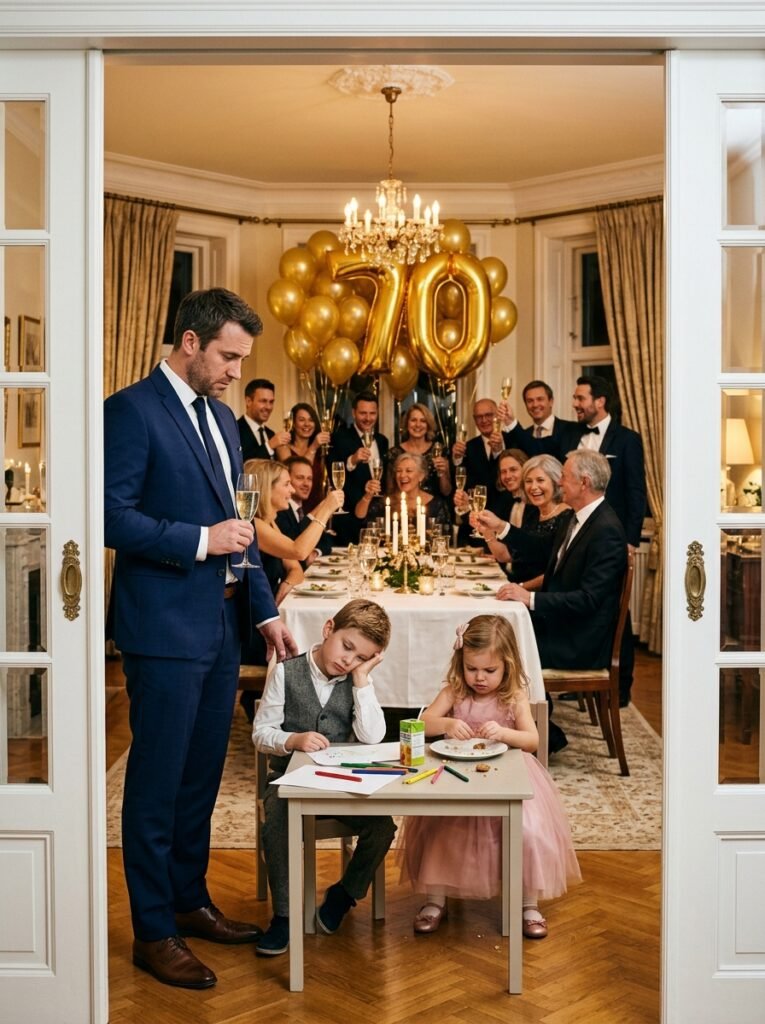
Lucas and Paige sat together at the small table beside the kitchen doors.
Lucas had opened a menu but wasn’t reading it.
Paige was turning her napkin over and over in her hands.
Walter’s face changed.
He looked at Shirley.
Then Mindy.
“What happened?”
Nobody answered.
“Eleven,” I said quietly.
Courtney pushed back her chair.
“Brandon, stop counting.”
I looked at her.
“Why?”
“Because Dad doesn’t need this tonight.”
Walter turned toward her.
“Need what?”
Courtney said nothing.
“Twelve.”
Walter’s attention shifted toward Paige.
“She was supposed to sit next to me.”
Mindy exhaled impatiently.
“We changed the arrangement.”
Walter frowned.
“Why?”
“The children would be more comfortable back there.”
“They don’t look comfortable.”
“They’re children.”
Walter’s eyes narrowed.
“Paige helped me choose the dessert.”
Nobody spoke.
“Thirteen.”
Shirley looked at me.
“Why do you even have that document?”
I glanced at my watch.
“Seven seconds early.”
She didn’t appreciate that.
“Answer me.”
“Walter asked me to review the funding schedule.”
Her expression changed.
“What funding schedule?”
Walter slowly lowered himself back into his chair.
“You didn’t tell her?”
He looked at me.
“No.”
I shook my head.
“You asked me not to.”
Walter turned to Shirley.
“I was going to announce it this weekend.”
“Announce what?”
He rested his fingertips on the paper.
“A trust for the grandchildren.”
Shirley stared.
“All of them?”
Walter looked toward the back table again.
“Yes.”
Mindy gave a short laugh.
“You can’t be serious.”
Walter turned to her.
“Why not?”
“You know why.”
“No,” Walter said. “Apparently I don’t.”
Mindy looked toward me, then toward Courtney.
“This is exactly the problem.”
“What problem?” Walter asked.
She lowered her voice.
“Dad, Lucas and Paige aren’t Grants.”
The restaurant seemed to become quieter.
Walter didn’t answer immediately.
Then he looked genuinely puzzled.
“Neither is Brandon.”
Mindy rolled her eyes.
“You know what I mean.”
“I’d like to hear you explain it.”
I almost interrupted.
Not because Mindy didn’t deserve to answer.
Because Paige was still sitting within sight.
Whatever the adults needed to untangle, my children did not need to sit there listening to themselves being debated like terms in a contract.
I looked toward Walter.
“We can talk later.”
He followed my gaze.
Understanding crossed his face.
Immediately he folded the document.
“You’re right.”
That was one of the reasons my children loved him.
Walter could change direction without turning it into a defeat.
He stood again.
Then walked past the main table.
Past Shirley.
Past Mindy.
Past the column.
Straight to Paige and Lucas.
Paige looked up.
“Grandpa?”
Walter pulled out the chair beside her.
“Someone made a mistake with the seating.”
Mindy shifted behind us.
Walter didn’t look at her.
He kept his attention on the children.
“Would you two do me a favor?”
Lucas looked cautious.
“What?”
“Sit with me.”
Paige brightened instantly.
“Really?”
“Of course.”
“But the important adults—”
Walter’s face tightened.
I knew he’d heard enough.
He said gently, “Sweetheart, this is my birthday. I get to decide who’s important.”
Paige smiled.
Lucas looked at me first.
I nodded.
They gathered their things.
Walter took Paige’s hand.
I walked beside Lucas.
No one applauded.
No one made a spectacle.
We simply moved two chairs.
The restaurant staff brought another place setting.
Walter shifted the seating himself so Paige sat on his left and Lucas on his right.
Then he looked at me.
“Where are you sitting?”
“Wherever there’s room.”
Walter pointed to the chair across from him.
“There.”
That put me beside Courtney.
Neither of us spoke.
At twenty seconds, almost exactly, Shirley leaned toward me.
Her voice was quiet.
“Did you know he was including them?”
I looked at my watch.
There it was.
The question.
“Yes.”
Her face changed.
“How long?”
“Six months.”
“And you never told Courtney?”
“Walter asked me not to.”
Shirley looked toward her husband.
Something complicated passed over her face.
Not just anger.
Fear.
That was the first thing that made me wonder whether the seating arrangement was about more than simple snobbery.
Because Shirley wasn’t looking at the trust like a woman offended by two children receiving money.
She was looking at it like a woman who had seen an old argument return.
Dinner continued.
Not normally.
But quietly enough.
Walter made sure Lucas got the steak he’d been excited about.
Paige ordered buttered pasta, then immediately asked whether she could have one of Walter’s roasted potatoes too.
“You’re stealing my dinner at my own birthday?”
“Yes.”
“Very bold.”
She grinned.
For the first time since we’d arrived, the tension in her shoulders disappeared.
That mattered more to me than anything being discussed at the other end of the table.
I didn’t touch the trust again.
Neither did Walter.
The musicians played the songs I’d selected from his college years.
A waiter brought out a chocolate cake with seventy small gold stars around the edge.
Lucas helped Walter blow out the candles.
Paige gave him the card she’d spent an hour decorating in our hotel room.
On the front, she’d written:
TO GRANDPA WALTER, WHO ALWAYS SAVES ME THE CHERRIES
Walter read it twice.
Then put on his glasses and read it again.
When he hugged her, his eyes were wet.
I looked toward Shirley.
She looked away.
Mindy did too.
Courtney didn’t.
She watched her father and Paige.
And for the first time that evening, I saw shame cross my wife’s face.
Not embarrassment.
Not discomfort.
Shame.
It should have made me feel vindicated.
It didn’t.
It made me tired.
After dinner, Walter asked me to walk with him.
The restaurant overlooked the Pacific.
A wide terrace curved around the building, with glass railings and low lanterns. The air smelled faintly of salt and jasmine from the landscaping.
The rest of the family remained inside for coffee.
Walter and I stood looking toward the dark ocean.
“You knew about the seating?”
“I found out before dinner.”
“How long before?”
“About an hour.”
“And you didn’t tell me.”
“It was your birthday.”
Walter sighed.
“Everybody keeps protecting my birthday like I’m twelve.”
“You’ve had a rough year.”
“I had a heart procedure. I didn’t become fragile.”
Fair.
He rested both hands on the railing.
“Did Mindy say those words in front of the kids?”
I didn’t want to repeat them.
But he deserved the truth.
“Yes.”
Walter closed his eyes.
“Which words?”
I told him.
When I finished, he stayed silent.
Then he said, “I taught her better than that.”
There was pain in his voice.
Not anger at losing face.
Pain at recognizing something in his daughter he didn’t understand.
“Maybe you did.”
He looked at me.
“And maybe I taught her something else without realizing it.”
“What?”
Walter didn’t answer immediately.
Instead he asked, “Did Courtney say anything?”
That question hurt more.
“No.”
His eyes closed again.
“She looked away.”
“Yes.”
Walter rubbed a hand over his face.
“I need to talk to her.”
“So do I.”
“Are you leaving her?”
There are questions that become impossible to answer because the simple versions have already disappeared.
“I don’t know.”
Walter nodded.
“That’s fair.”
I looked toward the restaurant windows.
Inside, Courtney was helping Paige put leftovers into a small box.
From a distance, they looked ordinary.
Like mother and daughter.
That was the problem.
Courtney had been in Paige’s life since she was four.
Lucas had been six.
Their biological mother, Emily, had died after a long illness when Paige was three.
I had met Courtney two years later.
She never asked the children to call her Mom.
She never tried to replace Emily.
She learned the songs Emily used to sing at bedtime because Lucas told her Paige still liked them.
She attended teacher conferences.
Learned how to braid hair badly.
Sat through rainy soccer games.
Stayed awake with Lucas the night before his first big school presentation because he was terrified he’d forget his lines.
For five years, Courtney had been building a family through a thousand ordinary choices.
Then one sentence from Mindy had exposed the one place Courtney still couldn’t stand up.
Her mother.
Her sister.
The family she’d been born into.
“I don’t understand Shirley,” I said.
Walter looked toward the ocean.
“You might after tomorrow.”
I frowned.
“What happens tomorrow?”
He smiled without humor.
“My wife and I finally have a conversation we’ve been avoiding for thirty-six years.”
“That sounds ominous.”
“It isn’t.”
“Thirty-six years makes it sound pretty ominous.”
Walter glanced at me.
“My father wasn’t my biological father.”
I stared.
He continued before I could respond.
“Technically, he was my stepfather.”
The words rearranged several pieces at once.
Walter’s obsession with never distinguishing Lucas and Paige.
His reaction to Mindy’s language.
The trust.
Shirley’s fear.
“Did your children know?”
“Some of it.”
“What does that mean?”
“They knew Henry Grant adopted me.”
“Then why would Mindy talk about blood?”
Walter’s face became sad.
“Because nobody ever told them what happened before that.”
Henry Grant entered Walter’s life when Walter was six.
Walter’s biological father, Robert, had left when Walter was an infant.
No dramatic disappearance.
No mystery.
He simply stopped participating.
Walter’s mother, Margaret, worked in a bakery and raised her son alone until she met Henry.
“He was a mechanic,” Walter told me. “He had terrible jokes and could fix anything except plumbing.”
I smiled.
“Sounds useful.”
“He was.”
Henry married Margaret when Walter was seven.
For two years, Walter called him Henry.
Then one evening, while they were changing a tire together, Walter accidentally said, “Dad, hand me the wrench.”
Walter stared at the ocean.
“I froze.”
“What did Henry do?”
“He handed me the wrench.”
“That was it?”
“That’s all.”
Walter smiled.
“Later that night he cried in the garage where he thought nobody could see.”
I imagined seven-year-old Walter watching through a kitchen window.
“Did he adopt you?”
“When I was nine.”
“And you took Grant.”
“Yes.”
“So Shirley knew.”
“Of course.”
“Then what has she been hiding?”
Walter hesitated.
“Henry’s family didn’t accept me.”
There it was.
“Because you weren’t blood.”
“Yes.”
His voice softened.
“Henry had a brother named Arthur. Arthur had children. They believed anything Henry owned should eventually stay with ‘real Grants.’”
I thought of Mindy’s wording.
“They used that phrase?”
“Constantly.”
“What happened?”
“Henry ignored them.”
Walter’s smile returned faintly.
“He was good at that.”
When Henry died, he left his house, savings, and repair shop equally divided between Margaret and Walter.
Arthur’s family challenged part of the estate.
They didn’t win.
But something else was damaged.
“Shirley and I had just gotten married,” Walter said. “She watched the whole thing.”
“And decided blood made inheritance dangerous.”
“Something like that.”
Walter rubbed his thumb across the railing.
“She became obsessed with clarity. Biological family. Legal family. Who had a claim to what. She told herself she was avoiding future conflict.”
“And you?”
“I thought she understood that Henry choosing me was the best thing that ever happened to me.”
He looked back through the glass at Paige.
“I didn’t realize she had learned the opposite lesson.”
That was the hidden truth.
Not a secret fortune.
Not a stranger appearing at the party.
A family argument inherited so quietly that nobody noticed what had survived.
Henry had believed love created family.
His relatives had believed blood did.
Walter had spent his life trying to live like Henry.
Shirley had spent hers trying to prevent another inheritance dispute.
Somewhere along the way, their children had absorbed both messages without understanding where either came from.
“Does Mindy know all that?” I asked.
“No.”
“She knows Henry adopted you.”
“Yes.”
“But not the estate fight.”
“No.”
“Why not?”
Walter gave me a weary look.
“You’re about to tell me hiding things doesn’t make them disappear.”
“I was considering it.”
“Save your breath.”
We stood quietly.
Then Walter said, “There’s something else.”
I almost laughed.
“Apparently tonight isn’t done.”
“It involves Courtney.”
I looked at him.
His face changed.
“She came to me eleven months ago.”
“About what?”
“Adopting Lucas and Paige.”
For several seconds I couldn’t process the sentence.
“Courtney wanted to adopt them?”
“She asked how I’d feel.”
My voice lowered.
“Why didn’t she ask me?”
Walter shook his head.
“She planned to.”
“But?”
“She wanted to speak with your children first.”
“That isn’t how that works.”
“She knew that.”
Walter lifted one hand.
“She wasn’t trying to arrange anything secretly. She wanted advice about whether bringing it up might make them feel she was asking them to replace Emily.”
That sounded like Courtney.
Painfully like Courtney.
“What did you tell her?”
“That being chosen doesn’t erase who came first.”
I looked away.
“Did she ever speak to them?”
“I don’t know.”
“She didn’t speak to me.”
Walter sighed.
“She spoke to Shirley.”
Of course.
I already knew what happened next.
“What did Shirley say?”
Walter’s expression hardened.
“She told Courtney adoption would create complications.”
“What complications?”
“The trust. Future inheritance. Family names.”
My jaw tightened.
Walter continued quickly.
“I didn’t know Shirley had said any of that until tonight.”
“Courtney listened.”
“Yes.”
“She let her mother make the decision.”
“Yes.”
I closed my eyes.
That hurt in a different place.
Because Courtney had wanted something meaningful.
Then had allowed fear to silence it.
And tonight, when the same fear was aimed directly at Lucas and Paige, she’d gone silent again.
“She loves them,” Walter said.
I opened my eyes.
“I know.”
“She does.”
“I know.”
“That matters.”
“Yes.”
I looked at him.
“But it’s not the only thing that matters.”
Walter nodded.
“No.”
Back at the hotel, Paige fell asleep quickly.
Lucas didn’t.
Our suite had two bedrooms connected by a small sitting room.
Courtney stayed downstairs with her family.
I sat beside Lucas near the window.
San Diego glowed below us.
“Dad?”
“Yeah?”
“Is Mindy mad at us?”
“No.”
He considered.
“She sounded mad.”
“She was talking about something adults sometimes get confused about.”
“What?”
“Family.”
Lucas frowned.
“How do you get confused about family?”
I almost smiled.
“Very easily, apparently.”
He pulled his knees toward his chest.
“Are Grandpa Walter and Grandma Shirley really our grandparents?”
I hated that a nine-year-old had been made to ask.
I chose my words carefully.
“Grandpa Walter believes he is.”
“What about Grandma Shirley?”
“That is something she needs to figure out.”
Lucas looked toward Paige’s room.
“Paige thinks Courtney is almost our mom.”
My throat tightened.
“What do you think?”
He shrugged.
“She isn’t Mom.”
“No.”
“But she’s Courtney.”
That answer was pure Lucas.
Simple.
Accurate.
“She does mom stuff.”
“What kind?”
“She knows Paige won’t eat the crust on toast.”
I smiled.
“True.”
“And she knows I hate when people watch me practice baseball.”
“Also true.”
“She came to school when I forgot my science project.”
“She did.”
Lucas looked at me.
“Can someone be family without being Mom?”
“Yes.”
He thought about that.
“Then Mindy was wrong.”
“Yes.”
I didn’t soften it.
Some truths were simple enough for children.
Lucas nodded.
Then asked the question I had been dreading.
“Why didn’t Courtney say that?”
I looked out the window.
Because she was afraid of disappointing her mother.
Because she had spent a lifetime learning how quickly disagreement became distance in the Grant family.
Because adults could love children and still fail them in specific moments.
But none of that belonged on a nine-year-old’s shoulders.
“I think Courtney got scared.”
“Of Mindy?”
“Of the argument.”
Lucas considered.
“I’m scared of arguments.”
“So am I sometimes.”
“But if somebody said Paige wasn’t my sister, I’d still say she was.”
There was no judgment in his voice.
Only certainty.
I looked at him.
“That’s a good thing to know about yourself.”
He yawned.
“Can I sleep in Paige’s room?”
“Sure.”
He stood.
At the doorway, he turned.
“Dad?”
“Yeah?”
“Don’t cancel Grandpa’s breakfast tomorrow.”
I blinked.
“You know about that?”
“He told me pancakes.”
I laughed.
“All right.”
Lucas disappeared into Paige’s room.
I sat alone for several minutes.
Then someone knocked.
Courtney.
She entered slowly.
Her shoes were in one hand.
Her eyes were red.
“How are they?”
“Sleeping.”
“Both?”
“Lucas just went in with Paige.”
She nodded.
“Can I see them?”
“Yes.”
She walked quietly to the doorway and looked inside.
Paige was asleep beneath the blanket.
Lucas had curled on top of the covers beside her.
Courtney stood there for a long time.
Then she closed the door halfway.
“I failed them.”
I didn’t answer.
She turned toward me.
“I did.”
“Yes.”
The word hurt her.
But she had asked for truth.
“I don’t know why I froze.”
“I do.”
Her eyes met mine.
“Your dad told me.”
She went still.
“About Henry?”
“And the adoption conversation.”
Courtney looked away.
“You weren’t supposed to know that.”
“Why?”
“Because I hadn’t decided what to do.”
“It was eleven months ago.”
“I know.”
“Were you planning to tell me?”
“Yes.”
“When?”
“I don’t know.”
I nodded.
There it was again.
Not malice.
Delay.
Fear disguised as waiting for the right moment.
“Why did you talk to your mother before me?”
Courtney sat on the sofa.
“Because I wanted her to be happy.”
The honesty surprised me.
“With you adopting my children?”
“Yes.”
“Why did you need her approval?”
“I don’t know.”
“You do.”
She stared at her hands.
Finally she said, “Because when Mom is unhappy with something, everyone feels it.”
That was true.
Shirley rarely shouted.
She withdrew.
Changed plans.
Stopped calling.
Made gatherings slightly colder until somebody came back into line.
Courtney had grown up adapting herself around those temperatures.
“That explains you,” I said.
“It doesn’t excuse tonight.”
“No.”
She nodded.
Tears filled her eyes.
“When Mindy said it, I heard Mom’s voice in my head.”
“What voice?”
“The one saying not to create a scene. Not to ruin Dad’s birthday. Not to turn everything into drama.”
“So you chose quiet.”
“Yes.”
“And Lucas heard rejection.”
Courtney covered her face.
“Yes.”
“And Paige cried.”
“I know.”
I let the silence remain.
After a while, she whispered, “Do you want me to leave?”
I thought carefully.
“No.”
She looked up.
“That doesn’t mean we’re okay.”
“I know.”
“It means the children are sleeping and we’re adults.”
She nodded.
“Tomorrow we’ll have breakfast with Walter.”
“And Mom?”
“I don’t know.”
Courtney looked toward the closed bedroom door.
“I need to talk to her.”
“Yes.”
“But first I need to talk to Lucas and Paige.”
“Yes.”
She wiped her eyes.
“I don’t want to explain myself to them.”
“Good.”
“I want to apologize.”
“That would be better.”
She nodded.
Then something changed in her expression.
“Brandon.”
“What?”
“The trust document.”
“Yes?”
“Dad told me there was something else in it.”
I frowned.
“What?”
“A letter.”
“I never saw a letter.”
“He said the attorney added it last week.”
“Why?”
Courtney hesitated.
“Dad apparently wrote personal instructions to be opened if there was ever disagreement over who counted as family.”
I stared.
“That seems oddly specific.”
“He knew Mom hadn’t accepted the beneficiary list.”
My stomach tightened.
“So this argument started before San Diego.”
“Yes.”
“How long before?”
“Months.”
“And your mother came anyway knowing Dad was including Lucas and Paige?”
“Yes.”
“Did Mindy know?”
Courtney nodded.
I felt the shape of the story change again.
The seating chart hadn’t been an impulsive decision.
It had been part of an argument Walter thought was still private.
“Where is the letter?”
“Dad has it.”
“What does it say?”
Courtney shook her head.
“I don’t know.”
Then she looked toward the door, where our children slept safely beyond the wall.
“But Dad said something strange.”
“What?”
“He said the letter isn’t mainly about money.”
I waited.
“He said it’s about Henry.”
Walter’s adoptive father.
Courtney’s grandfather in every sense that had mattered.
“What about him?”
Courtney’s eyes held mine.
“Dad says Henry left one final instruction nobody in the family ever followed.”
I stared.
“What instruction?”
“He wouldn’t tell me.”
She took a breath.
“He said he wants all of us at breakfast tomorrow before he reads it.”
Outside, the lights of San Diego stretched toward the dark edge of the ocean.
Behind us, Lucas and Paige slept beneath the same roof as the adults still trying to decide what family meant.
And for the first time, I understood that tomorrow’s breakfast wasn’t going to decide who received money from Walter’s trust.
It was going to reveal why, thirty-six years earlier, Henry Grant had tried to warn his family that blood was the least reliable way to measure belonging.
Breakfast was quieter than dinner.
That helped.
Walter had cancelled the private hotel room we’d originally reserved.
Instead, he asked everyone to meet on a shaded patio beside the resort garden.
No musicians.
No birthday decorations.
No long table designed to communicate status.
Just three round tables pushed together.
Walter arrived first.
He placed his cane against the chair even though he rarely used it anymore, then set a sealed envelope beside his coffee cup.
I noticed the handwriting immediately.
It was old-fashioned.
Block letters in faded blue ink.
FOR WALTER — AND FOR THE FAMILY AFTER HIM
Henry Grant.
Walter’s adoptive father.
Lucas and Paige came down with me.
Before we reached the patio, I stopped.
“You two don’t have to stay for the adult conversation.”
Lucas looked toward the breakfast buffet.
“Can we stay for pancakes?”
“Absolutely.”
“Then I vote pancakes.”
Paige nodded solemnly.
“Me too.”
Courtney approached from behind us.
She looked nervous.
“Can I talk to them before we go in?”
I looked at Lucas.
Then Paige.
“That’s their choice.”
Courtney’s eyes filled slightly.
She nodded.
“Okay.”
Lucas glanced at Paige.
“Here?”
“If that’s okay.”
Paige took my hand.
Courtney crouched so she wasn’t standing over them.
She didn’t begin with explanations.
That mattered.
“Last night, when Aunt Mindy said you didn’t belong, I should have spoken immediately.”
Lucas watched her.
Paige stared at her shoes.
Courtney continued.
“I didn’t.”
Her voice shook.
“I was afraid of making the argument bigger. But by staying quiet, I made you feel like I agreed.”
Paige looked up.
“Did you?”
“No.”
Courtney answered without hesitation.
“Not for one second.”
“Then why didn’t you say it?”
There was no anger in Paige’s voice.
Just seven-year-old logic.
Courtney swallowed.
“Because sometimes grown-ups can know the right thing and still get scared about saying it.”
Paige considered this.
“Grandpa says scared people can still be brave.”
A tear slipped down Courtney’s cheek.
“He’s right.”
Lucas folded his arms.
“Dad said you were scared of the argument.”
“I was.”
“I’m scared of arguments too.”
“I know.”
“But if someone said Paige wasn’t my sister, I’d say she was.”
Courtney looked at him.
“You’re right.”
Lucas seemed surprised by the lack of defense.
Courtney continued.
“I want to do better than I did last night.”
Paige asked, “Are you still our Courtney?”
That nearly broke me.
Courtney smiled through tears.
“If you want me to be.”
Paige stepped forward and hugged her.
Lucas took longer.
Then he put one arm around Courtney’s shoulder.
It lasted only a second.
It was enough.
Children rarely need perfect adults.
They need adults who repair what they damage.
We walked to breakfast together.
Shirley was already seated.
Mindy sat beside her.
Lance and his wife, Karen, sat farther down.
Walter had deliberately left no place cards.
Nobody could hide behind the idea that somebody else had arranged the hierarchy.
“Sit where you want,” he said.
Paige chose the chair beside him.
Lucas sat beside her.
I sat across from them.
Courtney took the seat beside me.
Shirley watched all of this.
She said nothing.
Walter poured coffee.
Then looked around the table.
“I’d like to say something before we discuss anything else.”
He turned toward Lucas and Paige.
“What happened last night should not have happened.”
Lucas stopped buttering his pancake.
Walter continued.
“This family is still learning some things it should have learned before you were born.”
Paige asked, “Like what?”
Walter smiled gently.
“Like how to stop making old mistakes look like traditions.”
I saw Lance lower his head.
Walter looked toward me.
“You were right to protect them.”
“I could’ve handled parts of it better.”
“Probably.”
Courtney glanced at me.
Walter smiled faintly.
“See? That’s family too. Everybody gets to be right and imperfect at the same time.”
Mindy shifted.
“Dad, can we not turn breakfast into a therapy session?”
Walter looked at her.
“No.”
She blinked.
He wasn’t sharp.
Just certain.
“I’ve spent most of my life avoiding this conversation because I thought not discussing old family disputes meant I’d moved beyond them.”
He touched the envelope.
“I was wrong.”
Shirley stared at the handwriting.
“You didn’t destroy that?”
“No.”
“You told me you had.”
Walter sighed.
“I told you I had put it away.”
“That’s not how I remember it.”
“Then one of us remembers incorrectly.”
There was no accusation.
Shirley’s expression softened slightly.
Walter looked toward us.
“My father, Henry Grant, adopted me when I was nine.”
Mindy frowned.
“We know that.”
“You know the legal fact.”
Walter touched the envelope.
“You don’t know the story.”
He told them about Robert.
About Margaret.
About the mechanic who became Dad slowly enough that nobody could identify the exact day it happened.
Lance smiled when Walter described Henry crying in the garage after young Walter accidentally called him Dad.
Mindy didn’t.
She looked increasingly uncomfortable.
Then Walter described Henry’s brother Arthur.
The arguments.
The relatives who believed Walter should never inherit Grant property.
The challenge after Henry died.
Shirley stared at her coffee.
Courtney looked toward her mother.
“You never told us.”
Shirley answered softly.
“No.”
“Why?”
“Your father hated talking about it.”
Walter shook his head.
“That wasn’t the only reason.”
Shirley looked at him.
“No.”
The word was quiet.
Walter waited.
After a long moment Shirley spoke.
“I was twenty-eight.”
Her voice had changed.
No command.
No certainty.
Just memory.
“Your grandfather died, and within two weeks people I’d been having Christmas dinner with were calling lawyers.”
Courtney listened.
“They said Walter wasn’t really a Grant. They said Henry had been manipulated. They questioned every gift he’d ever given us.”
She looked toward Walter.
“I watched your father go from grieving his dad to having to prove that his dad had loved him.”
That explained something.
Not everything.
But something.
“I promised myself our children would never go through that.”
Mindy frowned.
“So you made sure everything stayed with blood relatives.”
Shirley closed her eyes briefly.
“Yes.”
Walter looked at her.
“And somehow you never noticed what that said about me.”
The sentence wasn’t loud.
That made it land harder.
Shirley’s eyes filled.
“I did eventually.”
“When?”
“When you created the trust.”
Six months earlier.
Walter leaned back.
“And instead of telling me?”
“I argued with you about beneficiaries.”
“Yes.”
“And when I wouldn’t change it?”
She looked down.
“I complained to Mindy.”
Courtney’s expression changed.
“Mindy.”
Mindy folded her arms.
“Mom was worried.”
“About Lucas and Paige?”
“About fairness.”
“What fairness?”
Mindy looked at me.
“Dad has four biological grandchildren.”
“Six grandchildren,” Walter corrected.
Mindy sighed.
“You know what I mean.”
“No.”
His tone remained calm.
“I’ve allowed that phrase for too long. Explain what you mean.”
Mindy’s face flushed.
“I mean they have Brandon’s family.”
“So?”
“They’ll inherit from him.”
I almost laughed.
“This isn’t about inheritance for them.”
Mindy looked at me.
“You’re wealthy.”
“That doesn’t make Walter less their grandfather.”
“I didn’t say it did.”
“You told Paige she wasn’t.”
Silence.
Mindy looked away.
“That was poorly worded.”
Lucas spoke before any adult could.
“It wasn’t confusing.”
Mindy looked at him.
He continued, “You said we didn’t belong.”
Courtney touched his shoulder gently.
Lucas returned to his pancakes.
Mindy’s face changed.
For the first time, I saw her understand that adults often hide behind words like misunderstanding when children remember perfectly well what was said.
She took a breath.
“You’re right.”
Everyone went quiet.
She looked at Lucas.
Then Paige.
“I said something that made it sound like you were less family than the other kids.”
Paige whispered, “You said we weren’t blood.”
“I did.”
Mindy swallowed.
“That was wrong.”
No explanation.
Not yet.
Paige studied her.
“Are you sorry?”
“Yes.”
“Okay.”
Children could sometimes accept an apology faster than adults because they didn’t require it to solve every future question.
Paige returned to her orange juice.
Mindy looked almost stunned.
Walter reached for the envelope.
“This is why Henry wrote this.”
He broke the old seal carefully.
The paper inside had yellowed.
Walter unfolded it.
“My father wrote this after Arthur first threatened to challenge his will. He gave it to me about six months before he died.”
He began reading.
Henry’s voice existed only through Walter’s, but somehow it felt present.
Walter,
People use the word family as if it means one thing.
It doesn’t.
Sometimes it means biology.
Sometimes law.
Sometimes memory.
Sometimes responsibility.
The problem begins when people use one meaning to erase all the others.
Walter paused.
Nobody moved.
He continued.
I was not there when you were born.
I did not give you your eyes or your height or your terrible habit of leaving cabinet doors open.
Lance laughed softly.
Walter smiled.
“I still do that.”
Then continued.
But I was there for broken bicycles, report cards, fevers, first jobs, arguments, and the day you stood beside me at the courthouse and chose Grant as your name.
Walter’s voice thickened.
If anyone tells you that made you less my son than blood would have, they misunderstand what I believe a father is.
Shirley wiped her cheek.
Walter kept reading.
Do not spend your life trying to prove them wrong by guarding what I leave behind.
Walter stopped.
His hand trembled.
That line was why he’d kept the letter.
Maybe why he’d avoided it.
He continued.
If you turn inheritance into a test of who qualifies as family, then Arthur wins long after both of us are gone.
Nobody spoke.
Give according to need, character, relationship, and your own conscience.
Do not let my relatives teach your children that love must be biologically certified before it counts.
Walter lowered the paper.
There was one final paragraph.
And if someday somebody comes into your family without your blood but with love, responsibility, patience, and the courage to stay—make room at the table.
Silence settled over breakfast.
The phrase was almost too perfect for what had happened the previous evening.
Yet the letter was decades old.
That was what made it matter.
The problem wasn’t new.
Only the names had changed.
Paige looked at Walter.
“Is that why you moved my chair?”
He smiled.
“Yes.”
“Your dad sounds nice.”
“He was.”
“Was he my great-grandpa?”
Walter glanced toward Shirley.
Then back at Paige.
“Yes.”
Paige seemed satisfied.
“Okay.”
She reached for another pancake.
That simple acceptance broke something open in Shirley.
She began crying.
Quietly.
Courtney looked toward her mother.
For a moment, I thought Courtney would rush over and comfort her automatically.
She didn’t.
Not because she lacked compassion.
Because she was learning not to rescue her mother from every difficult feeling.
Shirley wiped her eyes herself.
Then looked at Walter.
“I hated that letter.”
He smiled sadly.
“I know.”
“You showed it to me once.”
“Yes.”
“After Arthur filed the challenge.”
“Yes.”
“I thought Henry was telling us not to protect what he’d built.”
Walter shook his head.
“He was telling us not to let fear define what it meant.”
Shirley looked toward Lucas and Paige.
“I did exactly that.”
Nobody contradicted her.
After a while she turned toward me.
“Brandon.”
“Yes?”
“I owe you an apology too.”
I didn’t respond immediately.
She continued.
“You paid for this weekend because you wanted Walter to have something beautiful.”
“Yes.”
“And I let myself treat your generosity like something expected.”
That was true.
“There were eleven plane tickets,” she said quietly. “I never even asked whether that was comfortable for you.”
“I could afford it.”
“That doesn’t mean I should have assumed.”
Also true.
Then she said, “And I let your children receive less welcome at an event you created.”
I appreciated that she didn’t call them Courtney’s stepchildren.
“My mistake was not financial,” she continued. “It was thinking contribution and belonging were separate things depending on who was making them.”
I nodded slowly.
“Thank you.”
She seemed surprised.
“You forgive me?”
“I said thank you.”
Walter smiled into his coffee.
Shirley actually laughed once.
“Fair.”
It was the first honest moment between us in years.
After breakfast, Walter formally announced the trust.
Nobody argued.
Not because Henry’s letter had magically solved everyone’s feelings.
Because the purpose of the trust became clearer once money stopped being treated as evidence of love.
Walter had structured it primarily for education and medical needs.
The grandchildren wouldn’t receive equal cash distributions at a particular age.
The trust would support each child according to defined purposes.
College.
Vocational training.
Certain health expenses.
Approved educational opportunities.
Mindy read the terms more carefully.
“So if one child doesn’t go to college?”
“They can use it for trade school or professional training,” Walter said.
“And if someone gets a full scholarship?”
“Then perhaps the trust helps someone else more.”
She looked surprised.
“So it isn’t divided into six equal shares.”
“No.”
“What happens to what’s left?”
“Eventually it goes to a scholarship fund.”
“For family?”
“For first-generation college students.”
Mindy sat back.
“That changes things.”
Walter looked at her.
“It shouldn’t change whether Lucas and Paige belong.”
“No.”
She looked toward me.
“I know.”
And I believed she was beginning to.
Not because one breakfast had remade her personality.
Because she had finally seen the architecture beneath the opinion she had inherited.
Sometimes people don’t realize they’re carrying someone else’s fear until you show them where it came from.
Courtney and I didn’t resolve our marriage in San Diego.
That would have been too easy.
We went home.
The children returned to school.
Suitcases were unpacked.
Bills arrived.
Life resumed its ordinary shape.
But our marriage didn’t.
For the first two weeks, Courtney slept in the guest room.
Not because I ordered her there.
She chose it.
“I think we need some space that isn’t punishment,” she said.
That sounded right.
We started counseling.
Our counselor, Dr. Naomi Reed, had a habit of asking simple questions that became difficult once you tried to answer them honestly.
During our second session she asked Courtney, “When did disagreement become dangerous to you?”
Courtney sat very still.
“Dangerous is a strong word.”
“Then choose another.”
Courtney thought.
“Expensive.”
I looked at her.
Dr. Reed did too.
“What did disagreement cost?”
“Peace.”
“With whom?”
“My mother.”
Courtney explained that Shirley rarely exploded.
Instead she became distant.
Quiet.
Unreachable.
If Courtney chose something Shirley disliked in high school, her mother might not mention it directly.
She would simply stop showing interest.
A school play.
A friend.
A college application.
Nothing cruel enough to name.
Just warmth withdrawn until Courtney came back toward the expected choice.
“I learned to keep Mom comfortable,” Courtney said.
Dr. Reed asked, “Did that strategy work?”
“Yes.”
“Did it make you happy?”
Courtney looked toward me.
“No.”
Then Dr. Reed asked me, “What did you learn?”
“About what?”
“Conflict.”
I knew immediately.
“That if I provide enough, people stay.”
Courtney frowned.
I had never said that aloud.
“My father left when I was thirteen,” I explained. “Not abandoned-us left. He moved away after the divorce and became someone who sent checks instead of showing up.”
I looked down.
“My mom worked constantly. Money was always tight.”
“So generosity became what?” Dr. Reed asked.
“Security.”
“That sounds positive.”
“It was.”
“And?”
I exhaled.
“Eventually I started using it as proof that I was doing my part.”
Courtney’s eyes filled.
I continued.
“If I paid for things, arranged things, solved things, I didn’t have to ask whether people actually valued me.”
That was uncomfortable.
Because it meant the San Diego weekend contained one of my patterns too.
I had paid for everything.
Not because Walter demanded it.
Because being useful felt safer than asking whether Courtney’s family truly accepted me and the kids.
Their disrespect was theirs.
But my habit of buying my way into every responsibility belonged to me.
Dr. Reed nodded.
“So Brandon pays to avoid asking for belonging. Courtney stays quiet to avoid risking it.”
Neither of us spoke.
There was our marriage.
Not ruined by one birthday dinner.
Exposed by it.
Courtney apologized to the children again later.
Not repeatedly.
We didn’t want Lucas and Paige carrying the responsibility of reassuring her.
Instead, she changed her behavior.
At Paige’s spring recital, Shirley commented that seating was crowded and suggested the children sit with other kids while adults stayed together.
Courtney smiled.
“Paige wants Brandon and me together.”
Shirley started to object.
Courtney added, “So that’s what we’re doing.”
No argument.
No apology.
No fear.
Just a decision.
I noticed.
At Lucas’s baseball game, Mindy made an offhand comment about “the Grant cousins.”
Courtney corrected her casually.
“All six cousins.”
Mindy paused.
Then nodded.
“All six.”
Lucas didn’t even look up from tying his shoe.
That was how I knew the repair was working.
The children no longer had to monitor the adults.
Three months after San Diego, Courtney asked me to meet her at the kitchen table after the kids went to sleep.
A folder sat in front of her.
My stomach tightened.
“What is that?”
She smiled nervously.
“Not divorce papers.”
“Good opening.”
She pushed the folder toward me.
An adoption information packet.
I stared.
“Courtney.”
“I talked to Dr. Reed first.”
“Okay.”
“And an attorney.”
“Okay.”
“But I’m not asking you to say yes.”
I looked at her.
“Then what are you asking?”
“Whether we can talk about it.”
That distinction mattered.
“I should have talked to you last year.”
“Yes.”
“I should never have made your mother, my mother, or anyone else part of the decision before you.”
“Yes.”
She nodded.
“I know adopting Lucas and Paige isn’t something I get because I’ve been around a long time.”
“No.”
“And I know Emily is their mother.”
My throat tightened.
“Yes.”
“I don’t want her erased.”
“I know.”
Courtney took a breath.
“I want to ask whether, someday, if the children want it too, I could become their legal parent without making them feel they have to redefine what Emily means.”
I looked at the folder.
Then at my wife.
“You’ve thought about this.”
“For more than a year.”
“I know.”
She winced slightly.
“I deserved that.”
“Probably.”
Then I smiled faintly.
“I don’t know the answer.”
“Neither do I.”
“That seems healthier than eleven months of secret planning.”
She laughed.
“Yes.”
We left the folder on the table.
For two weeks.
Then we met with a family attorney.
Then, separately, with a child therapist who explained how to discuss the possibility without placing pressure on Lucas or Paige.
Only then did we speak to them.
We chose a Saturday afternoon.
No ceremony.
No emotional speech.
Just four people in our living room.
Courtney said, “There is something I’d like someday, but you don’t have to want it.”
Lucas immediately looked suspicious.
“Are we moving?”
“No.”
“New school?”
“No.”
Paige asked, “Dog?”
I laughed.
“Also no.”
Courtney explained adoption simply.
She told them it wouldn’t change their memories of Emily.
Wouldn’t change her name in photo albums.
Wouldn’t make anyone replace anyone.
It would mean that legally, Courtney would become another parent.
Lucas thought for almost a minute.
Then asked, “Would I have to call you Mom?”
“No.”
“Could I?”
Courtney’s eyes filled.
“If you wanted.”
“Could I still call you Courtney?”
“Yes.”
“Could I alternate?”
She laughed through tears.
“Yes.”
Paige had another question.
“If you adopt me, is Mommy Emily still my mommy?”
I answered.
“Always.”
Courtney nodded.
“Always.”
Paige thought about it.
Then said, “Okay.”
Courtney carefully kept her expression neutral.
“Okay meaning you understand?”
“No. Okay meaning I want that.”
Lucas smiled.
“Me too.”
Then immediately asked whether we could order pizza.
That was the entire dramatic family decision.
Pizza came twenty-five minutes later.
Life continued.
The adoption took time.
Paperwork.
Home review.
Counseling.
Court appearances.
Emily’s parents were part of the conversation too.
That mattered enormously.
Her mother, Joan, cried when we told her.
At first I worried those tears meant pain.
Then Joan hugged Courtney.
“Thank you for not trying to replace her.”
Courtney whispered, “I couldn’t.”
Joan nodded.
“Good.”
Later, Joan gave Courtney something.
Emily’s old recipe box.
I hadn’t opened it in years.
Inside were handwritten recipes for banana bread, chicken soup, birthday frosting.
Courtney stared.
“I can’t take this.”
Joan smiled.
“I’m not giving you Emily.”
She touched the box.
“I’m giving you recipes.”
Courtney cried.
So did I.
Lucas complained that the adults were making everything weird.
That restored balance.
The adoption was finalized nine months after San Diego.
The judge asked Lucas whether he understood what was happening.
“Yes.”
“What does adoption mean to you?”
Lucas thought.
Then said, “Courtney is already family. The papers make the government catch up.”
The judge laughed.
So did everyone else.
Paige signed her name in enormous letters on a ceremonial page.
Then drew a heart beside it.
Courtney became their legal mother.
They still called her Courtney most days.
Sometimes Paige said Mom without noticing.
Sometimes Lucas did too.
Nobody counted.
That was the point.
Shirley changed more slowly.
I respected that more than an instant transformation.
She didn’t become a completely different woman because of one old letter.
She still liked categories.
Still cared too much about formalities.
Still planned holidays as though managing a military operation.
But she started catching herself.
At Thanksgiving, she handed out stockings.
Six grandchildren.
Six names.
No separate group.
At Christmas, she gave Paige a necklace that had belonged to Shirley’s mother.
Mindy noticed.
For a second, something old crossed her face.
Then she smiled.
“Paige, Grandma wore that to my high school graduation.”
Paige touched it carefully.
“Really?”
“Yes.”
“Did you have bad hair?”
Mindy laughed.
“Terrible.”
The room relaxed.
Walter caught my eye from across the room.
Neither of us said anything.
We didn’t need to.
A year after the birthday dinner, Walter wanted to return to San Diego.
I laughed when Courtney told me.
“You’re joking.”
“No.”
“Same restaurant?”
“That’s what he wants.”
“Your father has a strange sense of humor.”
“He’s seventy-one. Apparently he’s fearless now.”
This time, we split the costs.
Not because I couldn’t afford everything.
Because I finally understood contribution didn’t have to be proof of love.
Lance booked the flights.
Mindy handled hotel rooms.
Courtney arranged dinner.
Shirley chose flowers.
I reserved the musicians.
Walter’s only demand was the seating plan.
There was one long table.
No back section.
No children’s table.
Everyone could sit wherever they wanted.
When we arrived, I noticed one place card.
Only one.
At the head of the table.
It read:
HENRY GRANT
The chair remained empty.
Beside it sat a small framed copy of the final line from his letter.
MAKE ROOM AT THE TABLE.
Walter stood behind it for a moment.
Then smiled.
“My father finally got invited to San Diego.”
Paige asked, “Can I sit next to him?”
Walter laughed.
“Absolutely.”
So Paige sat beside the empty chair.
Lucas took the other side.
Nobody found that strange.
Dinner was ordinary.
Better than perfect.
Mindy argued with Lance about baseball.
Shirley complained that Walter was eating too much salt.
Courtney stole one of my potatoes.
Paige spilled water.
Lucas ate two desserts.
Nobody treated the children like symbols of family healing.
They were just kids.
Safe enough to be boring.
That was what I wanted most.
Near the end of dinner, Walter tapped his glass.
I looked at Courtney.
“Here we go.”
Walter stood.
“One year ago, Brandon made us all very uncomfortable.”
Everyone laughed.
I raised my glass.
“My pleasure.”
Walter continued.
“I thought about giving a speech tonight about family.”
Mindy groaned theatrically.
“Dad.”
“So I won’t.”
“Thank goodness.”
He smiled.
“I’ll say one thing.”
The table quieted.
“I spent years thinking my father taught me that blood doesn’t matter.”
He looked toward Henry’s empty chair.
“I was wrong.”
I frowned slightly.
Walter continued.
“Blood does matter.”
Shirley looked surprised.
“It tells us where some of our story begins.”
He looked toward Lucas and Paige.
“But it doesn’t get to decide where the story ends.”
The silence afterward was warm.
Not heavy.
Walter sat.
Paige whispered loudly, “Was that the whole speech?”
“Yes.”
“Good.”
Everyone laughed.
Later, Courtney and I walked along the beach.
The children were upstairs with Walter and Shirley, watching a movie.
The Pacific rolled toward us beneath a darkening sky.
Courtney slipped off her shoes and carried them in one hand.
“We almost didn’t make it here.”
I knew she wasn’t talking about San Diego.
“No.”
She looked at me.
“Do you ever think about leaving after that dinner?”
“Yes.”
Her face tightened.
“How close were you?”
“Close.”
“Why didn’t you?”
I considered.
“Because the thing I needed to know wasn’t whether you failed us that night.”
She waited.
“You did.”
“I know.”
“I needed to know what you did after.”
Courtney looked toward the water.
“And?”
“You stopped asking your mother for permission to be the person you wanted to be.”
She smiled faintly.
“Mostly.”
“Mostly is realistic.”
“What about you?”
“What about me?”
“You changed too.”
“I became more handsome.”
She laughed.
“Obviously.”
Then she grew serious.
“You stopped paying for everything.”
“I still pay for plenty.”
“You know what I mean.”
I did.
I stopped volunteering for every burden before anyone could ask.
Stopped believing my usefulness created my place in the family.
Sometimes Lance paid for dinner.
Sometimes Mindy hosted.
Sometimes Shirley asked me to bring nothing.
At first, that had made me strangely uncomfortable.
Then peaceful.
“I thought if I gave enough, nobody could question whether I belonged.”
Courtney reached for my hand.
“And now?”
“Now I think people either make room or they don’t.”
She squeezed my fingers.
“And if they don’t?”
“I stop dragging in my own chair.”
Courtney smiled.
“That sounds like something Dad would put in a trust document.”
“Please don’t tell him. We’ll get another breakfast speech.”
We walked farther.
Then Courtney said, “Thank you.”
“For what?”
“For not turning that night into revenge.”
I thought about the countdown.
The document.
The way the room had frozen.
“I came close.”
“You were angry.”
“Yes.”
“You had a right to be.”
“Yes.”
I looked at her.
“But humiliation wouldn’t have made Lucas feel more loved.”
She nodded.
“That was what changed everything.”
“What?”
“You moved their chairs.”
I had expected something larger.
“The trust mattered,” she said. “Grandpa Henry’s letter mattered. Therapy mattered. But before any of that, you just moved the chairs.”
I looked toward the hotel lights.
Maybe she was right.
Families like ours had spent generations debating belonging as though it were an abstract principle.
Blood.
Law.
Inheritance.
Names.
But sometimes belonging was embarrassingly practical.
A chair beside Grandpa.
A school pickup.
Remembering the crust comes off Paige’s toast.
Knowing Lucas needs silence before baseball games.
Making room.
Again and again.
Until nobody needs to ask whether the place is temporary.
Years later, Henry’s sentence became something of a family joke.
Make room at the table.
We used it when Lucas brought three teammates home without warning.
When Paige invited a lonely girl from school to Thanksgiving.
When Mindy’s oldest son came home from college with a girlfriend nobody had met and announced she’d be staying for four days.
Shirley looked at the crowded guest room list, closed her eyes, and muttered, “Henry Grant is ruining my scheduling.”
Walter nearly fell out of his chair laughing.
The trust did exactly what Walter intended.
Lance’s daughter used it for nursing school.
Mindy’s oldest needed help with graduate tuition.
Lucas eventually used part of his education fund for engineering camp.
Paige, at age ten, announced she intended to use hers to study marine biology “somewhere with dolphins.”
Walter told her the trust agreement did not guarantee dolphins.
She said she’d speak to his attorney.
Walter called her terrifying.
Everything became ordinary.
That was the miracle.
Not some permanent state where nobody ever hurt anyone.
A family where mistakes could be named before they hardened into identities.
Where apologies didn’t require immediate forgiveness.
Where belonging wasn’t used as leverage.
Where children didn’t have to earn the right to sit near the people they loved.
Sometimes I still think about the man I was at seventy seconds before Walter’s birthday dinner began.
I believed respect came from generosity.
I believed if I paid for enough flights, enough hotel rooms, enough celebrations, then nobody could ever look at my children and imply we were guests in the family.
I was wrong.
Money can purchase a room.
It can’t decide who belongs in it.
That decision is made by people.
By what they say.
By where they stand.
By whether they remain silent when silence becomes an answer.
Courtney learned that.
So did I.
So did Shirley.
Even Mindy.
None of us learned it perfectly.
But perfect families are mostly something people invent for photographs.
Real ones are messier.
They inherit fears they didn’t choose.
Repeat language they don’t understand.
Confuse tradition with wisdom.
Then, if they’re fortunate, somebody notices.
Somebody asks why.
Somebody pulls another chair toward the table.
Walter turned eighty several years later.
We celebrated at home.
He said he was finished with “destination birthdays and all associated emotional disasters.”
Everyone came.
Lucas was nineteen.
Paige was seventeen.
Courtney and I had been married long enough that people stopped asking whether the San Diego weekend had nearly ended us.
It had.
It also became the beginning of a different marriage.
Not one without conflict.
One where conflict no longer automatically meant abandonment.
After dinner, Walter asked Lucas to help him downstairs.
He had something to show us.
Lucas returned carrying a wooden toolbox.
Old.
Scratched.
The initials HG had been burned into the lid.
Henry’s.
Walter opened it.
Inside were wrenches, old receipts, and a photograph.
A thin boy stood beside a mechanic in front of a garage.
Walter at nine.
Henry with one hand resting lightly on his shoulder.
On the back, Henry had written:
My son Walter. First day as a Grant.
Paige read it aloud.
Then looked at Walter.
“Did you need papers to feel like his son?”
Walter smiled.
“No.”
“Then why did the adoption matter?”
He considered.
“Because love made me his son.”
He touched the photograph.
“The adoption meant he wanted the rest of the world to know he’d chosen the responsibility too.”
Paige nodded thoughtfully.
Then looked toward Courtney.
Courtney’s eyes filled.
Paige smiled.
“Same.”
That one word contained years.
Emily.
Loss.
Courtney.
Fear.
Adoption.
Repair.
Choice.
Walter handed Paige the photograph.
“Keep it.”
She stared.
“Really?”
“Yes.”
“What if somebody says it belongs to a blood relative?”
Walter looked around the room.
Shirley groaned.
“Oh, Walter, don’t encourage her.”
Everyone laughed.
Walter grinned.
Then said, “Tell them Henry already settled that argument.”
I looked around the table.
At my wife.
My children.
Mindy.
Lance.
Shirley.
Walter.
People who had hurt one another.
People who had changed.
People who still occasionally irritated me beyond reason.
Family.
Not because a document declared it.
Not because Walter’s trust funded it.
Not because every person shared blood.
Because over the years, we kept choosing the responsibility of making room.
That was the part I’d misunderstood when this story began.
I thought belonging was something generosity could earn.
Then I thought it was something disrespect could take away.
Eventually I understood neither was quite true.
Real belonging isn’t bought.
And it shouldn’t depend on pretending nobody has ever failed you.
It grows when people show up after failure and do the difficult work of becoming trustworthy again.
When Courtney stood silent that first night in San Diego, I thought she had chosen her family over us.
In a way, she had.
What I didn’t understand yet was that she had spent her entire life thinking those choices were permanent.
Choose Mom or disappoint Mom.
Choose peace or create conflict.
Choose the family you came from or risk losing it.
She had never learned there could be another choice.
Tell the truth.
Set the boundary.
Let people be upset.
And discover who stays.
Walter stayed.
Shirley struggled, then stayed.
Mindy argued, apologized, and stayed.
Courtney changed.
I changed.
Lucas and Paige grew up never again being sent to a table behind a column.
And Henry Grant, a mechanic who had been dead for decades before my children were born, somehow ended up teaching all of us the sentence we needed most.
Make room at the table.
So we did.