My son crawled to our mailbox missing a shoe, ribs broken, whispering ‘lock the door’ — and the man he was running from called me four times before the ambulance even left the driveway.
I found Eli curled beside the mailbox with one hand locked over his ribs and one bare foot dark with driveway dirt.
For a second, my brain refused to make sense of what I was seeing because he was supposed to be with family, not folded against the edge of my driveway like every movement hurt.
The July evening was still warm, the kind of ordinary summer evening that should have meant sprinklers, open windows, and somebody deciding what to make for dinner.
Instead, a yellow supermarket coupon had snagged on the crooked mailbox flag above him, fluttering every time the air moved while my son fought to keep his eyes open.
One shoe was gone.
His shirt was ripped.
He was breathing carefully, shallow enough that I could tell even before anyone examined him that something around his chest hurt badly.
I dropped beside him and said his name.
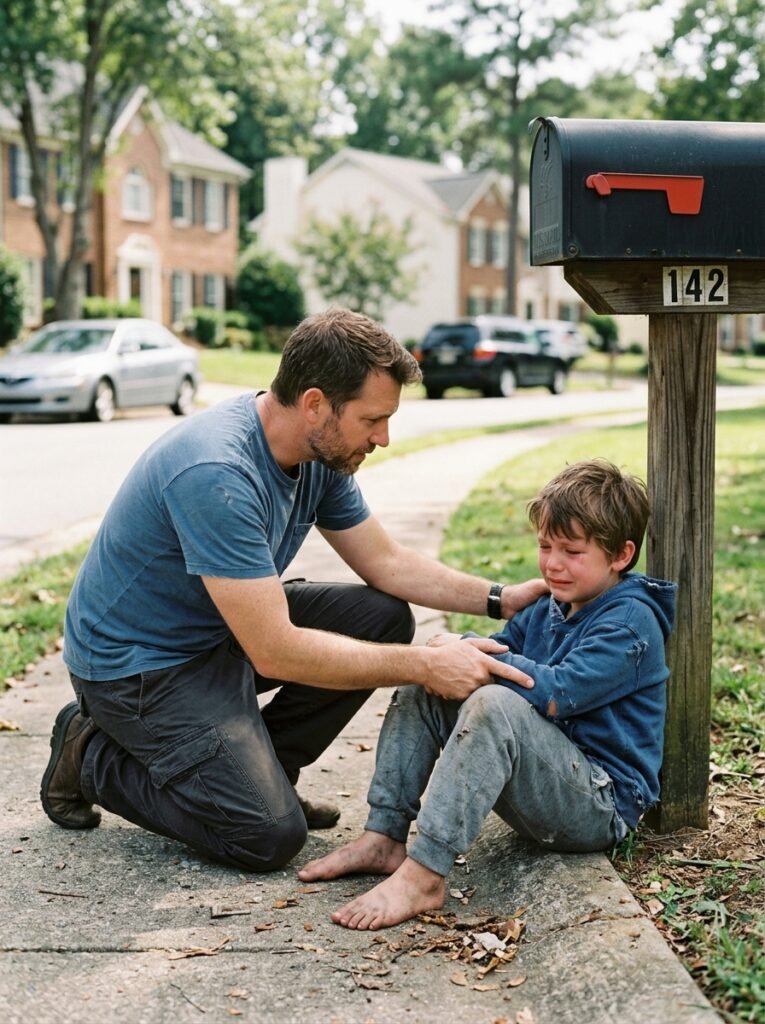
He opened one eye and looked directly at me.
“Dad, lock the door.”
That was all he gave me.
Not an explanation.
Not a name.
Not a story about how he had gotten from his grandfather’s house to my mailbox with one shoe missing and dirt ground into the bottom of his foot.
Just an instruction.
Lock the door.
I didn’t waste time asking who he thought was coming because whatever had happened, Eli was scared enough to make that the first thing he said after reaching me.
I got one arm behind his shoulders and the other beneath him, moving as carefully as I could while he held his ribs.
His face tightened when I lifted him, and that was enough to tell me I needed to stop trying to understand the whole situation and deal with the part directly in front of me.
I carried him inside.
I locked both entrances.
I closed the blinds.
Then I called 911.
When the dispatcher asked who had hurt him, I gave her his grandfather’s address.
Nothing more.
I wasn’t going to guess, embellish, or hand anyone a theory when my son could barely keep his eyes open.
I had spent too much of my life learning what happened when somebody else got to define you before you had the strength to speak for yourself.
So I stayed with facts.
Eli had come from that address.
He was injured.
He was frightened.
He had told me to lock the door.
Everything else could wait until he was safe enough to say it himself.
The paramedics arrived seven minutes later.
Seven minutes sounds short until you spend them watching your child struggle not to move because every deeper breath hurts.
They worked quickly, asking questions, checking him, cutting open his ripped shirt so they could examine him without forcing him to twist.
I kept one hand against his arm so he could feel that I was still there.
I didn’t promise him everything would be fine because I didn’t know that yet.
I just stayed where he could see me.
My phone started ringing before we had any answers.
My father called three times during the ambulance ride.
I ignored every one.
The first call could have been concern.
The second could have been confusion.
By the third, I was looking at Eli on the stretcher and wondering why the person whose house he had just fled was trying so hard to reach me before anyone had even finished examining him.
I still didn’t call back.
I watched the paramedics instead.
I watched their hands move from one piece of equipment to another.
I watched Eli’s face every time the ambulance hit a rough patch in the road.
And I kept thinking about the shoe he had left behind.
At 4:18 p.m., the fourth call came through.
This time, I answered.
Before I did, I turned on the recorder.
My father sounded calm enough to be calling about dinner plans.
There was no panic in his voice, no stumbling rush of questions about whether Eli was alive or what the doctors had said.
“I’m concerned about both of you,” he said.
I looked at Eli strapped to the stretcher.
Then I asked the simplest question I had.
“Where is his other shoe?”
There was a pause.
Not long enough to sound dramatic, but long enough for me to notice it.
“Your son became disoriented and ran away.”
That was his explanation.
Eli had become confused.
Eli had run.
The problem, according to my father’s first version, had started with Eli.
I didn’t argue with him.
I didn’t tell him what I believed.
I didn’t give him a chance to turn the call into a shouting match that could later be described however he wanted.
I saved the recording before the ambulance doors even finished closing behind us.
Inside the ER, the examination room smelled faintly of lemon disinfectant.
A paper snowflake left over from winter still hung crooked above the sink, an absurd little leftover from another season while the doctor checked my son’s pupils and ordered scans.
That snowflake stayed in my line of sight longer than it should have because concentrating on small, useless things was easier than staring at the possibility of what those scans might show.
Eli looked exhausted.
Every few minutes I checked whether he was still looking at me, whether he understood where he was, whether the tension in his face had changed.
The results eventually came back.
A concussion.
Two fractured ribs.
No bleeding inside his skull.
The last part mattered more than I can explain.
I let myself absorb it for maybe two seconds before my attention shifted back to what came next.
Eli was alive, conscious, injured, and finally somewhere people could document what they were seeing before anyone had time to rewrite it.
I asked the nurse to photograph every injury and seal his clothes separately.
I didn’t ask because I had already decided exactly what had happened.
I asked because physical facts have a way of becoming less certain once frightened families start arguing about them.
His ripped shirt was real.
His injuries were real.
The missing shoe was real.
The condition he arrived in was real.
I wanted the condition of those things preserved while they still existed exactly as they had when he came through the door.
Then a hospital social worker walked in carrying a tablet.
The expression on her face was careful, professional, and neutral.
She told me my father had already contacted the hospital.
That sentence changed the room for me.
He had not just called me.
He had reached past me.
According to him, I was unstable.
He claimed I had taken Eli during a mental health breakdown.
For a moment, the words landed harder than I expected because they were built from something real enough to sound believable.
I had a past.
I had received treatment.
I had completed a trauma program sixteen months earlier.
Those things were true.
And because they were true, my father didn’t need to invent an entirely different person.
He only needed to take facts from my life, remove the recovery and context around them, and arrange them so I looked dangerous at exactly the moment my injured son needed me to be believed.
I handed the social worker my phone.
I played the recorded call.
My father’s calm voice filled the room again.
“I’m concerned about both of you.”
Then my question.
“Where is his other shoe?”
Then his pause.
Then his explanation that Eli had become disoriented and run away.
After the recording ended, I showed her the discharge documents from the trauma program I had completed sixteen months earlier.
I didn’t pretend my past didn’t exist.
I didn’t try to turn myself into someone spotless because I knew how easily that could become another trap.
If I denied something documented, then the argument would stop being about Eli and become a debate over whether I was hiding my own history.
So I acknowledged it.
I had needed treatment.
I had completed it.
I was standing beside my injured son now, asking that the facts of this day be recorded in the order they actually happened.
I asked the social worker to note one thing carefully: who had contacted the hospital first, and exactly what my father had claimed before anyone outside that house knew Eli had survived.
She began typing.
My phone rang again while she was doing it.
My father.
This time I put him on speaker.
I wanted another person in the room to hear his answers as he gave them.
“Explain exactly how Eli became confused,” I said.
My father answered without raising his voice.
“He was scared, and your brother tried to stop him from injuring himself.”
There it was.
A new detail.
Now my brother was part of the explanation.
According to this version, Eli had been scared, confused, and somehow a danger to himself, while my brother had merely been trying to protect him.
I looked at the social worker.
Then I asked the question I had been holding.
“Then why was Eli’s blood found on the inside of the locked laundry-room window?”
The gentle voice disappeared.
The change was immediate enough that I didn’t need anyone to interpret it for me.
My father had sounded calm while describing me as unstable and Eli as confused.
The moment I named a physical detail that did not fit neatly into that explanation, the conversation changed.
Then my brother took the phone.
“We’re trying to prevent this family from ending up in court,” he said.
I stayed quiet.
Not because I had nothing to say.
Because people who believe they are managing a situation often say more when you stop interrupting them.
My brother kept talking.
“Bring him back tonight, and all of this remains a misunderstanding.”
That was the first moment the purpose of the call became impossible for me to ignore.
They were not simply asking whether Eli was safe.
They were asking for him back.
That night.
Before the hospital visit had even run its course.
Before the story they were telling had been tested against everything the doctors, nurses, and social worker could observe.
“No.”
I didn’t explain it.
I didn’t negotiate.
I said one word and left it there.
My father came back on the line, quieter now.
“A judge will look at your file, your treatment, and every name you went by before you turned into this devoted father.”
That threat did something his earlier explanation had not.
It gave the whole conversation a shape.
Until then, part of me had still been trying to decide whether I was listening to people in panic, people trying desperately to explain a terrible accident, people speaking badly because they were frightened by what had happened to Eli.
But frightened people usually ask about the injured person.
They ask what the doctor said.
They ask whether the scans are clear.
They ask whether the child is conscious.
My father was talking about my file.
My treatment.
My previous names.
My credibility.
That threat told me more than the explanation ever had.
Their story wasn’t being built after Eli escaped.
It was already waiting for him.
I looked back over the sequence in my head.
Eli crawled to my mailbox hurt and missing a shoe.
His first words were “lock the door.”
My father called again and again before the ambulance had even left the driveway.
When I finally answered, he said Eli had become disoriented and run away.
Then the hospital was contacted and told I was unstable.
Then my brother was introduced as the person supposedly trying to keep Eli from hurting himself.
Then, when I brought up the inside of the locked laundry-room window, they stopped explaining and started bargaining.
Bring him back tonight.
Make it a misunderstanding.
And when I refused, my father went straight to the part of my history he believed could make strangers doubt me.
In their version, my injured son was confused.
My brother had only been protecting him.
And I was the unstable father nobody should believe.
The frightening thing was not that each piece sounded perfect.
It was that the pieces fit together well enough to create doubt if nobody stopped to ask what happened first.
My treatment could be made to sound current instead of completed.
My concern for Eli could be described as instability.
His attempt to get away could be described as disorientation.
His injuries could be folded into the claim that he had been hurting himself.
And once that version existed, every frightened thing Eli did afterward could be used to reinforce it.
But they had moved too early.
They had contacted the hospital before they knew exactly what Eli had said.
They had tried to define me before anyone there had finished understanding him.
They had offered explanations before I had accused them of anything.
Most importantly, they had spoken in their own voices while someone other than me could hear them.
I ended the call.
There was no dramatic goodbye and no final argument because I had stopped caring about winning the conversation.
I cared about preserving it.
I forwarded the recording to the social worker before another word could be changed, softened, reinterpreted, or remembered differently later.
For the first time since I had found Eli beside the mailbox, I felt as if I had managed to do something that created even a little distance between him and the story being built around him.
The recording did not tell me everything that had happened inside my father’s house.
It did not explain the missing shoe.
It did not tell me exactly how Eli’s ribs had been fractured.
It did not explain the blood on the inside of the locked laundry-room window.
It did not tell me what my brother meant by trying to stop Eli from injuring himself.
And it did not erase the fact that my own history could still be used to make people hesitate before believing me.
But it preserved something that mattered.
It showed what my father chose to say before he knew what evidence anyone else had.
It showed how his explanation changed when I mentioned the window.
It showed my brother asking me to bring Eli back that same night so the whole thing could remain a misunderstanding.
And it showed exactly where the conversation went when I refused.
Not toward Eli’s condition.
Toward me.
Toward my past.
Toward whether I could be made unbelievable.
The social worker was still looking at the screen after the file finished sending.
I stayed beside the bed.
The hospital blanket had shifted slightly over Eli’s chest, and I found myself watching the rise and fall because after everything else, that simple movement was still the only thing I trusted without qualification.
The mailbox, the missing shoe, the ripped shirt, the locked doors, the ambulance calls, the scan results, the laundry-room window, the recording—those were all pieces of a story that other people were already fighting to control.
But Eli was not a piece of evidence to me.
He was my son.
And for sixteen months I had been carrying documents proving where I had been, what treatment I had completed, and how hard I had worked to rebuild a life after needing help.
Now the same history I had faced openly was being held over me like a reason I should surrender him without asking another question.
That was the part my father had misjudged.
I was no longer ashamed enough of getting help to let somebody weaponize the fact that I had needed it.
The records existed.
I had already handed them over myself.
There was nothing left for him to reveal that I was trying to hide.
What remained unanswered was Eli.
What happened inside that house?
Why had he been near a locked laundry-room window?
Why had he fled without his shoe?
Why had his grandfather’s first instinct been to describe him as disoriented?
And why had my brother been so desperate to get him returned before the night was over?
I did not have those answers yet.
I had only the order of events, and at that moment, the order mattered more than any polished explanation.
My father had tried to establish a story before Eli could tell his own.
I had spent the entire afternoon refusing to do the same thing from the opposite direction.
I had given the dispatcher an address instead of an accusation.
I had asked the hospital to preserve injuries and clothing instead of declaring what they proved.
I had shown the social worker my treatment records instead of denying my past.
I had asked questions on the phone instead of supplying answers.
Every one of those choices left room for facts I did not yet know.
My father’s choices seemed designed to close that room as quickly as possible.
That difference was the one thing I could hold onto while everything else still felt uncertain.
Then Eli shifted beneath the hospital blanket.
His hand moved slowly until his fingers found my sleeve.
He grabbed it and held on.