The smile lasted only a second.
Then a contraction seized my body so sharply that the room tilted.
The fetal monitor stuttered.
A nurse moved to my side. Another adjusted the sensors across my abdomen. The faint rhythm that had given me hope began to slow.
“His heart rate is dropping,” someone said.
The words came from far away, as though spoken from the other side of a wall.
A doctor leaned over me. Her eyes were steady, but her voice carried urgency.
“Elena, we need to deliver your baby now.”
My fingers closed around the edge of the blanket. “Will he live?”
“We are going to do everything we can.”
It was not a promise.
I turned toward Adrian.
He still stood beside my bed in his dark coat, snow melting from the shoulders. Until that night, he had been a face in an old photograph and a name hidden in my mother’s papers. Now he was the only person in the room who knew how my husband had tried to erase me.
“Don’t let Victor take him,” I whispered.
Adrian’s expression tightened.
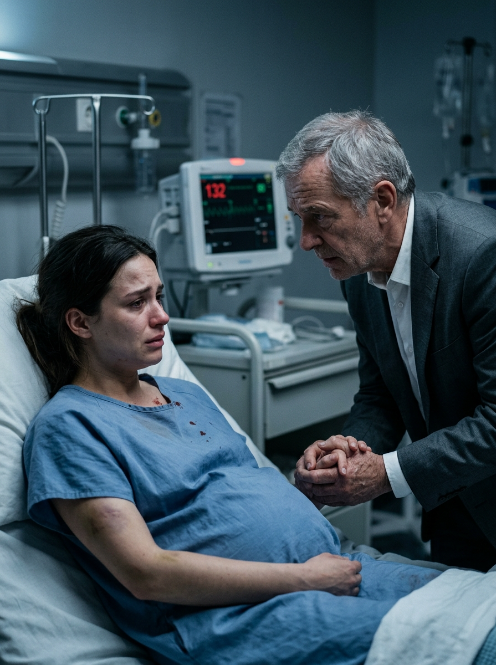
“He won’t.”
“Promise me.”
He took my uninjured hand.
“I promise.”
The medical team began moving my bed. White ceiling panels passed over me one after another as I was rushed down the corridor. Doors opened. Voices overlapped. A consent form appeared beside me, and the doctor explained an emergency cesarean delivery in words I could barely follow.
All I understood was that my son was still alive.
That had to be enough.
As the operating-room doors closed, Adrian remained on the other side.
For the first time since Victor pushed me from the cliff, I allowed myself to be afraid.
Not of dying.
Of waking up without my child.
The lights above me became a white blur.
I tried to remember the sound of his heartbeat.
Weak.
Fragile.
Alive.
Then the room disappeared.
I woke to silence.
Not the peaceful silence of snowfall. This silence was mechanical and careful, filled with the low hum of machines and the soft hiss of air moving through vents.
My first thought was of the cliff.
My second was of my baby.
I tried to sit up.
Pain stopped me before I moved more than an inch.
A nurse appeared at my side. “Easy. You’re safe.”
“My son.”
“He’s alive.”
The words settled over me like warmth.
I closed my eyes, and tears slipped into my hair.
“Where is he?”
“In the neonatal intensive care unit. He needed help breathing at first, but he’s stronger than the doctors expected.”
“Can I see him?”
“As soon as the doctor clears you to move.”
“How long was I asleep?”
“About fourteen hours.”
Fourteen hours.
Victor had spent those hours believing he had won.
The nurse checked my IV and adjusted the blanket. She spoke gently, explaining that I had three broken ribs, a fractured wrist, severe bruising, and mild hypothermia. The doctors had repaired a deep cut near my temple. My son had been delivered minutes after I arrived.
I listened, but the details floated past me.
“Does Victor know I’m alive?” I asked.
The nurse hesitated.
“No information has been released. Your chart is restricted.”
“Who restricted it?”
“I did.”
Adrian’s voice came from the doorway.
He had changed clothes. The tailored coat was gone, replaced by a charcoal sweater and dark trousers. Without the snow and storm around him, he seemed less like the powerful executive from business magazines and more like a tired man who had not slept.
The nurse gave him a brief nod and left.
Adrian stepped inside but did not come too close.
“I hope you don’t mind,” he said. “I asked the hospital to protect your identity until you could decide what you wanted.”
I studied him.
He had my eyes.
I had noticed it in my mother’s photograph, but seeing it in person was different. The same gray, the same slight narrowing at the corners when he was worried.
“Can you really do that?” I asked.
“For a limited time. The hospital has a legal obligation to protect patient privacy. Because your case may involve a crime, local authorities have also agreed not to release your condition yet.”
“Does Victor know they found me?”
“Not officially.”
My gaze moved to the window. Beyond the glass, morning sunlight shone on a city that had no idea I was still part of it.
“What did he tell the police?”
“That you insisted on getting out of the car during the storm. He claims you became upset, walked toward the overlook, and slipped before he could reach you.”
A bitter laugh caught in my ribs.
“He always did know how to make me sound unstable.”
Adrian pulled a chair closer to the bed.
“There were no witnesses on the road.”
“There was Serena.”
“The woman who was with him?”
“His mistress.”
Adrian’s face remained controlled, but something cold entered his eyes.
“She stood beside him.”
“Did she touch you?”
“No.”
“Did she try to help?”
I remembered Serena’s pale face above the cliff. Her nervous question. Victor’s answer. The two of them disappearing into the storm.
“No.”
Adrian looked away for a moment.
“Her name does not appear anywhere in Victor’s statement.”
“Of course it doesn’t.”
“He told investigators he was alone with you.”
That detail should not have surprised me, yet it did.
Victor was already rewriting the night.
He had removed Serena from the story. Soon he would remove every argument, every bruise hidden beneath long sleeves, every call he had monitored, every friend he had persuaded me to stop seeing.
And if I remained silent, people might believe him.
“How did you find me?” I asked.
Adrian’s attention returned to me.
“The insurance claim.”
“You said Victor had already filed it.”
“He contacted the emergency claims division before the search teams had recovered a body.”
“How long after he pushed me?”
“Less than an hour.”
My stomach turned.
“He didn’t even wait until morning.”
“No.”
“Then why were you in the helicopter?”
Adrian folded his hands.
“Your policy is unusually large. Claims of that size automatically trigger a senior review. I was notified because the beneficiary requested immediate processing and because your name was connected to a private family trust.”
“My mother’s trust?”
“Yes.”
I waited for him to continue.
“When I saw your name, I called the county sheriff. They told me you were missing near Blackthorn Cliff. The weather was worsening, and the local rescue unit was having trouble getting enough aircraft into the area. My company funds a regional emergency aviation program.”
“So you sent the helicopter.”
“I joined the search.”
“Why?”
The question came out more sharply than I intended.
He accepted it without flinching.
“Because I had already missed too much of your life.”
The room became very still.
I looked at the man beside my bed and felt anger rise through the exhaustion.
“You knew about me.”
“Yes.”
“For how long?”
“Since before you were born.”
My breath caught.
“My mother told me you didn’t know.”
“She had reasons for saying that.”
“What reasons?”
Adrian lowered his eyes.
“That story belongs to her as much as it does to me. I don’t want to tell it while you’re in pain and unable to leave this bed.”
“She’s dead.”
His face changed.
Not much. A small tightening around his mouth. A flicker in his eyes.
But I saw it.
“What aren’t you telling me?”
Before he could answer, the door opened.
A doctor entered with a tablet in her hands.
“Elena, your son is stable enough for you to visit him.”
Every other question vanished.
They took me to the neonatal unit in a wheelchair.
Each movement sent pain through my ribs, but I barely noticed. I followed the nurse through two locked doors, past sinks and cabinets, into a room filled with small beds and quiet machines.
My son lay beneath a clear plastic cover.
He was smaller than I had imagined, though the nurse assured me he was a healthy size for a newborn. A thin tube rested beneath his nose. One tiny hand lay beside his cheek.
His fingers were curled.
I stopped breathing.
For nine months, he had been movement beneath my heart. A flutter, then a kick, then the steady rolling pressure of a child running out of room.
Now he was here.
Separate from me.
Real.
“He has your chin,” Adrian said softly behind me.
I had almost forgotten he was there.
The nurse opened a side panel and helped me slide two fingers beneath my son’s hand.
His fingers closed around mine.
The feeling broke something open inside me.
“Hello,” I whispered. “I’m your mother.”
His eyelids moved, but he did not wake.
“I’m sorry the world was so cold when you arrived.”
My voice trembled.
“I’m going to make it warmer. I promise.”
The nurse explained that he had responded well to treatment. They wanted to watch his breathing and temperature, but there were no signs of serious injury from the fall.
A miracle, she called it.
I did not know whether I believed in miracles.
But I believed in the hand holding my finger.
“Have you chosen a name?” the nurse asked.
Victor and I had argued about names for months. He wanted Victor Junior. He said a son should carry his father’s legacy. Whenever I suggested another name, he dismissed it.
Now Victor had no place in the decision.
I looked at my child’s peaceful face.
“Noah,” I said.
Adrian’s gaze lifted.
My mother used to read me the story of Noah when storms frightened me. She would sit on the edge of my bed and tell me that survival was not the same as luck. Survival meant carrying something precious through the darkness until the world became safe again.
“His name is Noah,” I repeated.
The nurse smiled and wrote it down.
Noah Hale.
The name appeared on the temporary card beside his bed.
I stared at it.
Then I shook my head.
“Cross,” I said.
Adrian went still.
The nurse looked from him to me.
“Noah Cross.”
It was not a rejection of Victor made in anger. It was not even a gift to Adrian, not yet.
It was a choice.
My first free choice in years.
Adrian turned his face away, pretending to study a monitor. When he looked back, his eyes were bright.
“He’ll be proud of that name,” he said.
“He’ll decide for himself what he’s proud of.”
A faint smile appeared on Adrian’s face.
“Yes,” he said. “He will.”
By that afternoon, a detective came to take my statement.
Her name was Mara Chen. She had a quiet voice and an attentive stillness that made it difficult to hide anything from her.
She did not begin with the fall.
She asked about the drive.
Why had Victor taken me to Blackthorn Cliff during a winter storm?
“He said he wanted to show me the cabin he had rented for the weekend.”
“Did you know about the trip in advance?”
“No. He told me after dinner to pack a bag.”
“At nine months pregnant?”
“He said it would be our last chance to spend time alone before the baby came.”
“Did that seem unusual?”
Everything about Victor had seemed unusual by then.
His sudden kindness. His insistence that I leave my phone at home because he wanted the weekend to be “private.” The way he checked the weather report three times before we left. The heavy gloves he wore even inside the car.
“It seemed romantic,” I said.
Then I corrected myself.
“He wanted it to seem romantic.”
Mara wrote something down.
“When did Serena appear?”
“Her car was parked near the overlook. Victor said she was stranded and needed help.”
“You knew her?”
“Not personally. I had seen messages between them.”
“Did Victor know that?”
“Yes.”
“What happened when you got out of the car?”
I described the argument.
Serena had asked Victor why he brought me there. Victor told her to stop panicking. I demanded to know what was happening. He took my arm and led me closer to the overlook, speaking softly as though trying to calm me.
Then he pushed me.
Mara did not interrupt.
When I finished, she closed her notebook.
“There is something I need to explain. Victor’s early insurance request is suspicious, but suspicion is not proof that he intended to harm you. Your statement is important. Physical evidence from the overlook will be important. Serena’s testimony may be critical.”
“She’ll lie for him.”
“Possibly.”
“He’ll tell her what to say.”
“Possibly,” Mara repeated. “But people do not always behave as others expect when the consequences become real.”
I looked toward Noah’s empty bassinet beside my hospital bed. The nurses had promised to bring him to my room as soon as he no longer needed the warming unit.
“What happens if Victor learns I survived?”
“He will be questioned. Depending on the evidence, prosecutors will decide whether there is enough to arrest or charge him.”
“And if there isn’t?”
“Then we continue investigating.”
The answer was honest, but it frightened me.
For years, Victor had explained away every concern. He could turn a broken lamp into an accident and a cruel remark into a joke. He could make me apologize for things he had done.
“What if no one believes me?”
Mara leaned forward.
“I believe that you believe what you told me.”
“That isn’t the same thing.”
“No. It isn’t. My responsibility is to find evidence that stands independently of anyone’s charm, wealth, reputation, or fear.”
Her directness steadied me.
“You should also know that Victor has been appearing on television,” she continued.
My stomach tightened.
“What is he saying?”
“That you were struggling emotionally because of the pregnancy. That you had become confused during the storm.”
“He’s preparing people to doubt me.”
“Yes.”
The answer hurt, but it also clarified something.
Victor was not grieving.
He was working.
“Does he know the search is still active?”
“He has been told that conditions have delayed recovery.”
“And the insurance company?”
Adrian, who had remained near the window, finally spoke.
“The claim has been placed under routine review.”
“Does that mean denied?”
“No. It means nothing will be paid until the facts are established.”
“Will he know you’re involved?”
“Eventually.”
“But not yet?”
“Not unless we give him a reason to look closely.”
I considered the risks.
Keeping my survival private felt like hiding, and I was tired of hiding.
But announcing it too soon would give Victor time to reshape his story again. He would contact Serena. Destroy messages. Explain the early insurance claim as grief or panic.
For once, I did not want to react to him.
I wanted to make my own decision.
“How long can we keep this confidential?” I asked.
Mara answered carefully.
“A few days, perhaps longer if your doctors believe publicity could endanger your recovery. But not indefinitely.”
“I don’t need indefinitely.”
Adrian looked at me.
“What do you need?”
“Time to understand what he planned.”
That evening, Noah was brought to my room.
He slept against my chest beneath a warm blanket while snow began falling beyond the windows.
Adrian sat in the corner with a folder open on his lap, though he had not turned a page in nearly twenty minutes.
“You can come closer,” I said.
He looked up.
“I don’t want to intrude.”
“You flew into a snowstorm to pull me off a cliff. I think we’re past formal boundaries.”
He moved his chair beside the bed.
For a while, we watched Noah sleep.
“He looks peaceful,” Adrian said.
“He hasn’t met the family yet.”
A quiet laugh escaped him.
The sound surprised us both.
I studied his face.
“Did you ever have other children?”
“No.”
“Did you want them?”
“Yes.”
“Why didn’t you?”
He looked toward the window.
“After your mother left, I told myself I was too busy. Later, I told myself it was too late. Neither was the truth.”
“What was the truth?”
“I was waiting for someone who had made it clear she would not return.”
The answer raised more questions than it settled.
“My mother told me you abandoned her.”
Adrian’s shoulders lowered slightly, as if he had expected the accusation for years.
“She believed I chose the company over her.”
“Did you?”
“Yes.”
I had not expected the admission.
He continued before I could speak.
“Not in the simple way that sounds. But when she asked me to leave Cross Atlantic and disappear with her, I refused.”
“Why would she ask you to disappear?”
“She believed someone inside the company was using family trusts to hide illegal transfers.”
I glanced at the folder on his lap.
“Was she right?”
“I never found proof.”
“Did you believe her?”
“Not enough.”
The words seemed to cost him something.
“She was frightened. I thought fear had made her reckless. I insisted I could protect her without walking away from everything we had built.”
“And then?”
“She vanished.”
I stared at him.
“She died in a car accident.”
“That is what I was told.”
My pulse quickened.
“What do you mean, told?”
Adrian closed the folder.
“The police report said her car went off a bridge during heavy rain. The vehicle was recovered downstream.”
“And her body?”
“Was never found.”
I held Noah more tightly.
“My aunt said the casket was closed because the accident was so bad.”
“There was no body in the casket.”
The hospital room seemed to narrow around us.
“You were at the funeral.”
“I stood at the back. Your aunt asked me not to approach you.”
“Aunt Margaret knew who you were?”
“Yes.”
I remembered Margaret holding my hand beside the grave. Her rigid posture. The way she refused to answer questions about my father.
“She lied to me.”
“She thought she was protecting you.”
“Everyone keeps using that word.”
Adrian looked down.
“You’re right.”
My anger had nowhere to settle. My mother, my aunt, Adrian—each had made decisions about my life without me.
But beneath the anger was another feeling.
Hope.
Small, dangerous hope.
“You think my mother could be alive.”
“I think there are questions I never managed to answer.”
“Why didn’t you tell me?”
“I tried to contact you when you turned eighteen. Margaret returned my letters. Later, when you married Victor, I approached you after a charity event.”
A memory surfaced.
A silver-haired man waiting beside a black car. Victor placing a firm hand at my back and steering me toward another entrance.
“He said you were a reporter.”
“I told him who I was.”
I looked at Adrian.
“He knew?”
“Yes.”
The room went cold despite the heat.
Victor had known Adrian was my father.
Victor had known Adrian controlled the company holding the policy.
Perhaps our marriage had never begun where I thought it had.
“When did Victor learn about the trust?” I asked.
“Before your wedding, according to company records.”
“How?”
“That is one of the questions my investigators are working on.”
Noah stirred.
I lowered my voice.
“Do you think he married me for the insurance?”
“I don’t know.”
The uncertainty hurt more than a definite answer.
I had spent years wondering when Victor stopped loving me.
Now I had to consider whether he had ever loved me at all.
The next two days passed in a rhythm of doctors, interviews, and cautious hope.
Noah grew stronger.
His breathing improved enough for the tube to be removed. He had a serious expression when awake, as though already disappointed by the adults around him.
I learned to feed him despite my injured wrist. I learned to stand without pulling at the stitches. I learned that healing did not feel heroic.
It felt slow.
It felt like asking for help to cross a room.
It felt like sleeping for forty minutes and waking convinced that Victor had found us.
Each time panic rose, I looked at Noah.
He needed a mother who was present, not fearless.
So I breathed.
On the third morning, Mara arrived with news.
“Investigators found tire tracks at the overlook that match Serena’s vehicle,” she said. “That supports your account that she was there.”
“Has she admitted it?”
“She hasn’t been located.”
Adrian looked up from his phone. “Her apartment?”
“Empty. No sign of forced entry. Her employer says she called in sick yesterday.”
“Victor knows she’s missing?” I asked.
“He claims he has not spoken to her in weeks.”
“He was standing beside her on the cliff.”
“We recovered recent calls between them,” Mara said. “That makes his statement difficult to explain.”
For the first time, I felt the ground shift beneath Victor’s story.
Not collapse.
But crack.
“There’s something else,” Mara continued. “A maintenance camera captured Victor’s car entering the mountain road. Serena’s car followed eleven minutes later.”
“That proves they planned to meet.”
“It suggests it. We need more.”
Always more.
Evidence moved carefully. It did not leap to conclusions simply because I knew the truth.
I was beginning to understand why that mattered.
A knock interrupted us.
A hospital administrator entered carrying a small padded envelope.
“This was delivered for Elena,” she said.
Adrian stood immediately.
“By whom?”
“A courier. No sender listed.”
Mara took the envelope before anyone else could touch it. She photographed it, put on gloves, and opened it with a small blade.
Inside was a silver key and a folded note.
The message contained only eight words.
I am sorry. Locker 214. North Station. —S
Serena.
Mara read it twice.
“It could be a trap,” Adrian said.
“Or evidence,” I replied.
The key was old, the kind used for luggage lockers at the city’s central railway station.
Mara sealed it in a clear bag.
“I’ll request a warrant.”
“How long will that take?”
“Not long.”
I looked at the note again.
The handwriting trembled toward the end.
“She’s afraid.”
“Maybe,” Mara said.
“Victor said she wasn’t on the mountain. Now she’s leaving keys instead of speaking to police.”
“That tells us something. It does not tell us what.”
By afternoon, investigators had opened locker 214.
Inside was a canvas bag containing a second phone, several printed bank statements, and a small digital recorder.
The phone belonged to Serena.
The bank records showed monthly deposits from a private account linked to one of Victor’s consulting companies.
The recorder held a single audio file.
Mara played it in my room.
At first, there was only wind and the muffled sound of a car engine.
Then Serena’s voice.
“You said you were going to frighten her.”
Victor answered.
“I said I was going to solve the problem.”
“I’m not helping you hurt her.”
“You already helped. You sent the messages. You booked the cabin. You brought her medical file.”
A long silence followed.
Then Serena said, “She’s carrying your child.”
Victor’s reply was so calm that it frightened me more than shouting would have.
“The policy includes the child.”
The recording ended.
No one spoke.
I looked down at Noah, asleep in my arms.
Adrian moved toward the window. His reflection in the glass looked rigid and pale.
Mara stopped the recorder.
“This is significant,” she said. “It establishes planning and places Serena with Victor before the incident.”
“Is it enough to arrest him?”
“It may be enough for a warrant, especially combined with your statement and the physical evidence.”
“Then why did Serena leave it in a locker?”
“She may have intended to protect herself.”
“Or me.”
Adrian turned.
“She walked away from you on that cliff.”
“I know.”
I remembered Serena’s voice.
Is she dead?
Not grief. Not concern.
Fear.
Perhaps fear for herself.
I did not forgive her. I was not ready even to understand her. But the recording suggested she had drawn a line, however late, and Victor had crossed it.
“Find her,” I said to Mara.
“We’re trying.”
“Before Victor does.”
Mara held my gaze.
“That is the priority.”
That night, I dreamed of my mother.
She stood on the far side of a bridge in the rain, holding the crescent-shaped locket she wore in every childhood photograph.
I called to her.
She turned.
But when I tried to cross, the bridge lengthened beneath my feet.
I woke with my heart racing.
Noah slept in the bassinet beside me.
Across the room, Adrian was asleep in a chair, his head tilted at an uncomfortable angle. He had refused to leave the hospital, though I had never asked him to stay.
I watched him for a while.
My father.
The words still felt unfamiliar.
He had not protected my mother when she asked him to. He had allowed pride and doubt to separate them. He had failed to reach me for years.
But he had come into the storm.
Both things could be true.
People were rarely only the worst thing they had done.
Victor had taught me to see relationships as ledgers. Every kindness became a debt. Every mistake became a weapon.
I did not want to live that way anymore.
“Adrian,” I said softly.
He woke at once.
“What’s wrong?”
“Nothing.”
He sat upright, still disoriented.
“You should go home and sleep.”
“I’m fine.”
“You’re seventy years old.”
“Sixty-three.”
“Then stop sleeping like you’re twenty.”
He almost smiled.
I looked at Noah.
“When we leave here, I don’t want to go back to the house.”
“You won’t have to.”
“I also don’t want to spend the rest of my life being hidden in one of your properties.”
“That wasn’t my plan.”
“What was?”
“To ask what you wanted.”
The answer settled gently between us.
“I want a small place,” I said. “Somewhere quiet. Close to a park.”
Adrian nodded.
“I want Noah to know you, but I don’t want him growing up inside your company.”
“Agreed.”
“I want to make my own decisions, even when you think they’re wrong.”
“That may be more difficult.”
I raised an eyebrow.
“For me,” he clarified. “But agreed.”
“And I want the truth about my mother.”
His expression sobered.
“You deserve it.”
“All of it.”
“Yes.”
I looked at him for a long moment.
“Then stay.”
He leaned back in the chair.
This time, when he closed his eyes, the room felt less like a guarded hospital suite.
It felt almost like family.
The following morning, the news broke that police had reopened the investigation into my disappearance.
Victor appeared outside our home, surrounded by cameras.
Mara had warned me not to watch, but I did anyway.
He wore a dark coat and looked exhausted. Snow clung to the hedges behind him.
“My wife and unborn son are still missing,” he told reporters. “The rumors being spread about me are cruel and irresponsible. I loved Elena. I would never harm her.”
He paused, eyes lowered.
“I am cooperating fully with investigators.”
A reporter asked about Serena.
Victor’s expression did not change.
“I don’t know where she is.”
Another asked about the insurance claim.
“My financial adviser handled the paperwork. I was in shock.”
I almost admired how smoothly he lied.
Almost.
Then a reporter asked why his company had transferred money to Serena.
For the first time, Victor hesitated.
Only half a second.
But I saw it.
“She worked as a consultant.”
The broadcast cut back to the studio.
I turned off the television.
“He’ll blame everything on her,” I said.
Mara stood near the door.
“He may try.”
“She helped him, but the plan was his.”
“The recorder supports that.”
“Does he know about it?”
“Not yet.”
Adrian entered carrying coffee and a folder.
His expression told me something had changed.
“What happened?” I asked.
He closed the door behind him.
“Our internal review found the original application for your life insurance policy.”
“I thought Victor applied for it after we married.”
“So did I.”
He placed the folder on my bed.
The application was dated eleven years earlier.
I had been nineteen.
I had not yet met Victor.
The policyholder was the Cross Family Protection Trust.
The insured person was me.
And the request to increase the eventual death benefit to fifty million dollars had been signed by my mother.
I stared at the page.
“That’s impossible.”
Adrian said nothing.
“My mother had already been dead for years.”
“The signature was notarized.”
“By whom?”
He turned the page.
The notary’s name meant nothing to me.
But the witness did.
Margaret Ellis.
My aunt.
The woman who raised me.
The woman who said my mother was dead.
The woman who returned Adrian’s letters and told me I had no living father.
“She knew,” I whispered.
“It appears so.”
“Did you call her?”
“She’s not answering.”
Mara stepped closer.
“When was she last seen?”
Adrian took out his phone.
“Her neighbor says she left home yesterday morning with a suitcase.”
My chest tightened.
“Serena disappears. Now Margaret disappears.”
“There may be no connection,” Mara said.
But none of us believed that.
A nurse entered carrying Noah, and the conversation stopped.
I took my son and held him close.
His eyes opened.
Gray eyes.
Mine.
Adrian’s.
My mother’s.
Three generations connected by secrets I had never been allowed to see.
A few minutes later, Mara’s phone vibrated.
She read the message, and her expression changed.
“What is it?” I asked.
“Investigators traced the anonymous call that directed the rescue helicopter to your location.”
I looked at Adrian.
“I thought the claim led you to the mountain.”
“It did,” he said. “But the flight crew received exact coordinates while we were searching.”
Mara turned the phone toward us.
“The caller used a prepaid device. The signal came from North Station.”
“The same place as Serena’s locker,” I said.
“Yes.”
“So Serena called?”
“We thought so.”
“But?”
Mara hesitated.
“The station camera captured the person using the public telephone.”
She opened a still image.
An older woman stood beneath the station clock, her face partly hidden by a scarf. Silver threaded through her dark hair. One hand held the phone. The other rested against her chest.
Around her neck hung a crescent-shaped locket.
The same locket from my dreams.
The same locket my mother wore in every photograph Adrian had shown me.
I could not breathe.
Adrian sat down beside the bed.
His fingers trembled as he enlarged the image.
Though twenty years had changed her face, there was no mistaking her eyes.
They were my eyes.
“She saved me,” I whispered.
Adrian stared at the photograph.
Then his phone rang.
The screen displayed an unknown number.
For several seconds, none of us moved.
Adrian finally answered and put the call on speaker.
A woman breathed softly on the other end.
Then a voice I remembered from bedtime stories and long-ago storms said my name.
“Elena.”
I held Noah against my heart.
“Mom?”
The line went silent.
Then she whispered, “Do not let Adrian give Victor the insurance documents. The policy was never meant to protect you from your husband.”
My eyes met Adrian’s.
“What was it meant to protect me from?”
There was a pause.
When my mother answered, her voice was barely audible.
“Your father.”
The call ended.
THE WOMAN AT HER OWN FUNERAL
At seven the next morning, I stood barefoot in the kitchen of Adrian’s private guesthouse, watching rain silver the windows.
On the muted television above the marble counter, Victor’s face filled the screen.
He wore black. His hair was carefully disordered, his jaw shadowed just enough to suggest sleeplessness. A reporter stood beside him beneath a black umbrella while he spoke about love, loss, and the unbearable emptiness of waking without his wife.
Without me.
A photograph from our wedding appeared behind him.
In it, Victor was smiling at the camera.
I was smiling at Victor.
Back then, I had mistaken his attention for devotion. I had believed jealousy meant he cared, that constant questions meant he worried, that separating me from my father and friends was simply his way of protecting our marriage.
Now, watching him perform grief for millions of strangers, I saw the truth with startling clarity.
Victor had never loved me.
He had loved being believed.
Small footsteps crossed the floor behind me.
My son appeared in the kitchen doorway, dragging his blue blanket. His dark hair stuck up on one side, and sleep still softened his round face.
“Mommy?”
I switched off the television.
Liam looked at the blank screen, then at me.
“Was Daddy on there again?”
I crouched in front of him. “Yes.”
“Was he crying?”
The question held no judgment. Liam was six. To him, tears were still honest things.
I gently smoothed his hair.
“He looked like he was crying.”
Liam frowned as he considered the distinction.
“Is he sad because he thinks you’re gone?”
I felt Adrian’s presence before I saw him. He had stopped in the hallway, coffee untouched in his hand.
There were answers a child deserved and answers no child should have to carry.
“I think your father has a lot of feelings he doesn’t understand,” I said. “But none of those feelings are your fault.”
Liam’s small fingers tightened around his blanket.
“Are we going home today?”
The guesthouse was beautiful, but it was not home. There were no pencil marks on the pantry wall showing how tall Liam had grown. No faded stars on his bedroom ceiling. No chipped yellow mug he insisted was mine because it had a smiling sun on it.
Our home had become part of Victor’s performance.
Not anymore.
“Not today,” I said. “But soon, we’ll make a new home.”
“Can Grandpa come?”
Behind him, Adrian lowered his eyes.
For most of Liam’s life, Victor had found reasons to keep Adrian away. A business disagreement. An imagined insult. A scheduling conflict. A sudden illness. Each excuse had seemed small on its own.
Together, they had built a wall.
I looked at my father.
“If Grandpa wants to.”
Adrian set down his coffee. His voice was quieter than I had ever heard it.
“Grandpa would like that very much.”
Liam crossed the kitchen and wrapped both arms around Adrian’s waist.
My father went completely still.
Then his hand settled carefully on the back of Liam’s head.
He closed his eyes.
I had spent years thinking Adrian’s strength came from never breaking. In that moment, I understood it came from knowing exactly how much could be broken—and choosing to remain gentle anyway.
When Liam had gone to eat breakfast with Mrs. Alvarez, Adrian remained by the window.
“I should have come for you sooner,” he said.
“You tried.”
“Not hard enough.”
“I kept telling you I was fine.”
“You sounded rehearsed.”
“I was.”
His reflection met mine in the dark glass.
Victor had taught me to regard every attempt at rescue as interference. He told me Adrian wanted to control me, that my friends envied me, that concerned questions were attacks on our marriage. By the time I understood what was happening, I no longer trusted my own instincts.
“I wasn’t ready to hear you,” I admitted.
Adrian turned.
The ruthless businessman the world feared was gone. For one unguarded second, he was simply my father.
“You’re ready now.”
“Yes.”
He nodded once, holding himself together with visible effort.
“Then we finish this.”
Federal investigator Mara Chen arrived at eight with two attorneys and a case containing the settlement documents.
She was a compact woman with calm eyes and the patient manner of someone who never wasted movement.
She spread the papers across the dining table.
“The policy releases fifty million dollars upon confirmation of death,” she explained. “Victor has already submitted the death certificate, beneficiary claim, sworn statement, and electronic payment instructions.”
“All fraudulent,” Adrian said.
“All potentially fraudulent,” Mara corrected. “The distinction matters until he completes the final certification.”
She pointed to a page marked with three yellow tabs.
“This affidavit requires him to state that he has no knowledge your death was staged, caused, assisted, or misrepresented. It also requires him to confirm that he has disclosed every relevant communication concerning the incident.”
“And he’ll sign it publicly?” I asked.
“He demanded a ceremony. Your husband appears to believe public visibility will make the transaction seem legitimate.”
“He thinks cameras are armor,” I said.
Mara’s expression barely changed. “Today, they’ll be evidence.”
One of the attorneys slid a velvet box toward Adrian.
Inside rested the settlement check.
It was real.
My stomach tightened at the printed amount.
$50,000,000.00.
A number large enough to explain greed, but not cruelty. Nothing could explain the deliberate erasure of another human being.
“What happens after he signs?” I asked.
“The electronic funds will appear in the designated account,” Mara said. “They’ll remain under federal control. Victor will believe the transfer is complete.”
“And then I walk in.”
Adrian’s jaw hardened. “You don’t have to.”
“Yes, I do.”
“Elena—”
“He needs to see me.”
I heard the old fear whisper inside me. It sounded like locked doors, lowered voices, apologies offered simply to keep the peace.
But the fear no longer commanded me.
“I need to see him realize I’m not afraid,” I said.
Adrian studied my face.
Then he nodded.
Mara closed the document case.
“You cannot reveal yourself until Victor signs and confirms the transfer. If anything changes, follow my instructions. There will be officers throughout the building, but they will remain out of sight unless needed.”
“Will Liam be safe?”
“He’ll stay here with Mrs. Alvarez and two protective officers.”
Adrian glanced toward the hallway.
“Victor won’t get near him again.”
I placed my hand over my father’s clenched fist.
“Not because we’re stronger than Victor,” I said. “Because Liam is surrounded by people who love him.”
Adrian slowly opened his hand.
“That too.”
The memorial service began at noon.
St. Matthew’s Chapel stood at the edge of the city’s oldest cemetery, its gray stone walls darkened by rain. Black cars lined the circular drive. Reporters crowded behind velvet ropes, calling questions to executives, politicians, and society figures as they hurried beneath umbrellas.
Victor had invited everyone who mattered to him.
Which meant everyone whose opinion he believed he could use.
I entered through a side door wearing a black coat, a wide-brimmed hat, and a veil that covered most of my face. Mara walked beside me. To anyone watching, I was another grieving relative escorted away from the press.
Inside, the chapel smelled of lilies and polished wood.
My lilies.
Victor knew I disliked them.
He once brought home three enormous arrangements after forgetting our anniversary. When I told him their scent gave me headaches, he laughed and said I was impossible to please.
Now hundreds surrounded my portrait.
My picture stood on an easel beside the altar. It had been taken at a charity gala two years earlier. Victor had chosen the dress. Victor had approved my hair. Victor had stood behind the photographer and reminded me to look grateful.
Beneath the photograph, a silver plaque read:
ELENA VALE KING
BELOVED WIFE, DEVOTED MOTHER, GENTLE SOUL
Gentle soul.
Victor’s preferred phrase for a woman who did not disagree with him.
Mara led me into a narrow observation room behind the organ loft. A one-way panel gave us a clear view of the chapel without exposing us.
Adrian sat in the front pew.
He looked carved from stone.
Victor entered several minutes later.
The room rose.
He moved slowly down the aisle, accepting murmured condolences with a trembling nod. His hand rested over his heart. His eyes were red, but not swollen.
At his side walked Celeste King, his mother, wrapped in black silk and pearls. Her expression was composed, almost serene.
She had never been openly unkind to me. Celeste preferred quieter methods.
A suggestion that I was too sensitive.
A joke about how difficult I made Victor’s life.
A reminder that successful men needed peaceful homes.
Once, after Victor shattered a framed photograph during an argument, Celeste helped me sweep up the glass.
“Men under pressure sometimes forget their strength,” she had said.
Then she advised me not to provoke him when he was tired.
Now she took her place beside her son and looked directly at my portrait.
For one second, something passed over her face.
Not sorrow.
Recognition.
A chill moved through me.
“Did you see that?” I whispered.
Mara kept her eyes on the chapel. “See what?”
“Celeste looked at the photograph like she was waiting for something.”
“We’re recording everyone.”
The organ music faded.
Victor walked to the lectern.
He unfolded a sheet of paper, although I knew he had memorized every word.
“Elena believed in second chances,” he began.
My hands curled at my sides.
“She saw goodness where others saw imperfection. She gave love without condition, forgiveness without being asked, and kindness even to those who did not deserve it.”
His voice cracked in exactly the right place.
Several people lowered their heads.
“She was the heart of our family. Our son, Liam, was the center of her world.”
At the sound of Liam’s name, the chapel blurred.
Victor gripped the lectern.
“My greatest sorrow is that our boy must grow up without her guidance. But I promise Elena, wherever she may be, that I will devote the rest of my life to protecting him.”
“No,” I whispered.
Mara glanced at me.
Victor looked toward the cameras gathered at the rear of the chapel.
“I will preserve her legacy. I will honor her values. And I will make certain that those responsible for failing to protect her are held accountable.”
Adrian’s gaze lifted.
Victor was threatening him.
Even here, even now, he could not resist creating another enemy.
Then Victor said something that was not in the program.
“Elena also left a final letter.”
Mara straightened.
I stared through the glass.
Victor removed a cream envelope from inside his jacket.
My name appeared across the front in handwriting that looked almost like mine.
Almost.
“In this letter,” he continued, “Elena expressed her wish that our family remain united and that no outside influence separate father from son.”
Adrian rose from the pew.
Mara touched her earpiece.
“Stay seated,” she murmured, though Adrian could not hear her.
Victor’s eyes found him.
“For Elena’s sake,” Victor said, “I hope even those who doubted our marriage will respect her final request.”
The chapel filled with whispering.
My heart pounded, but the feeling was no longer fear.
It was fury sharpened into purpose.
“He’s using the memorial to build a custody claim,” I said.
Mara’s voice remained calm. “And he just introduced additional evidence.”
“The letter is forged.”
“We’ll prove it.”
Victor folded the page with reverence.
The performance continued.
Friends described his devotion. A business partner praised his strength. Celeste spoke about the beautiful daughter she had gained and lost, never once mentioning the years she had watched me disappear inside her son’s shadow.
Then a children’s choir sang the lullaby I used to sing to Liam.
That nearly broke me.
Not because of Victor.
Because, for a moment, I imagined Liam at home waiting for me. I imagined all the nights I had sat beside his bed, promising that monsters could be defeated if someone was brave enough to turn on the light.
I had not understood then that bravery did not mean feeling no fear.
It meant walking toward the switch with trembling hands.
The final note faded.
Adrian approached the altar carrying the velvet box.
The chapel became completely silent.
Victor stepped forward to meet him.
For years, the two men had occupied opposite ends of every room. Adrian saw Victor as polished emptiness. Victor saw Adrian as the only person he could not charm.
Now they faced each other beneath my smiling portrait.
“You requested personal delivery,” Adrian said.
Victor lowered his voice, but the microphones caught every word.
“I thought it appropriate. Elena would have wanted transparency.”
The muscles in Adrian’s cheek tightened.
He opened the box.
A murmur traveled through the chapel as the cameras zoomed in on the check.
Victor’s eyes flickered toward the amount.
There it was.
Not grief.
Hunger.
One naked flash of it, gone almost immediately.
Adrian presented the affidavit.
“The insurer requires your final signature and verbal confirmation.”
Victor glanced over the pages.
His attorney leaned toward him. They whispered briefly.
Mara pressed a finger to her earpiece.
“Once he confirms the transfer, we move,” she said.
Victor picked up the pen.
Adrian stopped him.
“Read the certification.”
A flicker of irritation crossed Victor’s face.
Then he remembered the cameras.
He smiled sadly.
“Of course.”
He read aloud that he had no knowledge of any conspiracy, deception, staged death, deliberate endangerment, or misrepresentation connected to my disappearance. He stated that every document submitted was truthful. He confirmed that no person had assisted him in obtaining the settlement through fraudulent means.
His voice did not shake once.
Then he signed.
The scratch of the pen seemed louder than the rain.
His attorney handed him a tablet.
Victor entered the final authorization code.
A green confirmation appeared on the screen.
TRANSFER COMPLETE.
Mara exhaled.
“Now.”
I removed my hat.
Then the veil.
For one final second, I looked at the woman in the memorial portrait.
She seemed like someone I had known long ago.
Someone careful.
Someone quiet.
Someone still waiting for permission to live.
I opened the door.
The first person to see me was Celeste.
Her face lost all color.
The second was Adrian.
He did not smile. He simply turned toward the aisle as if he had known, all his life, that I would eventually walk back to myself.
My heels struck the chapel floor.
One step.
Then another.
Whispers rose around me.
A woman gasped.
Someone dropped a program.
The cameras swung away from Victor and toward the dead woman walking into her own memorial.
Victor remained beside the altar.
His fingers still held the pen.
I stopped halfway down the aisle.
“You always did love an audience,” I said.
The chapel erupted.
Reporters shouted my name. Guests stood, blocking one another’s view. Phones lifted into the air.
Victor stared at me as if the world had split open.
“Elena?”
I kept walking.
His mouth moved, but no sound emerged.
When I reached the front pew, I placed one hand on its polished wooden edge. I needed to feel something solid.
Victor finally found his voice.
“This isn’t possible.”
The words echoed through the chapel.
Mara and two federal officers appeared from the side aisle.
Victor looked at them, then back at me.
I saw the moment he understood.
The check.
The affidavit.
The cameras.
Every confident lie had become a locked door, and he had closed each one himself.
“You’re alive,” he whispered.
“Yes.”
His expression changed rapidly—shock, calculation, wounded innocence.
Then came the mask I knew best.
Concern.
He stepped toward me.
“My God, Elena, where have you been? I’ve been searching everywhere. I thought—”
“Stop.”
He stopped.
One word.
That was all it took.
For years, I had imagined standing up to him would require a perfect speech. I thought I would need proof of every insult, every manipulation, every moment he convinced me that my memory could not be trusted.
But standing beneath the lights, I realized I owed him no explanation.
He was the one who had to explain.
“You submitted a death claim three hours after the court authorized a renewed search,” I said. “You forged my signature. You created a letter to use against my father. And you just swore that you knew nothing about the plan that nearly killed me.”
Victor’s eyes darted toward the cameras.
“This is a misunderstanding.”
“No,” I said. “It’s a record.”
His attorney stepped back.
Victor lowered his voice.
“You’re confused. You’ve been through a trauma. Whatever Adrian told you—”
“My father didn’t tell me who you were.”
I moved closer, though every instinct he had trained into me screamed to retreat.
“You did.”
His face hardened.
Only for a second.
But the cameras caught it.
“Where is Liam?” he demanded.
“Safe.”
“He’s my son.”
“He is not a possession.”
“You can’t keep him from me.”
“I’m not deciding that today. A court will. Based on evidence you can no longer hide.”
Victor’s composure fractured.
“You think this was my idea?”
Silence struck the room.
Mara’s eyes sharpened.
Adrian took one step forward.
Victor seemed to hear his own words too late.
“What did you say?” I asked.
His face closed.
“I said this is insane.”
“No. You said it wasn’t your idea.”
Celeste stood abruptly.
“Victor, don’t say another word.”
Everyone turned toward her.
She gripped the back of the pew. Her pearls trembled against her throat.
Victor looked at his mother.
For the first time that day, genuine fear entered his eyes.
Mara signaled to the officers.
“Victor King, you are being detained pending investigation into insurance fraud, wire fraud, falsification of federal documents, and conspiracy.”
The officers approached.
Victor did not resist. He was too conscious of the cameras for that.
As they escorted him toward the side door, he twisted to look at me.
“You don’t know what Adrian kept from you,” he called. “Ask him why the policy existed before we ever met.”
My breath caught.
Adrian’s face changed.
It was not guilt.
It was recognition.
Before I could speak, Victor disappeared through the door.
The chapel remained frozen.
Then every reporter began shouting at once.
Adrian brought me into the vestry while Mara’s team cleared the building.
For several minutes, neither of us spoke.
Outside, the memorial guests spilled into the rain, carrying a story far larger than the one they had expected to witness.
I stood beside a narrow stained-glass window.
“What did Victor mean?”
Adrian removed his glasses and rubbed the bridge of his nose.
“The insurance policy was part of a trust established when you were a child.”
“You told me it was created after my marriage.”
“I told you Victor became the beneficiary after your marriage.”
“That isn’t the same thing.”
“No.”
I turned away from him.
The old version of me would have gone silent. She would have swallowed her questions to avoid conflict.
I was not that woman anymore.
“What else haven’t you told me?”
Adrian looked suddenly older.
“Your mother helped create the trust.”
My mother had died when I was seven.
That was the fixed point around which my childhood had formed—the rainy funeral, Adrian’s black coat, a closed casket I had been too frightened to approach.
“She created an insurance policy worth fifty million dollars?”
“It wasn’t worth that then. The amount increased as the trust grew.”
“Why insure a child?”
“It wasn’t only insurance. It was a protection structure. Your mother believed someone was trying to gain control of the family assets.”
“Who?”
“She never told me.”
I laughed once, without humor.
“You expect me to believe that?”
“I expect you to believe I spent twenty-two years trying to answer that question.”
His honesty hurt more than another lie would have.
Before I could respond, Mara entered.
“We need to leave. The press has identified the guesthouse property.”
“Is Liam all right?” I asked.
“He’s safe. Mrs. Alvarez has him ready.”
Adrian reached for his coat, but I stopped him.
“This conversation isn’t finished.”
“No,” he said. “It isn’t.”
For once, his agreement did not feel like avoidance.
It felt like a promise.
Liam ran to me the moment I entered the guesthouse.
I dropped to my knees and caught him.
He wrapped himself around me so tightly that I could feel his heartbeat through my coat.
“Mommy! You were on TV!”
I closed my eyes.
“Was I?”
“Mrs. Alvarez turned it off, but I saw you walking.”
He leaned back and held my face between his hands.
“Everybody thought you were a ghost.”
Despite everything, I laughed.
“I’m not a ghost.”
“I knew.”
“You did?”
He nodded solemnly.
“Ghosts can’t make pancakes.”
It was the most logical thing anyone had said all day.
Behind him, Mrs. Alvarez wiped her eyes.
Adrian stood near the doorway, uncertain whether he belonged inside the moment.
Liam noticed him.
“Grandpa, come here.”
Adrian obeyed.
Liam took one of my hands and one of Adrian’s.
Then he joined them together.
“There,” he said. “Now nobody gets lost.”
My father looked at me.
The pain between us did not vanish. Years could not be repaired by one brave day, and love did not erase secrets.
But Liam’s small hand rested over ours.
That was a beginning.
“I’m sorry I didn’t listen to you,” I told Adrian.
“I’m sorry I gave you reasons not to trust me.”
His answer surprised me.
Not because it was dramatic.
Because it was true.
I squeezed his hand.
“We do better now.”
“We do better now,” he agreed.
Liam looked between us.
“Can we have pancakes?”
Mrs. Alvarez laughed through her tears.
At five in the afternoon, while the world argued over my return, the three of us stood together in the kitchen making pancakes.
Liam poured too much milk into the batter. Adrian burned the first batch. I found the yellow sun mug packed inside a box Mrs. Alvarez had rescued from my house.
Nothing was fixed.
Yet something had changed.
Victor no longer occupied every corner of my mind.
His voice was not the loudest one in the room.
Liam’s laughter was.
After Liam fell asleep, Mara returned.
She carried a sealed evidence bag and a thin black folder.
Adrian and I met her in the study.
“Victor’s devices are being processed,” she said. “We recovered several deleted messages from an encrypted application.”
“Messages to whom?” I asked.
“We don’t know yet.”
She placed three printed pages on the desk.
Most of the exchanges used code names.
THE HUSBAND.
THE FATHER.
THE CHILD.
And one repeated phrase that made my skin turn cold.
THE DAUGHTER.
Adrian read silently.
His hand tightened around the final page.
A message had been sent to Victor two days before the accident.
Once the daughter is declared dead, the father will act emotionally. Let him authorize the settlement. Do not alter the sequence.
Victor had responded:
And the child?
The unknown sender replied:
Leave the child untouched. He may still be useful to the trust.
I gripped the edge of the desk.
“Victor didn’t plan everything.”
“No,” Mara said. “He was being directed.”
“By Celeste?”
“She’s one possibility. But there’s more.”
Mara opened the black folder.
Inside was a copy of the original trust agreement, dated twenty-two years earlier.
My mother’s signature appeared at the bottom.
MIRIAM VALE.
Beneath it was a second signature belonging to an unnamed witness. The ink had faded, but the handwriting was clear.
I had seen it that morning.
On the forged letter Victor read at my memorial.
“That’s the same handwriting,” I said.
“We believe so.”
Adrian sat down slowly.
“That’s impossible.”
Mara studied him.
“Why?”
He looked at the signature as if it belonged to someone reaching out from another life.
“Because only one person witnessed Miriam sign the original trust.”
“Who?” I asked.
Adrian did not answer.
Mara removed one final photograph from the folder.
It had been captured by a traffic camera six weeks earlier.
A silver-haired woman sat in the back of a town car outside Victor’s office. Her face was turned partly toward the window. Time had changed her, but not enough.
She wore a narrow gold locket shaped like a crescent moon.
The same locket I remembered holding as a child while my mother brushed my hair.
The room seemed to tilt.
Adrian whispered her name.
“Miriam.”
I stared at the woman in the photograph.
At the familiar curve of her cheek.
At the eyes that looked exactly like mine.
My mother had not died twenty-two years ago.
She had been watching Victor.
She had known about the trust.
And two days before the accident, someone using her handwriting had ordered him to make certain I was declared dead.
Mara placed another photograph beside the first.
It showed the town car entering the private road leading to Adrian’s estate.
The timestamp was from that afternoon.
Twenty-three minutes earlier.
A soft electronic chime sounded through the guesthouse.
Someone had opened the front gate.
Upstairs, Liam called sleepily for me.
Then the security monitor on Adrian’s desk flickered to life.
The silver-haired woman stepped out of the car and looked directly into the camera.
Around her neck, the crescent-moon locket gleamed beneath the porch light.
She lifted one hand toward the intercom.
And smiled.