The Day the Iron Quits
Part One: Thirty Below
At thirty below zero on the second Tuesday in January, my mother-in-law’s brand-new hundred-and-eighty-thousand-dollar feed tractor wouldn’t turn over.
It was six-forty in the morning on the Thorsrud ranch, forty miles north of Roundup, Montana, in the open grass country between the Bull Mountains and the Musselshell River. The sky was just going from black to iron gray in the east. Four hundred bred cows were standing at the stackyard fence, bawling. The sound carried across the frozen yard like a train.
And the old Belgian team that Phyllis had been telling the whole family I was feeding “for nothing, at three thousand dollars a year” was standing in the barn alley, already in harness.
I’d harnessed them at six. Out of habit. Out of something deeper than habit.
Clint had sprayed ether into the tractor’s air intake twice.
It coughed once. A big, ugly, black-smoke cough. Then it quit.
He climbed down out of the cab and stood in the snow with the ether can in his glove, shaking his head.
“Fuel’s gelled,” he said. “In the lines. Filters too, probably. Diesel turns to Vaseline at thirty below if it’s not treated right.” He looked at the big green John Deere, still shiny, with the dealer’s sticker from Billings on the back window. “It’ll need to come into the shop and sit by the heater all day. Maybe two.”
Phyllis was standing on the front porch of the ranch house. In her husband’s old sheepskin coat, the one with the torn pocket, with her arms crossed.
She called across the frozen yard.
“Clint drives them,” she said. “Not her.”
I looked up at her from the barn door. My breath froze in front of my face.
“They don’t know him, Phyllis,” I said.
“Then they’ll learn,” Phyllis said. “Or they’ll go Monday. Like I said.”
Part Two: Monday
Monday was the canner buyer.
A man from a livestock dealer in Billings named Hollis Pruitt, who bought old horses for the kill pens. Phyllis had called him on Saturday. I’d heard her on the kitchen phone, the landline on the wall.
Twelve hundred dollars a head. For Duke and Sis.
He’d come with a stock trailer on Monday morning at nine and haul them to Billings. And from Billings, Hollis said, they’d go to a feedlot in Texas. And from there, across the border.
I knew what that meant. Everybody in ranch country knows what that means.
Duke is seventeen. Sis is fifteen.
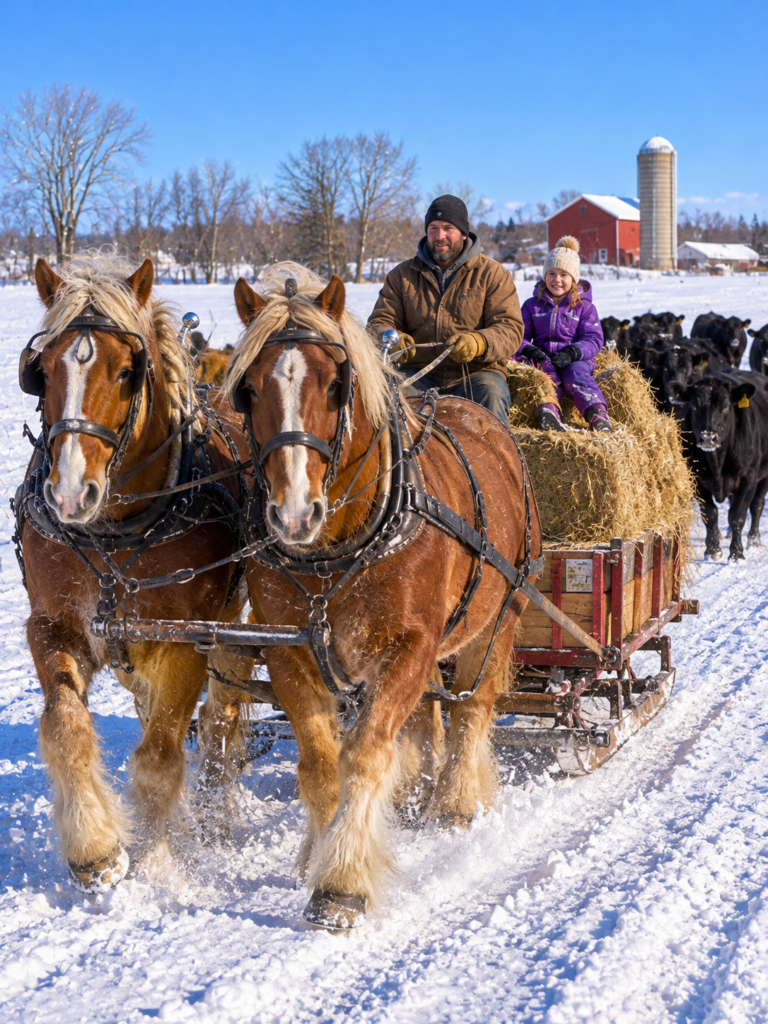
Two thousand pounds apiece of sorrel Belgian draft horse. Copper-red coats that go almost gold in the sun, with blond manes and tails and white blazes down their faces and feathers of white hair around their huge feet. Shoulders like a pickup truck hood. Hooves the size of dinner plates.
And more sense than most people I know.
Part Three: Why I Didn’t
People ask me why I didn’t just load them in the trailer and haul them to my brother’s place in Harlowton. Let Phyllis have her quiet. Let her have her tractor. Take the horses somewhere they’d be safe and let it go.
I thought about it. Every night that week. Lying awake next to an empty pillow, with my husband three hundred miles away.
But I didn’t.
Because four hundred pregnant cows don’t care whose horses they are.
They needed hay that morning. At thirty below, a cow burns through her energy just keeping warm. Pregnant cows, calving in March, can’t go a day without feed in that cold. Not without losing the calf. Not without some of them going down and not getting up.
And the only engine on that ranch that would start at thirty below was standing in the barn alley, in harness, with steam coming off its back.
Part Four: Gunnar
My father-in-law fed with horses every winter for forty years.
His name was Gunnar Thorsrud. His grandfather homesteaded the ranch in 1911, after coming over from a farm outside Trondheim, Norway, and proving up three hundred and twenty acres of shortgrass prairie. Gunnar grew it to six thousand acres. He ran Angus cows. He put up hay every summer with an old swather and a baler and stacked it in the stackyard. And every winter, from the first hard frost to the first green grass, he fed it out by horse and bobsled.
Not because he couldn’t afford a tractor. He had a tractor. An old 4020 he used for haying.
He fed with horses because horses start at thirty below. Because horses don’t gel. Because horses don’t need a shop or a block heater or a can of ether. Because if the iron quits in the middle of a January blizzard, four hundred cows still have to eat.
“The horses are for the day the iron quits,” he used to say.
He said it every winter. Every time somebody at the café in Roundup asked him why he was still feeding like his grandfather.
He raised Duke and Sis from colts. Duke’s mother was a mare named Belle that Gunnar bought at a draft horse sale in Shipshewana, Indiana, in 2006, and hauled home in a stock trailer across eleven hundred miles. Sis came two years later. He broke them both himself, in the round pen behind the barn, the old way. Slow. Patient. Talking to them the whole time.
He fed with them every single morning for fourteen winters.
Part Five: The Lines
Three years ago, in the second week of February, the week before his stroke, Gunnar did something I didn’t understand until later.
I’d been riding the sled with him most mornings that winter. I’d married his son, Elling, ten years earlier, and moved out to the ranch from Billings, where I’d grown up a city girl, a nurse’s daughter, who’d never been on a horse. Gunnar taught me everything. How to harness. How to hitch. How to read the cows. How to cut the twine on a bale and kick the flakes off the back of a moving sled.
He never let me drive. He always held the lines.
Then, that Tuesday morning in February, at the stackyard gate, he stopped the team. He sat there on the sled for a long time, looking out at the cows and the hills and the sun coming up over the Bull Mountains.
Then he handed me the lines.
“Your turn, Karin,” he said.
And he climbed down off the sled and walked back to the house. Slowly. With his hand on his chest.
I drove them that morning. My first time. Shaking the whole way. Duke and Sis did everything right. I don’t think I did anything at all. They knew the route. They knew where to stop. They knew when the hay was off.
When I got back to the barn, Gunnar was standing in the doorway, watching.
“Good,” he said. That’s all.
He had a stroke the following Monday. In the kitchen, at breakfast, with his coffee in his hand. He lived two more weeks in the hospital in Billings. He never spoke again.
He never drove the team again either.
Part Six: Phyllis
Phyllis has called them my pets at every holiday since.
Karin’s pets. Like Duke and Sis were a pair of poodles I’d bought at a pet store.
At Thanksgiving, in front of the whole family, around the big oak table in the ranch house dining room, she told everybody what their hay cost. Three thousand dollars a year. Six tons of grass hay for two horses who did nothing but stand around and eat.
“While her husband drives a water truck in North Dakota,” she said, “to pay for a tractor that does the work in half the time.”
At Christmas, she said it again. Louder. In front of her sister Darlene’s grandkids, who are seven and nine and had never seen a draft horse before and wanted to go out to the barn and pet them.
“Don’t get attached, kids,” Phyllis said. “They’re going to the canner come spring.”
The seven-year-old started crying.
Part Seven: Elling
My husband, Elling, was three hundred miles east that January. In the Bakken oil fields outside Williston, North Dakota. Driving a water truck for a trucking company, hauling produced water from the oil wells to the disposal sites. Two weeks on, one week off. Fourteen-hour days. Sleeping in a man camp with two hundred other guys.
He’d been doing it for eighteen months. To make the payments on that tractor.
Phyllis bought it in October 2023. A John Deere 6R with a bale processor on the back. A hundred and eighty thousand dollars. She said the ranch had to modernize. She said she wasn’t going to be one of those old widows who let her husband’s place fall apart. She said the horses were a relic. She said Gunnar was stubborn and old-fashioned and she should have made him get rid of them years ago.
She signed the loan papers at the bank in Roundup herself. The ranch is in her name. She’s the owner. Elling and I just live there and work it.
The payment was twenty-four hundred dollars a month. The ranch couldn’t cover it in winter. So Elling went to the oil patch.
He’d told her no on the phone. About the canner buyer. Saturday night, from the man camp. I heard his side of it. Phyllis had put him on speaker in the kitchen.
“Mom,” Elling said. His voice was tinny and far away. “Don’t sell Dad’s horses. Please. I’m asking you.”
“They eat three thousand dollars a year, Elling,” Phyllis said. “You’re breaking your back in North Dakota to make the tractor payment, and she’s feeding two pets.”
“They’re not pets,” Elling said. “They’re Dad’s team.”
“Your father’s dead,” Phyllis said.
And she hung up.
But it’s her ranch. Her name on the deed. Her name on the brand. And she’d already called the canner buyer.
Part Eight: Why She Hated Them
I know why she hates them.
I’ve known for three years. I just never said it out loud.
They were his. Gunnar’s. And every morning she stands at the kitchen window with her coffee and looks out across the yard and sees those two big sorrel horses going out to the stackyard with the sled behind them, the way they did every morning for fourteen years.
Only it’s not him driving anymore. It’s me. Her son’s wife. The city girl from Billings.
And every time she looks out that window, she sees her husband handing the lines to somebody else. She sees him choosing me.
That’s a hurt. I understand that. I’m not without a heart.
But it isn’t a reason to sell a good horse for meat.
Part Nine: The Sled
Clint climbed up onto the bobsled.
Clint Harvey is forty-four. Phyllis hired him in November, after the tractor came, to help with the cows while Elling was in North Dakota. He’s from Lewistown. He’s a decent man. Quiet, steady, good with iron. He can fix anything with an engine in it. He rebuilt our old swather last fall in three days.
He’d never held a set of driving lines in his life.
He stood on the front of the sled in his insulated coveralls and his fur-lined trapper hat. The sled is an old one, a wooden bobsled Gunnar’s father built in 1948, with steel runners and a flat hay rack on top. It was stacked with eight big round bales, the kind you unroll, and twenty small square bales on top for the heifers.
My daughter, Nora, was already sitting on top of the hay behind him.
She’s eleven. In her purple snowsuit with the reflective stripes, with her hood up and a scarf over her face so only her eyes showed. Holding a hook knife. Ready to cut the twine on the bales the way her grandfather taught her when she was eight.
She’d been riding the sled every morning since she was four. First with Grandpa Gunnar. Then with me.
The steam was pouring off Duke and Sis. Off their backs, their flanks, their huge noses. It rose straight up in the still air and hung there in a cloud around them, white against the gray sky.
Out at the stackyard, the cows were bawling. Four hundred of them. Lined up along the fence. Waiting.
Part Ten: “Get Up”
Clint picked up the lines from where I’d laid them over the front rail of the sled. Two long leather straps, worn smooth and dark from fourteen winters of Gunnar’s hands, and three winters of mine.
He held them the way you’d hold a pair of jumper cables. In his fists. Too tight.
He slapped them on the horses’ backs.
“Get up,” he said.
Nothing.
He clucked his tongue. The way people do in movies.
Nothing.
He slapped the lines harder. They snapped against Duke’s broad back with a sound like a wet towel.
“Come on,” Clint said. “Get up there. Get up!”
Sis swung her big head around in the harness. Slowly. She looked back over her shoulder at Clint. With one huge brown eye under her blond forelock.
She just looked at him. Like she was trying to figure out who he was.
And Duke set his feet.
Two tons of horse. Planted. All four plate-sized hooves dug into the packed snow of the barnyard. Like fence posts. Like he’d grown roots.
He wasn’t going anywhere.
Part Eleven: The Whip
Phyllis called from the porch.
“There’s a whip in the barn,” she said.
There is. An old buggy whip. Hanging on a nail by the harness room door. It was Gunnar’s father’s. Gunnar never once used it. He kept it there, he said, to remind himself of the kind of horseman he didn’t want to be.
Phyllis knew that. She’d been married to him for forty-one years.
“No,” I said.
It came out of me before I’d decided to say it. Loud. Across the frozen yard.
It was the first time I’d told my mother-in-law no on that ranch. In thirteen years.
The whole yard went quiet. Even the cows seemed to pause.
Clint looked at me.
Then he looked at the porch. At Phyllis, in Gunnar’s sheepskin coat with the torn pocket, with her arms crossed.
Then he looked back at me. And he held out the lines.
“Ma’am,” Clint said, “I’m not going to beat a horse at thirty below to find out who’s boss.”
Part Twelve: The Lines
I walked across the frozen yard to the sled.
I climbed up. The steel runners creaked under my weight. I stood on the front of the sled where Gunnar stood every winter morning for forty years.
Clint handed me the lines. Then he climbed down and stepped back.
I pulled my red wool scarf up over my mouth and nose. It was Gunnar’s. His wife knitted it for him in 1987. He gave it to me the first winter I rode the sled with him, when my face got frostbitten on the way to the north pasture.
The frost was already on my eyelashes. The sun was just clearing the Bull Mountains to the east. Low and bright and gold, throwing long blue shadows across the snow.
Out at the stackyard, the cows had stopped bawling. They were turning toward us. Every head. Four hundred cows, watching the barn.
They knew. Cows always know when the feed is coming.
Phyllis didn’t go inside.
I watched her out of the corner of my eye. She came down off the porch steps. She walked across the snow to the kitchen window. The one over the sink, where she stood every morning for forty years with her coffee, watching her husband feed.
She stood there in the snow outside her own kitchen window. Watching.
Part Thirteen: The Word
I took the lines.
I didn’t slap them. I didn’t cluck.
I held them the way Gunnar taught me. Loosely. Between my fingers, not in my fists. Light enough that I could feel the horses’ mouths through the leather. Like holding hands.
They’re not ropes, Karin, he told me, my first winter on the sled. They’re telephone lines. You talk through them. And you listen.
I said one word.
The one he taught me.
“Kom.”
It’s Norwegian. It means come.
Gunnar’s grandfather used it on the homestead in 1911, with a team of Norwegian Fjord horses he brought from Trondheim. Gunnar’s father used it with his Percherons. Gunnar used it with Duke and Sis, every morning, for fourteen winters.
He told me about it on my third morning on the sled. I’d asked him why he didn’t say giddyup like everybody else.
“Giddyup is telling them to go,” Gunnar said. “Kom is asking them to come with you.” He looked out at the team. “A horse that’s told will go as far as he has to. A horse that’s asked will go as far as you need.”
Part Fourteen: They Came
Duke’s ears came up.
Both of them. Swiveled back toward me, then forward again.
Sis swung her head back around to the front.
Then, together, without a single tug on the lines, without a slap, without a whip, they leaned into their collars.
You can feel it from the sled. When two tons of horse each lean into the harness at the same time. The traces go tight. The singletrees creak. And then the whole sled moves forward, hay and all, smooth as water, the steel runners hissing over the packed snow.
They walked out of the barnyard, through the gate, and down the lane toward the stackyard. At an easy, steady walk. Their huge feet crunching in the snow. Steam rolling off their backs in the low gold sun.
Behind me, on top of the hay, I heard Nora laugh. Muffled through her scarf.
“They know you, Mom,” she said.
Part Fifteen: Feeding
I fed four hundred cows that morning. The way Gunnar taught me. The way I’d done every morning for three winters.
Through the stackyard gate. Out into the big feed ground on the south slope, sheltered from the north wind by the ridge. The cows strung out behind us in a long black line, following the sled. Bawling. Jostling.
At the first spot, I said “Whoa,” soft and low, and Duke and Sis stopped. Nora jumped down with her hook knife and cut the twine on the first round bale. Clint had climbed back on the sled behind her. He helped her push the bale off the back, and it rolled down onto the snow and started to unroll.
“Kom,” I said. And the team walked on. And the bale unrolled behind us in a long green-gold carpet across the white snow, a hundred feet of it, and the cows lined up along it, eating.
Eight round bales. Twenty small squares for the heifers in the east pen. It took an hour and forty minutes.
Duke and Sis never once missed a step.
At the end, when the sled was empty and the cows were eating in long lines across the feed ground and the steam was rising off four hundred black backs in the sun, I stopped the team at the top of the slope. The same place Gunnar used to stop. Where you can see the whole ranch. The house and the barn and the stackyard and the Musselshell River, frozen in its bed of cottonwoods, and the Bull Mountains beyond.
I sat there on the sled for a while. Just looking.
Part Sixteen: Clint
Clint was sitting on the back edge of the empty sled with his legs hanging off. He hadn’t said anything the whole time.
“Ma’am,” he said finally. “Can I ask you something?”
“Sure.”
“That word,” Clint said. “What was it?”
“Kom,” I said. “It’s Norwegian. It means come.”
Clint thought about that for a long time. Looking at the horses.
“Not go,” he said.
“Not go,” I said.
He nodded slowly.
“I’ve been driving tractors for twenty-six years,” Clint said. “I never once asked one to come with me.”
Part Seventeen: The Window
When we came back into the barnyard at eight-thirty, Phyllis was still standing outside the kitchen window.
In the snow. In Gunnar’s old sheepskin coat. She hadn’t moved. She’d been standing there in thirty below for almost two hours.
I stopped the team in front of the barn. I said “Whoa.” They stopped.
I climbed down. My legs were stiff with cold. I couldn’t feel my toes.
Phyllis was looking at me.
I started unhitching the team. Unhooking the traces from the singletrees. My fingers were so cold I could barely work the snaps.
I heard her footsteps crunching across the snow behind me.
She stopped beside Duke’s shoulder. She didn’t say anything. She just stood there, looking at the horse. At his steaming back. At the frost on his whiskers and his eyelashes. At his huge brown eye.
Duke turned his head and looked at her.
Phyllis reached out her bare hand. Slowly. She hadn’t touched those horses in three years. Not once.
She put her palm flat on Duke’s neck. Under his blond mane, where it’s warmest.
And she started to cry.
Part Eighteen: Phyllis
“He asked me,” Phyllis said.
She was crying so hard I could barely understand her. Her hand was still on Duke’s neck.
“That morning,” she said. “The last Tuesday. Before the stroke. He asked me to ride the sled with him. One more time. He came in the kitchen at five-thirty with his coat on and he said, Phyl, come feed with me this morning. Like we used to.”
She was shaking.
“We used to,” she said. “When we were first married. In 1981. Every morning. I’d sit on the hay and cut the twine, like Nora does. We’d stop at the top of the slope and look at the river.” She wiped her face with the sleeve of his coat. “I stopped going when Elling was born. And then I just… never started again. Forty years. I always meant to.”
“And that morning,” Phyllis said, “he asked me. And it was cold. Twenty-two below. And I was in my bathrobe with my coffee. And I said, Oh, Gunnar, it’s too cold. Take Karin.”
She looked at me.
“So he took you,” she said. “And he gave you the lines. And he walked back to the house and sat down in his chair by the stove and didn’t say a word for the rest of the day.”
She put both hands over her face.
“And six days later, he was gone,” she said. “And the last thing he ever asked me to do, I said no. Because I didn’t want to get cold.”
Part Nineteen: Why
I stood there beside Duke in the frozen barnyard and didn’t say anything for a long time.
“Every morning,” Phyllis said, through her hands. “Every morning for three years, I stand at that window. And I watch you go out with his team. And I think, That should have been me. He asked me. And I sent her.”
She lowered her hands. Her face was raw from the cold and the crying.
“It’s not the hay,” she said. “It was never the hay. Three thousand dollars. I don’t care about three thousand dollars.” She looked at Duke. “I just couldn’t stand looking at them anymore. Every morning. Reminding me.”
“So you called the canner buyer,” I said quietly.
Phyllis nodded. She couldn’t speak.
“So they’d be gone,” I said. “And you wouldn’t have to look.”
Part Twenty: What I Said
I finished unhitching the traces. I laid them over Duke’s back, the way Gunnar did.
Then I turned to my mother-in-law.
“Phyllis,” I said. “Do you know what he said to me? That morning? When he gave me the lines?”
She shook her head.
“He said, Your turn, Karin,” I said. “And then he climbed down and walked back to the house.” I paused. “And I thought, for three years, that he was choosing me. Over you. Over Elling. That he was handing me the ranch.”
Phyllis looked at me.
“But I don’t think that’s what it was,” I said. “I think he knew. About his heart. I think he’d felt it. For weeks. He kept putting his hand on his chest that whole winter.” I swallowed. “I think he asked you to come because he wanted one more morning with you. And when you said no, he gave me the lines because he knew somebody had to know how. For the day the iron quits.”
Phyllis stared at me.
“He wasn’t choosing me over you,” I said. “He was choosing the cows. And the horses. And the ranch. He was making sure they’d be okay without him.” I looked at Duke and Sis, steaming in the cold. “And he gave them to me because I was the one sitting on the sled.”
I took a breath.
“It should have been you, Phyllis,” I said. “I know. I’ve always known.”
Part Twenty-One: The Phone Call
Phyllis went inside without saying anything else.
I put the horses away. Brushed them down in their stalls, the frost and sweat on their backs. Gave them each an extra coffee can of oats. Checked their water tank heater. Rubbed Sis behind the ears, the way she likes.
Clint went to the shop to start thawing out the tractor with the big propane heater.
Nora came and stood beside me in Sis’s stall, leaning against the big mare’s shoulder.
“Is Grandma okay?” she asked.
“I don’t know, baby,” I said.
At ten o’clock, I went into the house.
Phyllis was at the kitchen table. Still in Gunnar’s coat. She had the landline phone in her hand. The old beige one on the long cord.
She was talking to somebody.
“No, Hollis,” she was saying. “No. I’m sorry you made the trip arrangements. But they’re not for sale. Not Monday. Not ever.” She paused. “Yes. I’m sure. I’ve never been so sure about anything.” Another pause. “Thank you. Goodbye.”
She hung up.
She looked at me standing in the kitchen doorway.
“I canceled it,” she said.
Part Twenty-Two: Elling
I called Elling that night from the bedroom. On my cell phone, standing by the window because it’s the only place in the house with two bars.
He answered from the man camp outside Williston. I could hear the generators in the background. And men laughing. And a television.
I told him everything. The tractor. The gelled fuel. Clint on the sled. There’s a whip in the barn. The word. Kom. Phyllis in the snow outside the kitchen window. Phyllis crying with her hand on Duke’s neck.
He asked me. That last morning. And I said take Karin.
Elling didn’t say anything for a long time.
“I didn’t know that,” he said finally. “About that morning. She never told me.”
“She never told anybody,” I said.
“Is she okay?” Elling asked.
“I don’t know,” I said. “She canceled the canner buyer.”
I heard my husband let out a long breath. Three hundred miles away, in a trailer in North Dakota, at thirty below.
“Thank God,” he said. “Thank God, Karin.”
Then he said something I’ll never forget.
“Karin,” he said. “I’m coming home.”
“Your two weeks aren’t up until Sunday,” I said.
“Not for my week off,” Elling said. “For good. I’m giving notice tomorrow.” He paused. “Mom bought that tractor because she couldn’t stand to look at the horses. Not because the ranch needed it. And I’ve been driving water truck in North Dakota for eighteen months to pay for it.” He laughed, a tired, broken sound. “We don’t need a hundred-and-eighty-thousand-dollar tractor. Dad fed four hundred cows with two horses and a sled for forty years. We need me home.”
Part Twenty-Three: The Next Morning
The next morning was thirty-four below.
The tractor sat in the shop by the propane heater. Clint said maybe tomorrow.
I went out to the barn at five-thirty to harness the team. In the dark, by the light of the yard light. Nora came with me, in her purple snowsuit. She held the lantern while I put the collars on.
At six-fifteen, the kitchen door of the ranch house opened.
Phyllis came out onto the porch.
She was wearing Gunnar’s sheepskin coat. And his old fur-lined trapper hat with the ear flaps. And insulated coveralls I’d never seen before. Old ones. Faded tan Carhartts with a patch on the knee.
She came down the porch steps. Slowly. Across the frozen yard. To the barn door.
She stood there in the yellow light from the barn, looking at us. At me. At Nora. At Duke and Sis, standing in the alley in their harness, with steam coming off their backs.
“These were mine,” Phyllis said quietly. She looked down at the old Carhartt coveralls. “From 1981. I found them in the cedar chest last night. They still fit.” She almost laughed. “Barely.”
Nobody said anything.
“Karin,” Phyllis said. “Is there room on the sled?”
Part Twenty-Four: Room on the Sled
I looked at my mother-in-law. Sixty-six years old. In her forty-year-old coveralls and her dead husband’s coat and hat. Standing in the barn door at thirty-four below.
“There’s always room on the sled,” I said.
Nora climbed up on the hay first. Then she held out her mittened hand to her grandmother. Phyllis took it. Nora pulled. Clint gave a boost from behind. And Phyllis Thorsrud climbed up onto her husband’s grandfather’s bobsled for the first time in thirty-seven years.
She sat down on the hay beside her granddaughter.
Nora handed her a hook knife.
“You cut the twine on the left side,” Nora said seriously. “I do the right. Grandpa taught me.”
Phyllis looked at the knife in her hand. Then at her granddaughter.
“Grandpa taught me too,” she said. “A long time ago.”
Part Twenty-Five: The Top of the Slope
I took the lines.
I pulled Gunnar’s red scarf up over my mouth.
“Kom,” I said.
Duke and Sis leaned into their collars. And the sled moved forward, smooth as water, the runners hissing on the snow, out of the barnyard and down the lane toward the stackyard in the blue darkness before sunrise.
We fed four hundred cows that morning. Eight round bales. Twenty squares. Phyllis cut the twine on the left side. Nora cut the right. They pushed the bales off the back together. Clint rode along and helped.
Nobody said much.
At the end, when the sled was empty, I stopped the team at the top of the south slope. The place where you can see the whole ranch. The house and the barn and the stackyard and the frozen Musselshell River in its cottonwoods, and the Bull Mountains beyond.
The sun was just coming up. Low and red and gold. Throwing long blue shadows across the snow. The steam was rising off four hundred black backs on the feed ground below us, and off Duke and Sis in front of us, and off our own breath.
Phyllis sat on the back of the empty sled and looked out at it all for a long time.
“We used to stop here,” she said quietly. “Every morning. Gunnar and me. In 1981. Right here.” She wiped her eyes with the back of her mitten. “He’d hold the lines, and I’d sit on the hay, and we’d just look at the river. We didn’t talk. We didn’t need to.”
She was crying again. Quietly. With the frost on her eyelashes.
“I’m sorry, Gunnar,” she said, out loud, to the hills. “I’m sorry I said it was too cold.”
Nora put her arm around her grandmother.
I sat on the front of the sled, holding the lines loosely between my fingers. Like holding hands. Through the leather, I could feel Duke and Sis breathing. Waiting. Patient.
I didn’t say anything. There wasn’t anything to say.
Part Twenty-Six: The Tractor
Phyllis sold the tractor in March.
The John Deere dealer in Billings took it back. She lost about thirty thousand dollars on it. She paid the difference out of the cattle check from the fall calves.
“Worth every penny,” she said, signing the papers at the kitchen table, “to never have to look at that green monster sitting in the shop again.”
We kept Gunnar’s old 4020 for haying in the summer. It’s fifty years old and it starts at thirty below if you plug in the block heater the night before. Clint keeps it running. He’s good with iron.
And Phyllis kept Clint on. Not just for the winter. Full time. Year-round. She said a ranch needs somebody who’s good with engines.
And somebody who won’t beat a horse to find out who’s boss.
Part Twenty-Seven: Elling Home
Elling came home on the first of February.
He drove six hours from Williston in his pickup through a ground blizzard on Highway 2. He got to the ranch at eleven o’clock at night. I was waiting up at the kitchen table.
He came through the back door in his work coveralls, smelling like diesel and North Dakota, and stood in the kitchen and looked at me.
“Hi,” he said.
“Hi,” I said.
He hugged me for a long time.
The next morning, he came out to the barn at five-thirty. He helped me harness the team.
Duke nuzzled his coat pocket. Looking for the peppermints Elling always used to carry when he was a boy, riding the sled with his father.
Elling reached into his pocket. He’d brought some. From a gas station in Wolf Point.
He stood in the barn alley feeding his father’s horse a peppermint, with tears running down his face into his beard.
“Hey, Duke,” he said. “Hey, buddy. I’m home.”
Part Twenty-Eight: The Lines
On the first morning of March, the last hard cold snap before the calving started, it was twenty-six below.
We all went out to feed. Elling and me. Phyllis. Clint. And Nora, in her purple snowsuit.
At the barn door, when the team was hitched and the sled was loaded, I climbed up onto the front of the sled to take the lines.
Then I stopped.
I looked back at my daughter, sitting on the hay with her hook knife.
“Nora,” I said. “Come here.”
She climbed forward over the bales to the front of the sled. She stood beside me.
I held out the lines.
“Your turn,” I said.
Nora stared at the lines in my hands. Those worn leather straps, dark and smooth from fourteen winters of her grandfather’s hands and three winters of mine.
“Me?” she said. “Mom. I’m eleven.”
“Grandpa Gunnar was nine,” Phyllis said, from the back of the sled. “When his father first gave him the lines. I know because he told me. Every single winter, for forty-one years.”
Nora looked at her grandmother. Then at her father, standing at the barn door with his coffee. Then at me.
She took the lines.
She held them the way I’d shown her a hundred times on the way out to the stackyard, just for practice. Loosely. Between her fingers. Not in her fists. Like holding hands.
She looked out at the horses. At Duke and Sis, steaming in the cold, with their ears swiveled back toward her. Listening.
She didn’t slap the lines. She didn’t cluck.
She said one word. The one her grandfather taught me. The one I taught her.
“Kom.”
Duke’s ears came up.
Sis swung her head back to the front.
And together, without a tug, without a slap, two tons of horse each leaned into their collars, and the sled moved forward, smooth as water, and my eleven-year-old daughter drove her grandfather’s team out of the barnyard and down the lane toward four hundred cows bawling at the stackyard fence in the blue light before sunrise.
Phyllis didn’t stand at the kitchen window that morning.
She was sitting on the hay behind her granddaughter, in her 1981 coveralls and her husband’s coat, with a hook knife in her mittened hand, cutting the twine on the left side.
And when we got to the top of the south slope, Nora stopped the team. Right where her grandfather used to stop. Without anybody telling her to.
And all five of us sat there on the sled in the cold and watched the sun come up over the Bull Mountains, and nobody said a word. We didn’t need to.