Six Dollars a Shock
Part One: Frost
Frost was still silver on the ditch grass when I carried the card table down the lane.
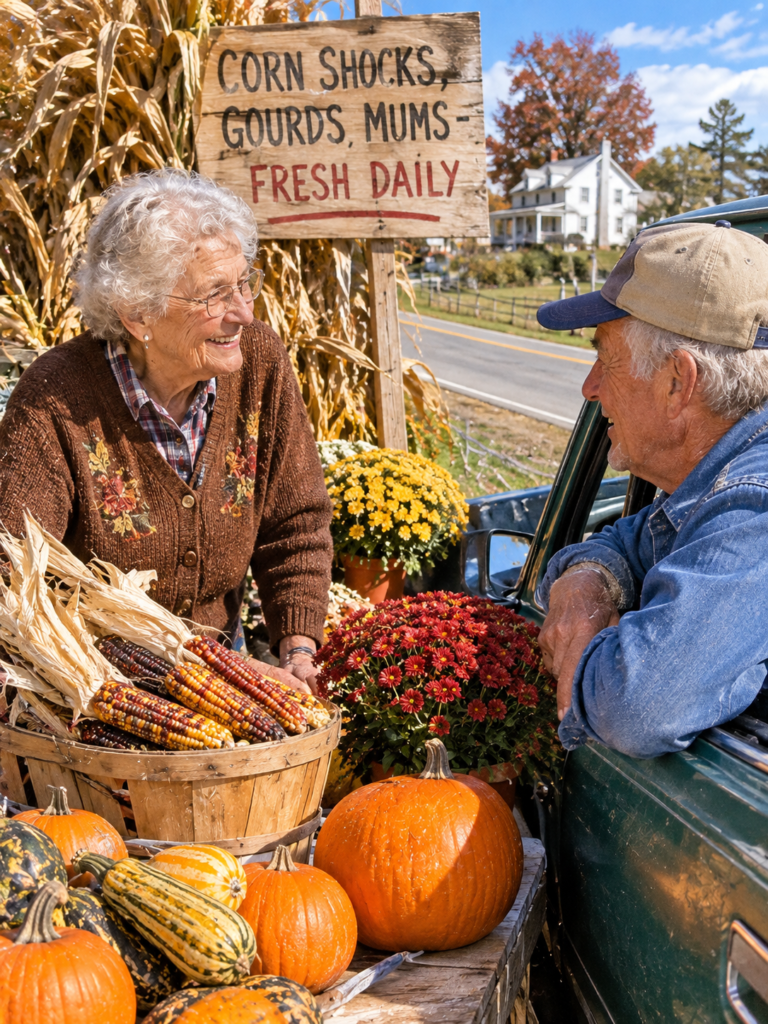
It was the second Saturday in October. Six-forty in the morning. The sun wasn’t up yet, but the sky over the Hendersons’ woods was going from gray to pink, and every blade of grass along the gravel was coated white. My breath smoked in front of me. My boots crunched.
The card table was the old one from the basement. Brown vinyl top, one leg that wobbles if you don’t wedge a matchbook under it. Virgil bought it at an auction in 1974 for a dollar and a half. We used it for pinochle on Friday nights for forty years.
I set it up at the end of our lane, right where the gravel meets the county road.
By seven o’clock, I had three corn shocks standing beside it.
Two from the barn. One I tied right there in the lane, with the bundle of stalks I’d carried down in the wheelbarrow and the twine from my coat pocket.
My hands were cold. My knees hurt. My back would tell me about it tomorrow.
I didn’t care.
I’m Eunice Albright. I’m sixty-eight years old.
I’ve lived on this farm on County Road 400 South, outside Pleasant Mills, Indiana, since I was twenty-one. I came here as a bride in a borrowed dress, with a suitcase and a cedar chest and a husband who had more corn ground than sense.
My husband, Virgil, poured the gravel in this lane in 1981.
Part Two: Virgil
He did it himself.
Borrowed a dump truck from his cousin Lyle. Hauled six loads from the quarry over by Decatur. Spread it with a shovel and a rake on a hot Saturday in July while I brought him lemonade in a mason jar.
When he was done, he stood at the end of the lane with his hands on his hips and his shirt soaked through with sweat.
“There,” he said. “Now we can put up a stand.”
That fall, we sold sweet corn at the end of that lane.
Then pumpkins. Then gourds. Then, the third year, corn shocks.
If you didn’t grow up in farm country, you might not know what a corn shock is.
It’s a bundle of dried cornstalks, tied upright around a center, standing about six feet tall. In the old days, farmers stood them up in the field to dry before they had combines. Now people buy them to decorate their porches in the fall. With pumpkins at the bottom and mums in a pot.
Virgil taught me to tie them.
He’d cut the stalks with a corn knife in late September, when they were brown and dry and rattled in the wind. He’d gather a big armful and stand it up and wrap it twice around the middle with baling twine.
Then he’d tie the knot.
It was his own knot. His father taught him. A kind of doubled half hitch with a twist on the end, so it’d hold all winter in the wind and still pull loose in March with one tug.
I watched him tie it a hundred times before I tried.
The first one I tied fell over in the barn.
The second one held.
“Six dollars,” Virgil said that first fall, setting a price sign against the stand. Hand-lettered on a piece of plywood.
“Six dollars?” I said. “Virgil, we could get eight in town.”
“People ought to be able to afford autumn,” he said. “Six dollars.”
That was 1983.
It was still six dollars forty years later.
Part Three: Forty Autumns
The stand grew.
Not much. It was never fancy. Two wooden racks Virgil built out of barn boards. A hand-painted sign that said ALBRIGHT’S — SWEET CORN — PUMPKINS — SHOCKS. A coffee can for the money. An honor system when we were in the field, and one of us sitting in a lawn chair when we weren’t.
But people came.
Every fall for forty years.
Mothers with little kids who wanted to pick their own pumpkin. Old couples from town who’d bought their shocks from us since the eighties. Young families who’d just moved to the new subdivision over by the high school, who’d never seen a real corn shock in their lives.
The kindergarten class from Pleasant Mills Elementary came every October on a field trip. They’d sit on hay bales and Virgil would show them how to tie a shock. Then he’d let each of them pick out a little gourd to take home.
We raised our son at that stand.
Gary was two the first fall. He sat in a laundry basket under the sign and ate a gourd. He was five the first time he made change. He was ten when he could carry a shock to a car by himself.
He was eighteen when he left for Purdue and didn’t come back.
I don’t say that bitterly.
Gary’s an engineer. He designs heating and cooling systems for big office buildings in Indianapolis. He has a wife, Denise, and two kids in high school, and a house in Carmel with a three-car garage.
He calls every Sunday.
He came home at Christmas and Easter and sometimes the Fourth of July.
He hasn’t stood at the stand since 1996.
Part Four: March
Virgil died in March.
In his chair.
It was a Tuesday morning. A little after six.
He’d been up since five, like always. He’d gone out to check the furnace in the hog barn, even though we hadn’t kept hogs since 2009. He’d come back in and poured himself a cup of coffee and sat down in his brown recliner by the kitchen window.
The farm report was on the radio. WOWO out of Fort Wayne. Corn futures and soybean futures and the cattle report.
I was at the stove making oatmeal.
“Beans are up a nickel,” Virgil said.
“Is that good?” I said.
He didn’t answer.
I turned around.
He was sitting in his chair with his coffee cup in his hand, looking out the window at the frost on the field.
He was gone.
The farm report was still talking on the radio.
Cash corn, Fort Wayne, three dollars and eighty-two cents.
I don’t remember much after that. The ambulance from Decatur. The man from the funeral home. Pastor Steinke at the kitchen table with his hand on mine.
I remember that I turned off the radio.
I haven’t turned it back on since.
Part Five: Gary
Gary drove down that afternoon.
He left work in the middle of a meeting. He drove two hours from Indianapolis in his big silver SUV. He walked into the kitchen and saw Virgil’s chair, empty, and his father’s coffee cup still on the windowsill.
He stood there for a long time.
Then he put his arms around me and cried.
He stayed.
Two weeks. Then a month. He worked from my kitchen table on his laptop. He drove back to Indianapolis on weekends to see Denise and the kids.
He was a comfort.
I want to say that clearly. He was.
He handled the funeral. The paperwork. The bank. The life insurance. The Social Security. He sat with me at the lawyer’s office in Decatur. He called the propane company and the electric company and the insurance agent.
He mowed the yard. He fixed the gutter on the back porch. He cleaned out the gutters on the barn.
He sat with me in the evenings. We watched Jeopardy! We didn’t talk much.
The grave still didn’t have a stone.
Just the little metal marker from the funeral home. Virgil T. Albright. 1952–2025.
Gary wanted to order one right away. A big granite one. He’d pay for it, he said.
I said no.
“I’ll buy it,” I said. “Virgil’s stone. I’ll buy it myself.”
“Mom,” Gary said. “It’s three thousand dollars.”
“Then I’ll save three thousand dollars,” I said.
Gary didn’t argue.
But I could see it on his face. How?
Part Six: The Evening
In September, the corn came in.
Hollis Pruett combined it. He’s farmed the ground to the north of us for forty years, and he’s combined Virgil’s back forty for thirty of them, ever since Virgil’s knees got bad. He came over in his big green combine and took it all in two days.
He left the stalks standing on the north twenty, the way Virgil always asked him to.
For the shocks.
I went out with Virgil’s corn knife on a Monday in late September.
I cut stalks for four days. I gathered them in the wheelbarrow and hauled them to the barn. I tied them with Virgil’s knot.
By the end of the week, I had forty-one shocks standing in the barn.
My hands were raw. My back was screaming. I hadn’t been so tired in years.
I’d never felt better since March.
Then one evening, Gary set his coffee down.
We were at the kitchen table. After Jeopardy! He’d driven down for the weekend.
He’d been quiet all through supper. Pushing his meatloaf around his plate.
He set his coffee cup down on the oilcloth. Carefully. Like he’d been practicing what he was going to say.
“Mom,” he said. “You can’t do the stand this year.”
I looked at him.
“Why not?” I said.
“You’re sixty-eight,” Gary said. “It’s for the best.”
Part Seven: For the Best
I didn’t say anything.
Gary kept going. He’d clearly rehearsed it.
“Dad’s gone,” he said. “You’re alone out here. You’ve got arthritis in your hands. Your back’s bad. You can’t be standing out there by the road in the cold all day.”
He looked at me.
“What if you fall?” he said. “What if you have a heart attack? Like Dad? Out there by the road, with nobody around?”
His voice cracked.
“I can’t lose you too, Mom,” he said.
I didn’t say anything.
I looked at my son. Forty-five years old, with gray coming in at his temples and Virgil’s big hands folded on my kitchen table.
I thought about the little boy in the laundry basket, eating a gourd.
“So here’s what I’m going to do,” Gary said. “I’ll run the stand this year. On weekends. I’ll come down Friday nights and do Saturdays and Sundays.”
He looked at me.
“You can stay in the house,” he said. “Where it’s warm. You don’t have to lift anything. You don’t have to stand out there. I’ll handle all of it.”
“You’ll handle it,” I said.
“I’ll handle it,” Gary said. “And I’ll give you the money. All of it. Whatever we make.”
He picked his coffee back up.
“It’s for the best, Mom,” he said again.
Part Eight: The Bright Stand
He built a new stand.
He didn’t use Virgil’s old racks. He said they were falling apart. He said the barn boards were rotted.
He went to Menards in Fort Wayne and bought new lumber. Pressure-treated pine. Galvanized screws. He built a big stand up by the road. Bigger than ours ever was. Painted white. With a roof.
He didn’t put it at the end of our lane.
He put it fifty yards up County Road 400 South. On the corner of our property, where it meets the state highway. Where the traffic is.
He hung a banner.
Vinyl. Printed at a shop in Indianapolis. Orange and yellow, with cartoon pumpkins in the corners.
A foot tall.
ALBRIGHT FARMS — FALL MARKET.
Albright Farms.
We were never Albright Farms. We were Albright’s. Just Albright’s.
He loaded my forty-one shocks into his truck.
I watched from the kitchen window. He backed his pickup up to the barn. He carried them out two at a time. My shocks. The ones I’d cut with Virgil’s knife and tied with Virgil’s knot.
He stood them up at his bright new stand under his bright new banner.
Then he put out his sign.
CORN SHOCKS — $12.
Twelve dollars.
Virgil never charged like that.
I never did.
Part Nine: Spending Money
That first Saturday, I stayed in the house.
Gary had asked me to. “Just relax, Mom,” he said. “Read a book. Watch TV. Take a nap.”
I did not take a nap.
I sat at the kitchen window and watched the cars drive past our lane. Past the end of the gravel. Up to Gary’s bright stand.
Some of them stopped.
A lot of them didn’t.
I saw Mrs. Hochstetler’s car slow down. She looked at the sign. She kept going.
I saw the young couple from the new subdivision. The ones with the twins. They pulled over. They got out. They looked at the price. They got back in their car and left.
I saw a pickup I didn’t recognize stop, and a man get out, and buy two. Twenty-four dollars. He drove away fast, with my shocks rattling in his truck bed.
Gary came down at dusk.
He walked into my kitchen in his Purdue sweatshirt, with his cheeks red from the cold. He was holding a grocery sack.
A brown paper bag from Kroger. Folded over at the top.
Full of cash.
He sat down at the kitchen table. He opened the sack.
He counted out a little stack of bills. Twenties and tens.
He slid it across the oilcloth to me.
“There’s your spending money, Mom,” he said.
I looked at the little stack.
Eighty-four dollars.
I looked at the grocery sack.
I could see more money in it. A lot more.
“Where’s the rest?” I asked.
“I’m putting it away for you,” Gary said. “In an account. For your care. In case you need help someday. In-home nursing. Assisted living. Whatever.”
He folded the top of the grocery sack back over.
“It’s for the best, Mom,” he said.
Spending money.
From the stand Virgil and I built.
Part Ten: I Did Not Call Anybody
That night, I sat in Virgil’s chair by the kitchen window for a long time.
The farm report radio was on the shelf above me. Off. Where I’d left it in March.
I looked out at the dark field. At the barn, with two shocks still standing inside. The two Gary hadn’t fit in his truck.
I did not call anybody.
Not Pastor Steinke. Not my sister in Muncie. Not the lawyer in Decatur.
Who would I call? What would I say?
My son took over my corn shock stand and charges too much?
No law was broken.
He thought he was helping.
You cannot arrest a man for deciding his mother is old.
And I would not squabble with my own son by the road.
Not in front of the neighbors. Not in front of Mrs. Hochstetler and the young couple with the twins and every car that drove down County Road 400 South.
That’s not how Virgil and I did things.
But I sat there in his chair.
And I looked out the window at the end of our lane.
At the gravel.
The lane was mine.
Virgil left me the farm. Every acre. The house. The barn. The lane.
Gary’s bright stand was on the corner, fifty yards up the road. On the edge of the property.
But the end of the lane, where the gravel meets the county road, where Virgil stood with his hands on his hips in 1981 and said Now we can put up a stand—
That was mine.
The gravel was Virgil’s.
And I had two shocks left in the barn.
Part Eleven: The Card Table
So that second Saturday, I got up at five-thirty.
I put on my long underwear and Virgil’s barn coat. His old Carhartt, brown canvas, worn white at the elbows. It’s too big for me. I roll up the sleeves.
I went down to the basement and found the card table.
I carried it down to the end of my lane.
Through the frost. In the dark. Past the barn and the old hog house and the big maple tree Virgil planted the year Gary was born.
I set it up where the gravel meets the county road.
I wedged a matchbook under the wobbly leg.
Then I went back to the barn for the two shocks.
I carried them one at a time. They’re not heavy. Maybe fifteen pounds. But they’re awkward. Six feet tall. They catch the wind.
I stood them up beside the card table.
Then I went back to the barn again. For the wheelbarrow.
There was a bundle of stalks left over in the corner. The ones I’d cut on the last day and hadn’t tied yet.
I wheeled them down the lane. I tied a third shock right there at the end of the gravel. With Virgil’s knot.
By seven o’clock, I had three corn shocks standing.
I went back to the house one more time.
I got a cigar box from Virgil’s dresser. Swisher Sweets. He kept his cufflinks in it. I dumped them in his sock drawer. I put in a few ones and a five for change.
I got a river rock from the flower bed by the porch. Smooth and gray, the size of a loaf of bread. Virgil brought it home from a fishing trip in Michigan in 1990.
And I got a piece of cardboard and a black marker.
I sat at the card table at the end of my lane, in Virgil’s coat, and wrote a sign.
In my own hand.
EUNICE.
Shocks, gourds, mums.
$6.
I set it on the card table.
I put the river rock on top so it wouldn’t blow away.
Then I sat down in a lawn chair.
And I waited.
Part Twelve: Marjorie
The first car was Marjorie’s blue Buick.
Marjorie Teeple has been my friend since 1979. We met at the Lutheran church in Pleasant Mills. She taught Sunday school. I taught Vacation Bible School. We’ve been in the same quilting circle for forty-two years.
She drives a 2004 Buick LeSabre, robin’s-egg blue, that she calls the Bluebird. She drives it to church, the grocery store, and the beauty shop. She drives it forty miles an hour no matter what the speed limit is.
She was on her way to the beauty shop in town. Every Saturday at eight-thirty.
She slowed down at the end of my lane.
She stopped.
She rolled down her window.
She looked at me. Sitting in a lawn chair in Virgil’s coat beside a card table and three corn shocks.
She looked at my sign. EUNICE.
Then she looked up the road.
At Gary’s bright stand. At his white roof. His vinyl banner, a foot tall. ALBRIGHT FARMS — FALL MARKET.
She squinted. Her eyes aren’t good anymore.
She read his sign out loud.
“Twelve dollars for a shock,” Marjorie read.
She turned and looked back at me.
“Lord have mercy,” she said.
She got out of the Bluebird.
She walked over to my card table in her church coat and her rain bonnet. She looked at my three shocks. She touched the twine. She looked at the knot.
“That’s Virgil’s knot,” she said quietly.
“It is,” I said.
She looked at me for a long moment.
She didn’t ask any questions. She didn’t need to. Marjorie’s known me for forty-six years.
She opened her purse.
She bought two of my shocks.
She paid in ones and a five. She counted them out on the card table. Twelve dollars.
I helped her load them into the back seat of the Bluebird. They stuck out the windows on both sides. She didn’t care.
She got back in the car. She rolled down her window again.
“I’ll tell the girls,” she said.
The girls means the quilting circle. And the church women. And the beauty shop. And anybody who will listen.
Marjorie Teeple has been telling the girls things since 1979.
She drove off toward town at forty miles an hour.
With my corn shocks sticking out both back windows of the Bluebird like wings.
Part Thirteen: Hollis
Then Hollis came by on his Gator.
Hollis Pruett is seventy-four. He’s farmed the ground north of us since 1971. He combined Virgil’s back forty for thirty years, ever since Virgil’s knees went.
He’s a big man. Gruff. Says about ten words a day. Wears a Pioneer seed cap so old you can’t read the letters anymore.
He drives a green John Deere Gator everywhere. Even to church.
He pulled up at the end of my lane.
He shut off the engine.
He looked at my card table. At my one remaining shock.
At my sign. EUNICE.
Then he looked up the road at Gary’s stand.
He didn’t say anything for a long time.
“You’re out of shocks,” he said finally.
I looked at my one shock.
“I’ve got one,” I said.
“That’s not out,” Hollis said. “That’s one.”
He climbed down off the Gator. Slowly. His knees are bad too.
He walked over and stood in front of my card table.
“Tie me one,” he said. “Right here.”
He folded his arms.
“I got time,” he said.
There was still a little pile of stalks in the wheelbarrow. Enough for one more.
So I got up from my lawn chair.
I gathered the stalks in my arms. I stood them up. I wrapped the twine twice around the middle.
I tied Virgil’s knot.
Hollis watched me the whole time.
He didn’t say anything. He just stood there with his arms folded and his old seed cap pulled down low, watching my hands.
When I was done, I stood the shock up beside the card table.
Hollis looked at it for a long time.
“That’s Virgil’s knot,” he said.
“It is,” I said.
“He tried to teach me that once,” Hollis said. “1987. I never could get it.”
He reached into his back pocket. He pulled out his wallet. He took out a ten-dollar bill.
He set it on the card table. Under the river rock.
“It’s six dollars,” I said. “I’ll get your change.”
“No,” Hollis said.
He picked up the shock. He carried it to the Gator. He laid it across the back.
He climbed back up into the seat.
“Cheapest entertainment I had all year,” he said.
Part Fourteen: The Marathon Station
He drove that shock straight into town.
I found out later. From Marjorie. Who found out from Hollis’s wife, Velma. Who found out from Hollis.
He drove his Gator two miles into Pleasant Mills. Down Main Street. With my corn shock lying across the back.
He pulled into the Marathon station on the corner of Main and Second.
Every Saturday morning, six old men sit in the back corner of the Marathon station. At a little plastic table by the coffee machine. They’ve done it for twenty years.
They drink coffee. They talk about the weather and the price of beans and who died. They solve all the world’s problems before nine o’clock.
Virgil used to be one of them.
Hollis walked in.
He was carrying the corn shock.
He stood it up in the middle of the Marathon station. Right by the slushie machine.
The six old men looked at it.
“What’s that, Hollis?” said Ray Kleinknight.
“Corn shock,” Hollis said.
“I can see it’s a corn shock,” Ray said.
Hollis poured himself a cup of coffee.
He sat down in Virgil’s old chair. The one nobody had sat in since March.
And he told them what my boy had done.
He told them about Gary’s bright stand. The vinyl banner. ALBRIGHT FARMS. Twelve dollars a shock.
He told them about the grocery sack. Spending money.
He told them about the card table at the end of the lane. The cigar box. The river rock.
The sign that said EUNICE.
He told them about Virgil’s knot.
The six old men didn’t say anything for a long time.
Then Ray Kleinknight set down his coffee.
“Twelve dollars,” he said. “For a shock.”
“Twelve,” Hollis said.
“Virgil charged six for forty years,” Ray said.
“He did,” Hollis said.
“Her own boy,” Ray said quietly. “Told Eunice she’s too old for the stand.”
He shook his head.
“Virgil’d have kicked his butt from here to Decatur,” he said.
Six old men.
Six wives.
Six telephones.
Part Fifteen: By Eleven
By eleven o’clock, I had sold every shock in the barn.
There weren’t many left after Gary took forty-one. But I’d gone back to the field with Virgil’s corn knife at nine-thirty, when the cars started coming. I cut more stalks. I tied them right there at the end of the lane.
My hands were raw. My back was screaming.
I tied eleven shocks between nine-thirty and eleven.
I sold every one.
Cars I knew.
Velma Pruett. Ray Kleinknight’s wife, Doris. Marjorie’s whole quilting circle, one after another, in a little parade of Buicks and Oldsmobiles. The pastor’s wife, Ruthann Steinke, in her minivan.
Cars I did not know.
A young man in a pickup with Ohio plates. A family in a minivan with three kids in the back. Two women in a little red car who said they’d driven all the way from Fort Wayne.
Some of them drove right past Gary’s bright stand to stop for me.
I watched them. They’d slow down at his banner. They’d look at his sign. $12. They’d keep driving.
Fifty yards down the road, they’d stop at the end of my lane.
A little girl got out of the minivan. She was maybe four. Pink coat. Pigtails.
She looked at my shocks standing in a row beside the card table.
“Mommy,” she said. “Look. Straw houses.”
Her whole face lit up like a window.
I gave her a gourd. A little green and yellow one, warty, shaped like a pear. Virgil used to give one to every kid.
She held it in both hands like it was made of gold.
A woman in a silver SUV rolled down her window. She didn’t get out.
She looked at me in Virgil’s coat. At my card table. At my sign.
“Are you the one,” she said, “from the gas station story?”
I didn’t know what to say.
“I suppose I am,” I said.
“Give me two,” she said.
She held out twenty dollars through the window. I gave her two shocks. Her husband loaded them into the back.
She was gone before I could even thank her.
Before I could give her the change.
Part Sixteen: The Good Cold Sun
At a quarter past eleven, I sat down at my empty table.
Every shock was gone. Every gourd. The three pots of mums I’d brought down from the porch.
The cigar box was full. Ones and fives and tens. I didn’t count it. I didn’t care.
I sat in my lawn chair at the end of my lane in Virgil’s coat.
The sun had come out. Good cold October sun. The frost was gone from the ditch grass. The sky was that hard blue you only get in October.
Up the road, I could see Gary’s bright stand. His white roof. His orange and yellow banner.
His shocks. My shocks. Still standing. Most of them.
I sat there and felt the sun on my face.
And for the first time since March, since the farm report and the coffee cup and Virgil’s chair, I felt something besides grief.
I was happy.
Not getting by. Not managing. Not holding up.
Happy.
Happier than I’d been since March.
And then I saw Gary’s truck come down the road.
Part Seventeen: Gary
It came slow.
His big silver pickup. Down County Road 400 South from his bright stand. Not fast. Barely moving.
I could see him through the windshield. Both hands on the wheel. Looking at me.
He pulled into the lane.
He stopped.
He sat in the truck for a long moment.
Then he got out.
He was wearing his Purdue sweatshirt and his good jeans and his clean work boots from Cabela’s. The ones that had never seen a barn.
He looked at my empty card table.
At the cigar box of ones and fives.
At the river rock. At my sign.
EUNICE.
Then he looked past me. At the end of the lane.
At the two bare stands. Virgil’s old barn-board racks. Standing empty at the edge of the gravel, where forty autumns had stood.
He’d left them there when he built his bright new stand. He said he’d haul them off later. For firewood.
He looked at them for a long time.
“Mom,” he said. “What are you doing.”
Part Eighteen: What I Said
It wasn’t a question. The way he said it.
It was a statement. Like he’d caught me doing something wrong.
Like I was a child.
I didn’t get up from my lawn chair.
I didn’t raise my voice.
I just looked at him.
“I’m selling shocks,” I said.
Gary looked at the cigar box.
“Mom,” he said. “We talked about this. You can’t be out here. You’re sixty-eight.”
“I’m aware of how old I am, Gary,” I said.
“It’s cold,” he said. “You’re out here by yourself. On the road. What if something happens?”
“Something did happen,” I said.
He stopped.
“Your father died,” I said. “In his chair. With the farm report on.”
Gary’s face changed.
“And then you came home,” I said. “And you were a comfort. You were. I want you to know that.”
I took a breath.
“And then you sat at my table,” I said, “and told me I was too old to do the one thing I still know how to do.”
Gary didn’t say anything.
“You built a new stand,” I said. “On the corner. With a banner that says Albright Farms.”
I looked up the road at it.
“We were never Albright Farms,” I said. “We were Albright’s. Your father painted that sign himself in 1981.”
“You took my forty-one shocks,” I said. “The ones I cut with his corn knife. The ones I tied with his knot.”
I looked at him.
“And you charged twelve dollars,” I said.
“Mom,” Gary said. “Six dollars is nothing. Those shocks are worth twelve. People in Carmel pay twenty.”
“This isn’t Carmel,” I said.
“Your father,” I said, “set the price at six dollars in 1983. Do you know why?”
Gary didn’t answer.
“He said people ought to be able to afford autumn,” I said.
Gary looked at the ground.
“And then,” I said, “you came down at dusk with a grocery sack. And you counted out eighty-four dollars and slid it across my kitchen table.”
I looked at him.
“And you called it spending money,” I said.
Gary closed his eyes.
“Spending money,” I said again. “From the stand your father and I built. With our own hands. On our own gravel. For forty autumns.”
My voice cracked. I let it.
“Like I’m a child,” I said. “Like I’m your child.”
Part Nineteen: The Truth
Gary didn’t say anything for a long time.
He stood in the lane in his clean boots. Looking at the empty card table.
Then he sat down.
On the gravel. Right there. In his good jeans.
He put his head in his hands.
“I wasn’t here,” he said.
His voice was muffled.
“When Dad died,” he said. “I wasn’t here. I was in a meeting. In Indianapolis. About an HVAC system for a parking garage.”
He laughed. It wasn’t a happy sound.
“A parking garage, Mom,” he said.
“I hadn’t been home since Christmas,” Gary said. “I’d talked to him on the phone the Sunday before. He asked me to come down and help him fix the barn door. I said I was too busy. I said I’d come in April.”
He looked up at me.
His eyes were wet.
“I never came,” he said.
“And then I drove down here,” Gary said. “And his chair was empty. And his coffee was on the windowsill. And the radio was off.”
He wiped his face with his sleeve.
“And I looked at you,” he said. “And you looked so small, Mom. In that kitchen. Alone.”
“And I thought, I’m not losing her too,” Gary said. “I’m not going to be in some meeting in Indianapolis when the phone rings.”
He looked at the cigar box.
“So I decided I’d take care of everything,” he said. “So you wouldn’t have to do anything. So nothing could happen to you.”
“I didn’t know how else to help,” he said quietly.
I looked at my son. Sitting on the gravel in his Purdue sweatshirt.
Forty-five years old.
Crying in the lane his father poured.
Part Twenty: Virgil’s Knot
I got up from my lawn chair.
My knees cracked. My back screamed. I didn’t care.
I sat down on the gravel next to my son.
We sat there for a long time. Not saying anything. Watching the cars go by on County Road 400 South.
A pickup slowed down at Gary’s bright stand. Looked at the price. Kept going.
“Gary,” I said finally. “Do you know what your father did, the week before he died?”
He shook his head.
“He went out to the barn,” I said. “On a Saturday. Cold. Twelve degrees. And he tied a corn shock.”
Gary looked at me.
“In March?” he said.
“In March,” I said. “Out of last fall’s stalks. He stood it up in the corner of the barn. By the door.”
I looked at the barn.
“I asked him why,” I said. “He said he wanted to make sure he still remembered the knot.”
Gary didn’t say anything.
“He said,” I told him, “Eunice, if I go first, you keep that stand going. You hear me? You keep it going. Six dollars. People ought to be able to afford autumn.”
Gary put his face in his hands again.
“That stand isn’t about money,” I said. “It never was. Not for your father. Not for me.”
I looked down the lane.
“It’s about the little girl who calls the shocks straw houses,” I said. “It’s about Marjorie in her Bluebird. It’s about Hollis watching me tie the knot. It’s about the kindergarten class on the hay bales.”
“It’s about being useful,” I said. “Sixty-eight years old, with your husband in the ground, it’s about still being useful.”
“You can’t protect me from getting old, Gary,” I said. “And you can’t protect me from dying. Nobody can.”
I took his hand.
“But you can take away the reason I get up in the morning,” I said. “And that’s worse.”
Part Twenty-One: The Sack
Gary sat on the gravel with my hand in his for a long time.
Then he got up.
He walked to his truck. He opened the door. He reached inside.
He came back carrying the grocery sack.
The brown Kroger bag. Folded over at the top.
He set it on my card table.
“Four hundred and ninety-two dollars,” he said quietly. “From last weekend and this morning.”
He pushed it toward me.
“It’s yours,” he said. “All of it. It always was.”
I looked at the sack.
I didn’t open it.
“Gary,” I said. “What are you saving it for? Really?”
He looked at the ground.
“For your nursing home,” he said. “Assisted living. Someday.”
He swallowed.
“And for Dad’s stone,” he said. “I was going to surprise you. At Christmas. I was going to order it and put it on the grave and drive you out there.”
I looked at my son.
“His stone,” I said.
“You said you’d buy it yourself,” Gary said. “You said you’d save three thousand dollars. And I thought—”
He stopped.
“I thought you couldn’t,” he said. “At your age. By yourself.”
I didn’t say anything for a long time.
Then I opened the cigar box.
Part Twenty-Two: The Cigar Box
I dumped it out on the card table.
Ones and fives and tens and twenties. Crumpled. Folded. A few coins.
I counted it. Out loud. Right there in front of him.
Two hundred and eighteen dollars.
From one morning. One card table. Fourteen shocks at six dollars. Some gourds. Three pots of mums.
And a lot of people who wouldn’t take their change.
“That,” I said, “is from this morning. At six dollars a shock.”
Gary stared at it.
“You sold fourteen,” he said slowly. “I sold nineteen. In two weekends.”
“At twelve,” I said.
“At twelve,” Gary said.
I put the money back in the cigar box.
I closed the lid.
“I’m going to buy your father’s stone,” I said. “Myself. Out of this box. Six dollars at a time.”
I looked at him.
“You can help,” I said. “If you want.”
Gary looked at the cigar box.
Then he looked at me.
“How?” he asked.
Part Twenty-Three: The Deal
“Take down that banner,” I said.
Gary blinked.
“Albright Farms,” I said. “Take it down. And that sign. Twelve dollars.”
I nodded at Virgil’s old barn-board racks at the end of the lane.
“Put those back up,” I said. “Here. At the end of the gravel. Where your father put them.”
“Your new stand’s a nice stand,” I said. “It’s got a roof. It’ll keep the mums dry. Haul it down here and put it next to his.”
I looked at him.
“Six dollars a shock,” I said.
“And you come down on Saturdays,” I said. “If you want. Not to run it. To help.”
I held out my raw, cracked hands.
“Carry the shocks,” I said. “Load them in people’s cars. Lift the heavy things.”
I smiled.
“I’ll sit in my lawn chair,” I said. “And take the money.”
Gary looked at my hands.
He looked at the cigar box.
He looked at the end of the lane. At the gravel his father poured.
“And Mom?” he said quietly.
“What?”
“Will you teach me the knot?” he asked.
Part Twenty-Four: The Lesson
He never learned it.
Not when he was a boy. Not when he was a teenager. He was always too busy. Basketball. Homework. Girls. Then Purdue. Then Indianapolis.
Virgil tried to teach him a dozen times.
Gary never sat still long enough.
So that afternoon, at the end of our lane, I taught my son Virgil’s knot.
We went out to the north twenty with the corn knife. We cut stalks together. We brought them back in the wheelbarrow.
I stood a bundle up. I showed him how to wrap the twine twice around the middle.
Then I showed him the knot.
A doubled half hitch. Then a twist on the end. Then you tuck the tail under. So it’ll hold all winter in the wind and still pull loose in March with one tug.
His first one fell over.
His second one fell over.
His third one held for about ten seconds.
“Your father’s first one fell over too,” I said. “In 1952. His daddy laughed at him for a week.”
Gary laughed. Through tears.
His fourth one held.
He stood back and looked at it. A crooked shock. Leaning a little to the left. With a knot that wasn’t quite right.
But it held.
He looked at it for a long time.
“Mom,” he said. “That’s Dad’s knot.”
“It is,” I said.
Part Twenty-Five: The Banner
He took down the banner that evening.
He rolled it up and put it in the back of his truck. He said Denise could use it for a garage sale.
He took down his sign. CORN SHOCKS — $12.
He hauled his bright white stand down to the end of the lane with the tractor. He set it right next to Virgil’s old barn-board racks.
Then he went to the barn.
He came back with something under his arm.
It was Virgil’s old sign.
The plywood one. Hand-lettered in 1981. ALBRIGHT’S — SWEET CORN — PUMPKINS — SHOCKS.
The paint was faded. One corner was split. There was a hornet’s nest on the back.
Gary knocked off the hornet’s nest. He found a can of white paint in the basement and a brush.
He touched up the letters. Carefully. Following his father’s brush strokes. The way he’d follow a blueprint.
Then he added one line at the bottom.
In red paint. In his own careful handwriting.
SINCE 1981. EUNICE & VIRGIL.
SHOCKS $6.
He hung it on Virgil’s old rack at the end of the lane.
He stood back and looked at it.
“Is that right, Mom?” he asked.
I looked at it for a long time.
“It’s right,” I said.
Part Twenty-Six: Every Saturday
That was a year ago.
Gary came down every Saturday that fall.
Every single one. Through November. Until the last shock was sold the Saturday before Thanksgiving.
He carried shocks to cars. He loaded pumpkins. He lifted the heavy things.
He tied shocks with me in the barn on Friday nights. His knots got better. By November, they were almost as good as mine.
I sat in my lawn chair in Virgil’s coat.
I took the money.
I put it in the cigar box.
People came. More than ever.
Hollis’s story at the Marathon station had traveled. To the beauty shop. To the church. To the Facebook group for Pleasant Mills, where Marjorie’s granddaughter posted a picture of my card table with the sign that said EUNICE.
Three hundred shares.
People drove from Fort Wayne. From Decatur. From Bluffton and Berne and Portland. Old couples and young families and people who just wanted to buy a six-dollar corn shock from the lady in the gas station story.
The kindergarten class came in October. On their field trip.
Gary showed them how to tie a shock.
He was terrible at explaining it. He kept using engineering words. Tension. Load-bearing. Torque.
The kids didn’t understand a word.
They loved him anyway.
At the end, he gave each of them a gourd.
Part Twenty-Seven: The Stone
By Thanksgiving, the cigar box had three thousand, one hundred and twelve dollars in it.
Six dollars at a time.
The Monday after Thanksgiving, Gary drove me to the monument company in Decatur.
We picked out a stone together. Gray granite. Simple. Rounded on the top.
The man at the monument company asked what we wanted carved on it.
Gary looked at me.
I opened my purse.
I took out a piece of paper. I’d written it out the night before, at the kitchen table, in my own hand.
VIRGIL T. ALBRIGHT
1952 – 2025
HE POURED THE GRAVEL.
And underneath, a small carving.
A corn shock.
The man at the monument company looked at the paper for a long time.
“A corn shock,” he said. “I’ve never carved one of those.”
“There’s a first time for everything,” I said.
I paid for it out of the cigar box.
Ones and fives and tens and twenties. Counted out on the counter of the monument company in Decatur.
Every dollar of it.
They set the stone in April. At the Lutheran cemetery in Pleasant Mills. On a cold, windy morning, with the frost still silver on the grass.
Gary drove me out there.
We stood in front of it for a long time.
HE POURED THE GRAVEL.
Gary put his arm around me.
“He’d like it,” he said.
“He would,” I said.
Part Twenty-Eight: The Radio
It’s October again now.
I’m sixty-nine.
It’s the second Saturday. Six-forty in the morning. Frost still silver on the ditch grass.
I’m sitting in my lawn chair at the end of my lane in Virgil’s coat. The sleeves rolled up.
Virgil’s barn-board racks are standing at the edge of the gravel. Gary’s white stand beside them, with the roof to keep the mums dry. The old plywood sign hangs above it.
ALBRIGHT’S. SINCE 1981. EUNICE & VIRGIL. SHOCKS $6.
Forty-four shocks are standing in a row.
Gary and I cut them together last week. He took four days off work. He drove down from Indianapolis with Denise and the kids.
His son, Tyler, is sixteen. He can tie Virgil’s knot now. Better than his father.
Gary’s here. In the barn. Loading the wheelbarrow with gourds.
He drives down every Friday night now. Even in the off-season. Even in winter.
He says it’s to help me.
I think it’s to help himself.
The card table is beside me. With the matchbook wedged under the wobbly leg.
The cigar box is on top. Swisher Sweets. Under the river rock.
And this morning, before I came down the lane, I did something I hadn’t done since March of last year.
I turned on the radio.
The farm report. WOWO out of Fort Wayne.
It’s on the card table now. A little battery radio Gary bought me at the Walmart in Decatur. Turned down low.
Cash corn, Fort Wayne, four dollars and eleven cents.
I sat there listening to it for a while.
Corn futures and soybean futures and the cattle report.
I didn’t cry.
At seven o’clock, the first car came down County Road 400 South.
A blue Buick. Robin’s-egg blue.
Forty miles an hour.
It slowed down at the end of my lane.
It stopped.
The window rolled down.
Marjorie Teeple looked at me in my lawn chair. In Virgil’s coat. Beside my card table and my forty-four shocks.
She looked at the sign.
She smiled.
“Six dollars,” Marjorie read.
She opened her purse.
“Lord have mercy,” she said. “Give me three.”
Gary came out of the barn with the wheelbarrow.
He loaded three shocks into the back seat of the Bluebird. They stuck out both windows like wings.
Marjorie paid in ones and a five.
She didn’t take her change.
She drove off toward town at forty miles an hour.
I put the money in the cigar box. Under the river rock.
Gary stood beside me at the end of the lane.
He looked up the road. At the empty corner where his bright stand used to be.
Then he looked down at the gravel under his boots. The gravel his father poured in 1981. Six loads from the quarry by Decatur, with a borrowed dump truck and a shovel and a rake.
“Mom,” he said. “Can I ask you something?”
“Of course.”
“When you’re—” he stopped. He tried again. “Someday. When you can’t do this anymore.”
He looked at the sign.
“Can I keep it going?” he asked. “The stand? Six dollars?”
I looked at my son.
At his Purdue sweatshirt with the hay stuck to it. At his hands. Virgil’s hands. With twine burns on the fingers now.
“You don’t have to ask me that,” I said.
“I know,” Gary said. “I’m asking anyway.”
I thought about it for a long time.
The farm report was playing on the little radio. Soybeans, Decatur, ten dollars and twenty cents.
“Yes,” I said. “You can keep it going.”
I smiled.
“But not yet,” I said. “I’m sixty-nine. I’ve got time.”
Gary laughed.
He picked up the wheelbarrow. He headed back to the barn for more gourds.
I sat in my lawn chair at the end of my lane.
In the good cold October sun.
And I waited for the next car.