My son told me his wife had run away with another man and stolen from our family business. Eight months later, I found her working as a waitress, heavily pregnant and barely able to stand. “Please don’t tell your son you found me,” she whispered. “He’ll destroy both of us.” I thought she was frightened of losing her baby. But when she noticed my trembling hands, she revealed something terrifying about the coffee my son brought me every morning.
My name is Raymond Callahan. I’m fifty-nine years old, and I’ve spent more than thirty years building a construction company in Dallas, Texas.
I thought I knew my only son, Garrett, better than anyone.
I was wrong.
That evening, I was having dinner with my longtime business partner, Frank Doyle, at a restaurant in Highland Park. We were supposed to discuss a contract worth twelve million dollars.
But I could barely concentrate.
For six months, I’d suffered unexplained dizziness, weakness in my legs, and a strange metallic taste in my mouth. My doctors suspected exhaustion, but the symptoms kept getting worse.
“Ray, are you feeling all right?” Frank asked.
“Just tired. I’ll be fine.”
Then a young waitress approached our table.
“Good evening, gentlemen. Can I get you anything?”
I looked up and froze.
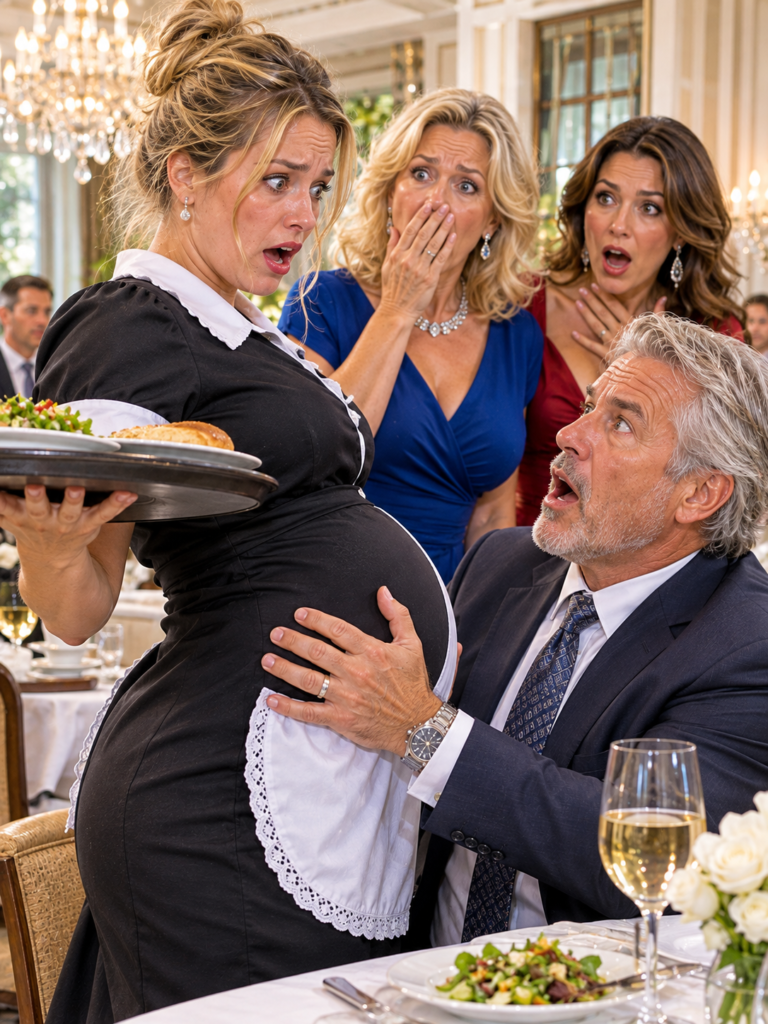
Standing in front of me was Rebecca Sullivan, my twenty-seven-year-old daughter-in-law.
Her hair was tied back, her shoes were worn, and her face looked exhausted. Beneath her black uniform, her pregnant belly was unmistakable.
Eight months earlier, Garrett had told me she’d disappeared with another man.
He’d also claimed she’d stolen money from our company.
“Rebecca?” I whispered.
Her serving tray trembled.
“I’m sorry, sir. You must have mistaken me for someone else.”
“Rebecca, it’s Ray.”
She glanced nervously toward the entrance before disappearing through the kitchen doors.
I immediately stood up.
“Ray, what about the contract?” Frank called.
“Something more important has come up.”
I followed her through the kitchen and found her leaning against a wall in the service alley, one hand resting protectively on her stomach.
“Rebecca, please. Tell me what’s happening.”
She began crying.
“You shouldn’t have followed me.”
“Garrett said you left him. He told me you ran away with another man and stole from the company.”
She stared at me.
“That’s what he told you?”
I nodded.
Rebecca wiped her cheeks.
“I never stole anything. Garrett threw me out. He canceled my cards, changed the locks, and threatened to ruin my life if I told anyone what happened.”
I struggled to understand what I was hearing.
“And the baby?”
She lowered her eyes.
“He’s Garrett’s son.”
I took an involuntary step forward, but she backed away.
“He doesn’t know I’m pregnant,” she explained. “If he finds out, he’ll try to take my baby. He already threatened to make everyone believe I’m mentally unstable.”
“Rebecca, Garrett would never do something like that.”
Her expression changed.
“You don’t know the man your son has become.”
I wanted to argue.
Instead, I remembered how quickly Garrett had convinced me that Rebecca was dishonest. I’d accepted his explanation without ever hearing her side.
“Why didn’t you contact me?” I asked.
“I tried.”
She looked toward the restaurant door again.
“Your son made sure I couldn’t reach you. And there’s something else you need to know.”
I waited.
Rebecca gripped my arm.
“Mr. Callahan, Garrett has been waiting for you to die.”
My stomach tightened.
“What are you talking about?”
She hesitated, then glanced at the trembling hand I’d been trying to hide all evening.
“I know you’ve been sick. I know about the dizziness and the weakness.”
“How?”
Her voice dropped almost to a whisper.
“Because I saw Garrett and another woman preparing something they were putting in your morning coffee.”
For a moment, I couldn’t speak.
Every morning for months, my son had brought me coffee at the office, insisting that I was working too hard and needed someone to look after me.
I’d always thought it was a small act of love.
Standing in that alley, looking at my frightened, pregnant daughter-in-law, I began to wonder whether I’d misunderstood everything…
PART 3: THE LAST CUP
I didn’t confront my son that night.
Every instinct I had as a father told me to drive to Garrett’s penthouse and demand the truth. But Rebecca was gripping my sleeve, shaking so hard I could feel it through the fabric.
“If you go to him now, he’ll know I talked,” she whispered. “And he’ll make sure nobody ever believes me.”
I looked at her swollen belly, her cracked hands, her worn-out shoes. Then I made the most important decision of my life.
“Pack your things,” I said. “You’re not staying another night in this place.”
She lived in a rented room above a laundromat in East Dallas. It had a mattress on the floor, a hot plate, and a folder hidden inside a torn pillowcase. She handed it to me with trembling fingers.
“I should have gone to the police,” she said. “But Garrett told me they’d never believe a woman he’d already painted as a thief.”
Inside the folder were photographs taken from a hallway, slightly blurred. In them, my son stood in the kitchen of his penthouse beside a slim blonde woman in a gray blazer. She was holding a small brown bottle. Garrett was stirring a coffee cup.
There was also a phone with a cracked screen, holding a forty-second video.
I watched it twice.
On the screen, Garrett’s voice was calm and almost cheerful. “Half a dose in the morning. The doctors will keep calling it burnout. Another few months and the board will vote me in as acting president.”
The woman laughed. “And the old man never suspects?”
“My father trusts anything I put in his hand.”
I set the phone down very carefully, because I didn’t trust myself not to throw it across the room.
Thirty-one years of building a company. Thirty-one years of believing I was building it for him.
“Who is she?” I asked, my voice barely working.
“Tessa Marlowe,” Rebecca said. “She was Garrett’s financial consultant. After I noticed money missing from the company accounts, I asked questions. Two days later, I was out of the house, and the missing money had become my crime.”
I closed my eyes.
“I’m so sorry, Rebecca.”
“You didn’t know.”
“I should have.”
She didn’t argue. She just placed her hand over mine, and we sat there in that cramped little room, two people who had both been lied to by the same man.
By midnight, Rebecca was asleep in the guest room of my house in Preston Hollow, with a security guard parked outside. By 1:00 a.m., I was sitting in Frank Doyle’s kitchen.
Frank had been my partner for twenty-six years. He listened to the entire story without interrupting. When I finished, his face had gone gray.
“Ray, I’ve been noticing things in the books for almost a year,” he said quietly. “Payments to vendors I’d never heard of. I brought it up with Garrett twice. He said it was a bookkeeping transition.”
“Why didn’t you tell me?”
“Because he’s your son.” Frank rubbed his eyes. “And because I didn’t want to be the man who accused him without proof.”
“Now we have proof.”
“Then we do this right,” Frank said. “Lawyers. Doctors. The police. No heroics.”
That was how I met Detective Angela Ruiz.
She was in her forties, sharp-eyed, with a voice that never rose and never needed to. She watched the video, reviewed the photographs, and asked Rebecca questions for nearly two hours. Then she turned to me.
“Mr. Callahan, have you had any medical testing for toxic exposure?”
“No. My doctors thought it was stress.”
“We’ll fix that today.”
By afternoon, I was at a hospital across town, far from my usual physicians, sitting across from a toxicologist named Dr. Patricia Wynn. She took blood, urine, and a hair sample, and asked me to describe every symptom in detail.
Three days later, she called me back to her office.
She didn’t waste any time.
“Mr. Callahan, your results show a significant level of a toxic heavy metal in your system. It’s consistent with repeated low-dose exposure over many months.”
I had known. Somewhere inside, I had known since the courtyard. Still, hearing it said aloud by a stranger in a white coat made the room tilt.
“Will I recover?” I asked.
“If the exposure stops now, most of the damage should be treatable. You may have lost more than a few months if this had continued.”
I thought of Rebecca, working a double shift while heavily pregnant, carrying a secret that could have cost her everything.
She hadn’t just saved my life.
She’d done it while terrified for her own.
Detective Ruiz laid out the plan in a quiet conference room the next morning.
“We have a video, but we need a confession or physical evidence tied directly to Garrett. If we move too early, his attorneys will argue the video is out of context.”
“What do you need from me?” I asked.
“Business as usual,” she said. “Tomorrow morning, Garrett will bring you coffee like he always does. You’ll take it, thank him, and set it aside. We’ll have officers and recording equipment in place. The cup will be collected.”
“And if he suspects?”
“He won’t. He believes you’re a tired old man who trusts his son.”
It was the most painful sentence anyone had ever said to me, because it was true.
That night, I didn’t sleep. I walked the halls of my own house like a stranger. In the guest room, Rebecca sat on the edge of the bed, one hand on her stomach.
“He kicked tonight,” she said, almost shyly. “For the first time in days.”
“Strong like his mother,” I said.
She smiled, then her eyes filled.
“Mr. Callahan, whatever happens tomorrow, he’s still your son.”
“I know.”
“It’s going to hurt.”
“I know that too.”
She was quiet for a moment. “I used to love him. I really did. I keep trying to find the exact moment he turned into someone else.”
“Maybe he didn’t turn into anyone,” I said. “Maybe I just never looked closely enough at who he was.”
She reached for my hand.
“Then look closely now.”
At 8:15 the next morning, I sat behind my desk on the twelfth floor of Callahan Construction.
Two plainclothes officers sat in an empty office down the hall. A small microphone was clipped inside my jacket. Detective Ruiz waited in a van in the parking garage, watching every second.
At 8:20, Garrett walked in.
He wore a navy suit, the same confident smile, and a paper cup from my favorite café in each hand.
“Morning, Dad.”
My heart pounded so hard I thought he’d hear it.
“Good morning, son.”
He set one cup in front of me, as he had done on hundreds of mornings, and sat down across from me. His eyes moved over my face the way a doctor’s might, studying, measuring.
“You look tired,” he said gently. “You’re pushing yourself too hard. Drink your coffee.”
For one long second, I looked at the cup.
Then I looked at my son.
“Garrett,” I said, “why did Rebecca leave?”
His smile didn’t flicker.
“We’ve been over this, Dad. She stole from us and ran off. I don’t like talking about it.”
“I saw her last week.”
The air in the office changed.
Garrett’s fingers tightened around his own cup.
“Saw her where?”
“Working in a restaurant. Pregnant.”
For the first time in my life, I watched my son’s face go completely empty. No shock, no concern, no joy at the news of a child. Only calculation, quick and cold.
“She’s lying to you,” he said softly. “She’s unstable, Dad. I didn’t want to tell you everything because I was protecting you.”
“Protecting me?”
“From the truth about her.”
“Then protect me from this one.”
I pushed the cup an inch toward him.
“Drink my coffee.”
Silence.
Garrett stared at the cup. A muscle in his jaw moved.
“Dad, that’s ridiculous.”
“Is it?”
“I made sure it was just how you like it.”
“Then you won’t mind having some.”
He stood up slowly. “I think you’re confused. The medication the doctors have you on—”
“I’m not on any medication, Garrett.”
That was when he made his mistake.
He glanced at the door.
It was a tiny movement, no more than a half-second. But it told me everything. He was measuring the distance to the exit.
“What did you put in it?” I asked.
“Nothing.”
“What did you and Tessa put in it?”
His face hardened. The mask finally slipped away, and the man underneath looked nothing like the boy I had taught to ride a bike in the cul-de-sac behind our first house.
“You were never going to retire,” he said.
“There it is.”
“You’re sixty years old and still sitting in that chair like you’ll live forever. Do you know how many years I’ve waited? How many times I’ve had to listen to you tell the board that I’m ‘not ready’?”
“So you decided to speed things up.”
“I decided to take what I earned!” His voice cracked through the room. “I worked for you my whole life, and you never once looked at me like I was enough.”
I stared at him.
“You were my son,” I said. “That was always enough.”
“Don’t.”
“I would have given you everything.”
“You gave me a title and a leash.”
Behind him, the office door opened.
Detective Ruiz stepped in with two uniformed officers.
“Garrett Callahan,” she said evenly, “you’re under arrest for attempted murder, fraud, and conspiracy.”
He spun toward her, then back toward me, and for a moment he looked like a frightened child.
“Dad. Dad, tell them this is a mistake.”
I couldn’t speak.
When the handcuffs closed around his wrists, I finally understood that some things cannot be undone, only survived.
Tessa Marlowe was arrested at the airport that same afternoon, a one-way ticket to Miami in her purse and a duffel bag containing nearly four hundred thousand dollars in cash.
Garrett’s attorneys fought for months. They argued the video was edited, the coffee had been tampered with by someone else, and the missing funds were poor accounting. But the prosecution had the recording from my office, the lab results from Dr. Wynn, the bank records Frank had quietly pulled together, and Tessa’s cooperation once she realized Garrett would let her take the fall.
In the end, Garrett accepted a plea deal.
Twenty-two years.
I sat in the second row of the courtroom as the judge read the sentence. Garrett never looked at me.
Rebecca sat beside me, holding my hand.
I didn’t cry until I got to my car.
Then I cried for a long time.
Our grandson was born on a snowy morning in February.
I was in the hospital waiting room when the nurse came out smiling. “Mr. Callahan? Your daughter-in-law is asking for you.”
Rebecca lay propped against pillows, exhausted and radiant, a tiny bundle wrapped in a blue blanket against her chest.
“Meet Henry,” she whispered.
I stepped closer.
He had dark, wrinkled little fists and a face scrunched in protest at the whole world. When I touched his hand, his fingers curled around my thumb with astonishing strength.
“Henry Raymond Sullivan-Callahan,” Rebecca said. “If that’s all right with you.”
I couldn’t answer. My throat had closed completely.
“Ray?”
“It’s more than all right.”
She smiled. “He’s going to know the truth someday. Not all at once. But I won’t build his life on a lie.”
“No,” I said softly. “Neither will I.”
She looked at me, her eyes steady.
“I’m not going to teach him to hate his father. But I’m not going to pretend, either.”
“That’s the right way.”
We sat in the quiet of that hospital room as snow drifted past the window, a broken family trying carefully to become something new.
Months passed.
I sold my controlling shares in Callahan Construction and moved the company into the hands of Frank and a new leadership team, with Rebecca as a voting board member. She had a head for numbers and a spine of steel, and she’d already caught two errors in the quarterly reports that would have taken Frank a week to find.
My health recovered slowly. The dizziness faded. The tremor in my hands eased. By summer, I could walk the length of White Rock Lake without stopping to rest.
One evening, I sat on the back porch with Henry asleep in my arms.
Rebecca came out with two mugs and handed one to me.
I looked down.
Coffee.
She saw my face and laughed softly. “Relax. I made it myself.”
I laughed too, and the sound surprised me. It was the first real laugh I’d had in over a year.
“Thank you,” I said.
“For the coffee?”
“For everything. For not walking away when you could have. For warning me when you had every reason to stay silent.”
Rebecca looked at the sleeping baby.
“You followed me into that alley,” she said. “You could have called Garrett. You could have walked away. You didn’t.”
“I almost did.”
“But you didn’t.”
I took a slow sip. It tasted like nothing but coffee, warm and bitter and honest.
“My father used to say that trust is the foundation of every structure worth building,” I said. “I spent thirty years pouring concrete and never once checked what was cracking underneath my own house.”
She leaned her head against my shoulder.
“Then we’ll rebuild it,” she said.
And as the Texas sun sank behind the trees and Henry stirred peacefully in my arms, I realized she was right.
Some foundations collapse.
But the people who survive them can build again, slower and wiser, with open eyes, and with truth poured into every corner.