Dinner Is Where the Cook Says It Is
Part One: The Steps
Every fall, the threshing dinner came off my garden and my canning.
And every fall, my mother-in-law told the crew of eighteen men it was all her own doing.
She met them on the farmhouse steps.
The same way she did every year. The second Saturday in August, at noon, when the whistle on the old steam engine blew and the men came walking up from the oat field with chaff in their hair and sweat dark on their shirts.
Faye stood at the top of the porch steps in her flowered apron. Her white hair was set in curls from the beauty shop in Eldora. She’d put on lipstick.
She raised one hand to shade her eyes from the sun.
“I have been cooking since four,” she told them.
I was right behind her with the roaster.
Forty pounds of beef. Chuck roast, braised since five that morning with onions and carrots and a pint of my own canned tomatoes. It was so heavy my arms were shaking. The handles were so hot they were burning through the dish towel I’d wrapped around my wrists.
I stood there on the porch behind her, holding it.
Not one man looked at me.
They looked at Faye. They took off their caps. They wiped their foreheads with red handkerchiefs.
“Smells wonderful, Faye,” said Dale Kruse, who’s farmed the section to the east for fifty years.
“You outdid yourself again,” said one of the Vogel boys.
“You’re a saint, Faye,” said Harold Mertz. “A living saint.”
Faye smiled and patted her curls.
“Oh, go on,” she said. “Wash up. It’s getting cold.”
The men went to the pump by the windmill to wash their hands.
I carried the roaster past Faye, through the screen door, down the hall, into her dining room. I set it on the long table. On the trivet. Next to my green beans and my sweet corn and my bread-and-butter pickles and my dinner rolls.
I said nothing.
I had been doing that for eleven years.
Part Two: The Half Acre
My name is Sheila Hemmingsen. I’m forty-three years old.
I married Roy Hemmingsen when I was thirty-two. A little late, by the standards out here. Hardin County, Iowa, where most girls marry the boy from the next farm over before they’re twenty-two.
I wasn’t from the next farm over. I was from Des Moines. I’d been a home economics teacher in Ames for nine years when I met Roy at a church supper in Iowa Falls.
He was quiet and shy, with big hands and a sunburned neck. He asked me what was in my potato salad. I told him. He asked me again the next week, at a different church supper, even though I knew he remembered.
We were married in June. I moved out to the farm in July.
Two farms, really. Roy and I live in a little white house on the east eighty. A quarter mile up the gravel lane is the home place. The big farmhouse where Roy grew up. Where his parents, Earl and Faye, still live.
Out back of our little white house, there’s a half acre.
When I moved out here, it was weeds and an old rusted hog feeder. Roy pulled the feeder out with the tractor that first fall. I tilled it the next spring.
I’ve gardened it every year since.
I grow everything.
Green beans, three kinds. Sweet corn, two plantings, three weeks apart, so it all doesn’t come ripe at once. Tomatoes, forty plants. Cucumbers for pickles. Beets. Carrots. Onions. Potatoes. Peppers. Squash. Pumpkins in the corner by the fence.
I put up two hundred quarts every summer.
I mean that number. Two hundred quarts. I count them.
Green beans, sixty quarts. Tomatoes, fifty. Pickles, thirty. Beets, twenty. Corn, cut off the cob and frozen, another forty bags. Applesauce from the old trees by the grove. Peach jam. Strawberry jam. Rhubarb sauce.
I stand at my stove in August with the windows open and the canner boiling and the sweat running down my back. I do it every day for six weeks.
My jars line the shelves in our basement. Floor to ceiling. Every one labeled with masking tape in my handwriting.
Part Three: The Threshing Bee
Every August, the Hemmingsens host the threshing bee.
They’ve done it since 1948.
Most farmers out here quit threshing oats the old way sixty years ago. Combines came in. Nobody wanted to shock bundles by hand and feed them into a separator anymore.
But Earl’s father, Arnold, kept a 1928 Case threshing machine in the big barn. And a 1916 Avery steam engine to run it. He brought them out every August for the neighbors. To thresh a few acres of oats the old way. For the memory of it.
When Arnold died, Earl kept doing it.
It’s become a big deal. People come from all over Hardin County to watch. They bring lawn chairs and sit along the fence line. The kids climb on the old tractors.
And eighteen men work the crew.
Pitchers and bundle haulers. A man to feed the separator. A man to run the engine. A man on the grain wagon. A man on the straw stack, getting chaff down his collar. Old men who’ve done it since they were boys. Young men who’ve never done it before.
They work from seven in the morning until the oats are done. Usually four or five in the afternoon.
And at noon, they stop for dinner.
The threshing dinner.
Out here, dinner is the noon meal. It’s the big one. Meat and potatoes and vegetables and bread and pie. Enough to keep eighteen men going through a hot August afternoon of pitching bundles.
For thirty years, Faye made it.
Then, eleven years ago, I married Roy.
The first August after our wedding, Faye called me on the phone.
“You’ll help with the threshing dinner,” she said. It wasn’t a question.
“Of course,” I said.
That first year, I helped.
I made the green beans. I made the rolls. I peeled potatoes in her kitchen while she made the roast and the gravy and the pies.
The second year, Faye’s arthritis was worse. I made the green beans and the rolls and the potatoes and the gravy.
By the third year, I was making all of it.
Part Four: Eleven Years
By the third year, Faye stopped cooking for the threshing dinner entirely.
She didn’t say so. She just stopped.
The week before, she’d call and say, “You’ll do the beef again, won’t you, Sheila? My hands are so bad this year.”
Then she’d call the next day. “And the beans. You know how the men love your beans.”
Then the potatoes. Then the gravy. Then the corn and the rolls and the pickles and the pies.
By the fifth year, I was making everything.
All of it. In my own kitchen. In the little white house on the east eighty.
Every bean on that table was mine.
I grew them on the half acre out back. I picked them in the morning dew. I snapped them on my back step and canned them in July.
The corn came off my second planting. I timed it every year so it’d be ripe the week of the bee.
The tomatoes in the beef came out of my jars. The pickles. The beets. The applesauce. All mine.
The beef came off our own steer.
Roy and I raise four steers a year on the pasture behind the barn. We send two to the locker plant in Iowa Falls in the spring. One for us. One for the threshing dinner.
The locker bill alone ran two hundred dollars. For the cutting and wrapping and freezing.
I paid it. Out of our grocery money.
The pies were mine. Six of them. Apple from the trees by the grove. Cherry from the jars I put up in June. Sour cream raisin, because Dale Kruse asks for it every year.
The rolls were mine. Six dozen. Up at two in the morning to get them rising.
On the morning of the threshing bee, I’d start at four.
I’d load everything into the back of Roy’s pickup. The roaster of beef. The kettles of potatoes and beans and corn. The pans of rolls under dish towels. The pies in their tins.
Then I’d drive it all a quarter mile up the gravel lane to the home place.
I’d carry it all into Faye’s kitchen.
I’d put the beef in Faye’s oven to keep warm. The potatoes on Faye’s stove. The pies on Faye’s counter.
And at noon, when the whistle blew, Faye would take the roaster out of her oven.
Part Five: Faye’s Part
Faye’s part was to carry one pan.
Forty feet. From her oven to her porch steps.
That was it. She’d wait until the whistle blew and the men started walking up from the field. Then she’d put on her oven mitts and take out the roaster.
She’d carry it through her kitchen. Down the hall. Out the front door. Onto the porch.
And she’d stand at the top of the steps holding it, while the men came up the lawn.
Then she’d hand it to me.
And she’d say, “I have been cooking since four.”
The first year she said it, I thought I’d misheard.
The second year, I thought maybe she meant it as a joke.
By the fifth year, I understood.
And to be standing there.
That was the rest of Faye’s part. To be standing on the steps when the men came up from the field. To be standing at the head of the table when they sat down. To be standing by the pie when they asked who made it.
To be standing there when they washed up and said, Thank you, Faye. You’re a saint.
Part Six: Why I Never Said a Word
You want to know why I never said a word.
I’ve asked myself that question for eleven years.
At my stove in August, with the canner boiling. In the dark at two in the morning, punching down roll dough. On the porch behind Faye, with forty pounds of beef burning my wrists.
Why don’t you just say something?
Here’s the answer.
There is no clean way to correct your mother-in-law.
Not in a place like this. Not in Hardin County, Iowa, where everybody’s known everybody for four generations. Where the Hemmingsens have hosted the threshing bee since 1948.
Not in front of eighteen hungry men.
Say one thing, and I’m the hard one.
I could see it. Clear as day.
Actually, Faye, I made that.
Eighteen men looking at me. Then looking at Faye. Then looking at their boots.
And then the story.
The one that would travel from the threshing bee to the co-op to the café in Eldora to the Lutheran church to every kitchen table in the county by Sunday.
Roy’s wife made a scene at the bee.
That’s the story that would have traveled.
Not Faye’s been taking credit for Sheila’s cooking for eleven years.
Roy’s wife made a scene.
The city girl from Des Moines. The one who married in late. The one who doesn’t know how things are done out here.
So I kept quiet.
And I kept cooking.
Part Seven: Roy
Roy knew.
He’s not stupid. He watched me get up at four every August. He carried the roaster out to the pickup. He saw the jars on the basement shelves.
But Roy is Earl’s son. And Earl is a quiet man. The quietest man I’ve ever known. In eleven years, I’ve heard him say maybe a hundred words that weren’t about the weather or the price of beans.
Roy learned quiet from his father.
“Mom’s had a hard life,” Roy said once. The fourth year. In bed, after the threshing dinner, when I was crying into my pillow so he wouldn’t hear.
He heard anyway.
“Her mother-in-law was terrible to her,” he said. “Grandma Hemmingsen. Mom doesn’t talk about it. But Dad told me once.”
“Told you what?”
Roy was quiet for a long time.
“That Grandma made Mom’s life miserable,” he said. “For twenty years. Until she died.”
“That doesn’t mean Faye gets to do it to me,” I said.
“I know,” Roy said. “I know it doesn’t.”
He put his arm around me in the dark.
“I’m sorry, Sheila,” he said. “I don’t know how to fix it.”
Part Eight: Megan
Our daughter, Megan, was born the second year we were married.
She’s nine now. She has Roy’s sunburned nose and my stubborn streak. She’s been helping me in the garden since she could walk.
She’s the one who noticed first.
She was seven. The threshing bee. She’d come with me that morning at four to help load the pickup. She’d carried the pickles. She’d carried the rolls.
At noon, she stood next to me on the porch while Faye met the crew on the steps.
“I have been cooking since four,” Faye told them.
Megan looked up at me.
She didn’t say anything. She just looked at me. With a little frown.
That night, at bedtime, she asked.
“Mom,” she said. “Why did Grandma say she cooked?”
I didn’t know what to tell her.
“Grandma’s hands hurt,” I said. “She can’t cook like she used to.”
“But she said she did,” Megan said.
“I know.”
Megan thought about it.
“That’s a lie,” she said.
“It’s complicated, honey,” I said.
“It’s not complicated,” Megan said. “You cooked. She said she cooked. That’s a lie.”
I didn’t have an answer.
I tucked her in. I turned off the light.
I stood in her doorway for a long time.
My seven-year-old daughter had seen in one afternoon what I’d been pretending not to see for nine years.
Part Nine: The Winter I Quit
Then, one winter, I quit keeping quiet.
It was January. The eleventh winter. The fields were frozen white. The wind was howling across the section. I was in the basement, counting jars.
Two hundred and four quarts. Floor to ceiling.
I stood in front of the shelves. I looked at my handwriting on the masking tape. Green beans, July 14. Tomatoes, August 3. Beets. Pickles. Applesauce.
And I thought about the threshing bee.
I thought about standing on that porch behind Faye with forty pounds of beef burning my wrists.
I thought about Harold Mertz calling her a saint.
I thought about Megan, at seven, saying that’s a lie.
I thought about Megan, at nine, watching me do it again. Learning from me.
Learning that when somebody takes credit for your work, you stand behind them and say nothing.
I didn’t want her to learn that.
I didn’t fight Faye.
I want to be clear about that. I didn’t call her. I didn’t confront her. I didn’t say a word to anyone.
I did something else instead.
Part Ten: The Machine Shed
Our machine shed sits out back.
Behind the little white house. Past the half acre. A big gray steel building, forty by eighty, with two sliding doors on the front and a concrete floor.
Roy keeps the tractor there in winter. And the planter. And the hay rake. And about thirty years of junk his father gave him.
That spring, I asked Roy to clean it out.
He looked at me like I’d lost my mind.
“Clean out the shed?” he said. “Sheila, what for?”
“I’ll tell you,” I said. “But you have to promise not to tell anyone. Not your mother. Not your dad. Not the Vogel boys. Not anybody.”
So I told him.
Sitting at our kitchen table on a cold night in March, with the wind rattling the windows.
He listened without saying anything. When I was done, he sat back in his chair and stared at me.
“You want to move the threshing dinner,” he said slowly.
“Yes.”
“Out of my mother’s house.”
“Yes.”
“To our machine shed.”
“Yes.”
Roy didn’t say anything for a long time.
“Mom’s going to have a fit,” he said.
“Probably,” I said.
He looked at the window. At the dark. At the yard light shining on the machine shed.
“The bee still runs at the home place,” he said. “The threshing. The engine’s in Dad’s barn. The oats are on Dad’s ground.”
“I know,” I said. “The bee stays where it is.”
I took his hand across the table.
“But the dinner doesn’t have to,” I said.
Roy looked at me.
“Dinner’s served where the cook says it is,” I said. “And I’m the cook. I’ve been the cook for eleven years.”
Roy thought about it for a long time.
Then he smiled. A slow smile. The one I fell in love with at the church supper in Iowa Falls.
“Okay,” he said. “Let’s clean out the shed.”
Part Eleven: On the Sly
Roy and I swept it out all summer.
On the sly. Like a couple of kids.
We did it in the evenings. After chores. After supper. After Megan was in bed. With the big shed doors closed so nobody driving by on the gravel road could see.
We hauled out thirty years of junk. An old cultivator. A broken hay rake. A pile of rusted fence posts. Seventeen coffee cans of bent nails. A 1974 Chevy pickup with no engine that Roy’s uncle left there in 1991.
Roy pulled it out with the tractor. We sold it for scrap. Two hundred and forty dollars.
That paid for the plywood.
We laid plywood down over the concrete.
Roy and I, on our knees, screwing sheets of three-quarter-inch plywood to sleepers so the floor would be smooth and warm and wouldn’t sweat.
We painted it. Gray porch paint.
We strung up lights.
Roy ran a new electric line from the house. We hung strings of white café lights across the rafters. Back and forth. Twenty strands.
The first night we turned them on, we stood in the middle of the shed and looked up at them for a long time.
“Sheila,” Roy said quietly. “It looks like a wedding.”
We borrowed tables.
Eight long folding tables from the Lutheran church in Eldora. The kind with the metal legs and the fake wood tops. We asked Pastor Lindgren in June. We told him it was for a family reunion.
He didn’t ask any questions. He just said, “Bring them back clean.”
I sewed tablecloths.
Red gingham. I bought forty yards of it at the fabric store in Iowa Falls. I told the lady it was for curtains.
I sewed them at my kitchen table, over three nights in July. After Megan was in bed. After the canning was done. Eight tablecloths. Hemmed by hand on all four sides.
Nobody knew but Roy and our Megan.
We told Megan in June.
She was nine. She was so excited she couldn’t sleep. She helped paint the floor. She helped string the lights. She sat on the kitchen floor at night while I sewed and handed me pins.
“Grandma’s going to be so surprised,” she said.
“Yes,” I said. “She is.”
“Are you going to tell her?” Megan asked.
“No,” I said.
Megan thought about that.
“Is that a lie?” she asked.
I put down my sewing.
“No, honey,” I said. “It’s a secret. A lie is when you say something that isn’t true. A secret is when you don’t say anything at all.”
Megan thought about that for a long time.
“Grandma’s been doing a lie,” she said. “And you’ve been doing a secret.”
“Yes,” I said.
“And now we’re doing a secret back.”
I laughed.
“Something like that,” I said.
Part Twelve: The Saturday
The bee still ran at the home place.
That August, the second Saturday, everything started the way it always does. The way it has since 1948.
At six in the morning, Earl fired up the old Avery steam engine in front of the big barn. Black smoke rolled out of the stack. The whistle screamed across the section.
By seven, the crew was there. Eighteen men. In their work clothes and their seed caps. Pitchforks over their shoulders.
The bundle wagons rolled out to the oat field.
The men pitched bundles onto the wagons. The wagons rolled back to the threshing machine. The men pitched bundles into the separator.
The old Case machine roared. Chaff flew. Straw came out the blower onto the stack. Oats poured out the spout into the grain wagon.
The spectators sat along the fence line in their lawn chairs. The kids climbed on the old tractors.
Faye was on her porch.
In her flowered apron. Her hair set in curls. Waving to the spectators.
Waiting for me to bring the food.
Part Thirteen: Roy Walks the Crew
At eight-thirty, Roy walked the crew.
He did it one at a time.
He walked out to the oat field where the bundle haulers were working. He walked over to the threshing machine where the feeders were working. He climbed up on the straw stack.
He talked to every man. Eighteen of them.
He said it plain to every man.
“Dinner’s at our place this year,” Roy said. “The machine shed. Down the lane. Noon.”
The man would look at him. Confused.
Then Roy would say the rest.
“Sheila’s been cooking.”
He said my name.
Once, to each of them.
Eighteen times. In the oat field. At the separator. On the straw stack. By the steam engine.
Sheila’s been cooking.
It was the first time my name was ever said out loud at the threshing bee.
In eleven years.
Some of the men didn’t say anything. They just nodded and went back to pitching bundles.
Some of them looked up the lane toward Faye on her porch. Then looked at Roy. Then looked at their boots.
Dale Kruse looked at Roy for a long time.
“Your place,” Dale said slowly. “Not your mother’s.”
“Our place,” Roy said.
Dale didn’t say anything for a moment.
Then he nodded once.
“Noon,” he said.
Part Fourteen: Four in the Morning
I was up at four.
For once, that was true.
I’d been up at four every threshing bee for eleven years. But nobody ever knew it but Roy. And Faye always said it.
This year, I said it to myself. Standing at my stove in the dark, with the oven light on and the radio playing KWMT out of Fort Dodge.
I have been cooking since four.
Forty pounds of beef, braising since five. In the big blue roaster. With onions and carrots and two pints of my own tomatoes.
Twenty pounds of potatoes, peeled the night before, in cold water in the refrigerator.
Green beans from my jars. Six quarts. With bacon and onions.
Sweet corn off my second planting. Picked that morning in the dark with a flashlight. Fifty ears.
Six dozen rolls. Up at two to get them rising.
Six pies. Apple and cherry and sour cream raisin.
Bread-and-butter pickles. Pickled beets. Applesauce.
Ten gallons of iced tea.
At eight o’clock, Megan came downstairs in her pajamas.
“Mom,” she said. “Are you scared?”
I was stirring the gravy. I didn’t turn around.
“Yes,” I said.
Part Fifteen: The Open Doors
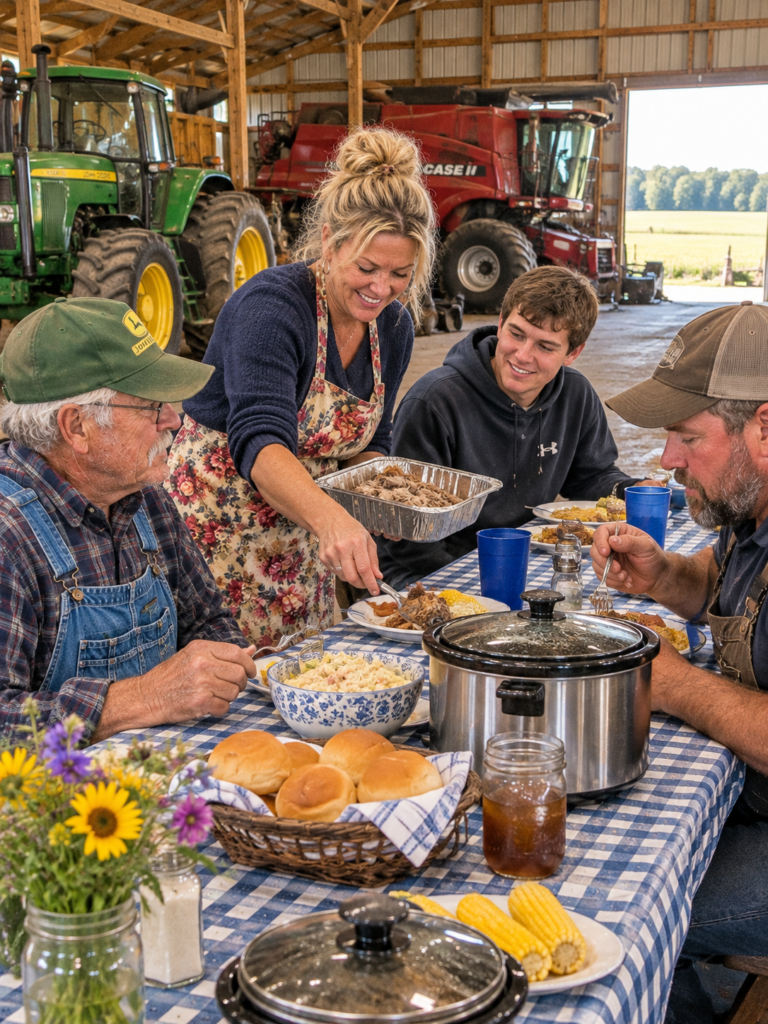
At eleven, I stood in the open doors of the machine shed.
Roy had slid them all the way open. Both sides. Forty feet of open door.
Inside, eight long tables ran in two rows down the middle of the shed. Covered in red gingham. Set with plates and silverware borrowed from the church.
The white café lights glowed in the rafters, even in the daylight.
At the far end, a long serving table. My blue roaster. My kettles. My pies in a row.
And past the doors, out the other end of the shed, the gold field.
Roy’s oats. Ripe and waving in the August sun. And beyond them, a quarter mile up the lane, the home place. The big barn. The black smoke from the steam engine.
The sound of the threshing machine, roaring.
And I was scared sick.
I stood in those open doors in my apron with my hands shaking.
I was scared they’d drive up to Faye’s out of habit.
Eighteen men. Hungry. Tired. Done at noon, walking to their trucks. Starting their engines.
Turning right. Up the lane. To the home place. Like they had for thirty-four years.
I was scared I’d stand in a full shed, empty.
Eight tables. Red cloths. White lights. Forty pounds of beef.
And no one.
Eleven years of cooking, riding on one lane.
Roy came and stood beside me.
He’d come down from the bee at eleven. He was covered in chaff. His face was sunburned.
He took my hand.
“They’ll come,” he said.
“You don’t know that.”
“No,” Roy said. “But I told every one of them. And I looked every one of them in the eye.”
Megan came out of the house in a clean dress. Blue, with little white flowers. She’d braided her own hair.
She stood on my other side. She took my other hand.
The three of us stood in the open doors of the machine shed.
And waited.
Part Sixteen: Noon
Noon came.
The whistle on the steam engine blew.
I heard it from a quarter mile away. That long, high scream. The signal that the crew was breaking for dinner.
The threshing machine went quiet.
I held my breath.
For a long time, nothing happened.
Thirty seconds. A minute. I could hear the men’s voices, far off, up at the home place. Laughing. Talking.
I could see Faye on her porch. Tiny from here. Standing at the top of her steps in her flowered apron.
Waiting.
Then I heard an engine start.
A truck turned down our lane.
Old Dale’s rusted Ford.
A 1979 F-150. Brown and tan. More rust than paint. With a cracked windshield and a Hardin County Farm Bureau sticker on the bumper.
It came down the gravel lane slowly, raising a little cloud of dust.
It turned in at our place.
Then another behind it.
The Vogel boys’ blue Chevy.
Then another.
Harold Mertz’s white Dodge.
Then another.
A whole string of them. Raising dust. Coming down the lane one after another, the way they used to come in a funeral procession.
Every one turning in at our place.
Not one went on up to Faye’s.
I stood in the open doors of the machine shed and watched them come.
Eleven trucks. Eighteen men.
Roy squeezed my hand so hard it hurt.
Megan was jumping up and down.
Dale Kruse pulled his rusted Ford up beside the shed. He shut off the engine. He climbed out.
He’s seventy-eight. He’s been on the threshing crew since 1958. He’s had both knees replaced.
He stood in front of the open doors. He took off his seed cap.
He looked at the eight tables. The red gingham. The white lights in the rafters. The blue roaster at the far end.
He looked at me.
“Well now,” Dale said.
He shook his head slowly.
“Well now, Sheila,” he said.
Part Seventeen: Whose Food
They sat.
I carried.
Megan poured the tea.
Eighteen men at eight long tables, in a machine shed with red gingham and white lights and the gold oat field through the open doors.
I carried the beef first. The blue roaster. Forty pounds. I didn’t wrap my wrists in a towel this time. I used oven mitts. Good ones.
I set it on the table in front of Dale.
He looked up at me.
Then the potatoes. The gravy. The green beans with bacon. The corn. The rolls in their baskets with dish towels over them. The pickles. The beets. The applesauce.
Megan went down the rows with a big glass pitcher of iced tea. Pouring every glass. Not spilling a drop.
Then Harold Mertz picked up an ear of corn.
He looked at it. He looked at me.
“This your corn, Sheila?” he asked.
The whole table went quiet.
“It is,” I said. “Off the half acre out back.”
Harold looked at the corn for a long time.
Then he nodded.
“It’s good corn,” he said.
Then one of the Vogel boys picked up a green bean.
“These your beans, Sheila?”
“Mine,” I said. “Put up in July.”
Then Ed Larson, holding a pickle.
“Your pickles?”
“Mine.”
Then a young man I didn’t know. A nephew of the Kruses, maybe, from Ames. Holding a roll.
“Ma’am,” he said. “Did you make these?”
“Up at two to get them rising,” I said.
He looked at the roll in his hand.
“These are the best rolls I’ve ever had in my life,” he said.
Down two long tables, one by one.
Each man asking whose food it was.
The beef. Our own steer. Off the pasture behind the barn.
The beets. Off the half acre.
The applesauce. The old trees by the grove.
The gravy. Mine.
Each one thanking me.
By name.
Thank you, Sheila.
Thank you, Sheila.
This is wonderful, Sheila.
Sheila, you outdid yourself.
Eighteen men.
Eighteen times.
I stood at the end of the serving table with my oven mitts in my hands and tears running down my face.
I didn’t wipe them away.
Megan came and stood beside me. She put her arm around my waist.
“Mom,” she whispered. “They know.”
Part Eighteen: The Doorway
Then I turned with a pan of corn.
The second batch. Fresh off the stove.
I turned around from the serving table.
And there in the doorway stood Faye.
She was standing in the open doors of the machine shed.
In her flowered apron. Her hair set in curls. Her lipstick on.
She’d walked down the lane. A quarter mile. On her bad hip. In the August heat.
She was holding nothing.
Her own stove a quarter mile off, going cold.
The shed went quiet.
Not all at once. The men at the near tables saw her first. They stopped talking. Then the men behind them. Then the whole shed.
Eighteen men. Forks halfway to their mouths. Looking at Faye in the doorway.
Then looking at me with the pan of corn.
Nobody said anything.
I didn’t know what to do.
I stood there with the corn. Faye stood there in the doorway. Thirty feet between us.
Eleven years between us.
Then Earl stepped up beside her.
Part Nineteen: Earl
My father-in-law, Earl Hemmingsen, is seventy-six years old.
He’s tall and thin and bent a little at the shoulders. He has big hands like Roy’s. A face like a dried creek bed. He’s worn the same pair of bib overalls to the threshing bee since 1971.
He’s run the steam engine every year since his father died.
He was still covered in coal soot. Black on his hands. Black on his face. Black in the creases around his eyes.
In thirty years, I never heard that man make a speech.
Not at Roy’s wedding. Not at Megan’s baptism. Not at his own fiftieth anniversary party in the church basement, when the whole congregation chanted speech, speech, speech and he just shook his head and sat back down.
Earl doesn’t make speeches.
Earl talks about the weather. And the price of beans. And sometimes, if you’re lucky, the engine.
He walked into the shed.
Past Faye. Past the first row of tables.
He walked down the aisle between the tables. In his sooty overalls. With eighteen men watching him.
He stopped at the head of the second table. Right in the middle of the shed. Under the white lights.
He picked up a spoon.
A plain steel spoon from the church silverware.
He tapped it twice on a coffee cup.
Clink. Clink.
The whole shed went still.
The men set down their forks.
Megan set down her pitcher.
Faye stood frozen in the doorway.
Earl looked right at me.
Past his own wife.
Part Twenty: What Earl Said
He didn’t say anything for a long moment.
He just stood there in the middle of the machine shed with a spoon in one hand and a coffee cup in the other. Looking at me. With his coal-black face and his tired eyes.
Then he set down the cup.
He cleared his throat.
“I’m not much for talking,” Earl said.
His voice was low and rough. Like a gate that hasn’t been opened in years.
“Most of you know that.”
A few of the old men smiled.
“But I’ve got something to say,” Earl said. “And I’ve waited eleven years to say it.”
He looked at me.
“Thirty-four years, really,” he said.
Nobody moved.
“I’ve eaten this dinner every August since I was a boy,” Earl said. “My mother made it. Then my wife made it. Then my son’s wife made it.”
He looked around the shed.
“And not once,” Earl said, “in all those years, did anybody thank the right woman.”
The shed was dead silent.
“My mother,” Earl said, “told this crew for twenty years that she cooked the threshing dinner.”
He looked at the doorway. At Faye.
“She didn’t,” Earl said quietly. “Faye did. My wife. From the time we married in 1972 until my mother died in 1992. Faye was up at four every August. Faye canned the beans. Faye made the rolls.”
He swallowed.
“And my mother stood on those porch steps,” Earl said, “and told every man in this county it was all her own doing.”
I turned and looked at Faye.
She was standing in the doorway with her hand over her mouth.
“I never said a word,” Earl said. “Not once. Twenty years. I let my mother take that from my wife. Because I didn’t know how to correct my own mother. Not in front of eighteen hungry men.”
He looked at his boots.
“I told myself it didn’t matter,” he said. “I told myself Faye didn’t mind.”
He looked up.
“She minded,” Earl said.
“When my mother died,” Earl said, “Faye finally got her turn. Her turn on the porch. Her turn to be thanked. And she’d waited twenty years for it.”
He looked at me.
“And then her hands got bad,” he said. “And she couldn’t cook anymore. And Sheila came along and started doing it all.”
He shook his head slowly.
“And Faye couldn’t let go,” Earl said. “Couldn’t give up the only thanks she ever got.”
He looked back at his wife in the doorway.
“So she did to Sheila,” Earl said, “exactly what my mother did to her.”
Faye made a sound. A small, broken sound.
“And I let that happen too,” Earl said. “Eleven more years. I stood by that steam engine every August and watched my son’s wife carry forty pounds of beef up the porch steps behind my wife, and I never said a word.”
His voice cracked.
“That’s thirty-one years I kept quiet,” he said. “Thirty-one years of watching the wrong woman get thanked. Twice.”
He turned to face me.
He took off his seed cap. His gray hair was matted with sweat and soot.
“Sheila,” he said.
“Thank you,” Earl said.
“For eleven years of threshing dinners. For your beef and your beans and your corn and your rolls.”
He looked at the eight tables. The red gingham. The white lights.
“For this,” he said.
Then he looked at the men.
“This dinner,” Earl said, “was cooked by Sheila Hemmingsen. Every bite of it. For eleven years.”
He paused.
“Before that,” he said, “it was cooked by Faye Hemmingsen. For twenty years. While my mother took the credit.”
He looked at the doorway.
“I’m sorry, Faye,” he said quietly. “I should’ve said it in 1972.”
Then he looked back at me.
“And I’m sorry, Sheila,” Earl said. “I should’ve said it the first year.”
He put his cap back on.
He sat down.
He picked up his fork.
Part Twenty-One: Faye
Nobody moved for a long time.
Then Faye walked into the shed.
She walked slowly. On her bad hip. Between the tables. Past eighteen men who wouldn’t look at her.
She walked all the way down the aisle. To the far end of the shed. To the serving table.
To me.
She stopped in front of me.
I was still holding the pan of corn.
She looked at it.
“That’s the second planting,” she said quietly.
Her voice was shaking.
“The one you put in three weeks after the first. So it’d be ripe the week of the bee.”
I stared at her.
“You noticed that?” I said.
“I noticed everything,” Faye said. “Every year. The tomatoes in the beef. The bacon in the beans. The sour cream raisin pie for Dale.”
She looked at the jars of pickles on the serving table. My handwriting on the masking tape.
“I noticed,” she said. “I just couldn’t say it.”
Her eyes filled with tears.
“Earl’s mother stood on those steps for twenty years,” Faye said. “And every year, I stood behind her holding the roaster. And every year, the men thanked her.”
Her voice broke.
“I was twenty-two the first year,” she said. “I cried in the bathroom. Earl’s mother found me and told me to wash my face and stop making a scene.”
“And then she died,” Faye said. “And I finally got to stand on the porch. And the men finally thanked me. And it was the best day of my life.”
She looked down at her hands. Gnarled and swollen with arthritis.
“And then these started,” she said. “And I couldn’t hold a paring knife. And I couldn’t punch down bread. And you came along. Young and strong. With your garden and your jars and your home economics degree.”
She looked up at me.
“And I thought, She’s going to take it,” Faye said. “The only thing I ever got thanked for.”
“So I took it first,” Faye said.
I didn’t say anything.
I couldn’t.
“It was wrong,” Faye said. “I knew it was wrong. Every single year. I’d stand on those steps and say I have been cooking since four, and I’d hear Earl’s mother’s voice coming out of my mouth.”
She wiped her eyes.
“And I couldn’t stop,” she said.
“I’m sorry, Sheila,” she said. “I’m sorry for eleven years.”
Part Twenty-Two: What I Said
I set the pan of corn down on the serving table.
I took off my oven mitts.
I looked at my mother-in-law. Standing in my machine shed in her flowered apron. Her hair set in curls. Her lipstick smudged now from crying.
At her hands. Gnarled and swollen.
At twenty years of standing behind somebody else on the porch steps, holding a roaster that burned her wrists.
“Faye,” I said. “Who made the pie crust?”
She stared at me.
“What?”
“The pie crust,” I said. “On the sour cream raisin. The one Dale asks for every year.”
Faye didn’t answer.
“It’s yours,” I said. “Your recipe. You gave it to me the first year. On a recipe card. In your handwriting. With lard, not shortening. And a splash of vinegar.”
I looked at her.
“I’ve made it every year since,” I said. “Exactly the way you wrote it. I never changed a thing.”
Faye put her hand over her mouth.
“And the beef,” I said. “Braised with tomatoes. That’s yours too. You told me that first August. Always put a pint of tomatoes in with the chuck roast, Sheila. Earl’s mother never did. It’s what makes the gravy.”
Faye was crying now. Openly.
“I didn’t think you remembered that,” she whispered.
“I remember everything,” I said.
I turned around.
I picked up a pie. The sour cream raisin. The one with Faye’s crust.
I turned back to the room. To the eighteen men at the eight long tables.
“This pie,” I said, loud enough for the whole shed to hear, “is made with Faye Hemmingsen’s crust recipe. She’s been making it since 1972.”
I held it up.
“Nobody ever thanked her for it,” I said.
The shed was silent.
Then Dale Kruse stood up.
Seventy-eight years old. Two new knees. Chaff still in his hair.
He took off his cap.
“Faye,” he said. “I’ve eaten that pie every August for fifty years.”
He looked at her.
“Thank you,” he said.
Then Harold Mertz stood up.
“Thank you, Faye.”
Then the Vogel boys.
Then Ed Larson.
Then the young man from Ames, who’d never been to a threshing bee before and didn’t know anything about any of it.
“Thank you, ma’am,” he said.
One by one. Eighteen men.
Thank you, Faye.
Thank you, Faye.
Thank you, Faye.
Faye stood in the middle of my machine shed and cried.
Part Twenty-Three: Two Chairs
There were eighteen men at eight tables.
There were two empty chairs at the end of the second table. Right under the white lights. I’d set them out that morning without knowing why.
Megan pulled one out.
She looked at her grandmother.
“Grandma,” she said. “Sit down. You walked all the way here.”
Faye looked at the chair.
Then she looked at me.
Megan pulled out the second chair.
She looked at me.
“Mom,” she said. “You sit too. You’ve been standing since four.”
I hadn’t sat down at a threshing dinner in eleven years.
Not once.
Faye and I sat down.
Side by side. At the end of the second table. Under the white lights.
Megan put a plate in front of each of us. She piled them with beef and potatoes and beans and corn. She poured us each a glass of iced tea.
She didn’t spill a drop.
Earl was sitting across from us.
He looked at his wife. Then at me.
He didn’t say anything.
He’d said enough for one day.
He just passed the rolls.
Part Twenty-Four: The Dishes
After dinner, the men went back to the bee.
The whistle on the steam engine blew at one. They threshed until four-thirty. Every bundle. The best oat crop in ten years, Earl said.
When they came back down the lane at five, to get their trucks, Dale Kruse stopped at the shed door.
I was inside, washing dishes in a big tub of hot water on the serving table. Faye was beside me, drying.
She’d stayed. All afternoon.
“Sheila,” Dale said. “Faye.”
We both turned around.
“Same time next year?” he asked. “Here?”
Faye and I looked at each other.
“Here,” Faye said.
Dale nodded.
“I’ll bring my wife’s rhubarb dream bars,” he said. “She’s been wanting to bring something for twenty years. Nobody ever asked.”
Part Twenty-Five: Every August
That was three years ago.
The threshing bee still runs at the home place.
Earl still fires up the old Avery steam engine at six in the morning. The black smoke still rolls out of the stack. The whistle still screams across the section.
The eighteen men still pitch bundles into the 1928 Case separator.
But the dinner is in our machine shed now.
Eight long tables from the Lutheran church. Red gingham tablecloths. White lights strung across the rafters.
And a sign.
Roy made it the second year. Out of an old barn board. He burned the letters in with a wood-burning tool from the hardware store in Iowa Falls.
It hangs over the big sliding doors.
THRESHING DINNER
Cooked by Sheila & Faye
Since 1972
Faye comes down to our house at four in the morning now.
Every second Saturday in August.
She can’t cook much. Her hands are worse every year. She can’t hold a paring knife. She can’t punch down bread.
But she can sit at my kitchen table and tell me when the gravy’s right.
And she can roll a pie crust. Slowly. With her knuckles. The way she’s done since 1972.
I make the beef. The beans. The corn. The rolls. The pickles. The beets.
Faye makes the crust for the sour cream raisin.
At noon, when the whistle blows and the trucks come down the lane, we stand together in the open doors of the machine shed.
Side by side.
The men come in and sit down. Megan pours the tea. She’s twelve now. She doesn’t spill a drop.
I carry the beef. Faye carries the pie.
And every year, before the men pick up their forks, Earl stands up.
He picks up a spoon. He taps it twice on a coffee cup.
Clink. Clink.
The shed goes still.
He doesn’t make a speech.
He just says two sentences.
“This dinner was cooked by Sheila,” he says. “The pie crust is Faye’s.”
Then he sits down. And the men say thank you.
To both of us.
By name.
Last August, after the dinner, after the dishes, after the trucks went home, I found Faye standing in the open doors of the machine shed.
Alone. Looking out at the gold oat field. And past it, up the lane, at the home place. Her own porch steps.
The sun was going down. The white lights were glowing in the rafters behind her.
“Faye?” I said. “You okay?”
She didn’t turn around.
“I was thinking about Earl’s mother,” she said quietly. “Standing on those steps.”
She was quiet for a long time.
“I wish somebody had built me a shed,” she said. “In 1972.”
I stood beside her.
I didn’t say anything for a while.
Then I took her hand. Her gnarled, swollen hand. The hand that rolled out pie crust with its knuckles because it couldn’t hold a rolling pin anymore.
“Somebody did,” I said. “It just took fifty years.”
Faye laughed. Then she cried. Then she did both.
Standing in the open doors of my machine shed, in her flowered apron, with the gold field going dark in front of us.
Megan came out of the house a few minutes later.
She was carrying a recipe card. An old one. Stained with lard and splashed with vinegar. In Faye’s handwriting, from 1972.
Pie Crust. For Sour Cream Raisin. Lard, not shortening. A splash of vinegar. Don’t overwork it.
“Grandma,” Megan said. “Will you teach me this? Next year?”
Faye looked at the card for a long time.
Then she looked at me.
Then she looked at her granddaughter.
“Only if you put your name on it,” she said. “When you make it. Every time.”
Megan thought about that.
“Grandma’s crust,” she said slowly. “Mom’s filling. My pie.”
She looked up.
“Is that a lie?” she asked.
Faye smiled.
“No, honey,” she said. “That’s a family.”