I was thirty-six when I became a mother. The boy who made that possible was already twelve.
On the morning he turned eighteen, that same boy came down our stairs carrying an old suitcase. He set his house key next to my plate of birthday pancakes and thanked me for everything.
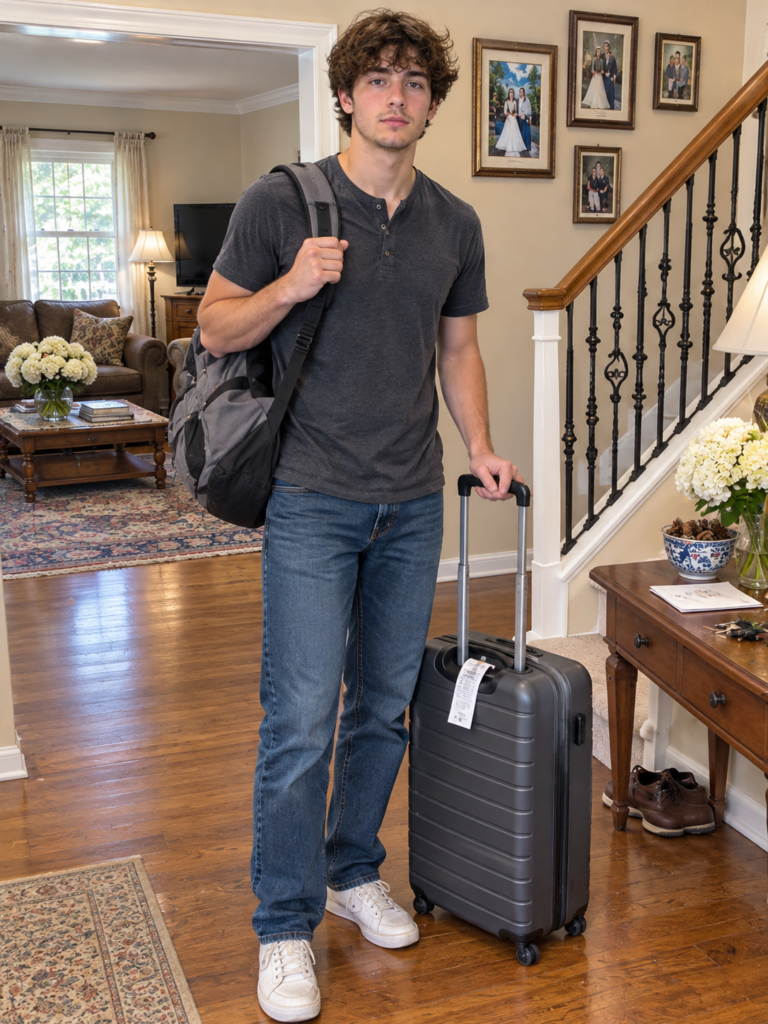
He thought he was saying goodbye.
He’d been planning that goodbye for six years, and I hadn’t known a thing about it.
For most of my adult life, I dreamed about having a baby.
I don’t mean a vague someday kind of dream. I mean the kind where you walk past the baby aisle at Target and your chest hurts. I had names picked out in a notebook. I had a box in the back of my closet with a tiny knitted hat my grandmother made before she died, for your first one, Emmy. I used to take it out and hold it.
But I had severe endometriosis. By thirty-two, I’d had three surgeries. By thirty-four, I’d been through two rounds of IVF. Both failed.
On a gray Tuesday in March, a doctor with kind eyes sat across a desk from my husband and me and said the word impossible. She said it gently, but she said it.
Richard held my hand while she said it.
In the parking lot afterward, he held me while I cried against the side of our car.
“We can still have a wonderful life, Emma,” he said into my hair. “Just the two of us. We’ll travel. We’ll go to Italy. We’ll sleep in on Sundays. We’ll be fine.”
I nodded into his coat.
I believed him. I believed he meant it kindly.
I still think he did, back then.
But I still wanted to be a mother.
That didn’t go away just because a doctor said my body couldn’t do it. If anything, it got louder. It sat in my chest like a stone.
For a year, I didn’t say anything. I went to work. I taught my fourth graders about fractions and the water cycle. I came home and made dinner and watched TV with Richard on the couch.
Then one evening in the spring, while we were doing dishes, I finally said it.
“What if we became foster parents?”
Richard stopped drying the plate in his hands. He stared at me.
“You’re serious?”
“Completely.”
He put the plate down on the counter very carefully.
“Emma,” he said, “raising somebody else’s child isn’t something you try because you’re disappointed.”
“I know that,” I said. “I’m not asking because I’m disappointed. I’m asking because I want to be a mother. And there are kids out there who need one.”
Richard was quiet for a long time. He looked out the kitchen window at the backyard.
“You’re sure you’re ready for this?” he said finally.
“More than anything.”
He sighed. Then he nodded.
“All right,” he said. “Let’s talk to the agency.”
I threw my arms around his neck. I got dish soap all over his shirt. He laughed.
I didn’t notice then that he never actually said he wanted it too.
I noticed a lot of things later.
The training took four months.
Every Tuesday night, we drove forty minutes to a community center and sat in folding chairs with eight other couples. We learned about trauma and attachment and what to do when a child hoards food or wakes up screaming. We did CPR on plastic dummies. We filled out forms about our finances, our marriage, and our childhoods. A fire inspector came to check our smoke detectors. A woman from the agency walked through every room of our house with a clipboard.
Richard did all of it. He went to every class. He signed every form. He never once complained.
I took that as a yes.
In June, we sat down with our social worker, a tired, warm woman named Mrs. Alvarez, at a little round table in her office.
“Would you consider an older child?” she asked.
Most families want babies. I knew that from the training. Babies and toddlers get placed fast. Older kids wait. Sometimes for years.
“Absolutely,” I said.
Richard didn’t say anything.
Mrs. Alvarez opened a folder.
“There’s a twelve-year-old boy named Nolan,” she said.
“What’s his story?”
“His mother died when he was six. Overdose.” She said it plainly, the way people who’ve said it too many times do. “His grandmother raised him after that, until she got sick. Kidney failure. She went into a care facility two years ago. She passed this winter.” She looked up at us. “He’s been moved several times since. Four placements in two years.”
“Four?” I said.
“None of them were bad, exactly,” she said. “They just didn’t stick. He’s quiet. Polite. Very polite. He’s not a behavior problem.” She closed the folder. “He’s just a kid nobody’s kept.”
“Poor boy,” I whispered.
Richard reached over and squeezed my hand under the table.
I thought it meant yes, let’s do this.
I think now it meant I know this is what you want.
Those aren’t the same thing.
That July afternoon, Mrs. Alvarez brought Nolan to our house.
It was ninety degrees out. The cicadas were screaming in the trees. I’d been cleaning since six in the morning. I’d baked chocolate chip cookies. I’d vacuumed his room three times.
When I opened the front door, a skinny boy was standing on our porch holding a black plastic trash bag full of clothes.
That was all he had. One trash bag.
He was small for twelve. He had dark hair that needed cutting, sharp elbows, and a T-shirt with a cartoon dinosaur on it that was too short in the arms. He had big brown eyes that looked past me into the house, checking.
I learned later that’s what kids who’ve been moved a lot do. They check the exits.
“Hi, Nolan,” I said. “I’m Emma.”
“Hello, ma’am.”
“You can call me Emma.”
He nodded. He didn’t say it.
He looked past me at Richard, who had come up behind me in the hallway.
“Where should I put my stuff?” he asked.
“Upstairs,” my husband answered. “I’ll show you.”
Nolan followed Richard up the stairs, holding that trash bag tight against his chest with both arms.
Mrs. Alvarez watched him go. Then she put her hand on my arm.
“Give him time,” she said quietly. “A lot of time.”
That evening, I was washing the dinner dishes when Nolan came into the kitchen.
He stood in the doorway for a long moment without saying anything. I pretended not to notice. We’d learned that in training. Don’t crowd them. Let them come to you.
Finally, he cleared his throat.
“Can I have an apple?”
“Of course, sweetheart.”
“From the refrigerator?”
“Yes,” I said. “You don’t have to ask permission to eat here. Anything in the fridge or the pantry, it’s yours. Okay?”
He nodded.
But he didn’t move. He just stood there, waiting.
So I dried my hands on a dish towel, walked over, and opened the refrigerator for him.
He took one apple from the drawer. He looked at me. Then he took a second one, quickly, and stuffed it into the pocket of his shorts.
“Thank you,” he said.
He went back upstairs.
That night, after he was asleep, I went to check on him. The second apple was under his pillow.
I sat down on the hallway floor outside his door and cried as quietly as I could.
For months, Nolan kept all his clothes in that trash bag.
I’d bought him a dresser before he came, a nice one, white wood with six drawers. I’d put new socks and underwear in the top drawer as a welcome. They stayed there untouched. Every morning, he reached into the trash bag in the corner and pulled out what he needed. Every night, he put his dirty clothes in a pile next to it, folded.
In October, I finally asked.
“Nolan, why haven’t you unpacked?”
He looked at the trash bag.
“Didn’t know if I could,” he said.
“Well,” I said, “you have a dresser.”
“Is that really mine?”
“Unless you think I need more storage for towels.”
He laughed. It was a short, surprised laugh, like he hadn’t expected it to come out.
That weekend, he unpacked. It took him about ten minutes. He didn’t have much.
I folded up the trash bag and put it in the recycling. He watched me do it.
Gradually, the apologies stopped. He’d been saying sorry for everything. Sorry for using the bathroom, sorry for taking the last cookie, sorry for laughing too loud at the TV. Little by little, the sorrys got fewer.
By Christmas, he’d stopped hiding food under his pillow.
Richard was good with him in those early years. I want to be fair about that.
Richard taught Nolan to ride a bike. Nolan had never had one. He was twelve years old and had never ridden a bike. Richard spent every evening for two weeks in our cul-de-sac, jogging along behind him holding the back of the seat. When Nolan finally rode all the way around by himself, Richard whooped so loud the neighbors came out on their porches.
Richard helped him with algebra at the kitchen table. Patient. Better than me. I teach fourth grade. I’m hopeless at anything past long division.
On Saturdays, Richard took him to Michael’s auto repair shop across town. Michael is Richard’s younger brother. He owns a garage called Bishop Brothers Auto, even though Richard never worked there a day in his life. Nolan loved it. He came home with grease under his fingernails, talking about carburetors and spark plugs and a 1972 Mustang somebody was restoring.
One evening that first winter, I smiled at Richard across the dinner table after Nolan went upstairs.
“We’re becoming a real family,” I said. “Aren’t we?”
“Nolan’s doing well,” Richard said.
“That’s not what I meant.”
“I know,” he said. He picked up his phone. “Anyway, Michael says he’s good with engines. Natural feel for it.”
I assumed Richard just struggled to say his feelings out loud. A lot of men do. His father was the same way. Cold. Never said I love you once in his whole life, Richard told me.
I told myself the bike and the algebra were his way of saying it.
Meanwhile, Nolan and I grew closer.
It happened slowly, in small things. He started hanging around the kitchen while I cooked. He started telling me about his day at school without being asked. He’d sit on the counter, swinging his legs, and tell me about the kid who threw up in gym or the substitute who couldn’t pronounce anybody’s name.
When he had nightmares, which he did a lot that first year, he’d come stand in our bedroom doorway in the dark. He never came in. He just stood there. I’d get up and walk him back to his room and sit on the edge of his bed until he fell asleep.
Richard never woke up for those. Or he pretended not to.
The first time Nolan called me Mom was in April, almost a year after he came.
It was an accident. He was looking for his soccer cleats, yelling from the top of the stairs.
“Mom! Have you seen my… “
Then he stopped.
I was standing at the bottom of the stairs with a laundry basket. I looked up at him. He looked down at me. His face went bright red.
“Sorry,” he said. “Emma. I meant Emma.”
“It’s okay,” I said. My voice came out funny.
“I didn’t mean…”
“Nolan,” I said. “It’s okay. You can call me whatever you want.”
He stood there for a long moment.
“Your cleats are in the garage,” I said. “By the bikes.”
“Okay,” he said. “Thanks.”
He went down to the garage.
I went into the laundry room, closed the door, sat down on top of the dryer, and cried into a pile of clean towels.
He kept calling me Mom after that. He never called me Emma again.
He called Richard Dad about six months later. Richard said, “Okay, bud,” and went back to reading the paper.
Three years later, when Nolan was fifteen, I brought up adoption.
We were in bed. Richard was reading something on his tablet.
“What if we made it official?” I said.
He didn’t look up. “Made what official?”
“Nolan. Adopting him.”
Now he looked up.
“You mean actually adopting him?”
“Yes. He’s already our son. In every way that counts. I just want it to be real on paper too.”
Richard put the tablet down on his chest.
“Why rush?” he said. “He’s happy here.”
“It’s not rushing. It’s been three years.”
“But we’re already a family, Emma.”
“Fostering ends at eighteen,” I said. “Legally, after that, we’re nothing to him. If we adopt him, we’d be his legal parents. Forever. Not just his foster parents.”
Richard was quiet for a moment.
“Let’s think about it,” he said. “It’s a big step. There’s a lot of paperwork. Lawyers. Court.”
“I’ve already looked into it. It’s not that complicated.”
“Let’s just think about it,” he said again. He picked his tablet back up. “We’re already a family, Emma. A piece of paper doesn’t change that.”
I wanted to believe him.
So I stopped asking.
That’s the part I’m most ashamed of now. I stopped asking. I let it go because I didn’t want to fight. Because I’d fought so hard to have a family, and I was terrified of breaking it.
But as Nolan got older, Richard and I disagreed about his future more and more.
It started small.
“He’s interested in engineering,” I said one night at dinner, after Nolan had gone upstairs. “His physics teacher says he’s one of the best students she’s had in years. She thinks he should look at Purdue. Or Georgia Tech.”
“Then he should learn something practical,” Richard said.
“College is practical.”
“Not everybody needs college, Emma.” Richard cut his steak. “Michael never went. He’s done fine. Nolan’s good with his hands. He’ll have to support himself someday.”
“Of course he will. But he doesn’t have to do everything alone.”
Richard chewed for a while.
“Life isn’t fair,” he said. “The sooner he learns that, the better.”
“He’s learned that already,” I said. “Probably better than anyone at this table.”
Richard didn’t answer.
Later that year, Richard noticed my notebook.
It was a thick spiral notebook with a green cover. I’d been filling it for over a year. College programs. Engineering schools. Admission requirements. Scholarship deadlines. Financial aid forms. Programs specifically for former foster kids. There are more than you’d think. There’s money out there if you know where to look.
Richard picked it up off the kitchen counter and flipped through it.
“What’s all this?”
“College programs. Scholarships.”
He turned a few more pages. Then he stopped at the back, where I’d been keeping track of something else.
“And this? What’s this money?”
“I’ve been putting part of my paycheck into a savings account,” I said. “Every month. For Nolan’s education.”
He stared at me.
“How long?”
“Since he was thirteen.”
“How much?”
I told him.
Richard closed the notebook and set it down very carefully on the counter.
“You’re spoiling him,” he said.
“I’m preparing him.”
He shook his head and walked out of the kitchen.
I told myself we just had different parenting styles. Lots of couples do. I told myself he’d come around when he saw how hard Nolan worked. When he saw the acceptance letters.
After fighting so hard to have a family, I was terrified of losing it.
Three years later, I found out how wrong I’d been.
On the morning of Nolan’s eighteenth birthday, I woke up at six o’clock to make his favorite chocolate chip pancakes.
It was a Saturday in October. Cold and bright. The maple tree in our front yard had turned completely red.
I’d been planning the day for weeks. Pancakes in the morning. Then a family dinner that evening, with Richard’s mother and Michael and my sister Vivian and a few of Nolan’s friends from school. I’d ordered a cake shaped like a car engine from the bakery downtown. It cost more than I want to admit.
I stacked the pancakes on a plate. I put two number candles on top, a one and an eight. Then I took them off again before the wax could melt into the chocolate chips. Then I put them back on. Then I took them off again.
Richard came into the kitchen in his robe and poured himself a cup of coffee. He watched me fuss with the candles and chuckled.
“You’re more nervous than he is.”
“Our boy’s eighteen,” I said.
“Exactly,” Richard said. “He’s an adult now.”
He took his coffee and walked out the back door onto the patio.
I didn’t think anything of how he said it.
I think about it all the time now.
I was reaching up into the cabinet for the good maple syrup when I heard something bump against the staircase.
Thump. Thump. Thump.
Something heavy, coming down one step at a time.
Nolan appeared in the kitchen doorway.
He was wearing his jacket, the brown canvas one Michael gave him from the shop, with BISHOP BROTHERS AUTO stitched over the pocket. He was carrying an old suitcase. The gray one with the broken wheel that we kept in the basement for donations.
“Happy birthday!” I said. I smiled. “Going somewhere?”
He looked at the plate of pancakes on the counter. At the number candles.
His face crumpled a little.
“I thought I’d be ready,” he said quietly.
“Ready for what?”
He didn’t answer. He walked over to the kitchen table and set his house key down next to my plate. Very carefully. Lined up straight with the edge of the placemat.
“I washed my sheets,” he said. “I wasn’t sure which cycle to use for them. I did the warm one. I hope that’s okay.”
“Nolan?”
“Thank you, Mom,” he said. “For everything.”
Then he put his arms around me and hugged me tight. Tighter than he’d hugged me since he was thirteen. His jacket smelled like motor oil and laundry soap.
My stomach dropped through the floor.
“Where are you going?” I said into his shoulder.
“The bus station,” he said. “There’s a nine-fifteen to Columbus. Jake’s cousin said I could crash on his couch for a while. Till I find something.”
“Why?”
He pulled back. He didn’t answer.
Instead, he said, “Could I take an old towel? I left mine upstairs. Because you bought it.”
I stared at him.
“Sweetheart,” I said, “your towel belongs to you. Everything in your room belongs to you.”
He glanced past me, through the kitchen window, at Richard. Richard was standing on the patio in his robe, drinking coffee, looking at his phone.
“I thought Dad told you,” Nolan said. “About his condition.”
“What condition?”
Nolan gripped the handle of his suitcase so tight his knuckles went white.
“He whispered it to me,” he said. “The first day. The day I moved in. When he showed me my room. I remembered every word.”
I pulled out a kitchen chair.
“Sit down, honey.”
“Mom, I’ll miss my bus.”
“Forget the bus,” I said. “Sit down and tell me what happened.”
He sat down slowly, still holding the suitcase handle.
He looked frightened. Not like an eighteen-year-old. Like a twelve-year-old standing on a porch with a trash bag.
“Dad said I could stay until I turned eighteen,” he said. “Then I’d have to leave.”
“What?”
I must have said it loud. Richard must have heard me from outside. A second later, the back door opened, and he came into the kitchen, still holding his coffee mug.
“What’s going on?” he said.
Nolan didn’t look at him. He kept talking to me, very quietly, staring at the table.
“He said, ‘You can stay here until you’re eighteen. Then you’re on your own. That’s the deal.’” Nolan swallowed. “And then he said, ‘Don’t make her choose between us.’”
I turned around slowly and looked at my husband.
“Tell me he’s mistaken,” I said.
Richard set his coffee mug down on the counter.
“He misunderstood,” he said. “He was twelve. Kids remember things wrong.”
Nolan shook his head.
“You reminded me when I turned sixteen,” he said quietly. “In the garage. You said, ‘Two years, kid. Start planning.’ And again last Christmas. When Mom was in the kitchen. You said, ‘Ten more months.’”
Richard’s face hardened.
“I was teaching you independence,” he said.
“You told a twelve-year-old,” I said, “who had already been moved four times in two years, that he had an expiration date?”
“Emma, don’t exaggerate.”
“I’m not exaggerating! I’m repeating what you said!”
If I’d known then what else Richard had planned, I’d have thrown him out of the house right there and then, in his bathrobe.
Nolan spoke up, quietly.
“It’s okay, Mom. I saved money from my job at Michael’s. Almost two thousand dollars. I can manage for a little while.”
I turned back to him.
“Why didn’t you ever tell me?” I said. “Why, Nolan? All these years?”
His eyes filled up with tears.
“Because you wanted a son so badly,” he said. “I could tell. The first day. You made cookies. You vacuumed my room so many times I could see the lines in the carpet.” He wiped his eyes with the sleeve of his jacket. “I didn’t want you to regret choosing me. I didn’t want to be the reason you and Dad fought. Dad said if I told you, you’d have to pick. And he said…” He stopped.
“Said what?”
“He said you’d pick him,” Nolan whispered. “Because you were married. And I was just the foster kid.”
For six years, my son had been counting down to the day he thought I’d stop loving him.
Every birthday. Every Christmas. Every report card on the refrigerator. Every pancake breakfast. He’d been counting.
I thought about the second apple under his pillow that first night.
He’d never stopped hiding food. Not really. He’d just found a different thing to hide.
“Richard,” I said. My voice was shaking. “Explain yourself.”
He crossed his arms.
“I agreed to become foster parents,” he said, “because you needed something after the treatments. You were falling apart, Emma. You couldn’t get out of bed some days. So I said yes.”
“Something?” I said. “Nolan is our son!”
“I supported you through everything,” Richard said. His voice was rising. “Every surgery. Every needle. Every failed IVF. Then you wanted a child, so I agreed. I gave you six years. Six years is enough. We deserve our old life back. The one we were supposed to have.”
I stared at him.
“Did you ever,” I said slowly, “see him as our son? Even once?”
Richard sighed. Like I was being tiresome.
“You could show some gratitude, Emma,” he said. “I sacrificed six years.”
Then he picked up his coffee mug, turned around, and walked into his study. He shut the door behind him.
Nolan stood up from the table.
“I’m sorry,” he said. “I’ll go. I didn’t mean to start this. I’ll just go.”
“No,” I said firmly. “You’re staying.”
“Mom, please don’t fight with him. Not because of me.”
“You’re not causing this fight,” I said. “He is.”
I picked up his suitcase. It was heavier than I expected. I carried it upstairs myself, one step at a time, and set it down next to his bed.
His room was perfectly neat. The bed was stripped. The clean sheets were folded in a stack on the bare mattress. His closet was empty except for a few hangers. The posters on his walls were gone. His old engine models were gone from his shelf.
He’d erased himself from this room.
Nolan stood in the doorway behind me.
“You belong here,” I said. “This is your room. This is your house.”
“But Dad…”
“Richard doesn’t get to decide whether you’re loved,” I said.
Nolan stood in the doorway for a long time.
“Can I at least leave after dinner?” he said finally. “So I don’t ruin your party?”
“Your party,” I said. “It’s your birthday. Please. Stay for your birthday. We’ll figure everything else out afterward. Together.”
He nodded slowly.
I started to walk past him back into the hallway. He caught my hand.
“Mom,” he said. “There’s something else.”
I stopped.
“I thought you knew about it too,” he said.
“What do you mean?”
He hesitated for a long time. He looked at the floor.
Then he told me.
Richard had already arranged Nolan’s future.
A full-time job at Michael’s shop, starting the Monday after his birthday. A little room above the garage where he could live. Nolan had known about it since August.
But there was more.
“Dad said most of my paycheck would go back to him,” Nolan said quietly. “For rent on the room. And food. And for…” He swallowed. “For what I cost. Growing up. He said I owed it. He said he had a number written down. He said I’d be paying it back for about four years.”
I couldn’t breathe.
“He said you knew,” Nolan said. “He said you agreed. That’s why I didn’t say anything. I thought you both…” His voice cracked. “I thought you both wanted me to pay you back.”
I put my arms around him. All six feet of him. He had to bend down.
“You don’t have to worry about any of that,” I said into his jacket. “I swear to you, I didn’t know. I would never, ever have agreed to that. Never.”
“Really?”
“Really. I’ll handle it.”
I went downstairs and out the front door and stood on the porch in my slippers. I called Michael.
He picked up on the third ring. I could hear an air wrench in the background.
“Emma! Hey! Happy birthday to the kid. Everything okay?”
“I need to ask you something about Richard.”
“Sure. What is it?”
I told him what Nolan had just told me. The job. The room. The paychecks. The upbringing expenses.
The air wrench in the background stopped.
Michael was quiet for a long time.
“He told you I agreed?” I asked. “Didn’t he? He told you this was something we both wanted?”
“Of course he did,” Michael said slowly. “He said you two talked it over. That you both thought Nolan needed to learn to stand on his own. He said…” Michael’s voice changed. “Emma, I had no idea. I swear to God. I thought it was strange. I thought it was harsh. But I thought you’d signed off on it.”
“I know,” I said. “I know you didn’t know. That’s why I need your help.”
“Anything.”
“Do you have it in writing? What he asked you?”
“Text messages,” Michael said. “Last couple months. He sent me a whole breakdown. With numbers.”
“Can you come tonight? To the party? And bring them?”
“I’ll be there,” Michael said. “Emma, the kid. Is he okay?”
I looked up at Nolan’s bedroom window.
“No,” I said. “But he will be.”
I hung up and stood on the porch for a long time.
I’d overlooked so much. I’d overlooked it because I wanted a family so badly that I couldn’t stand to look at the cracks in it. I’d told myself Richard was just bad at feelings. I’d told myself we had different styles. I’d stopped asking about adoption because I didn’t want to fight.
Being a mother meant more than having a child.
It meant protecting him. Even from the people I loved.
Especially from them.
By noon, I’d gathered everything I needed.
I got my green notebook out of my desk drawer. I printed out the last three years of statements from Nolan’s college savings account. I called my sister.
Vivian is three years older than me. She’s a nurse, divorced, blunt, and terrifying. She’s never liked Richard. She’s never said so to my face, but I always knew.
“I need you at dinner tonight,” I said.
“I’m already coming to dinner tonight.”
“I mean I need you. For real. Something’s going to happen.”
She was quiet for a second.
“Is it Richard?” she said.
“Yes.”
“Finally,” Vivian said. “I’ll bring the good wine.”
Then I called a lawyer. A woman named Diane Foster, a family lawyer my friend from school had used for her divorce. It was a Saturday. I left a message on her emergency line. She called me back in twenty minutes.
Michael texted me a little after noon.
Michael: Are you sure about tonight?
Me: Yes!
Michael: It’s Nolan’s birthday
Me: I know. That’s why Richard won’t get another chance to ruin one.
That afternoon, Richard came out of his study.
He found me in the kitchen, making the lasagna for dinner. Nolan was upstairs.
He leaned against the doorframe and watched me layer noodles for a while.
“You’re awfully calm,” he said.
“Shouldn’t I be?”
He smiled. He actually smiled. He thought he’d won.
“I knew you’d understand eventually,” he said. “Nolan needs to grow up, Emma. And we deserve some freedom. You’ll see. It’ll be good for both of you.”
I spread a layer of ricotta.
“Then why not tell everyone during your birthday toast?” I said. “Tonight. Make it official.”
Richard thought about it.
“Good idea,” he said.
He went back into his study, whistling.
Nolan came downstairs carrying the stack of dinner plates I’d asked him to bring from the dining room.
“Mom,” he said quietly. “Are you sure everything’s okay?”
I took the plates from him. I set them on the counter. I put my hands on both of his shoulders.
“Just enjoy your birthday, sweetheart,” I said. “Let me handle the rest.”
He looked at me for a long time. Then he nodded.
At 5:42, Michael texted.
Michael: Everything’s ready. On my way.
The guests arrived at six with gifts and balloons.
Richard’s mother, Margaret, came first. She’s seventy-four, small and sharp, a retired schoolteacher with white hair in a perfect bob. She hugged Nolan for a long time on the front porch and slipped him an envelope.
“Don’t spend it all on car parts,” she said.
“I’m definitely going to spend it all on car parts,” Nolan said.
She laughed and patted his cheek.
My sister Vivian came next, carrying two bottles of wine and a cone-shaped paper birthday hat. She made Nolan wear it. He protested. She ignored him. He wore it.
Michael came last. He hugged Nolan and handed him a box wrapped in newspaper. Inside was a brand-new socket wrench set, the expensive kind. Nolan stared at it like it was made of gold.
Michael caught my eye across the room. He nodded once.
Three of Nolan’s friends from school came too. Jake and Marcus and a quiet girl named Priya from his physics class. Nolan turned red every time Priya talked to him. Vivian noticed. She winked at me.
For a while, he seemed happy. Really happy. Laughing at the table in his stupid paper hat, talking about the Mustang at Michael’s shop, showing Priya the socket set.
I watched him and thought, This. This is what he should have had every day for six years. Without a countdown.
We ate the lasagna. We ate the salad. Vivian opened the second bottle of wine.
Then Richard stood up and tapped his glass with his fork.
“I’d like to say something about Nolan,” he said.
Everyone went quiet.
Nolan’s smile faded a little. He looked down at his plate.
“Six years ago,” Richard said, “we welcomed a young boy into our home. A scared little kid with a trash bag full of clothes.” He smiled around the table. “And today, he’s a man.”
Nolan smiled nervously.
“We’ve fulfilled our responsibility as parents,” Richard went on. “We gave him a roof, food, clothes, an education. Everything he needed. And now he’s ready to start an independent life. On his own two feet.” He raised his glass toward me. “And Emma and I can finally enjoy some freedom.”
His mother frowned.
“Freedom?” Margaret said.
I put down my fork.
“Richard,” I said, “why don’t you tell everyone about the condition you gave Nolan when he was twelve?”
His smile vanished.
“Emma,” he said quietly. “This isn’t necessary.”
“Then it shouldn’t be difficult to explain.”
“What condition?” Vivian asked. She was looking right at Richard.
I looked around the table. At Margaret, at Michael, at Vivian, and at Nolan’s three friends, who had gone completely still.
“On the day Nolan moved into this house,” I said, “when he was twelve years old, Richard took him upstairs and told him he could stay until he turned eighteen. And then he’d have to leave.”
Margaret gasped.
“Richard.”
“He told him not to tell me,” I said. “He told him not to make me choose. And he reminded him. At sixteen. At Christmas. Every year.” I looked at Richard. “Nolan came downstairs this morning with a packed suitcase. On his birthday. He’d stripped his bed and washed his sheets. He was going to take the nine-fifteen bus to Columbus.”
Jake whispered, “Dude,” and looked at Nolan.
Nolan stared at his plate.
“It was about responsibility!” Richard said.
“He was twelve,” I said.
Richard’s voice got louder.
“It’s not like I’m throwing him out onto the street! I’ve already arranged his future! A job, a place to live, everything!”
“Without asking me?”
“Ask Michael,” Richard said. “He agreed to everything.”
Everyone turned to look at his brother.
Michael put down his napkin and slowly stood up.
“Richard did offer Nolan a full-time job at my shop,” he said. “With a room upstairs.”
“See?” Richard said. He spread his hands, triumphant. “At least somebody here understands responsibility.”
“That’s what I thought I was helping with,” Michael said. “Until Emma called me this morning.”
Richard’s smile faltered.
“What does that mean?”
Michael looked him straight in the eye.
“I agreed to give Nolan a job,” he said. “I never agreed to help you collect a debt from him.”
“What debt?” Margaret whispered.
I picked up my phone. Michael had forwarded me the text messages that afternoon. I read them out loud.
“Richard suggested deducting most of Nolan’s wages,” I said. “Seventy percent of every paycheck. For rent on the room, for food, and for what he called his ‘upbringing expenses.’” I scrolled. “He made a spreadsheet. He sent it to Michael. Six years of groceries. Clothes. School supplies. Braces. His half of the car insurance. It comes to sixty-one thousand, four hundred dollars.”
The table was completely silent.
“Repayment,” Vivian whispered. “He wanted the kid to repay him?”
I read the last message.
“‘He knows he owes us,’” I read. “‘He won’t argue. He’s not the arguing type.’”
Margaret turned in her chair and stared at her son.
“You expected that child,” she said slowly, “to repay you? For raising him?”
Tears were running down Nolan’s cheeks now. He didn’t wipe them. He just sat there in his paper birthday hat.
“It’s true,” he whispered. “Dad said I owed him. He showed me the number. In August.”
Priya reached over under the table and took his hand. He let her.
Richard’s face went red.
“I was teaching him responsibility!” he said. “That’s how the real world works! Nobody gets anything for free! My father charged me rent when I was sixteen, and I turned out fine!”
“By making him pay for being our son?” I snapped. “That’s not parenting, Richard. That’s a bill.”
Michael turned to Nolan.
“Kid,” he said, “listen to me. Emma’s right. If you want a job at my shop, it’s yours. Any time. Full wages. Fair wages. Same as anybody. Nobody’s taking a dime of it.” He looked at Richard. “No debts.”
“Thank you,” Nolan whispered.
Richard turned and looked at me.
“Happy now?” he said.
“Not quite,” I said.
I reached under my chair and pulled out the green spiral notebook. I placed it on the table, right in the middle, next to the lasagna dish.
“There’s one more thing I want everyone to see,” I said.
“What’s that?” Nolan asked.
“Six years of college research,” I said. “For you.”
He stared at it.
“For me?”
“Scholarships,” I said. “Engineering programs. Purdue. Georgia Tech. Ohio State. Michigan. Programs specifically for kids who’ve been in foster care. Application deadlines. Financial aid forms. Everything.”
I opened the notebook and turned it toward him. Page after page of my handwriting. Notes. Phone numbers. Little stars next to the good ones.
Then I put the savings account statements next to it.
Richard frowned. He leaned over and looked at the numbers.
“What’s all that money for?”
“Nolan’s education,” I said.
Nolan stared at the statements. Then at me.
“Mom,” he said. “You did all this?”
“Of course I did.”
Richard snatched one of the statements off the table. He looked at the balance at the bottom.
“You’re spending this much on somebody who’s already eighteen?” he said. “Who’s legally not even ours anymore?”
I took the paper out of his hand.
“I was saving for our son’s future,” I said. “You were calculating how much his childhood cost you.”
“You don’t understand what I’ve sacrificed!”
“I understand perfectly.”
“No, you don’t!” Richard shouted. He slammed his hand on the table so hard the wine glasses jumped. “I agreed to take him because you couldn’t have a baby!”
The silence was immediate. Total.
Nolan’s friends stared at their plates. Vivian’s mouth fell open. Michael closed his eyes.
My mother-in-law put down her napkin and closed her eyes too.
“Richard,” Margaret said quietly. “I’m ashamed of you.”
He pointed across the table at Nolan.
“I did everything you asked of me, Emma!” he said. “Everything!”
“No, Richard,” I said. My voice was very calm now. I don’t know where the calm came from. “You did what you thought would make me happy. You never once thought about what Nolan needed.”
Nolan was still staring at the savings statements.
“You really think I could become an engineer?” he said quietly. To me. Like nobody else was in the room.
“I think you deserve the chance to find out,” I said.
For the first time that evening, he smiled.
It was a real smile. Watery and shaky. But real.
Richard pushed his chair back. It scraped across the floor.
“You’ve deliberately humiliated me,” he said. “In front of my own mother.”
“No,” I said. “You explained your own decisions. I just asked the question.”
“Then maybe,” Richard said, “I shouldn’t live in a house where my wife chooses a foster kid over her husband.”
For a moment, I remembered the man who’d held my hand through every failed treatment. Who’d held me in the parking lot while I cried against the car. Who’d jogged behind a twelve-year-old’s bicycle every night for two weeks.
I’d spent eighteen years building a life with him.
But I couldn’t protect that marriage at Nolan’s expense.
Not for one more day.
I stood up.
“That’s something we finally agree on,” I said.
Richard stared at me.
“What?”
“This house belonged to my parents before we were married,” I said. “It’s in my name. It always has been. And I want a divorce.”
He laughed nervously and looked around the table, like he was waiting for someone to tell him I was joking.
Nobody did.
“You’re being ridiculous,” he said.
“I’ve already set up a consultation with a lawyer,” I said. “For Monday. We’ll handle the legal details properly.”
“You can’t just throw me out of my own house!”
“I’m asking you to stay at a hotel tonight,” I said. “We’ll sort out the property and the living arrangements through the proper process. With lawyers. Fairly.”
I walked out into the hallway. When I came back, I was carrying a small suitcase. His black carry-on.
Richard blinked.
“What’s that?”
“Your essentials,” I said. “Toothbrush. Razor. Your blood pressure medication. Three days of clothes. Your phone charger. I packed them this afternoon.”
Vivian covered her mouth with her hand. Margaret didn’t move.
“You planned this?” Richard said.
“After what I learned this morning?” I said. “Yes. I planned it.”
He looked around the table.
“Mom? Michael?” he said. “You’re seriously letting her do this?”
His mother turned her face away. She looked out the window.
Michael shook his head slowly.
“Don’t look at me, Rich,” he said. “You sent me a spreadsheet.”
I walked over and placed the suitcase on the floor beside his chair.
“You told Nolan he’d have to leave this house when he turned eighteen,” I said. “Funny.” I looked at Richard. “You’re the only one leaving this house today.”
Richard stared at the suitcase. Then at Nolan.
For once in his life, he didn’t have anything to say.
He picked up the suitcase.
He walked out the front door without his coat.
A minute later, I heard his car start in the driveway and pull away.
Nobody said anything for a long moment.
Then Vivian picked up the wine bottle and filled every single glass at the table, including mine. All the way to the top.
“Well,” she said. “Who wants cake?”
Jake laughed. Then Marcus. Then Michael. Then, somehow, all of us, even Margaret, wiping her eyes with her napkin.
I brought out the cake shaped like a car engine. It was even more ridiculous than I’d expected. The baker had made little pistons out of fondant. Nolan laughed so hard when he saw it that his paper hat fell off.
We sang. He blew out the candles. All eighteen of them, plus one for good luck.
I don’t know what he wished for.
I hope it was something better than what he’d been counting down to.
Before she left, Margaret pulled me aside in the front hallway.
“I raised him,” she said quietly. “Richard. I raised him wrong, I think. His father was hard. Charged him rent at sixteen, just like he said. Never hugged him. Not once. I thought…” She shook her head. “I thought he’d grow up and be different. I thought he’d remember how it felt.”
“I’m sorry, Margaret.”
“Don’t be sorry for me.” She took my hand. “That boy in there,” she said, nodding toward the kitchen, “is my grandson. I don’t care what the papers say. I don’t care what my son says. You hear me? You call me. For anything. Graduation. Birthdays. Christmas. I want to be there.”
“I’ll call you,” I said.
She squeezed my hand. Then she left.
After everyone was gone, Nolan helped me clear the table.
He scraped plates. I loaded the dishwasher. Neither of us said anything for a while. The house was very quiet.
“Mom?”
“Yes?”
“Are you really divorcing Dad?” he said. “Because of me?”
I set down the plate I was holding.
“No, sweetheart,” I said. “I’m divorcing him because of what he chose to do. Not because of anything you did. Not because of you.”
Nolan looked at me uncertainly. He was holding a dirty fork in his hand like he’d forgotten it was there.
“If I had to choose whether to bring you into my life again,” I said, “knowing everything I know now, knowing all of it, I’d make the same choice. Every single time. A hundred times out of a hundred.”
He swallowed hard.
“I’ve been scared of turning eighteen for six years,” he said. “Every birthday. Like a clock. I used to lie in bed and count.”
“I wish I’d known, sweetheart,” I said. “I’ll never stop wishing I’d known. From now on, we talk about everything. Every single thing. Even the scary stuff.”
“Even college?”
“Especially college,” I said. “You get to choose.”
“And I can stay?”
“As long as you need,” I said. “As long as you want. Forever, if you want.”
Later that night, I was lying in bed alone when I heard a sound from his room down the hall.
The sound of a suitcase zipper opening.
I got up and stood in the hallway in the dark. Through the crack in his door, I watched him unpack. He put his shirts back in the dresser. He hung his jacket in the closet. He put his engine models back on the shelf, one by one, in the same order they’d been in before. He put his posters back up with the same old tape.
He made his bed with the clean sheets he’d washed that morning. On the warm cycle.
I went back to bed. I didn’t sleep for a long time.
The next few months weren’t easy.
Richard moved into an apartment across town. He called me every day for the first two weeks. Sometimes angry. Sometimes crying. Sometimes both. He said I’d been brainwashed. He said I’d thrown away eighteen years over a misunderstanding. He said he’d only been trying to protect our marriage.
Once, very late at night, he called and said, “I didn’t know how to love him, Emma. I didn’t know how. Nobody ever showed me.”
I sat on the edge of the bed holding the phone for a long time.
“I know,” I said finally. “But you knew how to make a spreadsheet.”
He hung up.
The divorce was final in April. Diane Foster was very, very good at her job. I kept the house. It had always been mine. We split the rest.
Richard never asked to see Nolan. Not once.
Nolan never asked to see him either.
In November, a month after his birthday, Nolan came into the kitchen one evening while I was grading spelling tests.
He sat down across from me at the table. He put a piece of paper in front of me.
It was a printout from the state court website. Petition for Adoption of an Adult.
I looked at it. Then at him.
“I looked it up,” he said. “In this state, you can adopt somebody even after they’re eighteen. If they want it. If they agree.” He was turning red. “I didn’t know if you… I mean, you don’t have to. I just thought… you said a piece of paper didn’t matter, and I know it doesn’t, but…”
“Nolan,” I said.
He stopped.
“It matters,” I said. “It mattered the whole time. I let somebody convince me it didn’t. I’m sorry I did.”
I picked up a pen.
“Show me where to sign,” I said.
We filed the petition in December.
The hearing was in February, in a small courtroom downtown with wood paneling and a flag in the corner. The judge was an older woman named Judge Okafor with reading glasses on a chain. She read through the paperwork carefully. Then she took off her glasses and looked at Nolan over the bench.
“Mr. Bishop,” she said. “Most adoptions I do, the child is too young to have an opinion. You’re eighteen. You’re an adult. So I’m going to ask you directly.” She folded her hands. “Why do you want this?”
Nolan stood up. He was wearing the suit we’d bought for the hearing, his first suit. The sleeves were a little long. He looked at me sitting next to him. Then back at the judge.
“Because for six years,” he said, “I thought I had an expiration date.” His voice shook a little. “I want to know I don’t. I want it in writing. So I never have to count again.”
Judge Okafor looked at him for a long time.
Then she put her glasses back on and signed the order.
“Granted,” she said. “Congratulations, Mr. Bishop.”
Then she looked at me and smiled.
“Congratulations, Mom.”
Vivian, in the second row, burst into tears. So did Margaret, sitting next to her. Michael, who’d taken the morning off from the shop, blew his nose so loudly the bailiff jumped.
In March, the acceptance letters started coming.
Ohio State. Michigan. Purdue.
Purdue came last, on a Thursday afternoon. Mechanical engineering, with a scholarship for students who’d been in foster care. It covered almost everything. My savings would cover the rest.
Nolan opened it at the kitchen table. He read it twice. Then he put it down very carefully, lined up straight with the edge of the placemat.
“Mom,” he said. “I got in.”
I’d known he would. I’d known for six years.
I cried anyway.
He’s at Purdue now, in his second semester. He calls me every Sunday night.
He works at Michael’s shop in the summers and over Christmas break. Full wages. Michael pays him more than the other part-timers and swears he doesn’t. Nolan rebuilt the engine on that 1972 Mustang with his own two hands. Michael says he’s the best natural mechanic he’s ever seen.
Margaret sends him a care package every month. Cookies and socks and twenty-dollar bills tucked inside greeting cards. Don’t spend it all on car parts. He spends it all on car parts.
He’s still seeing Priya. She’s at Purdue too. Vivian takes full credit.
Last December, Nolan came home for Christmas break.
On his first morning home, I made chocolate chip pancakes. I didn’t put any candles on them.
He came down the stairs in his pajamas, rubbing his eyes. No jacket. No suitcase.
He sat down at the kitchen table. Next to his plate, I’d put a small box wrapped in red paper.
“What’s this?” he said. “It’s not Christmas yet.”
“Open it.”
He opened it.
Inside was a house key. A new one. On a keychain shaped like a little silver wrench.
He picked it up and looked at it.
“I still have my old key,” he said. “You gave it back to me. Remember? On my birthday.”
“I know,” I said. “This one’s different.”
He turned it over in his fingers.
“Different how?”
I sat down across from him.
“That other key was for a foster kid,” I said. “Somebody told you it had an expiration date. This one’s for my son.” I reached over and closed his fingers around it. “This one doesn’t expire. Ever. Not at eighteen. Not at thirty. Not at fifty. You come home whenever you want. For as long as you want. No conditions.”
Nolan looked down at the key in his hand for a long time.
Then he got up and came around the table and hugged me. He was still taller than me. He still had to bend down.
“Thanks, Mom,” he said into my hair.
“Eat your pancakes,” I said. “They’re getting cold.”
He sat back down and put the key in the pocket of his pajama pants.
That night, after he went to bed, I went upstairs to turn off the hallway light. His door was half open.
The new key was on his nightstand, right next to his phone. Where he’d see it first thing in the morning.
His suitcase was in the closet, empty.