11:17
At exactly 11:17 on a Friday morning, my phone rang.
I was standing in the checkout line at the H-E-B on Louis Henna Boulevard with a cart full of groceries. Chicken thighs, frozen waffles, a big box of the strawberry yogurt tubes Ethan liked. I’d been in a good mood. The best mood I’d been in for months.
I almost didn’t answer. Then I saw the name on the screen.
Deer Creek Elementary.
“Mrs. Parker? This is Principal Harris. I need you and your husband to come to the school immediately.”
My hand went cold on the phone.
“What’s happened? Is Ethan all right?”
“He’s sitting here in my office.”
There was a brief silence on the line. I could hear voices behind him. Men’s voices. Low and serious.
“Mrs. Parker,” Principal Harris said, “there are two police officers here.”
The cashier was scanning my yogurt. Beep. Beep. I couldn’t hear anything else.
“Police?” I said. “What? What did Ethan do?”
“I’ve worked in education for twenty-three years,” Principal Harris said slowly, “and I’ve never encountered anything like this.”
“Mr. Harris, please. Is he hurt? Is he in trouble?”
“When you arrive, please come straight to my office,” he said. “And Mrs. Parker. Please don’t speak to any of the other parents until we’ve talked.”
“Why? What’s going on?”
He hung up.
I left the whole cart sitting there. The cashier called after me. I didn’t turn around.
I called Steven from the parking lot. My hands were shaking so badly I dialed the wrong number twice. He answered on the first ring. He works as an HVAC estimator and was in his truck between jobs in Georgetown.
“Julia? What’s wrong?”
“The school called. There are police there. With Ethan.”
“Police?”
“In the principal’s office. He wouldn’t tell me anything. He said don’t talk to the other parents.”
There was a long silence. Then I heard his truck engine rev.
“I’m twenty minutes out,” he said. “Go. I’ll meet you there.”
I drove to Deer Creek Elementary with my heart pounding so hard I could feel it in my teeth.
All I could think, the whole way, was that it was finally happening. The thing I’d been afraid of since the day Ethan was born. The thing every doctor and therapist and well-meaning relative had warned me about without ever quite saying it out loud.
The world was going to misunderstand my son.
Somebody was going to see a big, sweet ten-year-old boy who didn’t always know his own strength, who hugged too hard and talked too loud and didn’t understand some of the rules, and they were going to decide he was dangerous.
And they’d called the police.
Steven pulled into the parking lot ten seconds after I did. We’d both driven too fast. We ran through the front doors together.
The secretary, a gray-haired woman named Mrs. Fenwick, barely looked up from her desk. She just pointed down the hall toward the principal’s office.
“He’s expecting you,” she said.
She had tissues in her hand. Her eyes were red.
That scared me more than anything.
The door to Principal Harris’s office was closed. I could hear voices on the other side. A man talking. And then, clear as a bell, a voice I would know anywhere in the world.
Ethan. Laughing.
Steven pushed open the door first.
But before I tell you what we saw on the other side, I need to tell you who Ethan is. And how hard we fought to get him through the front doors of that school in the first place.
Chapter Two: Ten Years
Ethan was born on a Tuesday in April, ten years ago, at St. David’s in Round Rock, Texas. Eight pounds, two ounces. A full head of dark hair. The loudest cry on the whole maternity floor, the nurses said.
The doctor told us the next morning.
I remember he stood at the foot of my bed with a clipboard and didn’t look at us. He said the words “Trisomy 21.” He said “Down syndrome.” He said “I’m sorry.”
Steven was holding Ethan. He looked down at our son. Ethan was asleep, with his tiny fist curled up under his chin.
“Why are you sorry?” Steven asked the doctor.
The doctor didn’t have an answer.
The first years were hard. I won’t pretend they weren’t.
Ethan had a hole in his heart that needed surgery when he was five months old. He had low muscle tone, so he didn’t sit up until he was a year, or walk until he was almost three. He had speech therapy twice a week, physical therapy twice a week, occupational therapy once a week. I quit my job as a dental hygienist to drive him to all of it.
Our savings went fast. The therapy copays alone were four hundred dollars a month, even with Steven’s insurance. We sold my car. We stopped going out to eat. We put off having another baby, and then we stopped talking about it altogether.
But Ethan.
Oh, Ethan.
He was the happiest person I’d ever met.
He woke up laughing. He laughed at the dog, at the ceiling fan, at the way Steven’s eyebrows moved when he talked. He hugged everyone. The mailman. The cashier at H-E-B. Strangers at the park. He’d walk right up to them and wrap his arms around their legs and say, “Hi! I’m Ethan! I like your shoes!”
Most people smiled. Some people didn’t.
Some people pulled their kids away from him at the playground. Some people stared. One woman at a Chuck E. Cheese told me, loud enough for him to hear, that “kids like that” shouldn’t be allowed in places with “normal” children.
Ethan didn’t understand what she meant. He waved goodbye to her on the way out.
I did understand. I cried in the car for twenty minutes.
When he turned five, we tried preschool. A special education pre-K class at a public school in our district.
It didn’t go well. There were twelve kids and one teacher and one aide. Most of the kids had more severe needs than Ethan. Some couldn’t talk at all. The room was loud and chaotic. Ethan came home every day exhausted and quiet.
One afternoon in October, I picked him up early and found him sitting alone in a corner with his face to the wall. The aide said he’d been “disruptive.” He’d been singing.
I took him out that day and never brought him back.
So we schooled him at home. For five years.
I became his teacher. I bought curriculum. I watched YouTube videos about teaching reading to kids with Down syndrome. I made flash cards and math games and a hundred laminated picture schedules. We did school at the kitchen table every morning from nine to noon, and in the afternoons we went to the library, the park, the zoo, the children’s museum in Austin.
He learned to read. Slowly. He learned to add and subtract. He learned every state capital, because he loved maps, and he could name every dinosaur from the Triassic period, and he knew the planets in order and could tell you why Pluto wasn’t one anymore.
He was curious about everything. He asked more questions in a day than most people ask in a month.
“Mom, why is the sky blue?”
“Mom, where do clouds go at night?”
“Mom, why do people have to die?”
But there was one question he asked more than any other. Every night, at bedtime, after prayers.
“Mom,” he’d say. “When can I have a friend?”
He had cousins. He had me and Steven and his grandparents and the kids at church. But he didn’t have a friend. Not a real one. Not somebody his own age who called him on the phone and came over on Saturdays and saved him a seat.
He watched the neighbor kids from our front window. Playing basketball in the cul-de-sac. Riding bikes. Laughing about things he couldn’t hear.
“They have friends,” he’d say. “Why don’t I?”
I never had a good answer.
Chapter Three: The Fight
It was his pediatrician who finally said it out loud.
Dr. Anita Shah had been Ethan’s doctor since he was born. She was a small, fierce woman in her fifties who had a grandson with autism and no patience for people who underestimated kids.
At Ethan’s ten-year checkup in July, after she’d listened to his heart and checked his ears, she sat down across from me and folded her hands.
“Julia,” she said. “I want to talk about school.”
“He’s doing great at home,” I said. “He’s reading at a second-grade level. His math is coming along.”
“I know. You’ve done an incredible job.” She looked at Ethan, who was sitting on the exam table explaining to her nurse why a Stegosaurus was not a Triassic dinosaur. “But he needs more than academics. He needs opportunities to socialize with children his own age. Real ones. Every day. Not just at church.”
“I tried that. Remember? Pre-K.”
“I remember. And that wasn’t the right fit.” She leaned forward. “I’m not talking about a special education classroom. I’m talking about a regular one. With support. A general education fourth-grade class, with an aide and an IEP.”
I stared at her.
“Give him a chance to make friends,” she said. “Give him a chance to be part of a classroom. He’s ready, Julia. I think he’s been ready for a while.”
My husband and I were nervous. That’s an understatement.
We talked about it every night for a week. What if they’re cruel to him? What if he gets lost? What if he gets overwhelmed? What if he hugs the wrong kid and somebody’s parent complains?
“What if he’s lonely for the rest of his life,” Steven finally said, “because we were too scared to let him try?”
That ended the conversation.
But Ethan couldn’t have been happier.
When I told him, he jumped up and down in the kitchen so hard the dishes rattled. He ran upstairs and came back down with his backpack, a blue one with a T. rex on it that he’d been carrying around the house for two years “just in case.”
“When do I go?” he asked. “Tomorrow? Can I go tomorrow?”
“Not tomorrow, buddy. We have to do some paperwork first.”
I had no idea how much paperwork.
The Round Rock Independent School District did not want Ethan in a regular fourth-grade classroom.
They didn’t say it like that. They said it in meetings. In conference rooms with fluorescent lights and a pitcher of water nobody drank. With a special education coordinator, a school psychologist, a speech therapist, an assistant principal, and a woman from the district office named Dr. Lorraine Pickett who took notes on a laptop and never smiled.
They tested him for two weeks. IQ tests, reading tests, behavior assessments. Then they sat us down at a long table and told us what they recommended.
A “life skills” classroom. At a different school, twenty minutes away. With eight other kids with significant disabilities. Mainstreaming for art, music, and PE only.
“We believe this is the most appropriate placement,” Dr. Pickett said. “Given his cognitive profile.”
I almost said yes. I want to be honest about that.
I was so tired. And they were the experts. And they had charts and graphs and numbers. And maybe they were right. Maybe a regular classroom was too much for him.
Then Steven put his hand on the table.
“Can I ask a question?” he said. “Did any of you actually talk to him?”
Dr. Pickett looked up from her laptop.
“I mean really talk to him,” Steven said. “Not test him. Talk to him. Because if you did, he’d have told you he wants a friend. That’s all. He just wants a friend. And you want to send him twenty minutes away to a room with eight kids who mostly can’t talk.”
Nobody at the table said anything.
We didn’t sign the IEP that day.
Instead, I went home and spent three nights reading about the Individuals with Disabilities Education Act. The federal law. I learned a phrase I’d never heard before. Least restrictive environment.
It meant that schools are supposed to educate kids with disabilities alongside kids without disabilities, as much as possible. It meant a child should only be removed from a regular classroom if, even with aids and supports, they can’t make progress there.
Nobody had even tried the supports. They’d just looked at his test scores and decided.
We hired a special education advocate. A woman named Rosa Ibarra, who’d fought the district for her own daughter fifteen years earlier and now did it for other families. She charged eighty-five dollars an hour. We paid it out of the money we’d been saving for a new roof.
Rosa came to the next IEP meeting with a binder three inches thick. She quoted federal law. She quoted court cases. She quoted the district’s own policy manual back to them, page by page.
Two meetings later, the district agreed.
Ethan would attend Deer Creek Elementary, our neighborhood school, five minutes from our house. A general education fourth-grade classroom. With a full-time paraprofessional aide, speech therapy twice a week, and a modified curriculum in reading and math.
Starting the second Monday in October.
Ethan laid out his clothes for the first day a week early.
A green polo shirt. Khaki shorts. His blue T. rex backpack. White sneakers that lit up when he walked.
He set them on the chair in his bedroom, folded, with his sneakers lined up underneath. Every night that week, he checked to make sure they were still there.
“Mom,” he said on Sunday night, the night before. “What if nobody likes me?”
I sat down on the edge of his bed. I brushed his hair back from his forehead.
“Then they don’t know you yet,” I said. “Give them a chance. They’ll figure it out.”
He thought about that.
“Okay,” he said. “I’ll give them five days.”
Chapter Four: Five Days
On Monday, he came home grinning.
He came off the school bus like a rocket, his light-up sneakers flashing red, his backpack bouncing. He ran up the driveway and threw himself at me so hard I almost fell over.
“How was school, sweetheart?” I asked.
“Mom! I love it!”
He told me everything. His teacher was named Ms. Rivera and she had a pet tarantula named Fernando in a glass tank. His aide was named Mr. Dale and he knew all the dinosaurs too. They did math with blocks. There was a fire drill. The fire drill was loud. He didn’t cry.
“I didn’t cry, Mom,” he said proudly. “I covered my ears like you showed me.”
On Tuesday, he told us about a boy named Oliver.
“He sat by me,” Ethan said at dinner, with a mouthful of macaroni. “In science. On purpose. He has glasses. He likes Pokémon. He said I could see his cards tomorrow.”
Steven and I looked at each other across the table.
“That’s great, buddy,” Steven said. His voice was a little thick.
“He’s my friend,” Ethan said. He said it carefully, like he was trying the word on. “I think. Is that what a friend is? When they sit by you on purpose?”
“That’s exactly what a friend is,” I said.
On Wednesday, he said some classmates had invited him to sit with them at lunch.
Oliver, and two girls named Priya and Harper, and a boy named Marcus who could burp the alphabet. They sat at the end of the long cafeteria table near the windows. They let Ethan share their chips.
“Marcus did the alphabet,” Ethan reported, delighted. “All the way to Z. Ms. Rivera said that was disgusting.”
He laughed so hard telling it he had to put his fork down.
By Thursday, he was laying out his clothes for the next morning without being asked.
We couldn’t believe how quickly he’d settled in. After five years at the kitchen table. After the pre-K disaster and the playground stares and the woman at Chuck E. Cheese. Four days, and he had a friend who sat by him on purpose.
I called my mother in Waco and cried on the phone for ten minutes.
“See?” she said. “I told you. That boy can do anything.”
But there were other things that week. Things Ethan didn’t tell me, or didn’t know how to tell me. I only found out about them later.
There was a boy in his class named Mason Corbin. Big for his age, with a buzz cut and a Dallas Cowboys jersey he wore every day. On Monday, Mason watched Ethan at the pencil sharpener and said something to the kids at his table. They laughed.
On Tuesday, Mason called Ethan a word. A cruel word. One I won’t write here. Mr. Dale heard it and sent Mason to the office.
On Wednesday, Mason knocked Ethan’s lunch tray off the table “by accident.”
Ethan picked up his food and sat back down and told Oliver it was okay.
And there was something else I didn’t know about. Something the adults were doing.
Mason Corbin’s mother, Tracy, had started a petition.
She’d gotten forty-one signatures from parents of kids in the fourth grade, asking the school board to “review the placement of a severely disabled student in a general education classroom.” She said Ethan was “disruptive.” She said he took too much of the teacher’s time. She said it wasn’t fair to the “typical” kids.
She’d gotten it put on the agenda for the next school board meeting. The following Tuesday.
Nobody told us. Not yet.
There was one more thing I should tell you before I go back to that Friday.
Back when Ethan was six, we were at a cookout at my brother’s house in Pflugerville. My brother had a pistol in a nightstand drawer. Ethan wandered into the bedroom looking for the bathroom and opened the drawer.
He didn’t touch it. He was scared of it. He came and found me and pulled on my shirt and said, “Mom, there’s a gun.”
That night, I sat down with him and taught him a rule. I made it into a song, because Ethan learns best with songs. I sang it to the tune of “Row, Row, Row Your Boat.”
Stop, don’t touch, walk away,
Tell a grown-up fast.
Stop, don’t touch, walk away,
Safety comes first, not last.
We practiced it for months. With toy guns, with pictures, with role-play. Ethan sang it in the bathtub. He sang it in the car. My brother bought a gun safe after that.
I hadn’t thought about that song in years.
Chapter Five: The Office
Steven pushed open the door to Principal Harris’s office.
I don’t know what I expected. Ethan in handcuffs. Ethan crying. Ethan sitting in a corner with his face to the wall, the way I’d found him in pre-K.
That’s not what we saw.
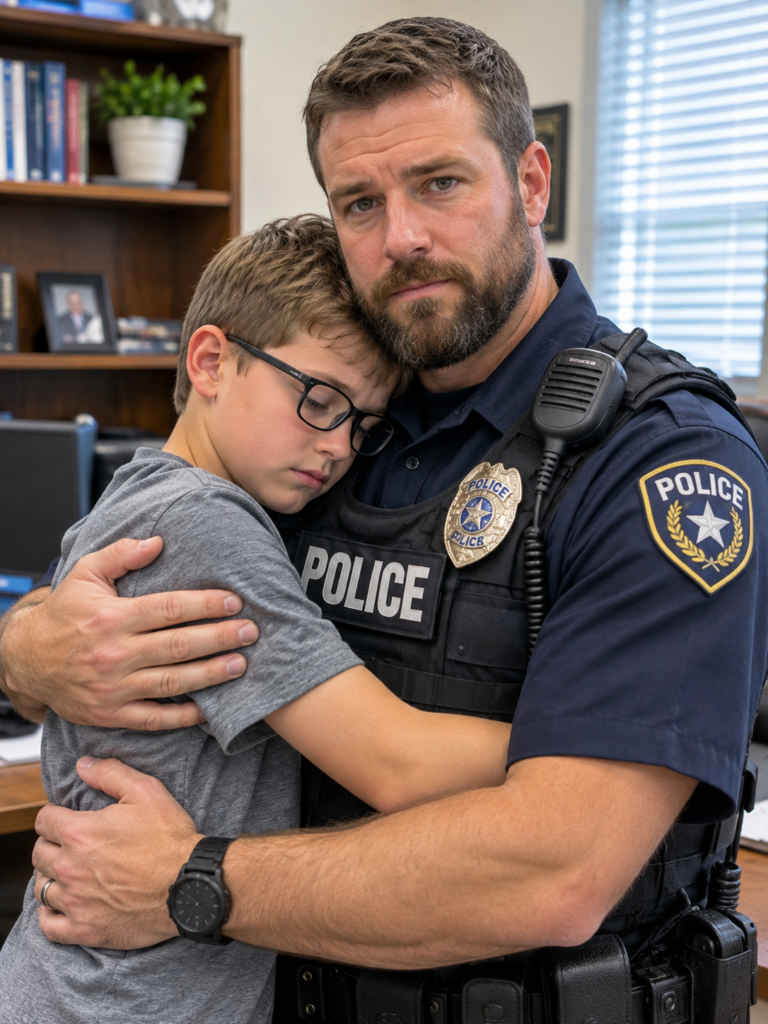
Ethan was sitting in Principal Harris’s big leather chair. The one behind the desk. His light-up sneakers didn’t reach the floor, and he was swinging his feet, so they flashed red against the carpet.
He was holding a chocolate chip cookie the size of a saucer. He had chocolate on his chin.
Across the desk from him sat two police officers in dark blue Round Rock Police uniforms. One was a tall Hispanic man in his forties with a gray mustache. The other was a younger woman with her hair in a tight bun. They were both leaning forward, elbows on their knees, listening to Ethan.
He was telling them about the Stegosaurus.
“Mom!” Ethan said when he saw us. “Dad! Look! I’m in the boss chair!”
I couldn’t speak. I just stood in the doorway.
Principal Harris was standing by the window. He was a big, soft-spoken man with gray hair and reading glasses on a cord. When he turned around, I saw that his eyes were red. Just like Mrs. Fenwick’s.
“Mr. and Mrs. Parker,” he said. “Thank you for coming so quickly. Please. Sit down.”
“Is he in trouble?” I said. My voice came out high and thin. “Please. Just tell me. Is he in trouble?”
The older officer stood up. He held out his hand to Steven, then to me.
“Mrs. Parker. Mr. Parker. I’m Officer Ray Delgado. This is Officer Hannah Kim. She’s the school resource officer for Deer Creek.”
He looked at me. He had kind, tired eyes.
“Ma’am,” he said. “Your son isn’t in trouble.”
My knees almost went out from under me. Steven caught my elbow.
“Then why are you here?” Steven asked.
Officer Delgado looked at Principal Harris. Principal Harris nodded.
“Mr. and Mrs. Parker,” Officer Delgado said, “about an hour and a half ago, your son may have saved several lives in this school.”
I don’t remember sitting down. I only remember that suddenly I was in a chair, and Steven was in the chair next to me, holding my hand so tight it hurt.
Ethan was still in the big leather chair, eating his cookie.
“Ethan,” Officer Kim said gently. “Do you want to tell your mom and dad what happened? Like you told us?”
Ethan nodded seriously. He put down his cookie. He wiped his hands on his shorts.
“I did the song,” he said.
I didn’t understand.
“What song, buddy?” Steven asked.
Ethan looked at me. He started singing. Softly. To the tune of “Row, Row, Row Your Boat.”
“Stop, don’t touch, walk away. Tell a grown-up fast.”
My hand went to my mouth.
“I did it, Mom,” Ethan said. “I did it just like we practiced. I stopped. I didn’t touch it. I walked away. And I told Mr. Dale fast.”
“Told him what, Ethan?” I whispered.
He looked at me with his big, serious eyes.
“Mason has a gun,” he said. “In his backpack.”
Chapter Six: What Ethan Saw
Officer Delgado told us the rest. With Ethan filling in the parts he thought were important.
It happened at morning recess. 9:45. The fourth graders were out on the playground behind the school. Ethan was sitting on the bench by the fence, waiting for Oliver to finish his turn on the monkey bars.
Mason Corbin came over and sat down next to him.
“He never sits by me,” Ethan said. “He said a bad word to me on Tuesday. But today he sat by me.”
Mason had his backpack with him. That was against the rules. Backpacks were supposed to stay on the hooks in the classroom. But Mason had brought it outside.
According to Ethan, Mason looked around to make sure no teachers were watching. Then he unzipped the front pocket of his backpack a little bit. Just a few inches.
“He said, ‘Look,’” Ethan told us. “He said, ‘You want to see something cool, retard?’”
He said the word flatly. Like he didn’t know what it meant. I think he didn’t, really. Not all of it. But he knew it was bad.
“And I looked,” Ethan said. “And it was a gun. A black one. Like Uncle Joe’s in the drawer.”
“Mason said, ‘Don’t tell anybody,’” Ethan went on. “He said, ‘Nobody will believe you anyway. You’re stupid.’”
He picked up his cookie again. He looked at it.
“I’m not stupid,” he said quietly.
“No, sir,” Officer Delgado said. “You are not.”
Officer Kim picked up the story.
“Ethan got up off that bench,” she said. “He didn’t run. He didn’t scream. He didn’t try to grab the backpack or argue with Mason. He walked straight across the playground to Mr. Dale, who was standing by the four-square courts.”
“I walked away,” Ethan said. “That’s the third part.”
“And he told Mr. Dale,” Officer Kim said. “Exactly what he saw. Mason has a gun in his backpack. The front pocket. It’s black.”
She paused.
“Mr. Dale told us that Ethan was shaking,” she said. “But he said it very clearly. Twice. And then he said, ‘I didn’t touch it. I did the song.’”
Mr. Dale believed him. That’s the part I’ll be grateful for until I die.
He didn’t say, are you sure? He didn’t say, maybe it was a toy. He didn’t think, this is the new kid with Down syndrome, he probably got confused. He looked at Ethan’s face and he believed him.
He walked over to Mason, very calmly, and asked him for his backpack. Mason said no. Mr. Dale got between Mason and the rest of the kids and radioed the office. Within two minutes, Officer Kim was on the playground. Within three, the school was in a lockdown.
The kids were brought inside. Mason was taken to a separate room. Officer Kim took the backpack.
“It was a loaded nine-millimeter handgun,” Officer Delgado said quietly. “Fully loaded. A round in the chamber.”
Steven made a sound. I couldn’t even breathe.
“It belongs to Mason’s father,” Officer Delgado said. “We’ve confirmed that. He kept it in the center console of his truck. Unlocked. Mason took it this morning before school.”
“Why?” I said. “Why would a ten-year-old bring a loaded gun to school?”
Officer Delgado and Principal Harris looked at each other.
“We’re still talking to Mason,” Principal Harris said carefully. “But it appears there are some older boys. Fifth graders. Who’ve been bullying him. On the bus. For several weeks.” He took off his reading glasses. “He told Officer Kim he was going to ‘make them stop’ at lunch recess.”
Lunch recess was at 11:45.
The fifth graders and the fourth graders share the same playground at lunch. Three hundred kids. Ms. Rivera’s class. Oliver. Priya and Harper. Marcus, who could burp the alphabet.
Ethan.
I looked at my son, sitting in the big leather chair, eating a chocolate chip cookie with chocolate on his chin.
He looked back at me.
“Mom?” he said. “Why are you crying? I did it right. Didn’t I do it right?”
Chapter Seven: Tracy
I got up out of my chair. I went around the desk. I knelt down beside that big leather chair and wrapped my arms around my son and held on.
“You did it right,” I said into his hair. “You did it so right, baby. You did it perfect.”
He patted my back with his cookie hand. “It’s okay, Mom,” he said. “Don’t cry. Everybody’s okay.”
Steven came around the other side of the chair. He put his arms around both of us. He didn’t say anything. He couldn’t.
Officer Delgado cleared his throat and looked out the window.
After a while, Principal Harris sat down at the edge of his desk.
“Mr. and Mrs. Parker,” he said. “I asked you not to speak to any other parents because the school is still in a secure hold. Parents are being notified. And I wanted you to hear the truth from us first, before rumors started.”
He hesitated.
“And because Mason’s mother is in the building,” he said. “She arrived about twenty minutes ago. She’s in the conference room with Mason and a counselor.”
“Tracy Corbin,” I said.
He looked surprised. “You know her?”
“No,” I said. “I just know her name. From the class list.”
I didn’t know then about the petition. I found out about thirty seconds later.
There was a commotion in the hallway. A woman’s voice, loud and frantic. Mrs. Fenwick saying, “Ma’am, please, you can’t…”
The office door flew open.
Tracy Corbin was in her late thirties, thin, with bleached blonde hair in a messy bun and a Lululemon jacket and leggings. She’d clearly come straight from somewhere. A gym, maybe. Her mascara had run down both cheeks in black streaks.
She looked at the police officers. She looked at Principal Harris. Then she saw Ethan in the big leather chair, and something happened to her face.
“Is that him?” she said. “Is that the boy?”
Steven stood up. He moved between her and Ethan. He’s not a big man, Steven. But he stood very straight.
“That’s my son,” he said.
Tracy stopped. She stared at Steven. Then past him at Ethan.
Officer Kim stepped forward. “Mrs. Corbin, I need you to…”
“I signed a petition,” Tracy said. Her voice cracked. “To get him out. Out of the class. I got forty-one people to sign it. It’s on the school board agenda Tuesday.”
Nobody in that room said a word.
I looked at Principal Harris. He looked at the floor. He’d known. Of course he’d known. It was on the agenda.
I looked at Tracy Corbin. At her running mascara and her shaking hands.
“Why?” I asked. It was the only thing I could think to say.
“Because Mason told me.” She was crying now. Openly. “He came home on Monday and said there was a retarded kid in his class who was weird and loud and got special treatment. He said the teacher spent all her time on him. And I believed him. I didn’t even meet your son. I just started the petition.”
She put her hand over her mouth.
“And this morning,” she said through her fingers, “my son put his father’s gun in his backpack. And the only person on that whole playground who did the right thing was the boy I was trying to get kicked out of school.”
Ethan put down his cookie. He climbed down out of the big leather chair. Before anybody could stop him, he walked around Steven and went straight up to Tracy Corbin.
“Are you Mason’s mom?” he asked.
She nodded. She couldn’t speak.
“Is Mason okay?”
She stared down at him.
“He’s okay,” she whispered. “He’s okay, honey. He’s not hurt.”
“Good,” Ethan said. He thought about it. “He was mean to me. He said bad words. But I don’t want him to be hurt.”
And then my son did what he always does. What he’s done since he could walk. To the mailman and the cashier and strangers at the park.
He wrapped his arms around Tracy Corbin’s waist and hugged her.
She broke.
There’s no other way to describe it. She sank down onto her knees right there on the carpet of the principal’s office and held on to my son and sobbed. Big, gasping, ugly sobs. Officer Kim had to look away. Officer Delgado took a handkerchief out of his pocket and blew his nose.
Ethan patted her back, the way he’d patted mine.
“It’s okay,” he told her. “Don’t cry. Everybody’s okay.”
Chapter Eight: The Weekend
They let us take Ethan home at one o’clock, after the lockdown was lifted and the police had his official statement.
The news vans were already in the parking lot. Two of them. KXAN and KVUE, with their satellite dishes up. Principal Harris walked us out the side door by the cafeteria so we wouldn’t have to pass them.
In the car, Ethan fell asleep before we got out of the parking lot. His head against the window. His light-up sneakers still blinking.
Steven drove. I sat in the back seat with Ethan. Neither of us said anything for the whole five minutes home.
By Friday night, it was everywhere.
The school district sent out a statement. It didn’t name Ethan, because he was a minor. It said that “a fourth-grade student reported seeing a weapon to a staff member, who responded immediately and appropriately,” and that “the quick action of this student and staff member likely prevented a tragedy.”
But this is Round Rock, Texas. Everybody knows everybody. And forty-one families had signed a petition about the new kid with Down syndrome in Ms. Rivera’s class.
They knew who it was.
My phone started buzzing at six o’clock and didn’t stop until midnight.
Texts from parents I didn’t know. Messages on Facebook. A voicemail from a woman who said her daughter, Harper, sat with Ethan at lunch and wouldn’t stop crying because she was so proud of him.
A message from Oliver’s mom, Linh Nguyen. Oliver wants to know if Ethan can come over tomorrow to see his Pokémon cards. He says Ethan is a superhero. Please say yes.
I said yes.
And then, around ten o’clock, a text from a number I didn’t know.
This is Kristen Doyle. I’m Marcus’s mom. I signed Tracy Corbin’s petition. I want you to know I’m sorry. I didn’t know your son. I never even met him. I let somebody else tell me who he was. I’m taking my name off tomorrow. I’m so sorry.
I sat on the edge of the bathtub and read that text five times.
Then I wrote back. Thank you. Marcus is one of Ethan’s favorite people. He says Marcus can burp the alphabet.
She wrote back: Oh God. He can. I’m so sorry about that too.
I laughed so hard I cried.
Ethan didn’t understand the fuss.
On Saturday morning, he woke up at seven and came downstairs in his dinosaur pajamas and asked for pancakes. He watched cartoons. He asked if he could go to Oliver’s house. He asked if Fernando the tarantula would be okay over the weekend all by himself.
At breakfast, Steven tried to talk to him about it.
“Buddy, do you know that what you did yesterday was really, really brave?”
Ethan poured way too much syrup on his pancakes.
“I was scared,” he said.
“I know. That’s what made it brave.”
He thought about that. He took a bite.
“I wasn’t brave,” he said with his mouth full. “I just did the song.”
On Saturday afternoon, I drove him to Oliver’s house. A two-story house on the other side of the subdivision, with a basketball hoop in the driveway.
Oliver was waiting on the front porch. When he saw our car pull in, he jumped off the porch and ran across the yard. He was skinny, with big round glasses and a Pikachu T-shirt.
He didn’t say hi. He just threw his arms around Ethan.
“My mom says you’re a hero,” Oliver said.
“No,” Ethan said. “I just did the song.”
“What song?”
So Ethan taught him. Right there in the driveway. Stop, don’t touch, walk away, tell a grown-up fast.
Oliver’s mother, Linh, stood on the porch watching them with her hand over her mouth.
Sunday afternoon, the doorbell rang.
I opened it. Tracy Corbin was standing on my porch.
She looked different. No Lululemon. Jeans and a plain gray T-shirt, and no makeup. Her eyes were swollen. She looked like she hadn’t slept since Friday.
Behind her, standing on the bottom step, was Mason.
Chapter Nine: Mason
He looked smaller than I expected.
He was big for ten, with his buzz cut and his broad shoulders. But he stood on my bottom step with his hands jammed in the pockets of his jeans and his head down, and he looked about six years old.
He wasn’t wearing his Cowboys jersey. Just a plain white T-shirt.
“Mrs. Parker,” Tracy said. “I’m sorry to come without calling. I didn’t have your number. I asked Principal Harris and he said he couldn’t give it out.” She swallowed. “Mason wanted to come. He asked me last night. He hasn’t asked me for anything in weeks.”
I stood in the doorway. I didn’t know what to do.
This was the boy who’d called my son a slur. Who knocked his lunch tray off the table. Who’d sat beside him on a bench and showed him a loaded gun and called him stupid.
This was the boy who might have walked onto a playground at 11:45 on Friday with three hundred children on it.
He was ten years old. He was standing on my step looking at his shoes.
“Is that Mason?”
Ethan had come up behind me. He was holding a plastic Triceratops. He peered around my legs at the boy on the step.
Mason looked up. He saw Ethan. His face crumpled.
“I’m sorry,” he said.
It came out of him all at once, like it had been stuck in his throat for two days.
“I’m sorry I called you that word. I’m sorry I knocked your tray down. I’m sorry I showed you the gun. I’m sorry I said you were stupid. You’re not stupid.” He was crying now. “You were the only one who did anything right. I was going to do something really bad. And you stopped me.”
Ethan looked at him for a long time. Then he looked up at me.
“Can he come in?” he asked.
I looked at Tracy. She was crying too, silently, with her arms wrapped around herself.
I thought about all the people who had pulled their kids away from Ethan at playgrounds. Who’d stared at him in restaurants. Who’d said kids like that.
I thought about how Ethan always waved goodbye to them anyway.
“Yes,” I said. “He can come in.”
Ethan took Mason upstairs to his room to show him his dinosaurs.
Tracy and I sat at my kitchen table. I made coffee. For a long time, neither of us said anything.
“They’re charging my husband,” she said finally. “Wade. Under the state law. Making a firearm accessible to a child. The district attorney’s office called yesterday.” She stared into her coffee. “He kept it in the truck. Loaded. In the console. For years. I told him a hundred times. He always said Mason knew better.”
“I’m sorry,” I said. I didn’t know if I meant it.
“Don’t be,” Tracy said. “He should be charged. I should be charged too, probably. I knew it was there.” She laughed, a broken sound. “And I spent the week writing a petition about how your son was a danger to my kid.”
“The bullying,” I said. “The fifth graders. Did you know?”
She shook her head. Tears ran down her face.
“He didn’t tell me,” she said. “For six weeks. Three boys on the bus. They called him fat. They took his lunch money. They held him down in the back seat and…” She stopped. “He didn’t tell anybody. Not me. Not his dad. Not a teacher. He thought it would make it worse.”
She wiped her eyes with the heel of her hand.
“So he decided to handle it himself,” she said. “With his father’s gun. Because his father always told him a man handles his own problems.”
We sat there with that for a while. The coffee got cold.
Upstairs, I could hear the boys. Ethan’s loud, happy voice, explaining something about Velociraptors. Mason’s quieter one, asking a question. Then laughter. Both of them.
Tracy looked up at the ceiling. At the sound.
“He hasn’t laughed in six weeks,” she said. “Not once. I didn’t even notice until right now.”
Chapter Ten: The Board Meeting
The school board meeting was Tuesday night at seven o’clock, in the board room at the district administration building on Mays Street.
I didn’t want to go. I knew what was on the agenda. Item 7: Parent petition regarding student placement in general education setting, Deer Creek Elementary. Even though half the people had taken their names off. Even though Ethan had done what he’d done.
The petition was still on the agenda. Tracy hadn’t withdrawn it.
“We should go,” Steven said. “If they’re going to talk about our son, I want to hear it.”
The board room was packed.
I’d never seen it like that. Every seat filled. People standing along the back wall and in the doorway. Two news cameras on tripods in the corner. Parents from Deer Creek, mostly. I recognized faces from the pickup line.
Rosa Ibarra, our advocate, was there. She sat next to us in the second row with her three-inch binder on her lap, just in case.
Oliver and his parents were there. Kristen Doyle and Marcus. Linh Nguyen. Priya’s mom. Harper’s mom. Ms. Rivera. Mr. Dale, in a sport coat that didn’t fit him quite right.
Principal Harris sat at the end of the front row. He nodded at us when we came in.
The board went through the first six agenda items. A budget amendment. A new bus contract. Approval of the minutes. Nobody in the room was listening.
Then the board president, a gray-haired woman named Dr. Evelyn Marsh, cleared her throat.
“Item seven,” she said. “A parent petition regarding student placement in a general education setting at Deer Creek Elementary.” She looked down at her papers. “The petition was submitted by Mrs. Tracy Corbin, with forty-one signatures. Twenty-eight of those signatures have since been withdrawn.” She looked up. “Mrs. Corbin has asked to address the board. Mrs. Corbin?”
Tracy stood up from the third row. She walked to the podium at the front of the room.
She was wearing a plain navy dress. Her hair was pulled back. She held a single sheet of paper in her hand, and it was shaking.
The room was dead silent.
She looked out at the crowd. She found me in the second row. She held my eyes for a long moment.
Then she unfolded her paper.
“My name is Tracy Corbin,” she said. “Two weeks ago, I started a petition to have a ten-year-old boy removed from my son’s classroom.”
Her voice shook. She kept going.
“I said he was disruptive. I said he took too much of the teacher’s time. I said it wasn’t fair to the other children.” She swallowed. “I’d never met him. I’d never spoken one word to him. I’d never even seen him. I just heard he was different, and I decided he didn’t belong.”
She looked down at her paper. Then she folded it back up and set it on the podium. She didn’t need it.
“Last Friday,” she said, “my son took his father’s loaded handgun to school. He meant to use it at lunch recess. On boys who’d been hurting him.”
Someone in the back of the room gasped. The news cameras zoomed in.
“Every adult in my son’s life failed him,” Tracy said. “His father, who left a gun in an unlocked truck. Me, who didn’t see he was being bullied for six weeks. The school bus driver. The teachers who didn’t notice. All of us.”
Her voice broke.
“And on Friday morning, the only person on that whole playground who did the right thing,” she said, “was the boy I was trying to get kicked out of school.”
She turned and looked at Steven and me in the second row.
“His name is Ethan,” she said. “His mother taught him a song when he was six years old. Stop, don’t touch, walk away, tell a grown-up fast. He sang it to himself on that bench. My son called him a terrible word and told him he was stupid and nobody would believe him. And Ethan got up and walked across the playground and told the truth anyway.”
She turned back to the board.
“He saved my son’s life,” she said. “And I don’t know how many others. And then on Sunday, he invited my boy into his house and showed him his dinosaurs.”
She picked up her folded paper.
“I am formally withdrawing this petition,” she said. “And I want it on the record that I am ashamed I ever wrote it.”
She tore it in half. Then in half again. She left the pieces on the podium.
Then she walked back to her seat.
Nobody moved for a long time.
Then somebody in the back started clapping. Just one person at first. Then another. Then the whole room. People standing up. Kristen Doyle. Linh Nguyen. Ms. Rivera, with tears running down her face. Mr. Dale, in his too-big sport coat.
They weren’t clapping for Tracy. Not exactly. And not for me or Steven.
They were clapping for a ten-year-old boy who wasn’t even there. Who was at home with his grandmother, in his dinosaur pajamas, probably eating too much syrup.
Dr. Marsh let it go on for a full minute. Then she tapped her gavel very gently.
“Item seven,” she said, her voice not quite steady, “is withdrawn. Thank you, Mrs. Corbin.”
Chapter Eleven: After
Wade Corbin pleaded guilty in January to making a firearm accessible to a child. It was his first offense. He got a fine, probation, and a mandatory gun safety course. As part of his plea, he had to install a locked safe in his truck and another in his house.
Tracy told me later that he cried in the courtroom. That he’d never cried in front of her before, not in fifteen years of marriage.
“He keeps saying, I thought he knew better,” she said. “Over and over. I thought my boy knew better.”
The three fifth graders who’d bullied Mason on the bus were suspended. Their parents were called in. One of the boys transferred to another school. The district put a monitor on the bus route and installed cameras.
Mason was out of school for two weeks. He saw a counselor, a woman named Dr. Adeyemi, twice a week. He still sees her. Tracy says it’s helping.
When he came back to Deer Creek, he wasn’t in Ms. Rivera’s class anymore. The district moved him to the other fourth-grade class, across the hall, as part of his safety plan.
But at lunch, he sat at the end of the long table by the window. With Oliver. And Priya and Harper. And Marcus, who could burp the alphabet.
And Ethan.
The district changed some things too.
In November, the school board voted unanimously to add a firearm safety lesson to the elementary health curriculum. Every kid in the district, kindergarten through fifth grade. It was based on a national program, the same basic idea I’d taught Ethan in my kitchen when he was six. Stop. Don’t touch. Leave the area. Tell an adult.
Principal Harris called me the day after the vote.
“I wanted you to know,” he said. “Ms. Rivera’s going to teach it to her class first. And she asked if Ethan would help her. Sing the song.”
“Will he have to sing it in front of everybody?”
“He volunteered,” Principal Harris said. “Before I finished asking.”
Dr. Lorraine Pickett, from the district office, requested a meeting in December. A special IEP review.
I braced myself. I brought Rosa Ibarra and her binder.
But Dr. Pickett didn’t want to change Ethan’s placement. She wanted to talk about expanding it.
“His teacher reports that his reading has improved by almost a full grade level in eight weeks,” she said, reading from her laptop. “His speech therapist reports significant gains in expressive language. And his behavior rating from the classroom aide is,” she paused and looked up at me, “and I’m quoting here, ‘a delight.’”
She closed the laptop.
“Mrs. Parker,” she said, “I owe you an apology. In July, I recommended a life skills placement for your son. Twenty minutes away, with minimal general education.” She hesitated. “I was wrong. I looked at a test score. I didn’t look at the child.”
She didn’t smile. But she held out her hand. I shook it.
In February, the Round Rock Police Department gave Ethan a certificate.
It was a small ceremony in the Deer Creek cafeteria. The whole fourth grade was there, sitting on the floor. Officer Delgado and Officer Kim came in their dress uniforms. The police chief came. So did the mayor, which surprised everyone.
Officer Delgado read the certificate out loud. Citizen Commendation, for exceptional courage and sound judgment in reporting a weapon on school property.
Then he handed it to Ethan and shook his hand.
Ethan looked at the certificate. He turned it over to see if there was anything on the back.
“Is this real?” he asked. “Like, real real?”
“Real real,” Officer Delgado said.
Ethan held it up over his head and turned around to face the fourth grade. And three hundred kids cheered so loud the windows rattled.
Chapter Twelve: Five Days
It’s May now. The last week of school.
Ethan finished fourth grade. He’s reading at a third-grade level. He can multiply by twos, fives, and tens. He knows every bone in the human arm because Ms. Rivera did a unit on skeletons, and he tells everyone about the humerus because he thinks it’s funny that a bone is called that.
He’s going to Deer Creek again next year. Fifth grade. Same school. Same friends.
He asked if Fernando the tarantula could come too. Ms. Rivera said she’d think about it.
Last Saturday, Ethan had his first-ever birthday party with friends.
Not cousins. Not church kids. Friends. Kids from his class who called the house and asked if they could come.
Eleven of them showed up. Oliver and Priya and Harper and Marcus. Two girls from his reading group. A boy named Diego from PE. Mason, with Tracy.
Steven grilled hot dogs. I made a dinosaur cake shaped like a Stegosaurus, which looked more like a lumpy green pillow, but nobody cared. Marcus burped the alphabet twice, once forward and once backward, and Ethan laughed so hard he fell off his chair.
At the end, Mason gave Ethan a present in a small box wrapped in Cowboys paper.
Inside was a T. rex figurine. A good one, the expensive kind from the museum gift shop in Austin. Hand-painted.
“I saved my allowance,” Mason said, not looking at him. “For three months.”
Ethan stared at it. Then he hugged Mason so hard they both almost fell down.
That night, after everyone went home, I went upstairs to tuck Ethan in.
He was in bed in his dinosaur pajamas. The new T. rex was on his nightstand, next to his police certificate in a frame Steven bought at Walmart. His blue backpack was hanging on the hook by the door, packed and ready for Monday.
I sat down on the edge of his bed. I brushed his hair back from his forehead, the way I’d done every night of his life.
We said prayers. He said thank you for his party, and his friends, and the hot dogs, and Fernando, and Officer Delgado.
Then he lay there for a minute, looking at the ceiling.
“Mom,” he said. “You know what I wanted? Before I went to school?”
“What, baby?”
“A friend,” he said. “Just one. Remember? I always asked. Every night.”
“I remember.”
He turned his head on the pillow and looked at me.
“I have eleven,” he said.
I couldn’t speak. I just nodded.
He thought about it some more. His eyes were getting heavy.
“Mason was mean to me at first,” he said sleepily. “But he’s my friend now.”
“Why do you think that is?” I asked. “Why did you give him another chance?”
Ethan yawned. He closed his eyes.
“Because you said,” he mumbled. “On the first day. If somebody doesn’t like me, they don’t know me yet. Give them a chance.”
He was almost asleep.
“I gave everybody five days,” he said. “Mason just needed more.”
I sat there in the dark for a long time after his breathing went slow and even.
I thought about the doctor at the foot of my bed ten years ago, with his clipboard, saying I’m sorry. I thought about the woman at Chuck E. Cheese. The life skills classroom twenty minutes away. Dr. Pickett’s test scores. Forty-one signatures on a petition.
All those people who looked at my son and decided who he was before they ever met him.
And I thought about a boy on a bench, alone, with a loaded gun three inches from his hand and a voice telling him he was stupid and nobody would believe him.
He didn’t argue. He didn’t fight. He just got up and did the thing he knew was right, and trusted somebody to listen.
I stood up. I pulled his blanket up over his shoulders. I looked at the T. rex on the nightstand and the certificate in the cheap frame.
Then I went to the door and turned off the light.
“Night, Mom,” Ethan said from the dark. Not quite asleep after all.
“Night, baby.”
“Mom?”
“Yeah?”
“Can you leave the hall light on?”
“Sure.”
I left it on. A thin yellow line across his floor, reaching all the way to the hook by the door where his blue backpack was waiting for Monday.
He always wants it on. He says it helps him see the way.