Pen Fourteen
Part One: The Parking Lot
I found out in a parking lot.
It was a Thursday in late October, a little after four in the afternoon. I was at the MFA feed store in Clinton, Missouri, loading two sacks of mineral into the back of my truck. The wind was coming hard out of the northwest, the first real cold of the year, and the sky had that low gray look that means sleet by morning.
I had one sack on my shoulder and one in my arms when somebody said my name.
“Troy? Troy Teague?”
I turned around.
It was Glen Paxton. Seventy-something, bowlegged, with a white mustache and a Stetson older than me. He runs about eighty head of black cows south of Deepwater. I’d known him my whole life. He used to buy my dad coffee at the sale barn every Tuesday.
He walked up to me slow. He put his hand on my shoulder.
“Sorry about Harlan,” he said.
I set the sack down slow.
I didn’t understand. I thought maybe Dad had gotten hurt. A cow had stepped on him, or he’d taken a fall in the alley. He was seventy-one. It happens.
“What do you mean, Glen?” I asked him.
Glen’s face changed.
He looked at me for a long time. Then he took his hand off my shoulder and took off his hat.
“Son,” he said. “Your dad passed. Better part of two weeks ago.”
I stood there in the parking lot of the MFA with the wind blowing grit in my eyes.
“That’s not right,” I said. “Somebody would’ve called me.”
Glen didn’t say anything.
“Somebody would’ve called,” I said again.
He told me what he knew. Heart attack. In his recliner. On a Sunday night. Charlene found him in the morning.
The funeral had been the following Saturday. At a little Baptist church over in Lincoln, Missouri, where Charlene’s people are from. Small service. Family only. He was buried in the cemetery behind the church, next to her first husband’s plot.
“I figured you boys knew,” Glen said. “I figured you were there.”
My father had been in the ground eleven days.
Nobody called me.
Nobody called my two brothers.
Part Two: Harlan
My dad was Harlan Teague.
He worked at the Clinton Livestock Auction for thirty years. Started there in 1994, when he was forty, after the dairy he’d been managing outside Windsor sold out to a big outfit from Kansas. He sorted cattle. That was his whole job. Thirty years of it.
Every Tuesday was sale day. He’d be at the barn by four in the morning, in the dark, in all weather. Ice storms. Hundred-degree heat. Didn’t matter.
Sorting is the hardest job at a sale barn and the one nobody notices.
Trucks and trailers back up to the loading chutes from three in the morning on. Cattle come off by the hundreds. Calves, yearlings, cull cows, bulls, pairs. Somebody has to sort them. Steers from heifers. Black from red. Light from heavy. Every consignor’s cattle kept straight so the checks go to the right people.
That was Dad. Down in the alleys between the pens, in a brown Carhartt coat and a feed-store cap, with a white fiberglass sorting stick in one hand. Opening gates. Closing gates. Calling numbers to the kid with the chalk.
Pen fourteen was his. The one by the scale house. He’d stand at that gate all day.
He was quiet. That’s what everybody said about him. Quiet and steady. He didn’t talk much and he didn’t need to. He could look at a pen of sixty calves and tell you which three were going to give you trouble.
He was good with cattle. Better than he was with people, maybe.
Better than he was with his sons.
There are three of us.
Lonnie’s the oldest. He’s forty-eight. He did twelve years in the Marines, two tours in Iraq, and came home and took a job in maintenance at Whiteman Air Force Base. He’s got a wife named Kris and two teenage boys. He’s the one who doesn’t say much. Like Dad.
I’m in the middle. I’m forty-four. I have a welding shop on the edge of Clinton. Trailer hitches, cattle gates, pipe fence. I run sixty cows on rented ground on the side. My wife’s name is Becca.
Keith’s the baby. Forty-one. He teaches agriculture at the high school in Warsaw and coaches FFA. He’s the one who talks. The one who cries at movies. Mom used to say Keith got all the feelings that were supposed to go to the rest of us.
Our mother died in 2006. Ovarian cancer. She was fifty-four.
Dad didn’t know what to do without her. None of us did.
Three years later, he married Charlene.
Part Three: Charlene
Charlene Hobbs was a widow from Lincoln, Missouri. She’d lost her husband to a farming accident in 2005. She had two grown daughters, Tammy and Rhonda, and a house in town with a white picket fence and a yard full of ceramic geese.
She met Dad at a church potluck. He told us about her on a Tuesday at the sale barn. He didn’t ask what we thought. He just said, “I’m getting married in June.”
She was nice enough at first. Polite. Brought a pie to Christmas.
But she didn’t want us around. Not really. You could feel it.
She’d answer the phone when we called and say Dad was busy. She’d say he was resting. She’d say they had plans that weekend. When we came by the house in Lincoln, she’d stand in the kitchen doorway with her arms crossed until we left.
Dad never said anything about it. Dad never said anything about anything.
So we stopped coming by as much.
I’m not proud of that. None of us are.
We’d see him at the sale barn instead. On Tuesdays. If we had cattle to sell or we were buying, we’d stop by pen fourteen and talk to him over the gate for a few minutes. He’d tell us what heifers were bringing. We’d tell him about our kids.
That was about it.
The last time I saw him was the first Tuesday of October.
I’d brought in eight cull cows. Dad sorted them into pen fourteen. He looked at them over the gate.
“That old brockle-face is going to bring a dollar ten,” he said. “She’s fleshy.”
“Think so?”
“Know so,” he said.
She brought a dollar twelve.
I waved at him from the sale ring bleachers. He nodded once.
That was the last thing that passed between us. A nod across a sale ring.
Part Four: Ninety Words
That night, after Glen told me, I called Keith.
He didn’t believe me. He said it had to be a mistake. Somebody else. Another Harlan.
Then he went quiet. I heard him typing.
“Troy,” he said. “It’s here. In the Lincoln paper. The obituary.”
He read it to me over the phone.
Harlan Dean Teague, 71, of Lincoln, passed away peacefully at his home on October 13. Harlan was a devoted husband to his loving wife of fifteen years, Charlene. He worked for many years in the livestock industry and enjoyed fishing and his church family.
He is survived by his wife, Charlene Teague; his daughters, Tammy (Doug) Price and Rhonda (Mike) Schuster; and his grandchildren, Kaylee, Brandon, Madison, and Austin.
He was preceded in death by his parents.
Services were held October 19 at First Baptist Church of Lincoln. Burial in Lincoln Cemetery.
I made him read it again.
His daughters, Tammy and Rhonda.
Her daughters. Grown women who’d known my father for fifteen years.
His grandchildren, Kaylee, Brandon, Madison, and Austin.
Her grandchildren.
It did not name Lonnie.
It did not name Keith.
It did not name me.
It did not name our mother. Twenty-six years of marriage to Linda Teague, and three sons, and a dairy farm outside Windsor.
It did not name our kids. Lonnie’s two boys. My daughter, Sadie. Keith’s twins.
Three sons. Erased in ninety words.
“It has to be a mistake,” Keith said. His voice was cracking. “The funeral home messed up. Somebody copied the wrong information.”
I didn’t say anything.
“Troy,” Keith said. “It has to be a mistake.”
I called Lonnie next.
He’d already seen it. Kris had found it on Facebook an hour earlier. He was sitting in his truck in his driveway in Knob Noster, he said. He’d been sitting there a while.
“It’s no mistake,” Lonnie said.
His voice was flat. The voice he uses when he’s angrier than he’s ever going to let you see.
“She did it on purpose,” he said. “While we weren’t looking.”
Part Five: Warrensburg
The next morning, I called a lawyer.
His name was Phil Cramer. He has an office on Holden Street in Warrensburg, above a title company. He did my granddad’s will back in the eighties. I’d never needed him for anything since.
I told him the whole thing. Dad. Charlene. The funeral. The obituary. The life insurance. Keith had found out from one of Dad’s old buddies at the dairy that Dad had a policy through the auction company. A hundred and fifty thousand.
Phil listened. He didn’t interrupt.
When I was done, he was quiet for a moment.
“Troy,” he said. “I’m going to tell you the truth. And I’m not going to charge you for it.”
“Okay.”
“She was his legal wife,” he said. “His next of kin. Under Missouri law, she had the right to make the funeral arrangements. She didn’t have to notify you. It’s wrong, but it isn’t illegal.”
“And the insurance?”
“If she was the named beneficiary,” Phil said, “the money’s hers. Life insurance doesn’t go through probate. It goes straight to whoever’s on the form.”
“What about the obituary?”
Phil sighed.
“There’s no law about what goes in an obituary,” he said. “She can write what she wants. It’s cruel. It’s not a crime.”
“So there’s nothing,” I said.
“There’s no crime to arrest her for,” Phil said. “No sheriff is ever coming. If you want, you can ask for a copy of his will. If there’s any property outside the insurance, maybe there’s something there. But I’d bet everything went to her.”
He paused.
“Troy,” he said, gently. “You can’t buy back a funeral you missed. Not with a lawsuit. Not with anything.”
Part Six: Lonnie’s Shop
So we didn’t sue.
That Sunday afternoon, the three of us sat in Lonnie’s shop in Knob Noster. It’s a metal building behind his house where he works on old tractors. A wood stove in the corner. A refrigerator full of Busch Light. A radio on the workbench that only gets one station.
We sat on overturned buckets around the stove. None of us said anything for a long time.
Keith had been crying all weekend. His eyes were red and swollen.
“I want to drive to her house,” he said finally. “Right now. Today.”
“And do what?” Lonnie said.
“I don’t know,” Keith said. “Ask her why. Make her look at us. Make her say it to our faces.”
Lonnie shook his head.
“No,” he said.
“Lonnie—”
“She wins if we make a scene,” Lonnie said. “That’s what she wants. Three Teague boys pounding on her door. Shouting in her yard. Her neighbors calling the sheriff.”
He took a drink of his beer.
“Then she gets to be the poor widow,” he said. “And we’re the ones who never visited. Who never called. Who showed up after he was gone to make trouble.”
Keith put his head in his hands.
“But we didn’t visit,” he said quietly. “Not much. We didn’t call enough.”
Nobody answered him. Because he was right.
I sat there by the stove for a long time.
I thought about the obituary. He worked for many years in the livestock industry. Like he’d sold insurance. Like he’d sat behind a desk.
Many years. Thirty years. Every Tuesday. Four in the morning.
In the livestock industry.
And then it came to me.
“Four hundred men knew Dad,” I said.
Lonnie and Keith looked up.
“Every Tuesday for thirty years,” I said. “Every rancher in five counties sold cattle through that barn. Every one of them dealt with Dad.”
I looked at my brothers.
“Not one of them knew he was gone,” I said. “Glen Paxton didn’t know until somebody at church told him last week. He’d been asking around at the barn why Harlan wasn’t there.”
“We can’t have his funeral,” I said. “That’s done. She did that.”
I leaned forward.
“But we can have his service,” I said. “Out at the barn. Where he lived.”
Lonnie looked at me for a long time.
Then he set down his beer.
“Where he lived,” he repeated.
Part Seven: The Barn
Monday morning, I called the owner.
His name is Buck Hensley. He’s sixty-eight. His father built the Clinton Livestock Auction in 1962. Buck took it over in 1989. He’s run it ever since.
He hired Dad in 1994.
He answered on the second ring.
“Hensley.”
“Buck, it’s Troy Teague. Harlan’s boy.”
There was a long silence on the line.
“Troy,” Buck said. His voice was rough. “I’ve been trying to call you boys for two weeks. I didn’t have your numbers. Charlene wouldn’t give them to me.”
I closed my eyes.
“She called me the morning after he died,” Buck said. “Told me Harlan passed. Said the funeral was family only. Said she’d let me know about any memorial.”
He cleared his throat.
“Then the obituary came out,” he said. “And I read it, and I thought, where are his boys?”
“Buck,” I said. “We didn’t know. Nobody told us. I found out in the MFA parking lot on Thursday.”
Buck didn’t say anything for a long time.
“Lord,” he said finally.
I told him what we wanted to do. A service. At the barn. For the men who knew Dad.
“The barn’s yours,” Buck said. “No charge. Whatever day you want.”
“Saturday?”
“Saturday,” Buck said. “I’ll have the boys clean the pens Friday night.”
Then he said something else.
“Troy,” he said. “Your dad’s locker is still here. In the office. Nobody’s touched it. I wasn’t sure who to give it to.”
He paused.
“I think you boys ought to have it,” he said.
Part Eight: The Country Way
We did it the country way.
No ad in the newspaper. No Facebook page. No funeral home website.
One man telling another at the feed store.
I made a sign. Just a piece of white poster board with black marker. I wrote it at my kitchen table on Monday night while Becca made supper.
Memorial service for HARLAN TEAGUE.
Sorted cattle at Clinton Livestock Auction, 1994–2024.
Saturday, November 2, 10 a.m. At the barn.
Hosted by his sons, Lonnie, Troy & Keith.
I made three of them.
One went by the register at the MFA in Clinton. One went on the bulletin board at the Casey’s in Windsor. One went in the window at the café in Deepwater, where the old ranchers eat breakfast every morning at five-thirty.
That was it.
Lonnie thought maybe a hundred would come.
“Dad didn’t have that many friends,” he said. “He didn’t talk to anybody.”
“He talked to everybody,” Keith said. “Just not much.”
Word got around.
On Tuesday, Glen Paxton called me. He said he’d told everybody at the Deepwater café. Then he’d told his sons. Then his sons told their neighbors.
On Wednesday, a man I didn’t know called me from Butler, forty miles away. He said he’d sold cattle through Clinton for twenty years. He asked if it was true about Harlan. He said he’d be there.
On Thursday, Becca’s cousin who works at the bank in Appleton City said three different customers had asked her about it.
Then Phil Cramer, the lawyer in Warrensburg, called.
“I heard about Saturday,” he said. “Would you mind if I came?”
“Did you know Dad?”
“I bought a bred heifer from him in 1987,” Phil said. “When he was managing the dairy. Best heifer I ever owned. He wouldn’t take my check. Said I could pay him when she calved.”
He paused.
“I’ll be there,” he said.
Part Nine: The Locker
On Friday afternoon, we drove to the barn.
All three of us. In Lonnie’s truck. We parked by the scale house, next to pen fourteen. The pens were empty and clean. Buck’s crew had scraped the alleys and spread fresh sawdust.
It smelled like the barn always smelled. Cattle and sawdust and diesel and old coffee. It smelled like Dad.
Buck met us at the office door.
He’s a big man, gone soft in the middle, with white hair and reading glasses on a cord around his neck. He’d been crying. You could tell.
He shook our hands. All three of us. He held on to Lonnie’s for a long time.
“Your dad’s locker is in the back,” he said. “Number six. Here’s the key.”
The locker room is a narrow space behind the office with a row of old metal lockers along one wall. Green paint, dented doors. Each one has a strip of masking tape with a name on it.
Number six said HARLAN.
Lonnie opened it.
Dad’s brown Carhartt coat was hanging on the hook. The one in the photograph Keith had picked out for the easel. Worn white at the elbows. A rip on the left pocket he’d fixed with a safety pin.
His white fiberglass sorting stick was leaning in the corner.
His thermos was on the top shelf. Stanley. Green. Dented. Half-full of coffee that had been sitting there for three weeks.
And on the bottom of the locker, there was a cardboard box.
It was an old Purina feed box. Tucked in the back, under a pair of rubber boots.
Keith knelt down and pulled it out.
There were three folders inside. Manila folders, the kind you buy at Walmart. Old, soft, the edges frayed.
Each one had a name written on the tab in Dad’s handwriting. Blocky capital letters, pressed hard with a carpenter’s pencil.
LONNIE.
TROY.
KEITH.
We stood there in that narrow room for a long time.
Then Keith handed each of us our folder.
Part Ten: What Was in the Folders
I opened mine.
The first thing on top was a newspaper clipping. The Clinton Daily Democrat. 1997. A photograph of a fifteen-year-old boy holding a halter on a black Angus heifer.
Troy Teague of Windsor FFA, Reserve Champion Breeding Heifer, Henry County Fair.
I’d forgotten that picture even existed.
Under it was another clipping. 2006. A little ad from the classifieds section.
TEAGUE WELDING. Trailer hitches, cattle gates, pipe fence. Troy Teague. Call 660-
My first ad. When I opened the shop. Eighteen years ago.
He’d cut it out and saved it.
Under that, a photo. A Polaroid. My daughter, Sadie, at about three years old, sitting on the hood of my truck in the sale barn parking lot. She was holding a sorting stick almost as tall as she was. Dad’s sorting stick.
On the white strip at the bottom of the Polaroid, in Dad’s pencil:
Sadie. Says she’s going to sort cattle like Grandpa. 2012.
Under that was a piece of paper folded in quarters.
It was a page torn out of one of those little pocket notebooks from the feed store. Dad carried them in his shirt pocket every Tuesday to write down pen numbers.
On this page, he’d written something else.
Troy built Buck a new loading chute gate. Best weld I ever saw. Didn’t charge him. Said Buck could pay him when he got around to it.
Same thing I told Phil Cramer about that heifer in ‘87.
He don’t know he got that from me.
I sat down on the bench in the locker room.
I couldn’t read anymore.
Lonnie was standing by the lockers with his folder open.
He had a stack of papers in his hand. Letters. Old ones, on thin blue airmail paper.
“These are mine,” he said. His voice didn’t sound like his voice. “From Iraq. I wrote them to Mom. In 2004.”
He looked at me.
“She must’ve given them to him,” he said. “Before she died.”
He held up something else. A newspaper clipping. The Warrensburg paper. 2008.
Local Marine returns home after second tour. A photo of Lonnie in his dress blues, with Kris and two little boys.
On the margin, in Dad’s carpenter’s pencil:
My boy. Came home.
Lonnie put the clipping back in the folder.
He walked out of the locker room. Out the back door. Into the empty alleys.
I watched him through the window. He walked down the alley to pen fourteen. He put both hands on the top rail of the gate. He put his head down on his hands.
He stood there a long time.
Keith was on the floor, sitting with his back against the lockers.
His folder was open in his lap. It was the thickest one.
Every FFA award his students had ever won. Every newspaper article about the Warsaw FFA chapter. A program from Keith’s wedding. A birth announcement for his twins.
And a letter.
It was in an envelope. Sealed. With KEITH written on the front.
Keith looked up at me.
“Should I open it?” he asked.
“It’s got your name on it,” I said.
He opened it.
It was a single sheet of lined paper. Dad’s handwriting. Dated 2018.
Keith read it out loud. His voice shook the whole time.
Keith,
You called me last week to tell me your class won state in livestock judging. I didn’t say much on the phone. I never do.
I’m writing this because I don’t know how to say it out loud.
I’m proud of you. All three of you. I tell everybody at this barn about you boys. Every Tuesday. Buck’s sick of hearing it.
I don’t come around much since I married Charlene. I know you boys think I picked her over you. I didn’t. I just didn’t know how to be in both places. Your mother was the one who kept us all together. When she died, I didn’t know how.
I should’ve tried harder. I’m sorry.
If I go first, I don’t want a big fuss. But if you boys want to do something, do it here. At the barn. That’s where I was myself.
Dad
Part Eleven: Saturday Morning
Saturday morning, I got to the barn at seven.
The sky was clear and cold. Frost on the gravel. The kind of November morning where your breath hangs in front of you like smoke.
Buck was already there. He’d turned on the heaters in the sale ring. He’d made coffee in the big urn. Forty cups.
“How many you think we’ll get?” he asked.
“Lonnie says a hundred,” I said.
Buck looked at the urn.
“I’ll make another pot,” he said.
Keith came at seven-thirty. He’d brought the photograph for the easel.
It was a picture Becca took two summers ago. Dad standing in the alley by pen fourteen. In his brown Carhartt coat. White sorting stick in one hand. He was looking off toward the loading chutes. Not smiling. Not frowning. Just watching the cattle come in.
It was the way everybody at that barn knew him.
Lonnie came at eight. He was wearing his dress blues.
I hadn’t seen him in his uniform since 2008. It was tight across the shoulders now. He’d had to let out the pants. But he’d shined the shoes until you could see your face in them.
“Dad did two years in the Army,” Lonnie said. “Fort Riley. 1972. Never talked about it.”
He straightened his jacket.
“Somebody in this family ought to wear a uniform today,” he said.
Part Twelve: The Lot Fills Up
I stood at the big sliding door at the front of the barn.
At eight-forty, the first truck pulled into the gravel lot.
A white Ford with a stock rack. Glen Paxton got out. He was wearing his good Stetson and a brown suit coat that didn’t match his pants.
He walked over and shook my hand.
“Thank you for doing this,” he said.
Then another truck pulled in. And another.
A blue Chevy with Bates County plates. A red Dodge with a hay spear on the back. A beat-up GMC with a cow dog riding in the bed.
Then three more. Then five.
By nine o’clock, there were thirty trucks in the lot.
By nine-thirty, there were seventy.
By ten, the gravel lot was full. Every space. Trucks parked along the fence. Trucks parked on the grass by the loading chutes.
Then men started parking in the hayfield across the road.
I stood at the sliding door and watched them come.
Work coats. Insulated bibs. Feed-store jackets with names stitched on the chest. Seed caps in their hands. Men in their seventies and eighties who’d been selling cattle at Clinton since before I was born. Young guys in their twenties with their wives. Women in barn coats. Kids.
They came from Deepwater and Windsor and Calhoun and Lowry City. From Butler and Appleton City and El Dorado Springs. From Sedalia and Warsaw and Osceola.
They didn’t talk much. They nodded to me as they came through the door. Some of them shook my hand. Some of them said, “Sorry about Harlan.” Some of them just put a hand on my shoulder and kept walking.
Every single one of them took off his hat.
The sale ring bleachers seat two hundred.
They filled up by ten.
Then men stood along the rails. Then they stood in the aisles. Then they stood three deep behind the top row, all the way back to the wall.
Lonnie found me at the door.
His face was white.
“Troy,” he said. “I quit counting at three hundred.”
Part Thirteen: The Ring
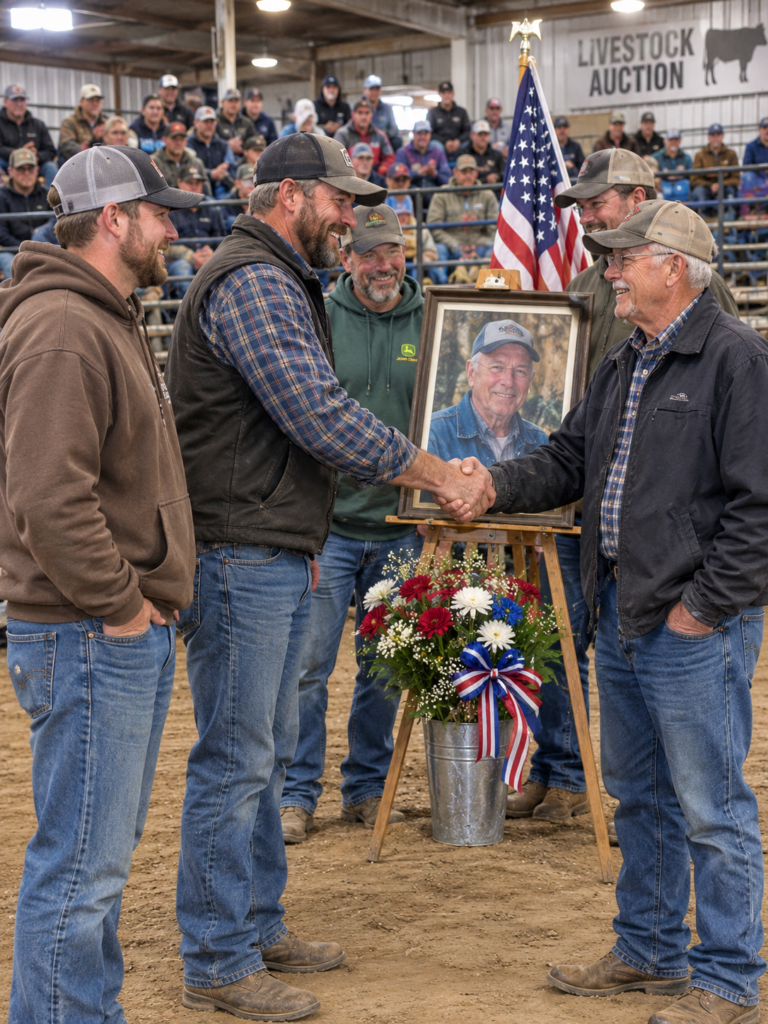
We set Dad’s photo on an easel in the middle of the sale ring.
The ring is a circle of sawdust about thirty feet across, with steel pipe rails and gates on two sides. On sale day, cattle come in one gate, circle the ring while the auctioneer calls them, and go out the other gate.
Today, it was empty. Except for the easel. And Dad’s white fiberglass sorting stick, leaning against it.
Buck had hung a flag over the auction block.
A big one. Five feet by eight. It belonged to the American Legion in Clinton. Somebody had called them on Thursday. They’d brought it over Friday night.
Under the flag, on the front of the auction block, Buck had taped a piece of cardboard. Hand-lettered in black marker.
HARLAN TEAGUE. PEN 14. 1994–2024.
Lonnie and Keith and I stood at the edge of the ring.
Becca was there. Kris and Lonnie’s boys. Keith’s wife, Amanda, and their twins. My daughter, Sadie, who’s fifteen now and stood next to me holding my hand like she hadn’t since she was little.
Then the barn did a thing I’d never heard it do.
It went quiet.
I’ve been coming to that sale barn since I was six years old. I’ve never once heard it quiet.
On sale day, it’s a roar. Cattle bawling. Gates clanging. Men shouting numbers. The auctioneer’s chant going a hundred miles an hour. Trucks backing up to the chutes. Radios. Phones. Kids running up and down the bleachers.
Even on a Saturday, when there’s no sale, there’s noise. Cattle in the pens. Wind in the tin roof. The scale-house radio playing country music.
But that morning, four hundred people stood in the sale ring at Clinton Livestock Auction.
And nobody made a sound.
Part Fourteen: Ray
Ray Daniels climbed up into the auctioneer’s box.
Ray has been the auctioneer at Clinton for twenty-six years. He’s sixty, with a gray goatee and a voice that can reach the back of the barn without a microphone. On sale day, he calls a thousand head of cattle in eight hours. He can sell a pen of calves in eleven seconds.
He climbed up into the same box he called from every Tuesday. The same high wooden booth behind the auction block, with the microphone and the bid board and the little window where he could see all the way down the alleys to pen fourteen.
He was wearing a black western shirt with pearl snaps and his good black hat. He took the hat off and set it on the desk in front of him.
He looked out over the barn.
Four hundred faces looked back at him.
Ray tapped the microphone.
The sound echoed off the tin roof.
Four hundred people held still.
He leaned in to say my father’s name.
And then he stopped.
He sat back. He took a breath. He looked down at the sale ring. At the easel with Dad’s picture. At the white sorting stick.
He looked at Lonnie in his dress blues. At Keith. At me.
Then he leaned forward again.
“Twenty-six years,” Ray said. His voice came out of the speakers rough and low. “I’ve called cattle from this box twenty-six years.”
He looked down the alley toward pen fourteen.
“And every Tuesday,” he said, “the first thing I did when I sat down in this chair was look out that window. To see if Harlan was at his gate.”
He swallowed.
“He always was,” Ray said.
“I’m an auctioneer,” Ray said. “So I’m going to do this the only way I know how.”
He picked up his gavel.
“This is lot number one,” he said. “And there’s only one lot today.”
He looked at the easel.
“Harlan Dean Teague,” Ray said.
He said it slow. Clear. Every syllable. Like he wanted it to soak into the walls of that barn.
“Seventy-one years old,” he said. “Thirty years at Clinton Livestock. Pen fourteen. Every Tuesday, four a.m., no excuses.”
“Sorted, by my count, about a million and a half head of cattle,” Ray said. “Never once mixed up a consignment. Never once sent a check to the wrong man.”
He paused.
“Never once took a sick day,” he said. “Not even the day after his wife Linda died. He was at that gate at four in the morning. I told him to go home. He said, Ray, I don’t know where home is right now.”
Somebody in the bleachers made a sound.
“Survived by,” Ray said.
He reached into his shirt pocket. He took out a piece of paper. He unfolded it.
“Survived by his three sons,” he said. “Lonnie, Troy, and Keith.”
The barn went even quieter. I didn’t think that was possible.
“His daughter-in-law Kris,” Ray read. “His daughter-in-law Becca. His daughter-in-law Amanda.”
“His grandsons, Cody and Wyatt. His granddaughter, Sadie. His grandson Mason and his granddaughter Lily. The twins.”
He looked up.
“And preceded in death,” he said, “by his wife of twenty-six years. Linda Teague. Who everybody in this barn knew made the best cinnamon rolls in Henry County. And who brought a pan of them to the sale every Tuesday for twelve years, until she couldn’t anymore.”
He folded the paper. He put it back in his pocket.
“Now,” Ray said. “I’m going to open the bidding.”
He looked out over the barn.
“Who’ll give me a story?”
Part Fifteen: The Bids
For a long moment, nobody moved.
Then, in the third row, an old man stood up.
It was Walt Ketcham. Eighty-six years old. He runs a hundred cows south of Lowry City with his grandsons. He’s been selling cattle at Clinton since 1962.
He held his seed cap in both hands.
“February of 2011,” he said. His voice was thin and shaky, but it carried. “Ice storm. You all remember.”
People nodded.
“I had forty heifers calving,” Walt said. “My wife was in the hospital in Kansas City. My boys were snowed in at their places. I couldn’t get to my cows.”
He swallowed.
“Harlan drove out to my place,” he said. “Thirty miles. On solid ice. Stayed in my calving barn for three nights. Pulled four calves. Saved every one of them.”
He looked at the easel.
“Never took a dime,” Walt said. “Said that’s what neighbors are for.”
He sat down.
Ray nodded slowly from the box.
“I got a story,” he said. “Who’ll give me another?”
A woman stood up near the rail. Thirties, in a barn coat, with a little girl on her hip.
“My name’s Jessie Morrow,” she said. “My dad died when I was nineteen. Left me forty cows and a mortgage I didn’t understand.”
She shifted her daughter to the other hip.
“I brought my first load of calves to this barn scared to death,” she said. “I didn’t know how to sort them. Didn’t know what they’d bring. Didn’t know anything.”
She looked at the photo.
“Harlan sorted them for me,” she said. “Showed me which ones would sell best together. Told me to hold back the three best heifers to keep for replacements.”
She wiped her eyes.
“I’ve got a hundred and twenty cows now,” she said. “Every one of them came from those three heifers.”
“Who’ll give me another?” Ray said.
They stood up one after another.
A man whose son’s 4-H steer got loose in the alley and broke through a gate, and Harlan caught it before it got to the highway. A cattle buyer from Oklahoma who said Harlan was the only sorter in Missouri who could look at a pen of mixed calves and tell you their weights within twenty pounds. A truck driver who’d had a heart attack in the loading dock in 2016, and Harlan did CPR until the ambulance came.
I didn’t know any of these stories.
Not one.
My father had never told me.
Part Sixteen: Every Tuesday
Then Buck Hensley stood up.
He’d been sitting in the front row, by the auction block. He stood slowly. His knees cracked. He turned around to face the bleachers.
“I’ll tell you something about Harlan,” Buck said.
“He didn’t talk much,” Buck said. “You all know that. You’d say good morning, and he’d nod. You’d ask about the weather, and he’d say going to rain.”
People laughed a little.
“But there was one thing he’d talk about,” Buck said. “Every Tuesday. Every single Tuesday for thirty years.”
He looked at me. At Lonnie. At Keith.
“His boys,” Buck said.
“I know more about these three than I know about my own nephews,” Buck said. “I know Lonnie did two tours in Iraq. I know Harlan didn’t sleep for a month when he was over there. He’d come to work with the radio on in his truck, listening to the news.”
He looked at Lonnie.
“I know Troy built me that loading chute gate out back,” Buck said. “Harlan told me Troy welded it at midnight because he had cows calving during the day.”
He looked at me.
“And I know Keith’s kids won state livestock judging in 2018,” Buck said. “Because Harlan came in that Tuesday and told every single person in this barn. Twice. Some of them three times.”
He turned back to the bleachers.
“Raise your hand,” Buck said, “if Harlan Teague ever told you about his boys.”
I watched the bleachers.
One hand went up. Then ten. Then fifty.
Then every hand in the barn.
Four hundred hands.
Lonnie made a sound next to me. A sound I’d never heard him make.
Keith was crying openly. Amanda had her arms around him.
I stood there with Sadie holding my hand, and I looked at four hundred hands in the air, and I understood something.
He never said it to us.
He said it to everybody else.
Every Tuesday. For thirty years. At pen fourteen. Over the gate. To anybody who’d stand still long enough to listen.
My boys.
Part Seventeen: Tammy
Ray called for one more story.
“Who’ll give me the last one?” he said.
For a long moment, nobody stood up.
Then, in the very back row, behind the men standing three deep, someone moved.
A woman worked her way down through the crowd. People stepped aside to let her through.
She was in her late forties. Brown hair going gray, pulled back in a ponytail. A navy wool coat. She was holding something wrapped in a dish towel.
She came all the way down to the rail of the sale ring.
She stopped in front of me and my brothers.
I knew her. I’d seen her at Christmas a few times. Fifteen years ago, at the wedding.
It was Tammy. Charlene’s oldest daughter.
Lonnie went stiff beside me. Keith wiped his eyes and stared.
Tammy looked at the three of us. Her eyes were red. Her chin was shaking.
“I’m sorry,” she said. “I know I don’t have any right to be here.”
The whole barn was watching. Four hundred people.
“I saw the sign at the Casey’s in Windsor,” Tammy said. “On Wednesday.”
She took a breath.
“I didn’t know Mom wrote that obituary the way she did,” she said. “I didn’t see it until it was in the paper. I called her. We had a fight. The worst fight we’ve ever had.”
She looked at the easel.
“I asked her why she didn’t call you,” she said. “She said you boys never came around. She said Harlan was hers now. She said she wasn’t going to share him at the end.”
Lonnie didn’t say anything.
“She’s not a bad person,” Tammy said. “She’s just scared. She was scared her whole marriage that Harlan loved your mother more than her. That he loved you boys more than her girls.”
She looked at me.
“And she was right,” Tammy said quietly. “He did. And he told her so. And she couldn’t stand it.”
She held out the thing wrapped in the dish towel.
“I brought this,” she said. “Mom doesn’t know I took it.”
Keith took it. He unwrapped the dish towel.
It was a ring. A plain gold wedding band. Worn thin. Scratched.
“It’s not the one from my mom,” Tammy said. “Charlene buried him with that one.”
She looked at the ring.
“That one was in his dresser drawer,” she said. “In a little box. With a picture of your mother.”
Keith held it up to the light. Inside the band, engraved, almost worn away:
H & L. 6-14-80.
“He kept it,” Tammy said. “Fifteen years. In his top drawer. Next to his socks.”
She looked at my brothers. At me.
“I think it belongs with you,” she said.
Then she turned around and walked back up through the crowd.
Part Eighteen: Pen Fourteen
After the stories, Ray did one more thing.
He stood up in the auctioneer’s box. He put his hat back on.
“There’s a tradition,” he said, “at some barns. When a man’s worked the alleys long enough, they close his gate.”
He looked down the alley toward the scale house.
“Pen fourteen,” he said. “Harlan’s gate.”
He looked at Lonnie, Keith, and me.
“Boys,” he said. “Would you close it?”
We walked out of the sale ring. Through the gate. Down the long alley between the empty pens. Four hundred people followed us. They walked out of the bleachers and lined both sides of the alley, standing along the rails.
Lonnie led the way. In his dress blues. Holding Dad’s white sorting stick.
Keith walked behind him. Holding the gold ring in his fist.
I walked last. With Sadie.
We stopped at pen fourteen.
It’s a steel pipe pen about twenty feet square, with a swinging gate on the alley side. Dad had hung that gate himself in 1998. I’d re-welded the hinges in 2015.
It was standing open.
Lonnie handed me the sorting stick.
I looked at it. White fiberglass. Six feet long. Wrapped in black electrical tape at the top where Dad held it. The tape was worn smooth from thirty years of his hand.
I handed it to Sadie.
She looked up at me.
“Grandpa let me hold it,” she said quietly. “When I was three. I told him I was going to sort cattle like him.”
“I know,” I said. “He wrote it down.”
Sadie walked to the gate. She put her hand on it. She looked back at the crowd. At four hundred people standing along the rails with their hats off.
Then she swung the gate shut.
The latch clicked.
Nobody said anything for a long time.
Then Buck Hensley walked up beside us. He was carrying a small brass plate and a cordless drill.
“I had this made Thursday,” he said. “At the trophy shop in Clinton.”
He held it up to the gate post. He drilled four screws.
PEN 14
HARLAN TEAGUE
SORTED CATTLE HERE EVERY TUESDAY, 1994–2024.
HE TALKED ABOUT HIS BOYS.
Part Nineteen: Lincoln
We drove to Lincoln the next week.
The three of us. In Lonnie’s truck. We didn’t call Charlene. We didn’t stop at her house.
We drove straight to the cemetery behind First Baptist Church.
Dad’s grave was in the back corner. Fresh dirt, still settling. A temporary marker from the funeral home. A pot of fake mums that had blown over in the wind.
Next to it was the grave of Charlene’s first husband. Roger Hobbs, 1950–2005. A double stone. Charlene’s name was already carved on the other side, with only her birth year.
Dad was on the other side of her.
Not next to our mother. Our mother is buried in Windsor. In the cemetery on the hill behind the Methodist church. Where Dad always said he’d go.
We stood there for a long time.
“He should be with Mom,” Keith said.
“I know,” I said.
“Can we move him?” Keith asked.
Lonnie shook his head.
“Not without her permission,” he said. “Phil said. She’s next of kin.”
So we didn’t move him.
Instead, Keith knelt down. He pulled the gold ring out of his pocket. The one that said H & L. 6-14-80.
He looked at it for a long time.
Then he put it back in his pocket.
“This goes to Mom,” he said. “Not here.”
Part Twenty: Windsor
We drove to Windsor that afternoon.
The cemetery on the hill behind the Methodist church. Mom’s grave is under a big cedar tree. A gray granite stone. Linda Kay Teague. 1952–2006. Beloved wife and mother.
There’s a blank space next to it. Where Dad was supposed to go. His name is already carved on the stone. Harlan Dean Teague. 1953–. He’d paid for it in 2006. The year she died.
The death year is still blank.
Lonnie knelt down by the stone.
He took a small trowel out of his coat pocket. He dug a little hole in the grass at the base of the stone. Right between Mom’s name and Dad’s.
Keith knelt down beside him. He took the ring out of his pocket.
He set it in the hole.
“Dad,” Keith said. “We couldn’t bring you home. But we brought you this.”
He covered it with dirt. He patted the grass down.
Lonnie put his hand on the stone. On Dad’s name. On the blank space where the death year should be.
“We’ll fix this part,” Lonnie said. “Soon as Phil says we can. We’ll put the year on.”
I stood behind them. I looked out over the cemetery. Over the town of Windsor. Over the fields going brown for winter.
Over the old dairy barn on the edge of town where Dad worked before the sale barn. Where we grew up. Where Mom made cinnamon rolls every Saturday morning.
Part Twenty-One: Tuesdays
Phil Cramer called in December.
Dad had a will. A simple one. Made in 2009, the year he married Charlene. Everything to his wife.
Except one thing.
To my sons, Lonnie, Troy, and Keith: my brown Carhartt coat, my sorting stick, and my green Stanley thermos, which are in my locker at Clinton Livestock Auction. Charlene doesn’t want them anyway.
Lonnie laughed when Phil read it to him. The first time I’d heard him laugh since October.
“He knew,” Lonnie said. “He knew exactly what she’d do.”
We split them up.
Lonnie took the thermos. He drinks his coffee out of it every morning at Whiteman.
Keith took the coat. He wears it to judge livestock shows with his FFA kids. It’s too big for him. He doesn’t care.
I took the sorting stick.
I don’t keep it in my house.
I keep it at the barn.
Every Tuesday now, I’m at Clinton Livestock Auction at four in the morning.
Buck offered me Dad’s job in November. Part-time. Just Tuesdays. I said yes before he finished asking.
I close my welding shop on Tuesdays now. Becca says I’m crazy. Sadie says it’s the best decision I ever made.
I stand at pen fourteen.
In the dark, in the cold, with the trucks backing up to the chutes and the cattle bawling in the alleys. With Dad’s white sorting stick in my hand, the black tape at the top worn smooth from his grip.
I open the gate. I close the gate. I call numbers to the kid with the chalk.
And sometimes, when there’s a lull between trucks, a rancher I don’t know will stop by the gate.
He’ll lean on the top rail. He’ll look at the brass plate on the post.
He talked about his boys.
“You Harlan’s boy?” he’ll ask.
“I’m Troy,” I’ll say. “The middle one.”
He’ll nod.
“The welder,” he’ll say. “Built the loading chute gate.”
“That’s right,” I’ll say.
He’ll stand there for a minute. Then he’ll say something.
“He told me about you,” the man will say.
Every time.
Every single Tuesday.
Some stranger stops by the gate and tells me something my father said about me. Something he never said to my face.
That I welded at midnight because I had cows calving. That I named my daughter after his mother. That I could build anything.
That he was proud.
I used to think my father didn’t know how to love us.
I was wrong.
He knew how.
He just didn’t know how to say it to us.
So he said it to four hundred other people instead.
One Tuesday at a time.
Over a steel gate at pen fourteen.
And they all came back to tell us.