The Bills by the Sugar Bowl
My stepmother told me at her kitchen table in April.
The bills were stacked by the sugar bowl. A neat pile, squared at the corners, the way Connie squared everything. On top was a pink envelope from Sanford Health in Fargo with the words PAST DUE stamped in red.
She poured me a cup of coffee I didn’t ask for. She sat down across from me. She folded her hands on top of the pile.
“He doesn’t remember saying it, Haley,” she said.
Dad was in the next room with the ball game on. The Twins were losing to Cleveland. I could hear the announcer’s voice, low and steady, and the click of Dad’s recliner when he shifted his weight.
He couldn’t shift much anymore.
The stroke took most of his right side in January. It happened on a Tuesday morning while he was shoveling the front walk. Connie found him face down in the snow by the mailbox. The doctors at Sanford said if she’d found him ten minutes later, there wouldn’t have been anything left to save.
It took his right arm. It took his right leg. It took the right side of his smile, so now when he grinned, only half his face came along.
It took a lot of his words, too.
“He doesn’t remember,” I repeated.
“No, honey.” Connie’s voice was gentle. Careful. “I asked him. Twice. He looked at me like I was speaking French.”
I stared down at my coffee.
The night Jake asked for my hand, back in December, Dad had walked me out to my car. It was ten below and the stars were so sharp they looked like broken glass. He hugged me right there in the driveway, in his old Carhartt jacket that smelled like diesel and Old Spice.
“Five thousand, kiddo,” he said into my hair. “For the wedding. I put it away for you. Don’t you tell Connie I’m getting soft.”
Six weeks later, he was face down in the snow.
“I’m his power of attorney now,” Connie said. “You know that. The lawyer set it up back when we got married, just in case. And now it’s not just in case anymore.”
She smoothed the top bill with one finger.
“I have to guard every dollar,” she said. “Every single one. You understand that, right?”
I looked at her. Connie Brekke Lindahl. Sixty-one years old. Gray bob, cut every five weeks at the Clip Joint on Main Street. Reading glasses on a beaded chain. She worked the front desk at the Harlow County Extension Office for twenty years and knew the name of every farmer’s wife in three counties.
She’d been married to my father for eleven years. I’d never once seen her cry.
“I understand,” I said.
I could have pushed back. I thought about it. I thought about saying, he told me in the driveway, I’m not making it up. I thought about walking into the next room and asking him myself, right in front of her.
But Connie had the legal say over Dad’s money. Every account. Every check. Every decision. That’s what the paper meant.
And I was not going to start my marriage fighting over five thousand dollars at my father’s bedside. Not with him sitting in that recliner, unable to get the words out, watching us fight over him like a couple of crows over roadkill.
“Okay,” I said.
Connie let out a breath. Her shoulders came down a little. “Thank you, honey.”
I stood up and put my coffee cup in the sink. I went into the living room and kissed Dad on top of his head. His hair was thinner than I remembered. His good hand came up and patted my arm.
“Love you, Dad,” I said.
He made a sound. It wasn’t a word. But I knew what it meant.
I cried the whole drive home.
Forty minutes on Highway 18, past fields still white with old snow, past the grain elevator in Hatton with its lights blinking red on top. I cried so hard I had to pull over once by a section line road and just sit there with the engine running.
It wasn’t really about the money. I want to be honest about that. Five thousand dollars was a lot to us. But it wasn’t the money.
It was that Dad promised. And now he couldn’t remember promising. And Connie got to decide what he remembered.
Chapter Two: The Driveway
My mother died when I was twelve.
Breast cancer. She found the lump in March and was gone by Thanksgiving. Her name was Linda. She had blonde hair like mine and she sang Patsy Cline songs while she did dishes and she made the best kolaches in Harlow County. She won a blue ribbon at the county fair three years running.
After the funeral, it was just Dad and me.
He didn’t know how to braid hair. He didn’t know how to buy a bra for a twelve-year-old. He burned every single pot roast for two years straight. But he got up every morning at five and made me oatmeal before he drove to the co-op, and he came to every one of my volleyball games, and he never once missed a parent-teacher conference.
Gene Lindahl. Six foot two, hands like baseball mitts. Thirty-four years driving grain trucks and fixing farm equipment for the Harlow Farmers Co-op. The kind of man who’d stop on a gravel road to help a stranger change a tire in a blizzard and then refuse to take their twenty dollars.
He met Connie when I was seventeen. At a pancake breakfast at the Lutheran church.
I hated her. I hated her the way only a seventeen-year-old girl can hate a woman who sits in her dead mother’s chair.
She was neat where Mom was messy. Quiet where Mom was loud. She put coasters on everything. She reorganized Mom’s spice cabinet in alphabetical order. She never once tried to make kolaches.
They got married two years later, when I was at nursing school in Grand Forks. A small ceremony at the courthouse. I went. I wore black. Dad didn’t say anything about it, but I saw his face.
I’m not proud of that.
Over the years, it got better. Sort of. Connie and I learned how to be polite. We talked about the weather and the price of soybeans and whether the Bison would make the playoffs. She sent me a birthday card every year with a twenty-dollar bill inside, signed Love, Dad and Connie, in her neat schoolteacher handwriting.
But we were never close. There was always a fence between us. A low one. But a fence.
I met Jake Hendrickson at a street dance in Mayville when I was twenty-six.
He was standing by the beer tent in a clean pair of Wranglers and a Bison hoodie, talking to a farmer about wheat prices. He had sunburned forearms and a laugh you could hear over the band. When he asked me to dance, he stepped on my foot twice and apologized both times like he’d run over my dog.
He worked at the grain elevator in Hatton. Twelve-hour shifts during harvest, unloading trucks, running the dryers, checking moisture levels. He was the most steady person I’d ever met. Nothing rattled him. Not blizzards, not broken augers, not my father.
The first time he came to dinner, Dad shook his hand and squeezed hard. Jake squeezed back just as hard and didn’t flinch.
After he left, Dad looked at me across the table.
“He’ll do,” he said.
From Gene Lindahl, that was practically a sonnet.
Jake asked Dad for my hand in December. Two weeks before Christmas. I didn’t know he was going to do it.
He drove out to the house alone on a Saturday afternoon. Connie told me later that he and Dad sat in the garage for an hour and a half, in the cold, with the space heater going and two cans of Grain Belt between them.
That night, Jake proposed to me on the frozen Goose River with a ring he’d been paying off at the jewelry store in Grand Forks since August. I said yes before he even finished the question.
The next night, we drove out to Dad’s to tell him officially. Connie made a pot roast. It wasn’t burned.
When we were leaving, Dad walked me out to my car. Just me. He told Jake to go warm up the truck.
He hugged me in the driveway, under the yard light, with the stars so sharp they hurt.
“Five thousand, kiddo,” he said. “I put it away for you. In case you ever found one worth marrying.”
“Dad. You don’t have to.”
“I know I don’t have to.” He pulled back and looked at me. His eyes were wet. “Your mom would’ve wanted to do it. So I’m doing it for both of us.”
That was the last real conversation I ever had with my father.
Six weeks later, he couldn’t say my name.
Chapter Three: The Legal Pad
Jake didn’t say one word against Connie.
When I got home that night in April, still crying, he was at the kitchen table in our rented farmhouse outside Hatton. He took one look at my face and got up and held me for a long time without saying anything.
Then I told him. All of it. The bills. Power of attorney. He doesn’t remember.
He listened. When I was done, he didn’t say she was lying. He didn’t say I should fight her. He didn’t say anything mean about Connie at all.
He got out a yellow legal pad instead.
“Okay,” he said. He clicked his pen. “Let’s figure out what we actually need.”
We sat at the kitchen table that night until almost one in the morning. Jake wrote everything down in his blocky farm-boy handwriting.
Church: two hundred dollars. Pastor Halvorsen wouldn’t take more than that, and he’d already said so.
Reception: the Harlow Community Center. Three hundred to rent the hall for the day. The Lutheran church women would do the food for twelve dollars a plate if we bought the meat.
Meat: Jake’s cousin Travis raised beef. He’d sell us a half at cost. Twenty-four hundred, butchered and wrapped.
DJ: Jake’s buddy Cody, who had speakers and a laptop and played every wedding in three counties. Four hundred.
Flowers. Dress. Suit rental. Cake. Invitations. Photographer. Beer.
Jake added it up twice. Then a third time.
“About nine thousand,” he said, “if we keep it plain.”
I put my face in my hands.
“We don’t have nine thousand dollars,” I said. “We have twenty-two hundred in savings. And that’s supposed to be for a down payment someday.”
“I know.” He tapped the pen against the pad. “So we work.”
“Work how?”
“Harvest starts in August. I’ll pick up every Saturday and Sunday shift they’ve got. That’s double time on Sundays. And you said the clinic needs someone for weekend emergencies.”
He looked at me across the table. Steady as a fence post.
“We can do this, Hal,” he said. “Without anybody’s five thousand dollars.”
So we did.
I’m a vet tech at the Prairie Animal Clinic in Mayville. Mostly cows and horses and farm dogs, with a few barn cats and the occasional pet goat. That summer, I picked up every extra shift they had. Weekend emergencies. Night calls. A calving in a thunderstorm at three in the morning, where I stood in a mud-filled barn up to my shins holding a flashlight while Dr. Bergstrom pulled a calf out backward.
Jake worked at the elevator from six in the morning until six at night, five days a week. Then he worked Saturday and Sunday too. By the end of August, he was so tired he fell asleep at the dinner table with a fork in his hand.
We stopped going out to eat. We stopped buying anything we didn’t need. I cut Jake’s hair in the kitchen with clippers from Walmart. He fixed the hole in my winter boots with Gorilla Glue.
I bought my wedding dress in June. A plain white dress off the rack at a bridal outlet in Fargo. No lace. No beading. Just white satin, with thin straps and a little bit of a train.
It cost two hundred and eighty dollars.
The lady at the store kept trying to show me the ones with sparkles. “This one’s only twelve hundred,” she said. “It’s on clearance.”
“This one’s perfect,” I said.
I stood in front of the three-way mirror in that dressing room and looked at myself for a long time. I thought about my mom. She’d have cried. She’d have made a fuss about the hem.
I wished so hard she was there that my chest ached.
Jake’s aunts said they’d make the bars.
In North Dakota, you don’t have a wedding without bars. Lemon bars. Scotcheroos. Seven-layer bars. Special K bars. Monster cookie bars. Jake’s Aunt Darla and Aunt Bev and Aunt Rhonda made twenty-two pans between them, which they stored in Aunt Darla’s chest freezer and guarded like gold bullion.
“Nobody touches the Scotcheroos until after the cake,” Aunt Darla told me. “I don’t care if it’s the governor.”
My friend Mandy from nursing school said she’d do my hair. Jake’s cousin Shelby, who had a fancy camera and was taking a photography class at the community college, said she’d take pictures for a hundred dollars and a plate of food.
Little by little, the numbers on Jake’s legal pad started going down.
Chapter Four: Tap Twice
In May, I drove out to Dad’s house to ask Connie the other thing.
It was a Sunday afternoon. The lilacs were blooming along the north side of the house, purple and heavy. Mom had planted those lilacs the year I was born. Connie never cut them back.
Connie was in the kitchen making a hotdish. Dad was in his wheelchair at the kitchen table, working on a therapy worksheet with his left hand. Big letters. Tracing shapes. Like a kindergartner.
He looked up when I came in. Half his face smiled.
“Hal,” he said. It came out slow and slurred, like he was talking with a mouthful of marbles. But it was my name.
I put my arms around his neck from behind and kissed the top of his head.
“Hi, Dad.”
I sat down at the table. Connie put the hotdish in the oven and came and sat across from me.
“I want to ask you something,” I said. “Both of you.”
Connie folded her hands. That careful way she had. Like she was waiting for bad news.
“I want Dad to give me away,” I said. “At the wedding. I want him to walk me down the aisle.”
Connie looked at Dad’s wheelchair. She looked at it for a long time.
“Oh, honey,” she said softly.
“I know he can’t walk,” I said. “That’s okay. I’ll push him.”
“Haley,” Connie said carefully. “He gets tired. Real tired. By two in the afternoon, he can barely keep his eyes open. And he hasn’t been out in public much. Not since January. Not in front of a crowd.”
“It’s not a crowd. It’s family.”
“It’s a hundred and fifty people,” Connie said. “All staring at him. In a wheelchair. With his face.” She lowered her voice, even though Dad was sitting right there. “He gets embarrassed. When he tries to talk and it doesn’t come. He gets so frustrated. I don’t know if he wants everybody staring at him like that.”
“Then I’ll push him,” I said again. “He doesn’t have to say anything. He just has to be there.”
Connie didn’t say yes.
She didn’t say no either. She just sat there with her hands folded, looking at Dad, with an expression on her face I couldn’t read.
Then I heard a sound.
Tap. Tap.
Dad’s good hand. His left hand. Tapping twice on the kitchen table.
I looked at him. He was looking right at me. Not at Connie. At me. His eyes were very clear.
That was the system his speech therapist had taught us in February, when he couldn’t say anything at all. One tap meant no. Two taps meant yes.
Tap. Tap.
“Dad,” I whispered.
He tapped twice again. Harder this time. So hard the salt shaker jumped.
Connie let out a long breath. She looked down at her hands. When she looked back up, her eyes were shiny, but no tears came. They never did with Connie.
“Well,” she said. “I guess that settles it.”
I got up and hugged my dad so hard his wheelchair rolled backward an inch. He made a sound that might have been a laugh.
Behind me, I heard Connie get up and go to the oven and open it and close it again. Like she needed something to do with her hands.
Every Tuesday that summer, Dad had speech therapy in Fargo. At the Sanford rehab clinic on Broadway.
Sixty miles each way. Connie drove him.
She’d leave the house at seven in the morning. His appointment was at nine. Then he had occupational therapy at ten-thirty and physical therapy at one. They’d get home around four, and Dad would be so exhausted he’d sleep in his recliner until supper.
Every single Tuesday. June. July. August. September.
I never asked what they worked on.
I should have. I know that now. But I was busy, and tired, and angry, and I told myself it was none of my business. Connie had the paper. Connie made the decisions. Connie drove him to Fargo.
I just showed up on Sundays and kissed him on the head and left.
Chapter Five: The Van
In late June, I drove past Dad’s house on the way home from a call at the Svoboda farm and saw something new in the driveway.
A van. A silver Dodge Grand Caravan, maybe five or six years old. Clean and shiny, with a wheelchair ramp folded up against the side door.
I pulled in. Connie was in the front yard watering the petunias.
“New van?” I said, getting out.
“Used,” she said. “From a dealer in Grand Forks. It’s got a ramp. He can roll right in. No more lifting him into the Buick.” She turned off the hose. “My back was about to give out.”
I looked at the van. I looked at the price sticker still in the back window. $26,900.
Twenty-six thousand, nine hundred dollars.
“That’s a nice van,” I said.
“It’s a necessary van,” Connie said.
I got back in my car and drove home. I didn’t say anything else. But my hands were shaking on the steering wheel.
My Aunt Marlene called me that night.
Marlene was Dad’s older sister. She was seventy, lived in Devils Lake, and had never liked Connie. Not once, not for one minute in eleven years.
“I heard Connie bought a new car,” she said. No hello. Marlene never said hello.
“A van, Aunt Marlene. With a wheelchair ramp.”
“With whose money?”
I didn’t answer.
“I’m just saying,” Marlene said. “Gene had money put away. He told me so himself. At Easter last year. He said he’d been saving for years. Ever since Linda died. He said he had a little nest egg for you.”
“Connie says he doesn’t remember.”
“Connie says.” Marlene snorted. “Connie says a lot of things. Connie’s got power of attorney over every dime Gene ever earned, and now she’s driving around in a brand-new van while you’re working double shifts to pay for your own wedding. You think about that, Haley.”
I did think about it.
I thought about it all night. I lay in bed next to Jake, who was snoring from his twelve-hour shift, and I stared at the ceiling and thought about that twenty-six-thousand-dollar van.
The next morning, I called a lawyer.
His name was Neil Hagen. He had an office above the bank in Mayville, and he did wills and land contracts and the occasional divorce. He’d known my dad for thirty years.
“Haley,” he said, when I told him who I was. “How’s your dad doing?”
“Not great.”
“I’m sorry to hear that. He’s a good man.”
I told him about the power of attorney. About the van. About the five thousand dollars. About Aunt Marlene.
He listened. When I was done, he was quiet for a while.
“Here’s what I can tell you,” Neil said. “Under North Dakota law, an agent under a power of attorney has a fiduciary duty. That means Connie has to act in your father’s best interest. Not her own. She has to keep records. She has to keep his money separate. And she can’t make gifts from his money unless the power of attorney specifically says she can.”
“What does that mean? Gifts?”
“It means,” Neil said carefully, “that even if your father remembered promising you five thousand dollars, and even if he wanted to give it to you, Connie might not be able to legally hand it over. Depending on what the document says. And depending on his situation.”
“What situation?”
He paused.
“Is your dad likely to need long-term care, Haley? A nursing home? Assisted living?”
I didn’t answer. I hadn’t let myself think about that.
“If he is,” Neil said gently, “and if he ends up needing Medicaid to pay for it, there’s a five-year lookback. Any gifts he makes in the five years before he applies, Medicaid counts against him. Gives him a penalty period. Months where he’s not covered at all.”
“So five thousand dollars to me…”
“Could cost your dad a couple of months of nursing home care,” Neil said. “At about nine thousand a month.”
I sat in my car in the clinic parking lot with the phone pressed against my ear.
“If you think Connie’s misusing his money,” Neil said, “you have the right to ask for an accounting. You’re his daughter. That’s an interested person. I can send her a letter. She’d have to show where every dollar went.”
I thought about it.
I thought about Connie folding her hands on top of the bills. I have to guard every dollar.
I thought about Dad tapping twice on the table.
“Let me think about it,” I said.
“Take your time,” Neil said. “And Haley? For what it’s worth, I’ve known Connie a long time too. She’s not the type.” He paused. “But I’ve been wrong before.”
Chapter Six: The Pawn Shop
I didn’t send the letter.
I almost did. Twice. I had it drafted in my email. Dear Connie, As Gene’s daughter, I’m requesting a full accounting of his finances under the power of attorney. Both times, I closed the laptop without hitting send.
Jake didn’t push me either way.
“What do you want to happen?” he asked me one night in July. We were sitting on the porch steps of the farmhouse, watching heat lightning flicker over the wheat fields.
“I want Dad to get better,” I said.
“Yeah,” Jake said. He put his arm around me. “Me too.”
In August, I saw something I couldn’t explain.
I was in Fargo on a Tuesday, picking up a special order of vaccine for the clinic. I stopped at a gas station on 13th Avenue, and while I was pumping, I looked across the street.
There was a pawn shop. Fargo Gold and Loan. Bars on the windows. A neon sign that said WE BUY GOLD.
And coming out the door, clutching her purse against her chest, was Connie.
She didn’t see me. She walked quickly to the silver van, parked at the end of the lot. She climbed in. She sat behind the steering wheel without starting it.
I watched her through the windshield.
She put both hands over her face. Her shoulders started shaking.
Connie Lindahl. Who never cried. Who didn’t cry when Dad had the stroke, who didn’t cry in the ICU, who didn’t cry when the neurologist said he’d probably never walk again.
She sat in a pawn shop parking lot on 13th Avenue in Fargo and cried so hard the van rocked.
I stood there with the gas nozzle in my hand until it clicked off.
Then she wiped her face, started the van, and drove away. Toward Broadway. Toward the rehab clinic, where Dad was in speech therapy.
I didn’t follow her.
I finished pumping gas. I paid. I drove back to Mayville with the vaccine in a cooler in the back seat. And I didn’t tell anybody what I’d seen. Not even Jake.
I didn’t know what it meant. I only knew that Connie had gone into a pawn shop with something and come out with nothing.
The next Sunday, I drove out to Dad’s for dinner.
Connie made chicken and dumplings. Dad was in his wheelchair at the table, and he was having a good day. He said “Hal” when I walked in. He said “Jake” when Jake followed me. He even said “good” when Connie asked him how the dumplings were.
Connie set down the basket of rolls. I watched her hands.
Her left hand.
For eleven years, Connie had worn a gold wedding band and a small diamond engagement ring, stacked together on her fourth finger. Not a big diamond. Maybe a quarter of a carat. Dad bought it at Ellingson’s Jewelers in Grand Forks, and he was so proud of it he showed it to everybody at the co-op.
Her finger was bare.
There was a pale stripe of skin where the rings used to be.
I looked up at her face. She saw me looking. She saw exactly what I was looking at.
For one second, something moved across her face. Fear. Or shame. Or both.
Then she smoothed her napkin over her lap.
“Pass the butter, Haley,” she said.
I passed the butter.
Chapter Seven: The Rehearsal
The wedding was the third Saturday in September.
The rehearsal was Friday evening at St. John’s Lutheran, the little white country church six miles outside Harlow where my mom and dad got married in 1987. Where I was baptized. Where we had Mom’s funeral.
It sat at the end of a gravel road with nothing around it but sunflower fields and a cemetery behind a low iron fence. Plain white siding. A bell tower with a real bell. Plain glass windows, no stained glass, so the daylight came through clear and white and fell across the wooden pews in long stripes.
Mom was buried in that cemetery, under an elm tree in the back row. I went out and visited her before the rehearsal started. I brought her a bunch of black-eyed Susans from the ditch along the road.
“I’m getting married tomorrow, Mom,” I told her. “Dad’s going to give me away.”
The elm tree rustled. That was all.
The rehearsal didn’t go well.
Pastor Halvorsen walked us through everything. Who stands where. When to come in. When to sit down. Jake practiced saying “I do” so loud that Aunt Darla laughed.
Then we got to the part where Dad gave me away.
I pushed his wheelchair down the aisle. The church floor was old wood, and it creaked. One of the wheels squeaked every three feet. By the time we got to the front, Dad’s face was gray and his good hand was gripping the armrest so hard his knuckles were white.
“And then I’ll ask,” Pastor Halvorsen said gently, “who gives this woman to be married. And Gene, you can just nod. Or raise your hand. Whatever’s comfortable.”
Dad looked at him. His mouth worked. Nothing came out.
He looked at Connie, sitting in the front pew.
Connie shook her head. Just a tiny shake. Almost nothing.
Dad’s shoulders slumped.
“He’s tired,” Connie said, standing up. “It’s late. He’s been up since six. He needs to go home.”
“We’re almost done,” I said.
“He’s done, Haley.”
“He can nod. That’s all he has to do. Pastor said he can just nod.”
Connie came down the aisle and put her hand on the back of Dad’s wheelchair. Right next to mine.
“He’s done,” she said again, very quietly. “Please.”
I let her take him.
She wheeled him out the side door to the van. I watched through the plain glass window as she lowered the ramp, rolled him up, buckled him in. I watched her lean in and say something to him. I watched him tap twice on the armrest.
Then she drove away.
I stood in the church with my wedding party and my soon-to-be husband and my mother’s cemetery out the back window. And I started crying.
“She doesn’t want him to do it,” I said to Jake in the parking lot. “She never wanted him to. She’s embarrassed of him.”
“Hal…”
“She sold her rings, Jake. I saw her coming out of a pawn shop in Fargo. And she bought a twenty-seven-thousand-dollar van. And she won’t give me the money Dad promised me. And now she won’t even let him give me away.”
Jake was quiet for a long time. He leaned against his truck and looked out at the sunflowers, black against the sunset.
“You ever think,” he said slowly, “that maybe there’s something she’s not telling you because she can’t?”
“Like what?”
“I don’t know.” He looked at me. “But I watched her face tonight. When she shook her head at him. That wasn’t embarrassment, Hal.”
“Then what was it?”
He thought about it.
“It looked like she was scared he’d try,” he said, “and it wouldn’t come out.”
Chapter Eight: Who Gives This Woman
The next morning, I woke up at five-thirty without an alarm. Just like Dad.
Mandy came over at eight and did my hair in a low bun at the back of my neck, with little pieces of baby’s breath tucked in. She pinned my veil on top. It was my mom’s veil. Dad had kept it in a cedar chest in the basement for fifteen years.
I put on my two-hundred-and-eighty-dollar dress. I looked in the mirror.
I looked like her. More than I ever had.
We got to the church at one-thirty. The wedding was at two.
The parking lot was full of pickups. Farm trucks, mostly. A few SUVs. A tractor, actually. Old Mr. Svoboda drove his John Deere over from his place a mile and a half down the road, because he said his wife wouldn’t let him drink and drive the truck.
A hundred and fifty people filled the wooden pews. Jake’s family on one side. Mine on the other. People from the co-op, from the vet clinic, from the grain elevator. Pastor Halvorsen’s wife. My old volleyball coach. Aunt Marlene in the third row, in a purple hat, with her arms crossed.
In the front pew sat Connie.
She wore a sage green dress. Her gray bob was done just so. Her hands were folded in her lap. Her left hand was still bare.
Dad was waiting for me in the little room off the vestibule where the choir kept their robes.
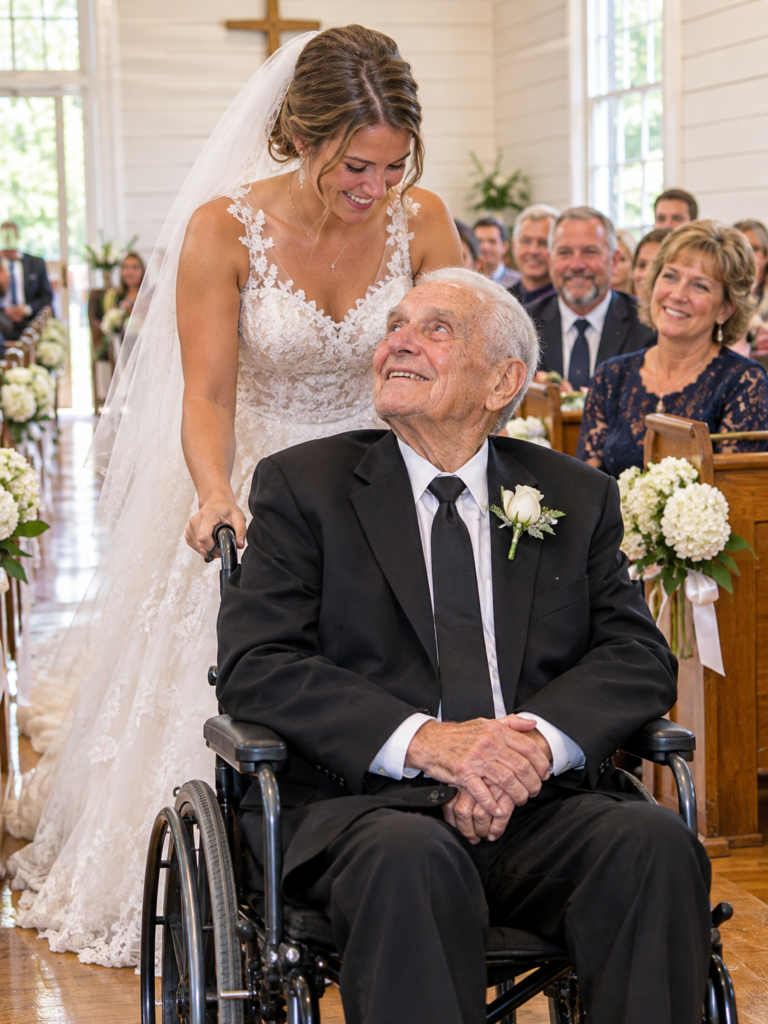
Someone had dressed him in his dark suit. His only suit. The one he wore to Mom’s funeral and to his own wedding to Connie. It hung looser on him now. They’d pinned a boutonniere on the lapel. A single yellow rose with a sprig of baby’s breath.
He was sitting in his wheelchair, very straight. He’d shaved. His hair was combed.
When I came through the door in my dress and my mother’s veil, his face crumpled. The good half and the bad half both.
“Hal,” he said.
“Hi, Daddy.”
His good hand came up. I took it. It was shaking.
“Pretty,” he said. It took him a long time. But he said it.
I heard the organ start.
Mrs. Engstrom, who’d played the organ at St. John’s for forty-one years, started the processional. Pachelbel’s Canon. The same song Mom walked down the aisle to in 1987.
Through the doorway, I heard a hundred and fifty people stand up. The wooden pews creaked. Somebody’s baby fussed and was hushed.
I took the handles of Dad’s wheelchair with one hand.
“Ready?” I said.
His good hand reached across and found my other hand, where it rested on the armrest. He gripped it.
He didn’t say anything. He just held on.
We went through the doorway into the church.
The aisle looked a mile long. The daylight was coming through those plain windows in long white stripes across the floor. The squeaky wheel squeaked. The old floorboards creaked. And Dad held my hand.
Not once did he let go. The whole way up.
He held it so tight it hurt. I could feel every bone in his fingers. I could feel how hard he was working just to sit up straight, just to keep his head up, just to be there.
I could hear people sniffling behind me. On both sides. Big strong farmers in their good shirts, wiping their eyes.
Somebody’s grandpa whispered, loud enough for half the church to hear, “Look at Gene.”
We stopped at the front.
Jake was standing there in his rented gray suit, with his hands clasped in front of him. He was crying. Big tears rolling right down his face, and he wasn’t even trying to hide it.
I set the brakes on Dad’s wheelchair. Click. Click.
His hand was shaking so hard in mine now. Trembling all the way up his arm.
Pastor Halvorsen looked down at us. He smiled. He asked it the way he asks it every Saturday. The way he’d asked it at a thousand weddings.
“Who gives this woman to be married?”
The church went quiet.
So quiet I could hear the wind in the sunflowers outside. So quiet I could hear the old clock in the back ticking. So quiet I could hear Dad breathing.
I waited for him to nod. That’s all he had to do. Pastor said so. Just a nod.
In the front pew, Connie leaned forward. Her hands came apart in her lap. She was gripping her knees.
Dad’s mouth was working at the first word. I could see it. His jaw moving. His lips trying to make a shape.
I squeezed his fingers.
He took a breath so deep I felt it run up my arm. All the way from his chest to his shoulder to his hand to mine.
And then my father spoke.
Chapter Nine: Her Mother and I
“Her…”
The word came out slow. Thick. But clear. Everyone in that church heard it.
“…mother…”
He stopped. His jaw was working. His face was red with effort. A tear ran down the bad side of his face, the side he couldn’t feel.
“…and I.”
The church was absolutely silent. Nobody breathed.
Dad took another breath. His hand crushed mine.
“Do.”
Her mother and I do.
Those were the words my father said at his own wedding, at his own church, in 1987. No. That’s not right. Those were the words Mom’s father said. Grandpa Olaf, giving Mom away to my dad, in this same church, on this same floor.
Her mother and I do.
The words fathers say. The words that mean: we raised her together. We both gave her to you. Even if one of us isn’t here.
Especially if one of us isn’t here.
I made a sound. I don’t know what it was. My hand went to my mouth.
Behind me, a hundred and fifty people broke at the same time. I heard Aunt Darla sob out loud. I heard old Mr. Svoboda blow his nose like a trumpet. I heard Aunt Marlene, in her purple hat, say “Oh, Gene,” in a voice I’d never heard her use.
Jake was crying so hard his shoulders shook.
Pastor Halvorsen had to take off his glasses and wipe them on his robe before he could go on.
And Dad. Dad sat there in his wheelchair with his chin up, breathing hard, still holding my hand. Half his face was smiling.
Then I looked at the front pew.
Connie.
She was sitting with both hands pressed flat over her mouth. Her eyes were closed. Tears were streaming down her face. Running down her cheeks and off her chin and onto her sage green dress, leaving dark spots.
Connie Lindahl, who never cried, was crying so hard her whole body shook.
And her lips were moving. Silently. Behind her hands. I could see them through her fingers.
Her mother and I do.
She was saying it with him. Word for word. Like she’d heard it a thousand times. Like she’d practiced it.
That was when I understood.
Every Tuesday. Every single Tuesday for five months. Sixty miles each way. Seven in the morning until four in the afternoon. Speech therapy at nine.
I never asked what they worked on.
They worked on this.
Four words. Her mother and I do. My father sat in a little room at the Sanford rehab clinic on Broadway, every Tuesday, with a speech therapist and a mirror and my stepmother, practicing four words. Over and over. Week after week. Month after month.
So he could give me away.
And Connie. Connie drove him there. And sat with him. And helped him practice. Helped him practice saying my mother’s name. Not hers. My mother’s. Linda’s. The first wife. The one whose spice cabinet she alphabetized. The one whose lilacs she never cut back.
She helped my father practice giving me away for both of them. Him and Mom.
And she never said a word.
At the rehearsal, when she shook her head at him. When she took him home early.
She wasn’t embarrassed of him. Jake was right.
She was scared. Scared he’d use the words up. Scared that if he tried on Friday and failed, in front of everybody, he’d lose his nerve. Scared he’d only have it in him once.
She was saving them. For this. For me.
Pastor Halvorsen put his glasses back on. He cleared his throat twice.
“Thank you, Gene,” he said softly.
Dad nodded once. Then he did something nobody expected. He let go of my hand. Slowly. Finger by finger.
He reached over with his good hand and took Jake’s hand. Jake knelt down beside the wheelchair so Dad could reach him. Dad held Jake’s hand for a moment. Then he put my hand in Jake’s. He folded our fingers together with his own.
He patted them twice.
Tap. Tap.
Yes.
Chapter Ten: The Ring
I don’t remember much of the rest of the ceremony. I know I said “I do.” I know Jake said it even louder than he did at the rehearsal. I know Shelby took two hundred pictures and that, in almost every single one, I’m crying.
I remember Pastor Halvorsen said, “You may kiss the bride,” and Jake kissed me so hard my veil fell off. I remember the bell ringing in the tower when we came out the doors. I remember old Mr. Svoboda honking the horn on his John Deere.
What I remember most is what happened afterward.
The reception was at the Harlow Community Center. Tables with white paper tablecloths and mason jars full of sunflowers. Travis’s beef, roasted all morning by the Lutheran church women. Mashed potatoes. Green bean hotdish. Twenty-two pans of bars, guarded by Aunt Darla with a serving spatula like a sword.
Dad sat at the head table next to me. He was exhausted. He fell asleep in his wheelchair twice during dinner, and both times somebody gently put a napkin under his chin.
But he was smiling. Even asleep.
Around eight o’clock, when the dancing started, I went looking for Connie.
I found her outside on the back steps of the community center. Alone. Sitting on the concrete in her sage green dress with her shoes off, looking out at the grain elevator in the distance, its lights blinking red against the dark.
I sat down next to her. My dress pooled on the step.
Neither of us said anything for a while. Inside, Cody the DJ was playing “Friends in Low Places,” and a hundred people were shouting along.
“Every Tuesday,” I said finally.
Connie nodded. She didn’t look at me.
“Since June,” she said. “He asked me. In May. The day you came and asked if he’d give you away. After you left, he tapped on the table. And then he pointed at the calendar. At the therapy appointments. And then he pointed at your picture on the fridge.”
She took a breath.
“Took me ten minutes to figure out what he meant,” she said. “Then he said ‘Linda.’ Just like that. Clear as anything. First time he’d said her name since January.”
“And you helped him.”
“His speech therapist, Brianna, said it was too ambitious. Four words. She said we should aim for one. Maybe ‘I do.’” Connie laughed a little through her tears. “Gene wouldn’t have it. He tapped on the table so hard he knocked over her pencil cup. Four words or nothing.”
“Why didn’t you tell me?”
“Because he might not have been able to do it,” she said simply. “And I didn’t want you walking down that aisle expecting something that didn’t come. I couldn’t stand the thought of it. Him trying and failing in front of you. In front of everybody. It would have broken him, Haley. And I think it would have broken you.”
She turned and looked at me for the first time.
“So I said nothing,” she said. “And I let you think I didn’t want him there. I figured you’d hate me either way. Better you hate me for that than for getting your hopes up.”
I looked down at her left hand. Resting on her knee. Bare.
“I saw you,” I said quietly. “In Fargo. In August. Coming out of the pawn shop on 13th Avenue.”
Connie went very still.
“You sold your rings,” I said.
She didn’t answer for a long time. When she finally did, her voice was very small.
“Speech therapy is a hundred and eighty dollars a session,” she said. “Medicare covers some of it. But after a certain number of visits in a year, it stops. There’s a cap. They make you fill out forms to justify more, and you wait, and sometimes they say no.” She shook her head. “We hit it in July. I applied for an exception. They denied it in August.”
“So you paid for it.”
“Ten more sessions,” she said. “To get to the wedding. Eighteen hundred dollars.” She looked down at her bare hand. “Fargo Gold and Loan gave me two thousand for the set.”
I couldn’t speak. I just sat there on the back steps of the community center in my wedding dress, staring at her hand.
“Haley,” Connie said. “There’s something else. About the money. The five thousand.”
“You don’t have to…”
“Yes, I do.” She took a breath. “He remembered.”
My heart stopped.
“He always remembered,” she said. “He’s remembered every day since January. He tries to tell me. He points at your picture. He says ‘Hal’ and then he says ‘money’ and then he gets so angry he cries. Because he can’t make the rest of the words come.”
“But you said…”
“I know what I said.” Her voice broke. “I lied to you, honey. At the kitchen table. I’m sorry. I’m so sorry.”
Chapter Eleven: Where the Money Went
She told me everything on those back steps.
The stroke happened on January 14th. Dad was in the ICU at Sanford for nine days. Then a rehab hospital for twenty-one days. Then home, with a home health nurse three times a week.
Medicare covered a lot of it. But not everything. There were deductibles. Copays. The ambulance. The twenty percent of every single doctor visit and every MRI and every therapy session.
And the rehab hospital. Medicare only covers the first twenty days in full. After that, there’s a daily copay. Over two hundred dollars a day.
“By April,” Connie said, “we’d paid eleven thousand dollars out of pocket. And that pile on the kitchen table, that was the next eight thousand.”
“The five thousand Gene put away for you,” she said. “It was in a savings account at Bremer Bank. Separate from everything else. He opened it the week your mom died. He put fifty dollars in it every month for fifteen years. Never touched it once.”
She wiped her eyes with the back of her hand.
“It’s gone, Haley,” she said. “I had to use it. In March. For the rehab hospital bill. I didn’t have any other choice. It was that or lose the house.”
I closed my eyes.
“And I went to Neil Hagen,” she said. “In Mayville. To ask him if I could give you what was left of anything. Even a thousand. And he told me about the Medicaid lookback. He said if Gene ever has to go into a nursing home, and he might, honey, he might, any gift I make from his money could cost him months of care. He said I couldn’t risk it. Not legally. Not as his agent.”
“Neil told me that too,” I whispered. “When I called him.”
Connie looked at me sharply. “You called Neil?”
“In July.” I felt my face get hot. “After you bought the van. I thought you were spending Dad’s money on yourself.”
She didn’t get angry. She just nodded slowly, like it made sense.
“The van,” she said, “was mine. My money. From my 401(k), from twenty years at the Extension Office. I took it out early. Paid the penalty and the taxes. Because I couldn’t lift him into the Buick anymore, Haley. I dropped him in February. In the church parking lot. He hit his head on the door frame and I had to call two men from the choir to help me get him up off the ice.”
She shook her head.
“I wasn’t going to let that happen again,” she said. “Not ever.”
“And the kitchen table,” I said. “In April. Why did you tell me he didn’t remember? Why didn’t you just tell me the truth? That the money was gone?”
Connie was quiet for a long time. Inside, Cody was playing “Amazed,” and I could hear people slow dancing, their boots shuffling on the old wood floor.
“Because he was in the next room,” she said. “Listening. And he can hear everything. His mind is all there, Haley. All of it. It’s just locked in.”
She pressed her fingers against her eyes.
“If I’d told you the money was gone, he’d have heard me. He’d have heard me tell his daughter that the money he saved for fifteen years, fifty dollars at a time, the money he promised her in the driveway, got spent on his hospital bills. Because of him. Because he got sick.” Her voice cracked in half. “It would have killed him. I mean it. It would have killed something in him that the stroke didn’t.”
“So you said he forgot.”
“So I said he forgot,” Connie said. “I’d rather you think he forgot than think he failed you. He’s been trying so hard, Haley. Every single day. I couldn’t take that from him too.”
I sat there on the back steps of the Harlow Community Center in my two-hundred-and-eighty-dollar dress, with my mother’s veil in my lap.
I thought about the kitchen table. Connie folding her hands on top of the bills. I have to guard every dollar.
I thought she meant from me.
She meant for him.
I reached over and took her left hand. Her bare one. I held it in both of mine.
It was the first time in eleven years I’d ever held my stepmother’s hand.
“Connie,” I said. “I’m so sorry.”
“For what?”
“For the courthouse. When I wore black. For the spice cabinet. For every Christmas I didn’t call. For thinking you were stealing from him.” My voice was shaking. “You’ve been taking care of my dad. All by yourself. And I’ve been sitting there every Sunday, eating your chicken and dumplings and thinking the worst of you.”
She squeezed my hand.
“You loved your mother,” Connie said simply. “And I was in her chair. I understood that. I always understood that.”
She looked out at the blinking red lights on the grain elevator.
“I never wanted to replace her, honey,” she said. “I just wanted to sit next to her place. And keep it warm.”
Chapter Twelve: Tap Twice
Jake found us out there twenty minutes later.
He came out the back door holding two paper plates, one in each hand. Each plate had a Scotcheroo on it.
“Aunt Darla says these are the last two,” he said. “She says if anybody else asks, they’re for the bride’s family.”
He handed one to me. He handed the other one to Connie.
Connie looked up at him. Then at the bar. Then at me.
“Bride’s family,” she repeated softly.
“That’s what she said,” Jake said, and went back inside.
We sat there and ate our Scotcheroos on the back steps, Connie and me. We didn’t say much. We didn’t need to.
When we went back in, Cody was playing “My Girl.” The father-daughter song. I’d told him to skip it. I’d told him Dad couldn’t dance.
But Dad was sitting at the edge of the dance floor in his wheelchair. And when he saw me come through the door, he raised his good hand. And he crooked one finger.
Come here.
I went out on that dance floor in front of a hundred and fifty people. I took Dad’s good hand. And I held it, and I swayed back and forth in front of his wheelchair while the Temptations sang.
That was our dance. Me swaying. Him holding on. His half smile. My mother’s veil back on my head.
Halfway through the song, Dad let go of my hand. He looked over at the edge of the dance floor, where Connie was standing alone in her sage dress.
He raised his finger again. He crooked it at her.
Come here.
Connie shook her head. She put her hand on her chest. Me? No.
Dad tapped twice on his armrest.
Tap. Tap.
Connie came out onto the dance floor.
She stood on the other side of Dad’s wheelchair. He took her hand in his. Then he reached over with that same hand, slowly, so slowly, and took mine too. And he held both of our hands together on the armrest in his one good hand.
And the three of us stayed like that until the song ended.
That was a year ago.
Dad is still in his wheelchair. He probably always will be. But he can say about thirty words now. Brianna says it’s a miracle. Dad says it’s “stubborn.” That’s one of his thirty.
Jake and I bought a house in Harlow in the spring. Two bedrooms, a big yard, five minutes from Dad and Connie. We had the down payment because we didn’t spend all of our savings on the wedding after all. Aunt Marlene paid for the beef. She told nobody until the bill came. “Gene would’ve done it,” she said. “So I did.”
Every Tuesday, I drive Dad to Fargo for therapy now. Connie does Thursdays. We switch off.
Last Christmas, Connie gave me a small box.
It was wrapped in plain brown paper with a red ribbon. Inside was a bank passbook from Bremer Bank. A savings account. In my name. And Dad’s.
It had one deposit. Fifty dollars. Made in December.
And a note card, in Connie’s neat schoolteacher handwriting, with an addition at the bottom in big, shaky, left-handed letters.
Fifty dollars a month. Every month. Started over. Not from Gene’s money. From mine. Neil Hagen says that’s allowed.
Under that, in letters so big and crooked they took up half the card:
FOR HAL. LOVE DAD.
I went over to their house that night. Christmas night. The lilacs along the north side of the house were bare sticks, buried in snow.
Connie was in the kitchen making coffee. Dad was in his recliner with the Christmas lights on, half asleep.
I knelt down beside his chair. I held up the passbook.
“Dad,” I said. “You didn’t have to do this.”
He opened his eyes. He looked at the passbook. Then he looked at me.
He said one of his thirty words. Slow and thick. But clear.
“Promised.”
I put my head down on the arm of his recliner and cried.
He put his good hand on top of my head. It was heavy and warm and it smelled like Old Spice.
Behind me, I heard Connie set two cups of coffee on the end table. I heard her sit down in her chair across the room. I heard her pick up her knitting.
I looked up. She was watching us over the top of her reading glasses. Her left hand was resting on her knitting.
On her fourth finger, there was a ring. A thin gold band. Plain. No diamond.
“Gene bought it at Ellingson’s,” she said, when she saw me looking. “In November. He made me drive him. Wouldn’t tell me why. Pointed at the case and tapped twice.”
She smiled. A real smile. I’d never seen her smile like that before.
“Fourteen karat,” she said. “Sixty-nine dollars. From the money in his wallet.”
Dad’s hand was still resting on my head.
I reached up and took it. His good hand. I held it in both of mine.
Then I tapped twice on the back of it.
Tap. Tap.
He squeezed my fingers. And he didn’t let go.