The Empty Chairs
I woke up from heart surgery alone.
The first thing I saw was the ceiling. White tiles with little holes in them. The second thing I saw was the window, gray Seattle sky pressing against the glass. The third thing I saw were the three chairs lined up against the wall beside my bed.
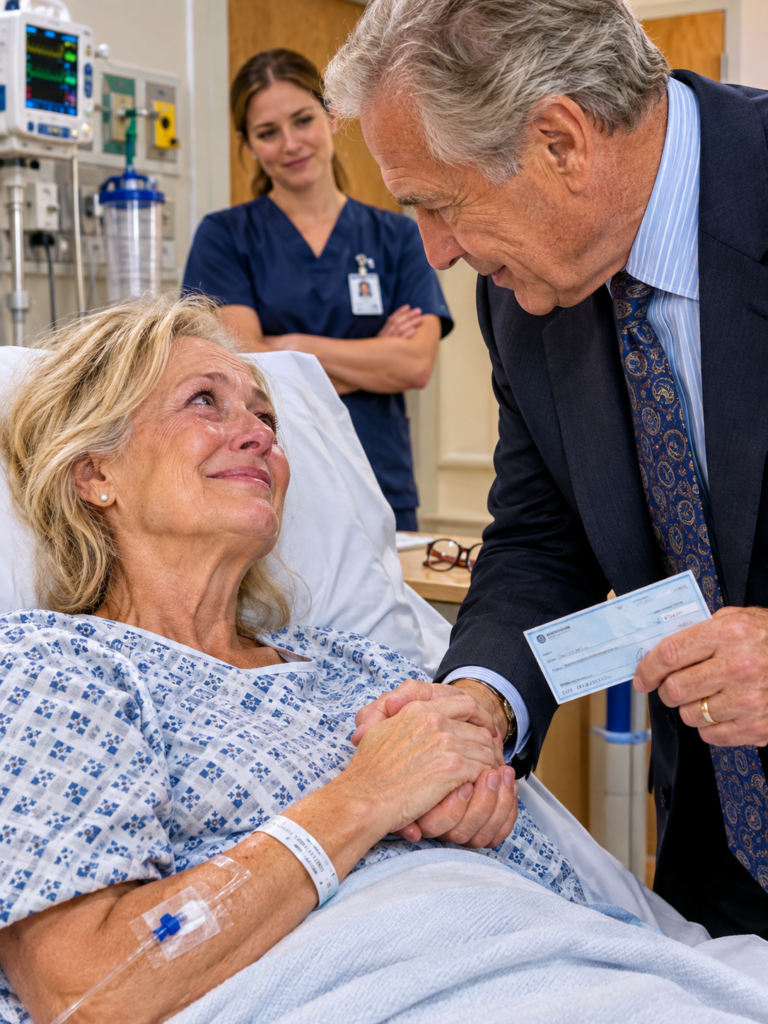
All three were empty.
I turned my head slowly. My neck felt like it was made of wet sand. There was a tube in my arm and a clip on my finger and wires taped to my chest under the hospital gown. A heart monitor ticked beside me, steady and green.
“Hello?” I said. It came out as a croak. My throat felt like someone had sanded it.
A nurse came in a minute later. She was young, maybe twenty-five, with a dark ponytail and pink scrubs and a name tag that said KAYLA, RN. She checked the monitor and smiled at me the way nurses smile at old women.
“There you are, Mrs. Davis. How are you feeling?”
“Thirsty,” I whispered.
She gave me a cup with a straw and held it while I took a sip. The water felt like heaven.
“Where are my kids?” I asked.
She took the cup away. She set it on the tray table. She adjusted my blanket, even though it didn’t need adjusting.
She would not meet my eyes.
“They were here during the surgery,” Kayla said softly. “All three of them. In the family waiting room.”
“Okay.”
“But they left. About an hour ago.”
I lay there and looked at her. I was still foggy from the anesthesia. Everything felt slow and far away, like I was underwater.
“Why?” I asked. “Did something happen? Is somebody sick?”
Her fingers tightened around the tablet she was holding. I watched her knuckles go a little white.
“They said,” she started. She stopped. She tried again. “They said the parking was getting too expensive.”
For a second, I really thought I had heard her wrong. I thought it was the drugs. I actually laughed a little, because it sounded so silly.
“The parking,” I repeated.
Kayla nodded. She looked like she wanted to be anywhere else in the world.
“The garage here is eight dollars an hour,” she said quietly. “After four hours, it’s a flat thirty-two. Your son said they’d already been here almost five hours. He said there was no point paying for another day when you’d just be sleeping anyway.”
I had just come through heart surgery. A valve replacement. The surgeon had told me there was a small chance I wouldn’t wake up at all. I’d signed the forms. I’d made my peace.
And my three children had promised me, every one of them, that they would be there when I opened my eyes.
David said he’d take the whole day off from his accounting office. “Mom, I’ll be right there. First face you see.”
Sarah said she’d bring flowers. Yellow roses, my favorite. “I’ll make the room pretty for you.”
Michael said he’d come straight after his morning sales calls. “Wouldn’t miss it, Ma.”
And they had walked away over thirty-two dollars.
I turned my face toward the window.
I didn’t want her to see. But the tears came before I could stop them. They ran sideways across my face and into my ear and soaked into the pillow.
The heart monitor beside me began beeping faster. Beep, beep, beep, beep.
“Mrs. Davis,” Kayla said, grabbing a tissue box off the counter. “Please. Try not to upset yourself. Your heart needs to rest.”
That only made it worse.
I was sixty-four years old. I had raised three children mostly by myself after my husband, Frank, died. I had worked thirty-one years as a school secretary in the Seattle Public Schools. I’d paid for braces and college applications and car repairs and one wedding.
And I was lying alone in a hospital bed after heart surgery, crying so hard my new valve hurt, because my children decided I wasn’t worth another day of parking.
That’s when I heard footsteps in the hallway.
Heavy, unhurried steps. They stopped right outside my door.
A tall man in a dark suit appeared in the doorway. He had salt-and-pepper hair, cut short. Wire-rimmed glasses. A leather briefcase in one hand. He stood very straight, with the kind of quiet authority that made Kayla immediately stand up straighter and tuck a loose hair behind her ear.
“Excuse me,” he said. His voice was deep and gentle. “Is this Adrienne Davis?”
I wiped my face with the back of my hand. I must have looked terrible. Red eyes. Hair flat on one side. Hospital gown.
“Yes,” I said. “That’s me.”
Chapter Two: The Lunch Card
He stepped into the room. When he got close enough to really see me, his expression changed. Something softened behind his glasses.
“Mrs. Davis,” he said. “You don’t remember me.”
I stared at him. I had no idea who he was. A doctor? Someone from the insurance company? A lawyer?
He set his briefcase down on one of the empty chairs.
“But you paid for my lunch,” he said, “every day in third grade.”
The room seemed to go still. Even the heart monitor seemed to slow down.
I searched his face. I tried to find something familiar in it. He was in his fifties, maybe. Successful. Expensive suit. Good shoes. Nothing about him looked like anybody I’d ever known.
“I’m sorry,” I said. “I don’t…”
“Malcolm,” he said. “Malcolm Peterson. I became Malcolm Chen after I was adopted. When I was ten.”
And suddenly, I saw him.
Franklin Elementary School, in South Seattle. 1978.
A thin little boy at the end of the long cafeteria table. Dark hair that stuck up in the back no matter what. A plaid shirt three sizes too big, sleeves rolled up four times. Sneakers with the toes worn through.
Brown eyes that always dropped down to the table at lunchtime, while the other kids opened their brown paper bags and their metal lunch boxes with cartoon characters on them.
He never had a lunch. Not once. He’d sit there with his hands in his lap and watch the other kids eat, and when anyone looked at him, he’d pretend to be reading something.
“You were hungry,” I whispered.
Malcolm nodded slowly.
“You noticed,” he said.
The memory came back in pieces.
I was sixteen that year. My father had hurt his back at the shipyard, and my family needed money. So I took a job as a teacher’s aide at Franklin, three afternoons a week and every lunch period. I helped in the classrooms. I watched the cafeteria. I made a dollar ninety an hour.
School lunches cost forty cents back then. I know he said three dollars, but that’s how he remembered it, and to a hungry eight-year-old forty cents might as well be a fortune.
I didn’t have much. But on the second day, I bought a strip of lunch tickets from the cafeteria office with my own money. And every day after that, I’d walk past Malcolm’s table and slip a ticket under his elbow.
“The cafeteria made extras today,” I told him. “Somebody needs to eat them, or they’ll go in the trash.”
He’d look up at me with those big brown eyes. Then he’d go get in line.
I never told him the truth. I never told anyone. Not my parents, not my friends. I spent almost half my tiny paycheck on those tickets, every week, for the whole school year.
Malcolm pulled one of the empty chairs over beside my bed. The chair where David was supposed to be sitting.
Kayla cleared her throat.
“Sir,” she said, a little nervously. “I’m sorry, but visiting hours on the cardiac floor are limited right after surgery. Unless you’re immediate family.”
Malcolm glanced at her. He didn’t seem annoyed. Just calm.
“I’m Dr. Malcolm Chen,” he said. “I own this hospital.”
Kayla’s eyes went wide. Her mouth opened and closed.
Mine probably did too.
“Oh,” Kayla said. “Oh. I’m so sorry, Dr. Chen. I didn’t recognize you. I’ll just… I’ll give you some privacy.”
She practically ran out of the room.
After she left, Malcolm sat quietly beside me for a moment. Then he reached into his briefcase and pulled out something small.
An old yellow lunch ticket. Cardboard, the size of a playing card, with FRANKLIN ELEMENTARY printed across the top in faded blue letters. Soft and fuzzy at the edges, the way paper gets when it’s been handled for decades.
“I kept the last one you gave me,” he said. “In June. The last day of school. You gave me two that day, and I only used one.”
He put it in my hand.
My hand shook as I held it. I couldn’t believe it was real. Forty-six years, and he’d kept a piece of cardboard.
“Why?” I asked.
He looked down at his own hands for a moment.
“That summer, my mother left,” he said. “For good. I went into foster care in August. Three homes in two years. Some of them were fine. One of them wasn’t.”
He paused.
“I carried that ticket in my shoe,” he said. “Every day. Under the insole. When I thought nobody in the whole world cared whether I ate or not, I’d take it out and look at it. And it reminded me that one person did.”
I started crying again. But this time, it wasn’t for the same reason.
He told me the rest of his story while I held that little yellow ticket.
When he was ten, a couple named Robert and Grace Chen adopted him. Robert was a pharmacist and Grace taught piano. They gave him a room with a window and three meals a day and a name that meant he belonged somewhere.
He went to the University of Washington. Then medical school. He became an internist, then a hospital administrator. Eventually, he and a group of partners bought a struggling hospital in Tacoma and turned it around. Then another one in Spokane. Then this one, in Seattle. Then one in Portland.
“Four hospitals,” he said. “Across the Pacific Northwest.”
“Four hospitals,” I repeated. I couldn’t wrap my head around it. The little boy in the plaid shirt.
“And every one of them,” he said, “has a program that makes sure no child who comes through our doors goes hungry. Kids in treatment. Kids whose parents are in treatment. Kids in the emergency room waiting with a sick grandmother. Every one of them gets a meal ticket at the front desk. No questions. No forms.”
“Because of one lunch ticket?” I asked.
He looked at me.
“Because of you,” he said.
For the first time that whole afternoon, the room didn’t feel so cold.
Chapter Three: The Folder
Then Malcolm looked over at the two empty chairs against the wall.
“Where are your children, Adrienne?”
The warmth disappeared.
“They left,” I said.
His eyes narrowed slightly behind his glasses. “Why?”
I swallowed. It felt like swallowing a stone.
“The parking was too expensive.”
He didn’t say anything for a long time. Maybe ten seconds. I watched his jaw move.
Then he reached out and took my hand. The one that wasn’t holding the lunch ticket. He held it very gently, the way you’d hold a bird.
“I’ve been looking for you for years, Adrienne,” he said.
Something in his voice had changed. It wasn’t sentimental anymore. It was serious. Careful. The voice of a doctor about to give you test results.
“I wanted the chance to thank you,” he said. “To repay what you did for me. But I also wanted to make sure you were all right.”
I looked at him.
“What does that mean?”
He didn’t answer right away. He let go of my hand and reached into his briefcase again.
This time, he pulled out a thick manila folder. It had a rubber band around it.
My heart monitor started picking up speed. I could hear it. Beep. Beep. Beep.
“Adrienne,” he said, “I need to tell you some things. And some of them are going to be hard to hear. I’m sorry I have to do it today, of all days. But I don’t think it can wait.”
I stared at the folder.
“How did you find me?” I asked.
“It took a long time,” he said. “I didn’t know your last name. Just Miss Adrienne. I called Franklin Elementary every few years. Old records were gone. Then last spring I hired a researcher who went through the district’s archived payroll from 1978. Teacher’s aides. There was only one Adrienne.”
“Adrienne Kowalski,” I said. “That was my maiden name.”
“Adrienne Kowalski,” he agreed. “Who married Frank Davis in 1983, had three children, and worked as a school secretary at Whitman Middle School for thirty-one years.”
“Once I found your name,” he said, “I wanted to know how you were doing before I just showed up. I didn’t want to embarrass you. If you were doing well, I was going to send a letter. If you were struggling, I wanted to help without making a big thing of it.”
He tapped the folder.
“So the researcher did a little more looking. Public records, mostly. And a few conversations.”
“And?” I said.
He looked at me steadily.
“I know you live on a small pension from the school district and your Social Security,” he said. “About thirty-one hundred a month together.”
I didn’t say anything. It was exactly right.
“I know you lent David sixty thousand dollars two years ago when his accounting practice was struggling,” he said. “From your savings. There’s a promissory note recorded with his business loan file. He hasn’t made a payment on it.”
My face went hot.
“I know you’ve been paying Sarah’s credit card bills,” he went on gently. “About eight hundred a month, for almost three years.”
“How do you know that?”
“Your bank reported it as a recurring transfer when she was added as an authorized user. It showed up in a credit report pulled on her last year. I’m not proud of how much a determined researcher can find, Adrienne. But it’s all out there.”
“And Michael?”
“You co-signed his car loan,” Malcolm said. “A Ram truck. Forty-one thousand dollars. He’s missed four payments. The lender’s been sending notices to your house.”
I closed my eyes.
All true. Every word. I’d never told anybody. Not my sister, not my friends at church. Because what kind of mother complains about helping her children?
“They’re my kids,” I said. “That’s what you do.”
“I know,” Malcolm said.
Then his voice dropped lower.
“And I know your children have been asking questions about your finances.”
My stomach tightened.
“What kind of questions?”
Malcolm opened the folder. But he didn’t hand me anything yet.
“Three weeks ago,” he said, “David met with an attorney. A man named Bradley Voss. He has an office in Bellevue. He specializes in elder law.”
I felt cold. Colder than the hospital air.
“Two weeks ago, Sarah toured three assisted-living facilities. One in Lynnwood, one in Shoreline, one in Everett. She told them she was looking for a placement for her mother. She asked about memory care.”
My fingers closed around the hospital blanket.
“Memory care,” I said. “I don’t need memory care. I do the crossword in pen.”
“I know,” Malcolm said.
“And Michael,” he said, “has been asking around about the process for having an older parent declared unable to manage her own affairs. He asked a paralegal at his gym. She told a friend. The friend happened to be my researcher’s cousin.” He shook his head. “Seattle’s a small town, sometimes.”
“No.”
The word came out of me before I could stop it.
“They wouldn’t,” I said. “They wouldn’t do that.”
Malcolm’s face stayed gentle. He didn’t argue. He just looked at me with those same brown eyes I remembered from the end of a cafeteria table.
“I hoped I was wrong,” he said.
“They’re my children.”
“I know.”
“They love me.”
“I’m sure,” Malcolm said quietly, “they would say they do.”
That answer frightened me more than any accusation would have.
Chapter Four: The Highlighted Sentence
Outside, the rain finally started. It tapped against the window, soft at first, then harder.
I looked at the empty chairs where David and Sarah and Michael were supposed to be sitting.
Then I looked at the folder in Malcolm’s hands.
“Why are you telling me this now?” I asked. “Today? Of all days?”
His jaw tightened.
“Because today was the test,” he said.
I stopped breathing for a moment.
“I found you in August,” Malcolm said. “I was going to come to your house. Knock on your door. Bring you flowers and tell you who I was. Then my researcher brought me this.” He touched the folder. “And I didn’t know what to do.”
“Why not just tell me?”
“Because I’m a stranger,” he said. “I’m a man you haven’t seen in forty-six years. If I’d shown up on your porch and told you your children were planning to have you declared incompetent, would you have believed me?”
I didn’t answer. I knew I wouldn’t have.
“Then I learned you were scheduled for surgery here,” he said. “In my hospital. And I thought, let’s see. If they’re good children who are just worried about their mother, they’ll be here. They’ll stay. They’ll be holding her hand when she wakes up. And I’ll come by later with flowers and a thank-you, and I’ll throw this folder in the shredder, and nobody will ever know.”
He looked toward the hallway, where my children had disappeared an hour ago.
“I hoped that when you needed them most,” he said, “they would stay.”
He paused.
“They didn’t.”
Then Malcolm pulled the first document halfway out of the folder.
I saw letterhead. VOSS ELDER LAW GROUP, PLLC. Bellevue, Washington.
I saw my name.
And one sentence, about halfway down the page, highlighted in bright yellow marker.
Before I could read it, Malcolm looked directly into my eyes.
“Adrienne,” he said. “The parking fee wasn’t the real reason they left.”
He handed me the page.
My reading glasses were in my purse, wherever my purse was. I held the paper at arm’s length and squinted.
It was a letter, dated two days earlier. It was addressed to the Health Information Management Department at my hospital. This hospital.
RE: Request for Medical Records and Capacity Evaluation, Patient Adrienne M. Davis.
I read the highlighted sentence. Then I read it again.
Petitioners intend to file for emergency appointment of a guardian and conservator on the afternoon of the Respondent’s surgery, while she remains hospitalized, as her post-operative condition will provide timely support for a finding of incapacity.
I didn’t understand at first. The words just sat there.
Then they didn’t.
“The afternoon of my surgery,” I said slowly.
“Today,” Malcolm said.
“They left,” I said, “to go file papers. Today. While I was asleep.”
“Mr. Voss’s office in Bellevue closes at five,” Malcolm said quietly. “It’s a forty-minute drive in traffic. They left here at two-fifteen. The emergency petition has to be filed with King County Superior Court before the clerk’s office closes at four-thirty.”
I looked at the clock on the wall. 3:47.
“They’re there right now,” I whispered.
“Probably,” Malcolm said.
The heart monitor started beeping so fast that Kayla came running back in.
“Mrs. Davis? Are you okay? Dr. Chen, her rate is…”
“I know,” Malcolm said. He was already standing up. He put his hand on my shoulder. “Adrienne. Breathe with me. In for four. Out for four. That’s it. That’s it.”
I breathed. In for four. Out for four. Kayla adjusted something on my IV. The beeping slowed.
When I could talk again, I looked at Malcolm.
“How did you get this?” I asked. “This letter.”
“It came to our records department this morning,” he said. “Because it asked one of our physicians to perform a capacity evaluation on you after surgery, it got flagged to our risk management office. Our general counsel called me an hour ago.”
“Did you do it? The evaluation?”
“No,” he said firmly. “Nobody evaluates you without your consent. Nobody releases your records without your authorization. That’s the law, and that’s my rule.” He paused. “But you’re the patient. And you have a right to know what’s being asked about you. So I came to tell you myself.”
Chapter Five: What They Wanted
I made Malcolm read me the rest of the folder. All of it. Slowly.
I needed to hear it out loud. I needed to know.
Kayla brought me a cup of ice chips and stood in the corner, pretending she wasn’t listening. Malcolm didn’t send her away. “She should hear it too,” he said. “If anybody comes to this floor asking about you tonight, I want the nurses to know.”
It was about my house.
Of course it was.
Frank and I bought a little two-bedroom bungalow in Ballard in 1986. Green with white trim, a front porch with a swing, a big cherry tree in the backyard that the kids used to climb. We paid ninety-four thousand dollars for it. Frank’s father lent us the down payment.
When Frank died nine years ago, the house was paid off. I still lived there. I still swung on the porch swing in the evenings.
According to the folder, it was now worth one million, one hundred and fifty thousand dollars.
“David’s practice is in trouble,” Malcolm said, reading from a page. “Serious trouble. He owes the IRS about a hundred and forty thousand dollars in unpaid payroll taxes. They’ve filed a lien. If he doesn’t pay, he could lose his CPA license.”
“He never told me,” I said.
“Sarah owes about sixty thousand on credit cards,” Malcolm went on. “Even with what you’ve been paying. And Michael’s truck is about to be repossessed. Which would hit your credit too, since you co-signed.”
I closed my eyes.
“So they need money,” I said.
“They need a lot of money,” Malcolm said. “And you’re sitting on a million-dollar house with no mortgage.”
He turned to another page. A draft of the petition, attached to Voss’s letter.
It asked the court to appoint David as my guardian and conservator. If the judge agreed, David would have legal authority over my medical care, where I lived, and all of my money and property.
It said I had become “increasingly forgetful” and “unable to manage finances.” It said I had “failed to pay bills on time.” It said I had “made imprudent financial decisions, including large unsecured loans.”
“The loans,” I said. “The loans I made to them.”
“Yes,” Malcolm said.
“They’re using the money I gave them,” I said, “to say I’m not smart enough to handle money.”
He didn’t say anything. He didn’t have to.
The last page was a printout from Sarah’s email. A reply from an assisted-living facility in Everett called Evergreen Terrace.
Thank you for your interest. We do have a semi-private room available in our memory care wing starting November 1st. Monthly cost is $7,400. As discussed, if the resident’s home is sold, proceeds can be placed in a managed account to cover long-term care costs.
“November first,” I said.
That was two weeks away.
I sat there in my hospital bed and looked out at the rain.
I thought about Sarah at seven, in a pink tutu, falling off the stage at her dance recital and getting right back up. I thought about Michael at four, crying because a worm got stepped on, and making me bury it in the backyard with a little stick for a cross. I thought about David at ten, doing my checkbook with me at the kitchen table, so proud he could add faster than me.
David. Who was going to stand up in front of a judge and say I couldn’t add.
“Adrienne,” Malcolm said quietly. “You don’t have to decide anything right now. You just had heart surgery.”
“Yes, I do,” I said.
I turned back to him. My voice was steady. I was surprised by that.
“Dr. Chen,” I said. “I need a lawyer. And I need one today.”
Chapter Six: Gloria
Her name was Gloria Nakamura.
She arrived at my hospital room at 5:20 that evening, in a rain-soaked trench coat, carrying a laptop bag and an umbrella that had turned inside out. She was about sixty, tiny, with short gray hair and bright red reading glasses.
“Mrs. Davis,” she said, shaking my hand very gently, so as not to bump the IV. “Dr. Chen told me about your afternoon. I’m so sorry.”
“Are you expensive?” I asked.
She laughed. “Very. But Dr. Chen says that’s not your problem today.”
I looked at Malcolm, who was standing by the window.
“I’m not going to let you…”
“You’re not letting me do anything,” he said. “Gloria is my friend. She owes me a favor from about twenty years ago. I’m calling it in. That’s all.”
Gloria had done elder law in Seattle for thirty years. She’d seen it all, she said. Sons who drained accounts. Daughters who forged signatures. Nephews who moved Grandma into a nursing home and sold her house before the paint dried.
“Here’s what you need to understand,” she said, sitting on the edge of the empty chair. “In Washington, guardianship is supposed to be a last resort. The law changed a few years ago. Courts are supposed to use the least restrictive option. They’re supposed to protect the person’s rights.”
“But?”
“But an emergency petition, filed right after heart surgery, with a family saying you’re confused and forgetful?” She shook her head. “A busy court commissioner might grant temporary powers just to be safe. Until there’s a full hearing. That’s what they’re counting on. Once David has temporary authority, he can start moving money. He can put you in that facility in Everett. He can list your house.”
“Can’t I just say no?”
“You can,” Gloria said. “And you will. But we need to do more than say no. We need to show them.”
She called the King County Superior Court clerk’s office from my hospital room. It was 5:45. The office was closed, but she had a number.
She hung up three minutes later.
“Filed at 4:22 p.m.,” she said. “Eight minutes before the window closed. David Davis, Petitioner. Sarah Davis-Ruiz and Michael Davis joining. Emergency motion for appointment of temporary guardian and conservator. Hearing set for Thursday morning at nine.”
“Thursday,” I said. “That’s two days.”
“That’s two days,” Gloria agreed. She pulled out a yellow legal pad. “So let’s get to work.”
Here’s what we did that night.
First, Gloria drafted a revocation of the medical power of attorney I’d signed years ago, naming David as my health care agent. I signed it right there in my hospital bed, with a notary who happened to be on staff in the hospital’s legal office. Malcolm made a phone call and she was there in fifteen minutes.
Second, I signed a new health care directive naming my oldest friend, Joyce Whitaker, from church. Joyce had been my friend for forty years. She’d driven me to every cardiology appointment for the last six months, because my kids were “too busy.”
Third, I signed a new durable power of attorney for finances. Also naming Joyce. Effective only if two doctors certified that I was incapacitated.
Fourth, I signed a letter instructing the hospital not to release any information about me to David, Sarah, or Michael without my written permission.
My hand was shaking by the end. But every signature was mine.
“One more thing,” Gloria said. “The most important thing.”
“What?”
“You need an independent capacity evaluation,” she said. “Not by anyone they picked. Not by anyone at this hospital, so nobody can say Dr. Chen influenced it. By a board-certified geriatrician who’s never met you. As soon as your doctors say you’re medically stable enough.”
“I’m stable,” I said.
“You had heart surgery six hours ago.”
“I do the crossword in pen,” I said.
Gloria looked at me over her red glasses. Then she smiled.
“I’ll call Dr. Elena Ruiz in the morning,” she said. “She’s the best in Seattle. And she can’t stand people who try to take old women’s houses.”
Chapter Seven: The Flowers
My children came back the next morning.
It was Wednesday, a little after ten. I was sitting up in bed eating red Jell-O. My chest hurt, but my head was clear. The surgeon had been by at eight and said everything looked “textbook.”
I heard them before I saw them. Sarah’s laugh in the hallway. Michael saying something about the vending machine. David telling them both to keep it down.
Then they came through the door.
Sarah first, carrying a big bouquet of yellow roses wrapped in cellophane. Michael behind her with a balloon that said GET WELL SOON. David last, in his gray work suit, holding a manila envelope.
“Mom!” Sarah said brightly. “Look at you! You’re awake!”
She came over and kissed my cheek. She smelled like perfume and coffee. She set the roses on the tray table, right next to my Jell-O.
“We were here all day yesterday,” she said. “You were so out of it. We didn’t want to wake you.”
“The nurse said you left,” I said, “because of the parking.”
Sarah’s smile flickered. Just for a second.
“Oh, that was Michael,” she said with a little laugh. “He was being dramatic. You know how he is.”
“Hey,” Michael said. He tied the balloon to the foot of my bed. “It was thirty-two bucks, Ma. That’s highway robbery.”
“Thirty-two dollars,” I said. “That’s highway robbery.”
He grinned. He didn’t hear what I meant. Michael never did.
David came around the other side of the bed. He kissed my forehead. He pulled up a chair.
“How are you feeling, Mom?”
“Sore,” I said. “But okay.”
“Good. That’s good.” He set the manila envelope on his lap. He smoothed it out with both hands. “Listen. While you’re in here, there’s some insurance stuff we need to take care of. Just some forms. Boring stuff. So we can handle your bills while you recover.”
“What kind of forms?”
“Just a power of attorney,” David said easily. “Updated. The old one’s from 2016. The insurance company wants a newer one. So I can talk to them for you.”
He slid a document out of the envelope. He uncapped a pen. He held both out to me.
“Just sign on the last page,” he said. “Where the yellow tab is.”
I didn’t take the pen.
I looked at my son. My oldest. He had Frank’s chin and Frank’s way of tilting his head when he wanted something. He was forty years old. He had a wife and two kids and a house in Kirkland with a three-car garage.
“Can I read it first?” I asked.
David’s smile tightened. “Mom. It’s twelve pages of legal language. You just had surgery. You don’t want to…”
“I’d like to read it,” I said.
“Mom, come on. We don’t have all day. Parking’s…”
He stopped.
The room went very quiet.
Sarah looked at the floor. Michael looked at the balloon.
“Parking’s expensive,” I said softly. “I know.”
I held out my hand. David hesitated. Then he gave me the document.
I put on my reading glasses. Joyce had brought them, along with my purse and a nightgown, at seven that morning.
I read the first page. Durable General Power of Attorney. Effective immediately. Grants the agent full authority to buy, sell, mortgage, or transfer any real property of the principal.
I read the second page. Authority to make gifts. Authority to change beneficiaries. Authority to transfer assets into trusts.
I turned to the last page. The yellow tab. Agent: David Francis Davis.
I set it down on my blanket.
“This isn’t an insurance form, David,” I said.
Chapter Eight: Malcolm Comes In
David’s face changed. All the warmth slid off it, like snow sliding off a roof.
“Mom,” he said carefully. “You’re confused. It’s the anesthesia. They said this might happen.”
“I’m not confused.”
“You’re not thinking clearly. That’s okay. That’s normal after what you went through.”
“I’m thinking very clearly, David.” I took off my reading glasses. “This gives you the power to sell my house. Today. Without asking me.”
“It’s for your protection!”
“Protection from what?”
He didn’t answer. He looked at Sarah. Sarah looked at the floor.
That’s when someone knocked on the doorframe.
Malcolm stood there. Dark suit. Briefcase. Gloria Nakamura was beside him with her red glasses and her laptop bag. And behind them, a woman I didn’t know yet. Fifties, silver earrings, a white coat with a hospital badge from a different hospital. Swedish Medical Center.
“Good morning,” Malcolm said pleasantly. “I hope we’re not interrupting.”
David stood up. “Who are you?”
“Malcolm Chen,” he said. “I’m a friend of your mother’s.”
“A friend?” David laughed. “Mom doesn’t have any friends who look like you.”
“Actually,” Malcolm said, “I’ve known her longer than you have.”
Gloria stepped forward. She held out a business card.
“Gloria Nakamura,” she said. “I represent your mother.”
David took the card. He read it. His face went pale.
“Represent her?” Sarah said. “For what? She doesn’t need a lawyer.”
“She does,” Gloria said, “since you filed a petition yesterday afternoon at 4:22 asking the King County Superior Court to appoint David as her emergency guardian and conservator.”
The room went dead silent. Even the heart monitor seemed to hold its breath.
Michael turned around slowly from the balloon. “Wait. What? We didn’t file it yet. Bradley said he was going to file it Friday.”
“Michael,” David said sharply.
“You told me Friday!”
“Michael, shut up.”
Gloria opened her laptop bag. She took out a stapled stack of papers.
“Your mother revoked her old health care power of attorney yesterday evening,” she said. “At 6:10 p.m. She’s executed a new one naming someone else. She’s also executed a new financial power of attorney, a new health care directive, and a written instruction to this hospital not to release her records to any of you.”
She set the papers on my tray table, next to the roses.
“And,” Gloria said, “your mother had an independent capacity evaluation at eight-thirty this morning.”
She turned to the woman in the white coat.
“This is Dr. Elena Ruiz. Board-certified in geriatric medicine. Twenty-two years. She’s testified in more than a hundred guardianship cases in this county.”
Dr. Ruiz stepped into the room. She had a calm, no-nonsense face.
“I evaluated Mrs. Davis for ninety minutes,” she said. “Cognitive testing. Executive function. Financial judgment. Memory. Orientation. She scored twenty-nine out of thirty on the Montreal Cognitive Assessment. The one point she missed was because she couldn’t see the picture of the camel without her glasses.”
I almost laughed. It had looked like a dog.
“She understands her finances,” Dr. Ruiz went on. “In detail. She could tell me her monthly income to the dollar. She knows the value of her house. She knows the balance of her savings account. She knows exactly how much she’s loaned to each of you.”
She looked at David.
“In my professional opinion,” she said, “Mrs. Davis has full capacity to make her own medical, financial, and personal decisions. My report will be filed with the court by noon.”
David’s mouth opened. Then it closed.
“She’s sixty-four,” he said finally. “She just had heart surgery. She’s forgetful. She forgot my daughter’s birthday last month.”
“I didn’t forget it,” I said. “I didn’t have the money for a present because I paid Michael’s truck payment. The lender called me. I called Emma and told her I’d take her for ice cream instead. She was fine with it.”
Michael flinched.
“And the bills,” David said. “She’s been late on bills.”
“I’ve been late on bills,” I said, “because I’ve been paying your sister’s credit cards and covering your brother’s truck and waiting for you to pay me back sixty thousand dollars.”
He stared at me.
“I’m not forgetful, David,” I said. “I’m broke. Because of you.”
Chapter Nine: Sarah
David turned on Malcolm.
“I don’t know who the hell you are,” he said, “but you’ve been filling her head with garbage. You’re some kind of con man. You’ve been working on her. Trying to get your hands on the house yourself.”
“David,” I said.
“No, Mom! Who is this guy? Some rich stranger shows up the day of your surgery and suddenly you have a lawyer and a new power of attorney and…”
“He owns this hospital,” Sarah said quietly.
Everyone turned to look at her.
She was standing by the window with her arms wrapped around herself. Her face had gone white. She was looking at Malcolm.
“Dr. Malcolm Chen,” she said. “Chen Health. I saw his picture on the wall in the lobby on the way in. He owns this hospital. And three others.”
David stopped.
“Why would the owner of a hospital want Mom’s little house?” Sarah said. Her voice was shaking. “Come on, David. Think about it for one second.”
David opened his mouth. He didn’t have anything to say.
Sarah looked at me. Her eyes were filling with tears.
“I didn’t want to do it, Mom,” she said. “I swear to God. I told David I didn’t want to.”
“Sarah,” David snapped.
“No. No, I’m done.” She wiped her eyes. “David came to me in August. He said you were getting old. He said you were making bad decisions. Giving away money. He said if we didn’t do something, you’d lose the house and end up on the street, and we’d all have to take care of you.”
“I was giving money to you,” I said quietly.
“I know.” She was crying now. “I know, Mom. I knew it the whole time. That’s the worst part. He said the guardianship would protect you. And he said that once the house was sold, there’d be enough for your care and some left over for each of us. And I needed it so bad. I’m so far underwater on these cards. I can’t even open my mail anymore.”
“So you went looking at memory care,” I said. “In Everett.”
She flinched like I’d slapped her.
“How do you know about that?”
“Seven thousand four hundred dollars a month,” I said. “Semi-private room. Available November first.”
Sarah put both hands over her face.
“I went to look,” she said through her fingers. “And I sat in the parking lot afterward and cried for an hour. Because there was a lady in a wheelchair in the hallway, and she kept asking everybody if they’d seen her daughter. Over and over. And nobody had.”
“Then yesterday,” Sarah said, wiping her face with her sleeve, “we were sitting in the waiting room. And David got a text from Bradley’s office. And he said, we have to go. Now. If we get the petition in today, while she’s still in the hospital, the judge will grant it for sure. Because she’ll be on drugs and confused, and it’ll look bad.”
She looked at Michael.
“And Michael said what about Mom, she’s going to wake up alone. And David said tell the nurse it’s the parking. She won’t even remember tomorrow.”
The room was silent.
I looked at David.
“She won’t even remember,” I said.
David didn’t say anything. He sat back down in his chair. He put his head in his hands.
Michael was standing by the balloon, looking like a little boy who’d been caught breaking a window.
“Ma,” he said. “I’m sorry. I didn’t… David said it was the right thing. He said he’d handle everything. He said I wouldn’t lose the truck.”
“You were going to put me in a home,” I said, “to save your truck.”
He didn’t answer. He started crying. Big, ugly, little-boy tears.
Malcolm hadn’t said a word through all of it. He was standing by the door with his briefcase, very still.
Now he stepped forward. He looked at my three children one by one.
“I’m going to say something,” he said quietly. “And then I’m going to leave, because this is your family and not mine.”
Nobody stopped him.
“When I was eight years old,” he said, “I didn’t have anything to eat. Every single day. For a whole year. My mother was sick, and we lived in a car for part of that winter. The other kids at school knew. They called me names.”
He looked at me.
“Your mother was sixteen. She was working because her own family didn’t have money. And every day, she put a lunch ticket under my elbow and told me the cafeteria had extras. She spent half of everything she earned. She never told a soul. Not then. Not in forty-six years. She didn’t do it to be thanked. She did it because she saw a hungry kid and she couldn’t walk past.”
He turned back to David.
“That’s who you were going to take to court,” he said. “That’s who you were going to tell a judge couldn’t manage her own life. A woman who’s been taking care of everybody, quietly, her whole life. Including you three.”
He picked up his briefcase.
“I’ve worked in hospitals for thirty years,” he said. “I’ve watched thousands of people die. You know what the ones at the end almost never say? I wish I’d gotten more money. They say, I wish my kids were here.”
He walked to the door. Then he stopped and looked back.
“She almost didn’t wake up yesterday,” he said. “And you weren’t here.”
Then he left.
Chapter Ten: Thursday
The hearing on Thursday took eleven minutes.
I wasn’t there in person. I was still in the hospital, recovering. Gloria set up a video call on a laptop on my tray table, and I watched it from my bed in my nightgown, with Joyce sitting next to me holding my hand.
The court commissioner was a woman named Patricia Lin. She looked at the petition. She looked at Dr. Ruiz’s report. She looked at the revocation of David’s power of attorney, and my new documents, and a declaration from Kayla, the nurse, about what my children said when they left.
Then she looked at Bradley Voss, the attorney from Bellevue, who looked very uncomfortable in his expensive suit.
“Mr. Voss,” she said. “Does your client wish to proceed with this petition?”
Bradley Voss turned around and whispered something to David.
David was sitting in the courtroom alone. Sarah and Michael weren’t with him. I found out later that Sarah had called Bradley Voss’s office on Wednesday afternoon and withdrawn her name from the petition. Michael had done the same an hour later.
David sat there for a long moment. I watched him on the little laptop screen. He looked so much like his father. Frank used to sit like that, with his elbows on his knees, when he’d lost something and didn’t know how to find it.
He shook his head.
“No, Your Honor,” Voss said. “My client withdraws the petition.”
Commissioner Lin made a note.
“The petition is dismissed,” she said. “With prejudice. Petitioner is ordered to pay the respondent’s reasonable attorney’s fees and costs.” She looked up at the camera, straight at me. “Mrs. Davis, can you hear me?”
“Yes, ma’am.”
“I’m sorry you had to deal with this while recovering from surgery,” she said. “I hope your recovery goes well. And I hope your family finds its way back to you.”
“Thank you,” I said.
The screen went dark.
Joyce squeezed my hand. “That’s it?”
“That’s it,” Gloria said. She closed her laptop. “Your house is yours. Your money is yours. Your life is yours.”
I lay back against my pillows. I closed my eyes. I didn’t cry. I was too tired to cry.
Gloria sent the bill for her fees to David’s attorney. It came to $14,860.
I found out a few weeks later that David paid it. Every dollar. He took it out of the line of credit on his house in Kirkland.
He also sent me something in the mail. A cashier’s check for five thousand dollars, and a promissory note, signed and notarized, agreeing to pay the remaining fifty-five thousand dollars he owed me at one thousand dollars a month.
There was no letter. Just the check and the note in a plain envelope.
On the memo line of the check, he’d written: 1 of 56.
Chapter Eleven: What Malcolm Did Next
I went home from the hospital the following Monday.
Joyce drove me. When we pulled up in front of my little green house in Ballard, there was a white van in the driveway with a logo on the side. Puget Sound Home Care.
A woman in blue scrubs was sitting on my porch swing.
“Mrs. Davis?” she said, standing up. “I’m Leticia. I’m your home health nurse. I’ll be here every morning for the next six weeks. Dr. Chen arranged it.”
I looked at Joyce. Joyce looked at me.
“I can’t afford a home nurse,” I said.
“It’s already paid for,” Leticia said. “The whole six weeks. He said you’d say that.”
Malcolm came by that Friday. He brought a bag of groceries and a bouquet of yellow roses.
Not from a florist. From the grocery store. Wrapped in plastic, with the price tag still on. $12.99.
“I wasn’t sure what kind you liked,” he said. “Sarah said yellow.”
“Sarah talked to you?”
“She called me,” he said. “Wednesday. To apologize. And to say thank you for telling the truth.”
I didn’t know what to say. I put the roses in water in my kitchen.
We sat on my porch swing that afternoon. The rain had stopped for once. The cherry tree in the backyard was bare, and the air smelled like wet leaves.
“I have something to ask you,” Malcolm said.
“Uh oh.”
He smiled. “Hear me out.”
He pulled a folder out of his briefcase. Not a thick one this time. Just a few pages.
“The children’s meal program at our hospitals,” he said. “The one I told you about. It’s grown a lot. We fed about forty thousand kids last year. Kids in treatment, kids in the ER, siblings, kids waiting with grandparents. It needs someone to run it. Someone who understands what it’s like to be hungry. And what it’s like to notice.”
I stared at him.
“I’m sixty-four,” I said. “I just had heart surgery.”
“It’s part-time,” he said. “Twenty hours a week. From home, mostly, with a few visits. Forty-two thousand a year. Full benefits.” He paused. “And free parking at all four hospitals.”
I laughed so hard my sternum hurt.
“Why me?” I asked, when I could breathe again.
“Because you’re the only person I know,” Malcolm said, “who would hand a hungry child a lunch ticket and say the cafeteria made extras. You never made me feel like a charity case. Not once. I want every kid in my hospitals to feel the way you made me feel.”
He put the folder on my lap.
“Think about it,” he said. “No rush.”
“I’ve thought about it,” I said. “Yes.”
There was one more thing. I didn’t find out about it until a month later, when Joyce drove me back to the hospital for my follow-up appointment.
We pulled into the parking garage. Joyce reached for her wallet as we came up to the ticket machine.
There was a new sign posted beside it. Big blue letters on a white background.
EFFECTIVE IMMEDIATELY: PARKING IS FREE FOR ALL FAMILY MEMBERS OF ADMITTED PATIENTS. NO TIME LIMIT. CHEN HEALTH. NO ONE SHOULD HAVE TO LEAVE A LOVED ONE BECAUSE OF THE COST OF STAYING.
Joyce read it out loud. Then she turned and looked at me.
“Did he do that because of you?” she asked.
I couldn’t answer. I just sat there in the passenger seat, looking at that sign, while the cars honked behind us.
Chapter Twelve: The Extras
It’s been almost a year now.
My heart is strong. The surgeon says I’ll probably outlive him. My little green house in Ballard is still mine. The cherry tree bloomed in April, so pink and full it looked like a cloud had landed in the backyard.
I run the Children’s Table program for Chen Health. That’s what we named it. I picked the name. I work three days a week, mostly from my kitchen table, and one day a week I visit the hospitals. We fed fifty-three thousand children this year. Every single one of them got a meal ticket at the front desk, with no forms, no questions, and no one making them feel small.
On the back of every ticket, in small letters, it says: The cafeteria made extras today.
David has made eleven payments. He’s never missed one. He sold his practice in the spring, paid off the IRS, and took a job as a staff accountant at a hospital in Bellevue. Not one of Malcolm’s. He said he needed to do it on his own.
He came to the house in June for the first time since the hospital. He stood on my porch for a long time before he knocked. When I opened the door, he couldn’t look at me.
“I don’t know how to say it, Mom,” he said.
“Then don’t say it yet,” I said. “Come in and have coffee.”
We sat at the kitchen table. We didn’t talk about the hospital. We talked about his kids. About Emma’s piano lessons. About the Mariners. At the end, at the door, he hugged me. A real hug. The first one in years.
“I’m going to keep paying,” he said into my shoulder.
“I know you are,” I said.
Sarah comes every Sunday now. She paid off two of her cards by selling her car and taking the bus. She found a financial counselor through her church. She’s still working on the rest.
We have lunch. Sometimes she helps me in the garden. Last month, while we were pulling weeds by the cherry tree, she started crying out of nowhere.
“What’s wrong?” I asked.
“I keep thinking about that lady,” she said. “In the hallway in Everett. In the wheelchair. Asking everybody if they’d seen her daughter.”
I put my dirty gardening glove on her shoulder.
“You’re here,” I said. “That’s what matters. You’re here now.”
Michael’s truck got repossessed in January. I let it happen. Gloria helped me work out a settlement with the lender so it wouldn’t ruin my credit. Michael drives a fifteen-year-old Corolla now. He hates it. He’s also gone back to school at night to finish the business degree he dropped out of at twenty.
He calls me every Wednesday. Every single one. Sometimes just for two minutes, from the parking lot at work.
“Just checking on you, Ma,” he says.
“I’m fine, honey,” I say.
“I know,” he says. “I just wanted to hear it.”
Last Tuesday, I was visiting the Seattle hospital for my monthly check on the program. I stopped in the cafeteria to get a cup of tea before I drove home.
There was a little girl sitting alone at the end of a long table near the window. Maybe eight years old. Dark braids. A hospital visitor sticker on her sweatshirt. She had a juice box and nothing else.
She was watching the people at the next table eat their sandwiches. When she saw me looking, she dropped her eyes to the table and pretended to read the label on her juice.
I knew that look. I’d seen it forty-seven years ago, at Franklin Elementary, at the end of a long cafeteria table.
I walked over. I didn’t make a big thing of it.
I slid a yellow meal ticket under her elbow.
She looked up at me with big brown eyes.
“What’s this?” she asked.
“The cafeteria made extras today,” I said. “Somebody needs to eat them. Or they’ll just go in the trash.”
She looked at the ticket. She looked at me. She looked over at the food line, where a man in a white hat was spooning out macaroni and cheese.
“Really?”
“Really,” I said.
She got up and went to get in line.
I went back out to my car in the parking garage. Free parking. No time limit. I sat behind the wheel for a moment before I started the engine.
In my purse, in the little zippered pocket where I keep my reading glasses, there’s an old yellow lunch ticket. Soft and fuzzy at the edges. FRANKLIN ELEMENTARY in faded blue letters.
Malcolm gave it back to me on my sixty-fifth birthday. He said he’d carried it long enough. He said it was my turn.
I took it out and held it for a minute in the quiet of the garage.
Forty-seven years ago, I thought I was giving away a few dollars to a hungry little boy. I didn’t know I was giving away anything that mattered. I didn’t know it would come back.
But it did. On the worst day of my life, when the chairs were empty and the people I’d fed for forty years walked out over thirty-two dollars, it came walking through the door in a dark suit with a briefcase.
The things you give quietly, with nobody watching, don’t disappear. They wait.
I put the ticket back in my purse. Then I started the car and drove home to my little green house, where my daughter’s car was in the driveway, and my porch light was on.