The Orange Bottle
My father thought throwing me out into a freezing October storm would teach me a lesson.
Three hours later, a police officer called our house and asked him a question that made his blood run cold.
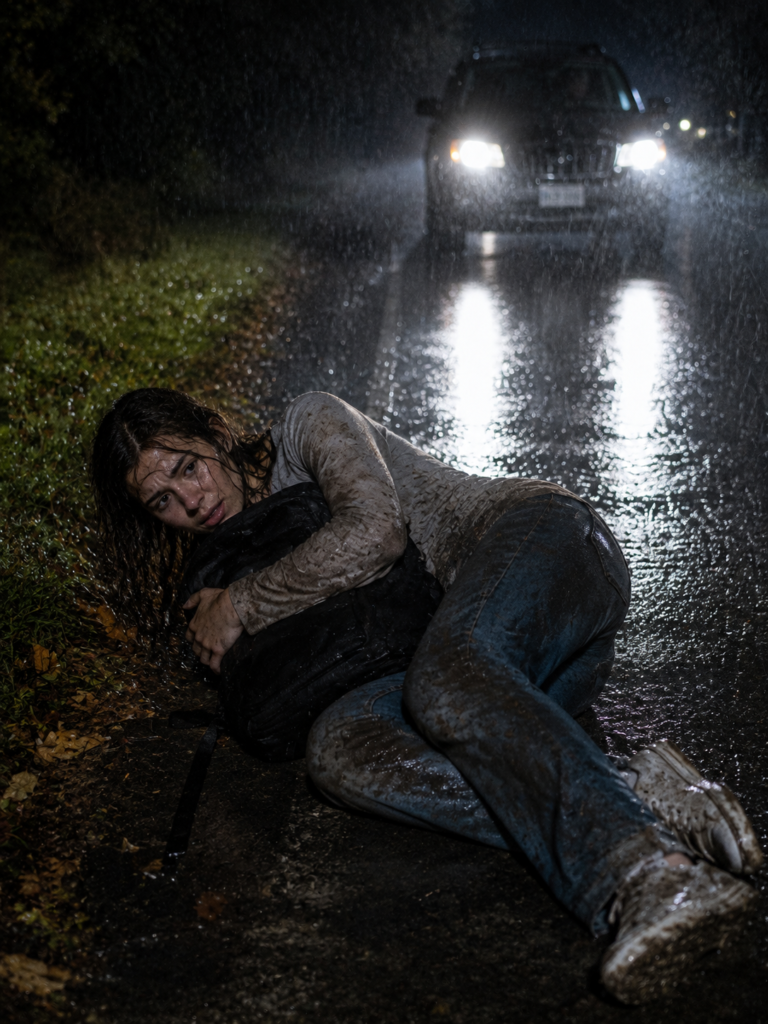
“Mr. Walls, are you aware your fifteen-year-old daughter was found nearly four miles from home?”
But that wasn’t the worst thing the officer told him. The worst part came a few seconds later. And by then, my father couldn’t even stand up without holding onto the wall.
My name doesn’t matter as much as what happened to me that night. Not yet, anyway. I’ll tell you my name at the end, when it means something.
What matters is that I was fifteen years old, soaked to the bone, and about to learn that the people who are supposed to protect you can sometimes become the very reason you need saving.
It started with my older sister, Karen.
It was a Tuesday night in late October. I was at the kitchen table doing algebra. Systems of equations. Two lines on a graph, and you had to find the one point where they crossed.
I remember that because I was stuck on number fourteen when Karen came down the stairs.
She was nineteen. She had straight auburn hair like our mom used to have, and she wore it down over one shoulder the way Mom did too. She was holding something in her fist. A small orange prescription bottle.
She walked right past me into the living room, where Dad was watching the Weather Channel. The storm was coming in from the west. A big red and purple blob on the map.
“Dad,” Karen said. “I need to show you something.”
I put my pencil down and went to the doorway.
Dad looked up from his recliner. He was a big man, broad in the shoulders, with graying hair he kept cut short. He drove a delivery truck for a beverage company, and his hands were rough and always a little bit cracked.
Karen held out the bottle. “I found these. With her stuff.”
She tilted her head toward me.
I stared at her. “What are you talking about?”
Karen wouldn’t look at me. She kept her eyes on Dad.
“In her backpack,” she said. “In the front pocket. I was looking for a phone charger.”
My father stood up slowly. He looked at the bottle in Karen’s hand. Then he turned toward me.
I had seen my dad angry before. I’d seen him yell at the TV during football and slam the truck door when it wouldn’t start. I’d seen him go quiet and hard when Mom was sick, the way a wall is quiet.
But I had never seen him look at me like this. Like I was something he’d stepped in.
“Drugs?” he said. “You’re bringing drugs into my house?”
“They aren’t mine.”
“Don’t you lie to me!”
His voice slammed through the room. The picture of Mom on the bookshelf actually rattled.
Karen shifted behind him, still holding the bottle. She had it turned so the label faced her palm. All I could see was orange plastic and a white cap.
Dad never asked to see it. He never reached out and turned it around. He never read the name.
That should have told me something.
Because two days earlier, on Sunday afternoon, I had come downstairs and heard Dad on the house phone in the kitchen. He was talking low.
“No, she’s not available to discuss a prescription,” he said. “She’s fifteen. Yeah. I’ll look into it.”
When he hung up, I asked him what that was about.
“Insurance mix-up,” he said. He didn’t look at me. He went out to the garage.
I’d never been prescribed anything in my life. Not even allergy medicine.
Now, two days later, Karen was standing in our living room saying she’d found drugs in my backpack.
And somehow, Dad wasn’t interested in putting those two things together.
“I have given you everything,” Dad shouted. “Everything. A roof over your head. Food on the table. I work fifty hours a week. And this is how you pay me back?”
“Dad, I swear to God, I’ve never seen that bottle before.”
“Your sister found it in your bag!”
I looked at Karen. She was standing near the hallway now, half in shadow. Her face was pale. She looked strange. Nervous. Like she was the one in trouble.
“Karen,” I whispered. “Tell him the truth.”
Her lips parted.
For one second, I really thought she was going to do it. I could see the words right there, behind her teeth. Her chin was shaking.
Then she lowered her eyes to the carpet.
“I’m sorry,” she muttered.
That was all. I’m sorry. She didn’t say what she was sorry for.
Dad took it the way he wanted to take it. Like she was sorry she had to turn me in.
Chapter Two: The Deadbolt
Dad pointed at the front door.
“Get out.”
I froze. I honestly thought I’d heard him wrong.
“What?”
“Get out of my house.” His face was red all the way up to his hairline. “I don’t need a sick daughter. I already watched one person I love waste away in this house. I’m not doing it again.”
The words knocked the air out of my lungs.
He meant Mom. Mom had died three years earlier, of ovarian cancer, in the hospital bed we set up in the dining room. She was forty-four. At the end she weighed ninety pounds and she couldn’t remember my middle name.
And now he was saying I was like that. Sick. Wasting away. Something he had to get rid of before it ruined him again.
I waited for him to take it back. I waited for his face to crack and for him to say, I didn’t mean that, kiddo.
He didn’t.
I looked toward the window. Rain was coming down so hard it bounced off the porch railing. The wind was bending the little maple tree in our front yard almost sideways.
“Dad,” I said. “It’s pouring outside.”
“Should have thought about that before you brought that garbage under my roof.”
I was wearing a navy sweatshirt with my school’s name on it, faded jeans with a hole in one knee, and my old Converse sneakers with the laces I never tied right. My dark brown hair was up in a messy ponytail.
My phone was upstairs, charging on my nightstand. My winter coat was hanging in the hallway closet. My wallet, with twenty-two dollars and my school ID, was on my desk.
“Can I at least get my…”
“Now!”
Karen flinched like he’d hit her.
I wanted to scream. I wanted to grab the bottle out of Karen’s hand and shove it in his face and make him read the label out loud. I wanted to ask him why the pharmacy was calling about me on Sunday when I didn’t take any medication.
But something inside me went very, very quiet.
My father had already chosen who to believe. I could see it on his face. Arguing wouldn’t change it. Crying wouldn’t change it. He’d made up his mind before Karen even finished talking.
I picked up my old green JanSport backpack from beside the stairs. It was almost empty. There was nothing in it except a half-finished algebra worksheet, a pencil with a chewed eraser, and a granola bar wrapper.
Number fourteen was still blank.
I put the backpack over my shoulder. I walked to the front door. I opened it.
Freezing rain swept across the porch and stung my cheeks like little needles.
I stepped outside.
Behind me, Dad slammed the door.
A second later, I heard the deadbolt turn.
Click.
I will remember that sound for the rest of my life. I still hear it sometimes when I’m falling asleep. A small, ordinary sound, the sound of a lock doing exactly what locks are supposed to do.
For a while, I just stood there under the porch roof. Rain was blowing in sideways and getting my jeans wet, but I didn’t move. I was waiting.
Surely he’d come back. He’d open the door and say, Get in here, it’s freezing, we’ll talk about this in the morning.
Surely Karen would say something. She’d break down and tell him the truth, and he’d come running out with my coat.
Surely somebody in that house would remember I was only fifteen.
I watched the window. I could see the blue light of the TV flickering on the ceiling. I could see a shadow move across the hallway. Then the porch light went off.
He turned off the porch light.
So I walked away.
At first, anger kept my feet moving.
I marched down Linden Street under the flickering streetlights with my jaw clenched so tight my teeth hurt. I told myself I didn’t need them. I told myself I’d go somewhere safe, somewhere warm, and in the morning Dad would wake up and realize what he’d done, and he’d feel terrible.
I wanted him to feel terrible. I wanted it so badly.
But by the time I reached the end of our neighborhood, where Linden runs into County Road 9, I realized something.
I had nowhere to go.
My best friend, Priya, lived on the other side of town, almost seven miles away. I didn’t know her parents’ phone number by heart. I didn’t know anybody’s number by heart except my own and my dad’s. Everybody else was just a name on a screen. And the screen was upstairs on my nightstand.
Our neighbors were mostly older people I’d never really talked to. The Hendersons, who yelled at kids for walking on their grass. Mrs. Pike, who was in a nursing home now. A young couple I’d never even seen.
I stood at the corner in the rain and thought about knocking on a stranger’s door. What would I even say? My dad kicked me out because my sister said I had drugs?
They’d call him. Of course they’d call him. And he’d come down the street in his truck and tell them I was a liar, and they’d believe him, because he was the adult.
So I turned onto County Road 9 and kept walking.
Chapter Three: Four Miles
County Road 9 runs east out of our town for about twelve miles before it hits the highway. There’s a gas station somewhere out there. I’d seen it from the car. A Marathon with a little convenience store.
I figured if I could get there, I could ask to use the phone. I could call Priya’s house by looking up the number. Maybe I could even call my aunt Diane in Columbus.
I didn’t know how far it was. I thought maybe two miles. Maybe three.
It was nine.
Within ten minutes, the rain had soaked all the way through my sweatshirt. It got heavier as it got wet, and it pulled down on my shoulders like a lead blanket. Cold water ran down the back of my neck and down my spine.
My jeans stuck to my legs. My Converse filled up with water until every single step made a miserable squishing sound.
I kept turning around to look at the road behind me.
Every time a pair of headlights came over the hill, my heart jumped in my chest. That’s him. He changed his mind. He’s sorry.
But every car just kept going. Their tires hissed on the wet road, and their taillights got smaller and smaller and disappeared.
Nobody stopped. I don’t think anybody even saw me. I was a dark shape on the side of a dark road in a navy sweatshirt.
I thought about Karen while I walked. I couldn’t stop thinking about her.
Karen used to be my favorite person in the world. When I was little, she’d let me sleep in her bed during thunderstorms. She taught me to ride a bike. She used to braid my hair before school, French braids, so tight it made my eyes water.
Then Mom got sick. And Karen changed.
She was sixteen then. She stopped braiding my hair. She stopped coming home after volleyball practice. She’d go out with her friends and come home late and go straight to her room and lock the door.
When Mom died, Karen didn’t cry at the funeral. Not once. I cried so hard I threw up in the church bathroom. Karen just stood there in her black dress with her arms crossed, staring at the casket like she was angry at it.
The next spring, she tore her ACL during a volleyball game. Her right knee. I heard it pop from the bleachers. She had surgery in May, and the doctor gave her a bottle of painkillers. Oxycodone.
I remember Dad picking up the prescription at the CVS on Main Street. I remember Karen saying they made her feel like she was floating.
She was supposed to take them for two weeks.
I don’t know when they stopped being for her knee.
After the first mile, I couldn’t stop shivering.
It wasn’t regular shivering. It was the kind that starts in your stomach and spreads outward, so your whole body jerks. My teeth chattered so hard I bit my tongue and tasted blood.
After the second mile, my fingers started going numb. They felt thick and clumsy, like I was wearing invisible oven mitts. I tried to stuff my hands under my armpits, but my armpits were wet too, and the shaking only got worse.
Thunder rolled over the trees. The wind pushed the rain sideways across the empty road, straight into my face, so I had to walk with my head down.
“Just keep walking,” I whispered.
My voice sounded tiny. The storm swallowed it whole.
The road went on and on. There were no sidewalks. No streetlights after the first mile. Just a narrow gravel shoulder and a ditch on the side, full of rushing water, and on the other side of the ditch, dark fields and patches of woods.
No houses with their lights on. No businesses. No shelter.
Somewhere in the third mile, my thoughts started slipping.
I couldn’t remember if I’d passed the same mailbox twice. There was a mailbox shaped like a fish, I think, and then later I saw it again. Or maybe it was a different fish. I kept looking for road signs, but they blurred in the rain and I couldn’t read them.
At one point, I saw our kitchen window. I swear I did. It was glowing yellow through the trees on my left, warm and bright, with the blue curtains Mom sewed. I could even smell Dad’s coffee, the cheap Folgers kind he made every morning.
Then I blinked. And there was nothing there. Just black trees and rain.
My knees started trembling. My chest hurt, a tight squeezing pain right in the middle, like someone was standing on it.
And then something strange happened.
I stopped feeling cold.
I was so cold that suddenly I didn’t feel cold enough anymore. I felt almost warm. I had the strangest urge to take off my sweatshirt, because it felt too heavy and too hot.
That frightened me more than anything else that night. Because even in my foggy brain, I knew that was wrong. We’d learned about it in health class, in the unit on outdoor safety. When you stop feeling cold, it means your body is giving up.
I remember thinking about my backpack. How stupid it was. I’d grabbed my algebra homework, and I hadn’t grabbed my coat.
Number fourteen. Two lines. Find where they cross.
Then my right knee buckled.
I stumbled sideways onto the gravel shoulder. My hands hit the ground, and I didn’t even feel the rocks.
“Get up,” I told myself. “Get up.”
I pushed against the ground. My arms shook so violently I could barely lift myself. I got one foot under me. Then the other. I managed one step.
Then my left knee gave out.
My cheek hit the wet gravel. I felt it, distantly, like it was happening to someone else.
Somewhere nearby, tires hissed along the road. A car. I tried to yell. I opened my mouth and nothing came out. Not a word. Not a sound.
The car kept going.
My backpack had slipped around under my chest. I curled around it the way you’d curl around a pillow. I pressed my numb hands against the wet green fabric.
Rain washed across my face. It got in my eyes and I couldn’t close them fast enough.
I thought about the porch light going off.
About Karen staring at the carpet.
About Dad turning the lock.
Click.
And then the world just went away.
Chapter Four: The Phone Call
Everything I’m about to tell you, I learned later. From Officer Daniels. From the doctors. From the woman who found me. From my father, a long time afterward, when he could finally say it out loud.
I wasn’t there for any of it. Not really.
Her name was Rosalind Okafor, but everybody called her Roz. She was fifty-three years old and she was a home health nurse. That night, she’d worked a double shift taking care of an old man with Parkinson’s in a farmhouse out past the county line, and she was driving home on County Road 9 a little after eleven.
She almost didn’t see me.
“I thought you were a garbage bag,” she told me later, sitting by my hospital bed. “That’s the God’s honest truth, baby. A big dark lump on the side of the road. I was already past you.”
Then her headlights caught something. A flash of white.
My sneaker. The white rubber toe of my Converse.
Roz slammed on her brakes so hard her purse flew off the passenger seat. She threw her car in reverse and backed up fifty feet on a dark wet road in the rain, which she says is the most dangerous thing she’s ever done in her life.
She found me lying at the edge of the drainage ditch. My face was turned to the side. My lips were blue. My skin was white, so white it almost glowed in her headlights.
She knelt down in the gravel and put two fingers on my neck.
Nothing.
She put her ear down against my mouth.
Nothing.
“I’ve been a nurse for twenty-nine years,” Roz told me. “I knew what I was looking at. I knew it was bad. But you were so little, curled up around that backpack like a baby with a blanket. I said, Lord, not this one. Not on my road.”
She called 911 on her cell phone. She put it on speaker and set it on the gravel. Then she rolled me onto my back, tilted my head, and started chest compressions right there on the side of County Road 9, in the freezing rain, with water running into her collar.
The dispatcher counted with her. One, two, three, four. Roz says she broke two of my ribs. She says she could feel them go. She kept pushing.
It took the ambulance fourteen minutes to get there.
Roz did CPR on me for fourteen minutes.
The paramedics took over. They cut off my wet sweatshirt right there in the ambulance and wrapped me in warm blankets and put heat packs under my arms. They put a breathing tube down my throat.
On the way to the hospital, my heart started again. Weak and slow and uneven. But it started.
My core body temperature, when they got me to Mercy General, was 82 degrees.
Normal is 98.6.
Back at home, my father had no idea where I was.
Maybe he thought I’d gone to a neighbor’s. Maybe he thought I was sitting on the back porch, sulking, waiting to come in. Maybe he expected me to come back in an hour, crying and begging at the door.
I don’t really know what he was thinking. He’s never been able to tell me. He says he doesn’t remember the first two hours. He says he sat in his recliner watching the Weather Channel and didn’t see any of it.
What I do know is that nearly three hours after he locked the door, at 12:47 in the morning, the house phone rang.
Officer Mike Daniels had been with the county police for eleven years. He told me about that phone call months later, in a quiet room at the courthouse, while we waited for a hearing to start.
“Mr. Walls?” he said. “This is Officer Daniels with the County Police Department.”
Dad’s voice was irritated, Officer Daniels said. Like he’d been woken up.
“What is this about?”
“Sir, do you have a fifteen-year-old daughter?”
“Yeah.” A pause. “Why?”
“When did you last see her?”
Dad hesitated. Officer Daniels said he could hear the hesitation, the way you hear a man deciding which version of the truth to tell.
“We had an argument,” Dad said. “She left.”
“Did she leave wearing a coat, sir?”
Silence on the line.
“Sir?”
“No,” Dad said finally.
“Did she have a phone with her? Money?”
Another silence. Longer.
Karen had come downstairs by then. She’d heard the phone ring. According to Officer Daniels, he could hear a young woman’s voice in the background asking, “Dad? Who is it? Dad?”
That’s when Dad’s voice changed.
“What’s going on?” he said. “Did she do something? Is she in trouble?”
“Mr. Walls,” Officer Daniels said, “your daughter was located off County Road 9 about four miles east of your residence.”
Dad grabbed the edge of the kitchen counter. Karen told me that part. She said she watched his knuckles go white.
“Located?” he said. “What does that mean, located?”
Officer Daniels paused.
“Sir, a passing driver spotted her near a drainage ditch. She was lying in the freezing rain. Completely unresponsive.”
Dad swallowed. Karen said it was so loud she could hear it across the kitchen.
“Is she okay?”
And then Officer Daniels said the words that made my father reach for the wall.
“Mr. Walls, when that driver found your daughter, she wasn’t breathing.”
Chapter Five: Waking Up
I woke up three days later.
The first thing I remember is the sound. A steady beep, beep, beep, somewhere above my head. And a hissing sound, like air going in and out of a tire.
The second thing I remember is the pain. Everywhere. My chest felt like someone had parked a car on it. My hands burned, a deep throbbing burn, like they’d been stuck in an oven. My throat was raw.
The third thing I remember is a woman’s face leaning over me. Dark skin, gray curls, reading glasses on a beaded chain. She was smiling, and she was crying at the same time.
“There she is,” the woman said softly. “There’s my girl. Welcome back, baby.”
I had no idea who she was.
I was in the pediatric ICU at Mercy General. They told me that later, when I could stay awake for more than a few minutes at a time.
I had severe hypothermia. My heart had stopped on the side of the road. The doctors called it a cardiac arrest from the cold. They had to warm my blood slowly, through tubes, over hours, because if they did it too fast my heart could stop again.
I had pneumonia from breathing in rainwater. I had two cracked ribs from the CPR. I had frostbite on three fingers of my left hand and two on my right. They didn’t know yet if I’d lose any of them.
I had a breathing tube for the first two days. It was out by the time I woke up, but my throat still felt like I’d swallowed sandpaper.
“You died for a little while,” the ICU doctor told me on the fourth day. Her name was Dr. Feldman. She said it gently, sitting on the edge of my bed. “About fourteen minutes. You’re very lucky. Cold can do that sometimes. It slows everything down. It protects the brain. If you’d been found any later, or if that woman hadn’t known CPR…”
She didn’t finish. She didn’t need to.
The woman with the gray curls was Roz.
She’d come to the hospital every single day. She sat by my bed after her shifts, in her scrubs, reading her Bible and doing word search puzzles. The nurses told me she’d been there when I first opened my eyes, and that she’d cried so hard the charge nurse brought her a whole box of tissues.
“Who are you?” I croaked the first time I could talk.
“I’m the lady who broke your ribs,” she said. “I’m sorry about that, baby.”
Then she told me the whole story. The garbage bag. The white sneaker. The fourteen minutes of counting.
I lay there listening, and tears ran out of the corners of my eyes and into my ears, and I couldn’t wipe them because my hands were wrapped up like boxing gloves.
“Why did you stop?” I whispered. “Nobody else stopped.”
Roz thought about that.
“Because I saw you,” she said. “And once you see somebody, you can’t unsee them. That’s the whole thing, baby. That’s all of it.”
My father was there too.
I didn’t see him at first. Roz told me he’d been there since the first night. He’d been sitting in the family waiting room down the hall, because the hospital social worker hadn’t allowed him into my room until she’d talked to the police.
When I finally saw him, it was the fifth day.
He was standing in the doorway of my room. He was wearing the same gray sweatshirt I’d seen him in that Tuesday night. He hadn’t shaved. His eyes were red and swollen and there were deep purple circles under them.
He looked about twenty years older than he had five days ago.
He didn’t come in. He just stood there, holding onto the doorframe with one hand, the way he must have held onto the kitchen wall.
I looked at him. He looked at me.
Neither of us said anything for a long time.
Then I turned my face toward the window. I didn’t decide to. I just did it.
When I looked back, he was gone.
Chapter Six: The Label
On the sixth day, a woman named Angela Reyes came into my room with a clipboard.
She was the hospital’s pediatric social worker. She was young, maybe thirty, with braids pulled back into a bun and a soft voice. She sat down in the chair Roz usually used and pulled it close to my bed.
“I need to ask you some questions,” she said. “Some of them might be hard. You can stop anytime. Okay?”
“Okay.”
“When a child comes into the hospital the way you did,” she said carefully, “we’re required by law to report it. To Children’s Services. There’s a caseworker assigned to you now. Her name is Mrs. Bell. And the police have an officer looking into what happened.”
“Officer Daniels,” I said. Roz had told me his name.
“That’s right.”
She asked me to tell her what happened that night. Everything. From the beginning.
So I did. I told her about the algebra homework. About Karen coming down the stairs. About the orange bottle and the label turned toward Karen’s palm. About Dad not asking to see it.
I told her about the phone call on Sunday. Dad saying, She’s not available to discuss a prescription. Dad saying it was an insurance mix-up.
Angela Reyes wrote it all down. When I got to the part about the phone call, she stopped writing and looked up at me.
“The pharmacy called your house,” she said slowly. “About a prescription in your name.”
“I guess so. I don’t know. I’ve never taken anything.”
She wrote something down and underlined it twice.
Officer Daniels came that afternoon. He was a tall man with a shaved head and a quiet, deep voice that made you want to tell him the truth. He stood at the foot of my bed with his hat in his hands, the way police officers do in movies when someone has died.
“I talked to your dad,” he said. “The night you came in. I asked him about the pills. The ones your sister said she found.”
“He believed her,” I said.
“I asked him to show me the bottle.” Officer Daniels paused. “He went home and got it. Brought it to the station the next morning. He hadn’t read the label until I asked him to.”
He looked at me steadily.
“The name on the bottle was yours.”
My heart did something funny in my chest. The monitor above my bed beeped faster. A nurse looked in from the hallway.
“I didn’t…”
“I know,” he said, holding up a hand. “Listen to me. I know.”
He pulled a chair over and sat down.
“Oxycodone. Ten milligrams. Sixty tablets,” he said. “Prescribed through an online telehealth clinic. A company out of Florida that the state attorney general has been looking at for about a year. They write pain prescriptions after a five-minute video call. The patient fills out a form online. Name, birthday, insurance card.”
“I never did that.”
“Somebody did. Using your name, your birthday, and your insurance information off your father’s family policy.” He paused. “The prescription was filled at the CVS on Main Street. Twice. Once in August and once in October.”
He took a folded paper out of his jacket pocket.
“Here’s the thing about oxycodone,” he said. “It’s a controlled substance. When somebody picks it up at the pharmacy, the pharmacist has to check ID. Every time. And it gets logged in the state’s prescription monitoring program. The name on the prescription and the name and ID number of the person who picked it up.”
He unfolded the paper. He didn’t hand it to me. He just held it so I could see.
It was a printout. Two lines highlighted in yellow. Two dates. Under Patient, my name. Under Picked Up By, a different name, and a driver’s license number.
Karen Elizabeth Walls.
I looked at that printout for a long time.
“The pharmacist flagged it the second time,” Officer Daniels said. “In October. She thought it was strange that a fifteen-year-old was getting a high-dose opioid from an online clinic, and that the person picking it up wasn’t a parent. So she called the house to check.”
“Sunday,” I whispered. “That was the call.”
“Your father told her you weren’t available,” Officer Daniels said. “And he hung up. And he didn’t ask anybody anything.” He folded the paper back up. “Maybe he suspected. Maybe he didn’t want to know. That’s something you’ll have to ask him.”
I closed my eyes.
Two lines on a graph. Find the point where they cross.
The pharmacy call. Karen’s bottle. Karen’s knee surgery. Karen floating. Karen locking her door every night.
They’d crossed right in front of him. And he’d looked away.
“What happens to Karen?” I asked.
“That depends,” Officer Daniels said. “Using somebody else’s identity to get a controlled substance is a felony in this state. Obtaining by fraud. But she’s nineteen. No record. If she’s honest, and if she gets help, there’s a drug court program here. Treatment instead of jail.”
“And Dad?”
He was quiet for a moment.
“I’ve referred it to the prosecutor,” he said. “Child endangerment. Putting a minor out of the house without shelter in dangerous weather. What happens next isn’t up to me.”
He stood up and put his hat back on.
“For what it’s worth,” he said at the door, “your father hasn’t left this hospital in six days. He sleeps in the waiting room. He asks the nurses about you every hour. They’re getting sick of him.”
He almost smiled.
“I’m not telling you to forgive him,” he said. “I’m just telling you.”
Chapter Seven: Karen
Karen came on the seventh day.
She came alone. Angela Reyes brought her to the door and asked me if it was okay. I said yes before I really thought about it.
My sister walked into my room like she was walking into a church. Slow. Careful. Looking at the floor.
She looked terrible. Her auburn hair was greasy and tangled. She’d lost weight; her jeans were hanging off her hips. Her skin had a yellowish gray color to it, and there were dark rings under her eyes like bruises. She was wearing an old hoodie of Mom’s, the purple Ohio State one, the sleeves pulled down over her hands.
She stopped at the foot of my bed. She looked at my wrapped hands. At the oxygen tube in my nose. At the bruises on my chest where they’d done CPR, which you could see above the neck of my hospital gown.
Then she started crying.
It wasn’t quiet crying. It was the kind that bends you in half. She put her hands over her face and her shoulders shook and she made a sound I had never heard a human being make, a high, thin, broken sound, like something tearing.
I didn’t say anything. I let her cry.
After a while, she sat down in Roz’s chair. She wiped her face on the purple sleeve.
“I’m sorry,” she said.
“You said that already,” I said. “That night. You said I’m sorry. And then you let him lock the door.”
She flinched like I’d slapped her.
“I know.”
“Why, Karen?”
She told me everything.
She told me about the pills after her knee surgery. About how they made her feel, for the first time since Mom died, like the world wasn’t crushing her. She said it was like somebody had finally taken a heavy coat off her shoulders.
When the prescription ran out, she called the surgeon’s office and asked for more. They gave her one refill. Then they said no.
She bought them from a guy at the community college for a while. Then he got arrested. Then she found the telehealth website.
“They wanted an insurance card and a name,” she said, staring at the blanket. “I couldn’t use my name. My name was already in the system from the surgery. They’d see I’d had them before. They’d flag me.”
“So you used mine.”
“You were fifteen,” she whispered. “You’d never had anything. You were clean. Nobody would look.”
“I didn’t think about it,” she said. “I swear to God, I didn’t think about what it meant. I just needed them. You don’t understand what it’s like when you need them. It’s like your whole body is screaming.”
She took a long breath.
“Then the pharmacy called. On Sunday. I heard Dad on the phone. I heard him say your name and prescription, and I knew. I knew it was over. I knew he was going to figure it out.”
“So you got there first.”
She nodded. Tears were dripping off her chin.
“I thought if I told him first,” she said, “if I said I found them in your bag, then when he looked into it, he’d think it was you. He’d ground you. Take your phone. Make you go to some counselor. You’d be in trouble for a couple of months, and you’d be okay, because you’re always okay. You’re the good one.” Her voice cracked in half. “I never thought he’d throw you out. I never, never thought that.”
“But when he did,” I said, “you didn’t say anything.”
She was quiet for a long time.
“I was going to,” she said finally. “After the door closed. I stood there in the hallway. I said, Dad. And he turned around and looked at me. And he said, Not now, Karen. Go to bed.”
She pressed her sleeves against her eyes.
“And I went,” she said. “I went upstairs and I took two of them and I lay down on my bed and I let the floating come. And I thought, she’ll go to the Hendersons’. She’ll go to a neighbor. She’ll be back in an hour.”
She looked at me. Her face was wet and red and swollen.
“I was floating,” she said. “While you were dying on the side of the road. I was lying on my bed, floating.”
I didn’t know what to say. There isn’t anything to say to that.
I looked at my sister. My sister who used to braid my hair so tight it made my eyes water. My sister who let me sleep in her bed during thunderstorms. Who stood at Mom’s funeral with her arms crossed and never cried.
I realized, looking at her, that she hadn’t stopped being that sister. She’d just been drowning. For three years. Right in front of us. And nobody had seen it, because Dad was drowning too, and I was too busy being good.
“Karen,” I said. “Are you still taking them?”
She looked down.
“Officer Daniels took the bottle,” she said. “I haven’t had any in four days. I’m so sick. I’ve been throwing up. I can’t sleep. My legs won’t stop moving.”
“Then you need help.”
“I know.”
“Real help, Karen. A doctor. A program.”
“I know.” She nodded and nodded. “There’s a place. The drug court thing. Officer Daniels told me about it. It’s ninety days in a residential program in Dayton, and then outpatient, and if I finish, they drop the felony.”
“Are you going to go?”
She looked up at me. For the first time since she walked in, she looked me straight in the eye.
“Yes,” she said. “I’m going on Monday.”
Chapter Eight: Aunt Diane
My mother’s younger sister, Diane, drove in from Columbus that night.
I hadn’t seen her in almost two years. Not since Mom’s second anniversary, when she and Dad had a fight in the driveway about something I wasn’t allowed to hear, and she drove off without saying goodbye.
She came through the door of my room at nine-thirty at night like a hurricane in a puffy coat. She was a high school vice principal, short and fierce, with Mom’s same green eyes and Mom’s same laugh.
She took one look at me and burst into tears.
“Oh, Bean,” she said. “Oh, my Bean.”
Nobody had called me Bean since Mom died. Mom gave me that name when I was a baby because I was so small. Aunt Diane was the only other person who ever used it.
She sat down on the edge of my bed and held my bandaged hands very, very carefully in hers. She held them like they were made of glass.
“Mrs. Bell called me,” she said, after she’d stopped crying. “From Children’s Services. They need a safe place for you to go when you get out of here. I said I’d take you.”
“Take me?”
“To Columbus. To my house. For a while.” She looked at me. “If you want. Nobody’s going to make you.”
“What about Dad?”
Her face changed. She looked toward the hallway. Toward the waiting room, where my father was probably sitting, staring at the wall.
“Your father,” she said carefully, “is going to have to show a judge that he can keep you safe. That’s how it works now. There’s going to be a hearing. They call it a dependency hearing. A judge will decide where you live while all this gets sorted out.”
“A judge,” I repeated.
“You’ll get your own lawyer,” she said. “A guardian ad litem. Somebody whose whole job is to speak for you. Just you.”
I didn’t know what to think. My whole world had flipped upside down in a week. I’d lived in that house on Linden Street my entire life. Mom’s sewing machine was still in the dining room. My bedroom still had glow-in-the-dark stars on the ceiling that Karen helped me stick up when I was seven.
“I don’t know what I want,” I said.
“That’s okay,” Aunt Diane said. “You don’t have to know yet.”
Later that night, after Aunt Diane went to her hotel, I couldn’t sleep. The beeping machines kept me awake. My hands throbbed. My ribs ached every time I breathed.
At two in the morning, I heard voices in the hallway.
One of them was Aunt Diane. She must have come back. The other was Dad.
They were trying to whisper, but they were both too angry to do it right.
“You locked her out,” Aunt Diane was saying. “In an ice storm. Fifteen years old. No coat, no phone. Do you know what Jenny would have done to you?”
Jenny was my mom.
“I know,” Dad said. His voice was ragged.
“Do you? Because I don’t think you do. I think you’ve been sitting in that house for three years with the curtains closed, pretending you’re fine, while one of your daughters turned into a drug addict and the other one turned into a ghost.”
“Diane…”
“I begged you. At the anniversary. I begged you to get help. Grief counseling. Something. And you told me to get off your property.”
Silence.
“I know,” Dad said again. Quieter.
“You don’t get to say I know anymore, Tom. You get to fix it. Or you get to lose them both.”
There was a long silence.
Then I heard a sound I had never heard in my whole life. I didn’t recognize it at first. It was a deep, choking, gasping sound, like somebody trying to breathe underwater.
It was my father crying.
He hadn’t cried at Mom’s funeral. He hadn’t cried in the hospital when she died. He stood by the bed holding her hand, and when the machine went flat, he just nodded and walked out to the parking lot and sat in his truck.
Now he was crying in a hospital hallway at two in the morning, so loud the night nurse came out to see what was wrong.
I lay in my bed and listened. I didn’t call out to him. I didn’t know if I wanted to.
But I didn’t put my hands over my ears, either.
Chapter Nine: What Dad Said
He came in on the ninth day. Angela Reyes was there. She sat in the corner of the room with her clipboard, because those were the rules for now.
He sat down in Roz’s chair. He held his hands together between his knees. They were shaking.
“Hey, kiddo,” he said.
“Hi.”
He looked at my bandaged hands. They’d taken some of the wrapping off by then. My fingers were swollen and purple at the tips. Dr. Feldman said I’d probably keep all of them, but the two on my left hand might always be sensitive to cold.
“Do they hurt?” he asked.
“Yeah.”
He nodded. He looked at the floor.
“I knew,” he said.
I looked at him.
“Not all of it,” he said. “But I knew something. When the pharmacy called on Sunday. I knew you’d never taken anything. I knew Karen had been different since her knee. I’d find her asleep in the afternoon. I’d hear her up at three in the morning. I’d count the money in my wallet and it would be wrong.”
He rubbed his face with both hands.
“And I didn’t want to know,” he said. “Because if I knew, I’d have to do something. And I didn’t know how to do anything. I couldn’t fix your mom. I couldn’t fix anything. I couldn’t even get out of my chair most nights.”
“So you picked me,” I said. “Because I was easier.”
He closed his eyes.
“When Karen came down with that bottle,” he said, “some part of me knew it wasn’t yours. Some part of me knew. But it was easier to be angry at you than to be scared for her. You were strong. You’d survive me being angry. I thought…”
He stopped.
“I thought you’d survive anything,” he said.
“You said I was sick,” I said. My voice was shaking. “You said you didn’t need a sick daughter. You said you already watched one person waste away.”
“I know.”
“You turned off the porch light.”
He made a sound like I’d punched him in the stomach.
“I know,” he whispered.
“I stood there,” I said. “On the porch. I waited. I waited for you to open the door. And you turned off the light.”
He couldn’t answer. He sat there with tears running down his face and dripping off his chin onto his knees, and he didn’t wipe them.
“I sat in that chair for three hours,” he said finally. “I told myself you were at the Hendersons’. I told myself you were fine. I told myself I was teaching you a lesson.”
He looked up at me.
“Then the phone rang,” he said. “And the officer said you weren’t breathing. And I couldn’t stand up. My legs just went. I held onto the kitchen wall and I thought, I did this. I put my baby girl in a ditch. Jenny’s baby. I locked the door and I put her in a ditch.”
He reached out his hand toward mine. Then he stopped, halfway, and pulled it back. Like he didn’t think he was allowed.
“I’m not asking you to forgive me,” he said. “I don’t deserve it. I’m just telling you I’m sorry. I’m going to be sorry for the rest of my life.”
I looked at my father. At his gray hair and his red eyes and his rough, cracked hands.
I wanted to forgive him. Part of me did. The part that was still seven years old, the part that used to ride on his shoulders at the county fair.
But the other part of me was still lying in that ditch. Still hearing the click of the deadbolt. Still watching the porch light go off.
“I can’t,” I said. “Not yet.”
He nodded slowly. Like he’d expected it.
“Okay,” he said. “Okay.”
He stood up. At the door, he turned around.
“I’m going to fix it,” he said. “Not with words. I’m going to do the work. Whatever it takes. However long.”
Then he left.
Angela Reyes put down her clipboard and came over and sat on the edge of my bed and just held my arm while I cried.
Chapter Ten: The Hearing
I got out of the hospital on the sixteenth day. Aunt Diane drove me to Columbus in her Honda with the heat turned all the way up, even though it wasn’t that cold.
“You don’t have to do that,” I said.
“Yes, I do,” she said. “For a while, I do.”
The dependency hearing was in early December, at the county courthouse in our town. It was a small courtroom with wood paneling and a flag in the corner and a heater that clanked.
There were more people there than I expected. Mrs. Bell, the caseworker, in a gray cardigan. My guardian ad litem, a lawyer named Mr. Hutchins, who had visited me twice in Columbus and asked me a hundred questions. Aunt Diane. Officer Daniels, in his uniform. Roz, in a purple church dress and a hat, who had asked if she could come and sit in the back.
And Dad. In a suit I’d never seen before. It didn’t fit right. It looked like he’d bought it the day before.
Karen wasn’t there. She was in her fifth week at the residential treatment program in Dayton. But she’d sent a letter.
The judge was a woman named Judge Harlan. She was older, with short white hair and glasses on a chain like Roz’s. She had a voice like a kind grandmother who would absolutely send you to your room.
The lawyers talked for a long time. About the night of the storm. About the prescription fraud. About Dad’s criminal case, which had been resolved the week before: he’d pleaded guilty to a misdemeanor charge of child endangerment. Ninety days suspended, two years of probation, a parenting program, and grief counseling twice a week.
Mr. Hutchins read part of Karen’s letter out loud. She’d written that she took full responsibility for using my identity, that I had never touched the pills, and that she was ninety-six hours from finishing detox and thirty-one days clean.
Then Judge Harlan read a report from Dad’s grief counselor. A man named Dr. Okonkwo. The report said Dad had attended every session. It said he was “engaged and remorseful” and had begun “processing three years of unresolved grief.”
I watched Dad while she read it. He sat very straight at the table with his hands folded. He didn’t look at me. He looked at the floor.
Then Judge Harlan looked at me over her glasses.
“Young lady,” she said. “Mr. Hutchins tells me you’d like to speak today. Is that right?”
My heart was pounding. My hands were sweating. My left fingers ached, the way they always did now when I was nervous.
“Yes, ma’am.”
“You can stay right there in your seat. You don’t have to come up. Take your time.”
I stood up anyway. I don’t know why. I just felt like I should be standing.
“Before you start,” the judge said gently, “would you please state your name for the record?”
I opened my mouth.
And for a second, nothing came out. Just like on the side of the road, when the car hissed past and I tried to yell and no sound came.
I thought about how I’d felt that whole night. Like I didn’t matter. Like I was a dark shape on the side of the road that cars drove past. Like my name was just something written on a bottle that somebody else picked up with their own ID.
Then I looked at the back of the courtroom. At Roz in her purple hat. She gave me a tiny nod.
Once you see somebody, you can’t unsee them.
“My name is Hannah,” I said. My voice shook, and then it didn’t. “Hannah Grace Walls.”
“Thank you, Hannah,” Judge Harlan said. “Go ahead.”
I’d written something on an index card. I took it out of my pocket. Then I put it back. I didn’t need it.
“I almost died,” I said. “On County Road 9. In October. I was dead for fourteen minutes. A nurse I’d never met knelt in a ditch in the rain and pushed on my chest for fourteen minutes until the ambulance came. She broke my ribs. She saved my life.”
I looked at Roz. She pressed a tissue to her mouth.
“I’m not here to say my dad is a monster,” I said. “He’s not. He’s my dad. He made the worst mistake a parent can make. He believed the easy story instead of the true one. And he locked the door.”
I looked at Dad. He was looking at me now. His eyes were wet.
“But I don’t think he’s a bad person,” I said. “I think he’s been sad for so long that he forgot how to see us. Me and Karen. We were right there. And he couldn’t see either of us.”
“So here’s what I want,” I said. “I want to stay with Aunt Diane. For now. Through the school year. I like my new school. I’m safe there. I can sleep.”
Judge Harlan nodded slowly.
“But I want to see my dad,” I said. “Every other weekend. With somebody there at first, if you think that’s best. And I want him to keep going to counseling. And I want him to go to the family program at Karen’s treatment center. Because we all need to learn how to be a family again, and none of us know how.”
My voice cracked.
“And I want him to come to my algebra tutoring,” I said. “On Saturdays. Because I missed three weeks of school and I’m failing, and he used to be good at math.”
Somebody in the courtroom laughed softly. Maybe Officer Daniels.
Dad put his hand over his mouth.
Judge Harlan looked at me for a long time. Then she looked at Dad.
“Mr. Walls,” she said. “Did you hear your daughter?”
“Yes, Your Honor,” Dad said. His voice was barely there.
“Every word?”
“Every word.”
“Good,” she said. “Because I’m going to order every one of them.”
She took off her glasses.
“Hannah,” she said, “I’ve been doing this for twenty-two years. I’ve heard a lot of children speak in this courtroom. I don’t think I’ve ever heard one speak more clearly.”
She put her glasses back on and picked up her pen.
“Temporary custody to the maternal aunt, Diane Mercer,” she said. “Supervised visitation with the father, to transition to unsupervised at the caseworker’s discretion. Continued counseling. Family therapy. Review hearing in six months.”
She looked at Dad one more time.
“And Mr. Walls,” she said. “Saturday tutoring. Don’t be late.”
Chapter Eleven: Rebuilding
Dad was never late. Not once.
Every other Saturday, he drove ninety minutes to Columbus and sat next to me at the kitchen table at Aunt Diane’s house while a college student named Marcus tried to teach me algebra. Mrs. Bell sat in the living room the first few times, pretending to read a magazine.
Dad didn’t talk much at first. He just sat there. When I got stuck, he’d lean over and look at the problem and say, “Try isolating the x first.” He was usually right.
After the fourth Saturday, Mrs. Bell stopped coming.
In January, we started family therapy at Karen’s treatment center in Dayton. Once a week, on Wednesday nights. Me, Dad, Karen, and a counselor named Ms. Abernathy in a small room with a box of tissues on every surface.
The first session was terrible. Karen cried the whole time. Dad didn’t say a single word. I sat with my arms crossed and stared at a poster on the wall about the stages of change.
The second session was a little less terrible.
By the sixth session, Karen and I were laughing about the time Mom tried to make sushi and set off every smoke alarm in the house. Dad laughed too. It was the first time I’d heard him laugh in three years. It came out rusty and surprised, like a door that hadn’t been opened.
Karen finished her ninety days in February. She moved into a sober living house in Dayton with five other women. She got a job at a coffee shop. She started going to meetings every day.
She called me on Sunday nights. Sometimes we talked for an hour. Sometimes for five minutes.
“Sixty-one days,” she’d tell me. Then ninety. Then a hundred and twenty.
“I’m proud of you,” I’d say.
“Don’t be proud of me yet,” she’d say. “Be proud of me in a year.”
She paid back the insurance company. Her lawyer worked it out as part of the drug court agreement: $1,140 for the two fraudulent prescriptions, at fifty dollars a month from her coffee shop paychecks. The online clinic in Florida was shut down in March. The state attorney general’s office sent Officer Daniels a letter thanking him for his report.
Dad sold the house on Linden Street in April.
He told me on a Saturday, at Aunt Diane’s kitchen table, after Marcus left.
“I can’t live there anymore,” he said. “Every time I walk past that front door, I hear it. The lock.”
I didn’t say anything. I heard it too.
“I found a place,” he said. “A little two-bedroom ranch. Closer to Columbus. Forty minutes from here instead of ninety.”
“Two bedrooms,” I said.
“One for me,” he said. “One for you. Whenever you want it. Whenever you’re ready. Even if that’s never.”
Roz came to my sixteenth birthday party in May. She brought a sweet potato pie and a card with a fifty-dollar bill in it and a note that said: For your first winter coat that’s entirely yours. Pick a warm one.
I hugged her for a long time. She smelled like cocoa butter and church.
“How are your fingers?” she asked.
“They hurt when it’s cold,” I said. “But I have all ten.”
“Good,” she said. “You keep all ten. You hear me? You keep every single one of them.”
At the six-month review hearing in June, Judge Harlan read the reports from Mrs. Bell and Ms. Abernathy and Dr. Okonkwo. She read my report card, which had a B-plus in algebra.
She looked up at Dad over her glasses.
“Tutoring seems to be going well,” she said.
“Yes, ma’am,” Dad said.
“Hannah,” she said. “Where do you want to live next school year?”
I looked at Aunt Diane. She squeezed my hand.
I looked at Dad. He was holding his breath. I could see it.
“I want to try living with my dad,” I said. “Part time. Weekends, for the summer. And then we’ll see.”
Dad let out his breath. He didn’t cry this time. He just nodded, and nodded, and kept nodding.
Chapter Twelve: The Key
It’s October again now. A year since the storm.
I live with Dad most of the time. I have the second bedroom in the little ranch house. I stuck glow-in-the-dark stars on the ceiling. Karen came down from Dayton on a Saturday and helped me put them up, standing on my desk chair the way she did when I was seven.
She has three hundred and thirty-four days clean. She’s thinking about nursing school. Roz is helping her fill out the applications.
I spend every other weekend with Aunt Diane, who says her house is too quiet without me and keeps buying cereal I don’t eat.
Last Tuesday, a storm came through.
It came in from the west, a big red and purple blob on the Weather Channel. The rain started around dinnertime. By seven, it was coming down so hard it bounced off the porch railing. The wind bent the little maple tree in our new front yard almost sideways.
I was at the kitchen table doing homework. Geometry now. Proofs.
Dad was in the living room. He got up and went to the window and stood there for a long time, watching the rain.
Then he came into the kitchen and sat down across from me.
“Hey, kiddo.”
“Hey.”
He didn’t say anything else. He just sat there. He stayed there for the whole storm, two hours, doing nothing, reading the newspaper and then just looking at it, while I did my proofs.
I knew why. I didn’t say anything. I let him sit.
Around nine-thirty, I needed to get something out of the car. My geometry book. I’d left it in the back seat of Aunt Diane’s Honda when she dropped me off.
I got up and went to the front closet. I took out my coat. My winter coat, the one I bought with Roz’s fifty dollars and some of my own babysitting money. It’s dark green and puffy and goes down to my knees. It’s the warmest coat I’ve ever owned.
I put it on and zipped it all the way up. I put my phone in one pocket. I put my house key in the other.
Dad gave me that key in June, the first night I stayed over. He put it on a ring with a little plastic tag that says in his handwriting: Hannah. Always.
I opened the front door. The porch light was on. It’s always on now. Dad put it on a timer the week he moved in, so it comes on at sunset and doesn’t go off until sunrise, no matter what.
The rain was blowing in sideways. I ran down to the car, grabbed my book, and ran back up the walk.
When I got to the porch, the door was closed.
I stood there for a second, rain dripping off my hood. My heart did something strange in my chest. My left fingers ached. For one second, just one, I was fifteen again, standing under a dark porch in a wet sweatshirt, waiting.
Then I heard a sound from the other side of the door.
The deadbolt turned.
Click.
The door swung open. Dad was standing there in his socks, holding it wide. The light from the hallway poured out onto the wet porch boards.
“Get in here,” he said. “It’s freezing.”
I stepped inside. He closed the door behind me.
And he left it unlocked.
I said at the beginning that my name didn’t matter as much as what happened to me that night.
I was wrong about that.
That night, I was a dark shape on the side of the road. A name on a bottle somebody else picked up. A sick daughter. A garbage bag in someone’s headlights.
And then a stranger saw a white sneaker in the rain and backed up fifty feet on a dark road and knelt down in the gravel.
My name is Hannah Grace Walls. I was fifteen. I died on County Road 9 for fourteen minutes, and a nurse named Roz Okafor counted out loud in the rain until I came back.
The sound I remember most from that night is a lock clicking shut.
But it isn’t the sound I hear when I come home now.