I never thought a plain white envelope could make me dread my own son’s birthday.
But there it was on the kitchen table the morning Adrian turned eighteen. Same size as always. Same cheap white paper. Same neat, careful handwriting spelling out our address, the way it had every single year since he was six.
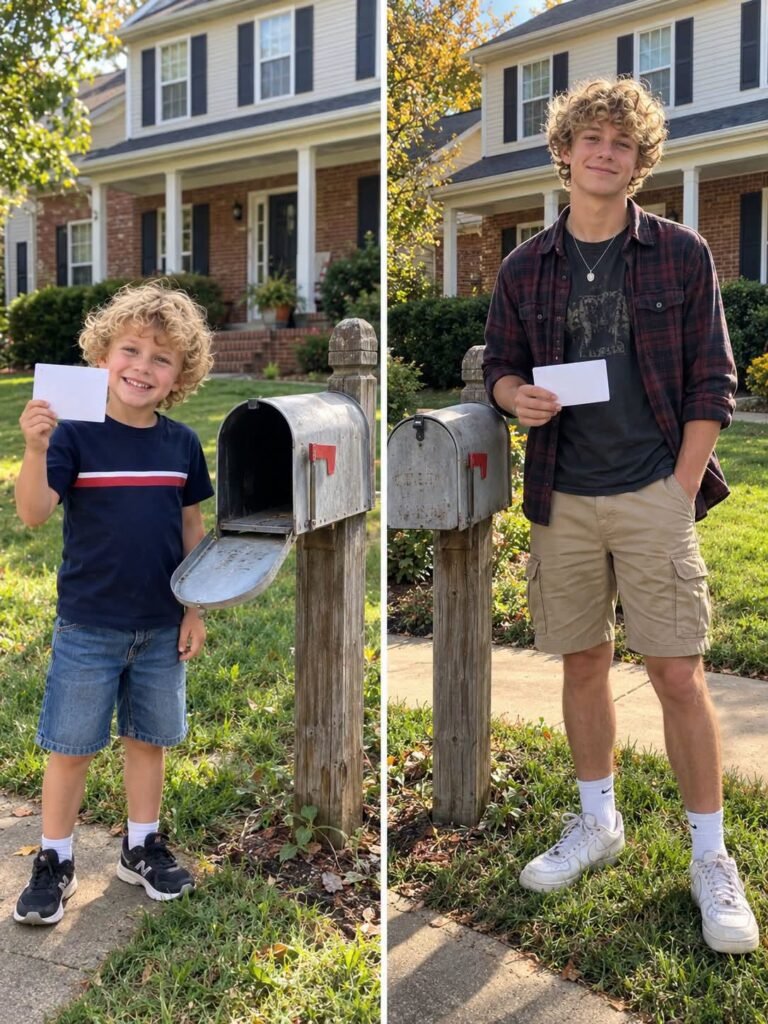
He came downstairs in his socks, hair sticking up, and saw it before he saw the cake.
He stopped in the doorway and smiled. Not the crooked, half-annoyed smile he’d worn for most of high school. The old one. The one from when he was little and the whole world was a surprise waiting to happen.
“There it is,” he said softly.
He picked it up and turned it over in his hands like it was something precious.
“Open it,” I said.
“You sound nervous.”
“I’m always nervous.”
“About my birthday card?”
“About everything,” I said. “I raised you.”
He laughed. Then he slid his finger under the flap.
I was standing at the counter, pretending to rinse dishes that were already clean. I watched him out of the corner of my eye. He pulled out the card first. A cartoon balloon on the front, the same bland kind as always.
Then he pulled out something else.
A folded letter.
That was new.
I stopped moving. The water ran over my hands.
Adrian unfolded it. And all the color drained out of his face so fast it scared me.
My name is Nora Walker. I’m forty-one years old. I’ve been a single mother since before my son was born.
The first envelope showed up when Adrian turned six.
I remember it exactly, because it was the same week the transmission died in my car and I was trying to figure out how to pay for it while also paying for a birthday party at the bowling alley that Adrian had been begging for since Christmas.
The envelope was in the mailbox with the electric bill and a coupon flyer for pizza.
No glitter. No cute stickers. No return address I recognized. Just our address in neat, careful handwriting. Blue ink. The kind of handwriting that looked like it belonged to someone who’d learned penmanship from a nun.
Inside was a generic birthday postcard with a cartoon balloon on the front. Happy Birthday! in red letters. Nothing written inside.
And a five-dollar bill, folded so crisply it looked like it had been ironed.
That was it.
No signature. No clue. Nothing personal at all.
At the time, I shrugged it off.
Kids get random birthday mail. Distant relatives remember late. Older people send cards and forget to sign them. Life is messy. My great-aunt Doris once sent Adrian a card that said Congratulations on your retirement because she’d grabbed the wrong one at the drugstore.
I was a single mother working full-time as a dental office manager, trying to keep the bills paid and cereal in the pantry. I didn’t have the energy to turn into a detective over five dollars and a postcard that looked like it came off the bargain rack at Target.
I handed it to Adrian. He held the five-dollar bill up to the light like it was a treasure map.
“Who’s it from?”
“I don’t know, baby.”
“A secret person?”
“I guess so.”
His eyes went huge.
“I have a secret person,” he whispered.
He spent the five dollars on a plastic dinosaur at the dollar store and a pack of gum. He told everyone at his party that he had a secret person. A boy named Tyler said that was stupid, and Adrian said Tyler was just jealous because nobody secretly loved him.
I didn’t think about it again.
Until it happened the next year.
When Adrian turned seven, another plain white envelope showed up. Another bland birthday card. A cartoon cake this time, with candles. Another five-dollar bill, folded crisp and neat.
No signature. No note. Same handwriting.
Adrian lost his mind.
“HE CAME BACK!”
“Or she,” I said.
“Or she,” he agreed. “Or it. What if it’s an alien, Mom?”
“Aliens don’t use the postal service.”
“How do you know?”
I didn’t have an answer for that.
By the third year, Adrian had turned it into an event.
On the morning of his eighth birthday, he woke me up at six-fifteen by standing next to my bed and breathing on my face.
“Mom. Mom. Check the mailbox.”
“It’s six in the morning, Adrian.”
“What if they came early?”
“Mail does not come at six in the morning. Mail is not magic.”
He grinned at me in the gray light, missing both front teeth.
“What if mystery mail is?”
I still remember how small he looked that day, standing on his tiptoes at the front window in his pajamas, watching for the mail truck. He stood there for almost four hours. Through breakfast. Through opening the Lego set I’d saved up for. Through his grandma calling to sing to him on the phone.
He didn’t care about the cake. Or the presents. Or the friends coming over later for pizza.
Just that envelope.
At 11:42, the mail truck turned onto our street.
Adrian screamed so loud the neighbor’s dog started barking.
And it was there. Another plain white envelope. Another cartoon card. Another five dollars.
Every single year, somehow, it came.
Sometimes it had five dollars. Sometimes ten.
When he turned eleven, there was a twenty in it. A crisp, brand-new twenty.
Adrian stood in the kitchen holding it with both hands like it was a royal decree.
“Oh,” he said gravely. “This is serious now.”
“Is it?”
“My secret person,” he announced, “is moving up in the world.”
I laughed out loud.
But the truth was, by then, it had gotten under my skin too.
I started checking postmarks.
They came from all over. Never the same place twice in a row. Cedar Falls. Marion. Ames. Once from a town in Minnesota I’d never heard of. As if whoever was sending them drove somewhere different every year just to mail one card.
I studied the handwriting. I held the envelopes up to the kitchen light like I was in some low-budget crime show. I compared the handwriting to every birthday card in the junk drawer.
Nothing matched.
I asked my mother.
“Mom, are you sending Adrian birthday money? In secret? Because it’s okay if you are. I just want to know.”
“Nora,” she said, “if I were sending my grandson money, I would sign my name in very large letters so he knew exactly who to thank.”
I asked my sister, Jess.
“Absolutely not,” she said. “I can’t even remember to send my own kids’ birthday cards.”
I even called an old friend from high school, Dana, and asked her jokingly, “If you’re the weirdo mailing my kid birthday money, just tell me so I can stop wondering.”
Dana laughed for a full minute.
“Nora, I have three kids and a mortgage. I’m not mailing your kid anything.”
Nobody knew anything.
Or at least, nobody would admit it.
Adrian loved the mystery.
I hated it.
Not because it felt dangerous. It never did. There was nothing creepy about it. No threats. No weird notes. No strange cars parked outside our house.
It felt intentional. Thoughtful, almost.
That’s what bothered me most. Someone out there remembered my son every single year. Never forgot. Never missed one. And they stayed just far enough away to remain faceless.
It felt like a hand resting on the edge of our life. Not pushing. Not pulling. Just resting there.
And I didn’t know whose hand it was.
When Adrian turned thirteen, he opened the envelope at the kitchen table while I was making pancakes.
He’d grown a lot that year. His voice was starting to crack. His feet were suddenly enormous. He’d stopped letting me hug him in front of his friends.
He pulled out the card. Ten dollars this time. He looked at the card for a long moment.
Then he lifted his eyes to me with a narrow little stare.
“What?” I said.
He tilted his head. “Are you doing this?”
I laughed. “Doing what?”
He held up the card. “These. Every year. Is this one of your weird mom things? Like when you used to pretend the tooth fairy left me notes in fancy handwriting?”
“I am deeply offended,” I said, “that you think I have this level of consistency.”
He didn’t laugh right away.
He looked back down at the card. Turned it over in his hands. Then he said quietly, without looking up:
“Could it be my dad?”
That one hit me harder than I expected. Right in the stomach.
I need to tell you about Adrian’s father. Briefly. Because he doesn’t deserve more than briefly.
His name was Kyle. We dated for about a year when I was twenty-two. He was charming and funny and played guitar badly at parties, and I thought I was in love with him.
When I told him I was pregnant, he said, “Wow. Okay. Let me think about it.”
He thought about it for two days.
Then he moved to Colorado with a friend and stopped answering his phone.
He was not some great lost love. He was not a tragic figure torn away by circumstances. He was just a man who disappeared the second responsibility looked less fun than freedom.
He never met Adrian. Never sent a gift. Never asked for a picture. Never called on a single birthday. There were years when I wasn’t sure he even remembered that I existed, let alone that he had a son.
So I answered Adrian the way I always did when that subject got too close.
“Sweetheart,” I said, flipping a pancake. “Your dad doesn’t know where we live.”
His face fell a little.
And I hated myself for how fast I kept going. I couldn’t stop.
“And even if he did,” I said, “I’m not exactly betting on him becoming Father of the Year through anonymous stationery.”
That got half a laugh out of him.
I slid a plate of pancakes across the table toward him.
“Maybe it’s an old teacher,” I said. “Maybe it’s one of my friends being weird. Maybe you’re part of a very low-budget spy operation, and one day you’re going to get a card with a secret code in it.”
He smiled. But it was thin.
Then I made the joke I should never have made.
“Besides,” I said, “these envelopes have money in them. Your father would never.”
That time, Adrian laughed for real.
But only for a second.
Then he looked down at the card again. And got quiet.
He didn’t eat much of his pancakes that morning.
After that, we stopped trying to solve it out loud.
The envelope just became part of the day. Like candles on the cake. Like the birthday photo I took every year in front of the same kitchen doorway. Like me pretending not to cry every year because my baby was getting taller and deeper-voiced and farther from the little boy who used to ask me if worms had moms.
But I watched him.
And I saw that he never stopped wondering.
When he was fifteen, I came home from work one evening and found him at the kitchen table with every single envelope spread out in front of him. All nine of them. I’d kept them all in a drawer. He’d found them.
He’d made a chart on a piece of notebook paper. Dates. Postmarks. Amounts.
“Look,” he said, without even saying hi. “Cedar Falls. Marion. Ames. Waterloo. They’re all within like a hundred miles of here. Except the Minnesota one. But that’s probably a vacation.”
“Adrian—”
“Whoever it is, they live close. Close enough to drive around and mail them from different places so we can’t find them.”
He looked up at me. His eyes were bright.
“We could drive to Cedar Falls,” he said. “This weekend. We could ask around. At the post office.”
“Ask them what? Have you seen a person mailing birthday cards?”
“Yeah!”
“Adrian, honey. They mail thousands of cards a day.”
His face fell.
“I just want to know,” he said quietly.
I sat down across from him. I looked at his chart. His careful handwriting. The little arrows he’d drawn.
“I know you do,” I said. “I want to know too.”
“Then why won’t you help me?”
I didn’t have a good answer. The real answer was that I was scared. Scared of what we’d find. Scared it would be Kyle. Scared it wouldn’t be Kyle, and Adrian would be crushed all over again.
“Because whoever it is,” I said finally, “has gone to a lot of trouble to stay secret. Maybe they have a reason.”
He gathered up the envelopes and put them back in the drawer without saying anything.
But he kept the chart. I found it in his desk years later.
When he was seventeen, I found out he’d looked up his father.
I didn’t snoop. He told me. He came into my bedroom one night in March, around eleven, and sat down on the end of my bed.
“I found him,” he said.
I put down my book.
“Who?”
“Kyle.”
He’d never called him Dad. Not once. It was always my dad in the abstract, or Kyle.
“Where?”
“Denver. He’s on Facebook.” Adrian stared at his hands. “He’s got a wife. And two kids. A boy and a girl. The boy’s like ten. They go camping. There’s like a hundred pictures of them camping.”
I didn’t say anything. I just reached over and put my hand on his foot through the blanket.
“I thought maybe,” Adrian said, and his voice cracked, “I thought maybe it was him sending the cards. Like maybe he felt bad. And he didn’t know how to say it. So he just. Sent money.”
“Oh, honey.”
“But he’s got a whole other family,” Adrian said. “He takes them camping. He doesn’t send cards. He doesn’t think about me at all.”
He wiped his face with his sleeve, fast and angry.
“I’m stupid,” he said.
“You’re not stupid.”
“I wanted it to be him,” he said. “So bad. Isn’t that stupid?”
I pulled him into a hug, and for once he let me, even though he was seventeen and six foot one.
“It’s not stupid,” I said into his shoulder. “It’s human.”
So you can understand, maybe, why I’d been dreading his eighteenth birthday.
Eighteen sounds big in a way the other birthdays don’t. It sounds final. Legal. Finished. One chapter closing whether you’re ready for it or not.
The night before, I stood in the kitchen frosting a chocolate cake he’d specifically requested “not to look emotional.” No writing. No sprinkles. No Happy 18th, My Baby! Just chocolate frosting, smoothed flat.
And I had this ache in my chest that I couldn’t explain.
I kept thinking, what if the envelope doesn’t come?
What if eighteen was the end? What if the secret person decided he was grown up now, and stopped? And Adrian stood at the window all morning watching for the mail truck, and nothing came?
I didn’t know what I’d say to him.
I didn’t sleep much that night.
But the envelope came that morning.
Early, for once. In the first mail. Like whoever it was knew.
And now my son was sitting at the kitchen table, holding a folded letter, and his face was white as paper.
“Adrian?” I said.
I turned off the water. I dried my hands on a dish towel. I didn’t take my eyes off him.
He read the letter once. Then again, slower. His lips were moving a little.
“Baby,” I said. “What is it?”
He looked up at me.
I swear I had never seen that expression on his face before. In eighteen years. Not fear, exactly. Not shock. Something deeper. Like a puzzle piece had just dropped into place, and he hated the picture it made.
“It’s not the usual card,” he said.
My stomach dropped.
He held the page tighter.
“Mom,” he said. “I know who sent them.”
For a second, the kitchen went silent in that awful way where even the refrigerator hum sounds far away.
I walked over to the table.
“Who?”
He swallowed.
“The letter’s signed.”
My voice came out thin and strange.
“Signed by who?”
He looked down at the bottom of the page.
“Thomas,” he said.
That name meant absolutely nothing to me.
I held out my hand. Adrian hesitated. Then he gave me the letter.
It was handwritten. Same neat, careful blue ink as all the envelopes.
Adrian,
If you are reading this, then you are 18, and I have kept my promise for as long as I was meant to.
First, happy birthday.
Second, I owe you the truth. Or at least enough of it for you to decide whether you want more.
Please go to the law office of Merrick and Rowe on Fulton Street and ask for the envelope left in your name. They have been instructed to give it to you once you become an adult.
You don’t know me the way you might think you do. But I knew someone who loved you very much.
I hope, in some small way, these birthdays helped you feel remembered.
Take care, son.
Thomas
I read it twice. Then a third time.
Take care, son.
Adrian noticed my eyes stop on that line.
“You see why I thought of my dad, right?” he said quietly.
I did. Of course I did.
A man’s name. A letter waiting at a law office. A secret stretched out across twelve birthdays. Take care, son.
It sounded exactly like the kind of dramatic nonsense an absent father might pull when he finally wanted redemption without the inconvenience of actual parenting. No diapers. No ear infections. No parent-teacher conferences. No sitting up all night with a feverish toddler. Just a few cards and some cash and then, at the end, a big dramatic reveal at a law office so he could look like a hero.
I felt something hot and bitter rise up in my chest.
“He’s got a lot of nerve,” I said.
Adrian’s eyes lifted.
“So you think it is him? Kyle?”
“No,” I said. Way too fast.
Then: “I don’t know.”
Adrian sat down hard in the kitchen chair.
“His middle name could be Thomas,” he said. “Couldn’t it? I don’t even know his middle name.”
I didn’t know either. I’d dated the man for a year and never learned his middle name.
“What if it is him?” Adrian said. “What if he’s been doing it this whole time? And all those pictures of him camping with his other kids, what if he was still thinking about me?”
His voice was so hopeful that it hurt to hear.
I looked at my son. Legally an adult for about three hours. And suddenly looking twelve years old again.
And I knew I had two choices.
I could downplay it. Tell him to forget it. Tell him it didn’t matter who sent the cards, and he should eat his cake and go to his party and move on with his life.
Or I could face whatever this was. With him.
I pulled out the chair across from him and sat down.
“Then we find out,” I said.
We went that afternoon.
Adrian was supposed to go to his friend Marcus’s house for a birthday thing. He texted Marcus and said he’d be late. Marcus texted back, ur missing the cake bro. Adrian didn’t answer.
Fulton Street was downtown, about twenty-five minutes away.
The whole drive there, Adrian bounced back and forth between total silence and nervous talking.
“What if he’s dead?” he said suddenly, at a red light.
“He signed the letter.”
“That doesn’t mean he signed it recently. People write letters before they die. Like in movies.”
“Please,” I said, “do not become more dramatic than the situation already is.”
He looked out the window. We passed a park. A gas station. A man walking three dogs.
“What if he wants to meet me?” he said quietly.
I tightened my hands on the steering wheel.
“Then you decide what to do.”
“What would you do?”
The honest answer was that I’d slam every door in his face. Every single one. I’d tell him he was eighteen years too late and to go back to Denver and his camping trips.
But Adrian wasn’t me. This was his life too. His father.
“I would get the truth first,” I said.
The law office was on the second floor of an old brick building downtown. The stairs creaked. The hallway smelled like old carpet and coffee.
The sign on the frosted glass door said MERRICK & ROWE, ATTORNEYS AT LAW in faded gold letters.
Adrian stood in front of it for a long time.
“You okay?” I asked.
“No,” he said.
Then he opened the door.
The receptionist was a woman in her sixties with silver hair in a bun and reading glasses on a beaded chain. She had the kind of calm, gentle voice that made every terrible situation sound like a dentist appointment.
“Good afternoon. Can I help you?”
“I got a letter,” Adrian said. He held it up. “It said to come here. To pick up an envelope.”
“Name?”
“Adrian. Adrian Walker.”
She typed something into her computer. Then she looked up at him over her glasses for a long moment. Studying his face.
Her expression softened.
“One moment,” she said, and stood up and went into a back room.
Adrian looked at me. I looked at him.
When she came back, she was carrying a large, thick manila envelope. Sealed with tape. Someone had written his name across the front in black ink.
ADRIAN WALKER. TO BE DELIVERED ON OR AFTER HIS 18TH BIRTHDAY.
My heart started pounding so hard I could feel it in my teeth.
She held it out.
Adrian took it with both hands.
“Would you like a room?” she asked gently.
I frowned. “A room?”
She gave a careful little nod.
“Mr. Merrick thought you might prefer some privacy,” she said.
That chilled me more than anything else so far.
She led us down a short hallway to a small conference room. A wooden table. Two chairs. A window looking out on the brick wall of the building next door.
And a box of tissues, pushed to one side of the table.
Like they already knew what kind of meetings happened in here.
She closed the door behind us.
Adrian sat down. He set the envelope on the table in front of him and stared at it.
I stayed standing. I felt like if I sat down, I might not be able to get back up.
He picked at the tape with his thumbnail.
“Mom,” he said. “Whatever’s in here.”
“I know.”
“Whatever it is. You’ll still be. You know.”
“I’ll still be your mom,” I said. “Whatever it is. Open it.”
He broke the seal.
Inside was another envelope. Smaller. Older. Yellowed slightly at the edges, the way paper gets when it sits in a drawer for a long time.
There was a stack of folded letters held together with a rubber band that had gone brittle.
And on top of everything was a typed note on Merrick & Rowe letterhead.
Adrian read it out loud.
Mr. Adrian Walker,
Enclosed, as instructed many years ago by my late client, Mr. Harold Walker, are personal letters to be delivered to you upon your eighteenth birthday. Mr. Thomas Bell facilitated the annual birthday correspondence and gifts at your grandfather’s request.
If you have any questions after reading, I am available.
Sincerely,
James Merrick
Adrian looked up so fast I thought he’d hurt his neck.
“My grandfather?” he said.
I felt the floor tilt under me.
Harold.
My father.
I sat down. I didn’t mean to. My legs just gave out, and the chair was there.
My dad died when Adrian was seven months old.
Pancreatic cancer. Fast and ugly. He was diagnosed in the spring, two months before Adrian was born. By Christmas, he was gone.
He was a quiet man. A machinist at the tractor plant for thirty-four years. He had big rough hands with grease permanently worked into the creases, and he could fix anything. Toasters. Lawnmowers. Bicycle chains. The broken heart of a twenty-two-year-old daughter whose boyfriend had just run off to Colorado.
When I told him I was pregnant and alone, I was terrified. I thought he’d be ashamed of me.
He was quiet for a long time. Then he put one of those big rough hands on top of my head, the way he did when I was little.
“Well,” he said. “Then I guess I’m going to be a grandpa.”
That was all. That was the whole conversation.
He was already sick when Adrian was born.
He came to the hospital anyway, two days after the diagnosis. Gray in the face, thinner than I’d ever seen him. He held his grandson in the hospital chair by the window for two hours. He wouldn’t let anybody else take him.
“Look at that frown,” he kept saying. “Look at him. He’s already disappointed in the state of the world.”
By the end, that winter, he barely had the strength to lift his head off the pillow.
But every single day, when I came to see him, the first thing he said was:
“How’s my boy?”
Not how are you, Nora. Not how am I. Just how’s my boy. Like Adrian was the sun rising and setting.
Adrian never really knew him.
He had photographs. A few stories I told him at bedtime. And a wooden toy truck my father had sanded and painted by hand at his workbench in the garage, in between chemo appointments. A red pickup truck with wheels that really turned.
He’d been working on a matching train set to go with it. An engine and three cars. But he got too sick to finish it.
I never found the train pieces after he died. I looked. I figured he’d thrown them out when he couldn’t work anymore.
Adrian slept with that red truck on his nightstand until he was eleven.
My hands started shaking before Adrian even took the rubber band off the letters.
Because I recognized the handwriting on the outside of the top one.
No one in the world could have faked that handwriting. Big, blocky letters. All capitals. Pressed so hard into the paper you could feel them from the back. The handwriting of a man who’d spent his whole life filling out work orders at a tractor plant.
My father’s.
Adrian unfolded the first letter slowly.
He looked at me. I nodded.
He began to read out loud.
“If you’re reading this, kiddo, then I missed more of your life than I ever wanted to.”
His voice caught.
“I’m sorry about that, first of all.”
He stopped. Cleared his throat. Started again.
“Your mother has always been stronger than anybody gives her credit for. You might not know that yet, but you will. She carried you before you were born, all by herself, and she’ll carry you in a hundred ways after. I hate leaving her to do this without me. I hate it more than I hate the cancer.”
I put my hand over my mouth.
Adrian’s voice was getting rougher. He kept going.
“So I asked my friend Thomas to help me with something after I’m gone. Tom and I have been fishing buddies for thirty years. He’s the most stubborn man I know, which is why I picked him. He’ll do it right. He won’t quit.”
“I want you to have one sign every year that somebody is thinking about you. Not enough to spoil you. Your mom would kill me. Just enough so that on your birthday, no matter what else life is doing to you, you’ll know you’re being remembered.”
Adrian blinked hard. Twice.
“I told Tom to wait until you were six. Old enough to check the mailbox. Old enough to wonder. I figured a little mystery never hurt a kid.”
He had to stop again. He pressed the back of his hand against his mouth.
I couldn’t breathe.
He found his place and kept reading.
“I know I won’t get to watch you grow up, kiddo. I know there’ll be school pictures I’ll never see and birthdays I’ll never get to clap at and probably a time, maybe more than one, when you’ll wonder who’s still in your corner. Especially without a dad around.”
“I can’t stand the thought of you ever feeling forgotten. Not for one day. Not for one birthday.”
“So Tom agreed to send a card every year until you’re grown. The money’s small on purpose. This was never about the money. It was about remembering.”
My son let out a sound then. A broken little sound that wasn’t quite a laugh and wasn’t quite crying.
I couldn’t breathe at all.
There were three more letters. Each one written at a different time while my father was sick. You could tell from the handwriting. It got shakier and shakier, the letters smaller, the lines drifting downhill across the page.
In the second one, he described Adrian as a baby.
“You frown in your sleep, kiddo. Like a little old man. Like you’re already disappointed in the state of the world. I don’t blame you. The world’s a mess. But you’re going to make it better. I can tell. You’ve got your mother’s stubborn chin.”
Adrian touched his own chin without seeming to notice he was doing it.
In the third letter, my father wrote:
“Don’t you ever judge your mother by her worst day. She’s going to have some bad ones. Raising a kid alone is the hardest job in the world, and she’s going to be tired, and she’s going to yell sometimes, and she’s going to make mistakes. But she loves hard. She loves so hard it could shatter her. Remember that, on her bad days. Remember that she’s doing it alone, and she’s doing it for you.”
I had to put my head down on the table.
Adrian reached over without looking and put his hand on my back.
The last letter was the shortest.
It was written closest to the end. I could tell. The handwriting barely held together. Some of the words ran off the edge of the line. One or two I couldn’t read at all.
Adrian read it very slowly.
“I’m asking Tom not to tell your mother.”
He looked up at me. Then back down.
“Not because I want secrets between you two. I don’t. But she’s got enough grief coming. She’s about to lose her dad. And I don’t want her opening those cards every year and counting them down as one more loss. One more year since I died. I want them to be light for her. A kindness without any weight to it. Something to make you both smile.”
“Let it be light. Until you’re old enough to carry the truth.”
“By then, I hope the mystery made you smile.”
“By then, I hope your mother has laughed more than she cried.”
“By then, maybe you’ll both know that love can keep showing up, long after a person’s gone.”
“Love you, kiddo. Be good to your mom.
“Grandpa.”
Adrian set the letter down on the table.
He stared at it for a long time.
I was crying openly now. Ugly, breathless crying. The kind that burns your throat and makes your whole face ache. I didn’t even try to stop it. The box of tissues was right there, and I used about half of it.
“I thought—” I said. And then I couldn’t finish.
Because what had I thought?
For twelve years, I’d thought some stranger was lurking around the edges of our life. Watching us. Or that maybe a deadbeat father had grown a conscience and was trying to buy back his son ten dollars at a time.
I’d thought I was alone. That I’d been raising Adrian completely alone, with no one in my corner except the people physically in the room.
And all those years, it had been my father.
Or rather, my father’s love. Moving through the hands of someone loyal enough to keep his word for eighteen years.
Adrian wiped at his eyes fast. Like he was embarrassed. Even though it was only the two of us, and the brick wall outside the window.
“So Thomas isn’t my dad,” he said.
I gave this wet, ridiculous half laugh. “No, honey. He’s not.”
He picked up the typed note from the lawyer and looked at the name.
“He’s Grandpa’s friend.”
I nodded.
“Did you know him?”
I had to think about it. Thomas Bell. Tom. Fishing buddies for thirty years.
And then it hit me.
“Tom Bell,” I said. “Oh my God. Tom Bell.”
I leaned back in the chair.
“He used to come by the house when I was little,” I said. “Every Saturday. He and Grandpa would go fishing out at the reservoir and come back with nothing and lie about it. He wore those awful brown suspenders. Every single day. And he cheated at cards. Every game. Rummy, poker, Go Fish. He cheated at Go Fish with an eight-year-old. He’d hide cards in his suspenders.”
Adrian actually smiled through his tears.
“And you forgot him?”
“I forgot a lot of things after your grandfather died,” I said.
That was the truth too.
Grief had eaten whole rooms out of my memory back then.
I’d been twenty-three, with a seven-month-old baby, and my father was gone, and Adrian’s father was gone, and my mother was so broken she could barely get out of bed. I was going to work and coming home and changing diapers and paying bills and crying in the shower so nobody would hear me.
The years blurred together. Some names went with them.
Tom Bell had been at the funeral. I remembered that now. A big, quiet, gray-haired man standing in the very back of the church in a brown suit. He hadn’t come up to talk to me. He’d just nodded at me once, from across the room, and left.
I’d never seen him again.
At least, I didn’t think I had.
There was a soft knock on the door.
A man stepped in. Older, maybe seventy, with white hair and kind, tired eyes behind wire-rimmed glasses. He held himself with the careful posture of a man who’d spent his whole career around other people’s hard days.
“I’m sorry to interrupt,” he said. “I’m James Merrick. I thought you might have some questions.”
He sat down at the end of the table.
He looked at Adrian for a long moment. Then he smiled. A small, sad smile.
“You look like him,” he said. “Your grandfather. Around the eyes.”
Adrian didn’t know what to say to that.
“I’m afraid I have some difficult news too,” Mr. Merrick said gently. “Thomas Bell passed away six months ago. In April. Heart failure. He was eighty-one.”
Adrian’s face fell.
“He died?”
“He did. But he came in here himself, last March, to make sure everything was in order. He addressed this year’s envelope himself. And the letter. He wanted to be absolutely certain the final one would still reach you on time. We mailed it for him.”
“He addressed it himself,” Adrian repeated. “Six months before.”
“He was very particular,” Mr. Merrick said. “He made me promise three times. He said he’d made a promise to Harold, and he wasn’t about to break it just because he was dead.”
Adrian laughed. Then his face crumpled, and he put his hand over his eyes.
I found my voice.
“Why keep it a secret from me?” I asked. “All these years. I would have— I don’t know what I would have done. But I would have wanted to know.”
Mr. Merrick hesitated. He took off his glasses and polished them on his tie.
“Your father was very specific,” he said. “He came to see me in October, I think. That last year. He could barely walk. Tom had to help him up the stairs.”
He put his glasses back on.
“He believed the cards would mean more if they felt like a simple kindness. Something light and fun. Rather than an obligation tied to grief. He worried that if you knew, Ms. Walker, you’d spend every one of Adrian’s birthdays mourning him instead of enjoying your son.”
That sounded exactly like my father.
And somehow, that made me cry even harder.
“So Thomas never wanted any credit?” Adrian asked. “For all those years? Twelve cards?”
“No,” Mr. Merrick said. “I asked him once. Years ago. I said, Tom, doesn’t it bother you? Doing all this and that boy never knowing who you are?”
“What did he say?”
Mr. Merrick smiled.
“He said, I’m not doing anything. I’m just holding the ladder for a friend.”
That sentence wrecked me.
I put my face in my hands right there at the table.
I’m just holding the ladder for a friend.
There was more, Mr. Merrick told us. Tom had driven to a different town every year to mail the cards, just like Adrian had figured out at fifteen. So we wouldn’t be able to trace them. He used his own money. Harold had left some, but Tom had added to it, quietly, over the years, when prices went up. That’s why the amount had grown.
“The twenty-dollar year,” Adrian said. “When I turned eleven.”
“His wife told me about that one,” Mr. Merrick said. “She said he came home very pleased with himself. He said, Harold would’ve wanted the kid to have a good year.”
“His wife?” I said. “Is she still—”
“Ruth. She’s still living. In the same house, out on Quarry Road. She knows everything.” He hesitated. “In fact, she asked me to tell you that if you’d ever like to visit, her door is open. She has some things of your father’s that Tom kept. She thinks you should have them.”
When we finally got back to the car, neither of us moved to start it.
We just sat there in the parking lot behind the brick building. Adrian held the letters in his lap like they were made of glass.
It was getting late. The sun was low and orange. Somewhere across town, his friends were eating his birthday cake without him.
“Mom,” he said quietly. “Did Grandpa really think I’d feel forgotten?”
I turned and looked at him.
“I think,” I said slowly, “he was scared of what he was leaving behind. He was leaving me alone with a baby. No husband. No dad. He was scared you’d grow up with nobody but me.”
Adrian stared out the windshield.
“I spent years thinking maybe it was Kyle,” he said. “Hoping. I feel so stupid.”
“You’re not stupid.”
“I wanted it to be him sometimes. Like, really badly. Even after I found his Facebook. I kept thinking, maybe he’s just bad at saying stuff out loud. Maybe the cards are his way.”
That hurt. But not because it offended me.
It hurt because it made sense. Because children can grow around an absence. They can grow tall and strong and funny and kind around it. But they still shape themselves around the hole.
“I know,” I said.
He looked down at the stack of letters in his lap.
“This is better, though,” he said.
I swallowed hard.
“Yeah?”
He nodded once.
“Yeah,” he said. “Because this means somebody who actually loved me remembered every single year. Somebody who actually wanted me.”
We drove home with the letters on the seat between us.
Adrian texted Marcus that he wasn’t coming. Marcus texted back, u ok? Adrian looked at it for a long time. Then he typed, yeah. better than ok. tell u tomorrow.
That night, we spread everything out on the kitchen table.
The same table where he’d opened every single envelope for twelve years. The same table where he’d once asked me, narrow-eyed, if I was secretly mailing them myself. The same table where he’d asked me if his father could be the one behind them, and I’d made that stupid joke.
And now the truth sat there in my father’s handwriting.
I went to the junk drawer and got out every single envelope. I’d kept all of them. Every card. Every envelope. I’d never thrown out a single one. Something in me always knew they mattered.
We laid them out in a row. Six through seventeen. Then the eighteenth at the end.
Twelve years of a promise, kept.
There was one last thing in the envelope from the law office. Adrian had missed it in the first rush. A small piece of lined notepaper, folded in half, tucked behind the attorney’s note.
The same neat, careful blue handwriting as all the envelopes.
Adrian,
Harold asked me to stop after your 18th birthday. He said by then you’d be a man, and you wouldn’t need a mystery anymore to know you were loved.
I don’t know if he was right about that. But I do know this. He talked about you before you could even talk back. Every fishing trip that last summer, it was all about you. Your frown. Your grip. How you’d be a ballplayer, or an engineer, or a troublemaker. Probably all three.
You were loved before you were born. And you were loved every year after.
Happy birthday, Adrian.
Tom
Adrian read it twice. Then he handed it to me without a word.
I read it.
“He sounds like Grandpa’s kind of person,” Adrian said quietly.
“He was,” I said. “Stubborn enough to keep a promise that long. Twelve years. Even past the end of his own life.”
Adrian smiled faintly at me across the table.
“Sounds familiar,” he said.
Around midnight, after the cake was half gone and both of us had cried ourselves completely empty, he asked me something.
“Do you think Grandpa would be mad? That you never knew?”
I shook my head.
“No,” I said. “I think he’d be relieved. I think he’d be relieved it worked.”
He looked at the row of envelopes on the table.
“I used to think the mystery was the best part,” he said.
“And now?”
He looked up at me. Red eyes. Exhausted. A tired, grown-up face that somehow, in the yellow kitchen light, still let me see every age he’d ever been. Six, standing at the window in his pajamas. Eight, missing his front teeth. Eleven, holding up that twenty-dollar bill like a royal decree. Thirteen, asking me quietly if it was his dad.
“Now,” he said, “I think the best part is that he found a way to stay.”
I didn’t have anything better to say than the truth.
“Me too,” I said.
The next Saturday, we drove out to Quarry Road.
Ruth Bell lived in a small white farmhouse with a sagging porch and about a dozen bird feeders. She was eighty years old, tiny, with a puff of white hair and enormous glasses.
She opened the door before we even knocked. She looked up at Adrian on her porch steps. Six foot one, eighteen years old, nervous, holding a bouquet of grocery-store flowers I’d made him buy.
She put her hand over her heart.
“Oh,” she said. “Oh, my. You’re so tall. Tom always pictured you little. He’d say, that boy’s turning ten today. That boy’s turning twelve. He always pictured you the size of a fishing pole.”
Adrian laughed. Then his eyes filled up.
Ruth reached up and patted his cheek like he was still ten.
“Come in,” she said. “I made a pie. Tom would’ve wanted you to have pie.”
We sat at her kitchen table for three hours.
She told us everything. How Tom used to sit at that very table every year in early October, a week before Adrian’s birthday, with a fresh card and a crisp bill. How he ironed the bills. Literally ironed them, with her steam iron, on the ironing board, because he said Harold would want the money to look respectable.
“I told him he was crazy,” Ruth said. “Ironing money. He said, Ruthie, a promise is a promise. You don’t do it halfway.”
How he’d pick a different town every year and drive out there just to mail it. Make a whole day of it. Stop for lunch at a diner. Come home and say, Well, Harold. One more down.
How he’d say a little something to Harold every year, standing at the mailbox. Like a prayer.
“What did he say?” Adrian asked.
Ruth smiled.
“He’d say, Still holding the ladder, old buddy. Still holding the ladder.”
Before we left, she went into the back bedroom and came out with a cardboard box. A shoebox. Old and soft at the corners.
She set it on the table in front of Adrian.
“Tom kept these,” she said. “Harold gave them to him. That last fall. He said, I can’t finish these, Tom. Hang on to them. Maybe someday the boy will want them.”
Adrian lifted the lid.
Inside, nestled in newspaper that had gone yellow, were pieces of wood.
A small train engine. Sanded smooth, but unpainted. Three little train cars, one with no wheels yet. A handful of tiny wooden wheels in a plastic bag. A few lengths of wooden track.
I made a sound I didn’t recognize.
“The train set,” I whispered. “To go with the truck. He was making it for you. When you were a baby. He got too sick to finish.”
Adrian picked up the little engine. He turned it over in his big hands. He ran his thumb along the smooth wood.
On the bottom, carved small and careful into the wood with a knife, were two letters.
H.W.
And a date. The year Adrian was born.
Yesterday, Adrian took all the old cards and letters up to his room.
He’d spent the whole week working on the train set in the garage. At my father’s old workbench, which I’d kept all these years and never had the heart to get rid of. He’d found my father’s paint in a coffee can on the shelf. Dried out, of course. He’d driven to the hardware store and matched the red as best he could.
He’d painted the engine red, to match the truck. He’d glued on the wheels. He’d finished the third car.
It sat now on the shelf above his desk. The red truck and the red train, side by side. Finished. Eighteen years late.
I stood in his doorway and watched him sort through the stack of cards on his bed.
“You know you’re an adult now,” I said. “Which means I can legally start being annoying in a much more dignified way.”
He rolled his eyes.
“Please don’t ruin the emotional ending.”
I laughed. “Too late.”
He looked down at the stack in his hands. Then back up at me.
“I think I’m going to frame one,” he said.
“One of the cards?”
“No.” He tapped the top letter. The first one. Big blocky capitals, pressed hard into the paper. “Grandpa’s first one.”
That nearly got me crying again.
I turned to go.
“Mom?”
I stopped.
“Yeah?”
He was quiet for a second. He looked at the train on the shelf. Then at me.
“Thanks for going with me,” he said.
So that’s the story of the envelopes.
For twelve years, I thought someone anonymous was reaching into my son’s life. A stranger at the edges. I thought maybe it was guilt, or regret, or some shadow from the past trying to buy his way back in ten dollars at a time.
I was wrong.
It was love.
Patient, disciplined, completely undramatic love. The kind that doesn’t need applause. The kind that keeps a promise quietly for years and years, past the point where anyone would blame you for quitting. The kind that irons a five-dollar bill on a steam iron because a dying friend would want it to look respectable.
The kind that understands a child doesn’t need grand gestures nearly as much as he needs to know that somewhere, somehow, someone is holding him in their thoughts.
My father couldn’t stay.
So he found a friend to hold the ladder.
And every single year, for twelve years, that ladder held.