The alarm went off at 5:00 a.m.
And for once in my life, I didn’t hit snooze.
I reached over and turned it off before it could beep a second time. Daniel was asleep beside me, flat on his back, one arm thrown over his eyes, snoring softly. He didn’t move.
I slipped out of bed. I pulled on yesterday’s sweatshirt from the chair in the corner. Gray, with a coffee stain on the cuff. I tiptoed across the old wooden floor, avoiding the board by the door that creaks, and I crept downstairs.
The house was still dark.
Outside the big kitchen window, the lake was a flat sheet of black glass. No wind. No birds yet. The only sound was the old refrigerator humming in the corner of my mother’s kitchen.
My mother’s kitchen.
That mattered to me a lot more that morning than it had a week before.
My mom has a little place by the lake.
It’s not fancy. It’s a two-story cedar cabin with a green metal roof and a screened porch and a wooden deck that looks out over the water. It has three bedrooms upstairs and one bathroom that everybody fights over. The kitchen still has the orange countertops from 1978. The couch in the living room is older than I am.
My dad bought it the year I was born. He paid for it with money he saved from twenty years of working overtime at the paper mill. He used to say it was the only thing he ever bought that was worth more than he paid for it.
He died when I was nineteen. A heart attack. On the dock, actually. Fishing for bass.
Mom almost sold the cabin after that. She couldn’t stand to be there. For two summers, she didn’t even go up. Then one day in June, she called me and said, “I think I’m going to go open up the lake house.” And she did. And she’s gone every summer since.
It’s hers now. Completely hers. She pays the taxes. She fixes the roof. She planted every single flower around it. She painted the shutters blue two summers ago, by herself, on a ladder, which I yelled at her about for a week.
“Your father would have painted them blue,” she said. “He always wanted blue.”
Daniel and I got married in the spring. In May. In a little church in my hometown, and then a reception at a barn with string lights and a taco truck.
This was the first summer our families spent together.
The first time Daniel’s parents, Susan and Richard, came up to the lake, my mother was nervous for a whole week before. I’ve never seen her so nervous. Not even at my wedding.
She called me every single night that week.
“What do they like to eat, honey?”
“Mom, they eat normal food.”
“Does Susan drink coffee or tea?”
“Coffee. I think. I don’t know.”
“Do they have any allergies?”
“I don’t think so.”
“What kind of pillows does Richard like? Firm or soft?”
“Mom. I have no idea what kind of pillows my father-in-law likes.”
She drove to the city and bought brand-new sheets for the guest room. Four-hundred-thread-count. Pale blue. She bought new towels. Fluffy white ones. She bought a little basket for the bathroom with tiny soaps and tiny lotions and a candle, like at a hotel.
She scrubbed the whole cabin from top to bottom. She washed the windows. She had the carpets cleaned.
“Mom,” I said, when I came up the Friday before, and found her on her hands and knees scrubbing the baseboards with a toothbrush. “What are you doing?”
“I want everything to be nice.”
“It’s always nice. It’s a lake cabin. People expect it to be a little messy.”
She sat back on her heels. She had a smear of cleaning spray on her cheek.
“They’re family now, honey,” she said. “You married Daniel. That means we’re all married to each other now. In a way. I want them to feel welcome.”
I didn’t know what to say to that. So I got down on the floor and helped her scrub the baseboards.
The weather held all summer. Warm and sunny, week after week. So we’d been going up to the lake almost every weekend since the middle of June.
Daniel and me. Susan and Richard. And Mom.
And every single weekend looked exactly the same.
My mom got up at six.
Every morning. Before anybody else. I’d hear her moving around downstairs. The coffee maker gurgling. The frying pan on the stove. The radio playing low. She always listens to the old country station in the morning.
She made breakfast for six people. Five of us, plus she always made extra. Bacon and eggs and pancakes. Or French toast. Or her famous blueberry muffins, from scratch, with the crumbly sugar on top.
Then she cleaned it all up. Every plate. Every pan. Every fork.
Then she stripped the beds and washed the towels and hung them on the line out back.
Then she drove forty minutes round trip to the big grocery store in town. Because the little store by the lake didn’t carry the right mayonnaise.
Susan didn’t eat regular mayonnaise.
She only ate the kind made with avocado oil. In the glass jar. Eleven dollars a jar. Mom found that out the first weekend, when Susan took one bite of her chicken salad sandwich and put it down and said, “Oh. Is this regular mayo?”
Mom drove to town the next morning and bought three jars.
Then she came back and made lunch.
Then she cleaned up lunch.
Then she cooked dinner. Always something nice. Grilled salmon. Pot roast. Chicken piccata. Homemade pasta. She made a peach cobbler every Saturday night because Richard mentioned once that he liked peach cobbler.
Then she cleaned up dinner.
Then she went to bed around ten. And got up at six and did it all over again.
And Susan?
Susan arrived on Friday evening. She walked through the cabin. She said, “Oh, this is so cute,” every single time, like she’d never seen it before.
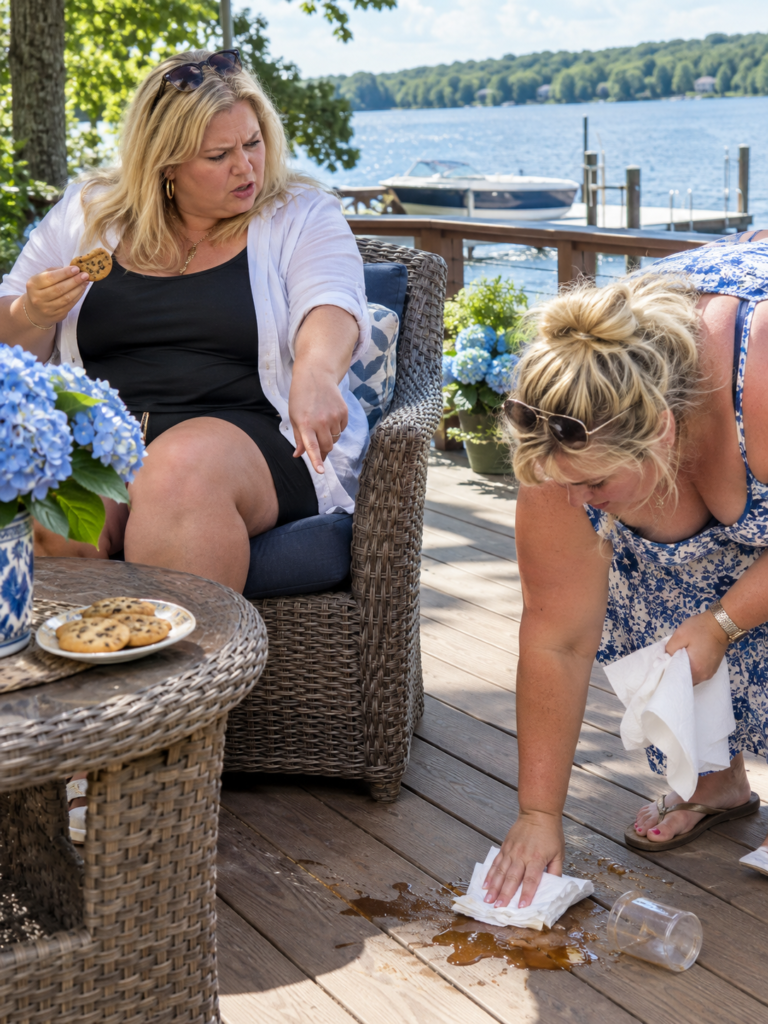
Then she walked out onto the deck. She got into the big lounger with the striped cushion. The one right in the middle of the deck with the best view of the water. She put her sunglasses on. She had her iced tea in one hand and her phone in the other.
And that was it.
That was her weekend.
All summer, she never once asked if she could help.
Not once.
Not in eight weekends.
She never carried a single plate to the sink. She never chopped an onion. She never wiped a counter. She never folded a towel.
She didn’t even bring her own coffee cup inside. She’d leave it on the little side table next to the lounger. Every morning. And by noon there’d be a ring on the wood, and my mom would come out and pick it up and wipe the ring off with a dish towel.
Susan would say, “Oh, thanks, Maggie,” without looking up from her phone.
And at some point, somewhere in July, she stopped saying even that.
She stopped saying thank you.
That was the part that actually got me. More than the coffee cups. More than the mayonnaise.
My mother would set a plate of food in front of her, a plate she’d spent two hours cooking, and Susan would just start eating. Looking at her phone. Not a word. Like the food had appeared out of thin air.
I talked to Daniel about it once. In July. In bed, with the lights off, whispering so nobody would hear through the thin cabin walls.
“Your mom never helps,” I said.
“I know,” he said.
“She never even says thank you anymore.”
“I know.” He was quiet for a moment. “She’s always been like that, babe. At home, my dad does everything. She plans stuff. She decides stuff. But she doesn’t do stuff.”
“But this isn’t her home. This is my mom’s home.”
“I know.”
“Should I say something?”
He was quiet for a long time.
“I don’t know,” he said honestly. “I don’t know what that would do.”
We didn’t talk about it again. Not for a few weeks.
But it was the flower boxes that finally pushed me over the edge.
The Saturday before, my mother had put new geraniums along the deck railing.
Six wooden flower boxes. She’d built them herself, in the spring, in the garage at home. Painted them the same blue as the shutters. And she’d filled every one of them with bright red geraniums.
She’d been looking forward to it for weeks. She told me all about it in the car on the way up. She showed me pictures on her phone. Pictures of the flowers at the garden center. Pictures of the boxes in her garage, drying after she painted them. Pictures of the little bags of potting soil.
“Your father always said red geraniums looked cheerful,” she said. “He used to say they looked like they were having a party.”
She showed me those pictures like she’d planted a prize-winning garden. Instead of six little boxes of red flowers.
She got up at five-thirty that Saturday morning to put them out. Before breakfast. So they’d be there when everybody came downstairs.
I came out on the deck with my coffee and saw them. All six blue boxes. Lined up along the deck railing. Full of bright red flowers. With the blue lake behind them.
It looked like a postcard.
“Mom,” I said. “They’re beautiful.”
She beamed.
Then Susan came out.
She was wearing a white linen cover-up and big sunglasses. She had her iced tea. She walked to the lounger. The big one in the middle, with the striped cushion.
The cushion my mother had put out for her that morning. Fluffed up. Brushed off.
Susan sat down. She stretched out her legs. She looked out at the water.
And then she saw the flowers.
She frowned. She lowered her sunglasses.
“Oh,” she said. “No. No, these are all wrong here.”
My mother was standing in the doorway with a tray of blueberry muffins. She stopped.
“I’m lying right here,” Susan said. She waved her hand at the flower boxes. “And they’re blocking my whole view of the water. I can’t see anything. Don’t do that again.”
Don’t do that again.
In my mother’s house.
About my mother’s flowers.
From the lounger my mother had put a fresh cushion on that morning.
I was standing there with my coffee cup. I couldn’t move.
And my mother said, “Oh. I didn’t think of that. I’m sorry, Susan.”
And she put down the tray of muffins.
And she started moving them.
She moved her own flowers.
One box at a time. Carrying them from the railing in front of the lounger to the far corner of the deck. Where nobody could see them. Behind the grill. Next to the trash cans.
While Susan watched.
Susan didn’t get up to help. She didn’t say oh, you don’t have to do that right now. She didn’t say never mind, it’s fine, leave them.
She just sat there in the lounger with her iced tea. Watching my mother carry six heavy wooden boxes full of dirt and flowers across the deck.
When the last one was moved, Susan put her sunglasses back on.
“That’s so much better,” she said. “Thanks, Maggie.”
It was the first time she’d said thank you in a month.
I knew my mother.
She’s soft. She’s always been soft. She’s the kind of woman who apologizes to a chair when she bumps into it. She’ll swallow anything to keep the peace. Anything.
Especially for me.
She would have moved those flowers a hundred times. She would have driven to town for the eleven-dollar mayonnaise a hundred times. She would have picked up a thousand coffee cups off that side table. And she’d never say a single word.
Because she didn’t want to cause trouble. For me. For my new marriage. For my new family.
That’s exactly why I wasn’t going to swallow it.
But I also knew that shouting wouldn’t do anything.
If I’d marched out on that deck and yelled at Susan, she would have gone home and told everybody. Her sister. Her friends at church. Her book club. Daniel’s new wife attacked me. Out of nowhere. At her mother’s lake house. I didn’t do anything.
And I didn’t want to spend the next thirty Christmases sitting across the table from a woman who thought I despised her. A woman who’d be at every birthday party for my future children. Every graduation. Every holiday. For the rest of my life.
So I didn’t say a word that Saturday.
Not at breakfast. Not at lunch. Not at dinner.
I watched my mother serve dinner to a woman who’d made her move her own flowers. I watched my mother clean up after her. I watched my mother go to bed at ten o’clock, exhausted.
And then I went upstairs and set my alarm for five in the morning.
“What are you doing?” Daniel asked. He was lying in bed, watching me set the alarm on my phone.
“I’m getting up early tomorrow.”
“Why?”
“I’m going to fix something.”
He propped himself up on one elbow.
“Is this about the flowers?”
“It’s about the whole summer,” I said. “The flowers were just the last straw.”
He was quiet for a long moment.
“What are you going to do?”
“I’m not sure yet,” I said. “But I’m done watching my mom work herself into the ground every weekend while your mother lies on a lounger. I’m just done, Daniel.”
I looked at him.
“Are you going to be mad at me?”
He thought about it. For a long time.
“No,” he said finally. “I’m not going to be mad at you.”
He lay back down.
“Honestly,” he said to the ceiling, “I should have done something myself. A long time ago.”
At 5:07 a.m., I found it.
An old dry-erase board. About two feet by three feet. Mom kept it leaning against the wall next to the pantry. When I was a kid, she used to write the grocery list on it. And the weather forecast. And little messages. Good luck on your swim test! Dad caught a big one!
It had been sitting there, blank, for years.
I carried it to the big wooden kitchen table. I propped it up against the fruit bowl, so anybody coming into the kitchen would see it first thing.
I found a black marker in the junk drawer. I tested it on my hand. It worked.
And at the top of the board, in big capital letters, I wrote:
WEEKEND JOBS
Then I divided up the work.
Daniel: breakfast cleanup.
Richard: grocery run.
Me: lunch.
Susan: breakfast.
Then I made a little chart for dinner. So it would rotate. Saturday night, Sunday night. Different people each night. I put Susan’s name next to Saturday.
Then, at the very bottom of the board, next to my mother’s name, I wrote:
Mom: enjoy your house.
I underlined your. Twice.
I was standing there looking at it. At my handwriting. Wondering if I’d gone too far. Wondering if I should erase the whole thing and go back to bed.
And then I heard slippers.
Behind me. On the wooden floor.
My mom was standing in the kitchen doorway.
She was wearing her old pink robe. The fuzzy one with the belt that’s been missing since 2011. Her gray hair was sticking up on one side. She had her reading glasses pushed up on top of her head.
“What are you doing?” she asked. “It’s five o’clock in the morning.”
“Fixing something,” I said.
She walked over to the kitchen table. She pulled her reading glasses down onto her nose. She read the board.
I watched her face change before she even got to the second line.
“No,” she said.
“Mom—”
“No, honey. Take that down. Right now.”
“It’s your house, Mom.”
“They’re guests.”
“They’ve been guests here almost every single weekend for two months.”
She lowered her voice. She glanced up at the ceiling. At the guest room right above us. Like Susan might somehow be able to hear us through the floor.
“You can’t give people chores,” she whispered, “when you’ve invited them somewhere. You just can’t. That’s not how it’s done.”
I looked at her.
“Why not?”
“Because that’s not how you treat guests.”
“Is telling the woman who owns the house where she’s allowed to put her own flowers,” I said, “how you treat a host?”
Her mouth went tight.
“She didn’t mean anything by it,” Mom said.
“You moved them, Mom. You moved all six of them. Behind the trash cans.”
“It wasn’t a big deal.”
“Then put them back.”
She didn’t answer.
She looked toward the big kitchen window. Out at the deck. Where six blue flower boxes full of red geraniums were sitting in the corner next to the grill. In the dark.
I knew that look. I’ve known it my whole life.
She wasn’t thinking about the flowers. She was thinking about how much discomfort she’d have to deal with if she admitted, out loud, that she wanted them back where she’d put them. How awkward it would be. What Susan would say. What Susan would think. What Susan would tell Daniel. What Daniel would tell me. Whether I’d be in trouble in my new marriage because my mother made a fuss about geraniums.
She was doing math. The same math she’s done my whole life.
“I’m not having you start something with your mother-in-law,” Mom said. “Because of me. I won’t have it.”
“I’m not starting anything, Mom,” I said. “I’m ending something.”
She reached past me for the eraser. It was sitting on the little ledge at the bottom of the board.
I picked up the whole board before she could get it.
“One day,” I said. “Please. Just try one day. One day where everybody takes care of themselves. And you don’t take care of anybody.”
“But I like taking care of people,” Mom said.
“I know you do,” I said. “But that’s different from being everybody’s maid.”
Her face changed.
Something went across it. Hurt. Like I’d slapped her.
I knew right away I’d gone too far. I opened my mouth to take it back.
And then we heard footsteps.
Upstairs. Directly over our heads. On the old wooden floor of the guest room.
Somebody was up.
Mom stared at the board in my hands.
“Oh, Lord,” she whispered.
I put the board back on the kitchen table. Propped against the fruit bowl. Right where it was.
Mom stood there for a second. Frozen.
Then she did something I’ve never seen her do. In my whole life.
She pulled out a chair at the kitchen table. And she sat down.
She didn’t go to the coffee maker. She didn’t go to the refrigerator for eggs. She didn’t reach for the frying pan.
She just sat down. In her fuzzy pink robe. With her hands folded in her lap. Like a guest.
She looked terrified.
Susan came downstairs fifteen minutes later.
She was already dressed for the deck. White linen cover-up. Sandals. Sunglasses pushed up on her head. Her hair was already done.
She walked straight past us. Straight to the coffee maker.
She didn’t say good morning.
The coffee maker was empty. Cold. The carafe was clean and dry, sitting on the burner.
There was no coffee.
Beside me, at the table, my mother made a tiny movement. Her hand came up off her lap. Toward the coffee maker. Automatically.
I reached over and touched her wrist.
She stopped.
Susan opened a cabinet. Then another one. Then a third one. She was looking for something.
“Is the coffee not on?” she asked. To nobody. To the cabinets.
“Not yet,” I said.
Susan turned around. She glanced at my mother. Sitting at the table in her robe. Doing nothing.
“Oh,” Susan said.
She looked confused. Like the coffee maker had broken. Like the sun hadn’t come up. Like something was wrong with the laws of the universe.
Then she saw the board.
She read it once.
Then she read it again.
She laughed.
A light little laugh. The kind you laugh when you think something’s a joke.
“What’s this?”
“Weekend jobs,” I said.
“I can see that,” Susan said. She tilted her head. She read it a third time. “I’m—breakfast?”
“You’re breakfast,” I said.
She looked at me like I’d just told her she was going to be reroofing the house.
“You’re serious?”
“Very serious.”
Her smile disappeared.
“Your mother,” Susan said slowly, “invited us here.”
Before I could answer, Daniel came downstairs.
He was wearing a T-shirt and pajama pants. His hair was a mess. He was yawning.
He stopped at the bottom of the stairs.
He looked at the board. He read it.
Then he looked at me.
I’d told him the night before that I was done watching my mom work herself sick. But I hadn’t told him exactly what I was going to do. I didn’t know myself until five o’clock that morning.
He looked at the board again. At his name. Daniel: breakfast cleanup.
Susan turned to him.
“Apparently,” she said, “I’m making breakfast.”
She said it like it was the funniest joke she’d ever heard. She said it like she was waiting for him to laugh. To say, Oh, Mom, of course you’re not.
Daniel hesitated.
It was only half a second.
But that half second felt like an hour to me.
Then he said, “Okay.”
Susan stared at him.
“Okay?“
“Yeah,” Daniel said. He scratched the back of his neck. “I’ll clean up afterward. It says right there.”
Susan folded her arms across her white linen cover-up.
“When people stay at my house,” she said, “I don’t hand them a chore list.”
Richard had just come down the stairs behind Daniel. He was wearing his fishing hat and a T-shirt that said WORLD’S OKAYEST GOLFER.
He stopped on the bottom step.
Daniel looked at his mother.
“No, Mom,” he said. “You don’t. Because at our house, Dad does all the grocery shopping. And I usually make breakfast when I’m home. And everybody clears the table after dinner. Everybody. Except you.”
Susan’s head snapped around. Toward Richard.
Richard was standing there on the bottom step. In his fishing hat. Looking like he wanted to go back upstairs.
He gave an awkward little shrug.
“I do usually shop,” he said.
“That’s not the point, Richard.”
But it was.
It was exactly the point.
Susan always thought of herself as a wonderful hostess. I’d heard her say it. At our engagement party. At Thanksgiving. Oh, I love entertaining. I’m a natural hostess. It’s my gift.
And it was true, sort of. She planned the dinners. She picked out the flowers for the table. She chose what music should be playing. She told everybody where to sit.
Other people did the actual work.
Richard did the shopping. Daniel did the cooking. Richard’s sister did the dishes. Susan stood in the middle of it all with a glass of wine and took the compliments.
I watched it start to sink in. Around the kitchen. On Richard’s face. On Daniel’s face. Even on Susan’s face, for just a second.
And then my mother tried to save everybody.
“I can just make some eggs,” Mom said quickly. She started to stand up. “It’s really no trouble. I’ll just—”
“No,” I said.
Firmly. Maybe a little too firmly.
Mom sat back down.
Susan gave me a long, hard look. The kind of look that said she was going to remember this. For a long, long time.
I looked back at her.
I didn’t look away.
Then Susan turned around. She walked to the refrigerator. She opened it.
“Fine,” she said. “Where are the eggs?”
By nine o’clock, breakfast had happened.
Nothing dramatic. Susan didn’t poison anybody. Nobody went hungry. The cabin didn’t burn down.
She made scrambled eggs and toast.
The eggs were a little dry. The toast was a little burned on one side.
She asked where the butter was. Even though she’d watched my mother take it off the exact same shelf in the refrigerator every single weekend for two months.
She asked where the frying pan was.
She couldn’t find the spatula. She looked in four different drawers. Then she used a fork.
Three times, my mom started to get up.
And three times, I said, “Sit down, Mom.”
She sat down. Every time. But she didn’t like it. She sat there at the kitchen table in her pink robe with her hands clenched in her lap, watching Susan crack eggs like somebody watching a horror movie.
After breakfast, Susan got up from the table.
And she left her plate sitting there. Right where she’d eaten. With a crust of toast on it and a smear of egg.
Out of habit. That’s all it was. Two months of habit. Two years, maybe. Thirty years.
She started walking toward the deck.
Daniel looked at her plate.
Then he looked at her.
“Mom,” he said.
Susan stopped in the doorway. She turned around.
She saw him looking at the plate.
She walked back to the table. She picked it up. She carried it to the sink.
She set it down in the sink. Hard. With a clatter.
And she walked out to the deck.
I should have felt triumphant.
I really should have. It worked. She made breakfast. She carried her own plate.
Instead, I just felt tired.
Because my mother looked miserable.
She was sitting at the kitchen table, staring at the pile of dishes in the sink. Her fingers were twitching. She looked like somebody who’d been told she wasn’t allowed to breathe.
By lunchtime, I realized Susan wasn’t the only person fighting the new system.
My mom followed me around the kitchen while I made lunch.
Every step. Right behind me.
“You’ve cut those tomatoes too thick,” she said.
“They’ll survive, Mom.”
“I could make the dressing. I have a good recipe for—”
“I’ve got it.”
“The good salad bowl is in the bottom cabinet. The wooden one. Not that one. That one’s for chips.”
“Mom.”
“And you should put the lettuce in the spinner first, or it’ll get soggy, and—”
“Mom.”
She stopped.
She stood there in the middle of her own kitchen. In her fuzzy pink robe. At noon. She hadn’t even gotten dressed. She’d been hovering in the kitchen all morning.
And she looked at me. And she asked something that I’ve never forgotten.
“What am I supposed to do?”
That question stayed with me.
Not Can I help? Not What do you need? Not Do you want me to make the dressing?
What am I supposed to do?
Like she didn’t know. Like she’d never known. Like she’d spent so many years doing things for other people that she’d forgotten how to exist without a job.
“Go sit outside,” I said gently. “On the deck. In the sun.”
“And do what?”
“Whatever you want.”
She looked genuinely lost.
Like I’d asked her to speak Chinese. Or fly a helicopter.
“I don’t know what I want,” she said.
“Then go find out,” I said.
She stood there for another moment. Then she went upstairs. I heard her door close.
Twenty minutes later, she came back down. Dressed. In her gardening jeans and an old T-shirt. With a book under her arm. A paperback mystery I’d given her for Christmas that she’d never even opened.
She went out to the deck.
She sat down in a plastic chair. Not the lounger. A plastic chair in the corner. Next to the grill. Next to her flower boxes.
She opened the book.
She read the same page for about forty-five minutes.
Later that afternoon, around three, I went upstairs to get a sweater. The wind was picking up off the lake.
The guest room door was closed. I could hear voices through it.
Susan and Richard.
I wasn’t trying to listen. I really wasn’t. I was just walking past to get to my room.
Until I heard Susan say:
“This is exactly what I was trying to prevent.”
I stopped in the hallway.
Richard said something too quietly for me to hear.
And then Susan said:
“She told me herself, Richard. She said it’s getting harder for her. The cleaning. The shopping. The driving. All of it. And now everybody’s treating her like she can’t manage her own house. Like she’s some little old lady who needs to be rescued.”
I knocked on the door.
The talking stopped. Instantly.
A second later, Susan opened the door. She looked at me.
“Can I help you?” she said.
“What are you talking about?” I asked.
“Excuse me?”
“You said my mother told you it was getting harder. What did she tell you?”
Susan looked at Richard. Then back at me. Her face changed.
“She didn’t tell you?”
“No,” I said. “She didn’t tell me anything.”
My mom was sitting on the deck when I came downstairs. Still in the plastic chair in the corner. Still holding her mystery novel. Still on page twelve.
I walked right up to her.
“Mom,” I said. “Did you tell Susan that the lake house is getting too hard for you?”
My mother looked up from her book.
She sighed. A long one.
“Oh, honey,” she said. “It wasn’t some big secret.”
“What did you tell her?”
“Nothing important. Just—talking.”
Susan had followed me downstairs. She was standing in the sliding glass door now. With her arms crossed.
“You told me,” Susan said to my mother, “that taking care of this place was wearing you out. Back in June. The first weekend. Remember? We were sitting right here.”
“I said I get tired more easily than I used to,” Mom said quietly. “That’s all. I’m sixty-eight.”
“And that the grocery runs were a nuisance,” Susan said. “And that opening up the whole house every weekend was a lot of work. And that your back’s been bothering you since you fell off the ladder painting the shutters.”
I turned to my mother.
“You fell off the ladder?”
Mom looked at her book.
“It was just a little fall,” she said. “I was fine. I landed in the hydrangeas.”
I turned around. I looked at Susan.
“So your solution,” I said slowly, “was to do absolutely nothing?”
Her face went hard.
“No,” she said. “My solution was not to make her feel like she couldn’t handle her own life.”
I actually laughed. Out loud. I couldn’t help it.
“By leaving coffee cups all over the deck?”
Susan’s face went red.
“You don’t understand,” she said.
“Then explain it to me.”
She was quiet for a long moment.
Then she walked out onto the deck. She didn’t go to her lounger. She pulled out one of the plastic chairs. Across from my mother. And she sat down.
She looked out at the water.
“When my mother got older,” Susan said, “we all started helping her. With everything. At least, that’s what we called it. Helping.”
Her voice was different. Softer. Quieter.
“We took the grocery bags out of her hands. We told her not to cook anymore. We told her to sit down every time she tried to clean. Every holiday, every birthday, she’d start to do something. Get up to clear the plates. Get up to make the gravy. And somebody would say, Mom, don’t worry about that. Mom, sit down. Mom, relax. We’ve got it.“
Susan looked down at her hands.
“We thought we were being so good to her,” she said. “We thought we were taking care of her.”
Nobody said anything. Richard was standing in the doorway now too. And Daniel, behind him.
“And one day,” Susan said, “she told me something. At Thanksgiving. The last one. Before she died. She was sitting in her chair in the living room. By herself. While everybody else was in the kitchen doing everything. And I went in to bring her a cup of coffee.”
She stopped. She swallowed.
“And she looked up at me,” Susan said, “and she said, Susie, you’ve all made me feel so useless.“
My mother put her book down in her lap.
“She said we’d decided she was old,” Susan said quietly. “Before she was. She said that every single time we told her to sit down, every time we took something out of her hands, what she heard was that nobody needed her anymore. That she didn’t have a job anymore. That she was just—waiting. To die.”
Susan’s eyes were wet behind her sunglasses.
“She died four months later,” she said. “And I never got to tell her I was sorry.”
I looked at my mother.
She was watching Susan very carefully. Very quietly. With her hands folded on top of her book.
“So when your mother told me this house was getting harder for her,” Susan said, “but she kept saying, over and over, how much she loved having everybody here—how much she loved cooking for everybody, how the house felt empty without people in it—I thought I understood. I thought, I’m not going to do to Maggie what I did to my mother. I’m not going to take this away from her.“
“So you thought making her wait on you hand and foot,” I said, “was helping her?”
“I thought,” Susan said, “letting her host the way she wanted to host was helping her. Letting her feel needed.”
And for one uncomfortable second, I could almost see how she got there.
Almost.
A woman who’d hurt her own mother by doing too much. Who’d sworn she’d never do it again. Who swung all the way to the other side.
Almost.
Then I remembered the flowers.
“And what does any of that,” I said, “have to do with leaving your coffee cup on the table every morning?”
Susan didn’t answer.
“Or making her drive forty minutes to town,” I said, “because you don’t like the mayonnaise she buys?”
Nothing.
“Or telling her where she’s allowed to put her own flowers? In her own house? That her husband bought? That she’s been coming to for thirty years?”
Susan’s face changed.
Across from her, my mother looked down at her lap.
I kept going. I couldn’t stop now.
“Maybe that’s why you let her make breakfast the first weekend,” I said. “Maybe that’s even why you let her make it the second weekend. Because you were trying to let her feel needed. Fine. I believe you.”
I looked right at her.
“But that isn’t why you stopped saying thank you.”
Susan’s mouth opened.
Then it closed.
She didn’t have an answer.
Richard was staring down at the deck boards. At his own feet. In his fishing hat.
Daniel was standing behind him in the doorway. Very still.
Nobody said anything. The wind moved through the pine trees around the cabin. A boat went by out on the lake, far away. A loon called somewhere.
It was a long, long silence.
And then my mother spoke.
“I do like it,” she said.
I turned toward her.
She folded her hands on top of her mystery novel. She looked out at the water.
“I like cooking for everybody,” Mom said. “I really do. I like having all the bedrooms full. I like hearing people moving around down here in the morning. I like the sound of it. The dishes. The voices. Somebody laughing on the deck.”
She was quiet for a moment.
“When your father died,” she said to me, “this house was so quiet. For so long. Two whole summers, I couldn’t come up here. Because it was so quiet. And now it’s not quiet anymore. And I love that. I really do love that.”
Susan looked relieved. Too quickly. Her shoulders came down.
But my mother wasn’t finished.
“But I suppose,” Mom said slowly, “I got carried away.”
“With what, Mom?” I asked.
She looked at me.
“Trying to make them want to come back,” she said.
I didn’t understand at first.
I just stood there on the deck. Looking at her.
And then I did.
All at once. Like a wave coming in off the lake.
My mother gave a small, embarrassed little laugh. She looked down at her hands.
“You got married, honey,” she said. “And suddenly there was this whole other family. Susan and Richard. Daniel’s aunts and uncles and cousins. All these people I didn’t know. And I just—” She stopped. “I wanted things to be easy. For you. I wanted them to like being here. I wanted them to like me. I wanted you to never have to worry that your mother and your husband’s mother couldn’t get along.”
I looked at her.
“The sheets,” I said quietly.
Mom smiled. Just a little. A tired, sheepish smile.
“The sheets,” she said.
“The four-hundred-thread-count sheets. And the new towels. And the little soap basket in the bathroom.”
“I wanted everybody to be comfortable.”
“The special mayonnaise,” I said. “Eleven dollars a jar.”
“Susan likes it,” Mom said.
“The peach cobbler. Every Saturday night. Because Richard said once, back in June, that he liked peach cobbler.”
Across the deck, Richard looked up. Surprised.
“You make that for me?” he said. “Every week?”
“You said you liked it,” Mom said.
Richard looked stricken.
“I did say that,” he said slowly. “I remember saying that. I don’t even—I don’t even really like peach cobbler that much. I was just being polite.”
My mother stared at him.
And then, for some reason, she started to laugh.
“Every time we came back,” I said. “Every Friday night. When our cars pulled in.”
Mom looked at me. She stopped laughing.
“I thought I was doing something right,” she said quietly.
The whole summer rearranged itself in my head. Like furniture being moved around in a room.
My mother hadn’t been serving Susan just because she couldn’t say no. Just because she was soft. Just because she wanted to keep the peace.
She’d been auditioning.
For eight weeks. Every weekend. Every pancake, every pot roast, every eleven-dollar jar of mayonnaise, every coffee cup picked up off the side table.
She’d been auditioning for a place in my new family.
She’d been trying to earn it.
Susan was looking at my mother. Her face had gone pale.
“Maggie,” she said. “I thought—I honestly thought you liked doing all of this. That it made you happy. You always looked so happy.”
Mom nodded.
“I do like it,” she said.
Susan blinked. Confused.
And then my mother said the thing that I think about all the time now. The thing I’ve written down and stuck on my own refrigerator at home.
“I like taking care of people, Susan,” Mom said quietly. “I don’t like being taken for granted. Those aren’t the same thing.”
Nobody had anything to say after that.
Susan sat very still in her plastic chair. Looking at my mother. Looking at the corner of the deck. At the six blue flower boxes full of red geraniums, sitting next to the trash cans.
Richard took off his fishing hat. He held it in both hands.
Daniel came out onto the deck. He sat down on the steps. He didn’t say anything either.
We all just sat there. The five of us. On my mother’s deck. Looking at the lake.
For a long time.
At five o’clock, Susan came into the kitchen.
She stood in front of the dry-erase board. She read it again.
Her name was beside dinner. Saturday: Susan.
For a second, I thought we were about to start the whole fight all over again. I braced myself. I was standing at the sink, washing lettuce.
Susan stared at the board.
Then she turned around and looked at my mother. Who was sitting at the kitchen table. With her mystery novel. On page thirty-one now. She’d made some progress.
“Maggie,” Susan said. “What were you planning to make? For tonight?”
Mom started to stand up.
I gave her a look.
She sat back down.
“Chicken,” Mom said. “With roasted potatoes. And green beans. The chicken’s in the refrigerator. I marinated it last night.”
Susan sighed. A long sigh. Like somebody about to climb a mountain.
“Fine,” she said. “Where do you keep the potatoes?”
Dinner wasn’t great.
It wasn’t awful either.
Susan overcooked the chicken. It was a little dry. Like the eggs. She forgot to put salt on the green beans. The potatoes were a little crunchy in the middle.
She asked about every single cabinet in the kitchen. Where’s the baking sheet? Where’s the olive oil? Where’s the pepper? Is this the oven mitt or a pot holder? What’s the difference?
But halfway through cooking, something changed.
She stopped asking my mother.
She started looking for things herself. Opening drawers. Opening cabinets. Finding things.
At one point, she found the spatula. The one she couldn’t find that morning. It was hanging on a hook on the side of the refrigerator. Right where it’s always been.
She held it up. She looked at it.
“Huh,” she said.
We all sat down to eat.
Susan’s dry chicken. Susan’s crunchy potatoes. Susan’s unsalted green beans.
Everybody ate everything.
“This is good, Mom,” Daniel said.
“No, it isn’t,” Susan said.
“It’s fine,” Richard said.
“It’s edible,” Susan said.
My mother took a bite of chicken. She chewed very slowly. Very carefully.
“It’s very good, Susan,” she said. “Thank you.”
Susan looked at her. For a long moment.
“You’re welcome, Maggie,” she said.
After dinner, my mom automatically reached for the plates.
Out of habit. Thirty years of habit. Her hands just went out on their own.
But Susan picked them up first.
“Leave those,” Susan said. “I’ll get them.”
My mother smiled.
And then her expression changed.
“Don’t you tell me to sit down either, Susan,” Mom said.
Susan froze. With a stack of plates in her hands.
And for the first time all day, I almost laughed.
Susan caught herself.
“Right,” she said. “Right. I’m sorry.”
She stood there holding the plates against her chest.
“Maggie,” she said carefully. “Would you like to help? With the dishes?”
My mother thought about it.
She really thought about it. I watched her think.
“No,” she said.
“Okay,” Susan said.
And she carried the dishes into the kitchen by herself.
That night, I found my mother on the deck. Alone. After everybody else had gone to bed.
She was sitting in the plastic chair in the corner. By her flower boxes. Looking at the lake. The moon was out. The water was silver.
I sat down next to her.
“I’m sorry, Mom,” I said. “For what I said this morning. About being everybody’s maid. That was mean.”
“It was a little mean,” she agreed.
“I didn’t mean it like that.”
“I know you didn’t.” She was quiet for a moment. “But it was also a little true.”
We sat there. The loon called again. Somewhere far out on the water.
“Your father would have hated this summer,” Mom said suddenly.
I looked at her.
“He would have hated watching me do all that,” she said. “Every weekend. He used to say I’d give away my own shoes if somebody said they liked them. He used to take things out of my hands. Not to do them for me. Just to make me stop. He’d take the dish towel and hide it.”
She laughed. A little.
“He hid a lot of dish towels,” she said. “I found one in the tackle box once. Three years after he died.”
I took her hand.
“I miss him,” she said.
“I know, Mom. I do too.”
The next morning, I came downstairs at seven.
Mom was already up. Sitting at the kitchen table. In her robe. With a cup of coffee she’d made just for herself. Reading her mystery novel. She was on page eighty-four.
The kitchen was quiet.
And in the sink, there was a coffee cup. Rinsed out. Upside down.
Susan’s coffee cup. The white one with the gold rim that she always uses.
She’d already been down. She’d made her own coffee. And she’d brought her cup in from the deck and rinsed it out and put it in the sink.
I didn’t say anything about it.
Neither did my mother.
We just looked at each other. And she smiled. And went back to her book.
Richard went to town for groceries that morning. By himself. He came back with a whole bag full of stuff. Including the regular mayonnaise.
“Susan said it’s fine,” he said, putting it in the refrigerator. “She said she was being silly. About the avocado stuff.”
He held up another jar. A glass one.
“I also got her one of these,” he said sheepishly. “Just in case.”
Before they left on Sunday afternoon, Susan went looking for my mother.
She found her on the deck. In the plastic chair in the corner. Still next to the flower boxes.
I stayed in the kitchen. Close enough to hear through the open sliding door. I didn’t pretend I wasn’t listening.
Susan stood there for a moment. She looked at the geraniums. The six blue boxes. The bright red flowers. Sitting in the corner by the trash cans.
“Maggie,” Susan said. “I’m sorry. About those. The flowers.”
My mother didn’t say anything.
“I shouldn’t have told you to move them,” Susan said. “It’s your house. It was a terrible thing to say. I don’t even know why I said it.”
My mother looked up at her.
“No,” Mom said quietly. “You shouldn’t have.”
And Susan accepted that.
She didn’t make any excuses. She didn’t say I was tired or I didn’t mean it like that or I was just joking. She didn’t give a big speech. She didn’t explain.
She just stood there. And she took it.
Then she looked at the flowers again. For a long moment.
“They are pretty,” she said.
My mother smiled.
“I know,” she said.
Daniel was loading our bags into the car out front.
Susan walked back through the kitchen on her way out. With her purse over her shoulder and her sunglasses on her head.
She stopped at the kitchen table.
She looked at the dry-erase board.
I’d already wiped it clean that morning. For next weekend. It was blank again. White and empty.
Susan picked up the black marker from the little ledge at the bottom.
For a second, I thought she was going to write something mean. Or erase the whole thing. Or make some kind of joke.
Instead, she uncapped the marker.
And at the top of the blank board, in neat, careful handwriting, she wrote:
Susan — Saturday breakfast.
She capped the marker. She put it back on the ledge.
She didn’t say anything. She didn’t look at me.
She just walked out the front door.
On her way to the car, she walked past the deck.
Past the big lounger with the striped cushion. The one in the middle of the deck. With the best view of the water. The one she’d been lying in all summer.
She paused next to it.
She looked at the lounger.
Then she looked at the corner of the deck. At the six blue boxes of red geraniums.
Then she did something I’ll never forget.
She walked over to the corner. She picked up one of the flower boxes. With both hands. It was heavy. Full of wet dirt.
She carried it across the deck. And she set it back on the railing. Right in front of the lounger. Right where my mother had put it.
Then she went back and got another one.
And another one.
She moved all six of them. By herself. Back to the railing. Every single one.
She was out of breath when she was done. Her white linen cover-up had dirt on it.
My mother was standing in the sliding glass door. Watching. With her hand over her mouth.
Susan brushed off her hands.
Then she looked at the lounger. At the view of the lake. At the six boxes of red geraniums blocking part of it.
She didn’t say a word.
She just picked up a plastic chair from the corner. And she moved it to the other end of the deck. Where you could see the whole lake. Past the flowers.
And she sat down in it. For just a minute. To look at the water.
Then she got up and walked to the car.
My mom noticed.
So did I.
I set my alarm for five o’clock that Sunday morning because I thought I needed to teach my mother-in-law a lesson. That nobody was there to serve her. That my mother wasn’t the hired help.
And I did. I think she learned it.
But that wasn’t the only thing that changed that weekend.
My mom stopped treating every visit like a test she had to pass.
The next weekend, she made breakfast on Sunday. Because she wanted to. Not because anybody expected it. Susan made breakfast on Saturday, like she wrote on the board. Scrambled eggs. Less dry this time. She’d watched a video, she told us.
The weekend after that, Mom and Susan made dinner together. Mom taught Susan how to make her pot roast. They stood side by side at the stove in the orange-countertop kitchen, arguing about how much garlic to use.
“More,” Mom said.
“That’s already a lot.”
“More, Susan.”
Susan put in more.
It was the best pot roast I’d ever had.
Susan started carrying her own plate. Every meal. Without anybody looking at her. She started asking before she expected something. Maggie, would it be okay if I took the kayak out? Maggie, do you mind if I use the last of the coffee?
She started doing just enough work to understand how much had always been happening around her. How much my mother had been carrying. All summer. Every weekend.
On the last weekend in August, when we closed up the cabin for the season, Susan got down on her hands and knees and scrubbed the bathroom floor.
Nobody asked her to.
She just did it.
When she was done, she stood up, and her knees cracked, and she said, “Good Lord. You do this every single week, Maggie?”
“Every single week,” Mom said.
Susan looked at her for a long moment.
“You’re a saint,” she said. “Or crazy. One of the two.”
“Probably both,” Mom said.
They both laughed.
And I learned something too.
I learned that defending my mother didn’t mean I had to fight every single battle for her. It didn’t mean yelling at Susan. It didn’t mean making a scene. It didn’t mean ruining thirty Christmases.
Sometimes I just had to get up at five o’clock in the morning with a dry-erase marker.
Sometimes I just had to make enough room for her to finally say no.
And then step back.
And let her say it.
We went up to the lake again last weekend. The first weekend of the new summer.
My mother had already planted her geraniums. Six blue boxes. Bright red flowers.
The dry-erase board was on the kitchen table when we got there. Propped against the fruit bowl.
At the top, in my mother’s handwriting, it said WEEKEND JOBS.
Underneath, there were five names. Everybody had a job. Breakfast, lunch, dinner, groceries, cleanup. Rotating.
At the bottom, next to her own name, my mother had written:
Maggie: Sunday breakfast. And enjoy my house.
She’d underlined my. Twice.
The geraniums stayed exactly where she planted them.
All summer.
And every morning, when Susan came out on the deck with her coffee, she walked right past the big lounger with the striped cushion. And she sat in the plastic chair at the end of the deck. Where you can see the whole lake.
Past the flowers.
Past the party.