My mom hadn’t been out to dinner in months.
Seven months, actually. I counted. The last time was Easter, at my aunt’s house, and that barely counted because it was family.
That fact had been bothering me more than I wanted to admit.
Because Molly always loved going out.
When I was a kid, my mother could turn an ordinary Tuesday dinner at a diner into an event. She’d study the menu like it held state secrets. She’d read every single description out loud in a funny voice. “Hand-breaded, golden-crisp onion rings, served with our signature dipping sauce.” Then she’d look up at me over the top of the menu and whisper, “What do you think the signature is? I bet it’s ketchup and mayonnaise. I bet they’re lying to us.”
She’d insist everybody at the table taste what she ordered. She’d hold her fork across the table at you until you gave in. And somehow, by the time dessert came, she’d be friends with the server. She’d know the server’s name, where she went to high school, and what her boyfriend did for a living.
My dad used to say she could make friends with a brick wall.
“Only if the wall has a nice personality,” Mom would say.
But somewhere along the way, restaurants stopped feeling safe to her.
It wasn’t because she stopped liking food. My mom still loves food more than anybody I know. She watches cooking shows every night. She can tell you the difference between six kinds of basil.
It was because people stopped minding their own business.
My mother is a big woman. She’s been a big woman for as long as I can remember. When I was little, I thought she was the softest, best-smelling, warmest place in the world to fall asleep. I still think that.
But other people didn’t see her the way I did.
Over the years, strangers made cruel comments about her weight.
Some of them whispered to each other and assumed she couldn’t hear. She always heard.
Some just stared at her plate. Like they were counting her fries.
And some were bold enough to say things right to her face.
I remember the first time I noticed. I was eleven. We were at a buffet for my cousin’s birthday. Mom was standing in line with her plate. A man behind her, some stranger in a golf shirt, said to his wife, not even quietly, “Well, at least we know where all the mashed potatoes went.”
His wife laughed.
Mom didn’t turn around. She just finished filling her plate and walked back to our table and sat down. She ate everything on it. She talked and laughed with my aunts. She seemed completely fine.
But in the car on the way home, she was quiet. And that night, I heard her crying in the bathroom with the water running.
I didn’t know what to do. I was eleven. I sat outside the bathroom door on the hallway carpet until she came out. She found me there and pretended she’d just been washing her face.
There were more.
A woman at the grocery store who looked in Mom’s cart and said, “Oh, honey, you don’t need all that.” It was ice cream. For my eighth-grade class party.
A man on an airplane who complained loudly to the flight attendant that he didn’t pay for his seat to “share it.”
A nurse at a doctor’s office, when Mom went in for an ear infection. She took one look at Mom and said, “Well, we know what the real problem is here,” before Mom even sat down.
A waiter, once, who brought Mom a salad she didn’t order. “I figured,” he said with a wink.
Every one of them took a little piece out of her.
Like someone chipping away at a statue with a tiny hammer. One chip at a time. Year after year.
After my father died, six years ago, it got worse.
Dad used to be her shield. He was a big guy too, with a loud laugh and a deep voice. If anybody said anything, he’d turn around in his chair very slowly and say, “Excuse me? I don’t think I heard you. Say it again. Louder.” And nobody ever said it again.
After he was gone, there was nobody standing between her and the world.
So she started building her own walls.
Invitations became excuses.
“I’m tired tonight, honey.”
“My stomach’s a little off.”
“Why don’t we just order something in? I’ll get the good lasagna from Tony’s.”
“I don’t have anything to wear.”
“It’s supposed to rain.”
I knew what all those excuses meant.
She was protecting herself.
So when her sixty-fifth birthday came around, I made a decision.
I wasn’t going to let another year go by with her celebrating at home. Alone. On her couch, with takeout and a cooking show. Because strangers had taught her to feel ashamed of taking up space in the world.
I called her a week before her birthday.
“I’m taking you to dinner,” I said. “For your birthday. A real one. At a restaurant.”
There was a pause on the line.
“Daphne,” she said.
“I know that tone.”
“I’m perfectly happy eating at home.”
“That’s not the point, Mom.”
She sighed. A long one. I could picture her sitting at her kitchen table, probably turning a coffee mug around and around in both hands. She does that when she’s nervous.
“Restaurants are exhausting, honey,” she said quietly.
“Not this one.”
I’d already picked the place.
Her favorite little Italian restaurant. On Cooper Street, downtown. It’s called Stella’s. It’s been there forever.
Nothing fancy. No white tablecloths or waiters in bow ties. Just really good food and a place where everybody seemed kind.
She used to love it. Years ago. My dad used to take her there every anniversary. They’d always sit at the same table by the front window, and Dad would order the veal, and Mom would order the lasagna, and they’d split a tiramisu.
After Dad died, she stopped going.
I understood why. But I also thought maybe it was time.
The dining room at Stella’s is small, with warm yellow lights. There are old black-and-white photographs all over the walls. The tables are close together, so the place always feels busy and happy without being loud or overwhelming. It smells like garlic and fresh bread from the second you walk in the door.
“Stella’s?” Mom said, when I told her.
“Stella’s.”
She was quiet for a long time.
“I haven’t been there since your father,” she said.
“I know.”
Another long pause.
“Fine,” she said finally. “But you are not telling them it’s my birthday.”
“I make no promises.”
“Daphne.“
“Fine,” I said. “No singing.”
That got a laugh out of her. A real one. A little one, but real.
It felt like a victory.
On the night of her birthday, I picked her up myself.
I drove to her house. The same house I grew up in. A little white ranch house with green shutters and the rosebushes Dad planted the year I was born.
I rang the doorbell.
When Mom opened the front door, I almost didn’t recognize the nervousness underneath her smile. It was right there. Right behind her eyes. I could see it.
She’d dressed very carefully. I could tell. Dark pants. A soft blue blouse I’d never seen before. She must have bought it for tonight. A silver necklace. And the little silver hoop earrings my father bought her for their thirtieth anniversary. She almost never wears them anymore. She keeps them in a velvet box on her dresser.
Her hair was curled. She was wearing lipstick. Pink.
“You look beautiful, Mom,” I said.
She immediately looked down at herself. At her blouse. Tugging at the hem.
“You have to say that,” she said.
“No, I don’t.”
“You’re my daughter.”
“Exactly,” I said. “I’ve had decades of practice telling you when you’re being ridiculous. And right now, you’re being ridiculous. You look beautiful.”
She laughed again.
And there she was. For just a second.
That was the version of my mother I wanted back.
The restaurant was busy when we got there. A Friday night. But not chaotic.
Plates clinked somewhere in the back. Somebody at the little bar near the front was laughing, a big booming laugh. Soft music was playing, some old Italian singer. The whole place smelled like garlic and tomatoes and fresh bread baking.
Mom stopped at the front door.
Just for half a second. Right on the threshold.
I noticed.
She noticed that I noticed.
And then she lifted her chin. The way she used to when I was little and we were going somewhere scary, like the dentist or my first day of kindergarten.
“Well,” she said. “I’m sixty-five years old. I’m too old to be scared of pasta.”
I smiled so hard my face hurt.
“That’s the spirit,” I said.
The hostess sat us at a table in the middle of the room. Not by the front window. I was relieved. I didn’t want Mom sitting at Dad’s table. Not tonight. That would’ve been too much.
A waiter came over. A young guy, maybe twenty-five, with a man bun and a name tag that said MARCO.
“Good evening, ladies. Can I start you off with something to drink?”
“A glass of the house red,” Mom said. “And whatever my daughter wants. She’s paying.”
Marco laughed. “Is it a special occasion?”
I opened my mouth.
Mom kicked me under the table. Hard.
“No,” she said sweetly. “Just a regular Friday.”
For the first hour, everything was perfect.
Mom laughed.
Not the polite little laugh she’d perfected over the past six years. The small, careful one she uses at church and the grocery store. The laugh that says I’m fine, don’t look at me.
She really laughed.
She told me a story about an old coworker at the insurance office, a woman named Barb, who once accidentally sent a long, angry email complaining about their manager… directly to the manager himself.
“She hit reply-all,” Mom said, wiping her eyes. “Reply-all, Daphne. It went to the whole company. Three hundred people. It said, and I quote, Gary has the personality of a wet paper bag and the management skills of a confused raccoon.“
“What happened?”
“Gary called her into his office,” Mom said. “And we all thought she was getting fired. And she came out twenty minutes later with a promotion.”
“What?“
“He said nobody had ever been honest with him before.” Mom shook her head. “He said he’d been trying to figure out why nobody liked him for eleven years.”
I laughed so hard that the couple at the next table looked over.
She stole a piece of bread off my bread plate. Even though there was an entire basket of bread sitting right in front of her.
“You have your own bread,” I said.
“Yours tastes better.”
“It’s the same bread, Mom.”
“It’s been touched by love,” she said. And popped it into her mouth.
Then she did something that surprised me.
Marco came back to take our dinner order. I ordered the chicken marsala.
Mom closed her menu.
“I’ll have the tiramisu,” she said.
Marco blinked.
“For dessert?” he said. “After your entrée?”
“No,” Mom said. “Now. Before my entrée.”
Marco looked at me. I shrugged.
“Before your entrée,” he repeated.
Mom grinned. A big grin. The one I remember from when I was little.
“That’s what birthdays are for,” she said.
Then she realized what she’d said. She put her hand over her mouth.
Marco’s face lit up.
“It’s your birthday?”
“No,” Mom said.
“Yes,” I said.
“Daphne.“
“I promised no singing,” I told her. “I didn’t promise I wouldn’t tell.”
Marco was grinning. “Happy birthday, ma’am. One tiramisu. Coming right up. Before dinner.”
I raised my wine glass.
“Now,” I said, “you’re making sense.”
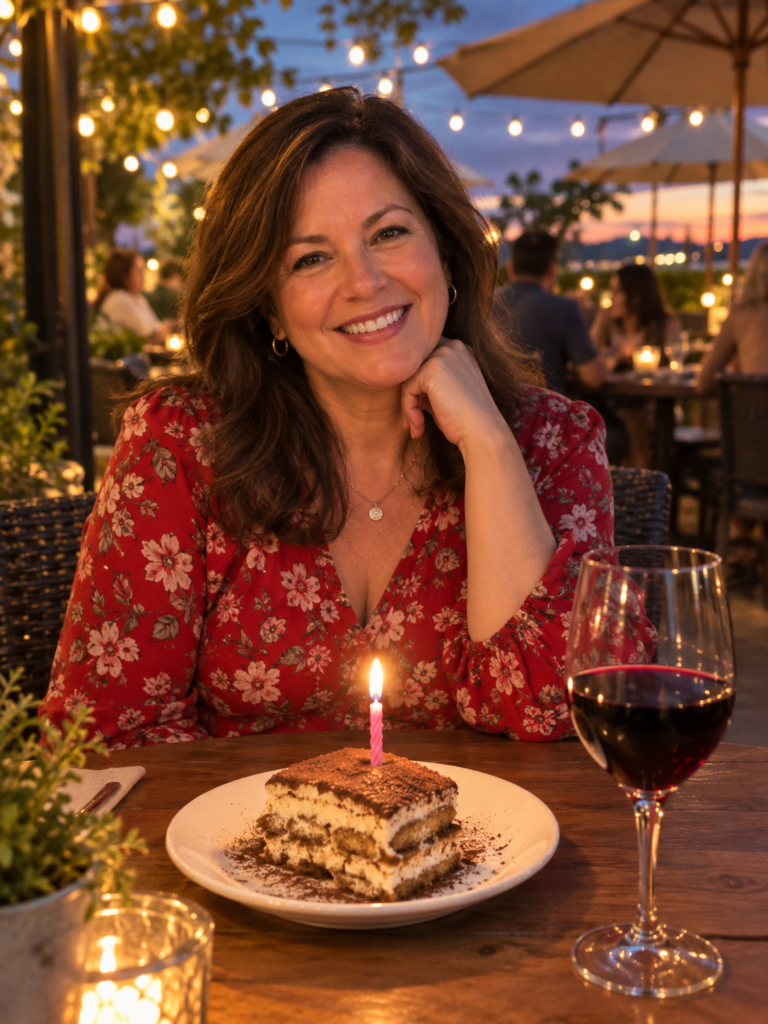
When the tiramisu came, it was huge. A big square of it on a white plate, dusted with cocoa powder, with little chocolate curls on top. And a single lit candle stuck in the middle.
“I said no singing,” Mom said, pointing at the candle.
“It’s not singing,” Marco said. “It’s just fire.”
He walked away before she could argue.
Mom looked at the candle for a moment. The little flame, flickering.
Then she closed her eyes and blew it out.
“What did you wish for?” I asked.
“If I tell you, it won’t come true.”
“You’re sixty-five. I don’t think the rules apply anymore.”
“The rules always apply,” she said seriously.
She picked up her fork. She took the first bite.
And she closed her eyes.
For a long moment, she didn’t say anything. She just sat there with her eyes closed. Chewing slowly.
“Still good?” I asked.
She opened her eyes. She nodded. Very seriously. Like a judge.
“Possibly,” she said, “better than I remember.”
For a while, I forgot why getting her through those restaurant doors had felt like such a huge accomplishment.
She looked comfortable. Relaxed. Her shoulders were down. She wasn’t tugging at her blouse. She wasn’t glancing around the room every few minutes to see who was looking.
She looked like herself.
At one point, halfway through the tiramisu, she leaned back in her chair and looked around the dining room. At the warm yellow lights. At the old photographs on the walls. At the couples and families eating and laughing. At Marco, balancing four plates on one arm.
“You know,” she said. “Maybe I should do this more often.”
Something tightened in my chest.
I wanted to jump up and hug her. I wanted to cry. I wanted to say, Yes, Mom, yes, please, I’ve been so worried about you, I’ve been so scared that you were disappearing.
But I didn’t.
Because if I reacted too strongly, she’d realize how worried I’d been. And then she’d feel bad. And then she’d feel like she had to take care of me. That’s what moms do.
So I just smiled.
“I know a daughter,” I said, “who would support that decision.”
Mom pointed her fork at me. There was cocoa powder on it.
“An expensive daughter,” she said.
“A devoted daughter.”
“Those aren’t mutually exclusive, honey.”
We were both laughing when I noticed the woman at the next table.
She’d been there most of the evening.
I hadn’t paid much attention to her before. She was sitting alone, at a table for two, right next to ours. Maybe four feet away. She was maybe fifty. Thin. Blonde hair in a very neat, very expensive-looking bob. A cream-colored sweater. A lot of gold jewelry. She had a salad in front of her. She’d barely touched it. She was drinking white wine.
Now she was staring at my mother.
Not glancing. Not looking. Staring.
Her eyes moved slowly. From Mom’s face. Down to the tiramisu. Then back up to Mom’s face. Then down to Mom’s body. Then back to the tiramisu.
My stomach went cold.
I knew that look.
I’d seen that look my whole life. At buffets. At grocery stores. At doctor’s offices. On airplanes.
Mom hadn’t noticed it yet. She was scraping the last bit of cocoa off her plate with the side of her fork. Humming a little under her breath.
Please, I thought. Please, please, please don’t notice. Not tonight.
Then it happened.
The woman at the next table set down her wine glass.
She looked my mother up and down. Slowly. Deliberately. From her head to her feet.
And then, loud enough for half the restaurant to hear, she said:
“Maybe skip dessert this time.”
The room went silent.
It happened so fast that my brain couldn’t keep up.
A man at the table behind us stopped with his fork halfway to his mouth. Marco, over by the wall with a tray of drinks, froze in place.
Even the laughing from the bar stopped. The old Italian music kept playing. That was the only sound.
And my mother’s smile just disappeared.
It was there. And then it was gone. Like somebody blew out a candle.
That hurt me more than what the woman said.
One second earlier, my mother had been laughing. Scraping cocoa off her plate. Humming. Talking about coming out to dinner more often.
Now she looked smaller.
I watched her get smaller. Right there in her chair. Her shoulders came up. Her head went down. Her hands went into her lap.
She didn’t look at the woman. She didn’t look at me. She looked down at the table.
Then she quietly reached down beside her chair for her purse.
“I think we should go,” she said.
The anger hit me so hard that my hands started shaking.
This was exactly why she hadn’t wanted to come.
This was exactly why she’d spent seven months turning down every single dinner. Why she’d said she was tired. Why she’d said her stomach was off. Why she’d said it was supposed to rain.
This was exactly why one nice evening had taken me a whole week of convincing.
This. This woman. This moment. People like this.
Before I could say anything, the woman laughed.
She actually laughed. A light, tinkly, pleased-with-herself laugh.
“You’ll thank me later,” she said.
I stood up.
I didn’t decide to. My legs just did it. My chair scraped loudly across the floor.
“So bullying strangers is your hobby?” I said.
My voice came out loud. Shaking.
“Daphne,” Mom said. She reached up and touched my wrist. Her fingers were cold. “Daphne. Please. Sit down. It’s fine.”
But I couldn’t sit there. I couldn’t sit there and watch her pick up her purse and walk out of this restaurant with her head down. I couldn’t watch her disappear again. Not tonight. Not on her birthday.
The woman just rolled her eyes.
“Someone has to tell the truth,” she said. She picked up her wine glass. “Honestly. I’m doing her a favor. People are too sensitive these days.”
I stared at her.
There were about a hundred things I wanted to say. Things my father would have said. Things that would’ve made the whole restaurant gasp.
None of them felt big enough.
And then there was a crash of movement from the back of the restaurant.
The swinging kitchen doors burst open.
Both of them. At the same time. They banged against the walls.
And the head chef walked out into the dining room.
I knew who he was. His name was on the front of the menu. Chef & Proprietor: Alaric Benedetti. And there was a picture of him on the restaurant’s website. A tall man, maybe sixty-something, with a thick gray beard and dark eyes and big forearms covered in old burn scars.
He was wearing a white chef’s coat. There was a dish towel over his shoulder. There was a smear of tomato sauce on his sleeve.
He wasn’t carrying any food.
He wasn’t smiling.
He walked straight through the dining room. Past every single table. Past Marco, frozen with his tray. Past the man with his fork still in the air.
He didn’t look at anybody.
And he stopped right beside my mother’s chair.
For a second, nobody said anything.
Then he turned and looked at the woman at the next table.
His face had gone pale. Completely pale. Like he’d seen a ghost.
He didn’t take his eyes off her.
“You need to leave,” he said quietly. “Right now.”
The woman laughed again. But it was a nervous laugh this time. Uncertain.
“Excuse me?” she said. “And who are you to tell me that?”
My heart skipped a beat.
The chef didn’t answer her.
Instead, he turned his head. Toward the young waiter standing by the front entrance. The one who’d seated us.
“Danny,” he said. “Lock the front door.”
Danny stared at him.
“Lock it?” he said. “Chef, it’s—it’s Friday night. We’ve got people coming—”
“Now, Danny.”
Danny’s confusion lasted exactly one second. Then he turned around and reached for the door. He turned the deadbolt.
Click.
That soft little click echoed through the whole restaurant.
The woman at the next table stopped smiling.
“What is this?” she said. Her voice had gone high and sharp. “What do you think you’re doing? You can’t lock me in here. That’s—that’s illegal. I’ll call the police.”
The chef finally looked away from her.
He turned and looked down at my mother.
“Molly?” he said.
My mother froze.
Completely. Like a statue.
I looked from her to him. From him to her.
Her purse slipped out of her fingers. It fell. It landed against the side of her chair with a little thud.
“Alaric?” she said.
And the way she said his name changed everything.
It wasn’t the voice of somebody recognizing a famous chef from a menu.
It was softer.
Older, somehow. Like she was saying a word she hadn’t said out loud in a very long time. A word from another life.
The chef swallowed hard. I watched his throat move.
For several long seconds, neither of them moved. Neither of them said anything. They just looked at each other.
Then he crouched down beside her chair. Slowly. His knees cracked. He put one hand on the back of her chair.
“I thought that was you,” he said quietly. “I saw you through the kitchen window. When you came in. I thought I was losing my mind.”
Mom stared at him.
“You work here?” she said.
“I own the place.”
Her lips parted. Nothing came out.
I felt completely lost.
“Mom,” I said carefully. “You know him?”
She didn’t answer me.
She didn’t even look at me. Her eyes stayed on Alaric. Like if she looked away, he’d disappear.
Behind us, the woman pushed back her chair. Loudly.
“This is ridiculous,” she said. “Unlock that door. Right now. I want to leave.”
Alaric stood up.
And his face went hard again.
“In a minute,” he said.
“You have no right,” the woman said. “No right to embarrass me like this. In front of all these people.”
I almost laughed. I actually almost laughed out loud.
“You embarrassed yourself,” I said.
She turned and glared at me.
“I wasn’t talking to you.”
“You were talking about my mother.”
“Daphne,” Mom murmured.
Her voice sounded strange. Strained. Like it was coming from far away.
I looked down at her.
And the anger inside me went cold. Almost instantly.
Because she wasn’t just upset anymore.
She looked shaken. Really shaken. Her hands were trembling in her lap. She was pale. Her eyes were wet.
Alaric noticed too.
He crouched back down next to her. He leaned in close.
“Are you all right?” he said. Very gently.
“I’m fine,” Mom said.
“You always say that,” Alaric said, “when you’re not.”
Mom’s head snapped around. She gave him a startled look.
And something passed between them.
I saw it. I don’t know how to describe it. Recognition. History. Something that went back a long way. The kind of history that doesn’t just disappear because years go by.
The kind of history I knew absolutely nothing about.
I sat back down in my chair. Slowly.
“Okay,” I said. “Somebody needs to explain what’s happening. Right now. Please.”
Mom rubbed her palms against the tops of her thighs. Back and forth. Nervous.
Alaric glanced around the dining room.
Everybody was pretending not to listen. Nobody was doing a very good job of it. The man at the table behind us had given up entirely. He was just openly staring, with his fork still in his hand. Marco hadn’t moved from his spot by the wall. The bartender was leaning on the bar with his chin in his hands.
Alaric lowered his voice.
“Your mother and I knew each other,” he said. “A long time ago.”
Mom let out a breath.
“That’s one way to put it,” she said.
My confusion got deeper.
Alaric smiled a little. Just at the corner of his mouth.
“We worked together,” he said.
“At a diner,” Mom added. “Before you were born, honey. Before I even met your father.”
I stared at her.
“You never told me that.”
“There are plenty of things I never told you, Daphne.”
That hurt a little. But I knew she didn’t mean it mean. It was just true.
Alaric folded his arms across his chest.
“Your mother,” he said, “saved my career.”
Mom shook her head immediately. Hard.
“No,” she said. “No. You did that yourself.”
“I was twenty-two,” Alaric said. “And stupid.”
“You were talented.”
“I was still stupid.”
And despite everything, despite the woman and the comment and the locked door and her hands shaking in her lap, Mom almost smiled.
Alaric turned to me.
“It was a diner called the Blue Spoon,” he said. “Out on Route 12. It’s a gas station now. I had just started cooking. I was a dishwasher, really. I wanted to be a cook. I had no money. No connections. No culinary school. No idea what I was doing.”
Mom interrupted him.
“You had some idea.”
“Very little,” Alaric said.
That time she did smile. A real one. A small one.
And for the first time since the woman said maybe skip dessert, some color came back into her face.
“Your mother was a waitress there,” Alaric said. “She’d been there two years. Everybody loved her. The regulars used to ask for her section. Truckers would drive an extra hour to sit in her section.”
“They tipped well,” Mom said. “That’s all it was.”
“They tipped well because you remembered their kids’ names.”
Mom didn’t argue with that.
“And she was the only person in that whole place,” Alaric said, “who took me seriously.”
He looked at Mom. Something soft came over his face.
“I used to test recipes,” he said. “After closing. In the kitchen. When the owner went home. I’d make things with whatever was left over. Leftover chicken. Old bread. Tomatoes that were about to go bad. And your mother would stay late. Every night. After her shift. She’d sit on a milk crate in the kitchen and taste everything I made.”
“Not everything,” Mom said. “The liver thing. I didn’t taste the liver thing.”
“The liver thing was a mistake,” Alaric agreed.
“It was a crime.”
A few people at the nearby tables laughed quietly.
“She’d tell me the truth,” Alaric said. “Always. If it was good, she said so. If it was bad, she said so. She’d say, Too much salt. Not enough garlic. This sauce tastes like a sock.“
“It did taste like a sock,” Mom said.
“It did,” Alaric said. “It really did.”
He looked at me.
“She told the owner I deserved a chance,” he said. “In the kitchen. On the line. As a real cook. She marched into his office one day and told him. She said, Frank, that boy in the back can cook better than anybody you’ve got. Put him on the line or you’re an idiot.“
“I didn’t say idiot,” Mom said.
“You said idiot.”
Mom thought about it.
“I might have said idiot,” she admitted.
“And he did,” Alaric said. “He put me on the line. On the grill. On weekends.”
Mom looked down at her hands.
“He deserved it,” she said quietly.
“I got fired two months later,” Alaric said.
I blinked.
“That doesn’t sound like saving your career,” I said.
Alaric laughed. A big, warm laugh.
“I deserved that too,” he said.
Mom sighed.
“You argued with the owner,” she said.
“He was serving spoiled seafood,” Alaric said. “Shrimp. It smelled like a dumpster. He wanted me to cover it up with Old Bay and serve it anyway.”
“You threw a pan.”
“I did not throw it at him.”
“It landed near him.”
“I had bad aim.”
“You had terrible aim,” Mom said. “It landed in the deep fryer. There was oil everywhere. The fire department came.”
“Nobody got hurt.”
“Frank’s eyebrows got hurt.”
A few people in the restaurant laughed out loud now. The man at the next table put down his fork completely and just laughed.
The tension in the room eased. Like somebody opened a window.
Even I smiled.
Then Alaric’s face went soft again.
“After I got fired,” he said, “I had nothing. No job. No references. Frank told every restaurant in town not to hire me. My rent was due. I was going to have to go back home to my father’s farm in Pennsylvania. And give up on cooking forever.”
He looked at my mother.
“And Molly helped me find another job.”
Mom’s eyes dropped to the table.
“Anyone would have,” she said.
“No,” Alaric said. “They wouldn’t have.”
His voice changed. It wasn’t loud. It didn’t need to be.
“She went to her cousin,” he said. “Her cousin’s husband worked at a hotel in the city. A big hotel. With a real kitchen. A French chef. And your mother got in her car, and drove two hours, and sat in that hotel lobby for four hours, waiting. Until the chef came out on his break. And she walked right up to him. In her waitress uniform. With her name tag still on.”
Mom put her hand over her eyes.
“And she said,” Alaric went on, “My name is Molly. I work at a diner. And there’s a boy there who can cook better than you. You should hire him before somebody else does.“
The whole restaurant was completely silent now.
“And he laughed at her,” Alaric said. “The French chef. He laughed. And then he said, Bring him in on Tuesday. If he’s as good as you say, I’ll hire him. If he’s not, you owe me a pie.“
“Did you get the job?” I asked.
“I got the job,” Alaric said. “I worked for him for eleven years. He taught me everything. Everything I know.”
He looked at Mom.
“I never forgot it,” he said quietly. “Not one day. Not in forty years.”
Mom looked uncomfortable. She shifted in her chair.
“That was more than forty years ago, Alaric,” she said.
“Doesn’t matter,” he said. “Doesn’t matter if it was four hundred.”
The woman at the next table crossed her arms over her cream-colored sweater.
“This is all very touching,” she said. “Really. But I’m leaving now.”
Alaric turned toward her.
“Yes,” he said. “You are.”
“Then unlock the door.”
Alaric looked at her for a long moment.
“You’ll pay your check first,” he said. “And then you’ll go.”
The woman’s mouth fell open.
“Excuse me? Of course I’m going to pay. What do you think I am?”
“I think,” Alaric said calmly, “you’re the same woman who walked out of here three weeks ago without paying. After telling my waitress, Rosa, that she was too fat to be working in a restaurant.”
The woman’s face went red.
“I—that’s not—”
“Rosa quit,” Alaric said. “She’s nineteen. She’s been working for me since she was sixteen. She cried in my walk-in freezer for an hour. And then she quit.”
He was quiet for a moment.
“I didn’t recognize you when you came in tonight,” he said. “Rosa’s the one who saw you. Not me. But when I heard your voice just now, through the kitchen doors, I knew. And I wasn’t going to let you walk out of here like it was nothing. Not again. Not before somebody got to say something to you.”
He nodded at Marco.
“Marco. Bring her check. Both of them. Tonight’s and the one from three weeks ago.”
Marco practically ran to the register.
The woman sat there, red-faced, while Marco brought two checks on a little tray. She pulled a credit card out of her purse and slapped it down without looking.
The whole restaurant watched.
When Marco brought her card back, Alaric nodded at Danny by the door.
Danny unlocked the deadbolt.
Click.
The woman grabbed her purse. She stood up. She yanked her coat off the back of her chair.
She started toward the door.
And then she stopped.
She turned around. And she looked at my mother one more time.
“I still think,” she said, “that people shouldn’t get so offended by the truth. It’s for your own good. It’s about your health.”
That did it.
Mom stood up.
I expected her to shrink again. I expected her to pick up her purse and look at the floor and walk out behind the woman with her head down. I expected her to say I’m fine in that small, careful voice.
She didn’t.
For years, I’d watched my mother avoid conflict. I’d watched her pretend comments didn’t hurt. I’d watched her smile and nod and walk away. I’d watched her disappear from places she used to love.
But this time, she stood up straight. All the way up. She put both hands flat on the table.
And she looked directly at the woman.
“You don’t know anything about my health,” Mom said.
The woman scoffed. “I can see enough.”
“No,” Mom said.
Her voice was quiet. But steady. Very, very steady.
“You can see my body,” she said. “That’s not the same thing.”
The dining room went completely still again.
“You don’t know what medications I take,” Mom said. “You don’t know that I have a thyroid that stopped working when I was forty. You don’t know I’ve been on steroids twice for my lungs. You don’t know what my blood pressure is. It’s fine, by the way. It’s better than my daughter’s.”
“It is,” I said. “It’s true. It’s annoying.”
“You don’t know what my doctor says,” Mom said. “You don’t know that I walk two miles every morning with my neighbor. You don’t know that I buried my husband six years ago and didn’t get out of bed for a month. You don’t know what I’ve survived.”
The woman opened her mouth.
Mom didn’t let her talk.
“You don’t know anything about my life,” Mom said. “Not one thing. You looked at me for ten seconds across a restaurant and decided you knew everything.”
She took a breath.
“And even if you did know,” she said. “Even if you knew every single thing about me. My weight. My blood pressure. My cholesterol. Everything. Humiliating a stranger in a restaurant on her birthday wouldn’t make you helpful.”
She looked the woman right in the eye.
“It would still just make you cruel.”
My throat got tight. I couldn’t swallow.
The woman looked around the restaurant.
Nobody was on her side. Not one person. The man at the next table was shaking his head at her. The couple by the window was glaring at her. Marco was standing by the bar with his arms crossed. The bartender had put down the glass he was drying.
She muttered something under her breath. I couldn’t hear what.
And then she walked out.
The front door closed behind her with a little jingle of the bell.
Mom sat back down.
Slowly. Carefully. Like her legs weren’t quite working right.
And her hands started shaking.
Not a little. A lot. On the table. Her whole body was trembling.
I reached across the table and grabbed both of her hands.
“Mom.”
She laughed once. A shaky, wet laugh. Her eyes were full of tears.
“I think I need a minute,” she said.
“You were amazing,” I said. “Mom. You were absolutely amazing.”
“I was terrified.”
“Those things can happen at the same time,” I said.
She squeezed my fingers. Hard.
And then, somewhere near the back of the restaurant, somebody started clapping.
I don’t know who. Just one person, at first. Slow claps.
Then somebody else joined in. And somebody else. The man at the next table. The couple by the window. Marco. The bartender. Danny by the front door.
Within ten seconds, the whole restaurant was clapping.
For my mother.
Mom put her face in her hands.
“Oh, God,” she said through her fingers. “Daphne. Make them stop.”
“I’m not going to make them stop,” I said. “Enjoy it.”
When the clapping finally died down, Alaric pulled out the empty chair at our table. The one next to Mom.
“May I?” he asked.
Mom nodded. She was wiping her eyes with her napkin.
He sat down.
For a moment, the three of us didn’t say anything. The restaurant slowly came back to life around us. People went back to their food. Conversations started up again. The music kept playing.
Then Alaric looked down at Mom’s plate. At the empty tiramisu dish. At the little candle, lying on its side.
“That’s all you ordered?” he said. “Tiramisu?”
“It came before dinner,” Mom said.
His eyebrows went up.
Mom shrugged.
“I’m sixty-five,” she said.
Alaric laughed. A real laugh. A big one.
“That,” he said, “sounds exactly like you.”
I looked at the two of them.
“So this is really your restaurant?” I asked Alaric.
He nodded.
“Twenty-three years,” he said. “I bought it from the Stellas when they retired. Kept the name. Didn’t feel right to change it.”
Mom looked around the dining room again. At the yellow lights. At the old photographs on the walls. At the little bar.
Her face changed.
“You actually did it,” she said softly. “You did it, Alaric. What you always talked about. On the milk crate. In the back of the Blue Spoon. You said you’d have your own restaurant someday. With your name on the menu.”
He smiled.
“Eventually,” he said.
“I came here,” Mom said slowly. “With my husband. Every anniversary. For almost fifteen years. We sat right there. By the front window.” She pointed. “I never knew it was you. Back in the kitchen.”
“I know,” Alaric said quietly.
Mom stared at him.
“You knew?”
“I saw you once,” he said. “About ten years ago. Through the kitchen window. With a big man with a loud laugh. You were splitting a tiramisu.” He looked down at the table. “You looked happy. Really happy. I didn’t want to interrupt that. So I stayed in the kitchen. I sent out an extra tiramisu. On the house. I told the waiter to say it was a mistake.”
Mom put her hand over her mouth.
“That was you? The extra tiramisu? Richard thought it was the best night of his life. He talked about it for a year. He told everybody the restaurant loved us.”
“The restaurant did love you,” Alaric said.
Then he pointed toward the wall behind us.
“Look,” he said.
Mom turned around in her chair.
There was a little alcove in the back of the dining room. Near the kitchen doors. It used to be a coat closet, I think. A few years ago, somebody had taken out the door and hung a lamp in there and covered the walls with framed photographs.
Old photographs. Black and white, most of them. Faded. People in kitchens. People at tables. Chefs in tall white hats.
And one of them, right in the middle, showed a much younger Alaric.
He was skinny. With a full head of black hair and no beard. He was standing in a cramped little diner kitchen, wearing a stained white apron. He was grinning at the camera.
And standing next to him was a young woman.
She had thick brown hair pulled back in a ponytail. She was wearing a pink waitress uniform with a white collar. There was a name tag on her chest. She was holding up a fork with something on it toward the camera. And she had the biggest smile I have ever seen in my entire life.
My mother.
Twenty years old.
I stood up to get a closer look.
I walked over to the alcove. I stood in front of the photograph.
Under it, screwed into the wall, there was a small brass plaque.
It said:
FOR MOLLY,
WHO TOLD ME I BELONGED IN A KITCHEN
BEFORE I BELIEVED IT.
My chest got so tight I couldn’t breathe.
I turned around.
Mom was standing behind me. She’d gotten up and followed me. She was staring at the photograph.
At herself. Twenty years old. In a pink uniform. With a fork in her hand and that enormous smile.
“You kept that,” she said. Barely a whisper. “All this time.”
“Of course I kept it,” Alaric said. He was standing behind her. “It’s been on every kitchen wall I ever worked in. The hotel. The place in Chicago. Here. It went up in the kitchen the day I opened. It came out here into the dining room four years ago. When we renovated. I wanted people to see it.”
Mom’s eyes filled up again.
“Four years ago,” she said. “I stopped coming out four years ago. Right around then.” She shook her head. “I would have seen it. If I’d come.”
“You’re seeing it now,” Alaric said.
“You never told me,” Mom said. “You never called. You never wrote. Not once. In forty years.”
Alaric looked at her.
“You disappeared, Molly,” he said gently.
Mom looked guilty. She looked down at her shoes.
“You quit the Blue Spoon,” Alaric said. “Three weeks after I started at the hotel. Nobody knew where you went. Frank didn’t know. Your cousin wouldn’t tell me. I went by your apartment. You’d moved. I looked for you. For a long time.”
“I got married,” Mom said quietly. “I met Richard. At a church picnic. We got married six months later. We moved across the state for his job. And then I had Daphne. And then—” She stopped. “Life happened, Alaric.”
“I know,” Alaric said. “I know it did.”
Mom nodded slowly.
“I thought about you,” she said. “Sometimes. Over the years. I’d see a cooking show on TV and think, I wonder if that boy ever got his restaurant.“
“He did,” Alaric said.
“He did,” Mom agreed.
Then Alaric glanced toward the kitchen doors.
“Give me five minutes,” he said.
“For what?”
“Your actual dinner.”
Mom laughed. She wiped her eyes.
“Oh, Alaric. I don’t think I can eat anything now. After all that.”
“Then you’ll take it home,” Alaric said. “In a box. And eat it tomorrow. Cold. Standing up in your kitchen. At midnight. Like you used to eat my leftovers at the Blue Spoon.”
“I did not eat them standing up at midnight.”
“You did. Every night. Out of the pan. With a fork. You thought I didn’t see you.”
Mom opened her mouth. Then she closed it again.
“I did,” she admitted. “I absolutely did.”
Alaric grinned. He turned around and pushed through the swinging kitchen doors.
We sat back down at our table.
Mom was quiet. She kept looking over at the alcove. At the photograph. At herself.
“I can’t believe you never told me,” I said. “About the diner. About Alaric. About any of it.”
“I didn’t think it mattered,” Mom said. “It was so long ago. It was before your father. Before you. It was like another person’s life.”
“It matters, Mom.”
She looked at me.
“You drove two hours,” I said, “and sat in a hotel lobby for four hours. In your waitress uniform. To get a stranger a job.”
“He wasn’t a stranger,” Mom said. “He was my friend.”
“You never do anything like that for yourself.”
Mom didn’t answer.
She looked back at the photograph. At the girl with the fork and the ponytail and that enormous smile.
“I used to,” she said quietly. “A long time ago. I used to be her.”
“You still are,” I said. “I saw her tonight. When you stood up.”
Mom looked at me for a long moment.
“Did you?”
“I did,” I said. “She was terrifying. Gary with the confused raccoon management skills would’ve been scared of her.”
Mom laughed so hard she snorted.
When Alaric came back, he was carrying a plate himself.
He set it down in front of Mom with a little flourish.
Fresh pasta. Wide, flat ribbons of it. Pappardelle. With a slow-cooked red sauce and big chunks of tender beef. A small side of roasted vegetables. Zucchini and peppers and little tomatoes. A thick slice of warm bread with olive oil.
“This is the first thing I ever made at the Blue Spoon,” Alaric said. “After closing. That you liked.”
Mom stared at it.
“The Sunday sauce,” she said.
“The Sunday sauce.”
“You made it on a Wednesday.”
“I made it on every day,” Alaric said. “It’s still the most popular thing on my menu.”
And next to the pasta, on its own little plate, there was another slice of tiramisu.
With a candle in it. Lit.
Mom covered her face with both hands.
“Alaric.”
“What?”
“I already had dessert.”
He set the plate down in front of her. He straightened up. And he looked around the dining room, at all the people pretending not to watch. Then back at my mother.
“Maybe,” he said, loud enough for the whole restaurant to hear, “don’t skip dessert this time.”
The whole restaurant laughed.
Every single person. The man at the next table. The couple by the window. Marco. Danny. The bartender.
And Mom laughed too.
Not nervously. Not politely. Not that small, careful laugh.
She laughed so hard that tears rolled down her cheeks. She laughed so hard she had to put her head down on the table. She laughed until she couldn’t breathe.
I laughed too. I couldn’t help it.
When she finally caught her breath, she sat up. She wiped her eyes with her napkin.
She looked at the candle, flickering on top of the tiramisu.
“What do I wish for?” she said. “I already made one wish tonight.”
“You’re sixty-five,” I said. “The rules don’t apply.”
“The rules always apply, Daphne.”
She closed her eyes. She blew out the candle.
Then she picked up her fork.
I watched her take a bite of the second tiramisu. She closed her eyes again. She smiled.
“Still good?” Alaric asked.
She opened her eyes. She looked up at him.
“Better,” she said. “It’s better than the first one.”
We stayed until the restaurant closed.
Alaric sat with us for almost two hours. His sous chef ran the kitchen. Every few minutes, somebody would poke their head out of the swinging doors and ask him a question, and he’d wave them away.
He and Mom told stories. About the Blue Spoon. About Frank and his eyebrows. About the trucker named Big Walt who ordered the exact same thing every single day for two years. Two eggs over easy, rye toast, and a slice of cherry pie. About the night the walk-in freezer broke and they had to eat forty pounds of ice cream before it melted.
“I’ve never been so sick in my life,” Mom said.
“You ate eleven scoops,” Alaric said.
“You ate fourteen.”
“I was a growing boy.”
“You were twenty-two!”
I sat there and watched them. And listened.
I found out more about my mother in two hours than I’d learned in thirty-eight years. That she’d wanted to go to college but couldn’t afford it. That she used to sing along to the jukebox at the Blue Spoon, and the truckers would put in quarters just to hear her. That she’d once driven Alaric to the emergency room at two in the morning when he cut his hand open on a meat slicer, and held the towel on it the whole way, and cracked jokes so he wouldn’t pass out.
“She saved my finger,” Alaric said. He held up his left hand. There was a long white scar across the index finger. “The doctor said if she hadn’t held the pressure so tight, I’d have lost it.”
“You were bleeding on my car seat,” Mom said. “I was mostly worried about the upholstery.”
“That’s a lie.”
“It’s a little bit of a lie,” Mom admitted.
At the end of the night, Alaric walked us to the front door.
He’d packed Mom’s leftover pasta in a box. And the rest of the second tiramisu in another box. And a whole extra tiramisu in a third box.
“For breakfast,” he said.
“I am not eating tiramisu for breakfast.”
“You’ll eat it standing up at midnight,” Alaric said. “I know you.”
Mom laughed.
At the door, he stopped. He looked at her.
“Molly,” he said. “Come back. Please. Anytime. Every Friday, if you want. Your table’s always here. Bring your daughter. Or come by yourself. I’ll sit with you.”
Mom looked at him for a long moment.
“I’d like that,” she said.
“And Molly,” Alaric said. He hesitated. “If anybody ever says anything to you in my restaurant again, you come get me. You don’t pick up your purse. You don’t leave. You come back to the kitchen and you get me. Okay?”
Mom’s eyes went shiny again.
“Okay,” she said.
He opened his arms.
And my mother, who hadn’t let anybody hug her in public in years, who always stepped back, who always turned sideways, who always made herself smaller, stepped forward and hugged him.
A real hug. Arms all the way around.
He held on for a long time.
On the drive home, Mom was quiet.
For several minutes, she didn’t say anything at all. She just looked out the passenger window at the dark streets going by. The three boxes of leftovers were on her lap. She was holding them like they were something precious.
The radio was on low. Some old song.
Then she turned toward me.
“Daphne?”
“Yeah, Mom?”
“I meant what I said earlier. At dinner.”
“About what?”
She looked at me across the front seat.
“Maybe I should do this more often,” she said.
This time, I didn’t try to hide how happy that made me.
I didn’t play it cool. I didn’t make a joke. I just let it be on my face. The whole thing.
“I’d like that, Mom,” I said. “I’d really, really like that.”
She smiled.
“So would I,” she said.
And for the first time in years, I believed her.
She went back the next Friday.
By herself. She didn’t even tell me. I found out because she sent me a picture. Her and Alaric, sitting at the table by the front window. Dad’s table. With a tiramisu between them. Two forks.
Underneath, she’d written: Don’t skip dessert.
It was the first time my mother had ever used an emoji. I didn’t even know she knew how.
She went back the Friday after that. And the Friday after that.
Some Fridays, I went with her. Some Fridays, she went alone. Some Fridays, her friend Carol from next door came. Carol is the one she walks two miles with every morning.
In December, Rosa came back. The nineteen-year-old waitress who quit. Alaric called her and told her what happened. She came back to work at Stella’s a week later.
The first night she was back, she was Mom’s waitress.
Mom asked her about her classes at the community college. About her little brother. About her boyfriend, who apparently was not good enough for her. By the time the tiramisu came, Mom knew her whole life story.
“Your mom,” Rosa told me later, “is the nicest customer I’ve ever had in my whole life.”
“She could make friends with a brick wall,” I said.
“Only if the wall has a nice personality,” Mom said from across the table.
It hasn’t been perfect.
A few months later, at the grocery store, a man looked in Mom’s cart and made a comment. Something about the cookies. She told me about it on the phone that night.
“What did you do?” I asked. I was bracing myself. Waiting to hear that she’d left the cart in the aisle and walked out of the store.
“I looked him right in the eye,” Mom said. “And I said, You can see my cart. That’s not the same thing as knowing my life.“
“And what did he say?”
“Nothing,” Mom said. “He just went red and pushed his cart away really fast. One of the wheels was squeaky. It was very satisfying.”
I laughed so hard I had to sit down.
“And then I bought the cookies,” Mom said. “Two boxes. And I ate three of them in the car in the parking lot.”
“Good for you, Mom.”
“Standing up would’ve been more dramatic,” she said. “But it’s hard to eat cookies standing up in a Buick.”
On her sixty-sixth birthday, I took her back to Stella’s.
This time, she didn’t hesitate at the door. Not even for half a second. She walked right in with her chin up and waved at Rosa and Marco and Danny by the door and the bartender, whose name, it turns out, is Gus.
We sat at Dad’s table. By the front window.
Alaric came out of the kitchen before we’d even ordered. He was carrying a tiramisu. A huge one. With sixty-six candles in it.
“That,” Mom said, “is a fire hazard.”
“I had to call the fire department to warn them,” Alaric said. “They said they’d have a truck standing by.”
“You’re exaggerating.”
“I’m not,” he said. “Ask Frank’s eyebrows.”
The whole restaurant sang to her.
She didn’t kick me under the table once.
She sat there and let them sing. All the way through. With her face pink and her eyes shining, wearing the silver hoop earrings my father gave her.
When they finished, she closed her eyes and made a wish.
Then she blew out all sixty-six candles in one breath.
“What did you wish for?” I asked her afterward.
She looked at me across the table. Then over at the little alcove in the back. At the photograph of a twenty-year-old girl in a pink uniform, holding up a fork and grinning at the camera.
“If I tell you,” she said, “it won’t come true.”
“You’re sixty-six, Mom. The rules don’t apply.”
She picked up her fork. She took the first bite of tiramisu. She closed her eyes.
“The rules always apply, honey,” she said.
She never told me what she wished for.
But I have a pretty good idea.
Because every Friday night now, there’s a big, warm, laughing woman sitting at the table by the front window at Stella’s. Taking up exactly as much space as she wants. Eating dessert first.
And she doesn’t skip it.
Not ever.