Chelsea did not open the third envelope immediately.
She just stood there on the porch staring at the first two.
Then Logan appeared behind her.
He was barefoot, still wearing the gray T-shirt he slept in, his hair flattened on one side.
“What is it?”
Chelsea did not answer.
She handed him the first envelope.
I could not hear what they were saying from where I sat inside my parked car, but I did not need to.
I knew exactly what was written on those pages.
Fiona had drafted every sentence.
The first notice concerned a private loan I had made to Logan and Chelsea four years earlier.
They called it “help with the down payment.”
The paperwork called it what it actually was.
A loan.
One hundred and twenty thousand dollars.
At the time, Logan had insisted we put everything in writing.
“Just so nobody gets confused later,” he had said.
I had been proud of him for saying that.
The agreement gave them ten years to repay me at a low interest rate.
But there was a clause.
If the property was refinanced, transferred, or used to secure additional debt without notifying me, the remaining balance could become due.
Six months earlier, Logan and Chelsea had refinanced the house.
They never told me.
I discovered it because the lender mailed a document to the house and Chelsea left it sitting beneath a catalog on the kitchen counter.
I had said nothing.
Accountants rarely interrupt bad decisions.
We record them.
The second envelope was a notice regarding a home equity line of credit.
Two years earlier, Logan had needed help qualifying.
I had placed a certificate of deposit as additional collateral.
Not my entire savings.
Just enough to make the bank comfortable.
That collateral arrangement was scheduled for renewal.
I was declining to renew it.
The bank had given them sixty days to replace the security, refinance the balance, or reduce the debt.
The third envelope was simpler.
And far more painful.
It was a formal notice terminating every automatic payment I had been making on their behalf.
The SUV.
Part of the homeowners insurance.
A monthly transfer toward property taxes.
And a quiet $1,400 deposit I had sent into Logan’s household account every month for almost five years.
Chelsea had once called that money “Logan’s quarterly bonus spread out monthly.”
Logan never corrected her.
Maybe he had forgotten where it came from.
Maybe forgetting had been easier.
On the porch, Logan finished reading.
Then he looked up sharply.
Chelsea snatched the third envelope from his hand.
She read it once.
Then again.
Her mouth opened.
Even from half a block away, I could see the panic beginning.
My phone rang thirty seconds later.
LOGAN.
I watched it buzz against the passenger seat.
Then stop.
It rang again.
I let that one stop too.
The third call came from Chelsea.
I turned the phone facedown.
For six years, I had answered whenever they needed me.
Plumber canceled?
Call Dad.
Need someone home for a delivery?
Call Albert.
Dinner running late?
Albert can cook.
Need help covering an unexpected bill?
Logan would appear at my bedroom door with that same embarrassed expression.
“Dad, just until next month.”
Next month had lasted years.
Now they could experience ten minutes without me.
I started the car and drove away.
By noon, I had seventeen missed calls.
By three, twenty-six.
At five fourteen, Logan finally left a voicemail.
“Dad, I don’t understand what you’re doing. Please call me. Chelsea is freaking out. The bank says we need to speak with someone immediately.”
I listened once.
Then deleted nothing.
Fiona had told me to preserve every message.
At seven thirty, another voicemail arrived.
This time Chelsea was speaking.
Her voice had lost its polished dinner-party softness.
“Albert, this is ridiculous. You cannot just sabotage your own son because your feelings got hurt. We gave you a place to live for six years. You should be grateful.”
I sat in the small furnished apartment I had rented near White Rock Lake and listened to that sentence twice.
We gave you a place to live.
That was how she remembered it.
Not the groceries I bought.
Not the plumbing repairs.
Not the property taxes I helped cover.
Not the roof repair I paid for after the hailstorm.
Not the childcare I provided when Logan’s niece stayed with them for an entire summer.
Not the thousands of meals.
Not the loan.
Not the collateral.
Not the years.
Only the spare bedroom.
I made tea.
Then I opened my laptop.
There are moments when anger asks you to act quickly.
Age had taught me something better.
Let documents speak first.
The next morning, Logan arrived at my apartment.
I do not know how he found the address.
Probably through the mail forwarding paperwork.
He knocked hard enough to shake the frame.
“Dad.”
I opened the door but did not invite him inside.
His face looked exhausted.
“Can we talk?”
“We are talking.”
He stared at me.
That surprised him.
My son had spent his entire life believing calmness meant surrender.
It did not.
“Why are you doing this?”
“I’m ending my financial involvement.”
“You could have warned us.”
I looked at him for several seconds.
“You warned me I needed to leave?”
His jaw tightened.
“That was different.”
“How?”
“Chelsea was upset. There were people over. Things got awkward.”
“She told you to remove me from the house.”
“She didn’t mean permanently.”
“I left permanently.”
He rubbed both hands over his face.
“Dad, the bank says if we can’t replace the collateral, our rate could jump or we may have to refinance again.”
“That sounds like something to discuss with your bank.”
“And the private loan?”
“You signed it.”
“You’re demanding the whole thing?”
“I am exercising a clause you agreed to.”
“You know we don’t have that kind of cash.”
“Yes.”
His eyes changed.
Not sadness.
Not yet.
Fear.
“What exactly do you want?”
There it was.
The same question Fiona had asked me.
But coming from Logan, it sounded different.
He assumed this was negotiation.
That I wanted an apology.
A room back.
Respect purchased under pressure.
“I want nothing.”
He blinked.
“What?”
“I don’t want the room. I don’t want dinner invitations. I don’t want Chelsea to apologize because the mortgage is frightening her. I don’t want you to choose me because a bank forced you to.”
“Then why do this?”
“Because I am done paying to remain unwanted.”
He looked as if I had slapped him.
I had never raised my voice.
That made it worse.
“Dad—”
“I spent six years trying to make your life easier. Somewhere along the way, you began believing easy was normal.”
He looked down.
I continued.
“You were not wrong to build a life with your wife. You were wrong to stand silently while she humiliated your father in front of strangers.”
His eyes lifted.
“I froze.”
“For six years?”
That ended the argument.
He stepped backward.
I started closing the door.
Then he said something that stopped me.
“How much money do you even have?”
I looked at him.
Not because the question offended me.
Because it revealed how quickly fear becomes curiosity.
“Enough to take care of myself.”
“Dad, seriously.”
“Goodbye, Logan.”
I closed the door.
Three days later, Chelsea came.
Unlike Logan, she did not knock.
She pounded.
I opened the door with Fiona standing several feet behind me.
We had been reviewing documents when Chelsea arrived.
Chelsea saw her and stopped.
“Who is this?”
“My attorney.”
Her expression hardened.
“You brought a lawyer into a family disagreement?”
Fiona answered before I could.
“Mrs. Higgins, Mr. Higgins did not bring me into a family disagreement. He retained me to manage his financial and legal affairs.”
Chelsea looked at me.
“This is insane.”
“No,” I said. “It’s organized.”
She crossed her arms.
“You lived in our house rent-free.”
Fiona glanced at me.
I nodded.
She opened a folder.
“Actually, Mrs. Higgins, according to these records, Mr. Higgins paid approximately forty-three thousand dollars in household expenses over the last six years, excluding the private loan.”
Chelsea’s face changed.
“That’s not possible.”
Fiona continued calmly.
“Insurance contributions. Property taxes. Repairs. Utilities. Vehicle payments. Monthly transfers.”
Chelsea looked at me.
“You kept track?”
“I was an accountant for thirty-five years.”
“You were keeping score?”
“No.”
I looked directly at her.
“I was keeping records.”
For the first time since I had known Chelsea, she had no immediate reply.
Then she recovered.
“Fine. You helped. Families help each other.”
“They do.”
“Then why are you acting like we stole from you?”
“I never said you stole.”
“You’re trying to take our house.”
“No.”
I shook my head.
“You are discovering how much of your house depended on money that was never yours.”
That sentence hit harder than I expected.
Her face went pale.
Then red.
She stepped toward me.
“You think you’re some kind of hero because you have a few retirement accounts?”
Fiona quietly closed her folder.
I almost smiled.
Chelsea still thought the issue was pride.
“A few retirement accounts,” I repeated.
“Yes.”
I studied her for a moment.
Then I made a decision.
Not because she deserved to know.
Because I wanted the financial relationship finished completely.
“I have a little over eight hundred thousand dollars in liquid savings and investments.”
Silence.
Chelsea stared at me.
Even Fiona looked up, though she already knew the number.
Chelsea gave a small laugh.
It was the laugh people make when reality arrives before they are prepared to receive it.
“No, you don’t.”
“I do.”
“Eight hundred thousand?”
“Approximately.”
Her eyes moved around my modest apartment.
The secondhand dining table.
The plain lamp.
The old cardigan hanging over a chair.
“You live like this with eight hundred thousand dollars?”
“Yes.”
“Why?”
“Because I don’t need expensive furniture to know what I’m worth.”
She stopped breathing for a second.
I could see the calculations beginning.
The same calculations I had seen countless times in corporate offices.
How much?
Who gets it?
When?
What changes now?
Then Chelsea said the sentence that ended any remaining doubt in my mind.
“Logan is your only child.”
Fiona looked at her.
I looked at her too.
Chelsea continued more softly.
“So eventually that money would be his anyway.”
There it was.
Not concern.
Inheritance.
Expectation.
Ownership of a future that had not happened yet.
I nodded slowly.
“That was the plan.”
Her face brightened for half a second.
Was.
She heard it.
“What does that mean?”
“It means plans can change.”
Chelsea’s voice sharpened.
“You would disinherit your own son over one bad night?”
“No.”
I stepped closer to the doorway.
“I would reconsider my estate after six years of bad nights.”
She left without another word.
That evening, Logan called.
This time, I answered.
“Eight hundred thousand?”
No hello.
No apology.
Just the number.
I closed my eyes.
“Chelsea told you.”
“She said you threatened to disinherit me.”
“I didn’t threaten anything.”
“Is it true?”
“Yes.”
There was a long silence.
Then his voice cracked slightly.
“Why didn’t you tell me?”
“Why would I?”
“I’m your son.”
“That did not seem particularly important at the dinner party.”
“Dad, stop doing that.”
“Doing what?”
“Making everything about that one night.”
I leaned back in my chair.
“All right. Let’s talk about Thanksgiving.”
Silence.
“Or the back door.”
He said nothing.
“The side table.”
Nothing.
“The evenings I was asked to stay upstairs.”
Nothing.
“The time Chelsea introduced me to her friends as ‘our live-in helper’ and laughed.”
His breathing changed.
“You heard that?”
“I was carrying the tray she asked me to prepare.”
He whispered something I could not understand.
Then he said, “Why didn’t you tell me it bothered you?”
I almost laughed.
Not because it was funny.
Because that question carried the comfortable innocence of people who benefit from another person’s silence.
“I did not know I had to explain humiliation to a forty-year-old man.”
He began crying.
Quietly.
For the first time since this started, my anger weakened.
He was still my son.
He was also responsible for his choices.
Both things could be true.
“I’m sorry,” he said.
I said nothing.
“I’m sorry, Dad.”
His voice broke.
“I kept telling myself Chelsea was stressed. Then I kept telling myself you didn’t care because you never complained. And then every time she pushed a little further, I just… let it happen.”
“That is what happened.”
“I didn’t want conflict.”
“You chose where the conflict landed.”
He inhaled sharply.
“What does that mean?”
“It means every time you protected yourself from arguing with Chelsea, I paid for your peace.”
Another silence.
Then he said, “Can I fix it?”
I looked out the window.
“No.”
He began speaking quickly.
“Dad—”
“You can improve it. That is different.”
“How?”
“Start by fixing your finances without me.”
That was not the answer he wanted.
But it was the answer he needed.
Over the next month, the structure of Logan and Chelsea’s life began collapsing exactly where the numbers predicted.
They sold the SUV.
Then Chelsea canceled a vacation to Cabo.
Then the designer furniture they had financed disappeared from the living room.
The bank required them to restructure their home equity debt.
Logan took on additional work.
Chelsea complained to relatives that I was “financially abusing” them.
That accusation lasted until Fiona sent one calm letter explaining that every payment I had stopped involved my own funds and every loan term I enforced had been signed voluntarily.
After that, the public accusations stopped.
The private ones did not.
My phone filled with messages.
Some angry.
Some pleading.
Some manipulative.
One from Chelsea simply said:
YOU’RE DESTROYING YOUR GRANDCHILDREN’S FUTURE.
There was only one problem.
Logan and Chelsea did not have children.
I stared at that message for nearly a minute.
Then another arrived.
I’M PREGNANT.
I sat down.
For the first time since leaving the house, my hands began to shake.
I called Logan immediately.
He answered on the first ring.
“Is Chelsea pregnant?”
Silence.
“Logan?”
“Yes.”
“How far?”
“Eleven weeks.”
My chest tightened.
“Why didn’t you tell me?”
“She wanted to wait.”
“And now she tells me during a financial dispute?”
“Dad, please.”
I stood and walked toward the window.
A grandchild.
Something I had stopped expecting.
Something my wife would have cried to hear.
For several minutes, all the careful walls I had built around myself cracked.
Then Logan said, “We need stability now.”
I closed my eyes.
There it was again.
Need.
Not relationship.
Need.
“What are you asking me for?”
He hesitated too long.
“The bank wants forty-five thousand to restructure the equity line under better terms.”
I felt something inside me go very still.
“And you want me to provide it.”
“We could write another agreement.”
“No.”
“Dad.”
“No.”
“This is your grandchild.”
“My grandchild is not collateral.”
“That’s not what I meant.”
“It is exactly what you meant, even if you did not realize it.”
He became angry.
“So what? You’re going to sit on eight hundred thousand dollars while your family struggles?”
“My family did not struggle when I was invisible in the spare room?”
“That’s unfair.”
“No, Logan. It is accounting.”
I lowered my voice.
“Your income did not suddenly disappear. Chelsea’s income did not suddenly disappear. What disappeared was the subsidy.”
He hung up on me.
Two days later, Fiona called.
“Albert, we have a problem.”
I had never heard concern in her voice before.
“What happened?”
“Chelsea attempted to submit a document to the lender showing your continued consent as collateral support.”
I stood up.
“What?”
“The bank contacted us because we had already notified them that you would not renew.”
My throat tightened.
“Did I sign anything?”
“No.”
“Then whose signature is on it?”
Fiona paused.
“That is the problem.”
The signature looked like mine.
It was not mine.
Fiona told me not to contact Logan or Chelsea.
The bank opened an internal fraud review.
A week later, Logan arrived at my apartment again.
This time he looked terrified.
Not tired.
Terrified.
“Dad, I swear I didn’t know.”
I did not invite him inside.
“Know what?”
His eyes filled.
“The signature.”
So he knew.
I stared at him.
“You need to leave.”
“Chelsea said it was just paperwork. She said you’d already agreed years ago and she was only updating the file.”
“Did you see her sign my name?”
“No.”
“Did you submit the document?”
He looked down.
That was the answer.
I felt something colder than anger.
“Logan.”
“I thought it was legitimate.”
“You submitted a document with my signature without speaking to me.”
“She told me you had signed it before you left.”
“And you believed her?”
“I wanted to.”
There are sentences that explain entire lives.
I wanted to.
That was Logan.
He wanted peace.
He wanted comfort.
He wanted the mortgage manageable.
He wanted his wife happy.
He wanted his father forgiving.
And whenever reality threatened one of those things, he accepted the version that cost him least in the moment.
“You need an attorney,” I said.
His head jerked up.
“What?”
“You need your own attorney. Not Fiona. Not Chelsea’s attorney. Yours.”
“Are you pressing charges?”
“The bank decides what it reports. I will tell the truth about my signature.”
“Dad, please.”
“I will not lie to protect you from a document you submitted.”
He covered his face.
Then, for the first time in my life, I watched my son understand that love and rescue were not the same thing.
The fraud review changed everything.
Chelsea finally admitted she had copied my signature from an old insurance document.
She insisted she never believed it would become a criminal matter.
She called it “a shortcut.”
The bank called it falsification.
Their lender froze the restructuring process.
An attorney advised Logan to cooperate fully.
He did.
That decision destroyed his marriage.
Chelsea accused him of choosing me over her.
Logan replied with words I never expected to hear.
“No. I’m choosing the truth before we lose everything.”
She moved out three days later.
The pregnancy, however, was real.
That complicated everything.
I did not celebrate their separation.
I did not hate Chelsea.
Hatred requires energy I no longer wanted to spend.
But I also did not intervene.
The house was eventually sold.
After paying the mortgage, home equity balance, closing costs, and the remaining amount owed under my private loan, Logan walked away with far less than he expected.
He moved into a two-bedroom apartment.
He sold expensive watches.
Canceled memberships.
Learned to cook.
For the first time since he was twenty-two, my son began living entirely on money he earned himself.
Six months after I left the house, he invited me to lunch.
Not at a steakhouse.
Not somewhere designed to impress me.
A small diner.
He arrived early.
When I sat down, he pushed an envelope across the table.
I did not touch it.
“What is this?”
“A repayment schedule.”
I opened it.
He had calculated the remaining amount he owed me after the house sale.
Monthly payments.
Interest.
Due dates.
Automatic transfers.
Neat columns.
I looked at him.
“You did this?”
He gave a tired smile.
“I had a good teacher.”
For the first time in months, I smiled back.
Then his expression became serious.
“I don’t want your money.”
I said nothing.
“I mean the eight hundred thousand.”
“You seemed interested before.”
“I was.”
He looked embarrassed.
“I think finding out about it showed me something ugly about myself.”
“That can happen.”
“I kept thinking about what I would get someday instead of what I had already lost.”
“What did you lose?”
“My father.”
That one hurt.
Because it was true.
And because it did not have to remain true.
Chelsea gave birth to a daughter two months later.
Her name was Grace.
The first photograph Logan sent me showed a tiny red-faced baby wrapped tightly in a white blanket.
I stared at that picture until the screen dimmed.
Then I whispered my late wife’s name.
“Martha, you should have seen her.”
Three days later, I visited the hospital.
Chelsea was exhausted.
She looked smaller somehow.
Less polished.
More human.
For a long moment, neither of us spoke.
Then she handed Grace to me.
My granddaughter weighed almost nothing.
Yet holding her felt heavier than every document Fiona had ever placed in front of me.
Chelsea looked at me and began crying.
“I’m sorry.”
I did not ask which part.
Maybe all of it.
Maybe only some.
I nodded.
“I hope you mean that one day even when you don’t need anything from me.”
She cried harder.
“I do.”
I wanted to believe her.
But trust is not rebuilt by one sentence.
It is rebuilt the same way savings are built.
Slowly.
Repeatedly.
Quietly.
So I did not promise money.
I did not promise inheritance.
I promised something better.
“I’ll be here for Grace.”
Chelsea closed her eyes.
“Thank you.”
A year passed.
Then another.
Logan never asked me for money again.
Not once.
He paid according to the schedule.
Sometimes early.
Chelsea and Logan did not reconcile, but they learned to co-parent without turning every disagreement into war.
The bank matter ended with Chelsea accepting responsibility and resolving the case through her attorney. There were penalties, legal costs, and consequences serious enough that she never again called paperwork “just paperwork.”
As for me, I bought a small house.
Cash.
Nothing extravagant.
Two bedrooms.
A little porch.
A pecan tree in the yard.
One room became my office.
The other became Grace’s room.
Not because she lived with me.
Because sometimes she stayed over on Saturdays.
She had a yellow blanket.
A shelf of books.
And a tiny wooden kitchen where she pretended to make me coffee.
One afternoon, when Grace was almost two, Logan came by carrying groceries.
He watched her run through the hallway and then looked at me.
“Dad?”
“Yes?”
“Did you change your will?”
I looked at him.
Years earlier, that question would have ended the conversation.
This time his face held no greed.
Only curiosity.
“Yes.”
He nodded slowly.
“Am I still in it?”
I smiled.
“That is none of your business.”
He laughed.
Actually laughed.
“You know what?”
“What?”
“I deserved that.”
He carried the groceries into the kitchen.
What Logan did not know was that I had changed my will twice.
The first time, immediately after leaving his house, I had removed him as the primary beneficiary.
Anger had written that version.
I never signed it.
The second version was written eighteen months later.
That one I signed.
Some money would go to Logan.
Not enough to ruin him.
Not enough to reward entitlement.
A substantial portion would go into a protected trust for Grace’s education, health, and first home.
Another portion would fund scholarships for older adults returning to school after losing a spouse.
The rest would go to several charities Martha had supported while she was alive.
But the will contained one provision Fiona had smiled at when she read it.
Logan could receive an additional share if, at the time of my death, he had fully repaid every dollar he owed under our agreement.
Not because I needed the money.
Because promises mattered.
Signatures mattered.
Character mattered most when nobody was forcing you to show it.
Four years after that Monday night dinner party, Logan made his final payment.
He came to my house with Grace holding his hand.
She ran straight toward me.
“Grandpa!”
I lifted her into my arms.
Logan stood on the porch holding a small envelope.
I raised an eyebrow.
“Another payment?”
“The last one.”
I set Grace down.
She ran toward her toys.
Logan handed me the envelope.
Inside was a cashier’s check.
The remaining balance.
Every cent.
I looked at him.
“You could have transferred it.”
“I know.”
“Then why bring it here?”
He looked toward the living room where Grace was singing to herself.
“Because I wanted to say something.”
I waited.
“I thought you leaving was the worst thing you ever did to me.”
He swallowed.
“It wasn’t.”
“No?”
“No.”
He looked me directly in the eyes.
“It was the first time you stopped protecting me from the consequences of becoming someone I didn’t like.”
For several seconds, neither of us spoke.
Then I reached out my hand.
He looked at it.
Instead of shaking it, he stepped forward and hugged me.
My son was forty-four years old.
I was seventy-two.
And somehow, standing beneath that pecan tree, we finally met each other as two grown men.
Not as provider and dependent.
Not as disappointed father and guilty son.
Just father and son.
Later that evening, after Logan and Grace left, I sat alone on the porch.
The sun was going down over Dallas.
The air had cooled.
On the table beside me sat the final repayment check.
My phone buzzed.
A photograph from Logan.
Grace asleep in the car seat.
Below it, a message.
Thanks for today, Dad.
I looked at those words for a long time.
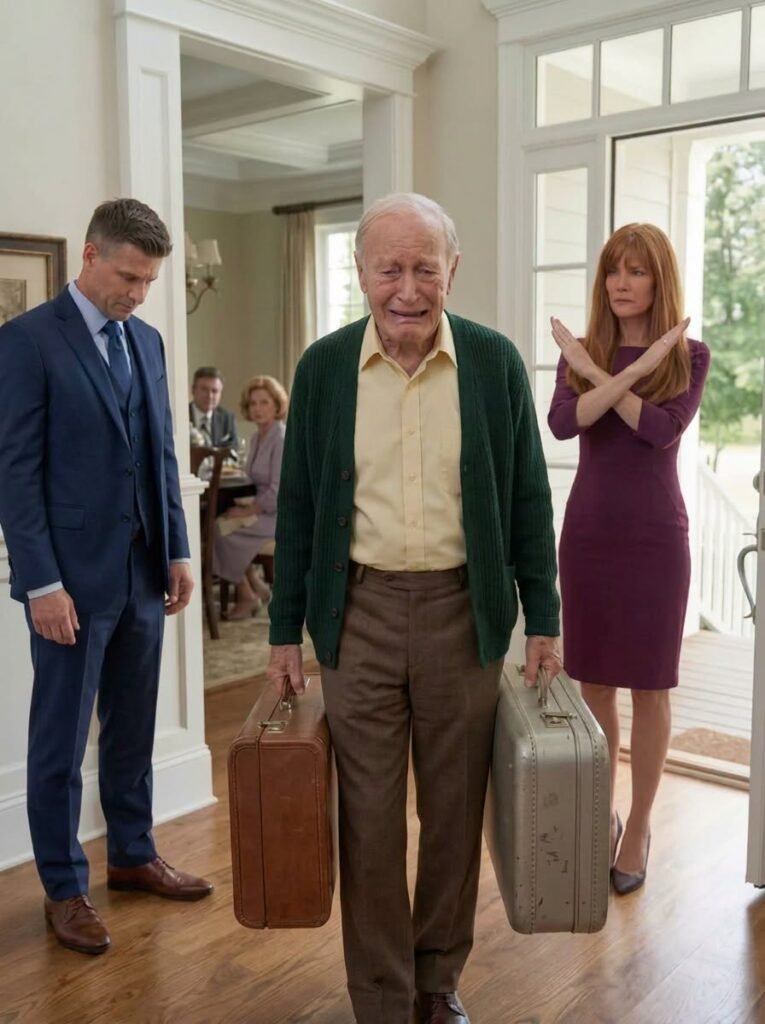
Then I thought about the morning I had left his house carrying two suitcases.
I had believed I was losing my family.
I had believed walking away meant closing a door forever.
But sometimes a door has to close before anyone notices who has been standing outside it.
I never told Logan exactly how much the eight hundred thousand eventually became.
Markets rose.
Investments compounded.
I continued living simply.
By the time he made his final payment, the amount was considerably higher.
But that number no longer mattered.
The most valuable thing I had protected was not my retirement account.
It was my dignity.
And the most important thing Logan recovered was not his inheritance.
It was himself.
People sometimes imagine revenge as watching someone suffer.
I learned something different.
Real victory is reaching the point where their suffering no longer gives you pleasure.
Where their apology does not control you.
Where their approval does not feed you.
Where you can love someone without financing their disrespect.
I had spent years believing silence kept the family together.
It did not.
Silence only hid the cracks.
Leaving exposed them.
Boundaries forced us to repair what could still be repaired.
And the things that could not be repaired?
We finally stopped pretending they were whole.
I picked up Logan’s check and carried it inside.
In my office, I opened the old metal filing cabinet I had owned since my accounting days.
Inside were folders labeled carefully.
TAXES.
INSURANCE.
ESTATE.
PROPERTY.
And one thin folder labeled LOGAN.
I placed the final payment inside.
Then I wrote one word across the front.
PAID.
I stared at it.
Then I smiled.
Not because the money had returned.
Because my son had.
I closed the drawer.
Turned off the light.
And walked down the hall toward the room where Grace’s yellow blanket waited for her next Saturday visit.
For years, everyone had assumed I was the old man with nowhere else to go.
They were wrong.
I had money.
I had choices.
I had a future.
I simply loved my son enough that I had forgotten I was allowed to choose myself.
The night Chelsea told Logan, “He needs to leave this house,” she thought she was removing a burden.
Instead, she removed the one person quietly carrying more of their life than either of them understood.
Three envelopes revealed the money.
But losing the money revealed something far more important.
Who we had become.
Who we were willing to change for.
And who we could still become when nobody else was paying the bill.
That was the inheritance I eventually gave my son.
Not eight hundred thousand dollars.
Something worth far more.
The knowledge that love can open a door for you.
But dignity must know when to walk through it.