“Where?”
Eli looked at me.
“In Grandpa’s laundry room.”
My stomach tightened.
“Why?”
His voice dropped to almost nothing.
“Because Uncle Mark stepped on it when he locked me in.”
I felt every muscle in my body go still.
Eli continued.
“The heel came off.”
He looked toward the door again.
“I put it behind the washer before I climbed out the window.”
The social worker started typing.
I finally understood why my father had called four times before the ambulance even left.
They weren’t checking on Eli.
They were trying to find out what he had escaped with.
Then Eli whispered one more thing.
“There’s something inside the shoe.”
I bent closer.
“What?”
His eyes filled.
“The thing Grandpa told Uncle Mark to burn.”
“The thing Grandpa told Uncle Mark to burn.”
For a second, I thought Eli had drifted back into confusion.
Then I saw his face.
He wasn’t confused.
He was terrified.
“What thing?”
Eli’s fingers tightened around my sleeve.
“A little black card.”
The social worker stopped typing.
“What kind of card?” she asked.
Eli shook his head.
“I don’t know.”
“Was it a credit card?”
“No.”
“A memory card?”
His eyes moved to her.
“Maybe.”
I leaned closer.
“How did it get inside your shoe?”
Eli swallowed.
“I put it there.”
The room went silent except for the monitor beside him.
I could hear every electronic beep.
Every breath.
Every second my father had been using to build another version of what happened.
“Start from the beginning,” I said. “Only what you remember.”
Eli closed his eyes.
“I was in Grandpa’s office.”
My stomach dropped.
He had been supposed to spend the afternoon helping my father clean out the garage.
That was the agreement.
Garage.
Pizza.
Home by five.
Nothing about the office.
“Why were you in there?”
“Grandpa told me to get the blue tool box.”
“From his office?”
Eli nodded.
“I couldn’t find it. Then I heard Uncle Mark downstairs.”
His breathing became shallow.
The nurse stepped closer.
I raised one hand.
“Eli, you don’t have to finish right now.”
“Yes, I do.”
His voice cracked.
“Because Grandpa is going to say I stole it.”
That sentence hurt worse than anything I had heard all afternoon.
My twelve-year-old son wasn’t worried that people wouldn’t believe he had been injured.
He already understood exactly how my family worked.
The person who found the secret became the problem.
“What did you see?” I asked.
“There was a laptop open.”
Eli stared toward the blanket.
“And Grandpa’s scanner.”
“What was on the screen?”
“Your name.”
I felt the air change.
Not my current name.
I knew that before he said anything else.
My father’s threat at the hospital came back immediately.
Every name you went by before you turned into this devoted father.
Sixteen months earlier, when I finished treatment, I had believed the worst part of my life was behind me.
I had been wrong.
Eli looked at me.
“There were folders.”
“What folders?”
“One said your old name.”
The social worker glanced at me.
I nodded once.
There was no point hiding it.
Before Eli was born, I had used my mother’s surname for several years.
Not illegally.
Not secretly.
After my parents separated, I stopped using my father’s name.
Years later, I changed it back when I got married.
My father had always hated that period of my life.
He called it betrayal.
He said I had tried to erase him.
“What else?” I asked.
Eli’s breathing shook.
“There were hospital papers.”
Mine.
I knew it immediately.
Not just treatment summaries.
There were details only a patient, doctor, or authorized family member should have possessed.
Medication lists.
Evaluation notes.
Records from the night sixteen months earlier when exhaustion, grief, and alcohol had ended with me sitting beneath fluorescent lights in an emergency psychiatric unit telling a doctor I was afraid of what would happen if I went home alone.
I had gotten help.
I had followed treatment.
I had done the work.
My father had spent sixteen months waiting for the existence of that treatment to become useful.
Eli continued.
“Then Uncle Mark came in.”
“What happened?”
“He asked Grandpa if the judge would really believe it.”
The social worker’s fingers stopped above the screen.
I didn’t move.
“What did Grandpa say?”
Eli looked straight at me.
“He said, ‘They won’t have to believe everything. They only have to doubt him once.’”
My skin went cold.
The hospital room seemed to shrink around us.
“What judge?”
“I don’t know.”
“Did they say anything about me?”
He nodded.
“They said you were going to fight the trust.”
I stared at him.
“What trust?”
“I don’t know.”
That made two of us.
Eli blinked slowly.
“Then Grandpa said they should have done this when Mom died.”
The world stopped.
My wife, Claire, had been dead for three years.
Pancreatic cancer.
Nine months from diagnosis to funeral.
There had been no custody fight.
No trust dispute.
No argument about inheritance.
At least none that I knew about.
I had been too busy trying to keep my wife alive.
Then too busy learning how to raise a grieving nine-year-old boy while barely functioning myself.
“What exactly did he say?”
Eli’s voice became smaller.
“He said, ‘We should have moved when Claire died. Now he’s stable again, and that complicates everything.’”
The social worker slowly lowered the tablet.
I finally understood what my father had been threatening.
This wasn’t about today.
Today was only the moment Eli saw too much.
Whatever they were doing had started years earlier.
“What happened after that?” I asked.
“Uncle Mark saw me.”
Eli’s breathing quickened.
“He asked what I heard.”
“What did you say?”
“Nothing.”
“And then?”
“He grabbed my arm.”
I felt my jaw lock.
Eli looked away.
“Grandpa said not to scare me.”
For half a second, that almost sounded merciful.
Then Eli finished.
“He said scared kids talk.”
I said nothing.
“He told Uncle Mark to put me somewhere quiet until they figured out what I saw.”
The laundry room.
Locked door.
Window.
Blood.
Missing shoe.
I reached for Eli’s hand.
“What about the card?”
“There was an envelope beside the laptop.”
“What was written on it?”
“I don’t know. Just numbers.”
“Did you open it?”
“No.”
He shook his head.
“It was already open.”
“And the card was inside?”
“Yes.”
“Why did you take it?”
Eli looked embarrassed.
“Because Uncle Mark said, ‘Burn that one too.’”
My heart kicked against my ribs.
“Too?”
He nodded.
“There were other papers in the fireplace.”
I looked at the social worker.
She was already standing.
“I need to contact law enforcement.”
“Do it.”
She stepped into the hallway.
I turned back to Eli.
“What happened after you took the card?”
“I put it in my shoe.”
“Why?”
“So they couldn’t see it in my pockets.”
He was twelve.
Twelve years old.
And somewhere between hearing his grandfather talk about destroying evidence and being dragged downstairs by his uncle, my son had made a decision that most adults would have been too frightened to make.
He had hidden the one thing they wanted destroyed.
Then he had survived long enough to carry the secret out.
“Uncle Mark locked you in the laundry room?”
Eli nodded.
“He said I needed to calm down.”
“Did Grandpa see?”
“Yes.”
“What did he do?”
“Nothing.”
That answer hurt more.
“What happened to your ribs?”
Eli’s eyes filled.
“I tried to get past Uncle Mark.”
He looked ashamed.
Like this was somehow his failure.
“He pushed me.”
I squeezed his hand.
“He pushed me into the sink.”
“Once?”
Eli hesitated.
“No.”
The word came out barely audible.
“He told me to stop fighting.”
I stood up.
Not because I was leaving.
Because suddenly sitting was impossible.
My hands were shaking.
I walked two steps toward the sink, turned, then came back.
I had spent sixteen months learning what to do when anger started making decisions before my brain could.
Name five things you see.
Breathe.
Separate action from emotion.
Do not hand someone else control of your next choice.
I stared at the crooked paper snowflake.
White paper.
Blue tape.
Stainless faucet.
Gray floor.
Hospital blanket.
I breathed.
Then I sat beside my son again.
“You did nothing wrong.”
Eli started crying.
Not loudly.
That made it worse.
“I thought he was going to kill me.”
I pulled him carefully against my chest.
His fractured ribs made even that difficult.
I could feel him trying not to move.
Trying not to hurt.
Trying to be smaller.
“No one is taking you back there.”
He whispered into my shirt.
“Grandpa said you’d lose me.”
I closed my eyes.
“No.”
“He said the court would give me to him.”
“No.”
“He said everybody knows you’re crazy.”
My son had spent three years watching me rebuild my life.
He knew about treatment.
I never hid it from him.
I told him that after his mother died, I got sick in a way people couldn’t always see.
That I had needed doctors.
That asking for help had kept me alive.
But my father had taken the most difficult thing I had ever survived and turned it into a weapon against my child.
I leaned back enough to see Eli’s face.
“Listen to me.”
He looked up.
“Getting treatment is not evidence that I’m dangerous.”
He blinked.
“It’s evidence that I got treatment.”
The door opened.
A police detective entered with the social worker behind him.
He introduced himself as Detective Aaron Pierce.
Mid-forties.
Gray at the temples.
No dramatic expression.
No sudden promises.
He looked at Eli first.
Not me.
“Would you feel safer if your dad stayed?”
“Yes.”
“Then he stays.”
That was the first thing anyone said that made Eli’s shoulders drop.
The interview lasted forty-three minutes.
Eli told the story again.
Slower this time.
Detective Pierce never filled in his sentences.
Never suggested answers.
Never asked him to guess.
Then he asked about the shoe.
“Could you show me where you left it?”
Eli nodded.
“Behind the washer. There’s a gap near the wall.”
Pierce wrote it down.
“Did anyone see you put it there?”
“No.”
“Did anyone see you climb out?”
“Uncle Mark.”
That mattered.
“How?”
“He came into the room right when I got the window open.”
“What happened?”
“I kicked him.”
“Where?”
“I don’t know. His arm, maybe.”
“And then?”
“I jumped.”
“How high is the window?”
“Not high outside. High inside.”
The laundry room was half underground.
I knew the window.
Four feet from the floor inside.
Barely two feet above the flower bed outside.
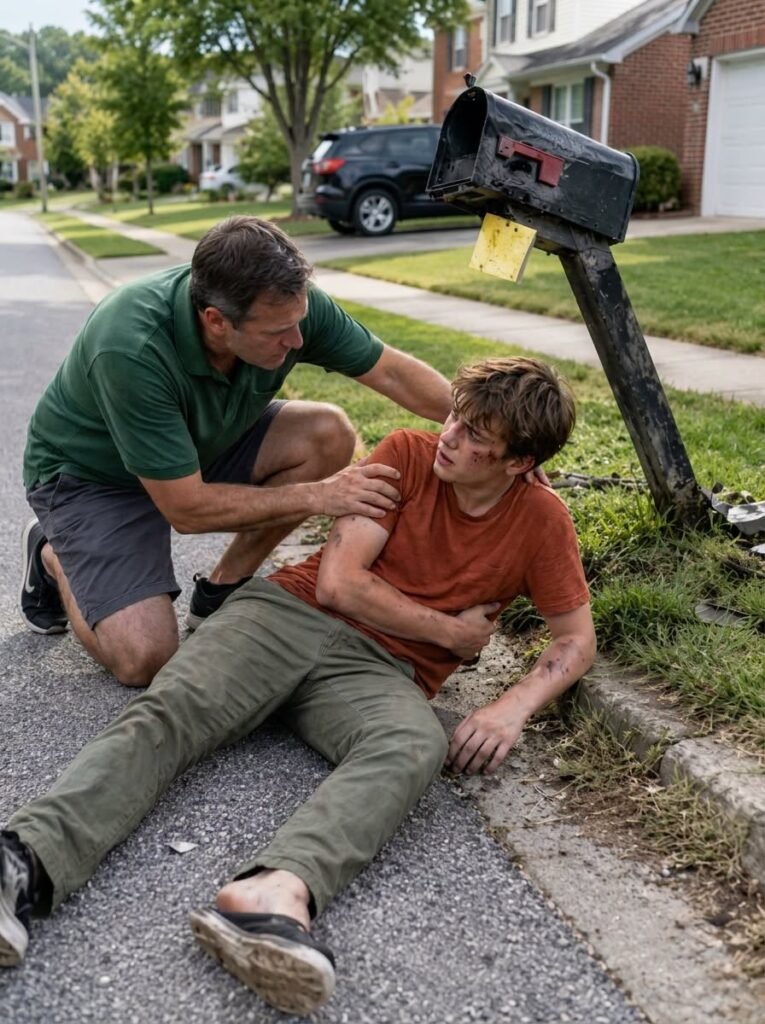
Eli had dropped into mulch, run through the side yard, crossed two neighborhood streets, and somehow covered almost half a mile with fractured ribs and one shoe.
Detective Pierce looked at me.
“Do you know if the property has cameras?”
“Yes.”
My father had cameras everywhere.
Driveway.
Front porch.
Garage.
Back gate.
Inside the office hallway.
The irony was almost unbearable.
A man obsessed with documenting everybody else had probably documented his own son’s escape.
Pierce stood.
“I’m going to seek preservation of the footage immediately.”
“Before they delete it?”
His expression told me he understood exactly why I asked.
“Yes.”
Then he added, “And we already have officers at the property.”
My phone vibrated.
My father.
Again.
I turned the screen toward Pierce.
He watched it ring.
“Answer?”
“Not this time.”
He held out his hand.
“May I?”
I gave him the phone.
The call ended.
Then a message appeared.
YOU ARE MAKING A MISTAKE YOU CANNOT REVERSE.
Detective Pierce photographed the screen.
Thirty seconds later another message came.
MARK IS WILLING TO FORGIVE WHAT ELI DID.
The detective looked at me.
“What exactly does your brother think Eli did?”
“I’d like to know too.”
Then the third message arrived.
BRING BACK THE CARD.
Nobody spoke.
My father had just done what frightened people do when they think intimidation still works.
He confirmed the evidence existed.
Pierce’s eyes sharpened.
“Do not respond.”
“I wasn’t planning to.”
He stepped into the hallway.
The next three hours moved in fragments.
A second scan.
Pain medication.
A child advocacy nurse.
Photographs.
Forms.
Police updates.
At 8:12 p.m., Detective Pierce returned.
He closed the door behind him.
“We recovered the shoe.”
I felt Eli’s hand move under the blanket.
“And?”
Pierce placed a small clear evidence bag on the counter.
Inside it was Eli’s sneaker.
The heel was partially separated.
Dark streaks marked one side.
There was a reddish smear near the laces.
I didn’t need anyone to tell me whose blood it probably was.
Pierce did not open the bag.
Instead, he showed me a photograph.
A tiny black microSD card had been taped beneath the removable insole.
Exactly where Eli said it would be.
“We found this inside.”
My mouth went dry.
“Have you looked at it?”
“It’s being processed.”
“Was anything else recovered?”
Pierce nodded.
“A great deal.”
That was all he said.
At 10:37 p.m., my father was detained.
At 10:52, Uncle Mark was detained too.
Neither was formally charged that night.
That came later.
But the first lie had already collapsed.
The home cameras had not been completely erased.
My father apparently knew how to delete clips from the phone app.
He did not know the system also uploaded motion events to a manufacturer account for twenty-four hours.
Detectives obtained them before the retention window expired.
The footage showed Eli arriving at 1:11 p.m.
It showed him entering the garage.
Then the house.
At 2:46, Uncle Mark’s truck arrived.
At 3:09, one camera captured Eli running past the side gate in one shoe.
Twenty-eight seconds later, Mark came after him.
He stopped at the edge of the driveway.
He didn’t call Eli’s name.
He didn’t chase him down the street.
He pulled out his phone.
And called our father.
That mattered.
But not as much as what came next.
At 3:13 p.m., four minutes after Eli escaped, the driveway camera showed my father carrying a metal trash can from the garage.
At 3:16, smoke began rising behind the house.
They had burned documents before calling me.
Before calling police.
Before calling an ambulance.
They never reported Eli missing.
They never asked neighbors to help find an injured child.
Instead, at 3:31, my father called me.
Then again.
Then again.
Then the fourth time at 4:18.
By then, he wasn’t trying to rescue Eli.
He was trying to control what Eli could say.
The microSD card explained why.
Detective Pierce came to my house two days after Eli was discharged.
Eli was asleep upstairs.
I had moved a chair beside his bed because he still woke every few hours.
The detective sat at my kitchen table with a folder he never opened.
“The card contained scanned documents, audio recordings, photographs, and financial files.”
My hands went cold.
“What kind of financial files?”
“Records connected to your late wife.”
Claire.
I stared at him.
“What records?”
“Insurance. A family trust. Property transfers.”
“I don’t know about any trust.”
“I know.”
That answer scared me.
“What are you saying?”
Pierce leaned forward.
“Did Claire ever tell you her parents created an inheritance account for Eli?”
“No.”
“She may not have known the final structure either.”
He opened the folder.
Claire’s father had died six years before she did.
Her mother had died when Claire was young.
I knew they had left her money.
Not enormous wealth.
Enough to pay off our house.
Enough to make treatment during her illness less terrifying.
Claire had always told me there was nothing complicated about the estate.
Apparently, she had been wrong.
There had been another account.
A protected trust.
Beneficiary: Eli.
Initial value: $418,000.
I read the number twice.
Then a third time.
“I’ve never seen this.”
“Your father had.”
I looked up.
Pierce slid one page toward me.
My father’s signature appeared at the bottom.
Not as beneficiary.
Not as trustee.
As witness to an amendment.
An amendment supposedly signed by Claire eleven days before she died.
The amendment did something very simple.
If I were found unable to act as Eli’s legal guardian because of death, incapacity, substance abuse, psychiatric instability, or court order, control of Eli’s trust would temporarily pass to my father.
Temporarily.
Until Eli turned twenty-five.
I stared at the page.
“Claire didn’t sign this.”
“We don’t believe she did.”
The room tilted.
“How do you know?”
“Because one of the files on the card appears to be a recording.”
Pierce took out his phone.
He didn’t play it immediately.
He watched me first.
“This may be difficult.”
“My wife has been dead three years. Difficult happened a long time ago.”
He pressed play.
My father’s voice filled my kitchen.
Older.
But unmistakable.
Then Mark.
They were arguing.
The audio quality was rough.
Probably recorded secretly from a phone left in a room.
Mark said, “The signature doesn’t match.”
My father answered, “It doesn’t have to survive a trial. It has to survive long enough to remove him.”
Mark asked, “And if Claire’s lawyer notices?”
My father laughed.
“Claire will be dead.”
I stopped breathing.
The recording continued.
Mark asked what would happen if I stayed stable.
My father answered with a sentence I will remember until I die.
“Then we make stability temporary.”
Detective Pierce paused the recording.
I stood up so fast my chair hit the wall.
For three years, I had believed my collapse after Claire died had been entirely mine.
Grief.
Alcohol.
Insomnia.
Panic.
I remembered the bottle of whiskey.
I remembered waking with no memory of sending messages.
I remembered my father arriving at my house before sunrise and saying he had found me incoherent.
I remembered him telling doctors I had been drinking for days.
I remembered believing him.
“What else is on the card?”
Pierce’s face tightened.
“Photographs.”
“What photographs?”
“Medication bottles.”
My stomach turned.
“They photographed my medication?”
“More than that.”
He slid another image across the table.
My old prescription bottle.
The label showed thirty tablets.
The next photograph showed the bottle open.
Beside it were loose pills.
And Mark’s hand.
The timestamp was from the week before my hospitalization.
I looked at Pierce.
“What did they do?”
“We’re still establishing that.”
But I already knew.
Not every detail.
Enough.
During the worst period after Claire’s death, my father kept bringing me drinks.
He said one would help me sleep.
He had access to my house.
He had access to my medication.
He was often the one who took Eli overnight when I couldn’t function.
I had thought he was helping.
Maybe some nights he had.
That was the sickest part.
People like my father rarely built lies out of nothing.
They wrapped lies around real things.
I really had been grieving.
I really had been drinking too much.
I really had entered treatment.
Then he had nudged reality exactly where he needed it to go.
“What was the plan?” I asked.
Pierce answered carefully.
“Investigators believe the objective was to establish a documented pattern of instability. If successful, they could petition for emergency guardianship of Eli. That would trigger control provisions in the trust.”
“For money?”
“Partly.”
Partly.
There was something worse.
“What else?”
Pierce pulled out the final document.
A property map.
My house.
Claire’s inherited lake property.
Three commercial lots I didn’t recognize.
All linked through the trust.
The current estimated value was just over $1.8 million.
My father hadn’t been trying to steal a grieving grandson.
He had been trying to gain control of an asset.
Eli was the key.
I was the obstacle.
And my breakdown after Claire died had almost opened the door.
“Why didn’t he do it then?”
Pierce tapped the folder.
“Because you entered treatment voluntarily.”
I didn’t understand.
He explained.
My admission had been voluntary.
I had complied.
No violence.
No child endangerment finding.
No involuntary commitment.
No criminal charge.
By doing exactly what my father later used to shame me, I had made it much harder for him to prove I was legally unfit.
Treatment had saved me twice.
Once from myself.
Once from him.
But there was still one question.
“Who made the recording?”
Pierce looked toward the ceiling.
Toward Eli’s room.
“We believe Claire did.”
I couldn’t speak.
“She knew?”
“We think she suspected.”
He slid over a handwritten note recovered from the card.
Claire’s handwriting.
I knew every curve.
Every uneven capital letter.
Every place her hand pressed harder into paper when she was angry.
IF YOU ARE HEARING THIS, I WAS RIGHT TO BE AFRAID.
My vision blurred.
Below that:
DO NOT LET THEM USE HIS GRIEF AGAINST HIM.
And beneath it:
ELI IS NOT AN ASSET.
I covered my mouth.
For the first time since her funeral, grief returned exactly as it had on the first day.
Not slowly.
Not gently.
It hit like someone opening a door underwater.
Claire had known enough to hide evidence.
But cancer moved faster.
Maybe she planned to tell me.
Maybe she tried.
Maybe she had been waiting for one more piece.
Instead, she died.
And somehow the card ended up inside my father’s office.
Pierce had an explanation for that too.
Claire’s attorney had mailed a sealed packet to our house after her death.
According to postal records, it required a signature.
I never received it.
My father signed.
He had been staying with me then.
Helping with Eli.
Managing meals.
Opening mail.
Holding me together.
Or pretending to.
He found the packet.
He found Claire’s evidence.
And he kept it.
For three years.
Until Eli opened the wrong office door.
The criminal case took eleven months.
My father never apologized.
Not once.
Mark tried.
But only after prosecutors showed him the recovered footage, the forged documents, the messages, and photographs from his own phone.
He claimed our father controlled him.
That may have been true.
It didn’t erase what he did to Eli.
Mark accepted a plea involving assault, unlawful restraint, evidence tampering, and conspiracy-related charges.
My father went to trial.
His attorney attacked everything.
My history.
My treatment.
My drinking after Claire died.
My old surname.
The months when I barely functioned.
Exactly the strategy my father had threatened to use from Eli’s hospital room.
For two days, I sat in court while strangers discussed the worst year of my life.
Then the prosecutor asked me one question.
“When you realized you were not well, what did you do?”
“I asked for help.”
That was it.
No dramatic speech.
No denial.
No shame.
Then Eli testified by recorded forensic interview.
The courtroom watched my twelve-year-old son explain the laundry room.
The window.
The shoe.
The card.
Uncle Mark stepping on his heel.
Grandpa standing there.
Doing nothing.
Then the prosecutor played the hospital call.
My father’s calm voice filled the courtroom.
Your son became disoriented and ran away.
Then they played his text.
BRING BACK THE CARD.
My father finally looked down.
The jury convicted him.
The trust amendment was voided.
The financial transfers were reversed where possible.
A court-appointed fiduciary took control until every transaction could be reconstructed.
I refused to serve as trustee.
That surprised people.
Maybe even disappointed some.
But the money was Eli’s.
Claire had wanted it protected.
So I protected it.
Not from poverty.
Not from taxes.
From family.
A professional trustee now manages everything.
I receive statements.
Eli will receive control according to Claire’s original documents.
No hidden amendments.
No grandfather.
No desperate father.
Not even me.
Six months after the trial, Eli and I drove past my father’s house for the first time.
We weren’t going there.
We were headed to the lake property Claire had left him.
The house was being sold.
A red sign stood near the road.
Eli watched it pass through the passenger window.
For a while, he said nothing.
Then he looked down at his shoes.
He was wearing a new pair.
Same brand.
Different color.
“Dad?”
“Yeah?”
“Did Grandpa ever love me?”
I gripped the steering wheel.
There are questions parents want to answer quickly.
This wasn’t one of them.
“I think he loved having a place in your life.”
Eli waited.
“But that isn’t the same as loving you correctly.”
He stared out the window again.
After a moment, he nodded.
We reached the lake just before sunset.
Claire had loved that place.
Tall pines.
Wooden dock.
Water so still it reflected the clouds.
Eli walked ahead of me carrying a cardboard box.
Inside were copies of Claire’s letters, photographs, and one item Detective Pierce had returned after the case closed.
The shoe.
Not the original evidence bag.
Just the shoe itself.
Cleaned as much as it could be.
Heel still torn.
Eli had asked for it back.
I thought he wanted to throw it away.
Instead, he sat at the end of the dock with it beside him.
“Mom saved us,” he said.
I sat down.
“Yes.”
He shook his head.
“Not exactly.”
I looked at him.
“She saved the card.”
He touched the damaged heel.
“But I saved the card too.”
For the first time, I understood what he needed me to say.
“You did.”
“And you recorded Grandpa.”
“Yes.”
“And you believed me.”
“Always.”
Eli stared across the water.
“So everybody did one part.”
The sun had almost reached the tree line.
I smiled despite myself.
“Yeah.”
He picked up the shoe.
For months, that shoe had meant the worst afternoon of his life.
A locked door.
A broken rib.
A window.
A terrified run home.
Now he held it differently.
Not like evidence.
Like proof.
Proof that he escaped.
Proof that someone could be frightened and still think.
Proof that being hurt did not make him helpless.
Eli opened the cardboard box.
He placed the shoe inside beside Claire’s copied note.
Then he closed the lid.
“What do you want to do with it?” I asked.
“Keep it.”
“For how long?”
He shrugged.
“Until I don’t need to.”
That answer was better than anything a therapist or judge or prosecutor could have given us.
We stayed at the lake until the mosquitoes came out.
On the drive home, Eli fell asleep.
At a red light, I looked at him.
Both shoes on.
Seat belt fastened.
Head against the window.
Safe.
My phone buzzed in the cup holder.
For one second, my whole body reacted.
The same cold sensation.
The same memory of four calls while my son lay strapped inside an ambulance.
I looked down.
Unknown number.
I almost ignored it.
Then I answered through the car speaker.
“Hello?”
A woman spoke.
“Is this Eli’s father?”
“Yes.”
“My name is Rebecca Shaw.”
The name meant nothing to me.
Then she said something that made me sit straighter.
“I knew Claire.”
I glanced at Eli.
Still sleeping.
“How?”
“I worked at the law office that prepared her original trust.”
My hand tightened around the wheel.
“What do you want?”
“To give you something.”
The light turned green.
I pulled into a parking lot instead.
“What?”
“A letter.”
“From Claire?”
“Yes.”
My heart stopped.
“Why do you have it?”
Rebecca was silent for several seconds.
“Because Claire told me not to send it unless your father ever tried to take Eli from you.”
I closed my eyes.
There it was.
Even after the conviction.
Even after the trust.
Claire had left one final safeguard.
Rebecca mailed the letter through Detective Pierce.
It arrived three days later.
I waited until Eli was home from school.
We opened it together.
Claire’s handwriting filled four pages.
Most of it was personal.
Things about Eli as a baby.
Things about me.
Things she had been afraid to say while dying.
But the final paragraph was different.
If Richard ever tells you that your worst days define you, remember that he only knows how to measure people by what can be used against them.
You are not your worst day.
Eli is not your weakness.
He is the reason you kept going.
And if our son ever has to choose between protecting the truth and protecting the family name, tell him I said this:
Burn the name.
Keep the truth.
Eli read that line twice.
Then he looked at me.
“Mom was intense.”
I laughed.
It came out broken.
So did his.
Then we both started crying.
Not because we had lost.
Because we had finally reached the part where losing Claire was no longer the last thing she gave us.
She had left instructions.
Evidence.
Protection.
And one sentence strong enough to outlive every lie my father built.
That night, I put Claire’s letter in our safe.
Eli put the damaged shoe beside it.
Not because we wanted to remember the violence.
Because someday, when the fear had faded enough, I wanted him to remember something else.
He had climbed through a locked laundry-room window with fractured ribs.
He had hidden the truth beneath his own foot.
He had crossed half a mile alone.
And when he reached home, he did not ask me to fight anyone.
He did not ask me to hurt anyone.
He looked at me with one shoe missing and whispered the smartest thing either of us did that day.
“Lock the door.”
So I did.
And this time, the people outside never controlled what happened inside again.