The officer looked down at the phone while my niece’s mother stood beside him, silent and steady. She had not come across the lawn to argue with my parents. She had come to make sure the officer saw something before anyone could convince him that what happened was an accident.
My mother took another step toward them.
“Please,” she said. “You don’t understand what you’re looking at.”
My niece’s mother didn’t even turn around.
The officer watched the screen for several seconds. Then his expression changed.
That was the first moment my father stopped looking irritated and started looking afraid.
Until then, he had been playing the same role he’d played for years. Calm father. Reasonable grandfather. Man surrounded by people who were supposedly overreacting. He had already told the officer that my daughter fell. He had already explained away my mother’s words as something I’d misunderstood.
But whatever was on that phone didn’t need my interpretation.
The officer looked up.
“Where did you get this?”
My niece’s mother finally faced him.
“I had my phone recording before the pictures started. I wanted to make sure the kids were smiling when everyone came outside.”
My mother’s face went completely still.
My father said nothing.
Inside the house, my niece was crying near the doorway, still dressed in the outfit she’d been prepared to wear for her birthday photos. She looked from the officer to her grandmother, then toward the ambulance where my daughter was being examined.
“Is that what happened?” she whispered.
Her mother crossed to her and knelt down.
“You didn’t do anything wrong.”
My niece shook her head.
“Grandma said we needed pictures.”
Her mother closed her eyes for one second.
Then she looked back toward the officer.
That small sentence changed the meaning of everything.
My parents hadn’t stumbled onto my sleeping daughter by accident. They had been trying to create a particular picture for my niece’s birthday. My mother had wanted my daughter to look humiliated. My father had gone along with it. And my niece had been close enough to understand that something was wrong even if she hadn’t understood why.
The officer asked to see the beginning of the recording.
My niece’s mother handed the phone back without hesitation.
On the screen, the birthday decorations appeared first. Balloons. A table waiting for cake. My niece moving in and out of frame while adults talked behind the camera.
Then my mother entered the room.
Her voice was unmistakable.
She was talking about my daughter.
Not affectionately. Not jokingly. She was complaining that my daughter would ruin the family pictures by looking tired and messy. My father answered her. He said they could “fix that” before anyone took the photographs.
The officer watched without saying anything.
Then came the part my parents could no longer explain away.
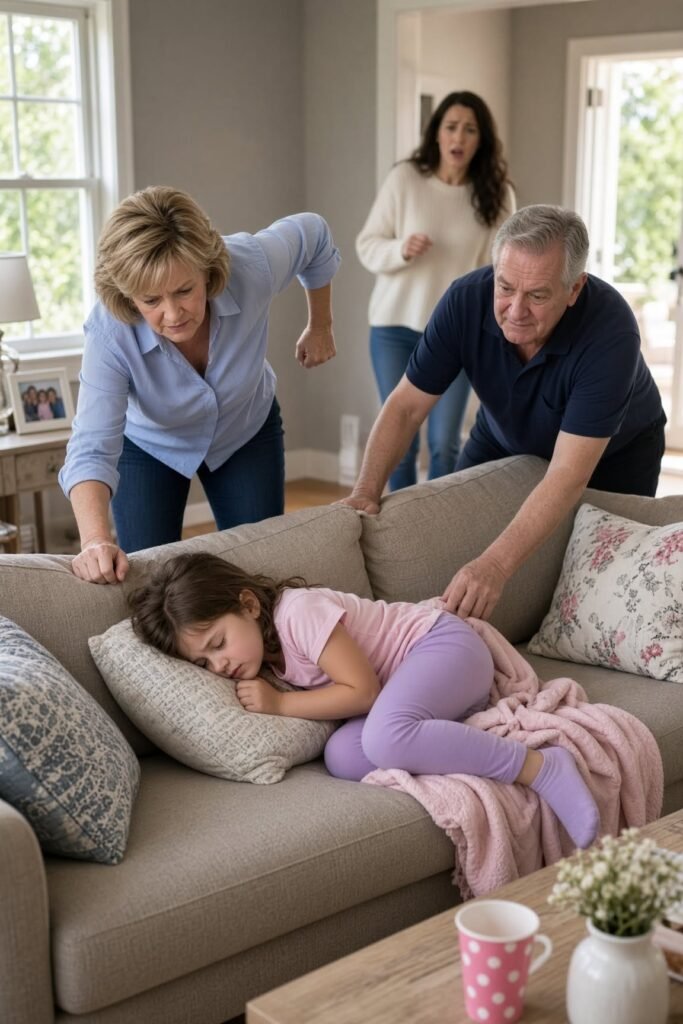
The recording showed them entering the room where my daughter was asleep.
It showed my mother waking her.
It showed my daughter pulling the blanket around herself and crying because she didn’t understand why Grandma was angry.
And then it showed my father striking her.
My stomach turned even though I’d already seen the aftermath.
My daughter had been six years old. She had been asleep. She had done nothing to anybody.
The video continued.
My mother leaned toward her after my father hit her.
The exact sentence I’d repeated to the officer came through the phone speakers.
“Finally she’ll look as worthless as she is.”
Nobody on the lawn moved.
My father looked at my mother.
My mother looked at the phone.
For once, neither of them had an explanation ready.
The officer stopped the video.
“This is your recording?”
My niece’s mother nodded.
“Yes.”
“You were present?”
“No. The phone was left inside to record the room.”
The officer looked toward the house.
“Does anyone else have access to the original?”
“I do. The file is backed up.”
My father finally spoke.
“That doesn’t show the whole situation.”
The officer turned toward him.
“Then you can explain the whole situation.”
My father opened his mouth.
Nothing came out.
For years, silence had been one of his weapons. He could make silence feel like judgment. He could wait until somebody else became uncomfortable and started explaining themselves.
This time, nobody rushed to fill it.
My mother tried a different approach.
“She was always difficult,” she said. “You know how she is.”
I looked at her.
“She’s six.”
My mother glanced toward the ambulance.
“I didn’t mean—”
“You meant exactly what you said.”
She stared at me.
I didn’t raise my voice. I didn’t need to.
The recording had already done that work.
An EMT came over and told me my daughter needed to be taken in for further evaluation. Her cheek was badly swollen, and she was frightened, but she was responsive.
I climbed into the ambulance with her.
Before I got inside, I heard my niece crying again.
“Mom, is Grandma going to jail?”
Her mother looked at her for a long moment.
“I don’t know. But the adults are going to handle what happened.”
My daughter reached for me from the stretcher.
I took her hand.
She still had part of her blanket wrapped around one ankle.
“Are we going home?” she asked.
“We’re going to the hospital first.”
She nodded, then looked toward the open ambulance doors.
“Will Grandma be there?”
“No.”
She relaxed slightly.
That tiny change in her face hurt more than anything else that morning.
At the hospital, the doctors examined her while I sat beside her bed. She kept asking whether she’d done something wrong. I told her the same thing every time.
No.
Nothing she had done caused this.
While we waited, an officer came in to ask me more questions. This time, I didn’t have to fight to be believed. The recording had established what happened, and the responders had documented my daughter’s injuries.
But my father had one last weapon.
He called me.
I didn’t answer.
He called again.
Then my mother called.
Then my father left a voicemail.
His voice was low and controlled.
“We are still your parents. Don’t destroy this family over one terrible misunderstanding.”
I listened to it once.
Then I deleted the voicemail.
Not because I wanted to erase what he’d said.
Because I finally understood that I didn’t have to keep receiving the same argument just because he had decided to make it.
A few hours later, my niece’s mother came to the hospital.
She didn’t bring flowers. She didn’t bring excuses.
She brought my niece.
My niece stood at the doorway clutching a small birthday gift she’d been given before everything happened.
She looked terrified.
“Can I see her?”
I asked my daughter.
She nodded.
My niece walked over slowly.
“I’m sorry,” she whispered.
My daughter frowned.
“Why?”
“Because it was my birthday.”
My daughter looked at me.
Then she looked back at her cousin.
“It wasn’t your fault.”
My niece started crying.
Her mother put an arm around her shoulders.
That was the moment I realized the damage my parents had caused went beyond my daughter.
They had tried to make one child feel worthless for the sake of another child’s celebration.
Instead, both girls had learned something they should never have had to learn that day: adults can use love, family, and celebrations as excuses for cruelty.
But they also learned something else.
Someone can stop it.
The investigation continued over the following days. My parents were no longer allowed to contact my daughter while the case was being handled. Family members who had spent years telling me to keep the peace suddenly started asking what they could do to help.
I didn’t give them a speech.
I simply told them the truth.
“Keeping the peace was never the same thing as keeping my child safe.”
Some people understood immediately.
Others didn’t.
One relative told me I had embarrassed the family.
I asked her which part she meant.
The sirens?
The bruises?
The video?
Or the fact that someone finally refused to pretend?
She stopped calling after that.
My parents had spent years controlling the family story because they understood something simple: if they controlled the story first, everyone else had to defend themselves inside it.
The recording broke that system.
There was no argument over tone.
No debate about whether my father sounded angry.
No question about whether my mother had been joking.
No room for anyone to tell me that I was being too sensitive.
There was only what the camera had captured.
My daughter asleep.
My parents entering the room.
Their actions.
Their words.
And the aftermath.
Weeks later, my daughter was healing. The swelling went down, although she still became nervous whenever someone moved too quickly near her face.
We changed our routines. We changed who was allowed around her. We stopped attending family gatherings where my parents might appear.
It wasn’t dramatic.
It was necessary.
One evening, my daughter was sitting at the kitchen table drawing. She suddenly looked up at me.
“Mom?”
“Yeah?”
“Am I worthless?”
My heart broke.
I pulled her into my arms.
“No. Not even close.”
She thought about that.
Then she held up her drawing.
It was a picture of our family, but she had drawn herself standing beside me. Above us was a huge yellow sun.
There were no grandparents in the picture.
I didn’t ask why.
I didn’t need to.
I kissed the top of her head.
The birthday photos my parents had cared so much about were never taken.
The balloons were eventually thrown away.
The cake was never served that morning.
The perfect family picture they wanted disappeared before anyone could take it.
But something else happened instead.
The truth survived.
And for the first time in my life, I understood that protecting my child wasn’t a betrayal of my parents.
It was my responsibility to her.
My parents had spent years teaching everyone that family loyalty meant silence.
That morning, a phone proved otherwise.
Sometimes loyalty means telling the truth when the truth ruins the picture everyone else wanted to keep.