The nurse looked at the message from my mother-in-law one more time, then turned toward the exam-room door and quietly asked another staff member to come inside. My husband was still insisting that there had been a misunderstanding. I was still holding my phone. And our newborn daughter was still being evaluated after a night when her stored milk had been deliberately emptied.
A few hours earlier, I had been standing in my kitchen staring at a refrigerator display that had suddenly made everything harder to explain away.
My daughter had been crying against my chest, but it wasn’t the strong, angry cry I had come to recognize since bringing her home. It was thin and weak. Her lips looked dry beneath the edge of her loose pink onesie, and a small hospital plaster was still wrapped around one tiny hand.
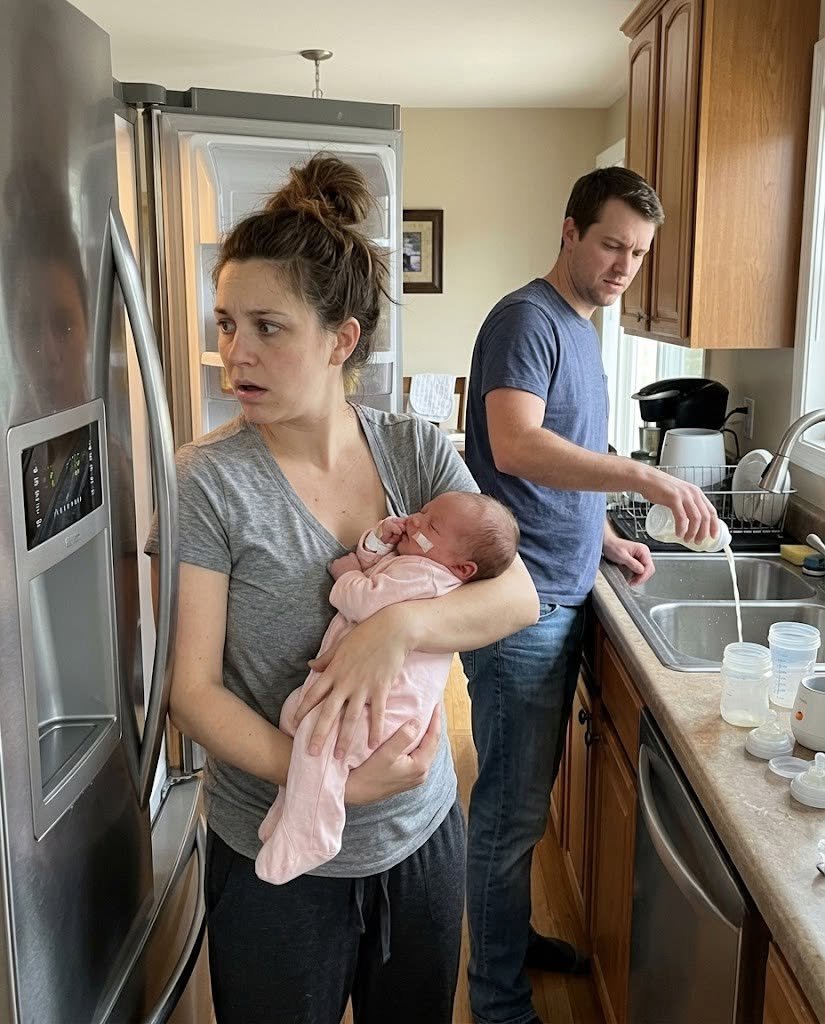
The sink smelled faintly of milk.
Every bottle I had pumped and carefully stored was gone.
They weren’t missing because I had forgotten where I put them. They weren’t spoiled. They hadn’t leaked. Someone had poured them out and left the empty storage bottles lined beside the faucet.
For a new mother, expressed milk isn’t just something sitting in a refrigerator. Each bottle represents time, discomfort, planning, and the effort of making sure your baby has something available when she needs it.
I had spent hours doing that work.
My husband had emptied all of it.
At first, I couldn’t understand how many times he could have done it without me noticing.
Then I looked at the refrigerator sensor.
The display showed eleven openings between midnight and dawn.
Eleven.
I stared at the number until it stopped looking like a malfunction and started looking like a timeline.
I turned toward my husband.
“Did you keep opening this?” I asked.
He didn’t hesitate.
“Every time you put more milk in there.”
That answer frightened me more than a denial would have.
I had expected anger. Maybe an excuse. Maybe a claim that he’d emptied everything at once because we’d been fighting.
Instead, he told me he had been watching the refrigerator throughout the night.
He knew when I pumped.
He knew when I stored another bottle.
And every time I replaced what was gone, he checked again.
Our daughter whimpered against my shirt.
Her little fist opened and closed near my collar.
The hospital plaster was still around her hand from her recent discharge.
I reached for my phone.
My husband stepped closer.
“What are you doing?”
“Getting her checked.”
“You’re overreacting.”
I didn’t want to argue about our marriage while holding a newborn who sounded weaker than she had earlier.
I called the after-hours number from her discharge paperwork and described what I was seeing. I kept my explanation simple. I answered the questions. I described the weak cry and dry-looking lips.
Then I mentioned the milk.
The person on the line asked me to repeat myself.
So I did.
“My husband poured out every bottle. He says his mother decides when the baby is allowed to eat.”
My husband’s expression changed.
He said my name under his breath and reached toward my phone.
I turned away.
The person on the line remained calm. Based on what I had described, they told me our daughter needed to be evaluated promptly.
That was enough.
My husband still wasn’t done trying to convince me otherwise.
“Mom knows babies,” he said. “You keep feeding her every time she fusses. She needs a routine.”
I looked again at the refrigerator history.
Eleven openings.
I remembered walking into the kitchen half-asleep after pumping. I remembered labeling bottles. I remembered placing them inside and returning to our daughter because I believed the milk would still be there when she needed it.
“Were you dumping them as I stored them?” I asked.
His jaw tightened.
Then he gave me the sentence that changed the way I understood the entire night.
“I was making sure you followed the rules.”
Rules.
That was the word he chose.
Not feeding guidance.
Not concern.
Rules.
He hadn’t made one angry decision in the middle of an argument. He had repeatedly monitored the refrigerator and removed the milk while I was caring for our daughter.
Our daughter began crying again.
The sound was still weak.
I stopped trying to convince him.
I picked up the diaper bag.
He followed me across the kitchen.
“My mother is going to call you,” he said. “Just wait until she explains this.”
“No.”
It was a small word, but it was the clearest decision I had made all morning.
He moved toward the hallway and started talking faster.
He talked about respect.
He talked about his mother’s experience.
He talked about how humiliating it would be if I told strangers about something that should stay inside the family.
I listened long enough to understand what he wanted.
He wasn’t asking me to reconsider whether our daughter should be fed.
He was asking me to protect the rule that had caused the problem.
I saved screenshots of the refrigerator history and slipped my phone into the outside pocket of the diaper bag.
Then I lifted our daughter against my shoulder, walked around my husband, and carried her through the front door.
The drive to the hospital wasn’t especially long, but it felt longer because I kept listening for every little sound from the back seat.
I checked the mirror more than once.
I listened for her cry.
I tried not to let my mind race ahead of what I knew.
At the hospital, I gave the staff the simplest version I could.
Our newborn had not been fed as expected.
The stored milk had been discarded.
Her cry had become weak.
They brought us back for an evaluation.
My husband arrived separately.
He immediately began saying there had been a misunderstanding.
That phrase kept appearing in his explanations.
Misunderstanding.
As though the empty bottles beside the sink were a misunderstanding.
As though eleven refrigerator openings were a misunderstanding.
As though his own words about enforcing rules had somehow meant something else.
I didn’t argue with him in the exam room.
The staff had our daughter in front of them, and that mattered more than winning a disagreement with him.
Then my phone lit up.
It was his mother.
For the first time since I had left the house, I saw something that connected her directly to what my husband had been describing.
Her message was short.
“Did he keep her on the feeding times I gave him?”
I read it once.
Then again.
My husband saw the screen at the same moment.
“Give me that,” he said.
I didn’t.
I held the phone where the nurse could see it.
I didn’t embellish the message.
I didn’t tell the nurse what I thought my mother-in-law intended.
I simply showed her what had been written.
Then I showed her the refrigerator history.
Eleven openings overnight.
I explained that my husband had admitted he opened the refrigerator each time I replaced milk because he was making sure I followed his mother’s rules.
The nurse read the message twice.
She looked toward my husband.
Then she walked to the exam-room door.
That was when another staff member was called inside.
For the first time that day, I realized I didn’t need to persuade everyone in the room.
The facts were starting to speak for themselves.
I sat beside our daughter while the evaluation continued.
My husband kept trying to explain.
He said his mother had raised children.
He said she knew what a newborn needed.
He said we were supposed to follow a schedule.
He said he had only been trying to help.
But the problem with his explanation was that it didn’t answer the simplest question.
Why had he emptied every bottle?
If he believed our daughter needed a schedule, why not discuss it with me?
Why monitor the refrigerator through the night?
Why remove the milk repeatedly instead of simply asking a question?
And why had his mother already known enough about the feeding schedule to ask whether he had kept it?
Those questions didn’t require a dramatic confrontation.
They were already sitting inside the story he had given us.
The nurse asked me a few more questions.
I answered them.
She asked about the timing.
I explained when I had pumped and when I had noticed the bottles were gone.
She asked what my husband had said.
I repeated his words as accurately as I could.
“I was making sure you followed the rules.”
The room became more serious without anyone needing to announce that it had.
My husband tried to interrupt.
“I didn’t mean she wasn’t supposed to feed her at all.”
I looked at him.
That wasn’t what he had said at home.
At home, he had told me our daughter needed to learn to wait until his mother approved feeding time.
He had poured out the milk.
He had watched the refrigerator.
He had admitted it.
Now, in front of medical staff, the explanation was becoming smaller.
He wasn’t denying what happened anymore.
He was changing what it was supposed to mean.
That distinction mattered.
I had spent enough time trying to explain myself to family members who were determined to hear something different.
I wasn’t going to do that with the people caring for my daughter.
I gave them the information they needed and let them evaluate her.
The hospital room became the opposite of our kitchen.
At home, my husband’s mother had been treated as the authority.
At the hospital, the focus was our newborn’s condition.
No family rule could replace that.
No argument about respect could make the empty bottles full again.
No explanation could erase the refrigerator history.
And no one needed to decide whether I was being dramatic before checking on a baby who had developed a weak cry and dry-looking lips.
My husband eventually sat down.
His shoulders dropped, but he still looked frustrated rather than apologetic.
He asked me to stop making things worse.
I told him I wasn’t making anything worse.
I was getting our daughter evaluated.
That was all.
The difference between those two things suddenly felt enormous.
He wanted the situation handled as a family matter.
I wanted our daughter’s needs handled as a priority.
Those were no longer the same thing.
The staff continued doing their work.
I stayed close to the baby.
The hospital plaster on her hand reminded me how recently we had already been there.
The pink onesie looked too loose around her tiny body.
Every small detail made the night before feel more real.
I thought about all those bottles sitting in the refrigerator only hours earlier.
I thought about how many times I had gotten up to pump while exhausted.
I thought about putting each bottle away because I believed it would be there when she needed it.
Then I thought about eleven openings.
The number no longer felt like a detail.
It was the clearest indication that this had been deliberate.
My husband had been awake.
He had been checking.
He had been removing the milk.
And somewhere in that same chain of events, his mother had been giving him feeding times she expected him to enforce.
Whatever their intention had been, I knew one thing with certainty.
Our daughter was not a rule to be managed.
She was a newborn who needed care.
When the nurse returned, she didn’t give me a dramatic speech.
She simply continued asking practical questions and documenting what was happening.
That was almost more powerful.
There was no shouting.
No family courtroom.
No grand declaration.
Just a medical team looking at the facts in front of them.
My husband noticed the direction the conversation was taking.
He tried one more time to make it about me.
“You always make everything bigger than it needs to be.”
I didn’t answer that.
Not because I didn’t have an answer.
Because the answer was already in the room.
Our daughter was being evaluated.
The milk had been discarded.
The refrigerator showed repeated access.
His mother had sent a message about the feeding schedule.
And he had admitted he was enforcing it.
That was enough information for the people who needed it.
The hardest part was realizing how easily I had been encouraged to doubt my own judgment.
The language had been familiar.
Routine.
Respect.
Experience.
Family.
Overreacting.
Each word sounded reasonable when separated from the others.
Together, they had been used to push me away from the one decision I had to make for myself.
Get the baby checked.
I had finally stopped asking whether someone else would approve.
The nurse had seen the message.
Another staff member had been called in.
And my husband, who had spent the morning telling me I was overreacting, was now sitting in a hospital room while someone other than his family evaluated what had actually happened.
I didn’t know yet what the next conversation would bring.
I didn’t know what his mother would say when she realized the message had been shown to the staff.
I didn’t know whether my husband would finally admit how much of the plan had come from her or whether he would continue trying to call it a misunderstanding.
But I knew I had made one decision that morning that I would not take back.
When my daughter needed care, I stopped asking permission.
And when the nurse returned to the room, she wasn’t looking at me like someone who needed to be convinced anymore.
She was looking at the evidence, the baby, and the man who had insisted there was nothing wrong.
The next question she asked was no longer about whether I was overreacting.
It was about exactly who had decided that a newborn should wait.